 Another Nuclear Megaproject Bites The Dust, Oil Price, By Leonard Hyman & William Tilles – Nov 19, 2018,Toshiba, the troubled Japanese electrical and electronics conglomerate and former owner of the bankrupt Westinghouse, Corp., decided last week cancel its Moorside nuclear project in the UK. If completed, this large nuclear power station would have provided about 7 percent of the UK’s electricity needs. Not that this announcement was a surprise.
Toshiba’s announcement follows word of a breakdown in negotiations with prospective buyer, Korea Electric Power (KEPCo). It appears the Koreans, like others, are rethinking their commitment to nuclear energy worldwide.
Absent the cancellation decision, Toshiba is likely to have had trouble financing a project of this magnitude especially given the stress on its finances from its troubled venture into American nuclear construction. The Moorside project in Cumbria will have cost Toshiba over £400 million and management announced it was taking a write off of £125 million. Toshiba described its decision as “economically rational.” Amen to that.
A government spokesperson commented, “All proposed nuclear projects in the UK are led by private sector developers and … this is entirely a commercial decision for Toshiba.” This is an interesting statement. The only UK nuclear construction project currently underway is owned by French and Chinese state controlled entities, financed with liberal debt guarantees provided by the UK government.
But let’s review the UK’s nuclear energy plans. There were at a minimum three large facilities planned. One for Cumbria, the Toshiba NuGen entity, is now cancelled. The Hinkley Point C units, being built by a French and Chinese consortium, are under construction and slated for commercial service in 2025-27. Lastly, Hitachi had a planned nuclear site in Wylfa.
Given the turmoil surrounding new nuclear construction, we have our doubts about the financial viability of Wylfa. This plant would cost at least 20 billion pounds ($26 billion). Press reports indicate government support would be necessary for close to two thirds of that amount. To further encourage developers, a government minister said in June that the government might directly invest 5 billion pounds into the project for a one third ownership share.
A little over three decades ago, Prime Minister Margaret Thatcher wanted her government to end state ownership of power producers. And she privatized the UK’s electricity industry. Her successors, who still call themselves Conservatives, seem to have reversed course. https://oilprice.com/Alternative-Energy/Nuclear-Power/Another-Nuclear-Megaproject-Bites-The-Dust.html
November 19, 2018
Posted by Christina Macpherson |
politics, UK |
Leave a comment

Delay in Dalgety Bay radiation remediation work ‘due to Brexit’, Courier UK by Aileen RobertsonNovember 19 2018 A further delay in the project to contain radiation at Dalgety Bay has been blamed on Brexit.
It was hoped remediation work to contain radioactive particles at the contaminated shore would be complete by the end of next summer.
But it has been revealed the work will not even be started in 2019 after the UK Government took longer than expected to give the plans final approval.
“I think every government department is focused on Brexit, and I think that’s potentially the problem,” said Labour councillor Bobby Clelland.
David Barratt, SNP councillor for Inverkeithing and Dalgety Bay, said: “It’s extremely disappointing that an entirely avoidable delay is now likely to occur and even more frustrating that this may be down to it sitting in someone’s inbox.
“I am writing to Lesley Laird as the MP for Dalgety Bay to express this frustration and to ask her to seek answers on why such a delay occurred in seeking ministerial approval.”
Radioactive particles were first discovered at the headland near Dalgety Bay Sailing Club in 1990.
The particles were found to contain radium-226 which was in paint used to make aircraft dials luminous. Studies of the coastline suggest incinerated radioactive waste was dumped prior to 1959, when the nearby airbase HMS Merlin was decommissioned.
After years of refusing to accept liability, the Ministry of Defence (MoD) was named as the polluter by the Scottish Environment Protection Agency more than two decades after the radiation was found.
The MoD has drawn up an action plan, including removing some of the contaminated debris and containing the rest by building a wall and new slipway, which is with UK ministers for approval.
Stephen Ritchie from the MoD’s Defence Infrastructure Organisation (DIO) told South and West Fife Area Committee the delay was “very frustrating for everybody”……….. https://www.thecourier.co.uk/fp/news/local/fife/766779/delay-in-dalgety-bay-radiation-remediation-work-due-to-brexit/
November 19, 2018
Posted by Christina Macpherson |
environment, politics, UK |
Leave a comment
https://www.hulldailymail.co.uk/news/hull-east-yorkshire-news/nuclear-bomb-threat-yorkshire-village-2228206
It was, understandably, opposed by residents By Alex Grove 18 NOV 2018
It is a quaint rural hamlet on the coast of East Yorkshire with around 600 people and a few small amenities.
Life in Skipsea is peaceful, sleepy and quiet, but a controversial proposal put forward by scientists 65 years ago threatened to effectively wipe out the village from existence and change the face of the seaside village forever.
In 1953, almost 240 miles away from Skipsea in another similarly small Berkshire village called Aldermaston, scientists at the Atomic Research Establishment seriously considered detonating a nuclear weapon next to Skipsea.
At the time it had a medieval church and the remains of a Norman castle but not much else, and its close proximity to the RAF base at Hull made it an ideal spot to explode an atomic bomb.
In the midst of the Cold War, the UK wanted to find a coastal site for an above-ground atomic bomb explosion after detonating under the sea off a group of islands near Australia in 1952.
They first opted for a Scottish beauty spot called Duncansby Wick near Caithness in the Highlands of Scotland, but this plan was halted by the damp.
They turned their attention to Donna Nook in Lincolnshire before settling on Skipsea.
However, the people of the small East Riding village were not going to relinquish their hamlet without a fight. Unsurprisingly, community leaders rallied to protest against the idea arguing the site chosen was too close to bungalows and beach huts. The area’s MPs encouraged the government to reconsider the radical plan and with opposition to the idea too fierce, the government backed down and secured Skipsea’s future with the bomb test carried out at Emu Field – a desert area in South Australia.
The village was still used later on by The Royal Observer Corps as a site for a Cold War observation post on the east coast of England. The site remained active from October 1959 until its decommissioning in September 1991. It gathered dust for years before being restored by an enthusiast ten years ago.
People may not think there is much to do in Skipsea with the village home to a couple of churches and post offices, a village hall a pub and a few shops.
However, this tale of old will just make you appreciate the fact that this quiet, sleepy village even exists at all.
November 19, 2018
Posted by Christina Macpherson |
history, UK, weapons and war |
Leave a comment
International Panel on Fissile Materials 18th Nov 2018 Martin Forwood: The UK government announced on 14 November 2018 that the THORP reprocessing plant at Sellafield has started its planned shutdown. A
Sellafield Stakeholder committee was told that by 11 November 2018, THORP would have chopped up (sheared) its last batch of spent fuel, bringing to an end almost a quarter century of operation.
Based on the officially published ‘annual throughput’ figures (tons reprocessed per year) collated
by the environmental group Cumbrians Opposed to a Radioactive Environment (CORE) since the plant opened in 1994, THORP has failed to meet its operational targets and schedules by a large margin. Just 5,045 tons were
reprocessed in the first 10 years of operation–the 7,000 tons only being completed on 4 December 4 2012–over nine years late. Not once during the Baseload period (1994-2003) was the nominal throughput rate of 1,000 tons
per year achieved. http://fissilematerials.org/blog/2018/11/sellafields_thorp_reproce.html
November 19, 2018
Posted by Christina Macpherson |
business and costs, reprocessing, UK |
Leave a comment
 In Cumbria 16th Nov 2018 A nuclear power station for West Cumbria is unlikely to ever get the
go-ahead without the backing of public money. That was the conclusion of a
heated debate at a full meeting of Cumbria County Council, which saw an
urgent notice of motion agreed after tempers flared among the 80
councillors gathered.
It was the first time the council had met following
the decision by Toshiba to win up NuGen, the developer behind the £15
billion Moorside power station plans in West Cumbria.
The motion raised by David Southward (Lab, Egremont) and seconded by council leader Stewart
Young (Lab, Carlisle) read: “Council calls on the Government to enter
into urgent discussions with all interested parties and to take any
necessary steps to ensure that the nuclear power plant construction project
at Moorside goes ahead.
“Council considers that due to the level of commercial risk involved in projects of this nature, they are highly
unlikely to proceed without Government support, whether that be by way of
equity acquisition, underwriting potential losses or guaranteeing the
strike price.” Cllr Southward called the decision a “devastating
blow” and meant the area missing out on 5,000 construction jobs lasting
eight years, and a further 1,000 operational jobs.
http://www.in-cumbria.com/Moorside-Nuclear-power-plans-for-West-Cumbria-need-public-cash-2ebfba47-e6c9-4fb6-8a1b-1df5e4748f99-ds
November 19, 2018
Posted by Christina Macpherson |
politics, UK |
Leave a comment
15th Nov 2018 On the morning after the Financial Times has called on the UK Government to reassess its long-term energy plans following the demise of Toshiba’sMoorside nuclear project, the Stop Hinkley Campaign has published a briefing about lessons we can learn from the Sellafield Thermal Oxide Reprocessing Plant which is in the process of closing after only 24 years of operation and a very chequered performance.
The “Lessons for Hinkley from Sellafield” briefing says: The cost of building THORP increased from
£300m in 1977 to £1.8bn on completion in 1992. With the additional cost of associated facilities this figure rose to £2.8bn. Originally expected to reprocess 7,000 tonnes of spent fuel in its first ten years, it has managed only around 9,300 in 24 years.
The original rationale for THORP ended with the closure of the UK’s fast reactor programme in 1994. The new rationale – to produce plutonium fuel for ordinary reactors – was a disaster costing the taxpayer £2.2bn.
Stop Hinkley Spokesperson Roy Pumfrey said: “The rationale for building the THORP plant at Sellafield had disappeared before it even opened. The lesson for 2018 is that we should scrap Hinkley C now before costs escalate. The cancellation costs are small relative to the £50billion extra we’ll have to pay for Hinkley’s electricity, if it ever generates any. If we wait any longer to scrap it,
we risk heading for another Sellafield-scale financial disaster.” http://www.stophinkley.org/PressReleases/pr181115.pdf
November 19, 2018
Posted by Christina Macpherson |
business and costs, reprocessing, UK |
Leave a comment
What’s In the 585-Page Brexit Divorce Deal Document?, By Ian Wishart, November 15, 2018,
November 17, 2018
Posted by Christina Macpherson |
politics international, UK |
Leave a comment
British scientists secretly used Australian population to test for radiation contamination after nuclear tests at Maralinga,
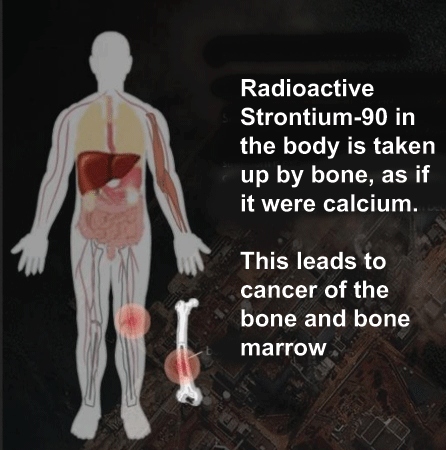
the agency said it had detected varying levels of Strontium-90 in all Australian capital cities.
https://www.adelaidenow.com.au/news/south-australia/british-scientists-secretly-used-australian-population-to-test-for-radiation-contamination-after-nuclear-tests-at-maralinga/news-story/988651beb4e94e1a4fd1b4c4649b3f03
Colin James, The Advertiser, August 29, 2014, BRITISH scientists secretly used the Australian population to test for radiation contamination after the nuclear tests at Maralinga in the 1950s, a new book confirms.
Its author, Frank Walker, has obtained the minutes of a top secret meeting in England where the UK Atomic Energy Research Establishment approved a program to determine the long-term effects of the tests on Australia and its citizens.
In his book, Maralinga, Walker details how the meeting at Harwell on May 24, 1957, decided to first obtain soil samples from pasture regions near Adelaide, Sydney, Melbourne, Brisbane and Perth to check for fallout from the nine nuclear bombs detonated at Maralinga and the Monte Bello Islands, off WA.
The second phase was to test vegetation, particularly grass and cabbage, and milk for the presence of the radioactive isotope, Strontium-90, a fission by-product of nuclear explosions.
The meeting was chaired by Professor Ernest Titterton, the nuclear scientist who oversaw the British nuclear tests in Australia.
According to the document obtained by Walker, Professor Titterton told the meeting he wanted to collect animal bones “to see if Strontium-90 is getting into domestic animals”.
The meeting decided to take bone samples from 12 sheep stations along a 800km path of fallout tracked by Royal Australian Air Force planes which flew into the mushroom clouds following each nuclear explosion at Maralinga.
Professor Titterton told the meeting that the final phase of the testing would be to determine if Strontium-90 was being absorbed by the Australian population.
“We have to find out if Strontium-90 is entering the food chain and getting into humans,” says the document, which has the file number DEFE 16/608.
The scientists then agreed to start testing the bones of dead Australian infants and children for radiation contamination.
“As many bones as possible are to be obtained,” says DEFE 16/608.
“The bones should be femurs. The required weight is 20-50 grams wet bone, subsequently ashed to provide samples of weight not less than two grams. The date of birth, age at death and locality of origin are to be reported.”
Professor Titterton said the bones would be crushed into a powder and sent to the UK for analysis along with the soil, animal samples and vegetation collected from the Australian testing sites.
As The Advertiser has previously reported, hundreds of bones were subsequently collected from the bodies of 21,830 dead babies, infants, children, teenagers and young adults across Australia without the knowledge of their parents.
The Strontium-90 testing program in Australia was the longest of its kind in the world, finally ending in 1978.
In September, 2001, following an extensive investigation by The Advertiser, the Australian Radiation Protection and Nuclear Safety Agency revealed it had kept ash samples from bones collected from hospitals in Adelaide, Sydney, Perth, Brisbane and Melbourne.
In a report to the then federal health minister, Michael Wooldridge, the agency said it had detected varying levels of Strontium-90 in all Australian capital cities.
|
|
November 17, 2018
Posted by Christina Macpherson |
AUSTRALIA, secrets,lies and civil liberties, UK |
Leave a comment
 Reuters 15th Nov 2018 , The first Chinese-designed atomic reactor for use in Britain moved a step
closer to fruition on Thursday as the UK nuclear regulator said it had
completed the second stage of its assessment of the technology. General
Nuclear Services, an industrial partnership between China General Nuclear
Power Corp (CGN) IPO-CGNP.HK and French utility EDF, hopes to use the
design at a nuclear plant planned to be built at Bradwell in Essex, eastern
England.
https://uk.reuters.com/article/nuclearpower-britain-china/update-2-china-designed-uk-nuclear-reactor-plan-clears-second-assessment-stage-idUKL8N1XQ4A1
November 17, 2018
Posted by Christina Macpherson |
politics, safety, UK |
Leave a comment
Dave Toke’s Blog 14th Nov 2018 , Clark’s plan to underwrite losses on Wylfa nuclear project will likely lead
to an embarrassing state-aid plea to the EU Commission.
Now that it seems, short of an extended ‘no-deal’ Brexit scenario, the UK will remain within
EU state-aid rules for a long time to come, Greg Clark will have to oversee
an embarrassing state aid case in support of his proposals to underwrite
the (almost certain) losses from building the Hitachi-led Wylfa nuclear
power plant.
I have already discussed how the taxpayer (and/or electricity
consumer) is exposed to almost certain multi-billion losses as a result of
the plan that Clark is touting here and in Japan. The last time that the UK
applied for what amounted to an exemption from EU state aid rules for
nuclear power was in late 2013 when Ed Davey led the plea for the Hinkley C
deal. The state aid was granted in October 2014 after the Commission ruled
that the Hinkley C deal was a reasonable way to avoid ‘market failure’.
Any application for state aid for Wylfa would be a tougher challenge. Indeed
the very proposal whereby the state will take at least a half equity share
in the project and take responsibility for cost overruns is an action that
in itself creates market failure if curbing carbon emissions is the
objective!
The Government’s cover story in 2013 was that support for
Hinkley C was on the same level available for renewable energy since
renewable energy schemes were also being offered CfDs (as well as very
extensive loan guarantees that most renewable energy schemes could not get
from the Government of course). The European Commission seemed to buy into
this line stating ‘The aid would not have a negative impact on other
low-carbon sources, given that they are also supported by the UK, and there
is no discrimination against renewable technologies’
https://realfeed-intariffs.blogspot.com/2018/11/clarks-plan-to-underwrite-losses-on.html
November 17, 2018
Posted by Christina Macpherson |
politics international, UK |
Leave a comment
ONR 13th Nov 2018 , Reactor 3 at Hunterston B remains offline, after being shut down since a
routine inspection into cracks in its graphite core, in March. Cracking of
the graphite bricks in Advanced Gas-cooled Reactors such as Hunterston B is
expected as the reactors age.
However, the number of cracks found during
the inspection of Reactor 3 has led to the licensee, EDF Nuclear Generation
Limited, carrying out further inspections of the core. Reactor 4 at
Hunterston B was taken offline in October for an inspection of its graphite
core.
EDF Energy has submitted a safety case for Reactor 4 and is preparing
one for Reactor 3. The safety cases will be assessed by us to determine
whether the reactors are safe to return to service. Neither reactor may
restart without our consent, which will be given only if it is safe to do
so.
http://news.onr.org.uk/2018/11/hunterston-b-outages/
November 17, 2018
Posted by Christina Macpherson |
safety, UK |
Leave a comment
Guardian 14th Nov 2018 Bristol has declared a “climate emergency”, with the council
unanimously backing a commitment to be carbon neutral by 2030 in an effort
to avoid catastrophic climate breakdown.
The motion put forward by Green
party councillor Carla Denyer and passed on Tuesday means the city has the
most ambitious emissions targets of the UK’s core cities group – with
radical policy implications in the coming years.
The move was triggered by
a UN report last month which said the world has just 12 years left to avoid
catastrophic climate breakdown. Denyer said: “This is a fantastic day for
Bristol and I’m delighted the council will be bringing forward its target
for making the city carbon neutral by 2030. She said the UN report made it
clear that “time to preserve Earth as we know it is running out”.
The target is much more radical than the UK government’s national target of
an 80% reduction in emissions by 2050 and comes amid growing concern about
interlinked ecological crisis, from climate breakdown to extinction. Denyer
said that the Bristol declaration could see a focus on renewable
electricity, carbon neutral buildings, congestion charges and investment in
clean transport infrastructure.
It could also have far-reaching
implications for big-ticket projects like the proposed expansion of Bristol
airport. The move was inspired by US cities such as Berkeley and Hoboken,
and the global C40 cities which have all set ambitious emissions targets.
Jonathan Bartley, the co-leader of the Green party, said Bristol’s
decision – which won cross-party support on the council – had set “a
gold standard on climate action”. “With the UN warning we have just 12
years to limit climate catastrophe this is the common-sense policymaking we
need to face the future.”
https://www.theguardian.com/uk-news/2018/nov/14/bristol-plans-to-become-carbon-neutral-by-2030
November 17, 2018
Posted by Christina Macpherson |
climate change, UK |
Leave a comment
BBC 14 November 2018 Reprocessing of spent nuclear fuel from around the world has ended at Sellafield.
November 17, 2018
Posted by Christina Macpherson |
reprocessing, UK |
Leave a comment
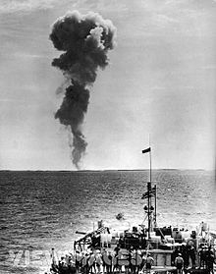 Britain’s nuclear bomb test legacy of early deaths and deformed children, Mirror, By Susie Boniface 14 NOV 2018
The horrific story behind the UK’s nuclear experiments have been told in full for the first time. After the horrors of the Second World War, it was deemed necessary for Britain to have a weapon that could unleash hell.
When atom bombs were dropped on Japan in 1945, LIFE magazine reported: “People’s bodies were terribly squeezed, then their internal organs ruptured…….
Of the 22,000 scientists and servicemen who took part in radioactive experiments in Australia and the South Pacific, just a handful are alive.
Their families report cancers, rare medical problems, high rates of miscarriage – and deformities, disability and death for their children – and their grandchildren.
Now, the full story of Britain’s nuclear experiments has been told for the first time in a new Mirror website that details not only the scientific, military and political battles, but the human fallout.
DAMNED features top-secret documents, eyewitness accounts and searing testimonies.
The site takes its name from an editorial written in 2002 by Mirror editor Richard Stott, who thundered: “How many more generations of the damned will our politicians allow to suffer before they accept the calamities of their predecessors and the consequences of their own cowardice?”
In May, the Mirror called for an award for the veterans and Defence Secretary Gavin Williamson has ordered a medal review.
DAMNED begins with Operation Hurricane in 1952, when Britain exploded its first atomic bomb, covers the Minor Trials in South Australia, which left the landscape littered with plutonium debris for decades, and reports on Operation Grapple in 1958 when the UK detonated its biggest weapon.
It also details the human cost and shows how every other nuclear nation on Earth came to accept and recognise their nuclear heroes – leaving Britain the only one to deny a duty of care………
In May, the Mirror called for an award for the veterans and Defence Secretary Gavin Williamson has ordered a medal review……….
DAMNED has a memorial section with the pictures and health problems of every veteran from our archives. Some of their stories can be read here: …… https://www.mirror.co.uk/news/uk-news/britains-nuclear-bomb-test-legacy-13590455
November 15, 2018
Posted by Christina Macpherson |
health, UK, weapons and war |
Leave a comment
 WYG points finger at government for Toshiba nuclear decision, Building UK, By Dave Rogers12 November 2018 Consultant forced to take £3m loss on business it bought for Moorside development. Consultant WYG has criticised the government for not being clear enough in its support to build a nuclear power station in Cumbria.
Publishing its annual results in June, WYG said it was forced to book a £3.2m cost on closing a business that it bought because of the work it expected to be carried out at the Moorside plant.
Land and property firm North Associates was snapped up in 2015 but delays on the plant forced the firm to shut the Carlisle-based business in March.
Last week Toshiba said it would wind-up its NuGen business which had been slated to carry out work building the plant at Moorside……….
Toshiba spent 18 months trying to sell NuGen but failed to find a firm willing to invest in the nuclear project. It said winding up the company would cost it £125m.
Engie walked away from NuGen, leaving Toshiba to try and sell the vehicle after posting a $8.4bn (£6.4bn) loss for the year ending 31 March 2017.
South Korean state-owned Kepco was chosen as preferred bidder over China General Nuclear in December last year but lost its preferred status in August after protracted talks hit delays – including a change of chief executive and a new government in Seoul. https://www.building.co.uk/news/wyg-points-finger-at-government-for-toshiba-nuclear-decision/5096491.article
November 13, 2018
Posted by Christina Macpherson |
business and costs, UK |
Leave a comment