Indeed, we could see those articles as pivotal in the current hostile environment against Assange; the purpose of which is presumably to prepare the way for the extradition of Assange to the US. Meanwhile, the Mueller inquiry into alleged links between US president Donald Trump and Russia – and Assange – is gaining headlines on an almost daily basis. And there is evidence that Assange has been secretly indicted and that an extradition request is imminent.
In such an environment, media outlets must provide hard evidence to substantiate allegations, and not simply fall back on anonymous ‘sources’ (usually code for spooks). The people these allegations target deserve better, and so do readers
Former diplomat challenges ‘fake’ Guardian claims about Julian Assange meeting Paul Manafort The Canary Tom Coburg 3rd December 2018 A former consul and first secretary at the Ecuadorian Embassy in London has spoken out against a “fake story” from the Guardian. Speaking to The Canary, Fidel Narváez insisted that the claim that former Trump campaign manager Paul Manafort met with WikiLeaks founder Julian Assange is entirely false.
The Canary has also seen a copy of correspondence to the Guardian from the same diplomat. In these, he makes a formal complaint, accusing the newspaper of fabricating an earlier story about a Russian plot to smuggle Assange to Russia.The Manafort claim The Canary previously reported on criticisms from WikiLeaks and others which stressed that Guardian claims about Manafort meeting Assange in 2013, 2015 and March 2016 were false.
WikiLeaks said it was preparing to sue the Guardian on the matter. And Manafort is also considering legal action, saying this story is “totally false and deliberately libellous”.
Narváez was initially consul and then first secretary at the Ecuadorian Embassy from 2010 to July 2018. He has now told The Canary that, to his knowledge, Manafort made no visits at any time during that period. He insisted:
It is impossible for any visitor to enter the embassy without going through very strict protocols and leaving a clear record: obtaining written approval from the ambassador, registering with security personnel, and leaving a copy of ID. The embassy is the most surveilled on Earth; not only are there cameras positioned on neighbouring buildings recording every visitor, but inside the building every movement is recorded with CCTV cameras, 24/7. In fact, security personnel have always spied on Julian and his visitors. It is simply not possible that Manafort visited the embassy.
In response, the Guardian told The Canary:
This story relied on a number of sources. We put these allegations to both Paul Manafort and Julian Assange’s representatives prior to publication. Neither responded to deny the visits taking place. We have since updated the story to reflect their denials.
Prior to the Guardian publishing the article, however, WikiLeaks did deny that the visits took place. It did that via a tweet in response to an email to Assange’s lawyers from one of the journalists who authored the article, saying how the Guardian was planning to run the story. The first published version of the article did not contain this WikiLeaksdenial.
And that’s not the only disputed Guardian piece…
There is another Guardian story by the same authors that Narváez also disputes.
On 21 September 2018, the Guardianclaimed there was a plan to smuggle Assange from the Ecuadorian Embassy via a diplomatic vehicle, and from there to Russia. But according to the article, the plan was called off after UK authorities refused to recognise that Assange was due diplomatic protection. The Guardian also referred to an alternative plan that would have seen Assange transported to Ecuador…………..
There are all sorts of internecine battles being waged inside the Ecuadorian Government that provide motive to feed false claims about Assange to the Guardian. Senain, the Ecuadorian intelligence service that the Guardian says showed it the incriminating report, has been furious with Assange for years, ever since WikiLeaks published files relating to the agency’s hacking and malware efforts.
……..A hostile environment of reputation-damaging ‘fake stories’
Narváez is accusing the Guardian of multiple fabrications. This is made worse by the fact that the articles in question were subsequently reproduced by numerous media outlets.
Narváez told The Canary that:
Luke Harding and Dan Collyns, the authors of the Manafort fake story, are the same ones who wrote the Russia smuggling plot fake story, and their ‘sources’ are most probably the same. I find it incredible that the Guardian allows these people to repeatedly damage the paper’s credibility and reputation.
Indeed, we could see those articles as pivotal in the current hostile environment against Assange; the purpose of which is presumably to prepare the way for the extradition of Assange to the US. Meanwhile, the Mueller inquiry into alleged links between US president Donald Trump and Russia – and Assange – is gaining headlines on an almost daily basis. And there is evidence that Assange has been secretly indicted and that an extradition request is imminent.
Tom Burke 28th Nov 2018 , For nuclear power to play a significant role globally in dealing with climate change we would have to build enough of it, quickly enough, to replace coal first and then gas in a very short space of time. You do not have to know very much about the engineering requirements of a nuclear power station, or our actual experience in constructing them, to think that this is akin to believing in unicorns.
A relatively simple piece of arithmetic on the specialised resource requirements and the equally specialised engineering and project management skills of a nuclear programme, let alone required scale of public investment is enough to make
it clear that a massive policy commitment to new nuclear power will not help the world stay below 2°C.
What is the British Government up to? My guess it is looking for a lot more long grass as it seeks a way to get itself off the nuclear hook onto which it has impaled itself by listening to the lobbies and caring more about the headlines than the climate.
As it does so, it will big up the importance of SMRs as a future option. Oddly enough, its concept of an SMR will bear a striking resemblance to a submarine propulsion reactor and we will build one somewhere on an existing nuclear site. Electricity consumers will indeed end up subsidising the defence budget and nuclear power will go on having a locally negative impact on the environment that outweighs any of its marginal environmental benefits. http://tomburke.co.uk/2018/11/28/the-future-of-nuclear-power-in-britain/
David Lowry’s Blog 1st Dec 2018 Imagine the British Foreign Office response if North Korea and Iran said they would comply with their nuclear safeguards and verification inspection obligations, but would conduct the inspections themselves!
NIS 28th Nov 2018 In response to a parliamentary question in July this year the Ministry of Defence said that publishing the nuclear safety rating given by its internal regulator would endanger national security.
Until 2015 the MoD published an annual report by the Defence Nuclear Safety Regulator (DNSR), which is responsible for the safety of nuclear weapons, submarine reactors and defence nuclear transport.
All the annual reports from April 2015 onwards have been censored. The MoD began releasing DNSR’s annual reports
in 2007, when it began doing so in order to avoid a freedom of information (FOI) tribunal hearing brought by the journalist Rob Edwards.
In 2015 the DNSR was brought together with several other internal MoD safety bodies to form the Defence Safety Authority (DSA). From that time the DNSR annual report was summarised alongside assessments of the safety record in other ‘domains’ of MoD activity. Each domain is given a Safety Assurance statement, where the level of safety assurance is rated either ‘substantial’, ‘limited’ or ‘none’. These cover both the safety standards in that domain and the capacity of the MoD’s internal regulator to provide that assurance. In the 2016/17 DSA report a separate assessment is made for each of these two aspects.
The Shadow Minister for Peace and Disarmament, Fabian Hamilton, asked the MoD to release the Safety Assurance
rating for the years when the DNSR reports were not being released. In response the MoD once again claimed that releasing the information would endanger national security, and confirmed that the 2017/18 report would also not be released, but said that “[t]his does not prevent the effective management and independent assessment of the Defence Nuclear Programme, nor prevent its duty holders being held to account” https://www.nuclearinfo.org/article/government-safety-transport/government-claims-releasing-nuclear-safety-assessment-would-risk
NIS 28th Nov 2018 The Atomic Weapons Establishment (AWE) plan to send up to 5,000 barrels of Higher Activity Waste to Sellafield for treatment and storage. Since the year 2000 AWE has been under pressure from its regulators to take action to reduce its holdings of radioactive waste, some of which dates back to the 1983 moratorium on waste being dumped at sea.
This culminated in an improvement notice in 2015 from the Office for Nuclear Regulation (ONR) which required AWE to produce a plan for dealing with its waste holdings.
Earlier efforts to deal with the waste floundered when a plan to procure a super-compactor and build a waste treatment centre at AWE Aldermaston. The building originally intended to house the super-compactor was unable to meet modern seismic resilience standards and the plan was abandoned when the Ministry of Defence (MoD) refused to spend the £78m required to build a new facility. The plan produced by AWE to satisfy the 2015 improvement notice concluded that sending the waste to be treated and stored at Sellafield would be preferable to building an on-site waste facility. https://www.nuclearinfo.org/article/waste-awe-aldermaston-other/awe%E2%80%99s-nuclear-waste-plan-send-it-sellafield
Ardrossan Herald 28th Nov 2018 THE chairman of Hunterston site stakeholders group has called upon the\ power station’s Reactor 3 to remain closed as a result of the increased number of cracks found in graphite bricks. It has been revealed that over 350 cracks have now been found, with concerns being raised as to the future operation of the plant.
However, owners EDF Energy closed reactor 3 earlier this year to carry out a more in-depth investigation, and have given
assurances that the cracks are ‘much narrower’ than set out than the safety parameters set which considerably lessens any danger.
Rita Holmes, chair of the Hunterston Site Stakeholder Group, said “If safety were indeed EDF’s number one priority, then reactor three would remain shut down. “As it is EDF is seeking permission to restart an aged reactor, which despite huge efforts and high cost, failed to back up its current safety case. The Hunterston keyway root cracking was not predicted to be so progressed. “There’s a lot at stake if the experts are wrong again.”
An EDF Energy spokesperson said: “The cracking only poses a potential challenge to the entry of the control rod in an extreme and highly unlikely (1 in 10,000 year) earthquake scenario and even then we have back-up systems which include super articulated control rods (designed to bypass distortions) and nitrogen plant which could be injected within
seconds to shut-down the unit.
During the most recent inspection of Reactor 3 we examined around a quarter of the core. As expected we identified a
number of new cracks. This number exceeded the operational limit of the existing safety case but was significantly mitigated by the cracks being much narrower than modelled in the safety case; something which was reported to the local site stakeholder group in June of this year. We have also carried out similar inspections on Reactor 4 and the case for return to service for that unit is currently with the ONR for review.” The return to service dates for the units which are cur rently on the REMIT website: Reactor 3 – 21 Feb 2019 and Reactor 4 – 14 Jan 2019. https://www.ardrossanherald.com/news/17261490.350-cracks-found-in-hunterston-reactor/
NFLA 28th Nov 2018, The Nuclear Free Local Authorities (NFLA) welcomes the unanimous decision
made today by Manchester City Council to formally support the International
Treaty for the Prohibition of Nuclear Weapons (TPNW). NFLA calls on the UK
Government to engage with the majority will of United Nations (UN) member
states by engaging in a process they have currently boycotted. The TPNW was
agreed at the UN by 122 countries (including the Republic of Ireland) in
July 2017 and is currently being ratified, a process that is expected to
conclude in 2019. The Treaty is a concerted attempt to move forward with
multilateral nuclear disarmament, but it has been opposed at every stage by
the nuclear weapon states, including the United Kingdom. NATO members, and
states like Australia and Japan who are linked to American security
policies, have also opposed this process. http://www.nuclearpolicy.info/news/nfla-welcomes-manchester-city-council-becoming-first-european-city-formally-support-treaty-prohibition-nuclear-weapons/
Gareth Porter 28 Nov 18 The accidental revelation in mid-November that U.S. federal prosecutors had secretly filed charges against WikiLeaks founder Julian Assange underlines the determination of the Trump administration to end Assange’s asylum in the Ecuadorian Embassy in London, where he has been staying since 2012.
Behind the revelation of those secret charges for supposedly threatening U.S. national security is a murky story of a political ploy by the Ecuadorian and British governments to create a phony rationale for ousting Assange from the embassy. The two regimes agreed to base their plan on the claim that Assange was conspiring to flee to Russia. Continue reading →
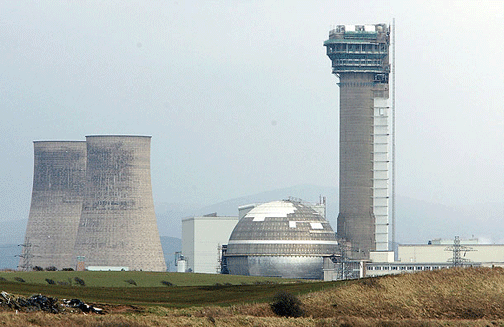
Sellafield: Europe’s most radioactively contaminated site
Inside Sellafield’s death zone with the nuclear clean-up robots,By Theo Leggett, Business correspondent, BBC News, 27 November 2018
The Thorp nuclear reprocessing plant at Sellafield, Cumbria, has recycled its final batch of reactor fuel. But it leaves behind a hugely toxic legacy for future generations to deal with. So how will it be made safe?
Thorp still looks almost new; a giant structure of cavernous halls, deep blue-tinged cooling ponds and giant lifting cranes, imposing in fresh yellow paint.
But now the complex process of decontaminating and dismantling begins.
It is a dangerous job that will take decades to complete and require a great deal of engineering ingenuity and state-of-the-art technology – some of which hasn’t even been invented yet.
This is why.
Five sieverts of radiation is considered a lethal dose for humans. Inside the Head End Shear Cave, where nuclear fuel rods were extracted from their casings and cut into pieces before being dissolved in heated nitric acid, the radiation level is 280 sieverts per hour.
We can only peer through leaded glass more than a metre thick at the inside of the steel-lined cell, which gleams under eerie, yellow-tinged lighting.
This is a place only robots can go.
They will begin the first stage of decommissioning – the post-operative clean-out – removing machinery and debris……….. Cleaning up other parts of the plant will also need robots and remotely operated vehicles (ROVs).
Some will need to be developed from scratch, while others can be adapted from systems already used in other industries, such as oil and gas, car manufacturing and even the space sector……..
The site in Cumbria contains a number of other redundant facilities, some dating back to the 1950s and many of them heavily contaminated, which are currently being decommissioned………
Remote submarines have explored and begun cleaning up old storage ponds. Other remote machines are being used to take cameras deep inside decaying bunkers, filled with radioactive debris.
The job of developing machines like these is shared with a large network of specialist companies, many of them based in Cumbria itself. They form part of a growing decommissioning industry within the UK, as the country grapples with the legacy of its first era of nuclear power.
The NDA believes that these companies can use what they learn at Sellafield, and other plants, to attract further business from overseas……..https://www.bbc.com/news/business-46301596
Times 25th Nov 2018, The Met Office warns tomorrow that climate change and rising sea levels will threaten more than 1.5m homes, turn farmland into marsh and wash away beaches by the end of the century. Its UK Climate Projections report
forecasts that the seas around Britain are likely to increase by 3-4ft by 2100, inundating low-lying land, putting 1.7m homes at risk and destroying many holiday beaches.
Some coastal towns may have to be abandoned because the huge cost of sea defences will make them “unviable”. Many stretches of prime, low-lying farmland could also be lost, with the lowest, such as Romney Marsh in Kent, the Somerset Levels and parts of Essex facing near-permanent inundation.
In some areas the impacts could reach far inland. Much of the farmland between King’s Lynn in Norfolk and Cambridge,
for example, would lie below the new sea level and so be at risk of turning to marsh. Across the UK, such a rise would leave 100,000 coastal properties at risk from wave erosion, with another 100,000 sited on seaside cliffs at risk from landslips. Up to 1.7m homes would face flooding, according to a recent report from the Committee on Climate Change.
The Met Officeprojections are the culmination of a three-year project commissioned by the Department for Environment, Food & Rural Affairs. The aim is to help policymakers prepare transport, power and other infrastructure for what is
likely to be the fastest change in climate humanity has experienced. Those changes are driven by greenhouse gas emissions, currently equivalent to 50bn tons of CO2 a year. About 1bn tons come from the UK, when imports and
aviation are included. https://www.thetimes.co.uk/article/f90ee99a-f025-11e8-9fcf-225198b37f0e
There are strong parallels between THORP and the proposed £20bn Hinkley Point C nuclear power plant. Powerful arguments were put forward against the construction of both plants, but the Government and the Nuclear Industry continued to stubbornly pursue these massively expensive and dangerous projects.
NuClear News, December 2018, The House of Commons Public Accounts Committee (PAC) says while the Nuclear Decommissioning Authority (NDA) and Sellafield Limited have made progress with reducing delays and expected cost overruns on 14 major projects at Sellafield, with a combined lifetime cost estimate of £6 billion, there is still a long way to go.
Most major projects at Sellafield are still significantly delayed, with expected combined cost overruns of £913 million. The NDA has not systematically reviewed why these projects keep running into difficulties, or analysed properly the constraints it says prevent them from making faster progress.
Until this work is completed, the Committee will remain sceptical about the long-term strategy to decommission Sellafield. And despite this Committee’s recommendation nearly five years ago, the Department for Business, Energy & Industrial Strategy has still not decided what to do with the plutonium stockpile currently stored at Sellafield.
Given the scale and unique challenges at Sellafield, the NDA must have a firm grip of the work that takes place on the site. This was not the case with the NDA’s recently failed contract to decommission its Magnox sites.
PAC Deputy Chair, Sir Geoffrey Clifton-Brown MP said:
“The Government’s oversight of the NDA’s performance could and should be much better, particularly on projects at Sellafield that cost a considerable amount of public money. BEIS needs to seriously get a grip on its oversight of nuclear decommissioning in this country.”
The Committee’s findings make yet more dreary reading for the UK taxpayer says Cumbrians
Opposed to a Radioactive Environment (CORE). The costs described as ‘a misuse of public funds’
by a spokesman for the report’s authors the Government’s Public Accounts Committee (PAC).
The PAC report pulls few punches in its criticism of the way the NDA is managing many of the
major projects needed to clean up Sellafield.
The site currently receives some £2bn of public money every year and, over the next 100+ years
of decommissioning is expected to cost a total of £91bn. In a slight but revealing departure from
the pattern of previous reports, PAC raises the spectre of the UK’s plutonium stockpile (40% of
the world’s global stock) and the latest thinking by Government on its long-term plutonium
management options. CORE says an update on its plutonium plans is currently being finalised
by the NDA and could be published soon.
The PAC report reveals the following:
Major projects are expected to cost over £900 million more than originally budgeted and be subjected to delays of over 13 years.
The NDA has cancelled three projects since 2012 after spending £586 million of taxpayers’ money on them.
Two of the above projects – the silo direct encapsulation project and the box transfer facility were cancelled after the NDA projected a combined cost increase of £2.1 billion and a combined delay of nine years
. The NDA’s programme to deal with the plutonium stockpile in the near term is late and its costs are increasing.
The concerning discovery last year (NAO report 20.6.18) that some plutonium canisters have been decaying faster than expected is made worse by the fact that the NDA’s project to repackage these canisters is at least two years late and expected to cost over £1.5 billion, £1 billion more than it first expected
. The series of contingency arrangements to manage these decaying canisters are shortterm fixes for a long-term problem and BEIS has yet to set out clearly what its strategy is and the associated costs to the taxpayer.
BEIS has still not decided between the two plutonium management options available – its long-term storage prior to final disposal as waste in a geological disposal facility (GDF) that has yet to be located or constructed, or its reuse as fuel in new nuclear power stations – but has told the PAC Committee that ‘it is not comfortable with any of the potential options for managing plutonium other than disposing it in the GDF’ (2)
Meanwhile the controversial Thermal Oxide Reprocessing Plant (THORP) at Sellafield has started work on processing its final batch of waste fuel after operating for only 24 years. (3) THORP opened in 1994 to reprocess spent fuel from the UK’s newer reactors – like Hinkley Point B – and overseas customers. Reprocessing is a chemical process which separates out plutonium and unused uranium from spent nuclear fuel.
There are strong parallels between THORP and the proposed £20bn Hinkley Point C nuclear power plant. Powerful arguments were put forward against the construction of both plants, but the Government and the Nuclear Industry continued to stubbornly pursue these massively expensive and dangerous projects. This Stop Hinkley Campaign briefing asks whether there are any lessons we can learn from the THORP experience to help us to evaluate the merits of continuing to build Hinkley Point C.
Currently, the ground-works for Hinkley Point C aren’t even finished so, in theory, it should be straightforward not to go ahead with the project, if it looks like full construction and operation would be a mistake. In fact not going ahead with the plant could save electricity consumers between £27bn and £50bn over the 35 years that the plant would have operated. (4)
The construction of THORP was very controversial and was the subject of a Public Inquiry in 1977, which ran for one hundred days. It was argued that the Inquiry would be a way of rationally weighing up all the evidence in order to come up with the correct decision on whether or not to give the plant the go-ahead. However, Professor Brian Wynne has argued that the Inquiry was in fact a charade, meant only to give the impression of rational decision making. (5)
At the Inquiry it was argued that THORP would be needed to supply plutonium for a new type of reactor – the Fast Breeder Reactor. Justice Parker, the Inquiry Inspector, concluded that THORP should go ahead and the Government agreed. It was built in the 1980s and switched on in the 1990s. Within a week of THORP starting up, the prototype Fast Reactor at Dounreay in the north of Scotland was shut down – ending the whole UK Fast Breeder programme. (6)
By 1992 the original rationale for THORP had all but disappeared before it even opened so the Government decided to commission the consulting firm Touche Ross to examine the financial implications of THORP’s operation or abandonment. It concluded that the economic benefit of operating THORP versus not operating it were £1.81bn for BNFL and £950m for the UK (7). In 1994, after a long and agonised debate, the Government decided to allow the plant to operate and the first waste spent fuel was ‘sheared’ – the outer cladding taken off – as the first step in the reprocessing process, in March of that year (8).
Another raison dêtre for THORP was quickly found, with construction work of the Sellafield MOX Plant beginning a few weeks later in April 1994. This was meant to produce plutonium fuel for ordinary reactors rather than Fast Breeders. The Sellafield MOX Plant was expected to generate £400m; instead it cost £2.2 Billion.
THORP was originally expected to reprocess 7,000 tonnes of spent fuel in its first ten years of operation. By the time it closes it will probably have reprocessed around 9,300 tonnes of spent fuel. If the plant had been working to its design capacity it should have completed 9,300 tonnes ten years ago in 2008 (9). THORP’s throughput was never reliable, nor to specification
The cost of building THORP steadily rose from £300m at the time of the public inquiry in 1977 to £1.8bn on completion in 1992. With the additional cost of associated facilities this figure rose to £2.8bn. The operator at the time – British Nuclear Fuels Ltd (BNFL) received advance payments from its customers of £1.6bn which largely covered the construction costs. The net result, according to BNFL was that over the first ten years the income would not only cover all building operating and future decommissioning costs, but would produce a profit of £500m. One economic analysis in 1993 pointed out that at a projected profit of only £50m per year, the economics of the project looked extremely vulnerable to unforeseen events, and British electricity consumers would be paying £1.7bn more than necessary to have British spent fuel reprocessed at THORP (10). This analysis turned out to be prophetic – there have certainly been plenty of unforeseen events since 1994. With THORP operating around a decade behind schedule, any notional profit originally expected must have long since been completely wiped out.
A report for the Government by management consultants Arthur D Little predicted in 2001 that the Sellafield MOX Plant would earn the UK more than £200m in foreign currency by exporting MOX fuel to Japan and several other countries. After the plant opened it was plagued by production problems due to its faulty design and layout. Instead of producing 120 tonnes of MOX a year, it managed less than 14 tonnes in eight years. The plant was closed in August 2011. (11) The plant is thought to have cost British taxpayers about £2.2bn in capital, operating and decommissioning costs since it was built. An internal report concluded that the facility was “not fit for purpose” and its performance over a decade was “very poor”. (12)
The economics of THORP and subsequently the Sellafield MOX Plant (SMP) depended on the constructors and operators being able to build and operate the facilities according to the specification. But nuclear facilities being built in the west have suffered from delays and almost always tended to have large cost overruns. Recent ones have ALL suffered horrendous cost overruns – in the USA (4), France (1) and Finland (1). Yet otherwise sensible, financial analysts have, in the past produced reports to justify building facilities at Sellafield and Hinkley which seem to ignore this fact and assume construction and operation will proceed precisely on target.
The prospects of avoiding a Sellafield-scale financial disaster with Hinkley Point C do not look good. As Emeritus Professor Steve Thomas has pointed out: “Hinkley Point C would use a technology unproven in operation – the EPR – which has run into appalling problems of cost & time overruns in the 3 projects using it. It would be supplied by Areva NP, which is in financial collapse and might not be saveable and has been found to be falsifying quality control records for safety critical items of equipment for up to 50 years – a bizarre situation.”
EDF’s EDF seeks to charge customers upfront for UK nuclear plants, Ft.com , 23 Nov 18, Financing scheme modelled on London’s ‘super sewer’ aims to cut cost of power from reactorsJonathan Ford in London NOVEMBER 22, 2018 EDF is pushing a plan to finance nuclear investment in Britain that it claims would cut the cost of power from new reactors to levels competitive with gas and renewable energy. The French state-backed power utility wants to use a technique commonly used in utilities such as water, airports and power distribution. This allows companies to charge customers upfront for new infrastructure. It is being used in the £4.2bn project to build a “super sewer” under London’s river Thames. But the mechanism has never been tried for a project as technically complicated and lengthy as a nuclear power station, which can take a decade to build. This and other challenges mean any gains are not assured.
With capital-intensive, long-life assets such as sewers and power transmission networks, financing represents a substantial chunk of the overall cost that needs to be recovered ………
Why nuclear revival is struggling to take hold EDF’s proposal comes at a time when Britain’s much touted nuclear renaissance is in danger of shorting out. The first deal — which will see the French group and its Chinese partners build a £20bn station at Hinkley Point in Somerset — was struck in 2016 at a guaranteed strike price of £92.50 per megawatt hour (MWh) in 2012 prices, indexed for 35 years and worth about £105 in current terms. Heavily criticised for being excessive, it was at least similar in headline terms to the prices required for renewables, nuclear’s main zero carbon competitor. However, renewable costs have since fallen sharply, with some deals for offshore wind farms being signed for as little as £55-60 per MWh with 15 year contracts. ……….
Observers agree that RAB financing could potentially secure substantial reductions in nuclear power costs. “While it should always be cheaper for the state to finance nuclear construction directly, this would clearly lower the prices from the Hinkley approach,” said Dieter Helm, a professor of energy policy at Oxford university
But it has prompted concerns about the equity of the structure. “What RAB financing does is transfer project risks to customers, who are least well placed to bear them,” said Martin Blaiklock, an infrastructure expert who likens the technique to “being forced to pay for a meal at a restaurant before the restaurant has even been built, let alone served any food”.
Will consumers benefit? Consumers who paid up front for five to 10 years would run the risk that if the reactor were delayed, over-budget or ultimately not commissioned, the power savings would not materialise and they might suffer a total loss. Nuclear has a poor record for delivering on time and to cost. Two projects in Europe using the same technology, at Olkiluoto in Finland and Flamanville in France, are running 10 and six years late respectively. Both are about three times over budget. EDF has yet to prove that its EPR reactor design can even generate electricity at commercial scale.
There are also legal question marks over whether the technique would be deemed an illegitimate subsidy under state-aid rules. “A nuclear power station isn’t like a sewer, a monopoly infrastructure asset,” said Peter Atherton, analyst at consultants Cornwall Energy. “It competes with other private sector generators, which means legally it could be shades of grey.” Lower costs may be necessary to get nuclear back on track, but most observers think they are not sufficient. “Ultimately it comes down to whether you strategically think as a nation you should do nuclear,” says Prof Helm. “But if you do think you need it, then clearly it’s right to seek to do it at the lowest cost.” https://www.ft.com/content/f9a96304-e980-11e8-885c-e64da4c0f981
Managing Radioactive Waste Update NuClear News December 2018 A meeting planned for December between NGOs and the Nuclear Decommissioning Authority’s Radioactive Waste Management Ltd (NDA/RWM) has been postponed until February 2019 due to a delay in BEIS announcing the next steps in the Geological Disposal Facility (GDF) process (originally scheduled for November 2018). Brexit is most likely to blame for this delay. (1)
Writing on the GDF Watch website before the cancellation, Roy Payne said “there’s no doubting the commitment in Whitehall to try and finalise GDF siting policy before Christmas. But if you ask about timing, you get the same silent stoic smiles revealing the lack of certainty across Whitehall about getting Ministerial decisions on anything at the moment”. He says it’s likely that it will be many months after the policy is launched before we see any sign of active community participation. (2)
The Committee on Radioactive Waste Management (CoRWM) which advises BEIS on dealing with nuclear waste, has recently published a paper in response to calls during the most recent consultation exercise to select a site for a Geological Disposal Facility (GDF) based on the ‘best geology’
CoRWM says RWM, the UK’s delivery body for a GDF, has developed generic environmental safety cases (gESC) for the three rock types: hard rocks (metamorphic and igneous rocks), soft rocks (clays and mudstones) and evaporites (salt deposits). CoRWM says the recognition that three very different rock types can provide for a safe GDF highlights the difficulty associated with selecting a ‘best’ geology as each rock type have their own advantages and disadvantages. For example, from the technical assessment carried out to support CoRWM’s initial work:
“Strong indurated1 rocks can provide repository concepts at depth that could provide long pathways and isolation from human intrusion. Weak indurated rocks could provide hydrogeological isolation but be constrained by depth limitations. Evaporites could provide hydrogeological isolation and low gas permeability. Excavations of some evaporites would be difficult to maintain over long time periods.”
CoRWM concludes that geologic attributes or parameters cannot be compared across rock types, and the concept of a site which scores ‘highest’ on all parameters’ simply cannot occur. The different and various roles played by geological settings proposed for GDFs across the world highlight this issue.
CoRWM says it recommended against geological screening in 2014 because the level of knowledge of the geology of much of the UK at the depths under consideration is too rudimentary to support a ‘screening out/in’ process. This position could only be changed by introducing, country-wide, a level of geological investigation, including investigative boreholes. This would clearly be unsupportable on both economic and public acceptability grounds. (3)
Cumbria Trust believes CoRWM’s paper calls into question their independence. They are supposed to act as an independent body, but some of their recent actions suggest to us that they are too close to BEIS and failing to adequately perform their advisory function and to challenge poor decision-making. Cumbria Trust has written to CoRWM expressing its concerns. The letter says:
“We feel that you are using an over-literal interpretation in responding to stakeholder consultation replies which advocated a search for the best geology, by taking this to mean the single best site in England and Wales. While a few stakeholders may have intended that in its very narrowest sense, which is clearly incompatible with voluntarism, we believe that the majority did not. By confining your response to this narrow interpretation, you have missed the opportunity to examine a more realistic and widely-held view. It is quite possible to combine the principle of voluntarism in site selection, which we accept, with some level of geological pre-selection. Cumbria Trust advocates actively seeking volunteers from areas which have promising geology, as recommended by many experts including the Lead Inspector of the Nirex Inquiry, Chris McDonald.”
The Trust also refers to a statement made in 2013 by Professor Yardley, who subsequently became RWM’s Chief Geologist, in which he pointed out that due to the UK’s extensive programme of spent fuel reprocessing there is a significant amount of carbon-14 present in the UK inventory. This poses a particular risk to a GDF project and increases the need for an effective gas barrier to prevent radioactive methane, amongst other gases, from escaping. This is a further reason why a clay host rock may well be preferable for the UK. (4)
1 in a million CoRWM also points out that:
A Geological Disposal Facility must isolate the waste it contains from people and the environment such that the risk levels to individuals that are most susceptible is kept within 1 in 1 million (10-6) into the very distant future. This is assured by developing a Safety Case which models the behaviour of the repository system.
The Environment Agency (EA) has set a limit on the risk that may be caused by the burial of radioactive wastes of 10-6 (i.e. one in a million). (5) However, the NDA Disposability Assessment Report for waste arising from new EPR reactors states:
“…a risk of 5.3 x 10⁻⁷ per year for the lifetime arisings of a fleet of six EPR reactors each generating a lifetime total of 900 canisters is calculated” (6)
This is more than half the total risk of 10-6 allowable for a GDF for 9.6GW of new capacity. If the Government succeeds in persuading the nuclear industry to go ahead with 18GW of new capacity clearly this will exceed the risk targets set by the EA.
Two ways round this have been suggested. Firstly there could be two repositories, but although both dumps might share the same access shaft, there would be a sufficient distance between two separate groups of disposal chambers so that you have in effect two dumps giving a potential dose to two different populations.
The second excuse seems to be that if the probability of such an outcome is very low then the Environment Agency may allow a risk higher than 10-6. This kind of ‘make-it-up as you go along’ technique of risk assessment will not go down well with communities surrounding a proposed GDF http://www.no2nuclearpower.org.uk/wp/wp-content/uploads/2018/11/NuClearNewsNo113.pdf
Will shake-up at London embassy leave Assange out in the cold?, By Claudia Rebaza and Lauren Said-Moorhouse, CNN, November 23, 2018London The Ecuadorian government has removed its ambassador to the UK, sparking speculation over Julian Assange’s future at the diplomatic mission there.
The 47-year-old founder of WikiLeaks moved into the Ecuadorian Embassy in central London in 2012 while wanted for questioning over sexual assault allegations in Sweden. Assange maintained his innocence and claimed the charges were nothing more than an attempt to extradite him to the United States.
Ambassador Carlos Abad Ortiz was forced to leave his post, according to an executive decree signed by Ecuadorian President Lenin Moreno and published Wednesday. The envoy had been in charge of the diplomatic mission since 2015 and had been an influential figure regarding Assange’s future.
After the announcement, WikiLeaks said Thursday on Twitter, “All diplomats known to Assange have now been terminated to transferred away from the embassy.”…..
the decision to oust Abad has fueled speculation that Ecuador is looking to push Assange out the door.
Fidel Narvaez, the former consul at the embassy, told CNN that Abad’s removal should be seen as a bad omen for the WikiLeaks founder and his asylum…….
WikiLeaks has been a focus of special counsel Robert Mueller’s investigation of any links between President Donald Trump’s associates and Russian efforts to interfere in the 2016 presidential election. WikiLeaks posted thousands of emails stolen from Democrats by Russian agents during the election.
The Justice Department investigation of Assange and WikiLeaks dates to at least 2010 when the site posted thousands of files stolen by the former US Army intelligence analyst now known as Chelsea Manning…….
Nuclear power station contest winners announced – after project is axed, Architects Journal UK, 21 NOVEMBER, 2018 BY MERLIN FULCHERReiach and Hall Architects and K2 Architects have been named winners of the RIBA’s Moorside contest to provide a visitor centre and workers accommodation for the Cumbrian nuclear power station that was cancelled earlier this month
The contest, launched by the RIBA almost three years ago, sought proposals for the 200ha site’s visitor centre and for a workers’ accommodation campus nearby.
On Monday (19 November) NuGen finally announced Reiach and Hall Architects had won the contest for the workers’ accommodation campus while K2 Architects had been chosen for the visitor centre. Neither project will go-ahead.
A shortlist was revealed in May 2016 but the announcement of winners was postponed. Last year the troubled £10 billion project was placed under review after joint-funder ENGIE withdrew and the reactor manufacturer Westinghouse filed for bankruptcy.
Earlier this month, the project’s sole remaining backer Toshiba announced it had failed to bring its preferred bidder Korea Electric Power Corporation on board and would be winding up its subsidiary NuGen, which had been tasked with delivering the ambitious scheme.
In a statement, NuGen said: ‘Though prizes for the competition itself have been awarded, NuGen had hoped to be able to announce the intention to work with winning entrants, regrettably though as NuGen is the process of being wound up, there will not be the opportunity.
‘NuGen thanks all entrants to the competitions and wishes them the best of success in their future projects.’
………. A separate competition, organised by the Landscape Institute, was also launched in January 2016 to find ‘creative and sustainable’ proposals for the facility’s surroundings but no winner has been announced…
……The two competitions together had a £20,000 prize fund, with the winning architect and landscape architect receiving £5,000 each and a chance to bid for work on the scheme.