Renewable energy can replace UK’s Moorside, Wylfa and Sizewell C nuclear power at a much cheaper cost
 ECIU (accessed) 17th Jan 2019 The future of the Government’s plans to roll out six new nuclear power
stations across Britain is looking increasingly parlous, as the Wylfa
project becomes the second power station to be scrapped in just two months.
Wylfa’s demise makes the Oldbury project extremely unlikely to proceed,
while Toshiba has already backed out of developing its Moorside station.
Their absence leaves space for new low-carbon capacity to fill the gap. Filling the ‘nuclear gap’ with
alternative low-carbon power sources would keep bills down, maintain secure
energy supply and allow the UK to maintain progress towards legally binding
climate targets.
A representative scenario, in which 80% of the energy
output of Moorside, Wylfa and Sizewell C was replaced in equal measure by
onshore and offshore wind, with the remaining 20% by solar PV would entail
an average price of £50-65/MWh, including the cost of system balancing.
This is 13-33% cheaper than the cost of energy from nuclear (not accounting
for nuclear system costs). This would see an additional 11.3 GW of onshore
wind and 5.7 GW of offshore wind capacity, as well as 20.8 GW of new solar
PV capacity. Renewable capacity is already set to increase on current
levels, as more – and cheaper – capacity continues to come online.
https://eciu.net/assets/Briefing-%E2%80%93-Filling-the-nuclear-gap-compressed.pdf
Dungeness B nuclear station – safety problems, reactors still shut down
|
IAEA 17th Jan 2019 , In September 2018, as part of a regulatory intervention on external
corrosion management, the UK nuclear safety regulator (Office for Nuclear Regulation (ONR)) issued a direction for Dungeness B nuclear power station to carry out a review and reassessment of safety addressing the corrosion of concealed systems that fulfil a safety function. Inspections carried out by the site nuclear licence holder (licensee) in response to this direction
identified that seismic restraints, pipework and storage vessels associated with several systems providing a safety function were found to be corroded to an unacceptable condition. This condition would have been present whilst the reactor was at power, although, the affected systems were not called upon to perform their safety function. Rectification of the degradation has now been undertaken whilst the units have been shut down for maintenance.
The rectification work required more than 300m of pipework associated with
reactor cooling systems to be renewed, along with renewal of numerous seismic pipework supports and remediation of carbon dioxide storage vessels. Both reactors at Dungeness B are currently (January 2019) shutdown
as part of the licensees ongoing recovery program. The licensee has identified a number of additional commitments that will be fulfilled prior to returning either reactor to service. ONR continues to engage with the licensee to monitor progress against commitments. The licensee has an on-going investigation underway to establish the causes of this issue. https://www-news.iaea.org/ErfView.aspx?mId=6033b140-6500-4900-a8bb-6bdb9f347c94 |
I
|
UK govt’s plan to let down solar householders has not gone down well
Physics World 16th Jan 2019 Dave Elliott: The UK government’s plan to abandon the feed-in tariff
(FIT) system for small renewable energy projects did not go down well,
especially since it meant the loss of the export tariff. Householders who
invested in a photovoltaic (PV) array on their roof have used that to
offset the cost of their investment by selling any extra power they
generated at a reasonable rate – 5.24 p/kWh – to their grid supplier.
However, with the FiT, along with the export tariff, to be closed to new
applicants from the end of March, they will get nothing for any exports. In
a parliamentary debate on the FiT in November last year, energy minister
Claire Perry said she aimed to avoid that situation. It certainly looked
unfair and counterproductive.
Claire Perry has now gone ahead with a
consultation on the Government’s proposals for a new market for
electricity export from small-scale PV solar, configured “so that people
are not providing it to the grid for free”. Under the proposed “Smart
Export Guarantee” (SEG), electricity suppliers would pay new small-scale
PV and other energy producers for excess electricity from homes and
businesses put back into the power grid.
https://physicsworld.com/a/after-the-fit/
UK government’s proposed ‘Regulated Asset Base’ (RAB) financing – a cover-up for a nuclear bailout
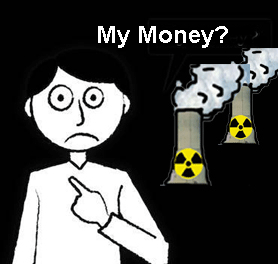  Dave Toke’s Blog 14th Dec 2019 There’s a bunch of highly misleading statements that the Government is to adopt so-called ‘Regulated Asset Base’ (RAB) financing of nuclear power projects. Dave Toke’s Blog 14th Dec 2019 There’s a bunch of highly misleading statements that the Government is to adopt so-called ‘Regulated Asset Base’ (RAB) financing of nuclear power projects.Yes, some of the mechanisms that are being proposed are also used in RAB, but the term is being grotesquely distorted to hide the fact that this is a cover for the Government risking very large sums of money to be lent to nuclear power developers.
Put simply, if the nuclear power projects are as expensive as they usually are the electricity consumer will lose an awful lot of money and prices will be jerked upwards. Either that or the
taxpayer takes a hit and funding of public services suffer big time. You can see the cover up printed in the Sunday Times yesterday where, we are told that ‘Ministers are expected to accelerate plans to introduce regulated asset base (RAB) financing, which is popular in the water and infrastructure sectors, for nuclear plants including the Horizon project’.
Under such schemes the developers are allowed to charge consumers in advance for the capital building projects. What Ministers are not emphasising of course, is that in industries such as water the Government does not lend lots of money to the privatised companies. They raise this on private markets. But in the case of nuclear power plants the bulk of the money needed to build them will be borrowed from the Government.
So if the nuclear plant has very big delays and cost overruns (as has happened to ALL nuclear power plant built in the West this century), the Government loses shedloads of money. The Treasury is likely to insist that this gets paid for by adding the (large) sums to electricity consumer bills. RAB has been used to try to finance nuclear power plant in the USA, in the states of Georgia and South Carolina recently.
The result was disaster and the developing company, Westinghouse, went bust. But this was ‘normal’ RAB where the developer takes the risk of cost overruns. But in the proposed UK
nuclear version it will be the electricity consumer who goes bust when the almost inevitable cost-overruns set in! The nuclear RAB is really a cover for a nuclear bailout. So let’s call it a ‘nuke bailout RAB’.
https://realfeed-intariffs.blogspot.com/2019/01/government-spreads-big-lie-about-rab.html |
Offshore wind leads, as UK’s renewable energy is on course to overtake fossil fuels
 Business Green 16th Jan 2019, Renewables are on course to overtake fossil fuels for the first time as the UK’s primary electricity source as early as 2020, according to the latest market forecast from EnAppSys. If current trends continue, the market analyst predicts growing renewable power sources such as wind and solar
will generate 121.3TWh of electricity over the calendar year of 2020, pushing ahead of declining coal and gas-fired power sources with a forecasted 105.6TWh of generation.
The forecast assumes current trends of declining fossil fuel generation and rising renewables generation continue at the same annual rate. In 2018, coal and gas fired power stations
produced a combined 130.9TWh, a 6.7 per cent fall from the previous year’s 140.3TWh, the report states.
Meanwhile, renewable sources delivered 95.9TWh last year, rising 15.2 per cent from 2017 – a strong performance bolstered by the UK’s increasing offshore wind capacity.
https://www.businessgreen.com/bg/news/3069376/report-renewables-to-overtake-fossil-fuels-in-uk-energy-mix-in-2020
UK’s ‘nuclear renaissance’ collapsing, as Hitachi ponders exit from Wylfa project
 FT 13th Jan 2019 Nick Butler: Who could blame the board of the Japanese company Hitachi if
its members decide at their meeting this week to scrap plans for a new nuclear power station at Wylfa on the North Wales island of Anglesey?
Hitachi has invested more than £840m in the project over the past six years. The technology has passed all the tests set by the UK’s nuclear regulator. But the company has been unable to get the government to put in place the clear and credible financial structure necessary to underpin the investment.
That failure has already led other investors to abandon the new plant planned at Moorside in Cumbria. Talk of scrapping the Wylfa project could be a bargaining tactic on the part of Hitachi but the reality is probably much simpler. Hitachi’s doubts have been well signalled during the
past few months and the company’s purchase of ABB’s power grid business at the end of last year gives it a range of investment choices.
Given Whitehall’s chronic indecision, the company is ready to use its capital elsewhere. Hitachi’s withdrawal would mark the collapse of the energy policy adopted in 2013 by the UK’s coalition government. Facing what were believed to be ever-rising energy prices the policy plumped for new nuclear, promising that 35 gigawatts of new capacity would be on stream by the mid 2030s – more than replacing the first generation of nuclear plants, which would by then have reached the end of their useful lives.
Because the price of gas seemed doomed to keep rising, new nuclear would come to look highly competitive over time as well as reducing dependence on imports. Since then much has changed, and the assumptions which underpinned the old policy now look laughably wrong.
The costs of all forms of energy (apart from nuclear) have fallen dramatically and there is no shortage of supply. Electricity demand is down thanks to efficiency gains and new technology.
The contract for the first new nuclear station being built at Hinkley Point in Somerset, which enjoys a guaranteed index-linked price for 35 years from the moment the plant is commissioned, looks exorbitant. The demise of Wylfa forces the need for a comprehensive review of energy policy.
Since the UK government is too busy preparing for Brexit to focus seriously on any other issue, the review should be conducted independently. Advances in energy technology offer more
possibilities each year. But those options will never be taken up unless the old outdated policy is scrapped and a more realistic approach put in place.
https://www.ft.com/content/7b33e9fa-1648-11e9-9e64-d150b3105d21
In Scotland, over 700 ‘safety events’ recorded at nuclear bases

 More than 700 ‘safety events’ recorded at nuclear bases, News and Star, 19. More than 700 nuclear safety events have been recorded at Scotland’s nuclear bases since 2006, the Ministry of Defence (MoD) has said.
UK to use Regulatory Asset Base (RAB) funding for Wylfa nuclear plant, exposing consumers to financial risk?
 Times 13th Jan 2019 Ministers will be forced to pioneer a new way of financing nuclear power after Hitachi walked away from a £16bn plant in north Wales. The suspension of the Japanese giant’s Horizon project on Anglesey, expected to be confirmed at a board meeting tomorrow, will force the government to lure investors with a financing method that would pile costs on to consumers, even before a plant has been built.
building the £20bn Hinkley Point power station in Somerset, and CGN has ambitions to build its own reactors on the Essex coast at Bradwell-on-Sea. Industry insiders said state-controlled CGN could swoop on Anglesey if Hitachi puts the project up for sale. Kepco of South Korea would also be interested.
megawatt hour for Hinkley Point’s electricity for 35 years. The Horizon deal would have guaranteed about £75 per megawatt hour, falling to the £50s for future reactors on the site.
https://www.thetimes.co.uk/article/fce4e714-169e-11e9-9e09-701e9f424b2e
Collapse of UK’s nuclear power plans as Hitachi Exit Follows Toshiba
U.K’s Nuclear Future Fades as Hitachi Exit Follows Toshiba, Bloomberg, By Lars Paulsson and Mathew Carr January 11, 2019,
EDF’s atomic plants need to be replaced by new generation
Offshore wind could be the winner from withdrawal, RBC says
…….Japanese conglomerate Hitachi Ltd. will halt work on the Wylfa project and take a one-time charge as negotiations with the British government over funding stalled, the Nikkei newspaper reported. After Toshiba Corp.’s withdrawal from its Moorside plant in November, it leaves the nation with just Electricite de France SA’s Hinkley Point project underway and that’s been mired in controversy because of delays and the cost to the U.K. consumer.
……..The Nikkei report said the company’s board will make a decision next week and cited an unidentified executive saying the project isn’t being abandoned entirely and could be restarted in the future.
Toshiba said in November it planned to liquidate NuGeneration Ltd., its U.K. nuclear power developer, after failing to find a partner or a buyer for the Moorside project. In September, China General Nuclear said it may give upthe chance to operate a nuclear plant at Bradwell amid political sensitivities over Chinese investments, the Financial Times reported.
As the U.K. is running out of nuclear options, other technologies stand to benefit.
“We see offshore wind as increasingly viable,” said John Musk, utilities analyst at RBC Europe Ltd. Natural gas power will probably provide a significant amount of the baseload power not met by renewables……..https://www.bloomberg.com/news/articles/2019-01-11/u-k-s-nuclear-future-fades-as-hitachi-exit-follows-toshiba
New danger for Julian Assange as Ecuador toes the USA line (and Australia won’t help him, though he’s their citizen)
More troubles for Julian Assange as Ecuador bows to pressure to extradite him following this letter, http://thewikidaily.com/more-troubles-for-julian-asange-as-ecuador-bows-to-pressure-to-extradite-him-following-this-letter/ We have been monitoring Julian asange’s asylum in Ecuadorian embassy in britain to outline the dangers the computer proggrammer and wikileaks founder face in coming future and it seems alot have been happening lately than the mainstream media’s are reporting.
Ecuador has begun a “Special Examination” of Julian Assange’s asylum and citizenship as it looks to the IMF for a bailout, the whistleblowing site reports, with conditions including handing over the WikiLeaks founder.
Former Ecuadorian President Rafael Correa tweeted an image of the letter he received from the State Comptroller General on December 19, which outlines the upcoming examination by the Direction National de Auditoria.
The audit will “determine whether the procedures for granting asylum and naturalization to Julian Assange were carried out in accordance with national and international law,” and will cover the period between January 1, 2012 and September 20, 2018.
Assange has been in the Ecuadorian Embassy in London since he sought asylum there in 2012. He was granted Ecuadorian citizenship last December in a bid to protect him from being extradited to the US where he fears he faces secret charges for publishing US government cables and documents.
WikiLeaks tweeted the news on Wednesday, joining the dots between the audit and Ecuador’s consideration of an International Monetary Fund bailout. The country owes China more than $6.5 billion in debt and falling oil prices have affected its repayment abilities.
According to WikiLeaks, Ecuador is considering a $10 billion bailout which would allegedly come with conditions such as “the US government demanded handing over Assange and dropping environmental claims against Chevron,” for its role in polluting the Amazon rainforest.
Assange’s position has increasingly been under threat under Correa’s successor, President Lenin Moreno, with Ecuadorian authorities restricting his internet access and visitors.“I believe they are going to turn over Assange to the US government,
People Against Wylfa B (PAWB) has warned for years of the coming financial failure of Wylfa nuclear project
Wales Online 11th Jan 2019 , The campaigning group People Against Wylfa B (PAWB) said in a statement: “Should the news be confirmed at a meeting of the Hitachi Board next week
then it will be a relief for all of us who worry about the future of our
island, our country, our language, our environment and indeed renewable
energy.
PAWB has warned for years that the costs associated with the Wylfa
project would be likely to prove fatal to the project, but we were ignored.
“Consequently, millions of taxpayers’ money from the island, Wales and
the UK was invested to back Wylfa B. In addition huge political capital has
been invested, and there has been a failure to have a mature public
discussion about the project other than in terms of cash and jobs.
“The legacy of this, if the reports from Japan prove to be true, is that over a
decade has been wasted on Wylfa, with very little alternative economic
planning in evidence. Our young people have been promised jobs on very
shaky foundations. “Good land has been destroyed to create infrastructure
to back the project. It is time for politicians and officials from the UK
Government, the Welsh Government and Anglesey to admit that they were
wrong. “Wales is rich in natural resources which can be used to create a
vibrant and sustainable energy future, and above all else create more jobs
in less time than Wylfa would have done.”
https://www.walesonline.co.uk/news/politics/hitachi-to-pull-plug-angleseys-15663299
‘Local Hero’ – a campaign to raise awareness of the environmental threat of planned Sizewell nuclear station
TEAGS 11th Jan 2019 Locals and campaigners create ‘Sizewell Hero’ – a tribute to the film
‘Local Hero’ – to launch a new online campaign, urging EDF to change
its approach. Theberton and Eastbridge Action Group on Sizewell [TEAGS]
today launched a new video and online campaign.
Made by local people, it is aimed at increasing awareness and concern about the impacts of the proposed Sizewell C&D nuclear power station to audiences beyond east Suffolk. EDF
launched its Stage 3 consultations on the twin-reactor development last
week. ‘Sizewell Hero, hosted on YouTube and Facebook, is a three-minute
homage to the award-winning 1980s film ‘Local Hero’, and shows a
company executive transformed and inspired by the beauty of Minsmere and
the coast at Sizewell to think again about the company’s plans.
The video is entirely a local initiative, starring Middleton actor Simon Bridge and
featuring other residents from Theberton and Middleton. The film was shot
and produced by Steve Sutton and crew from UK Aerial Photography Ltd, based
in Peasenhall. Permission to use the famous ‘Local Hero’ theme music
was kindly granted by Mark Knopfler’s management, Crockford Management
and the project was made possible by a grant from Lush Charity Pot. Stills
and ‘making of’ photos are available.
https://teags.org/sizewell-hero-video-and-online-campaign-launched/
UK will have to pile on costs to consumers, if new nuclear power is to go ahead
Energy ministers eye new formula to pay for Britain’s nuclear power plants
Japanese withdrawal leaves UK energy policy in tatters Times, John Collingridge, January 13 2019, Ministers will be forced to pioneer a new way of financing nuclear power after Hitachi walked away from a £16bn plant in north Wales.
UK’s nuclear energy renaissance derailed, as Japanese companies step back from nuclear investment?
 Japan’s nuclear rethink could derail UK energy plans, https://unearthed.greenpeace.org/2019/01/09/japan-uk-nuclear-plans-go-awry/, Doug Parr, 11 Jan 19, Reports in the Japanese press claim Hitachi is set to suspend all work on Wylfa, its nuclear power project in Wales.
A nuclear cover-up? Britain removes from public access, files on atomic bomb tests in Australia

“To now withdraw previously available documents is extremely unfortunate and hints at an  attempted cover-up.”
“worrying that properly released records can suddenly be removed from public access without notice or explanation.”
Review or ‘cover up’? Mystery as Australia nuclear weapons tests files withdrawn https://edition.cnn.com/2019/01/11/australia/uk-australia-nuclear-archives-intl/index.html, By James Griffiths, CNN
More than 65 years since the UK began conducting secret nuclear weapons testing in the Australian Outback, scores of files about the program have been withdrawn from the country’s National Archives without explanation.
The unannounced move came as a shock to many researchers and historians who rely on the files and have been campaigning to unseal the small number which remain classified.
“Many relevant UK documents have remained secret since the time of the tests, well past the conventional 30 years that government documents are normally withheld,” said expert Elizabeth Tynan, author of “Atomic Thunder: The Maralinga Story”.
“To now withdraw previously available documents is extremely unfortunate and hints at an attempted cover-up.”
Withdrawal of the files was first noted in late December. Access to them has remained closed in the new year.
Dark legacy The UK conducted 12 nuclear weapons tests in Australia in the 1950s and 1960s, mostly in the sparsely populated Outback of South Australia.
Information about the tests remained a tightly held secret for decades. It wasn’t until a Royal Commission was formed in 1984 — in the wake of several damning press reports — that the damage done to indigenous people and the Australian servicemen and women who worked on the testing grounds became widely known.
Indigenous people living nearby had long complained of the effects they suffered, including after a “black mist” settled over one camp near Maralinga in the wake of the Totem I test in October 1953. The mist caused stinging eyes and skin rashes. Others vomited and suffered from diarrhea.
These claims were dismissed and ridiculed by officials for decades — until, in the wake of the Royal Commission report, the UK agreed to pay the Australian government and the traditional owners of the Maralinga lands about AU$46 million ($30 million). The Australian authorities also paid indigenous Maralinga communities a settlement of AU$13.5 million ($9 million).
While the damage done to indigenous communities was acknowledged, much about the Totem I test — and other tests at Maralinga and later at Emu Field — remained secret, even before the recent withdrawal of archive documents.
“The British atomic tests in Australia did considerable harm to indigenous populations, to military and other personnel and to large parts of the country’s territory. This country has every right to know exactly what the tests entailed,” Tynan said. “Mysteries remain about the British nuclear tests in Australia, and these mysteries have become harder to bring to light with the closure of files by the British government.”
Alan Owen, chairman of the British Nuclear Test Veterans Association, which campaigns on behalf of former servicemen, said “the removal of these documents affects not only our campaign, but affects the many academic organizations that rely on this material.”
“We are very concerned that the documents will not be republished and the (Ministry of Defense) will again deny any responsibility for the effects the tests have had on our membership,” Owen told CNN.
Unclear motives Responding to a request for comment from CNN, a spokeswoman for the National Archives said the withdrawal of the Australian nuclear test files was done at the request of the Nuclear Decommissioning Authority (NDA), which has ultimate responsibility over them.
The NDA said that “a collection of records has been temporarily withdrawn from general access via The National Archive at Kew as part of a review process.”
“It is unclear, at this time, how long the review will take, however NDA anticipates that many of the documents will be restored to the public archive in due course,” a spokeswoman said.
Jon Agar, a professor of science and technology at University College London, said the withdrawal “is not just several records but two whole classes of files, many of which had previously been open to researchers at the National Archives.”
“These files are essential to any historian of the UK nuclear projects — which of course included tests in Australia. They have been closed without proper communication or consultation,” he added.
Agar shared correspondence he had with the NDA in which a spokeswoman said some files would be moved to a new archive — Nucleus — in the far north of Scotland. However the Nucleus archives focus on the British civil nuclear industry, and it is unclear why files on military testing would be moved there, or why those files would need to be withdrawn to do so.
Nucleus also does not offer the type of online access to its records as the National Archives does.
“Why not just copy the files if the nuclear industry needs them at Nucleus for administrative reasons? Why take them all out of public view?” Agar wrote on Twitter.
Information freedom In correspondence with both CNN and Agar, the NDA suggested those interested in the files could file freedom of information (FOI) requests for them.
Under the 2000 Freedom of Information Act, British citizens and concerned parties are granted the “right to access recorded information held by public sector organizations.”
FOI requests can be turned down if the government deems the information too sensitive or the request too expensive to process. Under a separate rule, the UK government should also declassify documents between 20 and 30 years after they were created.
According to the BBC, multiple UK government departments — including the Home Office and Cabinet Office — have been repeatedly condemned by auditors for their “poor,” “disappointing” and “unacceptable” treatment of FOI applications.
Commenting on the nuclear documents, Maurice Frankel, director of the Campaign for Freedom of Information, a UK-based NGO, said it was “worrying that properly released records can suddenly be removed from public access without notice or explanation.”
“It suggests that the historical record is fragile and transient and liable to be snatched away at any time, with or without good reason,” he added.
1 This Month





PLEASE OPPOSE HR 8255 AND S.3639 – bills would accelerate satellite deployment, with no environmental review or safeguards – https://ncstd5li.quorum.us/campaign/169331/
To see nuclear-related stories in greater depth and intensity – go to https://nuclearinformation.wordpress.com
-
Archives
- October 2026 (10)
- September 2026 (339)
- August 2026 (330)
- July 2026 (355)
- June 2026 (287)
- May 2026 (306)
- April 2026 (356)
- March 2026 (251)
- February 2026 (267)
- January 2026 (308)
- December 2025 (358)
- November 2025 (359)
-
Categories
- 1
- 1 NUCLEAR ISSUES
- business and costs
- climate change
- culture and arts
- ENERGY
- environment
- health
- history
- indigenous issues
- Legal
- marketing of nuclear
- media
- opposition to nuclear
- PERSONAL STORIES
- politics
- politics international
- Religion and ethics
- safety
- secrets,lies and civil liberties
- spinbuster
- technology
- Uranium
- wastes
- weapons and war
- Women
- 2 WORLD
- ACTION
- AFRICA
- Atrocities
- AUSTRALIA
- Christina's notes
- Christina's themes
- culture and arts
- Events
- Fuk 2022
- Fuk 2023
- Fukushima 2017
- Fukushima 2018
- fukushima 2019
- Fukushima 2020
- Fukushima 2021
- general
- global warming
- Humour (God we need it)
- Nuclear
- RARE EARTHS
- Reference
- resources – print
- Resources -audiovicual
- Weekly Newsletter
- World
- World Nuclear
- YouTube
-
RSS
Entries RSS
Comments RSS

