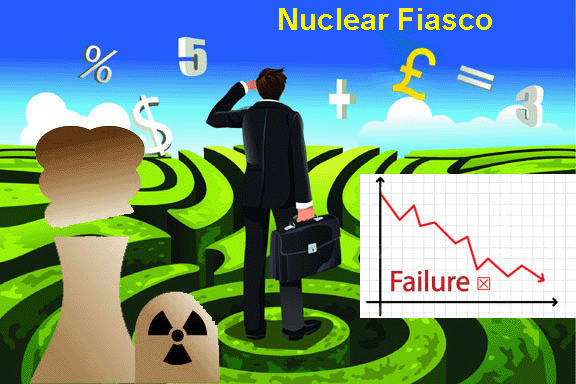
Telegraph 24th Jan 2019, Britain’s nuclear industry is falling inexorably into Chinese hands. At
Hinkley Point in Somerset, after years of debate and delay concrete is now
finally being poured by EDF for the base of Britain’s first nuclear reactor
to be built since Sizewell B.
But plans to build a fleet of new reactors at
other sites where existing plants are due to be retired from service are
tumbling like nine-pins.
Will any more be built? It’s hard to say, but without giant dollops of Chinese cash it looks increasingly improbable.
Amid falling costs for renewable alternatives, Britain’s nuclear dreams are
foundering on the rocks of cold economic reality, just as they did under
Thatcher when a flood of North Sea gas arrived to reshape the nation’s
energy landscape.
EDF, which owns the UK’s existing reactor fleet, and its
Chinese partner CGN remain committed to developing three new nuclear
projects at Hinkley, Sizewell in Suffolk and another at Bradwell in Essex –
a Chinese-led scheme – quite how the £50 billion-odd cost of building them
will be met remains murky. With debts of over 31 billion euros (£27bn),
the French state-owned company is strapped for cash and looks increasingly
reliant on its Beijing-backed partner to get them built.
The dawning reality is that without Chinese money to prop up EDF the industry is a
busted flush. Amid mounting security fears, Britain will have to think hard
about the wisdom of handing over the keys to a large part of its nuclear
fleet to Beijing.
Meanwhile, there are other ways China might seek to boost
its stake in Britain’s nuclear fleet. For starters, CGN has approached the
UK government about developing Moorside, the site adjacent to Sellafield
which has been vacated by Toshiba, using its own technology. It could seek
to do something similar at Wylfa too. Moreover, Centrica is planning to
offload a 20 pc stake it holds in EDF’s existing fleet of UK reactors.
China could be a willing buyer if it is allowed to do so.
Whether or not any of this matters is of course another question, but amid growing
tensions with China over espionage and security, many figures within
Britain’s security establishment view the prospect as alarming.
https://www.telegraph.co.uk/technology/2019/01/24/britains-nuclear-industry-falling-inexorably-chinese-hands/
January 26, 2019
Posted by Christina Macpherson |
politics, politics international, UK |
Leave a comment

|
Hitachi chairman: Nationalization only way to rescue UK nuclear project
Nakanishi says investor support of power plant has evaporated, Nikkei Asian Review AKIHIRO SANO, Nikkei staff writerJANUARY 24, 2019 DAVOS, Switzerland — Hitachi’s frozen nuclear power plant project in the U.K. could be revived only if the business is nationalized by Britain, Chairman Hiroaki Nakanishi said here on Wednesday.
“Nationalization is the only path” to resuming the project, he told reporters on the sidelines of the World Economic Forum’s annual meeting. Nakanishi said that a scheme under which the company would not be saddled with massive assets is necessary for construction to begin.
For the government to take a majority stake in the business to fill the funding gap left by the private sector, however, legal changes are needed, he said. This clouds the prospect of the project being revived as the tumult of Brexit leaves Theresa May’s government with little political capital to push for such a change.
he added that the investor community had lost the appetite to support the project, after watching other similar nuclear projects around the world stall.
The Japanese company said last Thursday that is was freezing the nuclear project under British subsidiary Horizon Nuclear Power. It also announced an impairment loss and related expenses of around 300 billion yen ($2.74 billion) for fiscal 2018 group earnings…….https://asia.nikkei.com/Business/Companies/Hitachi-chairman-Nationalization-only-way-to-rescue-UK-nuclear-project
|
|
January 24, 2019
Posted by Christina Macpherson |
politics, UK |
Leave a comment
Q&A: Can the UK meet its climate goals without the Wylfa nuclear plant?
Carbon Brief, 21 January 2019 “……. recent analysis from the government’s official advisers the Committee on Climate Change (CCC) shows the UK could meet its power demand and climate goals to 2030 at low cost, without any new nuclear beyond the Hinkley C scheme already being built in Somerset.
This new analysis reflects the dramatic cost reductions seen for renewables in recent years. Greg Clark, the UK’s secretary of state for business, energy and industrial strategy (BEIS), made a similar point last week as he spoke in parliament about the failed Wylfa deal. He told MPs:
“The economics of the energy market have changed significantly in recent years. The cost of renewable technologies such as offshore wind has fallen dramatically…The challenge of financing new nuclear is one of falling costs and greater abundance of alternative technologies, which means that nuclear is being outcompeted.”……….
The CCC’s “central renewables” and “high renewables” scenarios meet the 2030 carbon target without new nuclear beyond Hinkley C. In these scenarios, nuclear generation in 2030 is 35TWh – the estimated output of Hinkley C plus Sizewell B, each running for 90% of available hours……….
each of the 2030 scenarios supplies enough electricity to meet projected demand, meaning the lights would not “go out”. Gas would still supply 20-25% of electricity, most of which would be used to cover peak demand during winter or to fill gaps in variable renewable output.
The CCC scenarios out to 2030 all massively expand renewables, whether or not additional new nuclear plants get built. The renewable share of the mix increases from 33% in 2018 to at least 58% in 2030. Nuclear’s share falls from 18% in 2018 to between 10% and 17% in 2030. At the low end, where no new nuclear is added after Hinkley C, it is renewables that make up the gap.
[The CCC says: “We do not consider [the BEIS 2030] pathway credible.” This pathway sees nuclear’s share hold steady, though, as BEIS notes, this is “not based on [nuclear] developers’ proposed pipeline”. BEIS also assumes imports via electricity interconnectors reach 21% of the total while the CCC assumes net-zero imports, with interconnectors helping balance supply and demand.]
The CCC says expanding wind and solar is a “low-regrets” option as renewables are likely to be cheaper than new gas, with similar costs to running existing gas plants or raising imports, even after accounting for the costs of integrating their variable output onto the grid. The CCC adds:
“If new nuclear projects [beyond Hinkley C] were not to come forward, it is likely that renewables would be able to be deployed on shorter timescales and at lower cost.”
Replacing the output of the shelved new nuclear plants at Wylfa, Moorside and Oldbury with renewables would be 13-33% cheaper, including the costs of balancing variable output, according to quickfire analysis from the Energy and Climate Intelligence Unit.
Note that reductions in per-capita electricity generation have saved the UK the equivalent of four Hinkley Cs of demand since 2005, according to recent Carbon Brief analysis. The CCC assumes continued efficiency improvements to 2030 are offset by demand for electric vehicles and heating. ……https://www.carbonbrief.org/qa-can-the-uk-meet-its-climate-goals-without-the-wylfa-nuclear-plant
January 24, 2019
Posted by Christina Macpherson |
climate change, UK |
Leave a comment
|
 Now that UK nuclear power plans are in tatters, it’s vital to double down on wind and solar, The Conversation, David Toke, Reader in Energy Policy, University of Aberdeen January 23, 2019 Now that UK nuclear power plans are in tatters, it’s vital to double down on wind and solar, The Conversation, David Toke, Reader in Energy Policy, University of Aberdeen January 23, 2019 Now that Japanese giants Toshiba and Hitachi have walked away from UK nuclear power projects that had previously been abandoned by others, it has forced the government to reassess the pro-nuclear bias of its energy policy. Greg Clark, the UK business secretary, has recognised that nuclear power is no longer cost competitive with renewable energy, but don’t expect any extra push into the cheaper technology. There is easily enough solar and wind energy available to make up for the cancellation of the nuclear projects and to produce the low-carbon electricity required to make the UK’s 2030 carbon emissions targetsachievable. Instead, however, the country’s incentives and regulations favour developing more power plants driven by natural gas. Having hacked back emissions from power by over two-thirds since 1990, progress with decarbonising the grid risks coming to an end.
According to the UK parliament’s Committee on Climate Change, the UK needs to cut power emissions from about 265g of carbon dioxide per kilowatt hour in 2017 to under 100g by 2030. The government had been substantially relying on nuclear power to do this, having originally identified eight sites as viable for new plants. Six projects were taken forward, including Hitachi and Toshiba plants in Wales and Cumbria respectively.
Yet despite much larger government incentives than those available for renewables, most private nuclear builders are now steering clear, having seen the problems with new plants in the likes of the US and France. The only two projects still on the slate are a joint venture by EDF of France and CGN of China – both foreign state-owned companies. They are building the UK’s first new plant in over two decades, Hinkley C in south-west England; while also planning a second, Bradwell B, in the south east.
Nuclear and renewables
Even before the latest announcement that Hitachi’s Wylfa plant in Wales was being suspended, the Committee on Climate Change was already saying the UK needed to build more renewable capacity to reach its carbon reduction targets. Now the problem is even worse.
In 2018, 19% of the UK’s electricity was generated by nuclear plants. With most existing plants due to retire over the next few years, I calculate this may now fall to 10% by 2030 when you factor in the new-build cancellations. Solar and wind generation could easily more than make up for this. For years, renewables’ share of generation has been steadily rising. It reached 30% in 2018 and is due to reach 35% in 2020. But with no new incentives for onshore wind and solar and only limited incentives for offshore wind, it looks likely to fall far short of its potential………..
Power politics
The reason why more renewables are not on the cards is because the Treasury is keen to limit energy incentives. It worries that the electricity price has been increasing – and hence the Treasury wants to strictly limit new incentives, the costs of which are added to electricity bills. This, however, ignores the fact that CFD prices will benefit from the falling cost of building offshore wind farms – the price has more than halved in three years. Nevertheless, the amount of money available to pay for the contracts is being limited to around half that being made available to owners of gas-fired power plants to supply capacity when the wind isn’t blowing.
If all 27GW of offshore wind power schemes in various stages of planning got contracts, I calculate it would supply around one-third of the total electricity requirement. Coupled with the remaining nuclear power and the renewables that are already onstream, that would reach the 75% of power that the Committee on Climate Change reckons needs to be coming from these low-carbon sources by 2030 to achieve the emissions targets. This is not counting potential offshore wind resources which are not even being mobilised, plus large possibilities for onshore wind and solar. Instead, gas-fired power looks set to supply around half of UK electricity by 2030, compared to 40% at present.
One government justification for being less generous to renewables is that unlike gas or nuclear, they do not represent “firm” power – in other words, they only generate when the wind is blowing or the sun is shining. Proponents of renewable energy counter that you can reduce the generating capacity required by increasing the use of batteries to store power on the grid and by incentivising consumers to, say, use more power overnight when demand is lower.
Yet one other option that attracts less attention is that you also get spare “firm” capacity from small gas engines or open-cycle turbines. These can be built quickly and would only be sparingly needed in a system mostly supplied by renewables.
Based on my calculations using Hinkley C and Wylfa, they cost around one-twentieth of the projected cost of new nuclear power. They are alsonearly half the price of large gas-fired “CCGT” plants. Instead, however, the government spends the lion’s share of its incentives pot on large conventional power plants, many of which would operate whether they were subsidised or not……….
overnment policy is offering large incentives to new nuclear, gas-fired power and also shale gas extraction – but, paradoxically, not many are actually being developed. Meanwhile the cheapest options – onshore wind, solar and offshore wind – are being discriminated against. The collapse of the UK’s nuclear power plans should be an opportunity to think again. How frustrating that decarbonising power is instead falling off the agenda. https://theconversation.com/now-that-uk-nuclear-power-plans-are-in-tatters-its-vital-to-double-down-on-wind-and-solar-110253
|
|
January 24, 2019
Posted by Christina Macpherson |
renewable, UK |
Leave a comment

 Nuclear-powered Royal Navy submarine in near-miss with ferry ITV News 21 Jan 19, A nuclear-powered Royal Navy submarine was involved in a near-miss with a large passenger ferry, it has emerged.
An investigation has been launched into the previously unreported incident, which occurred in the Irish Sea on November 6.
The ferry was Stena Superfast VII, which operates between Northern Ireland and Scotland.
It has a capacity for 1,300 passengers and 660 cars.
The submarine was submerged at the depth needed to extend its periscope above the surface of the water.
The Royal Navy would not confirm which of its 10 submarines was involved. They are all nuclear-powered but only four carry Trident nuclear missiles……… https://www.itv.com/news/2019-01-21/royal-navy-submarine-in-near-miss-with-ferry/
January 22, 2019
Posted by Christina Macpherson |
safety, UK |
Leave a comment

Nuclear strategy in ‘meltdown’ after Wylfa suspension, David Blackman, 21 January 2019, source edie newsroom
The government’s nuclear strategy is in “meltdown” following Hitachi’s announcement that it is halting work on its plans for a new UK atomic power plant in north Wales, Alan Whitehead has said. Labour’s energy spokesperson told the House of Commons yesterday (17 January) that Hitachi’s announcement, which also means a halt of work by the company’s UK nuclear arm Horizon on its other UK project at Oldbury in Gloucestershire, is a “significant blow” to the economy.
He said that the latest move, combined with Toshiba’s decision in November to scrap its plans for a three-reactor plant at Moorside, means that a total of 9.2GW of planned nuclear generation will not be delivered.
Whitehead also accused the government of reacting “far too slowly” to concerns about financing from its potential nuclear partners, including Hitachi’s arm Horizon, adding that government “dithering” had contributed to the axing of Moorside………..
Greg Clark, secretary of state for business and energy said that renewable technologies offer increasingly cost-effective and reliable options compared with nuclear, which is chiefly justified on the grounds that it replaces the baseload generating capacity currently supplied by higher emitting coal and gas plants: “We have also seen a strengthening in the pipeline of projects coming forward, meaning that renewable energy may now be just as cheap, but also readily available.
“In many ways, the challenge of financing new nuclear is one of falling costs and greater abundance of alternative technologies, which means that nuclear is being outcompeted.”
But he said the government remains committed to nuclear through the recently agreed sector deal with the industry, adding that it is considering a proposal from a Rolls-Royce led consortium for a “significant” joint investment in a small modular reactor project.
In addition, he said the Department for Business, Energy and Industrial Strategy is exploring the regulated asset base model for financing nuclear development, which EDF is keen to see used for its next such project at Sizewell, and will be setting out its proposals for this new approach in an energy white paper that is due to be published in the summer. https://www.edie.net/news/11/Nuclear-strategy-in–meltdown–after-Wylfa-suspension/
January 22, 2019
Posted by Christina Macpherson |
politics, UK |
Leave a comment
|
Rolls-Royce in talks to supply Chinese nuclear plant in Essex, CGN hopes involvement of UK engineering group will allay security concerns concerns Jonathan Ford in London, Ft.com, 21 Jan 19
China’s largest state-backed nuclear company is in talks with Rolls-Royce about supplying equipment for the power plant it hopes to build in Essex as it seeks to allay national security concerns about the project. CGN is in discussions with the British engineering group over providing the control systems for the Hualong HPR1000 reactors the Chinese group plans to install at Bradwell on the Essex coast. Regarded as the central nervous system of a nuclear power plant, this technology not only drives the operation of the reactor, but allows it to be safely shut down should problems occur.
Using the British group’s equipment would be a significant concession by CGN. The Chinese group has developed its own control systems which it hopes to export along with its reactor technology. But the move is seen as a necessary sop to ease concerns about Chinese companies building critical national infrastructure in the UK. Britain’s nuclear programme is in disarray following Hitachi’s decision last week to shelve plans for a £20bn power station at Wylfa in Anglesey after financing plans for the scheme unravelled. That came two months after Toshiba pulled out of another project in Cumbria. The latest withdrawal leaves just EDF and CGN as potential bidders for new nuclear projects. The two companies are linked. The French group is building the Hinkley Point station in Somerset with financial backing from CGN.
Theresa May’s government has been less enthusiastic about Chinese investment than her predecessors, and Washington has raised concerns about Beijing taking civilian nuclear technology and transferring it to military uses. Various countries have barred Chinese suppliers from telecoms and energy markets over fears that “backdoors” could give the Chinese government access to data or control over the equipment. …….
Peter Atherton, an industry expert at consultancy Cornwall Energy, said the lack of bidders left the government with a dilemma. “On the one hand they want Chinese nuclear investment in order to provide competition to the French but on the other hand there are very obvious security issues,” he said. “If the government doesn’t trust China to build mobile telecom networks how on earth can they trust them to build nuclear power stations?”
CGN has appointed senior figures from the contracting and nuclear industry to its UK subsidiary. Its British advisory board is chaired by Sir Terry Morgan, the former chairman of Crossrail and the HS2 high speed rail project. He was dismissed from both roles after serious delays and overruns at the state-run Crossrail project. ……… https://www.ft.com/content/4d2f2814-1b41-11e9-9e64-d150b3105d21
|
|
January 22, 2019
Posted by Christina Macpherson |
business and costs, politics, UK |
1 Comment
Britain badly needs a dose of nuclear realism. If it remains a strategic necessity, the UK must find a way to win more bang for its buck, Ft.com , JONATHAN FORD , 21 Jan 19
One thing British politicians have never lacked when making nuclear policy is optimism. When it comes to atomic energy, they leave Dr Pangloss in the shade. Take the last big nuclear programme back in the 1960s, whose purpose was to meet a fifth of the UK’s electricity needs. Rather than using proven (if US made) reactor technology, the government bet instead on a homegrown gas-cooled type. The minister of power, Fred Lee, confidently predicted the experimental design would be a world beater. Britain had “hit the jackpot”, he declared. The UK certainly hit something. But it wasn’t pay dirt. The AGR programme dragged on for more than two decades and was, in the words of the man who commissioned it, Arthur Hawkins of the Central Electricity Generating Board, “a catastrophe that must not be repeated”. ………
Once again, there is plenty of wishful thinking. Indeed, policy has been driven largely by a series of optimistic guesses. These include not just the cost of new reactors, but also the willingness of private capital to fund them without assistance from the state. …….
again there are multiple reactor types. Repurposing often almost untested equipment for UK safety rules means that each starts from scratch with its own prototype, learning as it goes along. Add the need to fund these “first of type” schemes with private capital and it’s not surprising that projects have been falling by the wayside. Toshiba pulled out in November and, last week, Hitachi shelved plans to install its boiling water reactor technology at a promising site in Anglesey, having spent £2bn just getting to the start line.
The result is that a decade in, Britain has just one project under way — at Hinkley Point in Somerset — for which the government has struck an eye-wateringly expensive contract. The owner, EDF of France, is now saying it could do subsequent projects cheaper, because it will have the Hinkley experience to draw on. But given the absence of competition (the only other participant left in is CGN of China, EDF’s partner at Hinkley), the government faces the unpalatable prospect of a series of potentially disadvantageous bilateral deals. The UK originally set a target of about 18GW of electricity coming from nuclear by the 2030s. This has since been reduced to about 12GW. With only Hinkley and an ageing Sizewell B likely to be in operation, just 4.4GW of that target is likely to be met. ……….
Removing complexity (and wishful thinking) doesn’t come without cost. The government would have to acquire the necessary sites and assist bidders to get them to the start line. (Abu Dhabi cut some corners the UK might balk at, such as accepting the supplier’s home country safety accreditation). It means the government acting as owner, committing to fund construction itself rather than going through complex contortions to attract just a sliver of risk-bearing equity. There may not be the political willpower.
Of course, Britain does not have to go ahead with nuclear. It can run the risk of relying on other zero-carbon technologies, such as renewables, and other countries by building interconnectors. It can legislate to change the carbon targets it has set itself. But if nuclear power remains a strategic necessity, the UK needs a realistic programme to meet it. Otherwise the country will end up building vanishingly little new capacity, and doing so only at extortionate cost.
https://www.ft.com/content/5bc23eec-1caa-11e9-b2f7-97e4dbd3580d
January 22, 2019
Posted by Christina Macpherson |
business and costs, politics, UK |
Leave a comment
Observer 20th Jan 2019 A tech revolution – and an abundance of wind and waves – mean that the people of Orkney now produce more electricity than they can use. It seems the stuff of fantasy. Giant ships sail the seas burning fuel that has been extracted from water using energy provided by the winds, waves and tides. A dramatic but implausible notion, surely.
Yet this grand green vision could soon be realised thanks to a remarkable technological transformation that is now under way in Orkney. Perched 10 miles beyond the northern edge of
the British mainland, this archipelago of around 20 populated islands – as well as a smattering of uninhabited reefs and islets – has become the centre of a revolution in the way electricity is generated.
Orkney was once utterly dependent on power that was produced by burning coal and gas on the Scottish mainland and then transmitted through an undersea cable. Today the islands are so festooned with wind turbines, they cannot find enough uses for the emission-free power they create on their own. Community-owned wind turbines generate power for local villages; islanders drive non-polluting cars that run on electricity; devices that can turn the energy of the waves and the tides into electricity are being tested in the islands’ waters and seabed; and – in the near future – car and passenger ferries here will be fuelled not by diesel but by hydrogen, created from water that has been electrolysed using power from Orkney’s wind, wave and
tide generators.
https://www.theguardian.com/environment/2019/jan/20/orkney-northern-powerhouse-electricity-wind-waves-surplus-power-
January 22, 2019
Posted by Christina Macpherson |
renewable, UK |
Leave a comment
 Times 18th Jan 2019 , One thing that all these new power plants had in common was a reliance on foreign money. The same is true for proposed plants at Bradwell B and Sizewell C. Hitachi, too, was involved in a proposed plant in Gloucestershire, which is now unlikely to progress.
Such is the vast cost of nuclear projects that few companies in the world can afford to finance them alone, and even governments struggle.
In today’s money, Hinkley C is expected to cost twice as much as the Channel tunnel. George Osborne, as
chancellor, guaranteed a return of £92.50 at 2012 prices per megawatt hour (Mwh) generated. For context, one Mwh of offshore wind power, once thought ridiculously expensive, guarantees suppliers £57.50.
Britain now finds itself with a headache. With many already regarding the Cameron government’s trust in Chinese involvement as a potential compromise of national security, it is unlikely that there would be further appetite for
a replacement Chinese partner, even if one could be found.
The French may also consider themselves already overcommitted to British projects.
Ministers will be wary, at any rate, of offering guarantees as expensive as Hinkley. Greg Clark, secretary of state for business and energy, confirmed yesterday that the government planned an energy white paper in the summer
to propose new methods for attracting nuclear financing. Pressing ahead without new nuclear capacity is plausible, but not without a considerable expansion of renewable energy and its storage capabilities. Customers may need to pay more for energy at busier times or invest in domestic storage of their own.
https://www.thetimes.co.uk/article/02d3fb2c-1a9d-11e9-944c-54b267eb465b
January 19, 2019
Posted by Christina Macpherson |
politics, UK |
Leave a comment
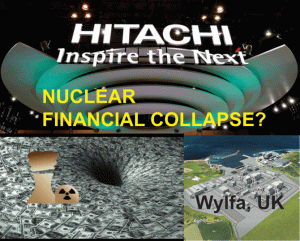 Hitachi to Cease Work on Nuclear Power Plant in North Wales, NYT, Stanley Reed, Jan. 17, 2019, Hitachi said on Thursday that it was suspending work on a 15 billion pound, or $19.3 billion, nuclear power project in North Wales after failing to agree on financial terms with the British and Japanese governments.
“The decision was made from the viewpoint of Hitachi’s economic rationality as a private enterprise,” the company, based in Japan, said.
Ben Russell, a spokesman for Hitachi’s British venture, Horizon Nuclear Power, said that discussions with the governments would continue but that its staff, currently around 300 people, would be cut to “a minimal handful.”
Hitachi will also stop planning work on a second project, in Oldbury, England. The company said it planned to take a write-off of 300 billion yen, or $2.75 billion, on the projects.
The decision by Hitachi is a blow to the British government, which is betting heavily on nuclear installations to help meet the country’s electric power needs in the coming decades.
The big question is whether Hitachi’s move will be a death knell for Britain’s campaign to build nuclear plants, which so far has resulted in only one project under construction.
While there are signs that the government is rethinking its energy policy, it was willing to go a long way toward trying to keep Hitachi on board.
In a statement to Parliament on Thursday, Greg Clark, the secretary of state for business and energy, said the government had been willing to consider providing one-third of the equity financing for the project and to take on all of the construction debt. When Hitachi continued to balk, Mr. Clark said, “I was not prepared to ask the taxpayer to take on a larger share.”
…….For Hitachi, though, the announcement could mark the end of a long and expensive saga. The company acquired the Horizon sites from two German utilities in 2012 for £697 million, or about $900 million, and wound up spending around £2 billion in total on design approvals, staff and other matters. It has been hiring apprentices, who have been training at a technical college on the island and going to Spain and Japan for work experience. At times in recent months more than 100 archaeologists were on the site, excavating and recording ancient structures that the construction would have destroyed.
Hitachi hoped Britain would prove to be an international showcase for its reactor designs. Ultimately, the company lost patience with the high level of spending required to land such a project there.
Hitachi had sought to arrive at a financial arrangement that would attract long-term investors like pension funds to the project and reduce its own exposure. But the offers of support from both the British and the Japanese sides were not enough………https://www.nytimes.com/2019/01/17/business/energy-environment/hitachi-horizon-wales-nuclear-plant.html
January 19, 2019
Posted by Christina Macpherson |
business and costs, politics, UK |
Leave a comment
 Windfarm industry urges UK to lift onshore subsidies ban, Guardian, Adam Vaughan, @adamvaughan_uk, 19 Jan 2019
Firms say 800 renewable projects ready to plug gap left after Wylfa nuclear plant scrapped Ministers have been urged to drop their block on subsidies for onshore windfarms, as industry figures showed that nearly 800 renewable projects are ready to plug much of the power gap left by the abandonment of the Wylfa nuclear project.
Hitachi dropped plans for the
nuclear plant in Wales this week, raising questions over what would replace it and leading the business secretary, Greg Clark, to admit that renewable energy sources are more competitively priced than nuclear.
The wind industry said if a bar on onshore windfarm subsidies was lifted it would allow the construction of 794 projects which have won consent through the planning system and are ready to build. Together they would generate around 12 terawatt hours of energy a year; two thirds of what Wylfa would have produced.
A dozen firms are behind the schemes, including small players and big names such as Scottish Power, Vattenfall, E.ON, EDF Energy and npower’s owner Innogy. But onshore windfarm installations have stalled since the government banned them from securing subsidies.
Emma Pinchbeck, the executive director of RenewableUK, which compiled the figures, said: “We have ready-to-go onshore wind that can help close the gap between the low carbon power we need and the amount government policy is actually delivering, and this week’s announcement on nuclear power has made this mammoth task even harder.”
But she said the government had “stacked the odds” against building the onshore windfarms needed to hit the
UK’s carbon targets, by excluding developers from competing for subsidies in auctions. Only offshore windfarms can compete for state funds currently.
The government’s figures show onshore windfarms are the cheapest source of new electricity generation. The Hinkley Point nuclear project in Somerset won a guaranteed price of £92.50 per megawatt hour, compared with £57.50 for offshore windfarms in the early 2020s. Experts think onshore windfarms could hit around £50 per MWh…….
The Scottish energy minister, Paul Wheelhouse, said that after the failure of Hitachi’s projects, it was time for the UK to prioritise onshore windfarms and other renewable technologies over nuclear.
The government’s infrastructure advisers, the National Infrastructure Commission, urged a rethink that would allow onshore windfarms to compete for support…….https://www.theguardian.com/environment/2019/jan/18/windfarm-industry-urges-uk-to-lift-onshore-subsidies-ban
January 19, 2019
Posted by Christina Macpherson |
renewable, UK |
Leave a comment
 Jim Green Nuclear Fuel Cycle Watch South Australia shared a link. 19 Jan 19
UK Secretary (Minister) for energy and business on the staggering subsidies offered to Hitachi to build reactors in Wales … and the project collapsed anyway!
Mr. Speaker, while negotiations were ongoing, I am sure the House will understand that the details were commercially sensitive, but following Hitachi’s announcement I can set out in more candid terms the support that the government was willing to offer in support of the project.
Firstly, the government was willing to consider taking a one third equity stake in the project, alongside investment from Hitachi and Government of Japan agencies and other strategic partners.
Secondly, the government was willing to consider providing all of the required debt financing to complete construction.
Thirdly, the government agreed to consider providing a Contract for Difference to the project with a strike price expected to be no more £75 per megawatt hour.
I hope the House would agree that this is a significant and generous package of potential support that goes beyond what any government has been willing to consider in the past. Despite this potential investment, and strong support from the government of Japan, Hitachi have reached the view that the project still posed too great a commercial challenge, particularly given their desire to deconsolidate the project from their balance sheet and the likely level of return on their investment. https://www.facebook.com/groups/1021186047913052/
January 19, 2019
Posted by Christina Macpherson |
politics, UK |
Leave a comment
 Why is the government cooling on nuclear?, BBC News, Simon JackBusiness editor17 January 2019
January 19, 2019
Posted by Christina Macpherson |
politics, UK |
Leave a comment