Opposition to unnecessary, environmentally destructive Sizewell nuclear project
after the Covid-19 lockdown restrictions are lifted. Community leaders
believe people need to be able to attend public meetings and other events
as part of the process for the Sizewell C planning application submitted
yesterday.
earliest – and a final decision on the project late next year. The
leaders of East Suffolk Council and Suffolk County Council have been
supportive of EDF Energy making the Development Consent Order submission
for permission for the project but are continuing to call on the company to
ensure they talk to the two local authorities before triggering the formal
Section 56 process and timescale which includes a period of formal public
engagement.
Energy asking them to delay the Section 56 process given the current
Government guidance on social distancing, social isolation and public
gatherings. We believe all parties must be satisfied that appropriate
public engagement can take place. “We would like EDF Energy to continue
its discussions with both councils so we can work together to find a
suitable solution that works for all our communities.”
Suffolk county councillors calling on them to let their hearts rule their
heads and reject the project, which he claims will “irreparably alter
that unique Suffolk character and nature of this tranquil and welcoming
county, transforming it into just another over-developed, car-dominated,
road-centred, urbanised area of the UK like so many others – bland,
conformist and uniform”.
the national planning inspectorate for permission to build two huge nuclear
reactors on a site which is barely big enough to contain them. It requires
the destruction of the 100 year old Coronation Wood for its overspill
facilities. The construction is designed to house two European Pressurised
Reactors generating 3.2 gigawatts of electricity at full power. The
Sizewell B plant has recently reduced its output by 50% at a reported cost
of £50million due to over-supply. This over-supply is not just a
consequence of the covid-19 pandemic. In 2005, the government made plans to
meet a predicted 15% increase in electricity demand by 2020. In fact,
demand has dropped over those 15 years by 16%, an overestimation of demand
by more than 30%. It is axiomatic that Sizewell C is not needed to ‘keep
the lights on’ nor is it an essential infrastructure project.”
https://www.eadt.co.uk/news/edf-delay-on-sizewell-c-consultation-1-6672349
Bankrupt French company AREVA, now resuscitated as Framatome to engineer UK’s nuclear fleet
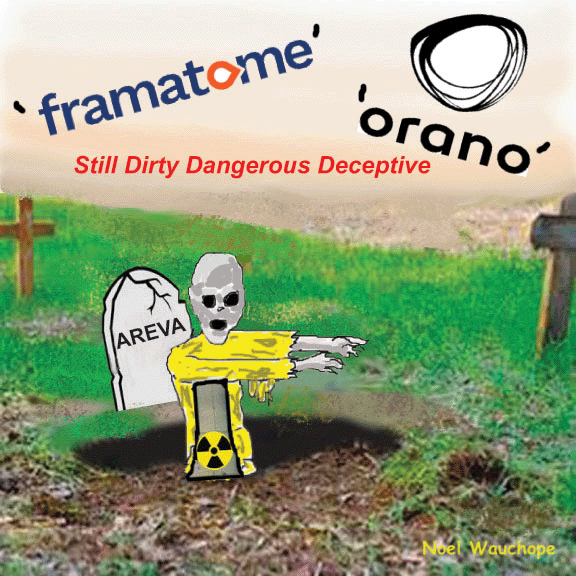
Framatome to provide engineering services to UK nuclear fleet, 29 May 2020 French company Framatome has signed a framework agreement with EDF in the UK to provide engineering services to support ongoing nuclear power plant operations…… EDF in the UK operates a fleet of eight nuclear power stations: Sizewell B, Hinkley Point B, Dungeness B, Hartlepool, Heysham 1 and 2, Hunterston, and Torness. https://www.neimagazine.com/news/newsframatome-to-provide-engineering-services-to-uk-nuclear-fleet-7944809
Government-owned Chinese company wants to build Sizewell nuclear plant
 State-owned Chinese company bids to build second UK nuclear plant, SMH, By Latika Bourke May 27, 2020 —A Chinese state-owned company blacklisted in the United States has applied to build a second nuclear plant in Britain amid growing concern in the UK government’s ranks about Chinese investment in critical infrastructure.China General Nuclear Power Group’s application creates a new headache for UK Prime Minister Boris Johnson, who is already facing a backbench revolt over his approval of Chinese firm Huawei to supply Britain’s 5G networks. State-owned Chinese company bids to build second UK nuclear plant, SMH, By Latika Bourke May 27, 2020 —A Chinese state-owned company blacklisted in the United States has applied to build a second nuclear plant in Britain amid growing concern in the UK government’s ranks about Chinese investment in critical infrastructure.China General Nuclear Power Group’s application creates a new headache for UK Prime Minister Boris Johnson, who is already facing a backbench revolt over his approval of Chinese firm Huawei to supply Britain’s 5G networks.
The UK does not have an investment review process like Australia’s Foreign Investment Review Board. However, Johnson has flagged a tightening of foreign investment rules in the wake of the pandemic and subsequent alarm about dependence on China. CGN, on Wednesday, submitted its planning application to build the Sizewell reactor in Suffolk, England with its French partner EDF. The project, estimated to cost at least £20 billion ($A37 billion) would be financed through private investment and construction would begin by the end of 2021 if approvals are given. CGN’s initial stake in the project would be 20 per cent compared to EDF’s 80 per cent. The same consortium was approved to build Britain’s Hinkley Point power station in 2016. The then prime minister Theresa May temporarily halted the project over concerns about Chinese investment in critical infrastructure but eventually gave the project the go-ahead. However, in August last year the Trump Administration placed CGN on the US entity list accusing it of acting contrary to the United States’ national security. The US has accused the Chinese company of stealing US nuclear technology for military use.
Sizewell’s approval process is expected to take at least 18 months at the same time as the government is being urged to tighten foreign investment rules. Former Conservative party leader and backbench MP Iain Duncan Smith told The Sydney Morning Herald and The Age that China must not be allowed to make any further inroads into the UK’s critical infrastructure. “We simply cannot go further down the road of becoming more dependant on China,” he said…….. https://www.smh.com.au/world/europe/state-owned-chinese-company-bids-to-build-second-uk-nuclear-plant-20200527-p54x37.html |
|
Soaring costs of UK’s Hinkley Point C nuclear project, and other nuclear plans, while renewables get cheaper
 Business Green 27th May 2020, significant concerns surround the high costs associated with new nuclear power, particularly in the wake of the controversial Hinkley Point Business Green 27th May 2020, significant concerns surround the high costs associated with new nuclear power, particularly in the wake of the controversial Hinkley PointC project in Somerset, which has soared £2.9bn over budget so far and is running 15 months behind schedule. EDF said Sizewell C would use the same
design as Hinkely Point C, and would therefore benefit from “significantly reduced construction costs and lower risk”. Financing could also help reduce costs even further, it added. Chinese state-owned firm CGN also holds a 20 per cent stake in the development phase of Sizewell C. The same company also holds a 33 per cent stake in Hinkley Point C. But many green
groups argue renewable power sources coupled with battery storage and grid flexibility technologies offer a far cheaper and more reliable, zero carbon source of electricity for the UK grid. A report last year by think tank ECIU argued the UK should look to scale up wind and solar rather than nuclear energy capacity going forward. Greenpeace UK chief scientist Doug
Parr said EDF’s decision to push for new nuclear power in the face of “cheaper, safer, faster and far more popular alternatives” being pursued elsewhere in the world was “difficult to explain”. “For half a century Britain was overly-optimistic about the technology, but we don’t have to keep making the same mistake,” he said. “All it would take to knock billions off our future energy bills is for the government to admit they are backing the wrong horse. Energy technologies and economics have changed enormously over the past five years, and energy policy needs to change with them.” |
|
UK’s National Trust says new Sizewell C nuclear power station poses threat to rare birds
National Trust. A new nuclear power station planned for the Suffolk coast
would threaten rare wildlife on protected heathland, according to the
National Trust.
submitted to the Planning Inspectorate tomorrow, to build twin reactors at
Sizewell in a project that the French state-controlled company says would
supply enough low carbon electricity for six million homes, or 7 per cent
of UK power.
that is one of Britain’s rarest habitats and is home to a breeding
population of endangered stone curlews. It has written to the leaders of
East Suffolk council and Suffolk county council to raise concerns about the
proposed £18 billion plant, which EDF would build with the Chinese nuclear
power company China General Nuclear (CGN). Stop Sizewell C, a local
campaign group, said the power stations “would be an expensive bridge to
nowhere: it will suck vital funds away from the technologies and projects
that are more capable of truly transforming our energy landscape”.
including the actors Bill Nighy and David Morrissey and the painter Maggi
Hambling, called on the government to step in to delay consideration of the
proposal until the coronavirus restrictions were lifted. Mr Nighy, who used
to live in Theberton with his former partner, the actress Diana Quick,
said: “It is beyond belief that EDF is pressing forward during these
terrible and uncertain times with a project so misguided, and which even
the government’s own advisers find deeply concerning.
will not fit to any degree in our new world, and this internationally
famous environment will be desecrated. This is a time to protect our
ecosystems, not shatter them.”
Sizewell nuclear planning application should be rejected until coronavirus lockdown restrictions are lifted
|
East Anglian Daily Times 24th May 2020, EDF Energy could be set this week to submit its final plans for a new £14billion nuclear power station on the Suffolk coast to the Government – despite widespread anger over the timing of the application. Community leaders across east Suffolk, along with many influential organisations and a host of celebrities have demanded that the power giant puts its plans for the new Sizewell C twin reactor on hold until after the coronavirus lockdown restrictions are lifted. They fear that current bans on public
meetings and people getting together even in small groups, plus the continued closure of libraries, will prevent many from seeing the full plans, debating them and giving their views. Central Suffolk and North Ipswich MP Dr Dan Poulter has written to Government ministers urging them to reject the planning application, known as the Development Consent Order, until after the Covid-19 crisis. News that the application is about to be made has left them deeply disappointed and saying it is the most inappropriate time to do so. https://www.eadt.co.uk/news/sizewell-c-dco-submission-wednesday-may-27-1-6668608 |
UK’s new nuclear plants – nearly all parts are sourced and/or funded from China and France
David Lowry’s Blog 24th May 2020, Letter from David Lowry to The Times: Your important revelation follows Johnson’s assertion to MPs on Wednesday that he is pursuing “measures
to protect our technological base.” The initiative, “Project Defend,”
is aimed at creating a new national resilience framework, which, The Times
reports, will address the current over-reliance on China for “medical and
other strategic imports.”
One such strategic import is civil nuclear
technology, on which UK is 100 per cent reliant on foreign suppliers for
the critical core reactor infrastructure, with the Hinkley C nuclear plant
under construction by French state generator, Electricite de France ( EdF)
using French technology, supported by French and Chinese capital
investment.
The next new nuclear plant in line for construction, at
Sizewell C in Suffolk, will have 20per cent of its costs paid for by
Chinese state company China General Nuclear.
The third new plant, at
Bradwell in Essex, is planned to entirely built using 100 per cent Chinese/
French designed technology, mostly imported, and backed by 62 per cent
Chinese funding. It would also be operated by a primarily Chinese technical
team. Only smaller parts for these new plants will be sourced from the UK
supply chain.
http://drdavidlowry.blogspot.com/2020/05/uk-china-nuclear-relations-need-reset.html
Britain will have to decide whether it wants nuclear power stations funded — and powered — by China.
|
Times 24th May 2020, The great China dilemma: Caught between two superpowers, Britain faces difficult decisions on everything from nuclear power to medicine. On the picturesque Suffolk coast, a battle is intensifying that will help define Britain’s relationship with China. In one corner is a group of celebrities and locals, including the Love Actually actor Bill Nighy, and Andy Wood, chief executive of Adnams brewery in Southwold. In the other are two nuclear power giants, Electricité de France (EDF) and China General Nuclear (CGN).
China and France want to build Sizewell C, a nuclear power station capable of supplying 7% of the UK’s electricity. The Stop Sizewell C campaigners share one concern with some politicians, notably the hard right of the Conservative Party: why is Britain relying on China to
supply its electricity? “China is adept at cyber-attacks,” said Alison Downes of Stop Sizewell C. “I would doubt whether there could be a 100% cast-iron guarantee that operating systems were immune to that. Even if you set aside security concerns, you’ve got real vulnerabilities with a government that is prepared to use economic sanctions.” Sizewell is just a part of the communist state’s Belt and Road initiative to dominate the world with cash, technology and influence. It plans to use the UK as a showcase for its nuclear technology, with state-owned CGN providing 20% of the funds for Sizewell.
China is also helping bankroll the delayed and over-budget Hinkley Point C power station in Somerset. However, the bigger prize lies on the Essex coast at Bradwell. There, 40 miles east of London, CGN wants to install its homegrown HPR1000 nuclear reactors. CGN will be the two-thirds owner of the Bradwell plant, EDF the junior partner.
EDF and CGN claim that the power stations will be impervious to cyber attack. In
Britain, a new China-sceptic organisation, the China Research Group, has been formed by Tory MPs led by Tom Tugendhat, chairman of the foreign affairs select committee. It is a far cry from the “golden era” in Sino-British relations promised by David Cameron in 2015, when Chinese
president Xi Jinping visited the UK and the pair drank pints in a pub. At CGN, concern is growing about the rising tide of Sinophobia and its investment in the UK. As the Chinese embassy in London pumps out defensive statements about China’s role in tackling Covid-19, Britain will have to decide whether it wants nuclear power stations funded — and powered — by China. CGN’s UK chief executive, Zheng Dongshan, is understood to have
pressed energy minister Nadhim Zahawi for clarity around the UK’s intentions on new nuclear. https://www.thetimes.co.uk/edition/business/the-great-china-dilemma-6rdmhw3wl |
Doubts on the funding of Britain’s £18bn Sizewell nuclear plan
Times 24th May 2020, EDF submits £18bn nuclear plan. Energy giant EDF is poised to submit plans for an £18bn nuclear power station on the Suffolk coast, stoking tensions
over China’s role in Britain’s critical infrastructure. EDF is expected
to submit a development consent order (DCO) to the planning inspectorate on
Wednesday — a crucial stage in building Sizewell C, which will supply 7%
of the country’s electricity. China General Nuclear (CGN) is funding 20%
of the Sizewell development, with the French state power company
shouldering the rest of the cost, although sources said CGN may opt not to
fund its construction.
https://www.thetimes.co.uk/article/edf-submits-18bn-nuclear-plan-lsc3q8378
Bosses at Hinkley Point C have slashed 80 roles after employees worked throughout the coronavirus lockdown
named, said the news came as a ‘bitter pill’ after he risked his own health
to still work at the construction site during the last few months. The
worker was made “redundant with immediate effect” on Friday afternoon (May
15). He said: “We have struggled every day during this pandemic and the way
EDF has managed the outbreak. This has made the risk we have being taking
coming to site every day one bitter sweet pill to swallow.”
https://www.bristolpost.co.uk/news/local-news/hinkley-point-c-cuts-80-4147171
Sellafield’s safety dilemma- risk of coronavirus versus risk of nuclear accident


|
Sellafield work must resume despite coronavirus lockdown in case of ‘nuclear incident’, says boss LancsLive By Steve Robson, Ian Molyneaux, 12 MAY 2020The boss of Sellafield has said decommissioning work needs to resume despite the coronavirus lockdown in case there is a ‘nuclear incident’.
The site near Seascale has been running at less than a fifth of normal operations for several weeks due to the Covid-19 pandemic, with around 1,500 key staff in work. Normally, Sellafield would have up to 8,000 people on site every day. At the beginning of May, a further 120 people came back to work, mainly attending off-site offices in Warrington to access specialist equipment and software. The company says it is making its way through a “cautious, limited, phased restart of work over the coming weeks”. Now Chief executive Martin Chown admitted he is faced with a difficult decision, but said it is vital Sellafield restarts some work. It is understood this refers to the decommissioning of old facilities that have the potential to cause a nuclear hazard if left to mothball…….. It is understood that a broad set of principles for restarting work at Sellafield have been agreed including a maximum of 3,500 people working on any one site at any given time, a maximum of 25per cent of staff working at off-site facilities, and work on construction sites only approved on the basis staff do not interact with the rest of the site. …. https://www.lancs.live/news/local-news/sellafield-work-must-resume-despite-18234403 |
Move to prevent dumping of Hinkley radioactive mud on the South Wales coast
|
The background shows that the Welsh Government believes concerns about the mud are irrational and are driven by “liars and scaremongers” (as the Environment Secretary said in 2018). In fact, in order to comply with the law, they need to address uncertainties and knowledge gaps and that is why we are recommending selection of members with a wide range of relevant knowledge. Please write to your elected representatives and circulate this widely, bearing in mind that Wales is not the only part of the UK affected. What little information the Welsh Government has issued suggests that announcement of the Expert Group’s membership may be imminent, so please act now. They will not want to look as if they’re backing down later. https://wanaarticles418353382.wordpress.com/category/hinkley-mud/ |
|
Ministry of Defence’s poor management of contracts for nuclear infrastructure projects
MPs slam MoD’s ‘utter failure’ to improve contract management as nuclear project costs soar
‘The department knows it can’t go on like this,’ says PAC chair The Ministry of Defence’s poor management of contracts has left taxpayers picking up the bill after nuclear infrastructure projects have swelled beyond their planned time and budget, a public spending watchdog has found.
The Public Accounts Committee found three nuclear infrastructure projects had together gone £1.45bn over budget and were each between 1.7 and 6.3 years because of problems with their contracts’ design and management.
The committee’s inquiry examined three projects: the building of a nuclear warhead assembly and disassembly facility, known as MENSA, at AWE Burghfield; the Rolls Royce-owned and operated Core Production Capability facilities at Raynesway, where the department is upgrading facilities for nuclear reactor core production; and the BAE Systems-owned Barrow shipyard facility to allow modular build of Dreadnought-class submarines.
The MoD was unable to explain why it had made repeated mistakes designing and managing the contracts – which represent the three biggest nuclear infrastructure projects it is managing – despite being warned about the same issues in the past, PAC said in a report last week.
The MPs said that both PAC and the National Audit Office had been warning of similar contracting mistakes for more than 30 years. The MoD had also “failed to learn lessons from comparable projects in the civil nuclear sector and in the United States”, they added.
The PAC report followed a NAO finding in January that “inherent uncertainties of early designs [in the three contracts] do not incentivise site operators, or their sub-contractors, to negotiate and share risks, increasing risks for the department”.
“It is therefore disappointing to see that in their early days the department made the same mistakes, also experienced by others, as were made more than 30 years ago,” the NAO report said.
The ministry said it “immensely regretted” the waste of money but admitted costs could keep rising because the contracts had left the government to assume financial risk……. https://www.civilserviceworld.com/articles/news/mps-slam-mods-utter-failure-improve-contract-management-nuclear-project-costs-soar
Shinfield residents urged to look out for update from nuclear weapons facility,
|
Shinfield residents urged to look out for update from nuclear weapons facility, Wokingham Today by Jess Warren Monday, May 18, 2020 RESIDENTS of Shinfield are being told to look out for an important communication coming from West Berkshire Council about the emergency planning zone around AWE Burghfield.People who live in Spencers Wood, Three Mile Cross and Grazeley will soon be updated about the enlarged emergency planning zone.
Although there has been no change in activities at AWE Burghfield, new legislation has required a review, and now the emergency plan for the facility must now cover a larger area.
This extended area — known as the Detailed Emergency Planning Zone (DEPZ) — now covers some homes and businesses in Spencers Wood, Three Mile Cross and Grazeley not previously included. “But there now has to be an emergency plan in place for a bigger area meaning some of our residents are in this DEPZ for the first time. …….Full details on the DEPZ can be found on West Berkshire’s website at: info.westberks.gov.uk/awe and more information can be found in their news release. |
|
Sizewell and Bradwell nuclear projects unnecessary, but also security danger if Chinese company in control
 Daily Mail 16th May 2020, White House official urges Britain not to hand China control of its electricity as Beijing-run nuclear energy company jostles for dominance. A senior US official has delivered a stark warning to Britain not to continue to let a Chinese state-run nuclear energy company control a large part of our electricity supply. Dr Christopher Ford, the US State Department’s assistant secretary for non-proliferation and international security, warned that China General Nuclear (CGN) is closely linked to the Communist regime’s military. Daily Mail 16th May 2020, White House official urges Britain not to hand China control of its electricity as Beijing-run nuclear energy company jostles for dominance. A senior US official has delivered a stark warning to Britain not to continue to let a Chinese state-run nuclear energy company control a large part of our electricity supply. Dr Christopher Ford, the US State Department’s assistant secretary for non-proliferation and international security, warned that China General Nuclear (CGN) is closely linked to the Communist regime’s military.Any involvement in UK power generation would jeopardise our political independence for many decades, he said. One of the company’s top engineers has previously been convicted and jailed in the US for running a spy network at the behest of Beijing.
Speaking exclusively to The Mail on Sunday, Dr Ford said: ‘We are trying to discourage our friends and partners from engaging with a Chinese nuclear company that is known for such acts.’ It is highly unusual for a serving US official to intervene so forcefully about an ally’s policy decisions but it shows how seriously the Trump administration views the Chinese threat.
Dr Ford’s fears are echoed by many senior figures in Britain, including Sir Richard Dearlove, the former head of MI6. He told The Mail on Sunday that if CGN was allowed a key role in building two vast nuclear power plants – at Sizewell in Suffolk and Bradwell in Essex – there would be a grave threat to national security. An analysis by this newspaper shows that the Chinese could have total or partial control over more than a quarter of Britain’s electricity needs. Dr Ford said this could result in ‘manipulation or coercion’, explaining: ‘China has not been shy about using economic levers as a political tool. Economic entanglements are being used for political purposes with greater frequency.’
He added that if Britain became dependent on CGN, China ‘could threaten to turn the switches on and off – and that can be a very powerful tool of influence.’ In Suffolk, the firm is in partnership with the French state-run company EDF, which is about to submit its final ‘consent order’ for permission to build a similar power station to Hinkley – even though an unfinished
prototype in northern France is eight years behind schedule and three times over budget. CGN’s share of the final project has yet to be determinedbut it has already agreed to take an 80 per cent stake in Bradwell, where it wants to build two of its own Hualong 1 reactors. Industry experts saythat although Hinkley, Sizewell and Bradwell could supply at least a fifth of the total power generated in Britain, it is not proved that they are really needed.
|
1 This Month




PLEASE OPPOSE HR 8255 AND S.3639 – bills would accelerate satellite deployment, with no environmental review or safeguards – https://ncstd5li.quorum.us/campaign/169331/
To see nuclear-related stories in greater depth and intensity – go to https://nuclearinformation.wordpress.com
-
Archives
- September 2026 (336)
- August 2026 (330)
- July 2026 (355)
- June 2026 (287)
- May 2026 (306)
- April 2026 (356)
- March 2026 (251)
- February 2026 (267)
- January 2026 (308)
- December 2025 (358)
- November 2025 (359)
- October 2025 (375)
-
Categories
- 1
- 1 NUCLEAR ISSUES
- business and costs
- climate change
- culture and arts
- ENERGY
- environment
- health
- history
- indigenous issues
- Legal
- marketing of nuclear
- media
- opposition to nuclear
- PERSONAL STORIES
- politics
- politics international
- Religion and ethics
- safety
- secrets,lies and civil liberties
- spinbuster
- technology
- Uranium
- wastes
- weapons and war
- Women
- 2 WORLD
- ACTION
- AFRICA
- Atrocities
- AUSTRALIA
- Christina's notes
- Christina's themes
- culture and arts
- Events
- Fuk 2022
- Fuk 2023
- Fukushima 2017
- Fukushima 2018
- fukushima 2019
- Fukushima 2020
- Fukushima 2021
- general
- global warming
- Humour (God we need it)
- Nuclear
- RARE EARTHS
- Reference
- resources – print
- Resources -audiovicual
- Weekly Newsletter
- World
- World Nuclear
- YouTube
-
RSS
Entries RSS
Comments RSS

