China is reconsidering building nuclear reactors in Britain
|
China poised to pull plans for UK nuclear plants https://www.straitstimes.com/world/europe/china-poised-to-pull-plans-for-uk-nuclear-plants 5 June 20 LONDON (BLOOMBERG) – China’s ambassador to the UK said that Prime Minister Boris Johnson’s plans to seek alternatives to Huawei Technologies Co Ltd in the 5G network could spoil plans for Chinese companies to build nuclear power plants and the HS2 high-speed rail network, the Sunday Times reported.Mr Liu Xiaoming signalled that Beijing is viewing the decision over Huawei as “a litmus test of whether Britain is a true and faithful partner of China”, the newspaper reported the ambassador telling business leaders, saying that the words were “interpreted as a threat by those listening”.
China General Nuclear Power Corp plans to build its own nuclear reactor at Bradwell in Essex, according to the newspaper report. China has a minority share in nuclear power plants at Hinkley Point in Somerset and Sizewell C in Suffolk, both in partnership with EDF of France. |
|
Deep concern over environmental cost of planned Sizewell C nuclear station
 East Anglian Daily Times 5th June 2020 Councillor David Blackburn: Deeply concerned over the environmental cost of Sizewell C. I share the ‘deep concerns’ of the National Trust to
the potential environmental costs of the proposed Sizewell C new nuclear
reactor project (EADT, 25th May).
They tally with those made at our recent
Saxmundham seminar from environmental representatives including the
naturalist Simon Barnes, the Suffolk Wildlife Trust and Suffolk Coastal
Friends of the Earth. At that meeting it was made clear that Sizewell C
could have major and long term negative effects on highly sensitive sites
like Minsmere, and as the National Trust notes, Dunwich Heath.
And we know as well that Coronation Wood is to be removed in the interim plans for the
site. The natural environment around Sizewell includes some rare and unique
habitats, and clearly an industrial development on the sheer scale of
Sizewell C can’t possibly be able to mitigate all of these issues.
It should also be noted that, in the past few months, renewable energy has
delivered the bulk of UK electricity needs and it is reported that EDF may
be paid £50 million just to turn Sizewell B off due to a lack of demand.
With longer-term concerns over climate change, coastal erosion and rising
sea levels there is a lethal combination of factors that make it much more
sensible not to develop new nuclear reactors in Suffolk. The concerns of
local environmental groups need to be heeded for this and future
generations so that we can continue to enjoy these beautiful landscapes and
their rare wildlife.
Most UK pension providers are investing in nuclear weapons companies

“The UN Treaty on the Prohibition of Nuclear Weapons (TPNW) was agreed in 2017.
“Once this is ratified by 50 states and comes into effect as a new piece of international law, the implications will be significant for nuclear armed states and financial institutions alike.
“The biggest banking corporations have a global reach and cannot disregard international law.”
|
Concerns raised over pension investments in nuclear weapons,
https://www.pensionsage.com/pa/Most-pension-providers-investing-in-nuclear-weapons.php By Sophie Smith 03/6/20 A report by the UK Nuclear Weapons Financing Research Group has raised concerns about the number of pension providers investing in companies that are producing nuclear weapons.
The report, Banks, Pensions and Nuclear Weapons: Investing in Change, found that among pension providers, policy on restricting investment in nuclear weapons is generally limited to ethical funds. Continue reading |
Climate Experts Predict ‘Grim Future’ For Nuclear Power
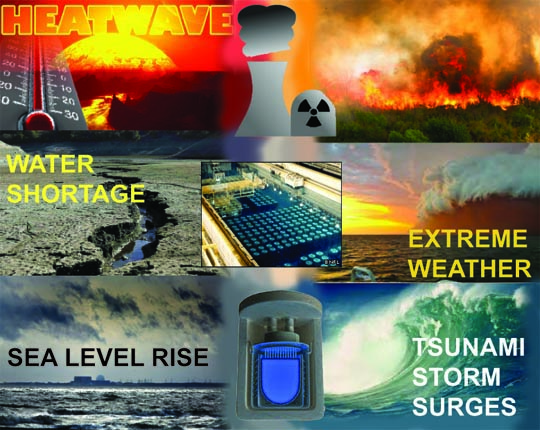
Climate Experts Predict ‘Grim Future’ For Nuclear Power
The result of research into black swans – called “Synthesising Unprecedented Coastal Conditions: Extreme Storm Surges” aka SUCCESS – was presented at the meeting. It was important to conduct this research, the academic said, because “the storm surge of 5th December 2013 caused sea levels in many parts of the country that were the highest ever recorded and begs the obvious question – could they have been worse?”
All in all, the presentations and discussions at the meeting would not have been particularly welcome to the ONR, whose job it is to make sure nuclear power stations are built to standards that guarantee public safety. In a statement to VICE, an ONR spokesperson said “ONR requires that nuclear new build sites are able to withstand extreme natural hazards, by designing against a one in 10,000 year event. Sites must identify these external hazards, which include the impact of climate change, and demonstrate that they are adequately protected against them throughout the lifetime of the facility.”
Assange too sick to attend the very unjust process of the UK extradition hearings
 Monica Del Mestre 3 June 20
2. In addition to other ongoing health concerns, Assange faces the serious risk of exposure to Covid in Belmarsh prison, and has been advised that even going to the video room to take part in hearings is unsafe. This is another reason he should be immediately released.
3. Assange’s lawyers have long complained they have had insufficient access to him in prison. Under lockdown conditions, they have had no access to him at all. They have repeatedly flagged that this lack of access seriously impacts their ability to prepare his defence.
4. One of the next steps agreed today is that psychiatric reports on Assange from the prosecution and defence will be due to the court on 31 July. Remember that UN Special Rapporteur @NilsMelzer has expressed alarm many times that Assange shows symptoms of psychological torture.
5. It is a welcome step that the continuation of the full extradition hearing was adjourned, as lockdown conditions present clear barriers to open justice – but 7 September may not be late enough to make a meaningful difference. Also the court is still struggling to find a venue.
6. It remains extremely frustrating that the court does not adequately accommodate NGO observers. I have never experienced so much difficulty accessing a trial in any country as at Woolwich Crown Court in February, and the teleconference option we now have is far from sufficient.
7. The press are also facing severe restrictions. Only 6 journalists have been allowed to attend in person the past 2 hearings, with others limited to the awful phone line. This case is of high public interest and a better solution must be found before the full hearing resumes.
8. Assange’s next callover hearing has been scheduled for 29 June at 10 am. We urge the court to find workable solutions to enable his safe attendance and ensure the press and observers are able to properly monitor proceedings. /END
UK’s Sizewell nuclear plan in doubt, due to cost and China’s involvement?
Plan for new UK nuclear plant under intense scrutiny, Proposal for reactor attracts attention because of Chinese role as well as cost Ft.com Nathalie Thomas in Edinburgh and Jim Pickard in London, JUNE 2 2020
Environmentalists insist cheaper, green technologies such as wind, solar and batteries should take precedence over nuclear. ……….Nuclear just isn’t cost-effective,” said Doug Parr, chief scientist for campaign group Greenpeace.
https://www.ft.com/content/4e3221ef-ac1e-43cc-8d68-e1397ca0637f Against this backdrop, the government last year launched a consultation on a possible new funding model for new nuclear plants. The so-called regulated asset base model is attractive to developers because it would cut the cost of capital for a new nuclear plant, reflecting how consumers would pay upfront for the project through their energy bills. These consumers could be left picking up the tab for cost overruns.
Please use the sharing tools found via the share button at the top or side of articles. Copying articles to share with others is a breach of FT.com T&Cs and Copyright Policy. Email licensing@ft.com to buy additional rights. Subscribers may share up to 10 or 20 articles per month using the gift article service. More information can be found here.
https://www.ft.com/content/4e3221ef-ac1e-43cc-8d68-e1397ca0637f
Estimated costs of Uk’s nuclear power projects – Sizewell C £18 billion ($22bn), Hinkley Point C £22.5bn
 Nuclear Engineering International 28th May 2020, The cost of Sizewell C is put at £18 billion ($22bn), while the estimated cost of Hinkley Point C is between £21.5bn and £22.5bn. The application for a Development Consent Order for Sizewell C follows four rounds of public consultation which began in 2012. More than 10,000 residents and organisations in Suffolk contributed their views.
Nationally important – to stop the dumping of radioactive mud off Cardiff coast
Western Mail 28th May 2020, A COALITION of high-profile environmental groups has urged First Minister Mark Drakeford to insist on the further testing of mud from a nuclear powerstation in Somerset before it is dumped in the Severn Estuary off Cardiff.
station were dumped in the face of significant public opposition amid
concerns that it could be radioactive and pose a threat to health. This was
denied by Natural Resources Wales, which licensed the dumping, the Welsh
Government and EDF, the French company which owns the power station.
location. A letter signed by 34 NGOs, policy analysts, experts and
campaigners, including Greenpeace UK, the leading environmentalist Sir
Jonathon Porritt, the Welsh Anti-Nuclear Alliance, the Low Level Radiation
Campaign, Nuclear Free Local Authorities and the Nuclear Consulting Group,
was yesterday delivered to First Minister Mark Drakeford.
(Wales) Act 2016, ensure that the mud sampling programme aimed at
establishing whether there are radioactive substances present is expanded,
and appoint an expert group which includes members nominated by
environmental groups when conducting the assessment of the mud.
Natural Resources Wales and the Welsh Government to take full account of
uncertainties. There is abundant evidence in the scientific literature that
uranium and plutonium particles are blown ashore and cause cancer,
leukaemia and birth defects, yet Westminster’s advisory committee COMARE
refuses to address them and EDF’s tests can’t detect them.
Level Radiation Campaign and chair of Together Against Sizewell C, said:
“The number and diversity of those who have been willing to put their
name to this letter indicates that this issue is of national importance.
The evidence points to the fact that the relationship between radioactive
dose and risk is not necessarily linear and this letter seeks recognition
of that uncertainty and a considered, science-based approach to the EDF
application.” A Welsh Government spokesman responded: “We have received
the letter and will respond in due course.”
https://www.pressreader.com/uk/western-mail/20200528/281767041433492
Britain, France, Germany not happy that USA will end waivers for Iran civilian nuclear projects
“We deeply regret the decision by the United States to end the three exemptions for key nuclear projects of the Joint Comprehensive Plan of Action (JCPOA), including the Arak reactor modernization project,” the statement said.
“These projects, including the Arak reactor modernization project, endorsed by U.N. Security Council Resolution 2231, have served the non-proliferation interests of all and provide the international community with assurances of the exclusively peaceful and safe nature of Iranian nuclear activities,” the three counties said.
Wednesday the United States announced the end of the waivers, which had allowed the continuation of projects related to Iran’s civil nuclear program, even though the Trump administration abandoned the 2015 international plan of action in 2018.
Under the waivers Russian, Chinese and European companies worked on the conversion of Iran’s Arak heavy water reactor to civilian purposes and on the transfer of nuclear fuel abroad.
Sellafield’s radioactive cats
Carlisle News & Star 30th May 2020, Claims that cats from West Cumbria’s nuclear site given out for adoption were found to have plutonium in their system have been challenged by
Sellafield. Radiation Free Lakeland claims samples analysed from two cats
showed plutonium and cesium in the poop of one of them. Marianne Birkby, of
the campaign group, said: “For Sellafield to be handing out cats to the
public is rather at odds with their policy of culling wildlife on site to
contain radioactive contamination.
https://www.newsandstar.co.uk/news/18476222.sellafield-challenges-claim-plutonium-sites-cats/
Sizewell C nuclear project now becoming prohibitively expensive?
NS Energy 27th May 2020, EDF has predicted the cost of Sizewell C will be 20% lower than Hinkley Point C – which is set to cost about £20bn ($26bn) – because of the similarities between the stations and established infrastructure. But in an interview with The Times in April 2018, the company’s UK chief executive Simone Rossi questioned whether the project would remain “feasible” without faster progress being made at the Hinkley Point C site – which has suffered from rising costs and delays – and a government guarantee.
The firm is still talking with the government about workable funding models that can convince it to stay at the table. Speaking about the possibility of no functional funding model appearing, Mr Rossi said: “This is the year where we need to understand whether this whole thing is really
feasible or not. “If we were to conclude that maybe it’s not feasible, then at that point maybe we say we are not in a position to continue the project.” In January 2020, it was reported that EDF was running out of time to secure a funding deal before the project became prohibitively expensive.
https://www.nsenergybusiness.com/features/sizewell-c-nuclear-power-station/
Wildlife charities unite to oppose Sizewell C nuclear power station
it must not go ahead. The RSPB and Suffolk Wildlife Trust (SWT) say they
have not seen evidence that the £14billion project can be built without
detrimentally impacting internationally and nationally important
landscapes, habitats, animals and plants on the Suffolk coast.
direct loss of nationally important and protected land on Sizewell Belts, a
Site of Special Scientific Interest (SSSI). An area between 10-12 hectares
– or roughly ten football pitches – will be covered in concrete. The
loss of this nationally rare fen habitat would be devastating and
irreplaceable.”
build will bring the Sizewell Estate adjacent to the internationally famous
wildlife haven. It is feared the building work may increase erosion,
upsetting the delicate balance of the reserve. It could affect the water
levels in Minsmere’s ditches, impacting its rare wetland wildlife, which
includes bitterns, water voles, otters and ducks.
https://www.eadt.co.uk/news/swt-rspb-unite-to-oppose-sizewell-c-nuclear-power-station-1-6674364
Chinese involvement in Sizewell nuclear plant the ‘next Huawei
 Telegraph 27th May 2020, Chinese involvement in Sizewell nuclear plant the ‘next Huawei’, MPs warn.
Call for energy policy and how the UK interacts with China to be reviewed.
Chinese involvement in the Sizewell C nuclear power station will be the
“next Huawei,” MPs have warned, as they called for an entire overhaul
of the energy policy.
It comes after EDF, the French energy company on
Wednesday submitted an application to build the next nuclear power plant in
Suffolk, which it intends to develop with the state-owned energy company,
China General Nuclear Power Group (CGN).
However Sir Iain Duncan Smith, the
former Conservative leader, warned the power plant was “the next
Huawei”. “It is another major manifestation of the problem we face
having set out on the wrong path with China years ago,” Sir Iain told The
Daily Telegraph.
Is it in the national interest? Chinese nuclear reactors for Bradwell, UK
BANNG 26th May 2020, The ‘golden era’ in relations between Britain and China which gave
birth to the prospect of a Chinese nuclear power station on the Blackwater
appears to be foundering less than five years after its triumphant
proclamation at the State Visit of the Chinese President Xi Jinping, in
October 2015.
The Blackwater Against New Nuclear Group (BANNG) has long
voiced its concerns about the potential security risks from Chinese control
of strategic UK infrastructure, such as the proposed Bradwell B nuclear
power station. These fears have been echoed by Dr. Robert Ford, the US
State Department’s Assistant Secretary for Non-Proliferation and
International Security, who has warned that the Chinese developer, China
General Nuclear Power Corporation, (CGN), ‘is closely linked to the
Communist regime’s military’ and urged Britain not to hand China
control of its electricity (Daily Mail, 16 May, 2020).
It is worth noting that the United states, with whom the UK is seeking a free trade deal, is
opposed to issuing a nuclear license to ‘an alien or any other
entity……it knows or has reason to believe is owned, controlled or
dominated by an alien, a foreign corporation, or a foreign government’
(Statement from US Nuclear Regulatory Commission).
Meanwhile, in the UK,
the ‘golden relationship’ is being questioned by Tory MPs, the Labour
Party and the Foreign Affairs and Defence Select Committees of MPs. Moves
are being made to toughen up company takeover laws, to strengthen security
and to assert the UK’s strategic independence. The Government has
recently set up ‘Project Defend’ to ‘identify, the country’s main
economic vulnerabilities to potentially hostile foreign governments as part
of a broader approach to national security’ (Reuters, 22 May, 2020).
BANNG’s Chair, Andy Blowers, has written to Nadhim Zahawi, the Energy
Minister, pointing to concerns about the Chinese threat to British
industry, trade and security and urging him to consider whether having
Chinese-designed and built reactors on a vulnerable site in Eastern England
is in the national interest.
Opposition to unnecessary, environmentally destructive Sizewell nuclear project
after the Covid-19 lockdown restrictions are lifted. Community leaders
believe people need to be able to attend public meetings and other events
as part of the process for the Sizewell C planning application submitted
yesterday.
earliest – and a final decision on the project late next year. The
leaders of East Suffolk Council and Suffolk County Council have been
supportive of EDF Energy making the Development Consent Order submission
for permission for the project but are continuing to call on the company to
ensure they talk to the two local authorities before triggering the formal
Section 56 process and timescale which includes a period of formal public
engagement.
Energy asking them to delay the Section 56 process given the current
Government guidance on social distancing, social isolation and public
gatherings. We believe all parties must be satisfied that appropriate
public engagement can take place. “We would like EDF Energy to continue
its discussions with both councils so we can work together to find a
suitable solution that works for all our communities.”
Suffolk county councillors calling on them to let their hearts rule their
heads and reject the project, which he claims will “irreparably alter
that unique Suffolk character and nature of this tranquil and welcoming
county, transforming it into just another over-developed, car-dominated,
road-centred, urbanised area of the UK like so many others – bland,
conformist and uniform”.
the national planning inspectorate for permission to build two huge nuclear
reactors on a site which is barely big enough to contain them. It requires
the destruction of the 100 year old Coronation Wood for its overspill
facilities. The construction is designed to house two European Pressurised
Reactors generating 3.2 gigawatts of electricity at full power. The
Sizewell B plant has recently reduced its output by 50% at a reported cost
of £50million due to over-supply. This over-supply is not just a
consequence of the covid-19 pandemic. In 2005, the government made plans to
meet a predicted 15% increase in electricity demand by 2020. In fact,
demand has dropped over those 15 years by 16%, an overestimation of demand
by more than 30%. It is axiomatic that Sizewell C is not needed to ‘keep
the lights on’ nor is it an essential infrastructure project.”
https://www.eadt.co.uk/news/edf-delay-on-sizewell-c-consultation-1-6672349
1 This Month




PLEASE OPPOSE HR 8255 AND S.3639 – bills would accelerate satellite deployment, with no environmental review or safeguards – https://ncstd5li.quorum.us/campaign/169331/
To see nuclear-related stories in greater depth and intensity – go to https://nuclearinformation.wordpress.com
-
Archives
- September 2026 (330)
- August 2026 (330)
- July 2026 (355)
- June 2026 (287)
- May 2026 (306)
- April 2026 (356)
- March 2026 (251)
- February 2026 (267)
- January 2026 (308)
- December 2025 (358)
- November 2025 (359)
- October 2025 (375)
-
Categories
- 1
- 1 NUCLEAR ISSUES
- business and costs
- climate change
- culture and arts
- ENERGY
- environment
- health
- history
- indigenous issues
- Legal
- marketing of nuclear
- media
- opposition to nuclear
- PERSONAL STORIES
- politics
- politics international
- Religion and ethics
- safety
- secrets,lies and civil liberties
- spinbuster
- technology
- Uranium
- wastes
- weapons and war
- Women
- 2 WORLD
- ACTION
- AFRICA
- Atrocities
- AUSTRALIA
- Christina's notes
- Christina's themes
- culture and arts
- Events
- Fuk 2022
- Fuk 2023
- Fukushima 2017
- Fukushima 2018
- fukushima 2019
- Fukushima 2020
- Fukushima 2021
- general
- global warming
- Humour (God we need it)
- Nuclear
- RARE EARTHS
- Reference
- resources – print
- Resources -audiovicual
- Weekly Newsletter
- World
- World Nuclear
- YouTube
-
RSS
Entries RSS
Comments RSS

