Hitachi pulls plug on Horizon nuclear subsidiary
 Hitachi pulls plug on Horizon nuclear offshoot John Collingridge, Sunday January 10 2021, The Sunday Times A project to build a huge nuclear power station in north Wales is to be wound down by the end of March, threatening hopes of its resurrection via a sale.
Japan’s Hitachi has told staff it will shut its Horizon subsidiary, which was to build a £20bn nuclear power plant at Wylfa on Anglesey, by March 31. That could scupper a sale of the site, despite interest from bidders including a US consortium of Bechtel, Southern Company and Westinghouse.
The Wylfa site is seen as one of the…… (subscribers only) https://www.thetimes.co.uk/article/hitachi-pulls-plug-on-horizon-nuclear-offshoot-q0tp0kcpx
Judge’s refusal to extradite Julian Assange is still part of cowardly process to deny freedom of information
The personal conveniently distracts from the political in the Assange story, https://www.theage.com.au/national/the-personal-conveniently-distracts-from-the-political-in-the-assange-story-20210107-p56siu.html
Elizabeth Farrelly Judge Vanessa Baraitser’s refusal to extradite Julian Assange for “mental health” reasons may look humanitarian but is in fact a deft political move. In reducing what should be an argument of law and principle to a test of personality, Baraitser managed at a blow to impugn Assange’s stability, repudiate any suggestion of innocence and open the door for America to prove the comforts of its solitary confinement and thereby win his extradition.
It’s a story of many twists and turns but underlying it throughout is a profound and widespread moral cowardice.
Baraitser’s 132-page ruling found that although the UK-US Extradition Treaty of 2003 specifically prohibits extradition for “political offence”, this provision never became law in the UK and therefore has no effect. In essence, the treaty is worthless.
The court also supported all 18 of the espionage charges against Assange, arguing that WikiLeaks’ hacking and publication “would amount to” offences in English law. Baraitser identified eight charges under the UK Official Secrets Act that would be, she said, equivalent.
Interestingly, this “would have” construction does not apply to the treaty question. Had Assange engaged in the same conduct in America, targeting British government information, he could not have been extradited because America’s “monist” system regards any treaty as law once signed. So it’s ironic that undermining this particular protection is a key US argument.
Anyone who saw the 2019 docudrama Official Secrets, chronicling the leakage by GCHQ analyst-turned-whistleblower Katharine Gun of information on US-UK dirty dealing in drumming up UN support for the Iraq war, will understand just how murky and terrifying such prosecutions can become.
This fear, and the persistent cowardice of yielding to it, is the theme of Assange’s story. I’ve written about Assange several times. I visited him in Ecuador’s embassy. Yet each time, I’ve found myself reluctant.
Seven years ago, when I met him, Assange was ebullient and hopeful, even funny. Now, as Baraitser says, he is “a depressed and sometimes despairing man who is genuinely fearful about his future”. Assange, she said, was at “high risk of serious depression leading to suicide if he were to be extradited and placed in solitary confinement for a long period”.
Baraitser noted the “bleak” conditions of Assange’s likely US confinement would include “severely restrictive detention conditions designed to remove physical contact and reduce social interaction and contact with the outside world to a bare minimum”, with family limited to one supervised 15-minute phone call a month. Detailing Assange’s mental state, she opined that his risk of suicide, in such conditions, was “very high”. This is the loophole she offers the appellant US prosecutor.
Those fears – his of 175 years in solitary (honestly, who wouldn’t top themselves?) and hers of his suicide – underpin her judgment. But there are other, more insidious fears at play here.
Such fears, I see now, feed my reluctance to revisit the Assange story: fear, in particular, of confronting the terrifying truth about our imperial system. Regardless of Assange’s innocence or guilt, the simple facts of what our controlling powers can do to you if you step out of line are terrifying.
But this small, individual fear also operates, very effectively, at nation level.
From the start, the case against Assange has contrived to turn issues of principle into questions of personality. The initial Swedish rape charges, since dropped for lack of evidence as the witness’s recollections after so long were clouded, were extremely personal, spinning off the cancellation of his credit cards upon his arrival in Stockholm, forcing him to accept hospitality; the seductions, the sex – which everyone agrees was consensual – his failure to wear a condom although asked and reluctance to take an STD test. Then the left turned against him because of the Clinton leaks – which one suspects would have been fine, had they been directed at the other side – and perceptions about Assange’s ego. He was vain, it was said, and narcissistic. As if that itself were a crime, reason enough to let him rot in solitary.
The personal and emotive nature of all this – the Swedish prosecutor’s refusal to interview him in London, Britain’s willingness to imprison him for a year on bail charges, America’s determination to prosecute him for exposing their war crimes (in the Iraq War Logs of October 2010 and the film Collateral Murder showing air crew shooting unarmed civilians from a helicopter) and the description of WikiLeaks by US Secretary of State Mike Pompeo as “a hostile non-state intelligence service” – all suggest a bigger picture, and smaller values, than mere truth or justice.
It’s often said that Assange endangered the lives of US informers but, as Baraitser notes, no causality has been shown. Even the Senate Committee on Armed Service said, “the review to date has not revealed any sensitive sources and methods compromised by disclosure”. It is said that Assange, by dumping hacked emails from Hillary Clinton’s campaign, gave us Trump. But if she was engaged in skulduggery as alleged, wasn’t it better for the world to make its own judgment?
When you look coldly at the facts it’s hard not to suspect that Sweden was coerced into the original charges and that Britain and Ecuador have been similarly pressured. Certainly Australia’s persistent refusal to intervene for Assange, an Australian citizen who has broken no Australian law, suggests a similar abject timidity in the face of US might.
That’s the fear that guys like Assange and Edward Snowden make us confront. And it’s why they deserve, at the very least, a fair and open trial.
Assange denied bail after extradition blocked, will appeal to UK High Court
 Assange denied bail after extradition blocked, will appeal to UK High Court, WSW
District Judge Vanessa Baraitser handed down the decision Wednesday in Westminster Magistrates Court, after ruling on Monday against Assange’s extradition to the United States on mental health grounds. Assange will remain in custody until the prosecution’s appeal of that ruling is heard.
WikiLeaks editor-in-chief Kristinn Hrafnsson announced afterwards that Assange’s legal team would be taking the bail decision to the High Court.
Baraitser’s refusal to grant bail confirms that her decision not to extradite was motivated by political considerations and not any genuine concern for Assange’s health. Assange will be kept in conditions which have had a grave impact on his mental health, during a massive escalation of the UK’s COVID-19 epidemic.
Speaking to the Sydney Morning Herald Tuesday, Nick Vamos, former head of special crime and head of extradition at the Crown Prosecution Service, indicated that the appeal process would likely take two to three months.
In her decision, Baraitser accepted the prosecution’s insistence that Assange’s flight into the Ecuadorian embassy in 2012—after a UK court had granted him bail in connection with Sweden’s trumped-up sexual assault investigation and extradition request—was proof of his willingness to abscond in the future. This is an absurd and vindictive position……..
Assange now has a court ruling in his favour. He is, regardless, prepared to submit to stringent bail conditions amounting to effective house arrest with a GPS tag—conditions which have allowed terror suspects to receive bail. His experience of claiming asylum in an embassy has proved it “unpleasant”, in Fitzgerald’s words, and led “to him being effectively confined for some seven years” before having his asylum revoked. “That is not something that he is ever likely to repeat.”
Assange also now has a family, a partner and two children, in the UK. Besides being a reason for Assange not to abscond, Fitzgerald argued, his family provides significant human rights grounds for his release on bail. On account of COVID-19 restrictions in the prison, Assange “hasn’t seen his family in person since March 2020”. He has never been able to live with them, having spent 15 months held on remand pending his extradition hearing.
Assange’s family, Fitzgerald noted, is highly relevant to the question of his mental and physical wellbeing. “The grant of bail”, he said, “would allow actual physical contact with his family, that would… alleviate mental distress”.
Baraitser had acknowledged the benefit of his family’s support to Assange in her ruling on extradition, which described him as a “depressed and sometimes despairing man, who is genuinely fearful about his future.”
Bail would also “considerably reduce” the risk of Assange’s exposure to COVID-19. Fitzgerald pointed to the “severe outbreak” of the virus suffered by Belmarsh Prison recently and said there had been 59 positive cases prior to Christmas. He added, “on any view, the position [the state of the UK’s epidemic] is worse now and, on any view, he would be safer isolating with his family than if he was in Belmarsh.”
Baraitser dismissed these concerns, declaring “this prison is managing prisoners’ health during this pandemic in an appropriate and responsible manner.”………. https://www.wsws.org/en/articles/2021/01/07/assa-j01.html?pk_campaign=assange-newsletter&pk_kwd=wsws
UK and Ireland Nuclear Free Local Authorities (NFLA) oppose underground coal mine – dangerously close to Sellafield’s radioactive wastes .
result of the coal mine has gone to the Sellafield site for internal review.https://www.nuclearpolicy.info/news/nfla-troubled-uk-communities-minister-not-calling-in-decision-deep-underground-coal-mine-west-cumbria/
UK’s Wylfa nuclear power plan – Council approval is postponed again.
North West Place 6th Jan 2021, The council has deferred its decision to award planning consent for the nuclear power plant scheme on Anglesey for a second time while its
developer winds up operations at the site after pulling out of the project.
https://www.placenorthwest.co.uk/news/wylfa-planning-deadline-moved-as-deal-yet-to-emerge/
Hinkley Point C mud dredging – radioactive mud could be dumped off Somerset instead of south Wales.
Energy is considering two sites in the Bristol Channel.
over concerns the mud was contaminated by nuclear waste. But a private disposal site off Portishead, on the England side of the channel, is also under consideration. A public outcry over the original mud dumping led to protests and petitions attracting hundreds of thousands of signatures online, a full Senedd debate and an acknowledgment by both the developers
and Natural Resources Wales that better communication with the public was needed over the plans.https://www.bbc.co.uk/news/uk-wales-55577848
Most Maldon District Councillors oppose Bradwell big nuclear development: small reactors would carry the same dangers.
favour of a recommendation to send a letter in support of the development of small modular reactors at the site of Bradwell B power station. The letter was sent to MP John Whittingdale and to the head of nuclear development at the Department for Business, Energy and Industrial Strategy in support of the development.
position to back Bradwell B due to the environmental and ecological impacts it would have.
on the plans for Bradwell B that a strong majority of councillors agreed with BANNG that Bradwell is an unsuitable, unacceptable and unsustainable site for nuclear development.
environmental, heritage and ecological problems as those opposed by Maldon
District Council in relation to Bradwell B.”
Australia’s Prime Minister Scott Morrison could stop the persecution of Australian citizen Julian Assange
|
Rex Patrick, Independent senator, January 5, 2021 A British judge has rejected the US Justice Department’s effort to have Wikileaks publisher Julian Assange extradited to the United States to face espionage charges for obtaining and publishing secret documents that revealed war crimes. The decision of Judge Vanessa Baraitser to deny the extradition request has given Assange an important legal victory in his efforts to avoid extradition for actions many would regard as inherent to media freedom – the right of journalists to obtain and publish information and to protect confidential sources. However, in her ruling Judge Baraitser dismissed the arguments of Assange’s lawyers in relation to these matters, saying she was satisfied that the American authorities made their extradition request in good faith, that the case was not politically driven, and that Assange was not merely acting as a journalist. |
|

British tax-payers’ £ 132 billion cost for 120 years of nuclear decommissioning
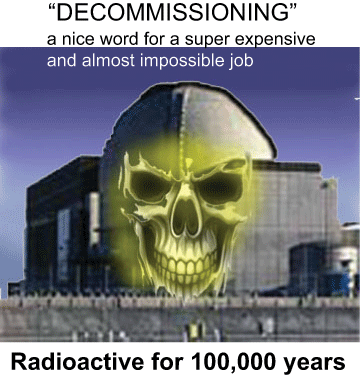 Brinkwire 4th Jan 2021, It has been warned that a “perpetual” lack of information about the condition of the nuclear facilities in Britain means that decommissioning for 120 years would not be complete and cost billions of pounds.
The decommissioning of UK civil nuclear power plants, including the Torness power plant in East Lothian and the Hunterston B power plant in Ayrshire, would cost the taxpayer about £ 132 billion, according to a new estimate, and will not be finished for 120 years.
The Public Accounts Committee blames the U.K. in its sober analysis. Government for a “sorry saga” of massively ineffective contracts, “weak” government monitoring and a “persistent” lack of awareness of the condition of nuclear installations. The Nuclear Decommissioning Authority (NDA) has left decades of inadequate information on the status and location of dangerous and
radioactive materials with a history of a lack of awareness about the condition of the sites it is responsible for safeguarding, the study warned. The NDA recognizes that it still does not have a complete understanding of the condition of the 17 sites in its custody, including the 10 former Magnox power plants, the report from the committee said.
According to the latest NDA figures, the decommissioning of UK civilian nuclear power plants would cost an incredible £ 132 billion for current and future generations of British taxpayers, and the work will not be finished for 120 years, with a huge effect on the lives of people living
near the plants, the study said.
Should £25 billion Hinkley C plant go ahead, with so many safety issues not solved?
David Lowry’s Blog 4th Jan 2021On Christmas Eve last year I received a detailed response to a Freedom of Information request I had made to the UK Office for Nuclear Regulation
[ONR] (I am a member of the chief nuclear inspector’s independent advisory
panel) on the 415 unresolved nuclear safety issues outstanding for the
nuclear licence for the Hinkley Point C nuclear power plant the north
Somerset coast, 18 miles from the Welsh capital city, Cardiff, across the
Bristol channel. It contains an alarming number of extremely important
unresolved matters.
Should this £25 billion plant really have been given
the regulatory green light with so many safety issues unfinished? It is
nonetheless reassuring that the ONR has been so thorough in flagging up key
matters that need safety resolution.
http://drdavidlowry.blogspot.com/2021/01/hinkley-point-c-new-nuclear-plant-still.html
Massive nuclear waste storage construction at Dounreay
Press & Journal 4th Jan 2021, Work on Dounreay’s newest radioactive waste store has reached new heights
following a marathon efforts by staff. The construction project was one of
the first to re-start work in June, following the easing of lockdown
restrictions. The 60-strong team has had to learn Covid-19 compliant ways
of working, sometimes in close proximity with each other, to keep
themselves and their colleagues safe on site.
Since then they have poured
1,500 tonnes of concrete and the building walls have now risen to above the
first floor level. Last week the team embarked on the biggest concrete pour
of the project so far, working for nine hours to lay the floor slab in the
crane maintenance bay (CMB) on the first floor of the building, with 27
lorries delivering 425 tonnes of concrete. An overnight shift completed the
job in the early hours of the morning.
The new intermediate level waste
store will hold drums of waste in safe long term storage at Dounreay in
accordance with Scottish Government policy. The £22 million contract,
awarded to Graham Construction Ltd, started in 2018 and is expected to take
around three years to complete. Dounreay project manager Dave Busby said
that casting the CMB floor slab was a significant construction milestone as
it will allow the team to install the 170 tonne CMB shield door early next
year.
Legal case on extradition of Julian Assange an alarming precedent for freedom of speech

|
Assange hearing outcome could set an “alarming precedent” for free speech https://www.indexoncensorship.org/2020/12/assange-hearing-outcome-could-set-an-alarming-precedent-for-free-speech/Benjamin Lynch, 2 Jan 2021, People need to “forget what they think they know” about WikiLeaks founder Julian Assange and recognise that if he is extradited to the USA, it would set a worrying precedent for media freedom. We speak to his partner about the case. Assange’s partner, Stella Moris, is remaining resolute despite his extradition hearing decision being less than a month away and him being held in a prison that has recently had a Covid-19 outbreak.
Speaking over the phone to Index, Moris discusses the hearing’s details and what it could mean for the future of freedom of expression. And she talks about the deep implications it has had for her and her young family. “Obviously it is very difficult. I speak to Julian on a daily basis unless there is a problem. [But] he is in prison. Soon to be for two years. He has been there for longer than many violent prisoners who are serving sentences. All in all, he has been deprived of his liberty for ten years now,” she told Index. She adds: “The kids speak to their father every day; we try to normalise it as much as we can for them. But of course, this is not a normal situation and our lives are on hold. It is inhumane and shouldn’t be happening in the UK.” The current hearing – which will decide whether there are grounds for Assange to stand trial in the USA – should reach a conclusion on 4 January. A trial in the USA (should the decision go against Assange) will have major ramifications for free speech and whistleblower journalism. The WikiLeaks founder is charged with conspiring with US intelligence analyst Chelsea Manning and hackers from groups such as Anonymous and LulzSec to obtain and publish classified information. Each of the 18 charges laid by US authorities, if Assange is extradited and convicted, carry a maximum penalty of 10 years. The allegations brought forward under the 1917 Espionage Act, alongside one other under the Computer Fraud and Abuse Act, mean Assange could face up to 175 years in prison – effectively a life sentence. Manning was initially sentenced to 35 years, but under the Obama administration her sentence was commuted to less than seven years. It is easy to get sidetracked about the current extradition hearing and get into arguments about whether Assange is a journalist, whether he is guilty of other crimes or whether the publication of the documents brought harm to anyone involved. Instead people’s attentions should focus on the precedent that will be set should the case go to trial in the USA. As it stands the case is unprecedented. No publisher has ever been tried under the Espionage Act, which itself was essentially created for spies imparting official secrets either for profit or otherwise. This is perhaps a direct contradiction of rulings of the courts in the UK. In December 2017, the UK’s information tribunal recognised WikiLeaks as a media organisation, in direct contradiction to the view of the US State Department. Australia’s media union, the Media, Arts and Entertainment Alliance, also presented an honorary member card to Assange’s Melbourne-based lawyer. Amidst the noise of the separate matters around the case, Moris insists people need to “forget what they think they know” and assess the issues involved. “There are a lot of assumptions being made over what this case is really about. There are all these sideshows. It is not about people being harmed because the US has admitted it has no evidence to make this argument. It comes down to the fact that the material published was classified. People who care about free speech and press freedom need to forget what they think they know about this case and look at it afresh and understand Julian is in prison for publishing. This is not something that democracies do.” “Are they saying what he published was not in the public interest? They say that is irrelevant. They can’t deny [what he published] wasn’t in the public interest because he was publishing information and evidence of state crimes, of state abuse, torture, of rendition, blacksites and of illegal killings. What they are arguing is that Julian published information that was secret and therefore he can be prosecuted over it.” ournalists publishing secret information is not new (nor is pressure for them not to publish) and can often be key to upholding democracy and ensuring states act properly. The Watergate revelations relied heavily on news organisations pressing on with publication despite attempts by the USA to stop them, including the threat of jail time. It proved a significant victory for free speech. If Assange is extradited and tried the case will impact journalists and the media “for years to come”, says Rebecca Vincent, director of international campaigns at Reporters Without Borders (RSF). “It feels like many in the media do not see the implications of this case as something that will possibly affect them,” she told Index. “This case will have ramifications on the climates for journalism and press freedom internationally for years to come.” “This is the first time we have seen the US government prosecute anybody for publishing leaked information. If they are successful, they will not stop with Assange and WikiLeaks. This could be applied, in theory, to any media outlet.” It’s common for journalists and publishers to cite a public interest defence for disputed documents. It is a centrepiece of a defence case against libel, for instance. “The information published was certainly in the public interest; it served to inform extensive public interest reporting that exposed war crimes and other illegal actions by states,” said Vincent. “The Espionage Act lacks a public interest defence. He cannot use it if he is sent to the United States and tried.” Essentially, what this means is that Assange is being treated as a spy not a publisher. If Assange is extradited and loses his case against the US government, any time classified information is published by a journalist there will be a precedent set that they can be charged and tried as a spy in the same way. “These sorts of cases are really highlighting the need for more robust legislation that cannot be manipulated to be used against journalists, whistleblowers and other sources. Ultimately, it is the public’s right to access information that is being impacted,” Vincent added. “You can see this for what it is; this very much feels like a political prosecution by states that are not meant to engage in this behaviour. The reason our states can get away with this is because of a lack of public pressure. A lack of public sympathy has resulted in a lack of widespread public pressure to hold our governments to account.” |
|
Bechtel, Westinghouse and Southern Company’s hopeless case to save shambolic Wylfa nuclear project

 People Against Wylfa B 31st Dec 2020, On the last day of troubled 2020, the Westminster Government has deferred a decision on a Development Consent Order for a nuclear power station at Wylfa until the end of April 2021. This is the fourth time this has happened, and the second time in a row for Duncan Hawthorne, chief executive Horizon, to ask for a deferral.
‘saviours’ of the radioactive poisoning project that would threaten the health of everyone on the island and beyond are three US companies.
was the V C Summer nuclear plant in South Carolina. It was abandoned
unfinished in 2017, and is still being paid for by taxpayers. https://www.stop-wylfa.org/news/
With all the costs and delays – why not scrap the Wylfa nuclear project right now?
|
Wylfa, more problems, more delay. Scrap it now https://www.stop-wylfa.org/2020/04/01/wylfa-more-problems-more-delay-scrap-it-now/ By Stop Wylfa 2 Jan 21, The London government has pushed back any decision on the Wylfa B power plant planning application until the end of September 2020.
The Secretary of State for Business, Energy and Industry says he has not been satisfied by answers given by Horizon Nuclear on environmental issues and other considerations. PAWB proposes that Horizon Nuclear’s planning application should be totally rejected. The national policy statement for nuclear power adopted several years ago is completely outdated and rather than approving this obviously defective application, the Westminster government should start from scratch with a thorough review of their energy policy and to recognise that reneweable technologies like wind, solar and marine have totally undermined any reason for investing billions of pounds in nuclear power. The COVID 19 crisis has already forced big changes in the Government’ s way of operating. They should now take the opportunity to take a fundamental review on investing in renewable technologies which offer clean and safe electricity. A green revolution can create thousands of jobs in Wales and the other countries of Britain without the threat of nuclear disasters and poisonous radioactive waste and their effects on human and environmental health for thousands of years. |
|
Glenn Greenwald: Julian Assange’s Imprisonment Exposes U.S. Myths About Freedom
|
Glenn Greenwald: Julian Assange’s Imprisonment Exposes U.S. Myths About Freedom The real measure of how free is a society is not how its mainstream, well-behaved ruling class servants are treated, but the fate of its actual dissidents. By Glenn Greenwald January 2, 2021
Persecution is not typically doled out to those who recite mainstream pieties, or refrain from posing meaningful threats to those who wield institutional power, or obediently stay within the lines of permissible speech and activism imposed by the ruling class. Those who render themselves acquiescent and harmless that way will — in every society, including the most repressive — usually be free of reprisals. …….. Those who do not seek to meaningfully dissent or subvert power will usually deny — because they do not perceive — that such dissent and subversion are, in fact, rigorously prohibited. They will continue to believe blissfully that the society in which they live guarantees core civic freedoms — of speech, of press, of assembly, of due process — because they have rendered their own speech and activism, if it exists at all, so innocuous that nobody with the capacity to do so would bother to try to curtail it………..
powerful officials in Washington can illegally leak the most sensitive government secrets and will suffer no punishment, or will get the lightest tap on the wrist, provided their aim is to advance mainstream narratives. ……..
those like Julian Assange who publish similar secrets but against the will of those elites, with the goal and outcome of exposing (rather than obscuring) ruling class lies and impeding (rather than advancing) their agenda, will suffer ………..
the ongoing imprisonment of Julian Assange not only a grotesque injustice but also a vital, crystal-clear prism for seeing the fundamental fraud of U.S. narratives about who is free and who is not, about where tyranny reigns and where it does not.
Assange has been imprisoned for almost two years. He was dragged out of the Ecuadorian Embassy in London by British police on April 11, 2019. That was possible only because the U.S., U.K. and Spanish governments coerced Ecuador’s meek President, Lenin Moreno, to withdraw the asylum extended to Assange seven years earlier by his staunch sovereignty-defending predecessor, Rafael Correa. The U.S. and British governments hate Assange because of his revelations that exposed their lies and crimes, ………
Assange is not currently imprisoned because he was convicted of a crime. Two weeks after he was dragged out of the embassy, he was found guilty of the minor offense of “skipping bail” and sentenced to 50 weeks in prison, the maximum penalty allowed by law. He fully served that sentence as of April of this year, and was thus scheduled to be released, facing no more charges. But just weeks before his release date, the U.S. Justice Department unveiled an indictment of Assange arising out of WikiLeaks’ 2010 publication of U.S. State Department diplomatic cables and war logs that revealed massive corruption by numerous governments, Bush and Obama officials, and various corporations around the world. That U.S. indictment and the accompanying request to extradite Assange to the U.S. to stand trial provided, by design, the pretext for the British government to imprison Assange indefinitely.
A judge quickly ruled that Assange could not be released on bail pending his extradition hearing, but instead must stay behind bars while the U.K. courts fully adjudicate the Justice Department’s extradition request. No matter what happens, it will takes years for this extradition process to conclude because whichever side (the DOJ or Assange) loses at each stage (and Assange is highly likely to lose the first round when the lower-court decision on the extradition request is issued next week), they will appeal, and Assange will linger in prison while these appeals wind their way very slowly through the U.K. judicial system. …..
Assange will be locked up for years without any need to prove he is guilty of any crime. He will have been just disappeared: silenced by the very governments whose corruption and crimes he denounced and exposed. Those are the same governments — the U.S. and U.K. — that sanctimoniously condemn their adversaries (but rarely their repressive allies) for violating free speech, free press and due process rights. These are the same governments that succeed — largely due to a limitlessly compliant corporate media that either believes the propaganda or knowingly disseminates it for their own rewards — in convincing large numbers of their citizens that, unlike in the Bad Countries such as Russia and Iran, these civic freedoms are guaranteed and protected in the Good Western Countries.
. (The ample evidence showing that the indictment of Assange is the single gravest threat to press freedoms in years, and that the arguments mounted to justify it are fraudulent, has been repeatedly documented by myself and others, so I will not rehash those discussions here………. https://wordpress.com/read/feeds/34005311/posts/3108045730
|
|
|
1 This Month




PLEASE OPPOSE HR 8255 AND S.3639 – bills would accelerate satellite deployment, with no environmental review or safeguards – https://ncstd5li.quorum.us/campaign/169331/
To see nuclear-related stories in greater depth and intensity – go to https://nuclearinformation.wordpress.com
-
Archives
- September 2026 (330)
- August 2026 (330)
- July 2026 (355)
- June 2026 (287)
- May 2026 (306)
- April 2026 (356)
- March 2026 (251)
- February 2026 (267)
- January 2026 (308)
- December 2025 (358)
- November 2025 (359)
- October 2025 (375)
-
Categories
- 1
- 1 NUCLEAR ISSUES
- business and costs
- climate change
- culture and arts
- ENERGY
- environment
- health
- history
- indigenous issues
- Legal
- marketing of nuclear
- media
- opposition to nuclear
- PERSONAL STORIES
- politics
- politics international
- Religion and ethics
- safety
- secrets,lies and civil liberties
- spinbuster
- technology
- Uranium
- wastes
- weapons and war
- Women
- 2 WORLD
- ACTION
- AFRICA
- Atrocities
- AUSTRALIA
- Christina's notes
- Christina's themes
- culture and arts
- Events
- Fuk 2022
- Fuk 2023
- Fukushima 2017
- Fukushima 2018
- fukushima 2019
- Fukushima 2020
- Fukushima 2021
- general
- global warming
- Humour (God we need it)
- Nuclear
- RARE EARTHS
- Reference
- resources – print
- Resources -audiovicual
- Weekly Newsletter
- World
- World Nuclear
- YouTube
-
RSS
Entries RSS
Comments RSS

