New delay in planning decision for £16bn Wylfa nuclear development on Anglesey
months for talks with potential new investors to continue. Japanese
multi-national Hitachi announced in September they were pulling out of
funding the £16bn nuclear development on Anglesey. At that point BEIS
Secretary of State Alok Sharma delayed the Development Consent Order (DCO)
decision for the application to December 31. Now following a letter from
Duncan Hawthorne, chief executive of Wylfa developer Horizon Nuclear Power,
that date has been extended to April 30.
Cover-up! how consumers will be forced to pay for cost-overruns for Sizewell C nuclear construction
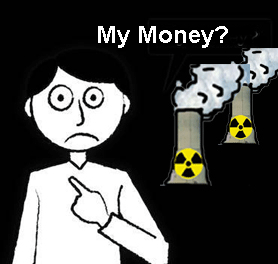 Cover-up! how consumers will be forced to pay for cost-overruns for Sizewell C construction, https://100percentrenewableuk.org/cover-up-how-consumers-will-be-forced-to-pay-for-cost-overruns-for-sizewell-c-construction–by David Toke, 30 Dec 20, In a historic change of policy the Conservatives have announced that consumers, not EDF, will pay for cost overruns in building Sizewell C. The crucial phrase in the Government’s document on the so-called ‘Regulated Asset Base’ (RAB) model is ‘Cost overruns that were not excluded from the RAB would be shared between investors and consumers through suppliers’ (para 47 page 14). Note: ‘consumers’ means electricity consumers who will have to pay twice for Sizewell C; extra on their bills long before any power is generated and for many years after generation begins. Cover-up! how consumers will be forced to pay for cost-overruns for Sizewell C construction, https://100percentrenewableuk.org/cover-up-how-consumers-will-be-forced-to-pay-for-cost-overruns-for-sizewell-c-construction–by David Toke, 30 Dec 20, In a historic change of policy the Conservatives have announced that consumers, not EDF, will pay for cost overruns in building Sizewell C. The crucial phrase in the Government’s document on the so-called ‘Regulated Asset Base’ (RAB) model is ‘Cost overruns that were not excluded from the RAB would be shared between investors and consumers through suppliers’ (para 47 page 14). Note: ‘consumers’ means electricity consumers who will have to pay twice for Sizewell C; extra on their bills long before any power is generated and for many years after generation begins.The RAB document was produced alongside the Government’s new Energy White Paper. This should be compared to the Government position in the 2011 White Paper which stated that ‘new nuclear stations should receive no public support unless similar support is available to other low-carbon technologies’. (page 8) Under the Government’s RAB proposals it is claimed that clear criteria are going to be set for what cost overruns will be payable by the consumer and what by the developer, with the outcomes carefully monitored by a ‘Regulator’. But of course once the construction juggernaut for Sizewell C starts rolling where information, not to mention armies of lawyers and hired consultants of various sorts, will be controlled by EDF, I do not seriously believe that EDF will be stopped from passing on virtually whatever costs it wants to pass on to the consumer. It is not even certain that the ‘Regulator’ will be able to stop costs of building (the still uncompleted) Hinkley C being passed onto the consumer through the books assigned to Sizewell C- that is given that workers are likely to be switched from one operation to the other. In other words, it is a blank cheque for EDF for a power plant that is not only unnecessary but which will actually cause large quantities of renewable energy to be wasted because of nuclear power’s inflexible operation (see our report on this). In effect not just consumers but renewable energy operators will be paying for the cost-overruns of building Sizewell C. Laughingly, in a world where no (at least western) nuclear power plant has been attempted this century without massive construction cost overruns being generated, the RAB document talks about ‘low probability risks such as cost overruns above a certain threshold’ (page 12). In the case of Hinkley C the cost overruns are mounting already. The most charitable explanation for the RAB document is that Treasury officials are allowing themselves to be engaged in an exercise of self-deception in order to launder a policy that if stated plainly would be deemed politically unacceptable. Reading between the lines of the RAB document and the Energy White Paper itself, the only substantial barrier stopping EDF being handed a blank cheque contract is the payment that EDF would receive for electricity generated. The White Paper says ‘We expect the sector to deliver the goal it set for itself in our Nuclear Sector Deal, published in 2018, to reduce the cost of nuclear new build projects by 30 per cent by 2030’ (page 49). So in other words the Treasury wants EDF to accept less than £65 per MWh in 2012 prices. (2012 prices, the year in which Hinkley C’s contract was priced is the funny money basis for electricity contracts these days!). Obviously EDF wants more, but with the RAB mechanism it may not need more. This is because RAB mechanism is a piece of political jelly that will allow any nuclear developer to offer to complete Sizewell C for a low sum when in reality British electricity consumers will pay for what will be called ‘cost overruns’ over and above such a figure. The RAB mechanism is a flexible political device that allows Sizewell C to be built regardless of cost realities. It is an act of public manipulation and mystification worthy of the best traditions of ‘Yes Minister’. But even so these plans are likely to cause mounting opposition when consumers realise they are likely to have to start paying extra on their bills without getting any electricity in return. Then they will have to pay extra again for the power when (evenutally) it does start being generated. Professor Tom Burke, the founding Director of E3G commented: ‘Constructing Sizewell will cost just over £20 billion. If EDF borrow this money it will double the cost to over £40 billion. EDF is negotiating with the government to make consumers pay the construction cost in advance by a levy on everyone’s energy bills. They will then have to pay again for the electricity which will still be more expensive than that from renewables.’ In effect consumers will have to pay twice for the project – first for several years before the plant has generated anything, and then again for up 40 years afterwards.
|
|
|
Brexit: UK and Euratom have signed a Nuclear Cooperation Agreement (NCA)
World Nuclear News 29th Dec 2020, The UK and the European Atomic Energy Community (Euratom) have signed a
Nuclear Cooperation Agreement (NCA). This is separate from the wider UK-EU Trade and Cooperation Agreement that was also announced on 24 December and which has since been approved by ambassadors from the 27 EU Member States, paving the way for it to take effect on 1 January. UK lawmakers will tomorrow return to the House of Commons, the lower chamber of parliament,
to vote on the so-called post-Brexit trade deal.
https://www.world-nuclear-news.org/Articles/UK-and-Euratom-sign-Nuclear-Cooperation-Agreement
Scotland wants no part in the Tories’ latest nuclear energy folly
|
Douglas Chapman: Scotland wants no part in the Tories’ latest nuclear energy folly https://leftfootforward.org/2020/12/douglas-chapman-scotland-wants-no-part-in-the-tories-latest-nuclear-energy-folly/ Douglas Chapman MP, 30 Dec 20,
As Scotland moves away from nuclear power, the UK Government is trying to impose this costly distraction, writes Douglas Chapman MP. The UK Government’s publication of their new Energy White Paper shows that they are still very much out of sync with Scotland.With nuclear power at the centre of Johnson’s great green revolution, Scotland and Westminster are once more at loggerheads. The UK Government argues that we must examine all renewable and low to zero carbon options as we turn from fossil fuels and face the climate crisis head on. But the White Paper reveals that the UK government are in discussions with French energy giant, EDF, to build a £20bn nuclear power plant at Sizewell in Suffolk. In addition, they plan to develop Small Modular Reactors (SMRs) or pop-up nuclear power plants built in factories rather than involving heavy construction, as well as research and development into more advanced nuclear technologies. This is a problem for Scotland given that energy is a reserved power and we have very different plans for our renewable development. The Scottish Government rejects the case for nuclear power to be included in the push to net zero, arguing that our future clean energy ambitions can be met by far safer, more affordable and more environmentally sound means. Scotland is in the fortunate position of having an abundance of natural resources with 25% of Europe’s tidal and wind resource for instance. We are aware of our responsibility to the natural environment as well as our citizens and our updated Climate Plan reflects these values of fairness, wellbeing and a just transition to a greener future. White elephant Right now, nuclear power is still included in our current energy mix and is sourced from two stations at Torness and Hunterston. The Scottish Government is moving towards decreasing this output and increasing solar, offshore and onshore wind sources, with our wind turbines having already produced nearly twice of our entire nations domestic power with some left over for export back in 2019. When wind and solar are by far the cheaper option as compared to nuclear, at £39.65/MWh to Hinkley’s £92.50, it’s a no brainer on cost. Overall, the nuclear industry is a slow and expensive business. Given we are facing a climate emergency of terrifying proportions, turning to nuclear energy and the development of new technologies like SMR’s will not be a quick fix. The vast sums pledged by Johnson to support EDF at Sizewell are even more controversial given that the government is examining a “regulated asset base” approach to funding, or in other words putting the financial risk on to the UK consumer. No to nuclear Results from the recent UK wide Citizens Assembly on Climate Change indicate that it’s not just the Scots who are concerned with nuclear power. Nearly half – 46% – of assembly members strongly disagreed that nuclear should be part of the renewable energy plan citing concerns with cost, safety, long-term waste management, and damage to the local environment. For Scotland, it’s more personal than that. We already carry the weight of responsibility as home to the UK’s domestic nuclear power base; a key tenant of SNP policy is ridding Scotland of the burden of Trident when we become independent, a hugely popular pledge with the Scottish electorate. And then there’s the not insignificant matter of toxic waste and the decommissioning debacle of existing nuclear reactors such as Dounreay in Thurso, which, according to the Nuclear Decommissioning Authority, will take another 313 years before its regarded as a “safe site”. In addition, in 2018, the nuclear reactors at Hunterston were shut down due to concerns over cracks in the graphite core. People living close by had every right to be worried. Big plans Now Johnson’s government is forcing through the Internal Market Bill and the blatant devolution power grab, Scotland will have even less say in how we manage our renewable resources, as devolved powers such as grant of consent and planning permission could be deliberately reserved in the name of Brexit. We may be a small nation, but we have big plans in fulfilling our obligation to the planet and our responsibility in this global climate challenge. New nuclear power stations are not and never will be part of these plans. The UK Government will have a fight on their hands if they try to derail our ambition. Douglas Chapman is the Scottish National Party MP for Dunfermline and West Fife. |
|
In so many ways, Sizewell C nuclear plan is a bad deal for Britain, and especially for climate action
 Why Sizewell C is a bad deal for the UK public and our net zero goals
https://bhesco.co.uk/blog/stop-sizewell-c-nuclear-power by Dan Curtis on 21/12/2020 It has been a tumultuous few weeks for the UK’s energy policy, with the Prime Minister’s Ten Point Plan for achieving Net Zero by 2050 followed swiftly by the Government’s long overdue Energy White Paper.
Then, the news broke that the UK Government has begun discussions with French utility EDF for the development of a new nuclear reactor at Sizewell, “C” in Suffolk, basically scrapping their 10 year policy that “there will be no levy, direct payment or market support for electricity supplied or capacity provided by a private sector new nuclear operator, unless similar support is also made available more widely to other types of generation”.
The site at Sizewell contains two existing nuclear power facilities, Sizewell A (decommissioning and site restoration until 2098 at taxpayers’ cost) and Sizewell B (still active). The new proposals are to build an extension to the site, implementing the same reactor design as that Hinkley Point “C” in Somerset.
Defenders of the project invariably claim that expanding the UK’s nuclear fleet will contribute to the decarbonisation of the energy supply, ensure energy security, while providing consumers with long-term affordable electricity – all arguments which fail to stand up to scrutiny, as we shall demonstrate.
Nuclear power does not provide good value for money
It takes a phenomenal amount of money to develop new nuclear power stations, before we even begin to consider the additional cost of storing and managing the radioactive waste material.
Hinkley C was originally estimated to cost £18 billion but the project has been mired in delays and is now vastly over-budget, predicted to cost up to £3 billion more than initially forecast – a quite remarkable overspend.
To address this vulnerability to financial losses for the project developers EDF and Chinese firm CGN, who are considering withdrawing their investment, the UK Government are considering investing directly in Sizewell C, shifting risk and cost to the British taxpayer.
This is in addition to a suggestion of implementing a “regulated asset base” financing model which would enable EDF to charge energy customers for the cost of construction as well as the cost of electricity generation (thereby exposing both customers and taxpayers to the risk of project cost overruns).
Adding to the financial nonsense of new nuclear power is the sky-high cost of the electricity that is produced to the end user. The government has granted a guaranteed, inflation linked price of £92.50 per megawatt hour for the electricity to be produced by Hinkley Point C.
Compare this to the cost of offshore wind, which under a 2019 contract for difference auction, saw prices come in at £39.65 per megawatt hour – less than half the cost of energy from Hinkley.
In contrast to the ever-increasing costs of nuclear (Sizewell C has an estimated starting price tag of £20 billion, which will no doubt balloon), the cost of solar and wind power continue to fall year on year, with solar costs having declined by an astonishing 87% since 2010.
A primary motivation for nuclear power is its value for military applications
The astronomical construction and decommissioning costs of nuclear power does not make financial sense when looking at it from a UK taxpayer/ consumer viewpoint. It is only when considering the wider potential applications of a nuclear programme that we can begin to understand why successive UK governments have been so supportive of the industry.
Researchers at the University of Sussex found compelling evidence that the UK’s domestic nuclear power programme is only supported by the Government because of its value in contributing towards the military nuclear weapons programme, which would otherwise be financially unviable without such subsidised support from domestic energy customers.
Prof Andrew Stirling of the university’s Science Policy Research Unit (SPRU) said:
”The exclusion of these issues from the consultation remit reflects a serious military-driven bias in UK Government attachments to nuclear power. This is not only making carbon emissions reductions slower and more expensive, but also impeding possibilities for the UK post-COVID economic recovery”.
We believe that the arguments in favour of nuclear power are disingenuous. Backers of nuclear power should be honest that they want to build more nuclear plants not because they will provide energy security or a good deal for customers, but because they are necessary for maintaining the UK’s fleet of nuclear submarines, and all of the sabre rattling ‘seat at the table’ geo-political bravado that goes along with retaining our position as a nuclear power.
New nuclear power takes too long to build to have any meaningful role in tackling the urgent climate crisis
Wherever new nuclear power stations are being built we see long delays and broken promises.
Hinkley Point C has suffered setbacks and complications ever since development began in 2017 and it is not expected to come online until 2025. It’s the same story at other locations where this type of reactor is being built, such as in Flamanville in France which is seven years overdue and the Olkiluoto plant in Finland which is ten years late! There is only one EPR nuclear reactor operational in the world. This is the Taishun plant in China, built on the same sea where Fukishima exploded in 2011.
Clearly, new nuclear power plants will not address the issue of urgent and radical carbon emissions reductions needed to be achieved by 2030 if we are to avoid irreversible climate breakdown.
It is also worth noting the gigantic carbon footprint that would result from the construction of Sizewell C. When considering the pros and cons of nuclear power, it is vital to honestly account for the enormous quantities of cement (which has a huge carbon footprint) and other hazardous materials required to build the facility in the first place.
Adding insult to the assertion that Sizewell C will be a long-term benefit to the environment is the fact that the site is to be located adjacent to an RSPB nature reserve Minsmere, a AONB site that EDF has already started demolishing.
Nuclear power produces nuclear waste which lasts for thousands of years
The by-product of nuclear fission is hazardous nuclear waste which remains radioactive for thousands of years. This presents an extraordinary liability and storage risk to future UK taxpayers and residents.
The current liability cost of decommissioning and safely storing our existing nuclear waste is estimated to be in the region of £232 billion – a truly eye-watering sum, and one that will only continue to increase as more nuclear reactors such as Hinkley and Sizewell contribute additional toxic waste materials for every year that they are operational.
The UK already has the largest stockpile of radioactive plutonium in the world, estimated to be between 112 and 140 tons, stored in an area of outstanding natural beauty in Cumbria. Future generations will not think kindly of us if we continue to add to this dangerous legacy with more hazardous nuclear waste that costs billions each year to manage to avert disaster.
The UK does not need Sizewell C or any other nuclear power stations – we can meet our energy needs with 100% clean renewable energy
We already have the means at our disposal to meet our heat and power needs through a combination of renewable energy and energy storage technologies.
Combine this with a comprehensive programme to reduce demand through energy efficiency improvements and we can conclude with confidence that there is no reason to develop new nuclear power stations in the UK. In fact, the alternatives will deliver lower energy prices for the consumer and better taxpayer value over the long term.
A common defence for nuclear power is the need for a steady supply of ‘base load’ power in the event that intermittant renewables cannot meet demand.
But this way of thinking is obsolete. Our future energy supply in the UK will be based on dynamism and flexibility, where consumers adapt their behaviour in sync with variable generation output. As Steve Holliday, former CEO of National Grid said in 2015:
“The idea of baseload power is already outdated. I think you should look at this the other way around. From a consumer’s point of view, baseload is what I am producing myself. The solar on my rooftop, my heat pump – that’s the baseload.”
The Government’s recent announcement that it is entering into talks with EDF regarding Sizewell C is, we are told, the beginning of a long consultation process which will consider the long-term costs and benefits of such a project before reaching a conclusion on whether to give it the go ahead.
These talks are by no means a ‘green-light’ to the project. We hope that it is not naïve to believe that due diligence will be done, that the information will be honest and transparent, and that logical, rational thinking for the benefit of all residents of our small island will prevail.
But this way of thinking is obsolete. Our future energy supply in the UK will be based on dynamism and flexibility, where consumers adapt their behaviour in sync with variable generation output. As Steve Holliday, former CEO of National Grid said in 2015:
“The idea of baseload power is already outdated. I think you should look at this the other way around. From a consumer’s point of view, baseload is what I am producing myself. The solar on my rooftop, my heat pump – that’s the baseload.”
The Government’s recent announcement that it is entering into talks with EDF regarding Sizewell C is, we are told, the beginning of a long consultation process which will consider the long-term costs and benefits of such a project before reaching a conclusion on whether to give it the go ahead.
These talks are by no means a ‘green-light’ to the project. We hope that it is not naïve to believe that due diligence will be done, that the information will be honest and transparent, and that logical, rational thinking for the benefit of all residents of our small island will prevail.’
Sources ……
Small Nuclear Reactors – the Big New Way – to get the public to fund the nuclear weapons industry
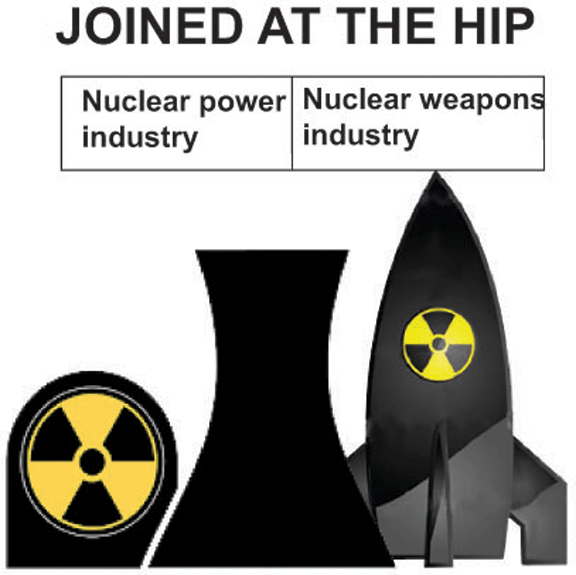
so-called “small nuclear reactors”
Downing Street told the Financial Times, which it faithfully reported, that it was “considering” £2 billion of taxpayers’ money to support “small nuclear reactors”
They are not small
The first thing to know about these beasts is that they are not small. 440MW? The plant at Wylfa (Anglesey, north Wales) was 460MW (it’s closed now). 440MW is bigger than all the Magnox type reactors except Wylfa and comparable to an Advanced Gas-cooled Reactor.
Only if military needs are driving this decision is it explicable.
”Clearly, the military need to maintain both reactor construction and operation skills and access to fissile materials will remain. I can well see the temptation for Defence Ministers to try to transfer this cost to civilian budgets,”
Any nation’s defence budget in this day and age cannot afford a new generation of nuclear weapons. So it needs to pass the costs onto the energy sector.
 How the UK’s secret defence policy is driving energy policy – with the public kept in the dark. https://www.thefifthestate.com.au/energy-lead/how-the-uks-secret-defence-policy-is-driving-energy-policy-with-the-public-kept-in-the-dark/ BY DAVID THORPE / 13 OCTOBER 2020
The UK government has for 15 years persistently backed the need for new nuclear power. Given its many problems, most informed observers can’t understand why. The answer lies in its commitment to being a nuclear military force. Continue reading
UK’s quest for nuclear fusion.
|
he science of nuclear fusion was proven in the early 1930s, after fusion of hydrogen isotopes was achieved in a laboratory. And we see fusion in action every day. The stars, including our Sun, are giant self-sustaining fusion reactors. ……..
Unlike nuclear fission, which breaks heavy atoms apart, nuclear fusion compresses light atoms together. This means there is far less harmful waste created by fusion. Neutron bombardment causes a fusion plant to become slightly radioactive, however these radioactive products are short-lived. Fusion therefore offers the tantalising potential for near-limitless, climate-friendly energy production that doesn’t come with a shadow of radioactive waste. Test reactors, such as the Joint European Torus (Jet) at Culham in England, have proved fusion is possible, albeit for short periods of time. The challenge is turning these experimental reactors into an ongoing process that is commercially viable. For this, it would need to generate more power than is needed to keep the fusion reaction going.
For decades, we have been promised that commercial fusion power plants will exist within 30 years. As far back as 1955, the physicist Homi J Bhabha claimed we would have fusion power within two decades. This claim, and many others since, have repeatedly failed to be achieved. The promise is eternal, but fusion always seems that same distance away………. https://www.bbc.com/future/article/20201214-the-uks-quest-for-affordable-fusion-by-2040
|
|

Unacceptable secrecy by the nuclear industry in Sizewell documentation
|
Sizewell C documentation secrecy just a continuation of lack of transparency by the nuclear industry http://drdavidlowry.blogspot.com/2020/12/sizewell-c-documentation-secrecy-just.html Dr David Lowry, 22 Dec 20, Between 18 November and 18 December 2020, NNB Generation Company (SZC Co.) carried out a public consultation on the proposed changes (dated 23 October 2020) for an Order Granting Development Consent for The Sizewell C Project. The document launching this supplementary consultation noted: “In January 2021, SZC Co. will submit a formal application to change the Sizewell C DCO application, as well as some Additional Information (i.e. information that has been developed in response to continuing engagement with stakeholders and which adds to the detail available within the application (but does not change it)).”
One of the supplemental documents submitted by SZC co. was on “Main Development Site Flood Risk Assessment,” a not inconsequential matter, in the context of climate change –induced sea-level rise, and greater perturbations in extreme weather ( storms, rainfall increase etc) over the time period SZC would operate, if ever built. (https://infrastructure.planninginspectorate.gov.uk/wp-content/ipc/uploads/projects/EN010012/EN010012-001715-SZC_Bk5_5.2_Appx1_7_MDS_Flood_Risk_Assessment_Part_1_of_14.pdf) The new mini-consultation letter then added under the headline Information Redacted or Marked as Confidential, the following: “The Procedural Decision requested clarification on the reasons for redactions and confidential marking on a number of the application documents. A summary of reasons is provided in Table 2. SZC observes in these reasons for redaction that “comprehension of the report is not affected by this redaction.”
The Planning inspectorate was not convinced by this assertion, and responded in a rejoinder letter on 22 December stating it was dissatisfied with “the extent and nature of the commercially sensitive aspect of these documents” and pointedly asked “why this could not be redacted without rendering them incomprehensible?”
Here is the full section outlining the Planning Inspectorate’s disquiet with SZC Co’s secrecy. Request for further clarification and documents from the Applicant Confidential documents “The Applicant’s response letter dated 16 November 2020 [AS-006] to the ExA’s procedural decision [PD-005] sets out at Table 2 a summary of its reasons for redactions and confidential markings. For certain documents [APP-292 to APP-295], the Applicant states that: “As these reports are not required in order for the Examining Authority to examine the application, we therefore request that these reports are withdrawn from the application.”
However, the commercial sensitivity of the investigations and data set out in these Environmental Statement (ES) Appendices is not immediately apparent. Furthermore, they comprise part of the ES which was submitted as part of the application and considered as such when the decision [PD-001] to accept the application was made. The Applicant is therefore requested to provide a further explanation in relation to:
(i) The extent and nature of the commercially sensitive aspect of these documents and why this could not be redacted without rendering them incomprehensible;
(ii) The justification for them not being required in order for the ExA [Examining Authority] to satisfactorily examine the application and to properly assess the basis for the related conclusions and findings in the main parts of the ES.” It adds: The additional information that is sought in respect of these confidential documents will assist the ExA to assess the potential implications of that course of action and reach an informed decision on the question of their withdrawal.” (National Infrastructure Planning, Planning Inspectorate, Document Reference: EN010012, 22 December 2020; https://infrastructure.planninginspectorate.gov.uk/wp-content/ipc/uploads/projects/EN010012/EN010012-002699-Sizewell%20PD4%20-%20Rule%2017%20VE%20Q.pdf)
This is just the latest of a very, very long line of unacceptable secrecy incidents by nuclear power plant operators, and demonstrates that notwithstanding their protestations as to transparency, they remain in fact addicted to secrecy.
|
|
The real reason for “civil” Small Nuclear Reactors- to supply expertise and technology for the nuclear weapons industry
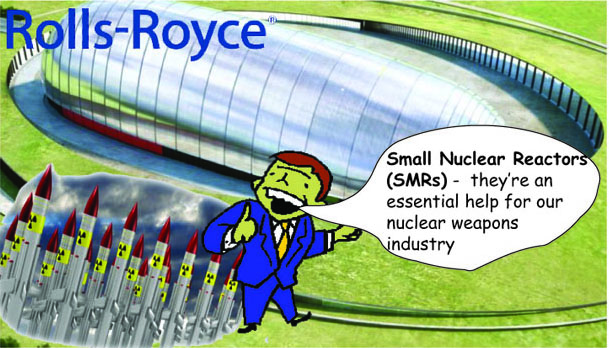
 How investment in SMRs supports “defense nuclear programs” https://concernedcitizens.net/2020/12/19/how-investment-in-smrs-supports-defense-nuclear-programs/comment-page-1/?unapproved=2198&moderation-hash=3219adce054494626a5ee71e323fef71#comment-2198 How investment in SMRs supports “defense nuclear programs” https://concernedcitizens.net/2020/12/19/how-investment-in-smrs-supports-defense-nuclear-programs/comment-page-1/?unapproved=2198&moderation-hash=3219adce054494626a5ee71e323fef71#comment-2198
1. Rolls-Royce, 2017, ‘UK SMR: A National Endeavour’, https://www.uknuclearsmr.org/wp-content/uploads/2017/09/V2088-Rolls-Royc… “The indigenous UK supply chain that supports defence nuclear programmes requires significant ongoing support to retain talent and develop and maintain capability between major programmes. Opportunities for the supply chain to invest in new capability are restricted by the limited size and scope of the defence nuclear programme. A UK SMR programme would increase the security, size and scope of opportunities for the UK supply chain significantly, enabling long-term sustainable investment in people, technology and capability. “Expanding the talent pool from which defence nuclear programmes can draw from would bring a double benefit. First, additional talent means more competition for senior technical and managerial positions, driving excellence and performance. Second, the expansion of a nuclear-capable skilled workforce through a civil nuclear UK SMR programme would relieve the Ministry of Defence of the burden of developing and retaining skills and capability. This would free up valuable resources for other investments.” |
|
EDF did a small survey of Suffolk community opinion -weighted to favour nuclear industry?
Suffolk towards the building of a new nuclear power station on the coast.
The survey was carried out by a company called ICM Unlimited on behalf of
EDF, which is looking to build the Sizewell C station. ICM interviewed a
representative sample of 500 adults in east Suffolk over the phone between
November 5 and November 19.
dismissed the research as “meaningless”, saying a sample of 500 people – in
an area with a population of 247,000 – was “hardly representative”. All
those that took part in the survey live in the area with data having been
weighted to the population profile of the East Suffolk Council adult
population.
https://www.eadt.co.uk/news/sizewell-c-survey-shows-favourable-results-6854678
Sizewell C nuclear plan – a disastrous and expensive mistake
heritage coast, but quite possibly the entire county, could be changed for
ever by the arrival of two new European pressurised reactors (EPRs).
‘Sizewell C, a proposed new nuclear power station in Suffolk, has the
potential to generate the reliable low carbon electricity the country needs
for decades to come’ is the claim made by EDF Energy, the French-owned
company behind the project. It also has the potential to be a disastrous
and expensive mistake. Many believe it already is.
https://www.spectator.co.uk/article/building-sizewell-c-would-be-a-nuclear-sized-disaster#
Ipswich Council raises fresh worries about Sizewell nuclear power plan
nuclear power station project on the Suffolk coast, citing train concerns
and impacts on housing as key worries.
consultation last month after tweaking plans for the £20billion scheme,
with Ipswich Borough Council’s planning committee on Wednesday agreeing its
response.
movements by rail on the East Suffolk Line should have regard to noise and
air quality disturbance; questions over the impact freight transport would
have on the Ipswich Garden Suburb development being built at the north of
the town; and fears that the extra freight by rail could reduce the number
of passenger trains on the East Suffolk Line – a key commuter route and
sustainable mode of transport. EDF agreed to transport more construction
materials by rail and sea in a bid to take hundreds of lorries off the road
during the construction, a move that would cut road haulage by 20%,
according to the developers.
https://www.eadt.co.uk/news/local-council/ipswich-borough-council-sizewell-c-consultation-response-6855812
Doubts about planned Berkshire ”garden town”, because it’s too close to AWE nuclear weapons factory
BBC 15th Dec 2020, Plans to build a new “garden town” could be scrapped over concerns about a
potential nuclear emergency. The proposed 15,000-home development in
Grazeley is within a couple of miles of nuclear weapons factory AWE
Burghfield. The Office for Nuclear Regulation has extended a “detailed
emergency planning zone” (DEPZ) for the plant, taking in most of the site
earmarked for homes.
That means anyone living in the zone could be affected
by a “reasonably foreseeable” radiation emergency. Three Berkshire councils
that have worked jointly on the plans are now considering shelving the
project, according to the Local Democracy Reporting Service (LDRS).
Why is UK govt taking the financial and flooding risk of Sizewell nuclear, when renewables are clearly safer and cheaper?
 Tax Research UK 16th Dec 2020, There is an article in the FT this morning that suggests something that
should be obvious, but needs saying. And that is that renewable energy is
now bringing deflation into the energy market.
Management. As he puts it: With the US poised to rejoin the Paris Agreement
under the incoming Biden administration and the proliferation of net-zero
commitments from various governments, the romance between equity markets
and renewable-energy goes from strength to strength.
overlooked: the underlying reason for the astonishing transformation of
renewables over the past decade from niche to mainstream competing
head-to-head with fossil fuels is economic rather than environmental.
fuels are intrinsically inflationary. This has huge implications for the
distribution of value across the global energy system over the next three
decades.
on the Suffolk coast where the chance that it will be flooded within the
foreseeable future is high? I wish I knew. We now have the option of viable
energy to sustain the transition we need. More investment in it only
increases its appeal. And yet still we stick with the harmful solutions. I
have never got this. I never will.
Law and Disorder: The case of Julian Assange
 In the case of Julian Assange, what is on trial is nothing less than our right to know what is done by governments in our name, and our capacity to hold power to account.

Law and Disorder: The case of Julian Assange, DiEM25, By Pam Stavropoulos | 10/12/2020,
What kind of law allows pursuit of charges under the 1917 United States Espionage Act — for which there is no public interest defence — against a journalist who is a foreign national?
The closing argument of the defence in the extradition hearing of WikiLeaks founder and publisher Julian Assange has been filed. For this and other reasons it is apposite to consider the authority invested in the law before which, in democratic societies, we are ostensibly all equal.
In fact, notwithstanding the familiar claims of objectivity (and as `everybody knows’ in Leonard Cohen’s famous lyric) the reality is somewhat different. Jokes about the law attest to this:
‘One law for the rich…’
‘Everyone has the right to their day in court — if they can pay for it’
‘What’s the difference between a good lawyer and a great one? A good lawyer knows the law. A great lawyer knows the judge’
The term ‘legal fiction’ calls into question the relationship between law, objectivity, and truth. On the one hand, law is the essential pillar of a functioning society. On the other, it is replete with anomalies both in conception and execution. To what extent can these perspectives be reconciled? High stakes are attached to this question.
Questioning claims of objectivity in the context of law.
1 This Month




PLEASE OPPOSE HR 8255 AND S.3639 – bills would accelerate satellite deployment, with no environmental review or safeguards – https://ncstd5li.quorum.us/campaign/169331/
To see nuclear-related stories in greater depth and intensity – go to https://nuclearinformation.wordpress.com
-
Archives
- September 2026 (330)
- August 2026 (330)
- July 2026 (355)
- June 2026 (287)
- May 2026 (306)
- April 2026 (356)
- March 2026 (251)
- February 2026 (267)
- January 2026 (308)
- December 2025 (358)
- November 2025 (359)
- October 2025 (375)
-
Categories
- 1
- 1 NUCLEAR ISSUES
- business and costs
- climate change
- culture and arts
- ENERGY
- environment
- health
- history
- indigenous issues
- Legal
- marketing of nuclear
- media
- opposition to nuclear
- PERSONAL STORIES
- politics
- politics international
- Religion and ethics
- safety
- secrets,lies and civil liberties
- spinbuster
- technology
- Uranium
- wastes
- weapons and war
- Women
- 2 WORLD
- ACTION
- AFRICA
- Atrocities
- AUSTRALIA
- Christina's notes
- Christina's themes
- culture and arts
- Events
- Fuk 2022
- Fuk 2023
- Fukushima 2017
- Fukushima 2018
- fukushima 2019
- Fukushima 2020
- Fukushima 2021
- general
- global warming
- Humour (God we need it)
- Nuclear
- RARE EARTHS
- Reference
- resources – print
- Resources -audiovicual
- Weekly Newsletter
- World
- World Nuclear
- YouTube
-
RSS
Entries RSS
Comments RSS

