Huge legacy of radioactive trash in UK, much of it already in Cumbria
Whitehaven News 30th January 2021, CHRIS WHITESIDE County councillor for Egremont North & St Bees (Conservative) Any consideration of the issue of nuclear waste in Cumbria
must start by recognising one basic fact. No matter how much some people
might wish it were otherwise, Britain already has thousands of tons of
low-level waste material, and a substantial amount of high-level nuclear
material, as a legacy of our existing and historical nuclear programmes.
And much of it is already in Cumbria.
Imagining that the tens of thousands
of cubic metres of nuclear material which is already here at sites like
Sellafield and the LLWR will somehow magically go away if you put up
posters demanding that there should be no nuclear waste in Cumbria or,
worse, try to sabotage any attempt to get a rational discussion going about
how we can most safely manage the nuclear waste which we already have by
vilifying anyone who takes part in a conversation about it, is not just
incredibly stupid but utterly irresponsible.
https://www.whitehavennews.co.uk/news/19051819.whitehaven-news-letters-nuclear-waste-years/
Why nuclear power is a bad way to balance renewable energy
Why nuclear power is a bad way to balance renewable energy https://100percentrenewableuk.org/why-nuclear-power-is-a-bad-way-to-balance-renewable-energy
David Toke, Ian Fairlie and Herbert Eppel from 100percentrenewableuk discuss how nuclear power effectively switches off wind and solar power and how a 100percent renewable energy system is much better for the UK than one involving nuclear power
The Government, backed by a lot of public policy reports paid for by pro-nuclear interests, constantly pushes out the view that nuclear power is ‘essential’ to balancing wind and solar power.
But what they never mention is the massive waste of renewables that occurs in such a scenario.
Under the scenarios planned by the Government nuclear power is paid very high prices to generate power even when there is excess electricity, which pushes renewables to close down.
The Government also refuses to undertake serious investigations of how a system that uses excess renewables to create short and long term storage is a much better way of organising our energy needs rather than wasting more money on building nuclear power statitons.
If you agree the aims of 100percentrenewableuk please join the discussion via our email group.
Half a £billion here, half a £billion there – the costs of Hinkley Point C go up again
 NFLA 28th Jan 2021, Half a billion here, half a billion there – the costs of Hinkley Point C
go up again, just as Hitachi finally gives up on Wylfa B.
The UK & Ireland .Nuclear Free Local Authorities (NFLA) note with little surprise the announcement from EDF Energy that the costs of building the Hinkley Point C has gone up again, now to an eye-watering £23 billion.
It also comes as the Japanese nuclear utility Hitachi formally withdraws its interest from the possible development of the Wylfa B site, criticising the UK Government’s lack of support in its decision.
https://www.nuclearpolicy.info/news/costs-hinkley-point-c-up-again-hitachi-finally-gives-up-wylfa-b/
EDF plans 2 new sites for dumping radioactive mud dredged from Hinkley Point
 NFLA 27th Jan 2021, The UK & Ireland Nuclear Free Local Authorities (NFLA), the ‘Stop
Hinkley’ campaign and the ‘Geiger Bay’ campaign have been involved in
raising concerns over the dumping of large amounts of dredged materials
from the EDF site at Hinkley Point into sites between the south Wales and
the Somerset coast.
building a new nuclear reactor at Hinkley Point, has announced that the
Portishead marine disposal site LU070 is now a possible dumping ground for
the seabed sediment it is seeking to dredge from Bridgwater Bay in order to
sink cooling water intake and outfall tunnels for the new reactors at
Hinkley Point.
Government permitted EDF to dump large quantities of Hinkley C dredged mud
at the Cardiff Deep Grounds inshore disposal site, only 2 miles off the
Cardiff Bay sea front.
suitable site available in the Bristol Channel. However, EDF has recently
announced its intention to apply to the Marine Management Organisation
(MMO) for a license to dump at Portishead, while also making a further
application to dump at the existing Welsh site. No reason has been given by
EDF for the Portishead proposal.
It is all over for Britain’s £20bn Wylfa nuclear project

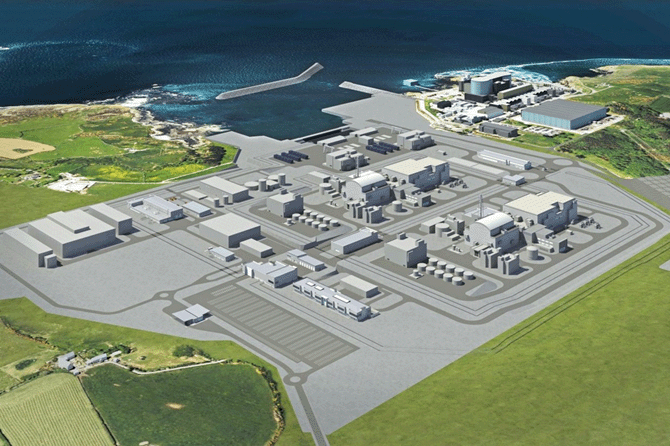 Wylfa: End for £20bn nuclear plant bid as plans ditched, It is all over for the £20bn project to build a new nuclear power plant on Anglesey, after developers dropped their planning bid.
Horizon Nuclear Power has pulled a request to approve reactor designs at Wylfa, blaming UK government funding options as one reason.
Japanese backers Hitachi pulled out of the development last September.
Another firm has since unveiled plans for a smaller hybrid nuclear and wind plant on a separate site at Wylfa.
The Development Consent Order (DCO) process, which is the name given to planning applications for major UK infrastructure projects such as Wylfa, has been under consideration since June 2018.
A decision was due to be made on the plan by the UK’s business and energy secretary at the end of April, following a series of requests by Horizon to extend the process while it held talks with other interested parties.
But Horizon has now written to the Planning Inspectorate and the Department for Business, Energy and Industrial Strategy, confirming the end of the troubled project.
Its letter said negotiations on the future of Wylfa had been “positive and encouraging”.
However, it added: “They have not, unfortunately, led to any definitive proposal that would have allowed the transfer to some new development entity.
“In light of this and in the absence of a new funding policy from HM Government, Hitachi Ltd., has taken the decision to wind-up Horizon as an active development entity by 31 March 2021.
“As a result, we must now, regretfully, withdraw the application.”…… https://www.bbc.com/news/uk-wales-55833186
Ho hum – another delay, another cost rise – for the beleaguered Hinkley nuclear power project
expected to rise again, the energy firm behind the plant revealed. EDF said
significant progress has been made on the site in Somerset but the start of
electricity generation is now expected in June 2026, compared with previous
estimates of an opening date at the end of 2025. The cost for the project
is now estimated at between £22 billion and £23 billion, compared with
projected costs of £21.5 billion and £22.5 billion announced in 2019. The
coronavirus crisis led to a number of changes on the Hinkley site,
including reducing the number of workers to enable social distancing, and
concentrating on the most critical areas of construction.
https://www.somersetlive.co.uk/news/uk-world-news/uks-new-nuclear-power-plant-4932726
Pandemic adds to delays and costs of Hinkley Point C nuclear project
|
Hinkley Point C nuclear power station cost rises by £500m, French group EDF warns pandemic delays will push back estimated start-up date to 2026 Ft.com, 27 Jan 21,
France’s EDF has again revised up the expected cost of Hinkley Point C, the nuclear power station under construction in south-west England, warning that delays arising from the pandemic will add about £500m and push back the station’s estimated start-up date to 2026.
The group, which is financing the construction of the plant along with its junior partner CGN of China, said it expected the project in Somerset to cost up to £23bn compared with a 2019 estimate of a maximum of £22.5bn. EDF quotes costs in 2015 prices in order to maintain consistency for the markets but the real bill is likely to be higher after accounting for inflation. …….https://www.ft.com/content/fbc43de5-d3ae-49fd-9f5f-9e84f1db508d
|
|
Bradwell: UK’s ill-conceived nuclear project, with cronyism and vested interests, will damage environment.
 Bradwell B Action Network 24th Jan 2021, Appeal to Prime Minster, Foreign and Energy Ministers, selected MP’s and Essex County Councillors to Reconsider Chinese State Plans for Essex Nuclear Power Plant by local community. Bradwell B Action Network (BAN), a front-line grass roots campaign organisation, sent a strong message to the Prime Minster and other representatives including the government energy and
foreign ministers and their opposites, pointing out a broad range of concerns and urging them to take immediate action to halt CGN’s plans for the Bradwell B nuclear plant.
State owned CGN are planning to build and operate. The site, at Bradwell on Sea, Essex is also within 30km range of large urban populations to the North, West and South. Despite UK security services raising concerns over the plans, consecutive Conservative governments have chosen to ignore the threats and allow CGN to pursue this ill-conceived project.
UK’s Centre for Policy Studies about to change its name to Centre for the Promotion of Nuclear Sizewell C?

|
Times 21st Jan 2021. Apparently the Centre for Policy Studies is “Britain’s leading centre-right think tank”. But who knew it was changing its name to the Centre for the Promotion of Sizewell C? Its latest missive comes with a press release headed: “Net zero target at risk without investment in new nuclear”.
And given the report’s general drift, you’d think all 58 pages had been penned by France’s EDF: the cost-overrun and late-delivery specialists behind the consumer-fleecing £22.5 billion Hinkley Point C.
Actually, you’d be wrong. EDF merely “supported” the report. Ask the CPS what that means and it admits it paid for it — or at least “contributed funding”.
True, Britain needs an energy mix…. But Sizewell C? That also brings flood risk and money from the Hong Kong crackdown experts of Beijing.
And the National Infrastructure Commission reckons a “highly renewable power system” plus “flexible technologies”, including hydrogen, “could besubstantially cheaper” than relying on a “fleet of nuclear power plants”. A fake independent report from the CPS hardly improves their
case. https://www.thetimes.co.uk/article/an-airline-takeover-that-might-fly-8t8qbjl07 |
|
More than half of public supports UK joining UN ban on nuclear weapons.
The National 22nd Jan 2021, More than half of public supports UK joining UN ban on nuclear weapons.
https://www.thenational.scot/news/19029821.half-public-supports-uk-joining-un-ban-nuclear-weapons/
Despite Covid regulations, 22 nuclear bombs delivered to Scotland

As many as 22 nuclear warheads were transported from England to Scotland in eight road convoys during 2020 despite coronavirus restrictions, according to a new report by campaigners.
Another bomb convoy arrived at the Royal Naval Armaments Depot at Coulport in Argyll on 15 January and set off south to the nuclear weapons factory at Burghfield in Berkshire on 20 January during a ban on non-essential travel.
Nukewatch, which monitors the convoys, accused the UK Ministry of Defence (MoD) of taking “disregard for public safety to a new low”. Critics and politicians questioned whether the convoys were essential…..
A historic United Nations treaty banning nuclear weapons came into force on 22 January 2021 after being signed by 51 countries. It is supported by the Scottish Government, but opposed by the UK Government.
Convoys comprising 20 or more vehicles regularly transport Trident nuclear warheads by road between Coulport and Burghfield for maintenance and upgrades. They are tracked and filmed by activists, and often travel close to Glasgow, Edinburgh, Newcastle, Manchester and Birmingham.
The Ferret reported in May 2018 that safety problems plaguing the convoys had risen to a record high. The total number of incidents logged by the MoD over ten years was 179.
A historic United Nations treaty banning nuclear weapons came into force on 22 January 2021 after being signed by 51 countries. It is supported by the Scottish Government, but opposed by the UK Government.
Convoys comprising 20 or more vehicles regularly transport Trident nuclear warheads by road between Coulport and Burghfield for maintenance and upgrades. They are tracked and filmed by activists, and often travel close to Glasgow, Edinburgh, Newcastle, Manchester and Birmingham.
The Ferret reported in May 2018 that safety problems plaguing the convoys had risen to a record high. The total number of incidents logged by the MoD over ten years was 179……..
Jane Tallents from Nukewatch criticised the MoD for ignoring lockdown travel bans. “We call on the MoD to suspend these non-essential movements at least while the Covid restrictions are at this high level,” she told The Ferret.
“The emergency plans for dealing with a serious accident while transporting nuclear weapons always looked inadequate to us. But travelling while all our hospitals are near to being overwhelmed by the pandemic is taking the MoDs disregard for public safety to a new low.
“The resources are just not available to organise an evacuation and tell people to take shelter near to the site of a radiation leak from a damaged warhead in transit especially in any of the high population areas they travel through.”
Tallents pointed to evidence that the warhead convoy often broke down. “We are told to trust their safety record with nuclear weapons but it appears they can’t even manage to keep their vehicles roadworthy,” she said.
The Nuclear Information Service, which researches nuclear weapons, also urged the MoD to stop bomb convoys during Covid restrictions. “I can’t see any reason for the convoys to happen during lockdown,” said the group’s director, David Cullen.
“I’m sure there’s enough leeway in the programme to work around the restrictions if they wanted to. There’s no way drivers and security staff can maintain safe distances within the convoy vehicles.”
He added: “The government owes Scotland an explanation, and I’d like to see them release the risk assessment they used to justify this.”
The Scottish Greens also disputed whether the bomb convoys were essential. “It is deeply irresponsible to have weapons of mass destruction on our roads, especially at the moment,” said Green MSP, Mark Ruskell.
“They increase the risk of being targeted by terrorist groups, and although the likelihood of a catastrophic incident remains slim, the implications of a safety breach would be horrific and impossible to contain.” https://theferret.scot/22-nuclear-bombs-scotland-covid/
So called “Improved” process for Cumbrian nuclear waste dump removes local right of veto

 Keep Cumbrian Coal in the Hole 21st Jan 2021 Copeland “Working Group” along with Allerdale “Working Group” are ostensibly the “local support” for a Geological Disposal Facility in Cumbria. They are enthusiastically going along with the ‘new and improved’ process of steps towards Geological Disposal of Heat Generating
Nuclear wastes.
UK govt and Japan’s TEPCO to work together on robots to clean up Sellafield an Fukushima’s nuclear pollution
Professional Engineering, Dangerous radioactive material from Fukushima and Sellafield will be retrieved by robots thanks to a new collaboration between the UK and Japan.
The £12m LongOps project is also aimed at automating aspects of nuclear fusion energy production, alongside decommissioning goals.
The four-year research collaboration will use long-reach robotic arms to make decommissioning faster and safer at Tepco’s Fukushima Daiichi reactors in Japan and at Sellafield in the UK.
The Fukushima Daiichi nuclear disaster saw a triple meltdown, three hydrogen explosions and the release of radioactive material after the loss of reactor core cooling following the 2011 earthquake and tsunami.
The Sellafield site in Cumbria is used for nuclear fuel reprocessing and storage, as well as ongoing decommissioning of previous reactors and facilities. There were 21 serious incidents of off-site radiological releases at Sellafield between 1950 and 2000, according to a paper in the Journal of Radiological Protection.
The new project will be led by the UK Atomic Energy Authority’s Remote Applications in Challenging Environments (Race) facility. It will be funded equally by UK Research and Innovation (UKRI), the UK Nuclear Decommissioning Authority (NDA) and Japan’s Tokyo Electric Power Company (Tepco). ….
The decommissioning of legacy nuclear facilities and fusion facilities are complex large-scale projects that are time-intensive to accomplish safely. Using robotics allows teams to keep human workers out of danger. …… https://www.imeche.org/news/news-article/uk-and-japan-tackle-legacy-of-fukushima-and-sellafield-with-robotic-collaboration
“They’ll be able to dream up some bogus price” – UK nuclear proponents want financing system

|
UK needs new finance model for nuclear – experts, Montel News , KELLY PAUL, London 18 Jan 2021
The UK must adopt a regulated asset base model (RAB) to kickstart investment in nuclear development, or risk the country missing its target to be net zero by 2050, proponents of the financing mechanism say.
A RAB model for financing could attract pension funds, insurance firms, sovereign wealth funds and infrastructure asset managers to shore up French utility EDF’s funds and carry a new nuclear project through to completion, industry experts told Montel. The UK’s plans to build new nuclear infrastructure in the country have stalled against a backdrop of political reticence to commit, spiralling costs associated with Hinkley Point C, which EDF is building, and the steady retreat of potential investors. …… Under RAB, an economic regulator would grant a licence to a company to charge a regulated price to users in exchange for the provision of infrastructure, in this case a nuclear reactor. …….
The UK government recently confirmed it has entered into negotiations with EDF on the Sizewell C reactor in Suffolk and has pledged to reach an investment decision on at least one nuclear power station by the end of the current parliament. High cost EDF itself signalled that the cost for the Hinkley C reactor would be between GBP 21.5 billion and GBP 22.5 billion, a rise of between GBP 1.9 billion and GBP 2.9 billion as compared with previous estimates. In France, meanwhile, the operator’s Flamanville reactor is running 11 years behind schedule and EDF’s estimated cost of completion has spiralled to EUR 12.4bn, up from its original estimate of EUR 3.3bn.
Blank cheque Detractors of the RAB model have dismissed the mechanism as a “blank cheque” for UK consumers to sign, while others called into question the price competitiveness of new nuclear given the falling cost of renewables. Critics maintain that by guaranteeing a significant source of capital ahead of the expensive construction phase, as RAB does, consumers are essentially being asked to pay for a reactor when they have no way of assessing how costly it will be, or if any of the delays that have marred Hinkley could occur again. At the government’s recent consultation on the RAB model, specific figures relating to financing were not discussed. “They’ll be able to dream up some bogus price,” said Stephen Thomas, emeritus professor of energy policy at the University of Greenwich. https://www.montelnews.com/en/story/uk-needs-new-finance-model-for-nuclear-experts/1187367 |
|
22 January – Trident Ploughshares, Scotland to celebrate entry into force of nuclear weapons ban
 The National 18th Jan 2021, MEMBERS of the anti-nuclear weapons group Trident Ploughshares will celebrate the entry into force of the UN Treaty on the Prohibition of Nuclear Weapons (TPNW) on January 22 with banner drops, billboards and
projections on buildings, and bell ringing in town centres across the UK.
In Edinburgh, messages will be projected on city centre buildings with
billboards proclaiming “UN outlaws nuclear weapons. Time for a clean
break”, with a variation asking “What about Scotland?” depicting
Nicola Sturgeon alongside her words: “No ifs, no buts, no nuclear weapons
on the Clyde, or anywhere.”
1 This Month


of the week– Nuclear Reactor Information Task Force

14 May – online event From Bombs to Data Centres: the Face of Nuclear Colonialism
To see nuclear-related stories in greater depth and intensity – go to https://nuclearinformation.wordpress.com
-
Archives
- May 2026 (173)
- April 2026 (356)
- March 2026 (251)
- February 2026 (268)
- January 2026 (308)
- December 2025 (358)
- November 2025 (359)
- October 2025 (376)
- September 2025 (257)
- August 2025 (319)
- July 2025 (230)
- June 2025 (348)
-
Categories
- 1
- 1 NUCLEAR ISSUES
- business and costs
- climate change
- culture and arts
- ENERGY
- environment
- health
- history
- indigenous issues
- Legal
- marketing of nuclear
- media
- opposition to nuclear
- PERSONAL STORIES
- politics
- politics international
- Religion and ethics
- safety
- secrets,lies and civil liberties
- spinbuster
- technology
- Uranium
- wastes
- weapons and war
- Women
- 2 WORLD
- ACTION
- AFRICA
- Atrocities
- AUSTRALIA
- Christina's notes
- Christina's themes
- culture and arts
- Events
- Fuk 2022
- Fuk 2023
- Fukushima 2017
- Fukushima 2018
- fukushima 2019
- Fukushima 2020
- Fukushima 2021
- general
- global warming
- Humour (God we need it)
- Nuclear
- RARE EARTHS
- Reference
- resources – print
- Resources -audiovicual
- Weekly Newsletter
- World
- World Nuclear
- YouTube
-
RSS
Entries RSS
Comments RSS
 nuclear-news