Profound questions raised by the employment tribunal case; bullying at Sellafield nuclear site?

 Byline Times 15th Jan 2021, An employment tribunal case that has been running for more than two yearshas started to raise profound questions over management at Europe’s
largest nuclear reprocessing plant, the ability of the employment tribunal
system to defend the rights of whistleblowers, ethical conduct by major law firms, and a conflict of interest at the Equality and Human Rights Commission.
The case of McDermott versus Sellafield, the Nuclear
Decommissioning Authority and former Sellafield HR director Heather Roberts
has been brought under the Public Interest Disclosure Act 1998 – also
known as the Whistleblowers’ Act. Alison McDermott, an HR professional
and diversity specialist, claims that the sudden termination of her
freelance contract in October 2018 by Sellafield was linked to her
protected disclosures containing evidence of systemic bullying, and racist
and sexist incidents at the Sellafield site in Cumbria.
Church leaders call on UK to sign nuclear weapons ban treaty
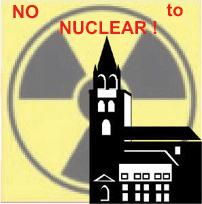 UK is urged to sign UN nuclear-weapons treaty https://www.churchtimes.co.uk/articles/2021/15-january/news/uk/uk-is-urged-to-sign-un-nuclear-weapons-treaty by PAT ASHWORTH, 15 JANUARY 2021 But there is resistance to change, say peace campaigners.
CAMPAIGNERS are urging the UK to sign the United Nations Treaty on the Prohibition of Nuclear Weapons, which will come into effect on 22 January.
The Archbishops of Canterbury and York, with more than 30 Church of England bishops, called on the Government in November to accept the treaty, which, they said, would “give hope to all people of goodwill who seek a peaceful future” (News, 20 November 2020).
It has been signed by 51 states. They will now be required to stop producing, developing, testing, or stationing nuclear weapons, and will be required to help any victims of their testing and use. Their financial institutions will be expected to stop investing in companies that produce nuclear weapons.
The UK, the United States, France, and Russia have not signed the treaty. Clergy and church leaders were reminded in a briefing by the Network of Christian Peace Organisations (NCPO), on Tuesday, of the overwhelming support given to a Lambeth Conference resolution in 1998, which called on the Government and the UN to press for an international mandate for all member states to prohibit nuclear warfare.
Now was the time to fulfil that, Rebecca Johnson, one of the architects of the treaty and a founder member of the International Campaign to Abolish Nuclear Weapons (ICAN), said. Nuclear weapons must be known for what they really were — weapons of mass destruction — and the phrase “nuclear powers” must be replaced with “nuclear-armed states”.
The treaty was a legal one, but it would work by persuasion and not by coercion; it was normative in taking away any status attached to hanging on to nuclear weapons, and in labelling as pariahs those who did. “We all need to think about what we can do to bring this treaty into force in our own countries. There is an important job here for faith leaders to do,” she said.
Although the C of E had a blanket policy of not investing in companies with an interest in nuclear weapons, everyone should examine investment practice in their churches, the policy adviser on international affairs for the ecumenical Joint Public Issues Team, Steve Hucklesby, said.
The treaty brought “a very real possibility of a new norm on nuclear weapons across the whole finance and business sectors; but be clear: there is resistance to change,” he continued. Pressure could be applied to banks and pension providers if individuals saw this as something relating to their own lives. “The issue now becomes compliance with an international treaty, to be applied across the whole of an institution’s business.”
An international meeting to be held in Vienna later this year will establish mechanisms for compliance. It will be open to observers from nuclear-armed states, who will not be able to vote but who should be urged to “attend, listen, and learn,” Ms Johnson said. “It is so important for the UK to join sooner rather than later . . . to be at the table.”
Russell Whiting, who chairs Christian CND, described a world in which President Trump, or even Joe Biden, had their finger on the nuclear button, as “an incredibly dangerous place”. The treaty has been declared dangerous by the Prime Minister, and by the former Foreign Secretary Philip Hammond. These governments had “misrepresented” the treaty wherever they went, saying that it would undermine the existing non-proliferation treaty, Ms Johnson said.
The General Synod called for the elimination of nuclear weapons in July 2018, but it stopped short of urging the Government to sign the treaty. The Government’s refusal to do so was described by the Archbishop of York, the Most Revd Stephen Cotrrell, then Bishop of Chelmsford, as “hugely disappointing” and “a decision that looks like complacency”. He questioned the billions of pounds spent on Trident (News, 13 July 2018).
The general secretary of the Roman Catholic peace movement Pax Christi, Pat Gaffney, said on Tuesday that RC bishops had issued a statement asking the Government to support the treaty — a move that she described as “a huge step forward, because they have habitually said it undermined the existing non-proliferation treaty. Catholics need to write to their bishops affirming what they are doing.”
The NCPO is holding a service online at 11.30 a.m. on 22 January, to mark the treaty. It will conclude with the ringing of the peace bell at Coventry Cathedral.
Leeds and Brighton cities pass resolutions supportint the Treaty on Prohibition of Nuclear Weapons
NFLA 14th Jan 2021, With just 9 days to go before the entry into force of the Treaty on the Prohibition of Nuclear Weapons, Leeds and Brighton pass resolutions
supporting the Treaty.
Property developer volunteers Allerdale, Cumbria for UK’s nuclear waste
anyone to volunteer anywhere, even an individual who doesn’t live in the area, or a company can volunteer it.
of the local population.
mirrored by the ease of withdrawing. There the government have chosen a highly prescriptive system.
As Britain’s plan for Wyfla nuclear project founders, it’s time to start a green revolution
PAWB 11th Jan 2021, On the last day of troubled 2020, the Westminster Government has deferred a decision on a Development Consent Order for a nuclear power station at Wylfa until the end of April 2021.
This is the fourth time this has happened, and the second time in a row for Duncan Hawthorne, chief executive Horizon, to ask for a deferral.
 On January 10 the Times revealed that Hitachi is winding Horizon up completely by March 31, 2021. This is the logical conclusion of the process that started exactly two years ago when Hitachi suspended Horizon’s operations at Wylfa. Then in September 2020, they announced that they were ditching their plans to build two huge reactors at Wylfa completely.
The attempt to build Wylfa B has been shambolic from the start. It’s high time to abandon the foolish dream that has paralyzed Anglesey’s development since 2006. As we approach the 10th
anniversary of the Fukushima disaster, the latest to be mentioned as ‘saviours’ of the radioactive poisoning project that would threaten the health of everyone on the island and beyond are three US companies.
Here they are: Bechtel Corporation, Westinghouse and Southern Company. Here are
some of the trio’s transgressions: Bechtel – recently fined nearly $58million for financial fraud with another company over a 10-year periodat Hanford Nuclear Reservation, the most radioactively contaminated site in the United States. This followed a fine of $125million for low quality work on the same site in 2016. Much more could be said about Bechtel. Westinghouse and Southern Company – Westinghouse went bankrupt while trying to build Vogtle Power Station in the state of Georgia.
The two AP1000 reactors of the type destined for Wylfa are five years behind Schedule, have doubled in cost to $25billion, and there is no guarantee that thepower station will ever be completed. Another of their projects was the V C Summer nuclear plant in South Carolina. It was abandoned unfinished in 2017, and is still being paid for by taxpayers.
However, with this latest information, it looks very unlikely that these three American companies are prepared to pay through their noses for two white elephant sites at Wylfa and Oldbury.
This is the end of Horizon’s journey. And the end once and for all of the nuclear industry’s plans to destroy an especially beautiful part of northern Ynys Môn. It is high time that politicians on Ynys Môn andGwynedd Councils, the Senedd in Cardiff, and at Westminster to recognise
this fact and to turn their attention towards cleaner, cheaper and more sustainable ways of producing electricity. The renewable technologies are available. This is the time to start a real green revolution.
Nuclear power – a dubious and very costly addition in UK’s energy plan
|
Renew Extra 9th Jan 2021, Dave Elliott: The White Paper on modelling UK electricity supply has some very odd things to say: it seems to see nuclear (and carbon capture) as low cost: ‘low-cost solutions at low carbon intensities can only be achieved with a combination of new nuclear and gas CCUS’.
However, it says that the use of hydrogen makes it more flexible, and it admits that ‘it is
technically possible for higher levels of hydrogen-fired generation to also replace nuclear and gas CCUS’, although it adds that ‘this is dependent on the quantity and cost of hydrogen available for generating electricity’. The White paper promised that a review of all existing energy National Policy Statements (NPSs), and presumably their cost and demand assumptions, would be carried out over the next year.
This is important since the old very dated NPSs (which were all designated by the government in 2011) have been used to justify decisions on energy. For example, the old NPSs were sometimes used to justify nuclear expansion on the basis of then expected growth in demand for electricity, whereas it’s actually fallen a lot.
It may help that the White Paper also noted that BEIS is to further upgrade its energy modelling work, going beyond its Mackay Carbon Calculator, its update of the late Prof. David Mackay’s 2011 modelling system.
There certainly are cost issues to face up to up. As far as it has panned out so far, nuclear would add even more costs (including curtailment costs) and doesn’t seem very suited to balancing variable renewables. CCS/CCSU may be similarly expensive and operationally
constrained. But although renewables have got dramatically cheaper and green hydrogen conversion for balancing may do too, there will still be system integration costs. As I noted in a recent post, they have been put, in an Imperial College London review, at €14 per MWh at up to 35%renewable penetration, right up to £30/MWh at up to 85% penetration, well below typical green generation cost. Some of there costs will fall, as the technology improves, and will be offset by efficiency savings, as energy supply and demand balancing gets better, but they are not zero.
https://renewextraweekly.blogspot.com/2021/01/hydrogen-flexibility-in-energy-white.html |
|
18 Cold War-era nuclear bunkers dotted around Cambridgeshire
These are the 18 Cold War-era nuclear bunkers dotted around Cambridgeshire
The sites can be found all over the county, Cambridgeshire Live, By Harry GoldTrainee Multimedia Reporter, 9 Jan 201,
|
Cambridgeshire is home to several Cold-war era nuclear bunkers, according to an online database. There are 18 of them dotted around the county, each with similar design structures. Officially called Royal Observer Corps (ROC) Monitoring Posts, they consist of a 14-foot-deep access shaft, a toilet/store and a monitoring room. The posts were constructed as a result of the Corps’ nuclear reporting role and operated by volunteers during the Cold War between 1955 and 1991. Half the posts were closed in 1968 during a reorganisation of the ROC and several others shut over the next 40 years as a result of structural difficulties. They were prone to issues such as flooding and vandalism, with the final ones decommissioned in 1991 after the break up of the Soviet Union. Here are the ones you can find in Cambridgeshire, according to online database Subterranea Britannica – along with another historic relic from the Cold war era.,,,,,,,,,,, https://www.cambridge-news.co.uk/news/local-news/cold-war-nuclear-bunker-cambridgeshire-19590971 |
|
Hitachi pulls plug on Horizon nuclear subsidiary
Hitachi pulls plug on Horizon nuclear offshoot John Collingridge, Sunday January 10 2021, The Sunday Times A project to build a huge nuclear power station in north Wales is to be wound down by the end of March, threatening hopes of its resurrection via a sale.
Japan’s Hitachi has told staff it will shut its Horizon subsidiary, which was to build a £20bn nuclear power plant at Wylfa on Anglesey, by March 31. That could scupper a sale of the site, despite interest from bidders including a US consortium of Bechtel, Southern Company and Westinghouse.
The Wylfa site is seen as one of the…… (subscribers only) https://www.thetimes.co.uk/article/hitachi-pulls-plug-on-horizon-nuclear-offshoot-q0tp0kcpx
Judge’s refusal to extradite Julian Assange is still part of cowardly process to deny freedom of information
The personal conveniently distracts from the political in the Assange story, https://www.theage.com.au/national/the-personal-conveniently-distracts-from-the-political-in-the-assange-story-20210107-p56siu.html
Elizabeth Farrelly Judge Vanessa Baraitser’s refusal to extradite Julian Assange for “mental health” reasons may look humanitarian but is in fact a deft political move. In reducing what should be an argument of law and principle to a test of personality, Baraitser managed at a blow to impugn Assange’s stability, repudiate any suggestion of innocence and open the door for America to prove the comforts of its solitary confinement and thereby win his extradition.
It’s a story of many twists and turns but underlying it throughout is a profound and widespread moral cowardice.
Baraitser’s 132-page ruling found that although the UK-US Extradition Treaty of 2003 specifically prohibits extradition for “political offence”, this provision never became law in the UK and therefore has no effect. In essence, the treaty is worthless.
The court also supported all 18 of the espionage charges against Assange, arguing that WikiLeaks’ hacking and publication “would amount to” offences in English law. Baraitser identified eight charges under the UK Official Secrets Act that would be, she said, equivalent.
Interestingly, this “would have” construction does not apply to the treaty question. Had Assange engaged in the same conduct in America, targeting British government information, he could not have been extradited because America’s “monist” system regards any treaty as law once signed. So it’s ironic that undermining this particular protection is a key US argument.
Anyone who saw the 2019 docudrama Official Secrets, chronicling the leakage by GCHQ analyst-turned-whistleblower Katharine Gun of information on US-UK dirty dealing in drumming up UN support for the Iraq war, will understand just how murky and terrifying such prosecutions can become.
This fear, and the persistent cowardice of yielding to it, is the theme of Assange’s story. I’ve written about Assange several times. I visited him in Ecuador’s embassy. Yet each time, I’ve found myself reluctant.
Seven years ago, when I met him, Assange was ebullient and hopeful, even funny. Now, as Baraitser says, he is “a depressed and sometimes despairing man who is genuinely fearful about his future”. Assange, she said, was at “high risk of serious depression leading to suicide if he were to be extradited and placed in solitary confinement for a long period”.
Baraitser noted the “bleak” conditions of Assange’s likely US confinement would include “severely restrictive detention conditions designed to remove physical contact and reduce social interaction and contact with the outside world to a bare minimum”, with family limited to one supervised 15-minute phone call a month. Detailing Assange’s mental state, she opined that his risk of suicide, in such conditions, was “very high”. This is the loophole she offers the appellant US prosecutor.
Those fears – his of 175 years in solitary (honestly, who wouldn’t top themselves?) and hers of his suicide – underpin her judgment. But there are other, more insidious fears at play here.
Such fears, I see now, feed my reluctance to revisit the Assange story: fear, in particular, of confronting the terrifying truth about our imperial system. Regardless of Assange’s innocence or guilt, the simple facts of what our controlling powers can do to you if you step out of line are terrifying.
But this small, individual fear also operates, very effectively, at nation level.
From the start, the case against Assange has contrived to turn issues of principle into questions of personality. The initial Swedish rape charges, since dropped for lack of evidence as the witness’s recollections after so long were clouded, were extremely personal, spinning off the cancellation of his credit cards upon his arrival in Stockholm, forcing him to accept hospitality; the seductions, the sex – which everyone agrees was consensual – his failure to wear a condom although asked and reluctance to take an STD test. Then the left turned against him because of the Clinton leaks – which one suspects would have been fine, had they been directed at the other side – and perceptions about Assange’s ego. He was vain, it was said, and narcissistic. As if that itself were a crime, reason enough to let him rot in solitary.
The personal and emotive nature of all this – the Swedish prosecutor’s refusal to interview him in London, Britain’s willingness to imprison him for a year on bail charges, America’s determination to prosecute him for exposing their war crimes (in the Iraq War Logs of October 2010 and the film Collateral Murder showing air crew shooting unarmed civilians from a helicopter) and the description of WikiLeaks by US Secretary of State Mike Pompeo as “a hostile non-state intelligence service” – all suggest a bigger picture, and smaller values, than mere truth or justice.
It’s often said that Assange endangered the lives of US informers but, as Baraitser notes, no causality has been shown. Even the Senate Committee on Armed Service said, “the review to date has not revealed any sensitive sources and methods compromised by disclosure”. It is said that Assange, by dumping hacked emails from Hillary Clinton’s campaign, gave us Trump. But if she was engaged in skulduggery as alleged, wasn’t it better for the world to make its own judgment?
When you look coldly at the facts it’s hard not to suspect that Sweden was coerced into the original charges and that Britain and Ecuador have been similarly pressured. Certainly Australia’s persistent refusal to intervene for Assange, an Australian citizen who has broken no Australian law, suggests a similar abject timidity in the face of US might.
That’s the fear that guys like Assange and Edward Snowden make us confront. And it’s why they deserve, at the very least, a fair and open trial.
Assange denied bail after extradition blocked, will appeal to UK High Court
 Assange denied bail after extradition blocked, will appeal to UK High Court, WSW
District Judge Vanessa Baraitser handed down the decision Wednesday in Westminster Magistrates Court, after ruling on Monday against Assange’s extradition to the United States on mental health grounds. Assange will remain in custody until the prosecution’s appeal of that ruling is heard.
WikiLeaks editor-in-chief Kristinn Hrafnsson announced afterwards that Assange’s legal team would be taking the bail decision to the High Court.
Baraitser’s refusal to grant bail confirms that her decision not to extradite was motivated by political considerations and not any genuine concern for Assange’s health. Assange will be kept in conditions which have had a grave impact on his mental health, during a massive escalation of the UK’s COVID-19 epidemic.
Speaking to the Sydney Morning Herald Tuesday, Nick Vamos, former head of special crime and head of extradition at the Crown Prosecution Service, indicated that the appeal process would likely take two to three months.
In her decision, Baraitser accepted the prosecution’s insistence that Assange’s flight into the Ecuadorian embassy in 2012—after a UK court had granted him bail in connection with Sweden’s trumped-up sexual assault investigation and extradition request—was proof of his willingness to abscond in the future. This is an absurd and vindictive position……..
Assange now has a court ruling in his favour. He is, regardless, prepared to submit to stringent bail conditions amounting to effective house arrest with a GPS tag—conditions which have allowed terror suspects to receive bail. His experience of claiming asylum in an embassy has proved it “unpleasant”, in Fitzgerald’s words, and led “to him being effectively confined for some seven years” before having his asylum revoked. “That is not something that he is ever likely to repeat.”
Assange also now has a family, a partner and two children, in the UK. Besides being a reason for Assange not to abscond, Fitzgerald argued, his family provides significant human rights grounds for his release on bail. On account of COVID-19 restrictions in the prison, Assange “hasn’t seen his family in person since March 2020”. He has never been able to live with them, having spent 15 months held on remand pending his extradition hearing.
Assange’s family, Fitzgerald noted, is highly relevant to the question of his mental and physical wellbeing. “The grant of bail”, he said, “would allow actual physical contact with his family, that would… alleviate mental distress”.
Baraitser had acknowledged the benefit of his family’s support to Assange in her ruling on extradition, which described him as a “depressed and sometimes despairing man, who is genuinely fearful about his future.”
Bail would also “considerably reduce” the risk of Assange’s exposure to COVID-19. Fitzgerald pointed to the “severe outbreak” of the virus suffered by Belmarsh Prison recently and said there had been 59 positive cases prior to Christmas. He added, “on any view, the position [the state of the UK’s epidemic] is worse now and, on any view, he would be safer isolating with his family than if he was in Belmarsh.”
Baraitser dismissed these concerns, declaring “this prison is managing prisoners’ health during this pandemic in an appropriate and responsible manner.”………. https://www.wsws.org/en/articles/2021/01/07/assa-j01.html?pk_campaign=assange-newsletter&pk_kwd=wsws
UK and Ireland Nuclear Free Local Authorities (NFLA) oppose underground coal mine – dangerously close to Sellafield’s radioactive wastes .
result of the coal mine has gone to the Sellafield site for internal review.https://www.nuclearpolicy.info/news/nfla-troubled-uk-communities-minister-not-calling-in-decision-deep-underground-coal-mine-west-cumbria/
UK’s Wylfa nuclear power plan – Council approval is postponed again.
North West Place 6th Jan 2021, The council has deferred its decision to award planning consent for the nuclear power plant scheme on Anglesey for a second time while its
developer winds up operations at the site after pulling out of the project.
https://www.placenorthwest.co.uk/news/wylfa-planning-deadline-moved-as-deal-yet-to-emerge/
Hinkley Point C mud dredging – radioactive mud could be dumped off Somerset instead of south Wales.
Energy is considering two sites in the Bristol Channel.
over concerns the mud was contaminated by nuclear waste. But a private disposal site off Portishead, on the England side of the channel, is also under consideration. A public outcry over the original mud dumping led to protests and petitions attracting hundreds of thousands of signatures online, a full Senedd debate and an acknowledgment by both the developers
and Natural Resources Wales that better communication with the public was needed over the plans.https://www.bbc.co.uk/news/uk-wales-55577848
Most Maldon District Councillors oppose Bradwell big nuclear development: small reactors would carry the same dangers.
favour of a recommendation to send a letter in support of the development of small modular reactors at the site of Bradwell B power station. The letter was sent to MP John Whittingdale and to the head of nuclear development at the Department for Business, Energy and Industrial Strategy in support of the development.
position to back Bradwell B due to the environmental and ecological impacts it would have.
on the plans for Bradwell B that a strong majority of councillors agreed with BANNG that Bradwell is an unsuitable, unacceptable and unsustainable site for nuclear development.
environmental, heritage and ecological problems as those opposed by Maldon
District Council in relation to Bradwell B.”
Australia’s Prime Minister Scott Morrison could stop the persecution of Australian citizen Julian Assange
|
Rex Patrick, Independent senator, January 5, 2021 A British judge has rejected the US Justice Department’s effort to have Wikileaks publisher Julian Assange extradited to the United States to face espionage charges for obtaining and publishing secret documents that revealed war crimes. The decision of Judge Vanessa Baraitser to deny the extradition request has given Assange an important legal victory in his efforts to avoid extradition for actions many would regard as inherent to media freedom – the right of journalists to obtain and publish information and to protect confidential sources. However, in her ruling Judge Baraitser dismissed the arguments of Assange’s lawyers in relation to these matters, saying she was satisfied that the American authorities made their extradition request in good faith, that the case was not politically driven, and that Assange was not merely acting as a journalist. |
|

1 This Month

of the week– Nuclear Reactor Information Task Force

14 May – online event From Bombs to Data Centres: the Face of Nuclear Colonialism
To see nuclear-related stories in greater depth and intensity – go to https://nuclearinformation.wordpress.com
-
Archives
- May 2026 (173)
- April 2026 (356)
- March 2026 (251)
- February 2026 (268)
- January 2026 (308)
- December 2025 (358)
- November 2025 (359)
- October 2025 (376)
- September 2025 (257)
- August 2025 (319)
- July 2025 (230)
- June 2025 (348)
-
Categories
- 1
- 1 NUCLEAR ISSUES
- business and costs
- climate change
- culture and arts
- ENERGY
- environment
- health
- history
- indigenous issues
- Legal
- marketing of nuclear
- media
- opposition to nuclear
- PERSONAL STORIES
- politics
- politics international
- Religion and ethics
- safety
- secrets,lies and civil liberties
- spinbuster
- technology
- Uranium
- wastes
- weapons and war
- Women
- 2 WORLD
- ACTION
- AFRICA
- Atrocities
- AUSTRALIA
- Christina's notes
- Christina's themes
- culture and arts
- Events
- Fuk 2022
- Fuk 2023
- Fukushima 2017
- Fukushima 2018
- fukushima 2019
- Fukushima 2020
- Fukushima 2021
- general
- global warming
- Humour (God we need it)
- Nuclear
- RARE EARTHS
- Reference
- resources – print
- Resources -audiovicual
- Weekly Newsletter
- World
- World Nuclear
- YouTube
-
RSS
Entries RSS
Comments RSS
 nuclear-news