British government’s enthusiasm for mini nuclear reactors, led by Rolls Royce and 8 other organisations

Brexit Britain strikes historic £210m deal with Rolls-Royce to create nuclear reactors
BREXIT Britain is set to see its emissions slashed as the Government is poised to make a landmark deal with Rolls-Royce to fund a fleet of nuclear mini-reactors.
Express UK, By JACOB PAUL, Mon, Oct 18, 2021 The move is set to help Prime Minister Boris Johnson race to his target of zero-carbon electricity by 2035 in a move set to impress ahead of the COP26 climate summit in Glasgow in less than two weeks time. Mr Johnson visited Rolls-Royce’s Bristol factory on Friday, where he was shown their state-of -the-art facility by their CEO, Warren East. A consortium led by Rolls-Royce had already secured £210million in backing from private investors for the small modular reactor (SMR) project, a sum that the Government is expected to match and even surpass.
Confirmation is expected before the spending review on October 27.
The consortium called UK SMR, is set to rebrand British engineering firm Rolls-Royce SMR under a request from the Government. Tom Greatrex, chief executive of the Nuclear Industry Association (NIA), said: “Match-funding for Rolls-Royce would be a huge signal to private investors that the government wants SMRs alongside new large-scale stations to hit net zero.
It would also show investors that the Government believes in nuclear as a green technology.”
Government support will help with the consortium’s multi-billion pound plans to build 16 SMRs up and down the country……………… Rolls-Royce is also being advised by HSBC, which has helped it secure £210million from private investors, which was a condition set by the government for them to hand out at least the same amount of funding.
This move could also signal a possible U-turn from the Government on their scheduled phasing out of nuclear power in the UK.
13 nuclear reactors capable of producing 7.8GW of power currently produce around 20 percent of the nation’s electricity.
But over half of that capacity comes from reactors that are scheduled to be replaced or halted by 2025. https://www.express.co.uk/news/science/1507881/brexit-britain-rolls-royce-nuclear-power-boris-johnson-cop26-climate-change
Clyde nuclear base emergency staff to strike from tomorrow over safety fears
Clyde nuclear base emergency staff to strike from tomorrow over safety fears, Herald Scotland, By Martin Williams @Martin1Williams, Senior News Reporter 18 Oct 21, EMERGENCY workers at the home of Britain’s nuclear weapons on the Clyde are set to strike over “major safety concerns” after managers slashed firefighter numbers.
Action has been previously been given the go-ahead following a ballot of workers after managers proceeded with cuts to eight posts from the specialist fire safety crew at HM Naval Base Clyde, a reduction in strength of 15 per cent, with the a union describing it as an “an accident waiting to happen”.
Unite members working for outsourcing services firm Capita Business Services will now start strike action from Tuesday in a dispute over cuts to fire and rescue crew levels, and a lack of consultation………………
Workers believe the cuts impair the abilities of the onsite fire crews to do their jobs properly, particularly, in relation to incidents that would involve wearing breathing apparatus.
Capita has previously stated that they intend to mitigate safety risks due to the cuts through an investment in new technology to reduce fire risk”.
But workers have said they are not aware of any new technology which would address ongoing safety concerns…………………………… https://www.heraldscotland.com/news/homenews/19655524.clyde-nuclear-base-emergency-staff-strike-tomorrow-safety-fears/
UK government’s grand energy plan – focus is on saving the nuclear industry
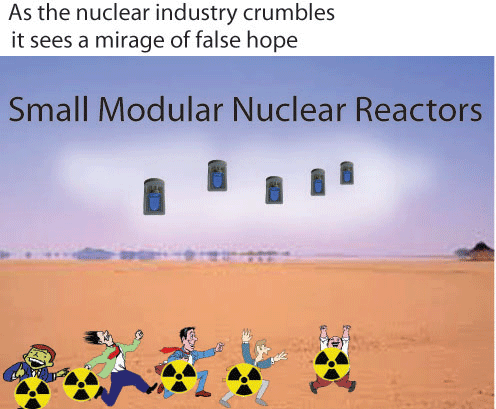
”Nuclear power is slow, dangerous and extortionately expensive. It will do nothing to address the current energy crisis, neither will it be effective to counter climate change”
Reviving nuclear power station projects such as Wylfa B on Anglesey and Trawsfynydd in Gwynedd is at the heart of the UK Government’s ambitions to attain net zero carbon emissions by 2035, government sources have said.
The UK Government is expected to reveal its new nuclear strategy in documents to be published next week, alongside a plan for how to pay for the new array of nuclear plants. US nuclear company Westinghouse is planning to revive plans for a nuclear power plant at Wylfa that was abandoned by Japan’s Hitachi in 2019, and the UK Government has indicated that it is keen to see the plan come to fruition.

Ministers are also expected to back smaller modular reactors which are being developed by a consortium led by Rolls-Royce. One of these is planned for installation in the now-decommissioned Trawsfynydd nuclear plant. Kwasi Kwarteng, the business secretary who has been under fire from industry this week due to
the rising cost of energy prices, is to unveil the overarching ‘Net Zero Strategy’ paper on Monday.
According to the Financial Times, the strategy will have a “heavy focus” on Britain’s languishing nuclear power
programme. Under the plans, an energy levy on consumers by the UK Government finance the cost of producing the power before the nuclear energy plants are built. Kwasi Kwarteng has set a target of 2035 to reach
‘net zero’ based on nuclear power, renewables and carbon capture and storage.
Anti-nuclear groups have already criticised the plans, saying that the emphasis should be placed on green renewable energy instead. Dylan Morgan of PAWB (People Against Wylfa B) said: “We have an immediate crisis now. Building huge reactors at a nuclear power station take at least 15 years. “Nuclear power is slow, dangerous and extortionately expensive. It will do nothing to address the current energy crisis, neither will it be effective to counter climate change”
Nation Cymru 16th Oct 2021
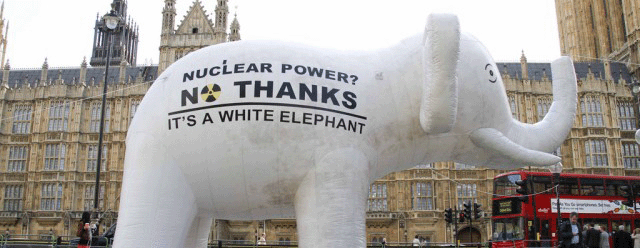
Sizewell C nuclear station – a white elephant that will irreversibly damage the environment
Campaigners protesting the building of Sizewell C have responded with
frustration to EDF’s £250 million package of funding to mitigate the
impacts of the proposed site. The biggest concern for those against the
project was the money put towards environmental causes – £78 million for
an independent environmental body to enhance the landscape of the area and
£22 million for investment in landscape impact mitigation and creation of
wildlife and habitat areas.
“It’s notable that by far the biggest sum –
£100 million – is for environmental projects,” said Alison Downes from
Stop Sizewell C. “This work will have to be ongoing for decades – through
the life of the station and potentially decommissioning – to make any
significant difference.”
“The environmental funding is simply a
recognition of the long term and irreversible damage they will do to the
environment,” said Pete Wilkinson of Together Against Sizewell C. “The
rest is a measure of the damage to this community EDF intends to inflict
for what will be a huge white elephant on our eroding, heritage coast.”
East Anglian Daily Times 15th Oct 2021
https://www.eadt.co.uk/news/sizewell-c-campaigners-react-to-money-plans-8415128
Demonising China is unhelpful while encouraging China to participate in Cop26
As Britain prepares to host the Cop26 climate conference in Glasgow next month, it is pursuing two contradictory policies that undermine its chances of success. On the one hand, it is seeking a unified global response to the climate crisis with nations agreeing to targets for the reduction of their coal and petroleum emissions.
But at the same time, it has joined the US in escalating a new cold war directed at confronting China and Russia at every turn. The two policies have polar opposite objectives in trying to persuade China, responsible for 27 per cent of global carbon emissions, to cut back on building new coal-fuelled power stations, but at the same time demonising China as a pariah state with whom political, commercial and intellectual contacts should be as limited as possible.
Independent 15th Oct 2021
https://www.independent.co.uk/climate-change/opinion/china-russia-climate-cop26-b1939164.html
Opposition to UK’s plans for nuclear fusion
ANTI-NUCLEAR campaigners have hit out at the UK Government’s plan to
create a prototype nuclear fusion power plant that is being developed with
hopes to sustain moves away from fossil fuels.
The Scottish Campaign for Nuclear Disarmament (CND) has said that this latest effort to extol the
virtues of nuclear fusion as a “low carbon” source of energy is to keep the
industry “alive” due to the UK being a “nuclear weapon state”.
The National 15th Oct 2021
UK to push for nuclear power: households to pay up long before the reactors are built
UK to put nuclear power at heart of net zero emissions strategy. British
ministers will put nuclear energy at the heart of Britain’s strategy to
reach net zero carbon emissions by 2050 in government documents due as
early as next week, along with new details on its funding model.
Kwasi Kwarteng, business secretary, is due to unveil the “Net Zero Strategy”,
as well as a “Heating and construction strategy” and an assessment of
the Treasury of the cost to reach the 2050 target. The main strategy will
be heavily focused on the long overdue and slow British nuclear program.
The country’s existing reactors are expected to be phased out by 2035,
with construction of a single large plant, Hinkley Point C, already
underway.
The creation of a “regulated asset base” (RAB) model will be
the key to the delivery of a future fleet of large nuclear power plants.
Under this program, households will be billed for the cost of the plant via an energy
tax long before it starts producing electricity, which could take a decade
or more from the time. where the final investment decision is made.
FT 16th Oct 2021
https://www.ft.com/content/e6426194-21e6-49c4-9520-97c337b350fd
Prince William: Saving Earth should come before space tourism
William told Newscast’s Adam Fleming he had “absolutely no interest” in going as high as space, adding there was a “fundamental question” over the carbon cost of space flights.
Prince William: Saving Earth should come before space tourism https://www.bbc.com/news/uk-5890307816
By George Bowden, 15 Oct 21,
BBC News Prince William has suggested entrepreneurs should focus on saving Earth rather than engaging in space tourism.
The Duke of Cambridge said great brains and minds should be “trying to repair this planet, not trying to find the next place to go and live”.
He also warned about a rise in “climate anxiety” among younger generations.
William spoke to the BBC’s Newscast ahead of the first Earthshot Prize to reward those trying to save the planet.
The prize’s name is a reference to the “moonshot” ambition of 1960s America, which saw then-President John F Kennedy pledge to get a man on the moon within a decade.
Speaking about the current space race and the drive to promote space tourism, William said: “We need some of the world’s greatest brains and minds fixed on trying to repair this planet, not trying to find the next place to go and live.”I think that ultimately is what sold it for me – that really is quite crucial to be focusing on this [planet] rather than giving up and heading out into space to try and think of solutions for the future.”
On Wednesday, Hollywood actor William Shatner became the oldest person to go to space as he blasted off aboard the Blue Origin sub-orbital capsule developed by billionaire Amazon founder Jeff Bezos.
Sir Richard Branson and Elon Musk are also building up space businesses.
He warned there was “a rise in climate anxiety” among young people who whose “futures are basically threatened the whole time”.
“It’s very unnerving and it’s very, you know, anxiety making,” he said.
The father-of-three challenged adults to channel their inner child to “remember how much it meant to be outdoors and what we’re robbing those future generations of”.
William also said his father, Prince Charles, had a “rough ride” when warning about climate change, adding: “It’s been a hard road for him.”
He said Charles, inspired by his father, the late Duke of Edinburgh, “talked about climate change a lot more, very early on, before anyone else thought it was a topic”.
The duke added that “it would be an absolute disaster if [Prince] George is sat here talking” about saving the planet in 30 year’s time.
Five winners of the Earthshot Prize, each receiving £1m, will be announced in a ceremony later this month.
William told Newscast’s Adam Fleming he had “absolutely no interest” in going as high as space, adding there was a “fundamental question” over the carbon cost of space flights.
Rebranded – ROLLS-ROYCE SMR , a new conglomerate of 9 groups (to spread the risks of uneconomic small nuclear reactors?)
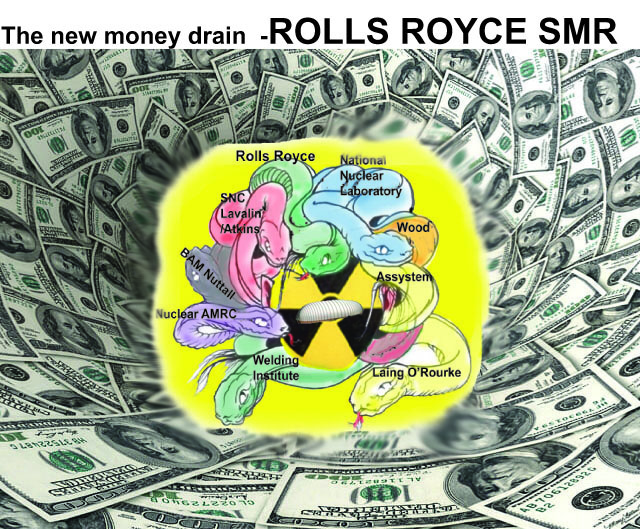
The nine-strong consortium also includes the National Nuclear Laboratory and Laing O’Rourke, the construction firm, alongside Assystem, SNC Lavalin/Atkins, Wood, BAM Nuttall, the Welding Institute and Nuclear AMRC.
UK poised to confirm funding for mini nuclear reactors for carbon-free energy Guardian,
Rolls-Royce-led consortium already has £210m in private backing for plans to build 16 reactors across the country, The government is poised to approve funding for a fleet of Rolls-Royce mini nuclear reactors that the prime minister hopes will help the UK reach his target of zero-carbon electricity by 2035.
A consortium led by the British engineering firm had already secured £210m in backing from private investors for the small modular reactor (SMR) project, a sum that the government is expected to match or better. Confirmation is expected before the spending review on 27 October, according to well-placed sources.
The consortium, known as UK SMR, will rebrand as Rolls-Royce SMR to coincide with Westminster’s blessing.
Tom Greatrex, the chief executive of the Nuclear Industry Association (NIA), said: “Match-funding for Rolls-Royce would be a huge signal to private investors that the government wants SMRs alongside new large-scale stations to hit net zero. It would also show investors that the government believes in nuclear as a green technology.”
Backing from the government will pave the way for the consortium’s multibillion-pound plan to build 16 SMRs around the country, the first of which could be plugged into the grid by 2031…………..
Confirmed support for SMRs could signal a concerted effort within government to reverse the scheduled decline in the UK’s nuclear power capacity. About 20% of the nation’s electricity comes from 13 nuclear reactors capable of producing 7.8GW of power. But more than half of that capacity comes from reactors due to retire by 2025, and plans to replace them have stalled.
Toshiba pulled out of a plant at Moorside in Cumbria in 2020, and Hitachi withdrew planning consent for a project at Wylfa Newydd, on Anglesey, this year. While Hinkley Point C is due to start generating electricity from 2026, only one new project, Sizewell C, is now in the works, with no final investment decision yet made.
Britain’s ability to build new nuclear reactors has been further complicated by the government’s unwillingness to allow any further involvement from the state-backed China General Nuclear. CGN has a 20% stake in Sizewell C but ministers have been looking into ways to remove it from the project before it moves to the construction phase. The Chinese company was due to take a lead role in the Bradwell reactor in Suffolk, which is now highly unlikely to go ahead.
Industry players are keen to see the government legislate to approve the regulated asset base (RAB) model, which allows private investors a more reliable stream of revenues from nuclear power plants – which typically require tens of billions of pounds to build – by piling costs on to household energy bills……..
The nine-strong consortium also includes the National Nuclear Laboratory and Laing O’Rourke, the construction firm, alongside Assystem, SNC Lavalin/Atkins, Wood, BAM Nuttall, the Welding Institute and Nuclear AMRC. https://www.theguardian.com/business/2021/oct/15/uk-poised-to-confirm-funding-for-mini-nuclear-reactors-for-green-energy
Waste Isolation Pilot Plant adds space for nuclear waste disposal near Carlsbad
Waste Isolation Pilot Plant adds space for nuclear waste disposal near Carlsbad Adrian Hedden, Carlsbad Current-Argus, 12 Oct 21, An eighth panel to store nuclear waste at the Waste Isolation Pilot Plant’s underground repository near Carlsbad was completed with waste expected to go in next year . At WIPP, low-level transuranic (TRU) nuclear waste made up of clothing materials and equipment irradiated during nuclear activities, is stored in an underground salt deposit about 2,000 feet underground.The facility stores the waste in panels, with each panel containing seven rooms where workers emplace drums of it and allow the salt to gradually collapse in for permanent disposal.WIPP has emplaced waste in seven panels so far but lost some capacity due to contamination from an accidental radiological release in 2014 that also disrupted mining and emplacement activities during a three-year shutdown of the WIPP’s core operations. But seven years since mining Panel 8 began, WIPP officials reported the work was complete in Tuesday announcement.Panel 7 was expected to be full by April 2022, per the announcement, and Panel 8 will be ready to accept waste immediately……………… The utility shaft project was paused last year when the New Mexico Environment Department denied extending a temporary authorization for construction ahead of a modification to WIPP’s permit to allow its use, citing concerns with COVID-19 infections at the site.The permit modification is under review by NMED.Also under review by NMED was a proposal by WIPP to construct two additional panels needed to restore the facility’s capacity from losses associated with the 2014 incident………. https://www.currentargus.com/story/news/local/2021/10/13/wipp-adds-space-nuclear-waste-disposal-near-carlsbad/6092842001/ |
Lincolnshire nuclear waste burial can go ahead only if the local community suports it
Plans to dispose of nuclear waste from across the UK in Lincolnshire can
only go ahead with the support of a “willing community”, officials have
said. Radioactive Waste Management (RWM), a government agency, has
identified a potential site at a former gas terminal in Theddlethorpe, near
Mablethorpe. However, opponents said the move would impact tourism and
lower house prices in the area. A working group has now been formed to
examine the proposals.
BBC 12th Oct 2021
They don’t even know if the geology of Theddlethorpe, Lincolnshire is suitable for nuclear waste burial
The mining engineer in charge of the multi-billion pound scheme to bury
nuclear waste deep under the sea bed off the Lincolnshire coast has
admitted it is not known if the site is even suitable.
Government agency Radioactive Waste Management wants to build a plant at the old gas terminal
at Theddlethorpe to receive “high-level” material for storage at a
“geological disposal facility” (GDF) in clay rock 500 metres below the
North Sea. A GDF contains solid radioactive waste encapsulated in concrete
or glass and packaged in a concrete or metal container which is stored in
underground tunnels and vaults.
If Theddlethorpe went ahead, vaults would
be constructed and rubbish dumped over the plant’s 100-year operational
life before the site is finally sealed off. Local talks and the process of
identifying a search area for the facility can now begin following the
launch of a working group on Tuesday, October 12, after the county council
agreed to join the group. But the site would probably not receive its first
trainloads of waste until the 2040s at the earliest, even if the numerous
planning hurdles were successfully cleared and the public gives its
consent. Head of siting Steve Reece said that RWM is not entirely certain
at this stage if Lincolnshire even has the right geology.
Lincolnshire Live 12th Oct 2021
https://www.lincolnshirelive.co.uk/news/local-news/officials-honestly-dont-know-lincolnshire-6047422
A particular threat to health: Why it is vital to stop the dumping of mud from Hinkley Point C in the Severn Estuary.
Richard Bramhall: A particular threat to health: Why it is vital to stop
the dumping of mud from Hinkley Point C in the Severn Estuary. In 2018 the
French state-owned company Électricité de France (EDF) dug more than
100,000 tonnes of radioactively contaminated mud from the bed of the Severn
near Hinkley Point. Ignoring widespread protests they dumped it back into
the water less than two miles from Cardiff. This was to allow construction
of huge inlets and outlets for water to cool the reactors in the new
nuclear power station – Hinkley Point C – which EDF is building in
Somerset.
EDF held an old licence for the 2018 dump but it expired before
they could shift their target volume of nearly a million tonnes. They
applied to renew the dumping at Cardiff but, because of strong opposition
in Wales and more protective Welsh environment law, they switched to a site
at Portishead near Bristol.
This August the Marine Management Organisation
granted a licence for the Portishead operation and dumping immediately
began again. Campaigners on both sides of the estuary have now applied for
a Judicial Review. The legal challenge identifies many scientific and
regulatory issues.
This article concerns only one:- the health impact of
radioactive particles in the mud. Every nuclear power station in the world
vents dust particles. They are licensed to do this. Filters trap fragments
bigger than about 5 microns (thousandths of a millimetre) but thousands of
billions of smaller particles are released, as data published by the UN
show. Particles this size are inhalable and are biologically very mobile.
The greatest proportion are made of uranium.
Nation Cymru 10th Oct 2021
First George Monbiot Award for Nukiller Greenwash to Springfields Nuclear Fuel Manufacturing Plant in Cumbria – On Anniversary of the Windscale Fire — RADIATION FREE LAKELAND

PRESS RELEASE Springfields Nuclear Fuel Manufacturing Plant Wins the first George Monbiot Nukiller Greenwash award. To mark the anniversary of the 1957 Windscale [ Sellafield ] fire in Cumbria, the Close Capenhurst Campaign and Radiation Free Lakeland have awarded the first George Monbiot Award to the Springfields Nuclear Fuel Manufacturing plant in Lancashire. George Monbiot […]
First George Monbiot Award for Nukiller Greenwash to Springfields Nuclear Fuel Manufacturing Plant in Cumbria – On Anniversary of the Windscale Fire — RADIATION FREE LAKELAND
Questions over water supply for the new £20billion nuclear plant for Sizewell, UK
A regional water supplier is scrambling to work out how to provide enough
water if Sizewell C is approved, after the Environment Agency proposed a
large cut to the amount it can take from the River Waveney. EDF, the
company behind plans for the new £20billion nuclear plant, insisted today
it had a “clear and deliverable” strategy for its water supply.
Ipswich Star 7th Oct 2021
https://www.ipswichstar.co.uk/news/business/sizewell-c-questions-over-water-supply-8392154
1 This Month
26 September – International Day for the Total Elimination of Nuclear Weapons





PLEASE OPPOSE HR 8255 AND S.3639 – bills would accelerate satellite deployment, with no environmental review or safeguards – https://ncstd5li.quorum.us/campaign/169331/
To see nuclear-related stories in greater depth and intensity – go to https://nuclearinformation.wordpress.com
-
Archives
- September 2026 (323)
- August 2026 (330)
- July 2026 (355)
- June 2026 (287)
- May 2026 (306)
- April 2026 (356)
- March 2026 (251)
- February 2026 (267)
- January 2026 (308)
- December 2025 (358)
- November 2025 (359)
- October 2025 (375)
-
Categories
- 1
- 1 NUCLEAR ISSUES
- business and costs
- climate change
- culture and arts
- ENERGY
- environment
- health
- history
- indigenous issues
- Legal
- marketing of nuclear
- media
- opposition to nuclear
- PERSONAL STORIES
- politics
- politics international
- Religion and ethics
- safety
- secrets,lies and civil liberties
- spinbuster
- technology
- Uranium
- wastes
- weapons and war
- Women
- 2 WORLD
- ACTION
- AFRICA
- Atrocities
- AUSTRALIA
- Christina's notes
- Christina's themes
- culture and arts
- Events
- Fuk 2022
- Fuk 2023
- Fukushima 2017
- Fukushima 2018
- fukushima 2019
- Fukushima 2020
- Fukushima 2021
- general
- global warming
- Humour (God we need it)
- Nuclear
- RARE EARTHS
- Reference
- resources – print
- Resources -audiovicual
- Weekly Newsletter
- World
- World Nuclear
- YouTube
-
RSS
Entries RSS
Comments RSS

