UK govt – cutting costs on troops as it expands nuclear missile numbers?
|
Labour question ‘baffling decision’ to expand nuclear missile numbers as Defence Secretary hints at army numbers cutsLabour have questioned the “baffling decision” to expand the nuclear missile numbers and demanded answers after the UK Defence Secretary refused to rule out cuts to the armed forces. The Scotsman By Alexander BrownSunday, 21st March 2021, ”…………. The Government last week published details of its major review of foreign and defence policy, known as the Integrated Review.
It stated the UK could consider deploying its nuclear arsenal against non-nuclear countries if they possess equivalent weapons of mass destruction – including new “emerging technologies”. However, UK Defence Secretary Ben Wallace refused to deny Army Numbers will be cut by up to 10,000. Asked if he could guarantee to maintain troop numbers, Mr Wallace told Sky’s Sophie Ridge: “I am not going to reveal on the media before Parliament, the details of the numbers of men and women of our armed forces. Labour’s Shadow Defence Secretary John Healey MP called for more support for military numbers, and accused the Government of repeating it’s mistakes. He said: “After weeks of trying to hide their true intentions, the cat is out the bag – the threats Britain faces are increasing but Conservative ministers are cutting the Army yet again. “Over the last decade the Conservatives have broken their pledges on full-time Forces numbers and run down our Armed Forces……… https://www.scotsman.com/news/politics/labour-question-baffling-decision-to-expand-nuclear-missile-numbers-as-defence-secretary-hints-at-army-numbers-cuts-3173345 |
|
How the British government reacted to the Fukushima catastrophe – with propaganda promoting the nuclear industry
 Revealed: British government’s plan to play down Fukushima Revealed: British government’s plan to play down Fukushima
https://www.theguardian.com/environment/2011/jun/30/british-government-plan-play-down-fukushima
Internal emails seen by Guardian show PR campaign was launched to protect UK nuclear plans after tsunami in Japan Rob Edwards Fri 1 Jul 2011
British government officials approached nuclear companies to draw up a co-ordinated public relations strategy to play down the Fukushima nuclear accident just two days after the earthquake and tsunami in Japan and before the extent of the radiation leak was known.
Internal emails seen by the Guardian show how the business and energy departments worked closely behind the scenes with the multinational companies EDF Energy, Areva and Westinghouse to try to ensure the accident did not derail their plans for a new generation of nuclear stations in the UK. “This has the potential to set the nuclear industry back globally,” wrote one official at the Department for Business, Innovation and Skills (BIS), whose name has been redacted. “We need to ensure the anti-nuclear chaps and chapesses do not gain ground on this. We need to occupy the territory and hold it. We really need to show the safety of nuclear.” Officials stressed the importance of preventing the incident from undermining public support for nuclear power. The Conservative MP Zac Goldsmith, who sits on the Commons environmental audit committee, condemned the extent of co-ordination between the government and nuclear companies that the emails appear to reveal. “The government has no business doing PR for the industry and it would be appalling if its departments have played down the impact of Fukushima,” he said. Louise Hutchins, a spokeswoman for Greenpeace, said the emails looked like “scandalous collusion”. “This highlights the government’s blind obsession with nuclear power and shows neither they, nor the industry, can be trusted when it comes to nuclear,” she said. The Fukushima accident, triggered by the Japan earthquake and tsunami on 11 March, has forced 80,000 people from their homes. Opinion polls suggest it has dented public support for nuclear power in Britain and around the world, with the governments of Germany, Italy, Switzerland, Thailand and Malaysia cancelling planned nuclear power stations in the wake of the accident. The business department emailed the nuclear firms and their representative body, the Nuclear Industry Association (NIA), on 13 March, two days after the disaster knocked out nuclear plants and their backup safety systems at Fukushima. The department argued it was not as bad as the “dramatic” TV pictures made it look, even though the consequences of the accident were still unfolding and two major explosions at reactors on the site were yet to happen. “Radiation released has been controlled – the reactor has been protected,” said the BIS official, whose name has been blacked out. “It is all part of the safety systems to control and manage a situation like this.”
The official suggested that if companies sent in their comments, they could be incorporated into briefs to ministers and government statements. “We need to all be working from the same material to get the message through to the media and the public. Anti-nuclear people across Europe have wasted no time blurring this all into Chernobyl and the works,” the official told Areva. “We need to quash any stories trying to compare this to Chernobyl.” Japanese officials initially rated the Fukushima accident as level four on the international nuclear event scale, meaning it had “local consequences”. But it was raised to level seven on 11 April, officially making it a major accident” and putting it on a par with Chernobyl in 1986. The Department for Energy and Climate Change (DECC) has released more than 80 emails sent in the weeks after Fukushima in response to requests under freedom of information legislation. They also show: Westinghouse said reported remarks on the cost of new nuclear power stations by the deputy prime minister, Nick Clegg, were “unhelpful and a little premature”. The company admitted its new reactor, AP1000, “was not designed for earthquakes [of] the magnitude of the earthquake in Japan”, and would need to be modified for seismic areas such as Japan and California. The head of the DECC’s office for nuclear development, Mark Higson, asked EDF to welcome the expected announcement of a safety review by the energy secretary, Chris Huhne, and added: “Not sure if EDF unilaterally asking for a review is wise. Might set off a bidding war.” EDF promised to be “sensitive” to how remediation work at a UK nuclear site “might be seen in the light of events in Japan”. It also requested that ministers did not delay approval for a new radioactive waste store at the Sizewell nuclear site in Suffolk, but accepting there was a “potential risk of judicial review”. The BIS warned it needed “a good industry response showing the safety of nuclear – otherwise it could have adverse consequences on the market”. On 7 April, the office for nuclear development invited companies to attend a meeting at the NIA’s headquarters in London. The aim was “to discuss a joint communications and engagement strategy aimed at ensuring we maintain confidence among the British public on the safety of nuclear power stations and nuclear new-build policy in light of recent events at the Fukushima nuclear power plant”. Other documents released by the government’s safety watchdog, the office for nuclear regulation, reveal that the text of an announcement on 5 April about the impact of Fukushima on the new nuclear programme was privately cleared with nuclear industry representatives at a meeting the previous week. According to one former regulator, who preferred not to be named, the degree of collusion was “truly shocking”. A spokesman for the DECC and BIS said: “Given the unprecedented events unfolding in Japan, it was appropriate to share information with key stakeholders, particularly those involved in operating nuclear sites. The government was very clear from the outset that it was important not to rush to judgment and that a response should be based on hard evidence. This is why we called on the chief nuclear inspector, Dr Mike Weightman, to provide a robust and evidence-based report.” A DECC source played down the significance of the emails from the unnamed BIS official, saying: “The junior BIS official was not responsible for nuclear policy and his views were irrelevant to ministers’ decisions in the aftermath of the Japanese earthquake.”
“I would be much more reassured if DECC had been worrying about how the government would cope with the $200bn-$300bn of liabilities from a catastrophic nuclear accident in Britain.” The government last week confirmed plans for eight new nuclear stations in England and Wales. “If acceptable proposals come forward in appropriate places, they will not face unnecessary holdups,” said the energy minister, Charles Hendry. The NIA did not comment directly on the emails. “We are funded by our member companies to represent their commercial interests and further the compelling case for new nuclear build in the UK,” said the association’s spokesman. “We welcome the interim findings of the independent regulator, Dr Mike Weightman, who has reported back to government that UK nuclear reactors are safe.” This article is more than 9 years old
Internal emails seen by Guardian show PR campaign was launched to protect UK nuclear plans after tsunami in Japan |
|
Hinkley Point C nuclear power station ‘could suck up 182 million fish a year’ from Severn Estuary
the power station is subject to requires an acoustic fish deterrent to be installed at the site, but EDF is trying to have this part of the DCO changed so the deterrent is no longer required. The reason the deterrent was part of the original DCO is because due to the cooling operation required, the design features two vast tunnels capable of sucking up 120,000 litres of cooling water per second from the sea and circulating it through the system to cool the nuclear reactor.
Hinkley Point nuclear reactors with cracks are allowed to resume limited operations
Reuters 17th March 2021, Britain will allow two nuclear reactors at Hinkley Point where cracks were
found to resume limited operations ahead of their scheduled closure in 2022, the sector’s regulator said on Wednesday.
UN expresses concern over UK’s move to increase nuclear weapons arsenal
|
UN expresses concern over UK’s move to increase nuclear weapons arsenal https://www.business-standard.com/article/international/un-expresses-concern-over-uk-s-move-to-increase-nuclear-weapons-arsenal-121031800241_1.html
The UN has expressed concerns over the UK’s decision to increase its nuclear weapons arsenal, as part of the country’s foreign policy overhaulThe UN has expressed concerns over the UK’s decision to increase its nuclear weapons arsenal, as part of the country’s foreign policy overhaul. The UK’s decision is contrary to its obligations under Article VI of the Nuclear Non-Proliferation Treaty (NPT), Xinhua news agency quoted Stephane Dujarric, spokesman for UN Secretary-General Antonio Guterres, as saying at a briefing on Wednesday. It could have a damaging impact on global stability and efforts to pursue a world free of nuclear weapons, he said.
“At a time when nuclear weapon risks are higher than they have been since the Cold War, investments in disarmament and arms control is the best way to strengthen the stability and reduce nuclear danger,” Dujarric was quoted as further saying. The UK government on Tuesday announced its plan to increase the number of nuclear warheads to not more than 260, reversing its previous policy of reducing its overall nuclear warhead stockpile ceiling to not more than 180 warheads by the mid-2020s. Outlining the strategy to MPs, Prime Minister Boris Johnson said the UK would have to “re-learn the art” of competing against countries with “opposing values”. But he added the UK would remain “unswervingly committed” to the NATO defence alliance and preserving peace and security in Europe. Speaking to the BBC on Tuesday, Beatrice Fihn, head of the International Campaign to Abolish Nuclear Weapons, described the UK’s decision to change its nuclear provision as “outrageous, irresponsible and very dangerous”. She said it went against international law and did not address the real security threats faced by the UK such as climate change and disinformation. |
|
‘Toxic masculinity’ – Britain to build more nuclear weapons

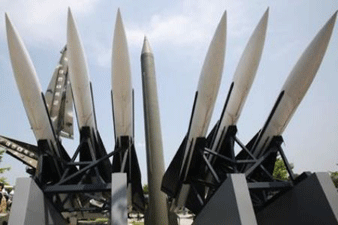
Boris Johnson ‘violating international law’ with plan to build more nuclear weapons, Defence review appears to breach Article 6 of nuclear non-proliferation treaty, Independent, Jon Stone Policy Correspondent, 16 Mar 21,
”………..Reacting to the new policy, Beatrice Fihn, executive director of the International Campaign to Abolish Nuclear Weapons (ICAN), said: “A decision by the United Kingdom to increase its stockpile of weapons of mass destruction in the middle of a pandemic is irresponsible, dangerous and violates international law.
“While the British people are struggling to cope with the pandemic, an economic crisis, violence against women, and racism, the government choses to increase insecurity and threats in the world. This is toxic masculinity on display.
“While the majority of the world’s nations are leading the way to a safer future without nuclear weapons by joining the Treaty on the Prohibition of Nuclear Weapons, the United Kingdom is pushing for a dangerous new nuclear arms race.”
In a further statement, the organisation suggested the UK would face censure at the next NPT review conference, which is due to take place in August at the United Nations.
“The United Kingdom is legally obligated under the nuclear non-proliferation treaty to pursue disarmament. States will meet soon to review the NPT’s success and when they do, the UK will have to answer for its actions,” the statement said.
ICAN won the Nobel Peace Prize in 2017 for its “ground-breaking efforts to achieve a treaty-based prohibition” of nuclear weapons.
Article 6 of the NPT, to which Britain is a signatory, commits countries to “pursue negotiations in good faith on effective measures relating to cessation of the nuclear arms race at an early date and to nuclear disarmament”.
Kate Hudson, general secretary of the UK’s Campaign for Nuclear Disarmament, said: “A decision to increase Britain’s nuclear arsenal absolutely goes against our legal obligations under the nuclear non-proliferation treaty.
“Not only is the UK failing to take the required steps towards disarmament, it is willfully and actively embarking on a new nuclear arms race – at a time when presidents Biden and Putin have renewed their bilateral nuclear reductions treaty. Britain must not be responsible for pushing the world towards nuclear war. This is a dangerous and irresponsible move, and must be reversed.”….. https://www.independent.co.uk/news/uk/politics/boris-johnson-uk-nuclear-weapons-international-law-b1817827.html
UK should build foreig policy on aid, conflict resolution, not on reversing nuclear disarmament
 Tax Research UK 16th March 2021. Billions will be wasted, nuclear waste will be created, a dangerous precedent of reversing disarmament will have been set, and the world will be more unsafe, all for no gain. If the UK was wise now (and but isn’t) it would be pursuing a very different foreign policy, based on that of
Norway.
That country does punch above its weight. It has a strong foreign policy based on aid. It uses that to build strong diplomatic links around the world. And in the process it works, quietly, on conflict resolution.
That’s the way foreign policy should be done. We are just aggressively waving colonial flags. And that’s a disaster as well as being nuclear insanity.
https://www.taxresearch.org.uk/Blog/2021/03/16/nuclear-insanity/
Dilemma over plan to dump Himkley nuclear mud off Cardiff coast

Nation Cymru 15th March 2021, Proposals to dump hundreds of thousands of tonnes more mud from theconstruction of a new nuclear power plant two miles off the Cardiff coast
will be discussed in the Senedd tomorrow. Last year a petition opposing EDF
Energy’s application demanded a full Environmental Impact Assessment
(EIA) before the dump could be licensed. The petition gained almost 10,700
signatures and forced a Senedd debate. In 2018 EDF were granted permission
to dump at the Cardiff Deep Grounds inshore disposal site despite fierce
opposition and an earlier debate in the Senedd.
https://nation.cymru/news/battle-to-block-hinkley-c-mud-dump-returns-to-the-senedd/
New report on human and environmental impact of Hinkley Point C nuclear project

group, has raised concerns around its potential impact on Wales. Among the concerns of the group of expert panellists are its effects on the Severn estuary off the South Wales coast. The estuary has one of the most extensive inter-tidal wildlife habitats in the UK and is the point where several of the UK’s longest rivers meet, including the River Usk near Newport.
https://www.walesonline.co.uk/news/wales-news/hinkley-c-nuclear-severn-estuary-20165575
Nuclear power losing out in the UK – not a good omen for the global nuclear industry
 Seeking Alpha 13th March 2021, My comments on offshore wind making other forms of energy uncompetitive in 2017 have only become more clear in the past 3 years. Now the adoption ofnoffshore wind is happening elsewhere around the world including in the US, Japan, South Korea, Taiwan, China, India.
not one, but 16 of these plants with a capacity of 440 MW at a cost of 2 billion pounds each.
The Rolls Royce strategy is that by building multiple SMRs it will get good at it and the cost might go down. The reality behind this proposal is that it seems pretty ambitious to set out to build 16 plants before one has been successfully constructed. Time seems against this concept as the UK will have largely exited nuclear power by 2030.
Safety breaches at Sellafield have raised fears of a Chernobyl-style disaster.
Fears of Chernobyl-style disaster after 25 safety breaches at Sellafield nuclear plant There have been burst pipes, unstable chemicals, radiation leaks, a cooling tower failure and two plant evacuations in less two years at the site in Cumbria. Mirror John Siddle, 13 MAR 2021
Safety breaches at Sellafield have raised fears of a Chernobyl-style disaster.
Campaigners worry that incidents at Europe’s largest nuclear plant in Cumbria could lead to a blast bigger than the 1986 Ukraine horror.
An official report logs 25 breaches in less than two years, including burst pipes, unstable chemicals, radiation leaks, a cooling tower failure and two plant evacuations.
The bomb squad was called in last August after chemicals “changed state”.
Janine Allis-Smith, of a local anti-nuke group, says campaigners “fear an explosion that would make Chernobyl look like a tea party”.
Sellafield – which now splits spent nuclear fuel into plutonium, uranium and waste – said incident reports were published to reassure the public….
https://www.mirror.co.uk/news/uk-news/fears-chernobyl-style-disaster-after-23709599
UK govt set to increase Trident nuclear warheads, despite commitment to decrease nuclear weaponss stockpile
The National 13th March 2021, THE UK Government is expected to set out plans to increase the number of Trident nuclear warheads next week in what has been described as a “highly provocative” move.
In 2015 the UK’s strategic defence review committed to “reduce the overall nuclear weapon stockpile to no more than 180” by the 2020s – but Whitehall sources indicated this cap may
increase.
Trident nuclear warhead numbers set to increase for first time since cold war
|
Trident nuclear warhead numbers set to increase for first time since cold war https://www.theguardian.com/uk-news/2021/mar/12/trident-nuclear-warhead-numbers-set-to-increase-for-first-time-since-cold-war
Defence and foreign policy review expected to signal rise, in move analysts say is diplomatically provocative Dan Sabbagh Defence and security editor Downing Street’s integrated review of defence and foreign policy is expected next week to signal a potential increase of the number of Trident nuclear warheads for the first time since the end of the cold war.
Whitehall sources indicated that a cap on total warhead numbers – currently set at 180 – is expected to increase, although the exact figure is not yet known, in a move that analysts said was diplomatically provocative. The UK’s stockpile of nuclear weapons peaked at about 500 in the late 1970s, but had been gradually decreasing ever since as the perceived threat from the Soviet Union and now Russia had been assumed to be decreasing. The last strategic defence review, in 2015, committed the UK to “reduce the overall nuclear weapon stockpile to no more than 180 warheads” by the mid 2020s – and reducing the numbers of operationally available warheads to 120. Each warhead is estimated to have an explosive power of 100 kilotons. The atomic bomb dropped on Hiroshima at the end of the second world war was about 15 kilotons. The full reasons for the anticipated move are not yet clear but it comes amid speculation it is designed to help persuade the US to co-fund aspects of a Trident replacement warhead for the the 2030s. Its costs, too, are uncertain. “If this is confirmed, this would be a highly provocative move,” said David Cullen, the director of the Nuclear Information Service. “The UK has repeatedly pointed to its reducing warhead stockpile as evidence that it is fulfilling its legal duties under the nuclear non-proliferation treaty. “If they are tearing up decades of progress in reducing numbers, it will be a slap in the face to the 190 other members of the treaty, and will be regarded as a shocking breach of faith.” Britain has operated its own nuclear weapons since the 1950s but for the past 60 years, following an agreement between the then prime minister, Harold Macmillan, and the then US president, John F Kennedy, the UK has been heavily dependent on US technology. Trident missiles are deployed in four submarines, one of which is continuously at sea to make sure it can strike back in the event of an unprovoked nuclear attack. It relies on an existing US W76 warhead, based on a 1970s design, called Holbrook. However, the W76 is ageing, and the US has proposed developing a more powerful replacement, called the W93. The UK is particularly keen for the US to start work on the W93 and last summer the defence secretary, Ben Wallace, lobbied Congress for the work to go ahead. British MPs voted to renew Trident in principle in 2016, but the Commons is expected to have to vote on a new warhead at some point. In 2016, the Conservatives almost uniformly backed renewal, the SNP voted against, while Labour was split. The MoD has said developing the next generation of Dreadnought submarines to carry the new warhead would cost £30bn plus a £10bn contingency. But officials have so far refused to say how much the warhead would cost. An MoD spokesperson said: “The UK is committed to maintaining its independent nuclear deterrent, which exists to deter the most extreme threats to our national security and way of life. “Replacing the warhead and building four new Dreadnought class submarines are UK sovereign programmes that will maintain the deterrent into the future. We will not comment on speculation about the integrated review, which will be published on Tuesday.” |
|
A dangerous and toxic culture of bullying at Britain’s Sellafield nuclear site
BBC 10th March 2021, A “toxic culture” of bullying and harassment at Sellafield could let
serious safety concerns go unreported, whistleblowers have told the BBC. In
a leaked letter, the nuclear site’s group for ethnic minority staff
described “shocking stories” of racial abuse.
Other workers said sexist and homophobic bullying had become routine. Sellafield said it was committed to eradicating unacceptable behaviour from the workplace.
A BBC investigation found: Multiple claims of serious bullying and sexual harassment among its
10,000-strong workforce. Allegations of racial abuse outlined in a leaked
letter to senior management. Concerns about the working culture at the site
and how it could impact nuclear safety.
“When I started working there, it quickly became apparent there was rampant bullying in the organisation,” said Alison McDermott, a senior consultant hired in 2017 to work on
Sellafield’s equality strategy. She said staff interviews and focus groups
revealed serious allegations of sexual harassment at the sprawling site on
the Cumbrian coast.
Scottish Council calls on big pension fund to stop investing in weapons makers

The Ferret 5th March 2021, Inverclyde Council has called on Scotland’s largest council pension fund to stop investing in arms and to commit to ethical investments. A motion was passed this week after Inverclyde Council was told that Strathclyde Pension Fund (SPF) held shares in 11 of the world’s 20 biggest arms manufacturers, including some involved in the production of nuclear weapons. The council’s decision has been welcomed by Campaign Against Arms Trade, Nuclear Free Local Authorities (NFLA) and Don’t Bank on the Bomb.
https://theferret.scot/inverclyde-council-pension-fund-invest-ethically/
1 This Month


of the week– Nuclear Reactor Information Task Force

14 May – online event From Bombs to Data Centres: the Face of Nuclear Colonialism
To see nuclear-related stories in greater depth and intensity – go to https://nuclearinformation.wordpress.com
-
Archives
- May 2026 (173)
- April 2026 (356)
- March 2026 (251)
- February 2026 (268)
- January 2026 (308)
- December 2025 (358)
- November 2025 (359)
- October 2025 (376)
- September 2025 (257)
- August 2025 (319)
- July 2025 (230)
- June 2025 (348)
-
Categories
- 1
- 1 NUCLEAR ISSUES
- business and costs
- climate change
- culture and arts
- ENERGY
- environment
- health
- history
- indigenous issues
- Legal
- marketing of nuclear
- media
- opposition to nuclear
- PERSONAL STORIES
- politics
- politics international
- Religion and ethics
- safety
- secrets,lies and civil liberties
- spinbuster
- technology
- Uranium
- wastes
- weapons and war
- Women
- 2 WORLD
- ACTION
- AFRICA
- Atrocities
- AUSTRALIA
- Christina's notes
- Christina's themes
- culture and arts
- Events
- Fuk 2022
- Fuk 2023
- Fukushima 2017
- Fukushima 2018
- fukushima 2019
- Fukushima 2020
- Fukushima 2021
- general
- global warming
- Humour (God we need it)
- Nuclear
- RARE EARTHS
- Reference
- resources – print
- Resources -audiovicual
- Weekly Newsletter
- World
- World Nuclear
- YouTube
-
RSS
Entries RSS
Comments RSS
 nuclear-news