UK Parliament’s Public Accounts Committee sets out the grim facts on costs of decommissioning nuclear reactors
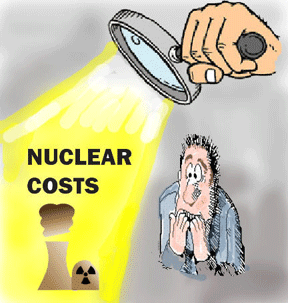
Despite government already having had to provide additional funding of
£10.7 billion, there remains a strong likelihood that more taxpayers’
money will be required to meet the costs of decommissioning the seven
Advanced Gas-cooled Reactor nuclear power stations.
The Nuclear Liabilities Fund, which was set up to meet the decommissioning costs of these stations,
has not kept up with the increased costs of decommissioning or met its
investment targets. In response, government has chosen to top up the Fund
with taxpayers’ money, providing an injection of capital of £5.1 billion
in 2020–21 with a further £5.6 billion expected in 2021–22. HM
Treasury and the Department for Business, Energy & Industrial Strategy have
opted to maintain an investment strategy for the Fund whereby around 80% of
its assets are invested in the National Loans Fund currently earning
minimal returns.
Estimated decommissioning costs on the other hand have
almost doubled since March 2004, estimated at £23.5 billion in March 2021,
and there remains a significant risk that the costs could rise further
putting strain on the Fund.
Public Accounts Committee 20th May 2022
https://publications.parliament.uk/pa/cm5803/cmselect/cmpubacc/118/summary.html
UK nuclear power stations’ decommissioning cost soars to £23.5bn
UK nuclear power stations’ decommissioning cost soars to £23.5bn https://www.theguardian.com/environment/2022/may/20/uk-nuclear-power-stations-decommissioning-cost Failures in government’s investment strategy mean taxpayer has contributed £10.7bn in just two yearsm Sandra Laville Environment correspondent Fri 20 May 2022
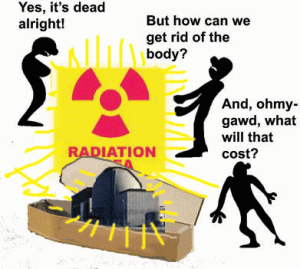
The cost of decommissioning the UK’s seven ageing nuclear power stations has nearly doubled to £23.5bn and is likely to rise further, the public accounts committee has said.
The soaring costs of safely decommissioning the advanced gas-cooled reactors (AGRs), including Dungeness B, Hunterston B and Hinkley B, are being loaded on to the taxpayer, their report said.
Failures in the government’s investment strategy for the fund, which was set up to pay for the decommissioning, have led to the taxpayer topping it up by an additional £10.7bn in just two years.
The nuclear power stations are owned by EDF Energy and provide much of the UK’s nuclear power-generated electricity, which makes up 16% of the energy mix. But the stations are nearing the end of their lives and are scheduled to stop generating electricity during this decade.
The government has recently agreed that once the stations have been defuelled by EDF, which involves the removal of all the spent fuel from the reactor core and cooling ponds, ownership of the stations will be transferred to the government’s Nuclear Decommissioning Authority (NDA) to complete decommissioning.
“The pace at which the stations can be defuelled could have a big impact on the costs, between £3.1bn and £8bn depending on the time taken,” the inquiry report said. “Successful defuelling will depend on all parties being ready and working together, including the NDA being ready to receive and dismantle the volume of fuel arriving at Sellafield. Any delays in the defuelling process could result in costs increasing substantially.
“The handover agreement does not appear to sufficiently ‘incentivise cost efficiency and ensure a smooth transfer of defuelled stations to the NDA’.”
The public accounts committee also said it had concerns over whether the NDA had the capacity to take on the seven AGR stations in addition to its other responsibilities, which includes decommissioning the older Magnox reactors.
It will cost the UK taxpayer £132bn to decommission all the UK’s civil nuclear sites and the work will not be completed for another 120 years, according to latest estimates.
Boris Johnson has pledged to build eight nuclear power stations in eight years. But the UK has no facility for permanently and safely storing the waste from past, present or future nuclear power stations. Most is currently stored at Sellafield, one of the most complex and hazardous nuclear sites in the world.
Nuclear Waste Services, an arm of the government, is seeking a site to build a geological deposit facility deep underground for all the UK’s nuclear waste.
MPs on the public accounts committee said in their report on Friday the government must learn lessons from the rising costs of decommissioning the seven AGR reactors and be clear how the decommissioning of proposed new nuclear stations would be funded.
The seven stations were sold by the government to EDF in 2009, with the later agreement that the French company would remove the fuel from the stations when they closed, and the Nuclear Decommissioning Authority would take on the decommissioning of the sites. But the cost of decommissioning the seven AGR reactors that began to close last year, plus Sizewell B, has more than doubled from £12.6bn in 2004-05 to £23.5bn in 2020-21, the public accounts committee report said.
“There remain significant uncertainties that will need to be managed to prevent further increases in costs and ease pressures on the fund,” the report said. “The cost of defuelling will depend on the stations not closing significantly earlier than planned and how quickly they can be defuelled once electricity generation ceases.”
The public accounts committee, in a previous report, said the cost of decommissioning the older Magnox reactors – which were the first generation of UK nuclear stations – had increased by billions of pounds because of uncertainty over the condition of the sites and how to tackle the decommissioning.
The PAC report said the closure of seven nuclear stations by 2028 would have a significant impact on energy production, but EDF has said there can be no extensions to the life of the reactors while the UK waits for new generating capacity to come online.
Cost of shutting down UK’s old nuclear reactors is doubling and then some
The cost of decommissioning the UK’s seven ageing nuclear power stations
has nearly doubled to £23.5bn and is likely to rise further, the public
accounts committee has said. The soaring costs of safely decommissioning
the advanced gas-cooled reactors (AGRs), including Dungeness B, Hunsterston
B and Hinkley B, are being loaded on to the taxpayer, their report said.
Failures in the government’s investment strategy for the fund, which was
set up to pay for the decommissioning, have led to the taxpayer topping it
up by an additional £10.7bn in just two years. The nuclear power stations
are owned by EDF Energy and provide much of the UK’s nuclear
power-generated electricity, which makes up 16% of the energy mix. But the
stations are nearing the end of their lives and are scheduled to stop
generating electricity during this decade. The government has recently
agreed that once the stations have been defuelled by EDF, which involves
the removal of all the spent fuel from the reactor core and cooling ponds,
ownership of the stations will be transferred to the government’s Nuclear
Decommissioning Authority (NDA) to complete decommissioning.
Guardian 20th May 2022
https://www.theguardian.com/environment/2022/may/20/uk-nuclear-power-stations-decommissioning-cost
Greens oppose Nato membership for Scotland and ‘evil’ nuclear weapons
The National By Angus Cochrane@_Anguscchrn, Multimedia Journalist 18 May 22, NUCLEAR weapons are “simply evil”, the Scottish Greens have said as they detailed their reasons for opposing Nato membership for an independent Scotland.
West Scotland MSP Ross Greer said it would be “morally wrong” for Scotland to join Nato if it were to become independent. It comes after Nicola Sturgeon reaffirmed her party’s support for joining the military alliance in the event of a Yes vote.
Greer explained both parties, who signed a historic co-operation deal in Holyrood last year, “agreed to disagree” on Nato. The MSP told BBC Scotland’s The Nine: “It’s no surprise to anyone that the Scottish Greens and the SNP have different positions on Nato.
“For the Scottish Greens, we enthusiastically believe in co-operation, especially in areas like security and defence.
“Patrick Harvie lists one of them and that is Nato’s first strike nuclear policy. Nato reserves the right to launch the first strike in a nuclear war.
“That would be world ending and we believe that is simply evil. No-one has the right to do that and we believe it would be morally wrong for Scotland to join such an alliance.”
BBC Scotland put it to Greer that nuclear weapons were a deterrent.
Greer added: “But it is a Nato policy. First strike is not about responding to an attack, first strike is about the right to launch, to actually start that war, to start the last world war, because it would be the war that ended the world as we know it.
| “That’s the nature of nuclear weapons.“The very existence of nuclear weapons risks the chance of nuclear war.“If we want to persuade rogue and hostile states to reduce their nuclear stockpiles, asking them to do it, demanding that they do it unilaterally, has no chance of success.”“This is a fundamental moral question. I don’t want the last thing that my country potentially does in its existence is to wipe another country off the map. Nuclear weapons are simply evil.”…………………….. The intervention comes after Nicola Sturgeon said the Russian invasion of Ukraine has strengthened the case for joining Nato…………………………… https://www.thenational.scot/news/20147291.greens-oppose-nato-membership-scotland-evil-nuclear-weapons/ |
“We agree with the First Minister that Scotland has a really positive role to play in Europe’s collective security arrangements. But we disagree on membership of Nato for two reasons.
Sellafield Update 2022
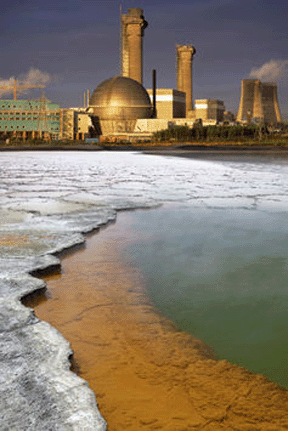
nuClear News, May 2922, Executive Summary
Reprocessing
Spent fuel from the UK’s first-generation Magnox reactors is still being reprocessed. It was
scheduled to end in 2012 to help the UK meet its international obligations to end the radioactive
pollution of the north-east Atlantic. It’s now scheduled to end later this year.
Storage
At the end of 2021, the First Generation Magnox Storage Pond (FGMSP), one of Sellafield’s most
hazardous facilities, and the Pile Fuel Storage Pond (PFSP) still contained 75% of the legacy
spent fuel which has to be removed and placed in interim storage. This degraded fuel won’t be
in interim storage until 2025. It will then have to be conditioned, and eventually transferred to
the proposed Geological Disposal Facility by 2125.
Spent fuel
The Thermal Oxide Reprocessing Plant (THORP) has closed, and almost 5,000 tonnes of unreprocessed spent fuel from the UK’s second-generation Advanced Gas-cooled Reactors (AGRs)
will be stored in ponds at Sellafield until at least 2075. In addition, an estimated 141 tonnes of
exotic fuel will remain in storage once the Magnox reprocessing plant closes, and isn’t expected
to be in a modern interim storage facility until 2028. Sellafield is also contracted to receive and
store spent submarine fuel from the MoD.
Plutonium
The government has yet to decide about possible re-use or disposal of the 140 tonnes of
plutonium stored at Sellafield. Its preferred option is to re-use it in Mixed Oxide Fuel (MOX) for
nuclear reactors, but some plutonium will be unsuitable for this and will need to be immobilised
and treated as a waste for disposal. Some of the older plutonium packages and facilities are
amongst the highest hazards on the Sellafield site. All plutonium needs to be gradually transferred to a new store, and two more stores are likely to be required – one is expected to be
ready in 2033 and the second in 2040.
High Level Waste
High Level Waste (HLW) Liquors, left over after reprocessing, need to be constantly cooled
otherwise they would start to boil causing radioactivity to escape and contaminate the
surrounding environment. Conversion of these liquors into a solid form and emplacement in
storage is not expected to be complete until 2030. The solid waste will remain in storage until
‘disposal’ by 2104. All HLW belonging to overseas customers should be returned by 2025.
Levels of risk
In 2013 Sellafield was described as posing an “intolerable risk”. Then in 2018 it was reported
that “work to reduce risk and high hazard at Sellafield has taken an encouraging turn for the
better”. Since then, the site has not been much in the news, but there is still a lot of work to do,
as many of the risks remain. And the timescales for carrying out this work are simply
staggering. According to the UK Radioactive Waste Inventory decommissioning won’t be
complete until around 2090 and then all buildings won’t be demolished until 2120 – almost a
century from now. (1)
Nuclear Free Local Authorities seeks assurance British nuclear will not rely on Russian uranium
An organisation representing UK councils, Nuclear Free Local Authorities
(NFLA), has written for reassurance that Russian uranium will not be used
to power British nuclear reactors. The group reached out to the Chief
Executive of nuclear plant operator EDF energy, Simone Rossi, and the
Minister for Climate Change, Greg Hands, for clarification.
This comesafter NFLA Chair, Cllr David Blackburn, noticed mentions of a long-term
contract for natural and enriched uranium with Russian-owned supplier Tenex
in an EDF Energy report. In the annual financial report from EDF’s French
parent company, one section looks at the company’s strategy for enriching
natural uranium into uranium 235
Environment Journal 17th May 2022
Beaches near Sellafield contaminated with radioactive particles.
Radiation Free Lakeland has written to Cumbria Wildlife Trust asking them
to cancel the “Sea-Coastal Foraging Evening” at St Bees on 18th May.
Who doesn’t love to forage for food on the beach? The problem with
beaches near Sellafield (and not so near) is that radioactive particles are
routinely washed onto the beaches and into the abundant wild food found on
our beaches. Sellafield has blighted our coasts and continues to do so with
impunity thanks to the criminal nonchalance promoted by events like the one
organised by Cumbria Wildlife Trust. The risk to health is very real,
especially to the young and the pregnant.
Radiation Free Lakeland 15th May 2022
Boris Johnson’s UK ”nuclear renaissance” – now desperate for funding, pleads to USA
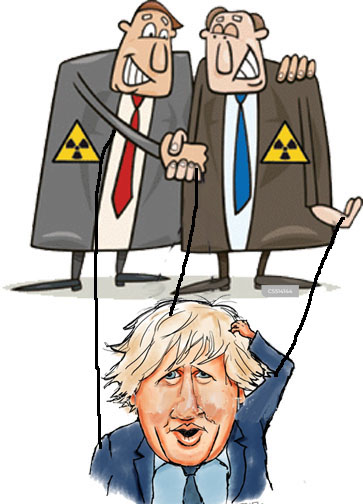
| Kwasi Kwarteng seeks US investment for UK nuclear plants to end reliance on China. There are plans for expansion of nuclear power in Britain as part of a new energy security strategy following the invasion of Ukraine. The Business Secretary is to fly to the US this week to drum up American investment in new nuclear plants amid concerns that the UK is too reliant on China for help building reactors in Britain. Kwasi Kwarteng is expected to hold talks with Jennifer Granholm, the US energy secretary, in Washington DC, where a Whitehall source said the minister was “keen to strengthen cooperation with the Americans on energy security”. Last month Boris Johnson and Mr Kwarteng announced plans for a massive expansion of nuclear energy in Britain as part of the country’s new energy security strategy that followed Vladimir Putin’s invasion of Ukraine. Mr Kwarteng is said to be concerned that Britain has become too reliant on two major players in the nuclear market – China General Nuclear, a Chinese state-owned energy giant, and EDF, which is owned by the French state. Ministers are hoping to raise more than £10 billion in private capital to fund the new Sizewell C nuclear power station in Suffolk. The Government is expected to take a 20 per cent equity stake in the project, with a further 20 per cent for EDF and the final 60 per cent coming from private investors. A Whitehall source said: “We’ve become too reliant on a handful of companies to develop new nuclear. Britain split the atom and built the world’s first full-scale nuclear power station, but we’ve fallen so far behind after three decades of drift. “We want British and American companies to pile in the cash to get our nuclear renaissance off the ground. The Business Secretary is keen to work with safe and reliable investors from like-minded countries and hug them close.” Telegraph 14th May 2022 https://www.telegraph.co.uk/politics/2022/05/14/kwasi-kwarteng-seeks-boost-us-investment-nuclear-end-reliance/ |
Uncertain funding for Britain’s plans for new nuclear reactors
China General Nuclear has provided substantial investment for Britain’s
nuclear power stations alongside France’s EDF. The two companies are
funding Hinkley Point C in Somerset but the project has been beset by cost
overruns and delays.
EDF is expected to announce more delays to Hinkley C
within weeks and will have to raise billions in extra finance for the
project. The company has warned CGN is not likely to increase its funding
for the plant.
Ministers have drawn up a so-called Regulated Asset Base
funding model to replace Chinese investment for nuclear plants in future
and incentivise other private investors to put forward funding. The RAB
model would see consumers start paying indirectly towards the costs of a
new power project during the construction phase. They would fund the
project through a small rise in their energy bills.
The model replaces the current Contracts for Difference scheme used for Hinkley Point C whereby
the developer finances the construction phase and only receives revenue
when the plant generates electricity.
EDF has also warned that separate
plans to build the Bradwell nuclear power plant in Essex are likely to fall
through because of political opposition to Chinese investment. In its
annual report, EDF said: “There is great uncertainty around the
development perspectives of the Bradwell Project, mainly related to the
political opposition to a Chinese company leading a critical UK
infrastructure project and from the lack of local stakeholder support.
““The risks of not being in a position to carry out the Bradwell project
are high and have increased in 2021.”
The government is also exploring
options for squeezing China out of the plans to build the Sizewell C plant
in Suffolk.
Telegraph 13th May 2022
https://www.telegraph.co.uk/business/2022/05/13/energy-bills-rise-pay-nuclear-plants-says-kwarteng/
Regulated Asset Base system will transfer nuclear’s financial risks to the UK public, rather than the nuclear companies

Some energy experts, however, are sceptical that the promised tidal wave of investment will ever materialise
Cran-McGreehin says one danger of the RABmodel is that it transfers risk to bill-payers rather than the companies building the station.
| City institutions have been taking a keen interest in the Tideway’s progress. Investors are intrigued by the novel way the £4.2 billion project was financed. The method has been seized on by the government to kick-start a £100 billion-plus splurge on new nuclear power stations, a move that could create a giant new market in infrastructure investment. The not-so-magic ingredient is asking customers to pay more up front and to guarantee payments in the future. Kwasi Kwarteng, the business secretary, said the plan would have a “small effect” on bills but did not say by how much they would go up. Industry experts think each large new station — and the plan envisages as many as eight — would add between £6-£10 to the average household bill. The buffer of cash raised from customers can be used to hammer out problems with power plant designs, and can be eaten into if construction proves troublesome. The project company is also allowed to continue to charge customers once the station is working, with the amount based on the value of the project. The whole arrangement is monitored by an independent regulator, hence its name: regulated asset base (RAB) financing. As a condition of the licence, investors in the project company are on the hook for a pre-agreed level of cost overruns. The Department for Business claims the reduction in interest payments could save consumers £30 billion over the life of a new power station. “In essence it is reducing the cost of capital by cutting back the construction risk to investors,” Richard Goodfellow, head of infrastructure, projects and energy at the City law firm Addleshaw Goddard, said. Some energy experts, however, are sceptical that the promised tidal wave of investment will ever materialise. “There is no cheap or easy way to do new nuclear,” Simon Cran-McGreehin, head of analysis at the Energy and Climate Intelligence Unit (ECIU), said. “I fear the government’s big ambitions will prove a distraction that won’t ultimately lead to much.” Since Johnson threw his weight behind the RAB route, the government has quickly put in place some necessary stepping stones. Four days after the nuclear summit at Downing Street, the Department for Business quietly published the criteria that projects would have to meet. Ministers are hoping that big British pension funds will buy the bonds and have helped to clear the way with reforms to the EU’s Solvency II regime, which at present limits the type of investments that insurers can hold. Goddard sees groups with a record of investing in infrastructure projects — Canadian pension funds, for example — as the biggest players. “I would expect the bulk of the investment — perhaps two-thirds — to come from the big global infrastructure funds that are already big investors in UK assets,” he said. “There are some investors who will be put off — either because of the size of the projects, the timescales, or just because it is nuclear.” After Sizewell, the pipeline of projects is unclear. Ministers are keen to push ahead with the on-again, off-again scheme for a new station at Wylfa on Anglesey. Hitachi, the Japanese industrial group, was to have built two new reactors there, but the project has now been taken up by the US engineering giant Bechtel. Senior sources at EDF say it is also casting a covetous eye over Wylfa as the possible site for another Hinkley Point design. There have also been discussions on a new plant at Moorside, close to the Sellafield nuclear site in Cumbria. RAB financing could also be adopted for a new type of small reactor. Rolls-Royce, which builds the power plants for nuclear submarines, has submitted a design to Britain’s nuclear regulators, while two US providers, Last Energy and TerraPower, are also weighing options in the UK. Cran-McGreehin says one danger of the RABmodel is that it transfers risk to bill-payers rather than the companies building the station. His bigger query, however, is whether there is too much concentration on nuclear. “Governments do from time to time get very excited about nuclear, then cool off,” he said. “I am not convinced allthis will actually come to pass, and in the meantime it risks taking thefocus away from investment in renewable energy.” Times 14th May 2022 https://www.thetimes.co.uk/article/why-nuclear-push-could-be-sweet-music-for-city-7gj7s5s38 |
Kwasi Kwarteng: Nuclear push may increase energy bills, minister admits.
Kwasi Kwarteng: Nuclear push may increase energy bills, minister admits.
THE TORY Energy Secretary has admitted the Government’s nuclear plans may
increase household energy bills. Kwasi Kwarteng conceded the Tory push for
new nuclear power plants could see energy bills go up despite the
Government’s failure to introduce immediate measures to tackle the cost
of living crisis.
The National 13th May 2022
Timely release of Netflix documentary on Three Mile Island nuclear accident
| Christina Macpherson <christinamacpherson@gmail.com> | 7:18 AM (10 hours ago) |  | |
| to me |
There are those
who would maintain, despite all this, that the profit motive is fine so
long as the industry is properly regulated. Again, the Three Mile Island
affair calls this into question. Regulators tend to be appointed by
politicians. Even if they have an apolitical remit – such as, you know,
keeping people safe – their leaders tend to play close attention to
political priorities. If the political priority is to encourage nuclear
energy as an alternative to importing hydrocarbons from unreliable
partners, then they will pay attention to that.
Independent 14th May 2022
https://www.independent.co.uk/voices/three-mile-island-netflix-documentary-nuclear-power-b2078962.html
Drones seized at UK nuclear bases after a ‘swarm’ and reports of ‘red lights’
Drones have been seized by security personnel at nuclear facilities with
one report of a ‘swarm’ at a UK installation, newly released files
show. The unmanned aerial systems were either sighted or secured at sites
across the country amid concerns over the security threat posed by the
technology.
Twenty such reports between 2020 and last year have been
released to Metro.co.uk under the Freedom of Information Act. In two
instances, the drones landed ‘in the area’ and were secured by
personnel. Multiple other reports were made of the aerial vehicles near
facilities or nuclear objects such as reactors, boats and submarines. A
passing detail in another response shows there was a report of a swarm –
where interlinked drones take part in the same operation or attack – at a
nuclear licensed site in the UK. The incident took place between January
2014 and July 2020, according to the Office for Nuclear Regulation, which
gave no further details.
The reports come at a time of heightened tensions
between the West and China and Russia, which have each been linked to
concerted physical and cyber spying operations in the UK. Peter Burt, who
has studied drone use and is part of the Nukewatch monitoring network,
wants the UK authorities to provide a fuller picture of the incidents and
the potential threats posed. Mr Burt told Metro.co.uk:
‘There have
certainly been cases of coordinated swarms of drones spotted flying over
nuclear facilities in other countries, for example in France and the United
States, so this raises questions about the security of our own nuclear
facilities. I think it’s a legitimate question to ask whether similar
incidents have occurred in this country and, if they have, who do we think
is behind them? ‘I have had scant information back from the Ministry of
Defence when I have submitted Freedom of Information Act requests about
this issue and I think there is a clear public interest in more information
being disclosed.’
Metro 15th May 2022
Cost of living: Ministers consider delaying nuclear power decommissioning to help ease crisis
Government will consider plans only if nuclear regulator believes it is safe to keep reactors online
inews By Richard Vaughan Ministers are looking into delaying the decommissioning of existing nuclear power stations in a bid to keep soaring energy prices down in the coming years, i understands.
Prime Minister Boris Johnson has demanded his Cabinet look into ways to tackle the cost of living crisis, urging them to be “as creative as possible” in devising measures to ease the burden on households.
Whitehall sources have told i that among the options being examined are plans to keep existing nuclear reactors going beyond the date they are due to be taken off grid……..
Six of the UK’s seven nuclear reactors are due to go offline by 2030. Due to the rampant cost of fossil fuels, nuclear power is now among the cheaper energy sources for the UK, prompting Business Secretary Kwasi Kwarteng to look at whether they could be kept operational.
Nuclear industry insiders believe the Hinkley Point B reactor, which is due for decommission in July, could be extended for several more years.
Six of the UK’s seven nuclear reactors are due to go offline by 2030. Due to the rampant cost of fossil fuels, nuclear power is now among the cheaper energy sources for the UK, prompting Business Secretary Kwasi Kwarteng to look at whether they could be kept operational.
Nuclear industry insiders believe the Hinkley Point B reactor, which is due for decommission in July, could be extended for several more years.,,,,,,,,,,,,,,,,,,,,,,,,,,,,,,,,,,,,,,, https://inews.co.uk/news/politics/cost-of-living-ministers-consider-delaying-nuclear-power-decommissioning-to-help-ease-crisis-1625223
The future of nuclear waste: what’s the plan and can it be safe?
The future of nuclear waste: what’s the plan and can it be safe? The Conversation , Lewis Blackburn, EPSRC Doctoral Prize Fellow in Materials Science, University of Sheffield 11 May 22, The UK is planning to significantly expand its nuclear capability, in an effort to decrease its reliance on carbon-based fossil fuels. The government is aiming to construct up to eight new reactors over the next couple of decades, with a view to increasing power capacity from approximately 8 gigawatts (GW) today to 24GW by 2050. This would meet around 25% of the forecast UK energy demand, compared to around 16% in 2020
As part of this plan to triple nuclear capacity, also in the works is a £210 million investment for Rolls-Royce to develop and produce a fleet of small modular reactors (SMRs). …………
New reactors will inevitably mean more radioactive waste. Nuclear waste decommissioning, as of 2019, was already estimated to cost UK taxpayers £3 billion per year. The vast majority of our waste is held in storage facilities at or near ground level, mostly at Sellafield nuclear waste site in Cumbria, which is so large it has the infrastructure of a small town.
But above-ground nuclear storage isn’t a feasible long term plan – governments, academics and scientists are in agreement that permanent disposal below ground is the only long-term strategy that satisfies security and environmental concerns. So what plans are underway, and can they be delivered safely?
……….. Previous ideas have included disposing of the extra waste in space, in the sea and below the ocean floor where tectonic plates converge, but each has been shelved as too risky.Now, almost every nation plans to isolate radioactive waste from the environment in an underground, highly engineered structure called a geological disposal facility (GDF). Some models see GDFs constructed at 1,000 metres underground but 700 metres is more realistic. These facilities will receive low, intermediate or high level nuclear wastes (classified as such according to radioactivity and half-life) and store them safely for up to hundreds of thousands of years.
The process for creating such a facility is not simple. The organisation responsible for delivering the GDF, which in the UK is Nuclear Waste Services (NWS), must not only overcome huge environmental and technical issues but also earn the public’s support.
Will all GDFs look the same?Although generic design concepts do exist, each GDF will have unique aspects based on the size and constitution of the waste inventory and the geology of where it is installed. Every nation will tailor its GDF to its individual needs, under the scrutiny of regulators and the public.Underpinning all GDFs, however, will be what is known as the multi-barrier concept. This combines man-made and natural barriers to isolate nuclear waste from the environment, and allow it to steadily decay.
The system for preparing high-level waste for storage in such a system will start with spent nuclear fuel rods from reactors. First, any uranium and plutonium that is still usable for future reactions will be recovered. The residual waste will then be dried and dispersed into a host glass, which is used because glass is tough, durable in groundwater and resistant to radiation. The molten glass will then be poured into a metal container and solidified, so that there are two layers of protection.
This packaged waste will then be surrounded by a backfill of clay or cement, which seals the excavated rock cavities and underground tunnel structures. Hundreds of metres of rock itself will act as the final layer of containment.
How is the UK programme going?The UK GDF programme is in its early stages. The siting process operates on a so-called volunteerism approach, in which communities can put themselves forward as potential sites to host the facility. At present, a working group (Theddlethorpe, Lincolnshire) and three community partnerships (Allerdale, Mid Copeland and South Copeland in Cumbria) have formed. Whilst working groups are at earlier stages of the siting process, the next steps for community partnerships are to begin more extensive geological surveys, followed by drilling boreholes to assess the underlying rock………………..
The UK government aims to identify a suitable site within the next 15-20 years, after which construction can start. The timescale from siting to closing and sealing the first UK GDF is 100 years, making this the largest UK infrastructure project ever……….
Is there another way?
It is the scientific consensus, internationally, that the GDF approach is the most technically feasible way to permanently dispose of nuclear waste. ………
The only other approach that has received any traction is the deep borehole disposal (DBD) concept. At face value, this is not too dissimilar from a GDF approach; drilling boreholes much deeper than a GDF would be (up to several kilometers) and putting waste packages at the bottom. Countries such as Norway are considering this approach. https://theconversation.com/the-future-of-nuclear-waste-whats-the-plan-and-can-it-be-safe-181884
1 This Month


of the week– Nuclear Reactor Information Task Force

14 May – online event From Bombs to Data Centres: the Face of Nuclear Colonialism
To see nuclear-related stories in greater depth and intensity – go to https://nuclearinformation.wordpress.com
-
Archives
- May 2026 (156)
- April 2026 (356)
- March 2026 (251)
- February 2026 (268)
- January 2026 (308)
- December 2025 (358)
- November 2025 (359)
- October 2025 (376)
- September 2025 (257)
- August 2025 (319)
- July 2025 (230)
- June 2025 (348)
-
Categories
- 1
- 1 NUCLEAR ISSUES
- business and costs
- climate change
- culture and arts
- ENERGY
- environment
- health
- history
- indigenous issues
- Legal
- marketing of nuclear
- media
- opposition to nuclear
- PERSONAL STORIES
- politics
- politics international
- Religion and ethics
- safety
- secrets,lies and civil liberties
- spinbuster
- technology
- Uranium
- wastes
- weapons and war
- Women
- 2 WORLD
- ACTION
- AFRICA
- Atrocities
- AUSTRALIA
- Christina's notes
- Christina's themes
- culture and arts
- Events
- Fuk 2022
- Fuk 2023
- Fukushima 2017
- Fukushima 2018
- fukushima 2019
- Fukushima 2020
- Fukushima 2021
- general
- global warming
- Humour (God we need it)
- Nuclear
- RARE EARTHS
- Reference
- resources – print
- Resources -audiovicual
- Weekly Newsletter
- World
- World Nuclear
- YouTube
-
RSS
Entries RSS
Comments RSS
 nuclear-news