Dounreay nuclear plant radiation scare over high numbers of ‘harmful’ radioactive particles.

Highest number of nuclear particles found in 26
years and ‘they may pose risk’. A public health warning has been issued
after harmful radioactive particles were discovered to have leaked out in
the area surrounding Dounreay nuclear plant, in Caithness. Fragments of
irradiated nuclear fuel have been detected at the shoreline near the power
plant and nuclear testing facility, with experts from independent Dounreay
Particles Advisory Group saying they “pose a realistic potential to cause
harm to members of the public”.
The radioactive material is said to be the
at the highest levels almost three decades – with 73 per cent of the
particles found deemed “significant”, according to a report. A survey found
15 particles on the shoreline, the most since 1996 when 17 were found, The
Daily Mail reported.
It comes after research suggested the leaks occurred
sometime between 1958 and 1984. In response to ongoing concerns, Dounreay
Site Restoration Ltd, which is in charge of the plant’s clean-up, said it
was closely monitoring the situation.
It comes as Shaun Burnie of
Greenpeace Asia, a nuclear specialist who formerly worked at Dounreay, also
warns of the risk to public health. He said: “The scale of the radiological
hazard from the Dounreay particles is enormous, with hundreds of thousands
and more highly radioactive nuclear fuel particles on the sea bed.
Express 29th Oct 2022
Academics and industry questioned on UK nuclear power supply.

The Science and Technology Committee begin its Delivering Nuclear Power evidence
sessions on National Engineering Day in the UK. This session examines how
UK nuclear energy production will be maintained and increased. The
Government has said nuclear power will play a key part in the UK’s energy
security and goal of reaching Net Zero emissions by 2050, setting the
intention to triple the current electricity output by 2050.
However, all but one civil nuclear reactor in the UK will be decommissioned by 2028
under current plans. And only one new reactor, Hinkley point C in Somerset,
is currently expected to be operational before 2030. In the final panel,
the Committee will question EDF executives on the four-year delay in the
construction of Hinkley Point C, completion of which is expected in 2027.
The progress in plans for a new reactor in Sizewell C in Suffolk will also
be discussed.
UK Parliament 28th Oct 2022
Sizewell C nuclear could become low on the priority list of UK government projects
Therese Coffey’s appointment as the new Environment Secretary came as a
surprise to those who expected her to return to the backbenches after the
departure of her close friend Liz Truss from Downing Street.
But actually it looks like quite an astute move by new Prime Minister Rishi Sunak if he
wants to keep all wings of his party onside.
What it also does is throw up
a very real challenge for her – the Environment Secretary has one of the
most controversial green issues in the country sitting in the middle of her
constituency and an electorate divided about what the government could do.
Dr Coffey is now in charge of the Department for the Environment, Food and
Rural Affairs – it’s effectively the old Min of Ag with environmental
issues tagged on.
What happens at Sizewell is not up to the Environment
Secretary, but the department has a very big input into the decision. It
would probably have to be one of her more junior ministers who actually
makes its case in the Sizewell debate – but as Secretary of State she will
always be closely identified with that by the public.
Of course, it remains
to be seen how much of an issue Sizewell C is likely to be for the Sunak
government. It is a very expensive project and would require a great deal
of government capital expenditure to get it under way. Given that we’re
facing a second era of austerity in 15 years and that any investment now
will not pay off for a decade, I can’t help feeling that any moves towards
progressing Sizewell C are likely to proceed in first gear (or even be left
in neutral) for the next two or three years.
East Anglian Daily Times 27th Oct 2022
https://www.eadt.co.uk/news/23080960.will-coffeys-new-job-mean-sizewell-suffolk-coast/
Reporters Without Borders leads 16 organisations urging UK Home Secretary to intervene in extradition of Julian Assange.

UK: RSF leads a coalition of 16 organisations in urging Home Secretary Suella Braverman to urgently intervene in Assange extradition
Reporters Without Borders (RSF) has led a coalition of 16 organisations in urging the new UK Home Secretary, Suella Braverman, to intervene in the US government’s request to extradite Wikileaks publisher Julian Assange. These groups, representing press freedom, free expression, and journalists’ organisations, have also requested a meeting with Braverman to discuss concerns in the case, after a request for a meeting with former Home Secretary, Priti Patel, went unanswered. The full text of the letter is below.
The Rt. Hon Suella Braverman
Secretary of State for the Home Department
2 Marsham Street
London
SW1P 4DF
7 October 2022
Dear Home Secretary,
We, the undersigned press freedom, free expression and journalists’ organisations, are writing to raise the case of WikiLeaks publisher Julian Assange and request you to urgently intervene to ensure he is not extradited to the United States.
In June your predecessor, Priti Patel, signed the order to extradite Mr Assange, despite widespread international concern that his extradition would have alarming implications for journalism and press freedom. In fact, many of the signatories in this letter wrote to Ms Patel warning that Assange’s prosecution “would set a dangerous precedent that could be applied to any media outlet that published stories based on leaked information, or indeed any journalist, publisher or source anywhere in the world.”
Our request for a meeting was unfortunately left unanswered. We are therefore now asking you, Home Secretary, to meet with the signatories of this letter to discuss the case in detail.
We urge you, Home Secretary, to intervene in this extradition request as a matter of priority. In the US, Mr Assange would face trial on 17 counts under the Espionage Act and one count under the Computer Fraud and Abuse Act, which combined could see him imprisoned for up to 175 years. He is highly likely to be detained there in conditions of isolation or solitary confinement despite the US government’s assurances, which would severely exacerbate his risk of suicide.
Further, Mr Assange would be unable to adequately defend himself in the US courts, as the Espionage Act lacks a public interest defence. This would not align with the values of fairness, justice and a public commitment to media freedom that the UK continues to promote.
You now have an opportunity to ensure that this extradition does not proceed. An opportunity to demonstrate through action that the UK means what it says in its commitment to media freedom. And most importantly, the opportunity to reunite Mr Assange with his young family after many years of separation – an act that may ultimately save his life. We ask you to seize this opportunity as a matter of urgency and ensure that the UK government acts in the interest of journalism and press freedom and does not enable the US government to continue to pursue this more than decade-old, politically motivated case.
We look forward to hearing from you and discussing the case further. We would be grateful for a prompt response. Please reply via Azzurra Moores at Reporters Without Borders (RSF) at amoores@rsf.org.
Sincerely,
Rebecca Vincent, Director of Operations and Campaigns, Reporters Without Borders (RSF)
Laurens Hueting, Senior Advocacy Officer, European Centre for Press and Media Freedom (ECPMF)
Séamus Dooley, Assistant General Secretary, National Union of Journalists
Ricardo Gutiérrez, General Secretary, European Federation of Journalists (EFJ)
Ruth Smeeth, Chief Executive, Index on Censorship
Mark Johnson, Legal & Policy Officer, Big Brother Watch
Peter Tatchell, Director, Peter Tatchell Foundation
Dr Suelette Dreyfus, Executive Director, Blueprint for Free Speech
Romana Cacchioli, Executive Director, PEN International
Daniel Gorman, Director, English PEN
Ricky Monahan Brown, President, Scottish PEN
Alix Parodi, President, PEN Suisse Romand
Tanja Tuma, President, Slovene PEN
Alix Parodi, President, PEN Suisse Romand
Zoë Rodriguez, joint President, PEN Sydney, and Chair of the PEN International Women Writers
Jesper Bengtsson, President, Swedish PEN


Scotland ‘could fund England’s nuclear plants after independence’ under “regulated asset base” (RAB) model

the RAB model was favoured by the Tory government because “the fact is the market has fled nuclear”.
“The market has fled nuclear because of the risk and liability. The only way of getting nuclear through is with vast public subsidy, and this is a way of disguising that public subsidy.
the RAB model had been tried before in the US – under the name Early Cost Recovery – “and failed miserably”.
And that public money would come at the very start of construction. They would be paying right from the word go, so this is essentially free money. Even with that there really doesn’t seem to be much interest from the market.”
SCOTTISH bill payers could still be funding nuclear projects south of the Border through additional fees on their energy bills even after independence, one expert has said.
It comes as the UK Government looks to award the first contracts for new nuclear stations in England, which will be funded through the “regulated asset base” (RAB) model.
This RAB model will see electricity suppliers pay a levy to “relevant licensee nuclear companies”, with the costs passed on to consumers in the form of additional fees on top of their energy bills. Under conservative UK Government estimates, this could mean Scottish households’ energy bills rising by around £100 a year.
Dr Paul Dorfman, the chair of the non-profit Nuclear Consulting Group and associate fellow at the University of Sussex’s Science Policy Research Unit, told The National that the RAB model was favoured by the Tory government because “the fact is the market has fled nuclear”.
“RAB is absolutely, unequivocally all about trying to incentivise the market,” he said, “and it is doing it with public money.”
Dorfman went on: “And that public money would come at the very start of construction. They would be paying right from the word go, so this is essentially free money. Even with that there really doesn’t seem to be much interest from the market.”
The nuclear expert, who will give evidence on the topic to a Westminster committee next week, said the RAB model had been tried before in the US – under the name Early Cost Recovery – “and failed miserably”.
He said: “It can work for projects which you know will come in on time, but nuclear has huge liabilities and huge over-runs, and that’s precisely why it doesn’t work. RAB doesn’t work for projects with high liability and high risk.
“The market has fled nuclear because of the risk and liability. The only way of getting nuclear through is with vast public subsidy, and this is a way of disguising that public subsidy.
Dorfman warned that once the UK Government started sinking billions of pounds into efforts to begin construction of eight new nuclear stations by 2030, it would “become a fait accompli”.
He said that even after 17 years – the amount of time he estimates it will take from a contract being awarded to a nuclear plant being finished – “the UK public, and the Scots public, who may no longer be part of the UK, will still be liable for that”.
Dorfman said the first RAB nuclear contracts looked set to be awarded in 2023, estimating that would mean a completion date of the first nuclear plants around 2040.

“That’s too late for our climate,” he said. “It’s far too late for the current energy crisis. The point is of course, why do this when last year solar and wind made up three-quarters of all total new electricity generation capacity installed worldwide?”
“
The Nuclear Consulting Group chair further cautioned that no one knows for certain what the RAB funding arrangements will be.
Craig Dalzell, the head of policy and research at Common Weal, a think tank which has recently produced a report on the RAB funding model, said the “ongoing liability” for new nuclear projects in England should “not be outsourced to Scotland post-independence”.
Dalzell told The National: “The idea that Scottish energy users could be paying for the UK’s nuclear RAB schemes even after independence will surely be something that should be resisted. The Scottish Government should do everything it can to extract guarantees from the UK Government that this will not be the case and that the ongoing liability for these plants will not be outsourced to Scotland post-independence.
“At the very least, any payments for these plants should be taken into account when the time comes for independence negotiations and I would expect these charges to be offset against other debts or added to an equivalent payment from the remaining UK to Scotland to compensate for their mismanagement of energy policy.”
The UK Government’s Department for Business, Energy and Industrial Strategy declined to comment, saying only that its policy has not changed despite a new Secretary of State, Grant Shapps, taking control.
You can read Dr Dorfman’s written evidence on nuclear power to the House of Commons’ Science and Technology Committee here.
Together Against Sizewell and other groups to fight on, despite legal setback

Campaigners have pledged to fight on after the High Court rejected their
appeal against the Government’s decision to approve the new Sizewell C
nuclear power station. Together Against Sizewell C (TASC) and other
campaign groups are seeking an oral hearing through the judicial review
process after an initial assessment by the legal authority deemed the
appeal should be rejected.
The review of the approval had been sought on
the grounds that the decision was unlawful amid concerns about the
maintenance of a water supply to the new £20bn station and the resilience
of the coastline. The provision of fresh water to the site was one of the
key issues raised by the Planning Inspectorate when considering the plans.
TASC chair Pete Wilkinson described the rejection verdict as ‘predictable
and wholly unreasonable,’ adding there appeared to be a ‘presumption’
that judicial reviews should be dismissed rather than used as a forum for
democracy.
East Anglian Daily Times 28th Oct 2022
https://www.eadt.co.uk/news/23082932.high-court-rejects-sizewell-legal-challenge/
‘Whistleblower’ says legal battle with nuclear site owners ‘almost broke me’
A consultant who claims she was dismissed by Sellafield for exposing failures to address a “toxic” working culture has been granted an appeal against her employment tribunal loss.
Yorkshire Post, By Nathan Hyde, 23 Oct 22,
Equality and diversity consultant Alison McDermott said her contract at the nuclear processing plant ended after she wrote a damning “whistleblowing” report about the human resources (HR) leadership team, claiming they had failed to address complaints about bullying and harassment.
After refusing a £160,000 settlement, she took her case to an employment tribunal. But Employment Judge Philip Lancaster dismissed her claim and ruled she was not a whistleblower, following a hearing in Leeds.
She was then ordered to pay £40,000 to help cover the legal costs of Sellafield Ltd and its parent company – the Nuclear Decommissioning Authority.
Ms McDermott, from Burley in Wharfedale, has been granted an appeal and she is now raising money to cover her legal costs, ahead of the next hearing in January.
Her legal team have challenged the ruling, but also criticised the judge for refusing to look at the alleged “toxic culture” at Sellafield and alleged failure of the HR team. They said this provides vital context, as it explains Ms McDermott’s decision to become a whistleblower.
“I am doing everything I can because I’m really concerned about what’s going on at Sellafield,” she said………………………………
Ms McDermott signed a two-day-a-week contract with Sellafield Ltd to work as a consultant in equality and diversity at the nuclear fuel reprocessing and decommissioning site in September 2018.
After taking on the role, looked into allegations of sexual harrasment and homophobic abuse.
She also recieved an anonymous letter claiming “serious problems” about sexual harassment “are being ignored”.
The following month, she compiled a report on the HR leadership team, saying they were viewed as “broken and dysfunctional”
by some staff and failing to effectively deal with allegations of harassment and bullying.
Shortly after filing the report, she was told her £1,500-a-day contract would be terminated due to “funding constraints”.
But during the tribunal, Sellafield’s lawyers said it was because the report, which had cost around £12,000, was “questionable and insubstantial” and “lacked any meaningful analysis”.
According to the ruling, the judge accepted the funding constraints excuse was used to allow Ms McDermott to leave “with her head held high”.
He ruled she was not a whistleblower, because she could not make any “disclosures” which are protected under UK employment law.
Sellafield Ltd, which has previously stated it is committed to eradicating bullying and harassment, has been approached for comment. https://www.yorkshirepost.co.uk/news/people/whistleblower-says-legal-battle-with-nuclear-site-owners-almost-broke-me-3889870
Rishi Sunak’s Richmond constituency is one of the potential locations for a small nuclear reactor factory
Second Welsh location shortlisted for siting of new nuclear reactor
factory. Shotton has been added to the list of potential locations for one
of the three factories across the UK which will manufacture Rolls-Royce’s
fleet of new SMR reactors.
Deeside was confirmed as the first Welsh
location when the initial round of six potential sites were announced in
July. Redcar in the northeast of England has also been added to the
shortlist of candidates list alongside Shotton.
The Rolls-Royce-led
consortium developing the new technology has confirmed the eight locations
following a bidding process which was launched in January and involved
several English regional development bodies and the Welsh Government.
The eight sites also include Tory leadership candidate – and former
Chancellor Rishi Sunak’s Richmond constituency in North Yorkshire, along
with Sunderland, Ferrybridge in West Yorkshire, Stallingborough,
Lincolnshire, and Carlisle. The winning bid has been promised investment of
up to £200m and the creation of up to 200 jobs.
Nation Cymru 22nd Oct 2022
Second Welsh location shortlisted for siting of new nuclear reactor factory
What is Regulatory Asset Base and how will it affect future energy charges for Scots?
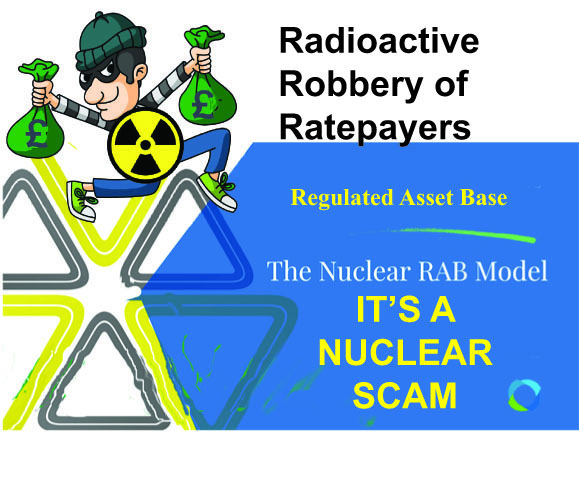
THE UK Government is set on using a Regulatory Asset Base (RAB) model to fund
nuclear projects south of the Border. This will directly result in Scots
paying more on their energy bills. Here, former Scottish Office chief
statistician Jim Cuthbert explains what an RAB model is, and the problems
behind it. There are two main problems.
First, the construction phase of
nuclear projects is extremely long. Further, nuclear construction is
notoriously beset by technical difficulties. Midway through a nuclear
construction project, it will be extremely difficult for the regulator to
resist pressure for the RAB base to be inflated to overcome any technical
problems or uncertainties.
Secondly, the operating life of nuclear projects
is again very long, with the UK Government’s current working assumption
being about 60 years. This means that any surplus which is built into the
stream of future RAB payments will be available to be capitalised over this
long period – which will greatly increase the potential windfall profits
to be extracted by the original equity investors.
The National 23rd Oct 2022
https://www.thenational.scot/politics/23071054.rab-will-affect-future-energy-charges-scots/
Nuclear Free Local Authorities urge the UK’s new Chancellor to scrap plan to invest in the Sizewell nuclear white elephant

Hot on the heels of the new Chancellor’s U-turn of everything his
predecessor held dear, the Chair of the Nuclear Free Local Authorities has
written to Jeremy Hunt to urge him to reverse the promised investment of
£700 million made by the previous prime minister on a flying-visit to
Sizewell C and to withdraw from making a commitment to taking an equity
stake in the nuclear ‘white elephant’.
In his letter to the Chancellor, NFLA Chair, Councillor David Blackburn asks for common sense and caution to prevail: “Once the government has Sizewell C on the hook, rather than
land the fish, it is more likely the fish will swallow you whole! Nuclear
projects are always inevitably delivered way over cost and way over time,
and, as an equity holder, His Majesty’s Government will be saddled with
ever greater demands for cash with an ever-decreasing likelihood of
offloading this turkey to a private investor.”
NFLA 20th Oct 2022
Off the hook: UK government absolves nuclear operators from accident liability

“It’s as we suspected”, says the Chair of the Nuclear Free Local Authorities, expressing his disappointment that once more the UK Government is providing a subsidy to the nuclear industry by absolving operators of the need to pay compensation in the event of an accident.
In a letter to Energy Minister Lord Callanan, Councillor David Blackburn asked how nuclear operators, at present French-owned EDF Energy, would be expected to comply with the requirements of the revised provisions of the Paris Convention that they pay out up to 700 million Euro in damages after an accident, whether through taking out insurance with private-sector underwriters to pay the compensation in the event of an accident or by setting aside funds in an escrow account. This liability will increase by a further 100 million Euro in each of the next five years.
In the letter, Cllr Blackburn also expressed the NFLA’s fears that the UK Government would provide a taxpayer funded bailout for the industry by taking on the liability itself, and Lord Callanan’s reply, citing an immature insurance market, makes it clear that this will indeed be the case: ‘the Government has agreed initially to provide an indemnity, for an economic charge, to cover increased personal injury liabilities for the 10-to-30-year period’.
Commenting Councillor Blackburn said: “This is yet another example of a situation in which nuclear enjoys the benefit of a public subsidy.
“Exactly like the situation with the Nuclear Liabilities Fund, where taxpayers pick up the tab for the cost of decommissioning, which in the last two financial years has meant a further £10.7 billion of public money going to the Fund, the poor suffering British taxpayer will have to shell out up to 1.2 billion Euros, that should be paid by the industry, in the event of a nuclear accident.
“By accepting liability, the government is de-risking nuclear operations. And EDF Energy and its ultimate owner, France, are laughing – they can dodge the liability and walk away scot-free if calamity strikes”.
The NFLA has now sent a request under the Freedom of Information Act seeking further details of the so-called ‘economic charge’ paid by nuclear operator EDF Energy to allow them to evade their legal responsibilities. https://www.nuclearpolicy.info/news/off-the-hook-uk-government-absolves-nuclear-operators-from-accident-liability/
‘A nuclear waste dump and seaside resort don’t go well together’.
Campaigners say the proposal will harm Mabletherpe’s tourism sector. A
proposed nuclear waste dump is hanging over communities like ‘the Sword
of Damocles’, campaigners have claimed.
A company is exploring whether the former Theddlethorpe Gas Terminal could be used to store the waste
underground. They claim it would create 4,000 jobs, and safely store the
radioactive material. However, the Guardians of the East Coast say that the
long decision-making process will harm tourism in Mablethorpe.
Ken Smith, chair of the group, said: “A nuclear waste dump and a bucket-and-spade
resort don’t go well together either. For every job created there, one
could be lost in the tourism industry. “And investment won’t come while
the possibility of the nuclear waste is hanging over Theddlethorpe like the
Sword of Damocles. “It would be better that we found out either way
sooner rather than later. The town will get more run down while a decision
is dragging on.” He likened the long-running fight, which could take 10
to 15 years, to a “war of attrition”.
The Lincolnite 19th Oct 2022
NFLA urges government to distribute iodine tablets to help prepare for nuclear threat
On the 40th anniversary of the Cuban Missile Crisis, President Jo Biden
has recently warned that the situation today is grave as the world faced in
October 1962. In response, the Nuclear Free Local Authorities have written
to the Energy and Health Secretaries urging them to follow the example of
the Polish and United States Government by acquiring and distributing
iodine tablets to the public as a precautionary protective message should
the war in Ukraine become nuclear.
NFLA 17th Oct 2022
Anti-nuclear campaigners have raised fears about a plan to turn Trawsfynydd into a test-bed for a new generation of mini nuclear power plants.
The Nuclear Decommissioning Authority which owns the Trawsfynydd
nuclear power plant site has signed an agreement with the Welsh
government’s development company, Cwmni Egino, to share information on
how best to redevelop the site. Cwmni Egino chief executive Alan Raymant
has said that they are focused on installing one of a new generation of
mini nuclear reactors developed by Rolls-Royce, with an aim to start on the
work by 2027.
But anti-nuclear campaigners CND Cymru, Cymdeithas y Cymod,
CADNO, and PAWB have released a statement opposing the plans and backing
renewables instead. “Wales is already a net exporter of electricity, and
the investment into true renewables like wave, wind, tidal, and sun will be
much more effective than the billions washed down the nuclear drain,”
they said. “We jointly call on the NDA to reconsider its support of
nuclear development in Wales, and Trawsfynydd and Wylfa in particular, and
further call on the UK and Welsh Government to invest in the green, clean,
and renewable future of wave, wind, and sun that we all deserve.”
Last month anti-nuclear campaigners have protested against plans for new nuclear
power stations to be built in Wales with a 70-mile march across Gwynedd and
Anglesey. Plaid Cymru Gwynedd Council leader Dyfrig Siencyn is among those
to have backed the plans for a new reactor at the nuclear power plant,
which employed 500 people when in operation between 1967 and 1993.
“There’s quite a strong anti-nuclear lobby, and they have been
demonstrating recently; we received a petition from them as a council,”
he told the Telegraph newspaper. “But I think we need nuclear energy if
we are serious about addressing the climate change emergency.”
Nation Cymru 14th Oct 2022 https://nation.cymru/news/anti-nuclear-campaigners-raise-fears-about-trawsfynydd-mini-nuke-test-bed-plans/
Low operating costs make the case for investing in utility-scale renewable projects
Renewables met 100% of global electricity demand growth during the first
half of 2022. So says the ‘Global Electricity Mid-Year Insights 2022’
from Ember, a global energy think tank. In fact, it says there was a 389
TWh increase in the demand for electricity in the first half of 2022
compared to the first half of 2021, whereas the rise in renewables supply
was actually a bit more – 416TWh.
That’s not surprising given that
renewables are getting so cheap- including in the UK, with wind and solar
the most prolificate new sources across world. However, that in turn may
create a bit of a problem for older renewables, set up under quite
lucrative subsidy schemes, based on now high gas prices, like the
Renewables Obligation in the UK. As I have noted in earlier posts, there is
pressure on them to switch to the more competitive CfD system. Certainly
the RO system is based on adding a subsidy to wholesale gas prices, so
something has to change, since gas prices are now so high. But there are
issues- will every supplier be happy to accept less earnings? They may drag
their feet.
The record-breaking run in power prices, particularly in
Europe, is creating a favorable investment case for solar and wind
projects, making it increasingly compelling to develop renewable assets
purely based on project economics. According to Norwegian consultancy
Rystad Energy, current spot prices in Germany, France, Italy, and the
United Kingdom would all result in payback of 12 months or less.
Considering the average monthly spot prices for August in these countries
were all well over €400/MWh and the relatively low operating costs of
renewables, investing in utility-scale projects appear to be a no-brainer.
Renew Extra 15th Oct 2022
https://renewextraweekly.blogspot.com/2022/10/renewable-booming-but-windfall-tax.html
1 This Month
26 September – International Day for the Total Elimination of Nuclear Weapons





PLEASE OPPOSE HR 8255 AND S.3639 – bills would accelerate satellite deployment, with no environmental review or safeguards – https://ncstd5li.quorum.us/campaign/169331/
To see nuclear-related stories in greater depth and intensity – go to https://nuclearinformation.wordpress.com
-
Archives
- September 2026 (305)
- August 2026 (330)
- July 2026 (355)
- June 2026 (287)
- May 2026 (306)
- April 2026 (356)
- March 2026 (251)
- February 2026 (267)
- January 2026 (308)
- December 2025 (358)
- November 2025 (359)
- October 2025 (375)
-
Categories
- 1
- 1 NUCLEAR ISSUES
- business and costs
- climate change
- culture and arts
- ENERGY
- environment
- health
- history
- indigenous issues
- Legal
- marketing of nuclear
- media
- opposition to nuclear
- PERSONAL STORIES
- politics
- politics international
- Religion and ethics
- safety
- secrets,lies and civil liberties
- spinbuster
- technology
- Uranium
- wastes
- weapons and war
- Women
- 2 WORLD
- ACTION
- AFRICA
- Atrocities
- AUSTRALIA
- Christina's notes
- Christina's themes
- culture and arts
- Events
- Fuk 2022
- Fuk 2023
- Fukushima 2017
- Fukushima 2018
- fukushima 2019
- Fukushima 2020
- Fukushima 2021
- general
- global warming
- Humour (God we need it)
- Nuclear
- RARE EARTHS
- Reference
- resources – print
- Resources -audiovicual
- Weekly Newsletter
- World
- World Nuclear
- YouTube
-
RSS
Entries RSS
Comments RSS

