Co-Founder of Green and Blacks Calls Out Small Modular Reactors: They Would Produce 30 Times As Much Nuclear Waste
While Nuclear Luvvies and Lords in Cumbria Big Up Small Modular Reactors being touted by Rolls Royce, science is stacked against them. IF science is genuinely allied to ethics and a living planet then Small Modular Reactors (or any nuclear fuelled plan ) should not even be on the table.
Co-Founder of Green and Blacks Calls Out Small Modular Reactors: They Would Produce 30 Times As Much Nuclear Waste — RADIATION FREE LAKELAND
ular Reactors
(or any nuclear fuelled plan) should not even be on the table. Craig Sams
the co-founder of Green and Blacks has written on social media: “This was
what I wrote 12 years ago. The New Scientist now reports that SMRs (Small
Modular Reactors) produce 30 times as much nuclear waste for the amount of
electricity produced and its more complex. I realise Boris upset everyone
by boozing when he should’ve been following his own rules, but condemning
future generations to even worse nuclear waste problems than we already
have is the real crime against humanity. No more nuclear. The French
nuclear power stations are corroding badly and nobody’s sure what to do.
The Irish Sea is still contaminating fish. We had to stop serving laver
bread in our restaurant Seed back in 1970 because of radioactive waste
contamination and things have only got worse since then. Wind, solar,
geothermal, oil,gas, anything but nuclear”
Radiation Free Lakeland 2nd June 2022
UK government urged to end its obsession with nuclear power

THE UK Government has been urged to end its “obsession” with nuclear
power and focus on renewable energy. The SNP have said it is “abundantly
clear” nuclear will cost more and will send energy bills soaring even
further, while people in Scotland “can see clean energy being produced in
their own backyards”.
It comes as a written response to a parliamentary
question confirms further delays to the UK’s Hinkley Point C nuclear
power station, which reports suggest could cost the taxpayer up to £26
billion – opening four years later than scheduled. MP Alan Brown, the party’s Shadow Minister for Energy and Climate change, said the delays added “insult to injury” for consumers, after UK
Government Business Secretary Kwasi Kwarteng admitted recently the
construction of new nuclear plants would initially raise household energy
bills.
Based on the contract awarded by the Westminster government to
Hinkley Point C, the electricity that will be generated by that existing
nuclear station will be priced at £92.50 per megawatt hour, for a 35-year
contract, whereas the electricity being generated from offshore wind is
currently priced at £39.65 per megawatt hour on a 15-year concession. This
means Hinkley Point C alone could add up to £40 a year to consumer bills,
compared to wind power, which could reduce bills by £8 a year. Brown said:
“This latest admission shows the Westminster government’s obsession
with nuclear power will do absolutely nothing to help people cope with the
spiralling Tory-made cost of living crisis. “For months we’ve heard
endless lectures and bleatings from the Tories on their nuclear obsession,
yet every week we’re treated to new reports and estimates of the true
cost of prioritising a massive shift towards nuclear.
“The latest reports simply add insult to injury for the consumers whose energy bills have
skyrocketed in recent months and who were promised a great reprieve when
the UK shifts its reliance to nuclear.
The Scottish Greens have also branded the UK Government’s drive towards nuclear as nonsensical. The
party’s climate change spokesperson, Mark Ruskell, said: “Both the Tory
Government and Labour Party’s ideological obsession with nuclear power
doesn’t make sense either economically or environmentally. “Nuclear is
hugely expensive and leaves a toxic waste legacy for generations. Instead
of investing in toxic white elephants, investment should be focused in
Scotland’s massive renewable potential.”
Lynn Jamieson, chair of the Scottish Campaign for Nuclear Disarmament (CND), said she rejected the UK
Government’s claims nuclear was good for the planet, and insisted we
should be transitioning away from it. She said: “The UK Government’s
claims that nuclear is good for the environment ignores the harms of
uranium mining, the radioactive waste, the risks of cancers and
catastrophic accident – irrationally favouring nuclear industries over
cheaper, safer and more quickly available renewables.
The National 1st June 2022
Nuclear safety warning threatens to derail Boris Johnson’s energy revolution
Austria objects to Sizewell C plant in its latest attack on British energy policy, Telegraph, By Helen Cahill 29 May 2022 . Boris Johnson’s plans for a nuclear energy revolution are facing a fresh hurdle after the Austrian government officially raised concerns about the safety of a new reactor design.
In a letter to the Business Department, Austria’s energy ministry raised the spectre of “severe accidents with high releases” at the Sizewell C plant to be built in Suffolk.The warning, made under the Espoo convention in which nearby countries are allowed to comment on nuclear projects, raises the prospect of legal action to derail Sizewell and will be considered by the Government as part of a planning decision in coming months.
…………………… The Austrians said that it is “questionable” whether the Sizewell design could guarantee that radioactivity will be retained within the reactor’s core.
They warned that the high power of the EPR reactor reduces the time available for an operator to react to any fault and prevent a major accident, and added: “At this time, it cannot be proven beyond doubt that severe accidents with high releases cannot occur.”
The intervention comes after Britain put nuclear power at the heart of its long-term energy strategy. https://www.telegraph.co.uk/business/2022/05/29/nuclear-safety-warning-threatens-derail-johnsons-energy-revolution/
Boris Johnson promised ”1 nuclear reactor a year for 8 years” – one by 2040 if he’s lucky!
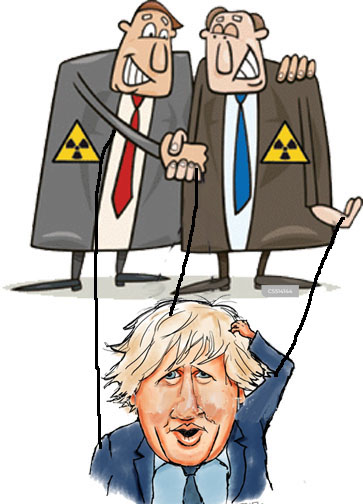
With the weather changing dramatically across the world, will politicians
finally take the climate crisis seriously? With a concerted effort, there
could still be time. But time is the critical thing. And on the campaign
trail in “red wall” seats before the May elections, the prime minister,
Boris Johnson, repeatedly promised building nuclear reactors “one a year
for eight years”.
Last week at the Conservative conference in Wales he
was at it again – this time promising one on Anglesey and another at
Trawsfynydd in Mid Wales.
Anyone who knows a little about nuclear reactors
(current designs 10 years late and £10bn over budget) or about the prime
minister’s other mega-projects – bridges across the Thames and Irish
Sea, and an airport in the Thames estuary – is confident that this
won’t happen.
A protest via my MP brought a measured response from Greg
Hands, the minister responsible for energy policy. He said provided
reactors were value for money and technically sound, the government’s
target for nuclear projects was to give one a final investment decision
this parliament, and two in the next – so maybe three building starts by
2030. On current trends that means one reactor possibly ready by 2040 and
two others much later. Far too late to heal the climate.
Guardian 27th May 2022
Another university infiltrated by the nuclear industry – University of Derby and Rolls Royce

| Rolls-Royce Submarines announced plans recently to open a new academy dedicated to nuclear training within the city. The academy forms part of their Rolls-Royce Submarines’ plans to boost nuclear capability in the UK and create a pipeline for nurturing talent. In partnership with the University of Derby, the site will create 200 new apprenticeships every year for at least the next 10 years. The academy is set to open in September 2022. The Council’s iHub – managed by Connect Derby – will become the home of the new academy, taking centre-stage at the manufacturing-focused innovation and technology site, Infinity Park. Derby City Council 26th May 2022 https://www.derby.gov.uk/news/2022/may/ihub-rolls-royce-nuclear-skills-academy/ |
Chinese involvement is entrenched in Britain’s nuclear power plans
In this week’s Gossage Gossip, our columnist discusses whether the
UK’s recent ban on China’s involvement in nuclear power came a little
too late. It has become clear that, for national security reasons
safeguarding the electricity system, the Government has decided to minimise
the amount of direct Chinese involvement in new nuclear construction. While
China was originally welcomed with open arms, the idea now is to kick the
Chinese out from their projected 40% funding of Sizewell C, and block
entirely the concept of a 100% Chinese reactor at Bradwell B.
But might this be a case of shutting the stable doors well after the horses have
bolted? For instance, it seems that the special constabulary force who
police Britain’s 10 civil nuclear sites do so using surveillance cameras
produced by a Chinese state-backed firm called Hikvision. This firm has
been sanctioned under export and investment restrictions by the US
government and is implicated in human rights abuses in Xinjiang. Due to the
sensitivity of their work, unlike regular British police forces, frontline
officers may be routinely armed. But it won’t stop their every move being
monitored by the camera manufacturers.
A major worry regarding Sizewell C
is reliable accessibility to copious amounts of cooling water, a growing
problem in dry East Anglia. The local supplier, Essex and Suffolk Water,
are statutorily bound to provide water on demand to all households – but
has no such obligations for non-residential establishments. All they can
offer is ‘best endeavours’ to supply. And who owns this water company?
Step forward Li-Ka Shing. His company, CK Group, also owns UK Power
Networks, just about the largest electricity distribution company in
Britain. Li-Ka Shing happens to be not just one of the richest men in
China, but also an industrialist known to be very close to President Xi.
Prospective constructor Electricité de France has been instructed to cost
out just how much more heavy dependence upon desalination of North Sea
water will add to their overheads, already upwards of £21 billion.
Electrical Review 26th May 2022
Security issues at UK’s civil nuclear facilities have reached highest level in 14 years
The number of formal reports documenting security issues at the UK’s
civil nuclear facilities has hit its highest level in at least 12 years
amid a decline in inspections, the Guardian can reveal. Experts said the
news raised concerns about the regulator’s capacity to cope with a
planned expansion in the sector. A total of 456 incident notification forms
documenting security issues at UK nuclear facilities were submitted to the
Office for Nuclear Regulation (ONR) over 2021, according to information
obtained by the Guardian and the investigative journalism organisation
Point Source. This is 30% higher than the 320 reports filed during the
whole of 2020 and more than double the 213 reports that were filed in 2018.
Guardian 26th May 2022
Pretense in UK that Wylfa and other new nuclear stations are affordable – investors are staying away in droves.
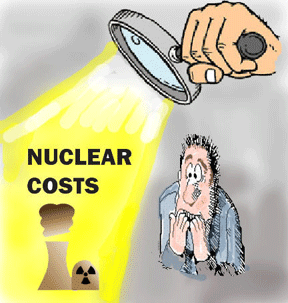
A new Wylfa will cost between £14 and £17bn to build and won’t be up
and running until the 2030s, the UK Government have been told. Sources told
the Times newspaper that the 2.3-gigawatt plant would take six years to
build, on top of a lengthy planning and regulatory process, meaning that it
would not be operational until the early years of the next decade.
Westinghouse and Bechtel, the reactor maker and engineering group, are
hoping to win UK Government backing for their plan to build two reactors at
Wylfa on Anglesey. Their AP1000 reactor design has already completed
initial safety approval for use in Britain. However, Bechtel were hoping to
secure £20m from the UK Government before being able to provide a full
breakdown of the total costs of the project. Ivan Baldwin, head of the UK
civil nuclear market for Bechtel, told the Times that this taxpayer funding
would enable the developer to “provide to the government an estimated
project cost” and “to determine the optimum construction schedule at
the site”.
Hitachi, of Japan, currently own the rights to the Wylfa site
after giving up on their own plans to build a nuclear power plant there.
Dylan Morgan from People Against Wylfa B (PAWB) responded to the
announcement to say that Boris Johnson was just “shooting from the
hip”. “All his bluster about possible new nuclear reactors displays an
astounding level of economic and environmental illiteracy,” he said.
“Firstly, where is the strong economy coming out of Covid and post
Brexit? No nuclear companies will go it alone and invest heavily in
building new nuclear reactors.
“As in the case of Rolls Royce and their
modular reactor which isn’t small at all at 475 MW, bigger than the old
Magnox reactors at Trawsfynydd, they want government public handouts for
designing the reactors, more astronomic handouts financed through our
already vastly inflated electricity bills to construct these radiotoxic
monstrosities, and then even more handouts for an agreed price for
electricity produced, and last but not at all least, the massive
decommissioning costs over thousands of years of reactors and all the
problems with storage of hazardous nuclear wastes.
“There is little wonder that no corporations have come forward in droves to get a nuclear
renaissance much promised from the Blair/Brown era going. “Labelling
Wylfa and Trawsfynydd as possible new sites for this most dangerous, dirty,
radiotoxic, health-threatening and expensive technology is an insult to the
people of Wales. “It is the totally wrong path to tread and it may be the
case that Johnson will not be in office for too long to realise his madcap
nuclear ambitions.”
Nation Cymru 24th May 2022
https://nation.cymru/news/new-wylfa-will-cost-14-17bn-to-build-and-wont-be-ready-until-2030s/
Leaked emails expose UK Home Secretary Priti Patel’s connection to MI6-style ‘research and influence operation’AND to extraditing Julian Assange

British Home Secretary Priti Patel is due to imminently decide on whether WikiLeaks founder Julian Assange is extradited to the US, where he faces life imprisonment for journalistic activities.
Patel sat on the advisory council of the neoconservative Henry Jackson Society think tank alongside Lord James Arbuthnot – a former Conservative Minister of Defence whose wife, Lady Emma Arbuthnot, made two key rulings against Assange in 2018, before being forced to step aside due to a “perception of bias.”
it is safe to assume the intelligence cabal bringing its influence to bear on Patel would strongly favor his extradition to the US.
The GRAYZONE, KIT KLARENBERG·MAY 18, 2022,
A deeply anti-democratic MI6-linked cabal’s apparent influence on Priti Patel raises serious questions about her fitness to rule on Julian Assange’s extradition to the US.
- Cabal now managing MI6-inspired “research and influence operation”
- Effort may be funded by intelligence agency actors
- British Home Secretary implicated in plot
- Green advocates and perceived Chinese agents targeted
- Home Office infiltrated by cabal’s civil service mole
- Cabal seeks to seize power over energy policy and “displace” government minister
Hinkley Point C – costs soar, delays again. UK govt’s big bet on nuclear is backfiring
| The risks to the government’s plans to build another eight nuclear power plants have been underlined by the latest wave of ballooning costs and delays at Hinkley Point C. EDF, which is constructing the 3,200MW reactor in Somerset, has warned that estimated costs have jumped to between £25 billion and £26 billion, while the power station will not now start producing electricity until June 2027 at the earliest. The revised estimates are £3 billion higher than the previous cost projections in January last year, which were in turn well ahead of the group’s initial £18 billion forecast when the project was approved in 2016. Hinkley is Britain’s first new nuclear plant in decades. It is expected to power six million homes, with the government guaranteeing that consumers pay an index-linked £92.50 per megawatt hour, in 2012 prices, for its electricity. Construction costs are being met by EDF and its junior partner in the project, CGN of China. Critics seized on the latest overruns to point out the risks to Boris Johnson’s blueprint for another 24 gigawatts of new nuclear power by 2050. The Stop Sizewell C lobby group pointed out that, while EDF and CGN are on the hook for Hinkley’s “rocketing costs”, a proposed new financing model would see consumers paying upfront via higher bills for cost overruns. “The £20 billion estimate for Sizewell C is already two years out of date, with zero chance of it being delivered at that cost,” it said, noting that the risk of spiralling costs would “fall on consumers”. Doug Parr, Greenpeace’s UK policy director, said: “The government’s big bet on nuclear is backfiring with every extra billion added to the bill”. He advocated investment in offshore wind instead. Costs at the prototype for Hinkley, the Flamanville plant in France, have rocketed from €3.3 billion to €12.7 billion. Construction is running more than a decade late. Times 20th May 2022 https://www.thetimes.co.uk/article/hinkley-point-c-nuclear-plant-to-open-a-decade-late-9vsk6w9zx |
£3 billion more, 1 year longer: EDF Energy announces latest price hike and further delay at Hinkley Point C
£3 billion more, 1 year longer: EDF Energy announces latest price hike
and further delay at Hinkley Point C. Whilst news that yet another civil
nuclear power plant is to be delivered still further over-budget and still
further behind schedule may be ‘par for the course’, the Nuclear Free
Local Authorities still find EDF’s latest pronouncement that Hinkley
Point C will cost £3 billion more and take one year longer to build
shocking.
In a media release yesterday (Thursday 19 May), the French parent
of UK nuclear operator, EDF Energy, conceded that, on their latest
estimate, Hinkley Point C will now cost £25 to 26 billion to build and
become operational no earlier than July 2027.
EDF last updated its Hinkley
Point construction schedule in January 2021, when it stated the plant would
be delayed by a further six months to June 2026 with the cost rising by an
additional half billion pounds to £22 billion to 23 billion. NFLA Chair
Councillor David Blackburn commented: “EDF Energy have blamed COVID and
the Ukraine conflict for the price hike and the delay, but Hinkley Point C
was already way over budget and way behind schedule before either of these
calamities occurred. For the simple reality is that nuclear costs too much
and takes too long”.
NFLA 20th May 2022
UK Ministers taking the public for fools, as they tout grandiose and delusional nuclear power schemes
Betting on the French will not keep Britain’s lights on, EDF’s latest
Hinkley Point delay shows PM’s nuclear ambitions are divorced from
reality.
It is testament to the sheer incompetence of France’s
state-backed utility EDF that Hinkley Point C has become Britain’s most
radioactive construction project and it hasn’t even been built yet. In
fact, one wonders if it ever will be at this rate after yet more delays and
cost overruns.
For critics of atomic energy, Hinkley Point is the gift that
keeps on giving. For the rest of the country it remains laughably elusive.
After repeated setbacks, Britain’s first new plant in three decades was
already scheduled to be nine years overdue and £7bn over budget having
been pushed back to 2026, while estimated build costs had rocketed to
£23bn.
And now? An announcement from EDF, snuck out at 10pm on Thursday
night, reveals that the project has been delayed by another year at best,
and will cost a further £3bn, with Covid the excruciatingly predictable
excuse being provided. It is the fourth time that EDF has had to revise the
timetable and budget since construction began in October 2016.
At this point, any suggestion that the Prime Minister’s recently announced
ambition to build 24 gigawatts of new nuclear capacity, equivalent to
another six Hinkleys, each costing £20bn, have any chance of being
realised should be banished. Ministers are taking us for fools with these
grandiose yet delusional schemes.
Like so many of this Government’s plans
to transform important areas of the economy, Britain’s nuclear ambitions
are totally divorced from reality, and will remain so while we continue to
depend on the same unreliable partner with a risible track record of
delivering on its promises.
But it is in France where the major red flags can be found. EDF’s flagship Flamanville plant in
Normandy, which is being built using the same European Pressurised Reactors
(EPR) that are set to be deployed at Hinkley, was originally meant to come
on line in 2009. Instead, it won’t be ready until 2023, nearly a decade and
a half later than originally planned, and is £10bn over budget after costs
quadrupled from initial estimates in 2004.
Yet Flamanville is just one of
many plants where EDF is experiencing problems. The company has been forced
to launch a programme of checks on its entire fleet of 56 nuclear reactors
after the discovery of corrosion caused outages at some. A total of 12 are
offline, exacerbating a perilous financial squeeze as it prepares to
spearhead Emmanuel Macron’s plans to put nuclear power at the heart of
his country’s pursuit of carbon neutrality by 2050. And yet, incredibly,
EDF harbours ambitions to build another plant in the UK, at Sizewell C in
Suffolk.
Telegraph 21st May 2022
https://www.telegraph.co.uk/business/2022/05/21/betting-french-will-not-keep-britains-lights/
UK’s energy policy (for a nuclear ”renaissance”) ignores the fastest and most cost-effective measure – SAVING ENERGY

| Andrew Warrant: Energy policy is big news again. Initially, because fuel prices are rocketing, and set to rise even more this autumn. Plus the invasion of Ukraine has precipitated a determination to minimise the amount of gas and oil purchased in future from Russia. These two factors have prompted Prime Minister Boris Johnson to devise a new energy security strategy. Published last month, its reception was uniformly dismissive. Not so much because of the energy supply sources it concentrated upon but mainly because it entirely omitted any serious consideration of the policy area deemed most capable of providing swift cost-effective solutions. Saving energy. The Times’ editorial was unsparingly contemptuous. The UK government’s new energy security strategy amounted to “little more than a glorified press release.” The “eye-catching announcement” of eight new nuclear power plants offers “no analysis of why Britain had succeeded in starting construction on just one new reactor in the 16 years since Tony Blair announced a nuclear renaissance.” It added: “What is certain isthis new nuclear programme will not bring energy bills down any time soon. if ever. Instead, it will push bills up as the costs of construction are passed on to consumers. Nor will it do much in the near term to reduce Britain’s reliance on Russian oil and gas given that it takes at least a decade to build a nuclear power station.” While no doubt well-intentioned, Rishi Sunak’s attempts to alleviate the cost of living – including through a £150 council tax rebate for most homes and a £200 loan towards energy bills – have been overly complicated and badly targeted. And, as Helen Barnard of the Joseph Rowntree Foundation has pointed out, the £2.4bn the Treasury lost cutting fuel duty would have covered the cost of insulating a third of all social housing in the country. “Theconsultancy E3G has calculated that new energy efficiency measures could reduce the heating bills for poorly insulated homes by an average of £500 and end the UK’s dependence on Russian gas (which is admittedly quite limited) within a year. There is a very revealing explanation for why no new plans are being proposed. It is that “this is not being imposed on people and is a gradual transition following the grain of behaviour. The British people are no-nonsense pragmatists who can make decisions based on the information.” But if an Englishman’s home really is his castle, then why did fears for COVID 19 lock everybody inside their castle? If we want people to support delivery of a collective good like energy security or climate mitigation, then it is sensible to see it as collective action. And for Government to lead it. The parallel with the pandemic is spot on.Energy in Buildings and Industry 18th May 2022 https://eibi.co.uk/article/collective-spirit-required-to-ensure-energy-security/ |
UK Home Secretary PRITI PATEL WAS PART OF CIA-LINKED LOBBY GROUP WITH HUSBAND OF ASSANGE JUDGE

Home Secretary Priti Patel, who will soon decide whether to extradite Julian Assange to the US, has been a political adviser to – and been funded by – a right-wing lobby group which has attacked Assange in the British media for a decade. DECLASSIFIED UK, MATT KENNARD, 29 MARCH 2022
- Patel sat on advisory council of Henry Jackson Society (HJS) with Lord Arbuthnot, whose wife later made two key legal rulings against Assange
- Former CIA director James Woolsey has been an HJS patron since 2006
- HJS has hosted three other ex-CIA directors in London since 2014
- Patel was paid £2,500 by HJS to fly to Washington for a “security” programme in the US Congress
- Patel ignores Declassified’s request for clarification of her role in HJS
Priti Patel sat on the Henry Jackson Society’s (HJS) advisory council from around 2013-16, although the exact dates are unclear as neither the HJS nor Patel responded to Declassified’s requests for clarification.
She has also received funds from the HJS, and was paid £2,500 by the group to visit Washington in March 2013 to attend a “security” programme in the US Congress.
Patel, who became an MP in 2010 and was appointed Home Secretary in 2019, also hosted an HJS event in parliament soon after she returned from Washington.
After the UK Supreme Court said this month it was refusing to hear Assange’s appeal of a High Court decision against him, the WikiLeaks founder’s fate now lies in Patel’s hands. He faces life in prison in the US.
The HJS, which was founded in 2005 and does not disclose its funders, has links to the CIA, the intelligence agency behind the prosecution of Assange and which reportedly developed plans to assassinate him.
One of the HJS’s international patrons is James Woolsey, CIA director from 1993-95, who was in this role throughout the period Patel was advising the group. Woolsey’s affiliation to the HJS goes back to at least 2006, soon after it was founded.
In 2014, the group hosted General David Petraeus, CIA director from 2011-12, at a UK parliament meeting from which all media were barred.
Three years later, in 2017, the HJS organised another event at parliament with General Michael Hayden, CIA director from 2006-9, to “discuss the current state of the American Intelligence Community and its relationships with foreign partners.”
Hayden described “the relationship within the Five Eyes community as strong as ever, despite potential concerns over recent intelligence leaks between members.” Five Eyes is an intelligence alliance comprising Australia, Canada, New Zealand, the UK, and the US.
‘Perception of bias’
During a visit to the UK in July 2020, then US Secretary of State Mike Pompeo spoke at a roundtable hosted by the HJS with what the Washington Post referred to as a group of “hawkish” members of the Conservative Party.
As director of the CIA in 2017, Pompeo had launched a blistering attack on WikiLeaks calling the media organisation a “hostile intelligence service” that makes “common cause with dictators”.
Pompeo did not provide evidence but added a threat: “To give them the space to crush us with misappropriated secrets is a perversion of what our great Constitution stands for. It ends now.”
On the HJS advisory council at the same time as Patel was Lord James Arbuthnot, a former Conservative defence minister. His wife, Lady Emma Arbuthnot, was Westminster Chief Magistrate from 2016-2021.
For part of her tenure, she was in charge of the Assange case and made two key rulings against him in 2018. Lady Arbuthnot eventually stepped aside from ruling on the case because of a “perception of bias” but never declared a conflict of interest.
The links between Patel and Lord Arbuthnot go further. In 2010, soon after becoming an MP, Patel was appointed one of five parliamentary officers of the Conservative Friends of Israel (CFI) when the group was chaired by Lord Arbuthnot.
CFI has been described as “beyond doubt the most well-connected and probably the best funded of all Westminster lobbying groups”. It also does not disclose its funders.
Patel was forced to resign as Secretary of State for International Development in November 2017 after it was revealed that she had held more than a dozen undeclared meetings with Israeli ministers and organisations while on holiday in the country.
Many of these were arranged by CFI’s honorary president, Lord Polak. Patel’s resignation letter accepted that her conduct “fell below…standards of transparency and openness”.
HJS staff have been repeatedly critical of Julian Assange and WikiLeaks in the British media since 2011 when its then associate director, Douglas Murray, engaged in a combative debate with Assange.
………. Over the following years, the HJS and its staff continued to be among the most active civil society voices for impugning the motives and reputation of Assange.
This stands in contrast to nearly all human rights and press freedom organisations which argue that extraditing the WikiLeaks publisher to the US would be a grave blow to media freedom.
‘Conspiracy theories’
In October 2016, the HJS released a statement to the media, which claimed: “Mr Assange has a long track record of stealing and distributing information, peddling conspiracy theories, and casting aspersions on the moral standing of western democratic governments. He has done this whilst supporting, and being supported by, autocratic regimes.”
No evidence was supplied to support the assertions.
A number of other HJS staff—including spokesperson Sam Armstrong and then chief of staff Ellie Green—have made anti-Assange interventions in the British media.
Secrecy
In October 2019, as home secretary, Patel visited Washington again to meet William Barr, the US Attorney General who was then in charge of the Assange case as head of the Department of Justice.
Together they signed the Cloud Act which made it easier for American and British law enforcement agencies to demand electronic data on targets as they undertake investigations.
Assange’s defence team had previously raised the concern in court that Barr may be using Assange’s extradition case in the UK for political ends.
In August 2020, Declassified requested basic information about Patel’s 2019 trip to Washington. The Home Office confirmed it held the information but refused to release it because the department considered “that disclosure of some of the information would prejudice relations between the UK and the United States”.
In May 2020, Declassified also requested information about any calls or emails made or received by Patel since she became Home Secretary which concerned the case of Julian Assange, or mentioned his name.
The Home Office told us “we can neither confirm nor deny whether we hold the information you have requested” because “to do so either way would disclose information that constitutes the personal data of Julian Assange”.
The same request for Sajid Javid’s tenure as Home Secretary from 2018-19 was rejected because the department said “we have carried out a thorough search and we have established that the Home Office does not hold the information that you have requested.”
This was despite the fact Javid signed the initial US extradition request for Assange in June 2019. The shadow home secretary at the time, Diane Abbott, opposed approving the US extradition request.
Declassified previously revealed that before signing the US request, Javid had attended six secretive meetings, some attended by former CIA directors, which were organised by a US lobby group which has published calls for Assange to be assassinated or taken down.
The Home Office recently admitted it had eight officials working on Operation Pelican, the UK government campaign to seize Assange from the Ecuadorian embassy in London.
The department, however, claimed it did not know which other UK government ministries were involved in the operation.
Priti Patel and the Henry Jackson Society did not respond to requests for information and comment. https://declassifieduk.org/priti-patel-was-part-of-cia-linked-lobby-group-with-husband-of-assange-judge/
UK Public Accounts Committee warns on need to double-check on safety of aging nuclear reactors
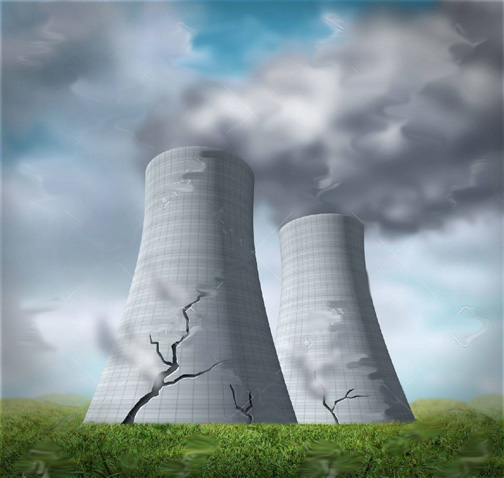
Ageing nuclear reactors must be ‘double-checked’ for safety before
being kept going to ease energy crisis. Closure of seven nuclear reactors
by 2028 will ‘significantly reduce’ UK energy generation, the Public
Accounts Committee warns, and taxpayers face billions of pounds in extra
costs.
iNews 20th May 2022
1 This Month


of the week– Nuclear Reactor Information Task Force

14 May – online event From Bombs to Data Centres: the Face of Nuclear Colonialism
To see nuclear-related stories in greater depth and intensity – go to https://nuclearinformation.wordpress.com
-
Archives
- May 2026 (156)
- April 2026 (356)
- March 2026 (251)
- February 2026 (268)
- January 2026 (308)
- December 2025 (358)
- November 2025 (359)
- October 2025 (376)
- September 2025 (257)
- August 2025 (319)
- July 2025 (230)
- June 2025 (348)
-
Categories
- 1
- 1 NUCLEAR ISSUES
- business and costs
- climate change
- culture and arts
- ENERGY
- environment
- health
- history
- indigenous issues
- Legal
- marketing of nuclear
- media
- opposition to nuclear
- PERSONAL STORIES
- politics
- politics international
- Religion and ethics
- safety
- secrets,lies and civil liberties
- spinbuster
- technology
- Uranium
- wastes
- weapons and war
- Women
- 2 WORLD
- ACTION
- AFRICA
- Atrocities
- AUSTRALIA
- Christina's notes
- Christina's themes
- culture and arts
- Events
- Fuk 2022
- Fuk 2023
- Fukushima 2017
- Fukushima 2018
- fukushima 2019
- Fukushima 2020
- Fukushima 2021
- general
- global warming
- Humour (God we need it)
- Nuclear
- RARE EARTHS
- Reference
- resources – print
- Resources -audiovicual
- Weekly Newsletter
- World
- World Nuclear
- YouTube
-
RSS
Entries RSS
Comments RSS
 nuclear-news