Boris Johnson demands that UK government declares nuclear to be “a green energy” source, and boosts the industry .
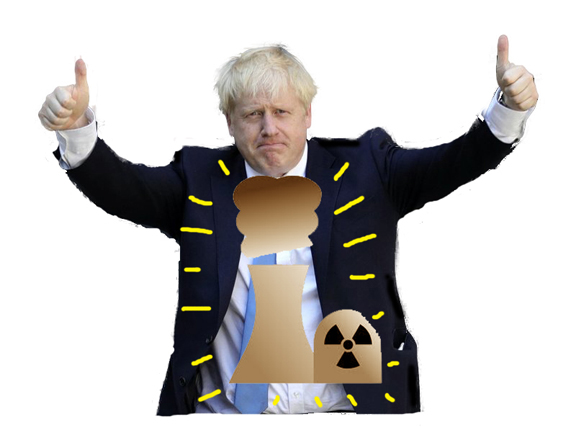
Boris Johnson has increased pressure on Rishi Sunak to boost nuclear
capacity with funding for two more large-scale projects before the next
election.
In a new intervention since leaving No 10, Johnson, accompanied
by Priti Patel, the former home secretary, warned that the country had a
“damaging gap in our nuclear capabilities and a weakness in our energy
supply”.
In a letter seen by The Times signed by 57 Tory MPs, Sunak was
urged to fund the development of two more projects before the end of this
parliament. the 57 Tories — including Anne-Marie Trevelyan, the Foreign
Office minister, and Sir Graham Brady, chairman of the 1922 Committee —
said that more had to be done.
In the letter, organised by Virginia
Crosbie, the MP for Ynys Môn, they said the government needed “at all
costs” to avoid errors they say that Labour made in not recognising the
“good value” of nuclear power.
They demanded that the government
declare nuclear “unambiguously” to be a green energy source, set out
binding nuclear targets for 2035 and 2050 and order officials to start
talks with Rolls-Royce to fund small modular reactors. The letter said:
“We are the only major nuclear nation in the world without a sovereign
reactor design to deploy or export. It is time we changed that.”
Times 23rd Feb 2023
Nuclear power – carbon intensive and environmentally damaging -NOT GREEN – Nuclear Free Local Authorities
NFLAs call on Chancellor not to class nuclear as ‘green’

– 23 Feb 23,
Fearing the UK Government may – for once – follow an unwanted lead set in Europe, the Chair of UK/Ireland Nuclear Free Local Authorities network has written to the Chancellor of the Exchequer requesting that he refrain for reclassifying nuclear as a ‘green investment’ under revised taxonomy rules.
There has been much speculation in the corridors of power, in the press and amongst the anti-nuclear community that Jeremy Hunt may soon choose to reclassify ‘nuclear’ as a green investment to unlock more private investment in the government’s planned future civil nuclear programme.
A reclassification in the revised taxonomy rules would make such investment more ‘attractive’ and ‘acceptable’ to certain large pension funds and investment companies.
The European Commission has previously adopted an identical strategy, but it was one which met with significant political and societal opposition and led to legal challenges from member states.
In his letter, Councillor Lawrence O’Neill outlines how nuclear power is both carbon-intensive and environmentally damaging. Commenting he said:
“It would be a complete misnomer to describe nuclear as ‘green’. From mining the uranium ore through to dealing with the legacy of radioactive waste, civil nuclear power leaves a massive carbon footprint and contaminates all it touches. The NFLAs hope that the Chancellor will see the logic of leaving things as they are and accede to our request, but if not we shall be ready to stand shoulder-to-shoulder with all those opposed to this change. Nuclear is not ‘green’ and never will be.”
The letter sent to the Chancellor reads::…………………………….. https://www.nuclearpolicy.info/news/nflas-call-on-chancellor-not-to-class-nuclear-as-green/—
Cost of EDF’s new UK nuclear project rises to $40 billion (msn.com).
By America Hernandez, 21 Feb 23 PARIS (Reuters) – EDF’s new nuclear plant in southwest England is likely to cost about 2% more than its last budget estimate as inflation propels the price tag to almost 33 billion pounds ($40 billion), EDF documents show.
Britain plans to build new nuclear plants to boost its energy security and help meet a target for net zero emissions by 2050.
EDF warned in a results presentation on Friday the cost of the Hinkley Point C project, Britain’s first new nuclear plant in more than two decades, “could reach 32.7 billion pounds” based on inflation indexes as of June 30, 2022.
Its previously published cost estimate in May 2022 was 31-32 billion euros when adjusted for inflation.
PARIS (Reuters) – EDF’s new nuclear plant in southwest England is likely to cost about 2% more than its last budget estimate as inflation propels the price tag to almost 33 billion pounds ($40 billion), EDF documents show.
Britain plans to build new nuclear plants to boost its energy security and help meet a target for net zero emissions by 2050.
EDF warned in a results presentation on Friday the cost of the Hinkley Point C project, Britain’s first new nuclear plant in more than two decades, “could reach 32.7 billion pounds” based on inflation indexes as of June 30, 2022.
Its previously published cost estimate in May 2022 was 31-32 billion euros when adjusted for inflation. https://www.msn.com/en-au/money/other/cost-of-edf-s-new-uk-nuclear-project-rises-to-40-billion/ar-AA17IxdK?ocid=msedgntp&cvid=a11054ac2c0c487f9a20627240342227
Yet another £6 billion cost hike for UK’s Hinkley Point C nuclear project

Hinkley C’s £6bn cost hike tests UK’s nuclear resolve. A further £6 billion
cost increase at Hinkley Point C will test the government’s commitment to
funding future large-scale nuclear projects, according to energy industry
experts.
The figure was revealed alongside EDF’s accounts last week, with
construction of the 3.2GW power plant now estimated to cost as much as
£32.7 billion. That is a £6 billion increase on the revised construction
price set last year and is almost double the £18 billion figure set in 2016
when EDF first started work on the project.
The latest cost hike has been
attributed to rising inflation, however engineering problems and complex
ground conditions have previously pushed the cost up, as well as a £500
million cost increase due to Covid-19 and pandemic-related working
restrictions.
Utility Week 21st Feb 2023
https://utilityweek.co.uk/hinkley-cs-6bn-cost-hike-tests-uks-nuclear-resolve/
Do not bring nuclear energy plants to Scotland, SNP tells new UK energy minister
The SNP has warned new energy minister Andrew Bowie to keep new nuclear power out of Scotland.
Energy policy has long been one of the most contentious issues between the UK and Scottish governments, with disagreements around the future of oil and gas and potential new nuclear stations raging in recent years.
Now, the SNP has urged the UK Government to focus on renewables as opposed to the creation of new nuclear power, which they say would not immediately solve the country’s current energy security issues.
According to a report from Politico, Mr Bowie is set to become the UK’s first ever nuclear energy minister, putting the West Aberdeenshire and Kincardine MP at odds with the Government in Edinburgh.
The SNP’s Westminster energy spokesman Alan Brown said: “Andrew Bowie must be taking up one of the most pointless ministerial positions in the UK government.
“If the Tories think they will bring down energy bills by building nuclear power stations that won’t be ready for years to come then they are more delusional than we thought.
“Scotland is awash with renewable energy potential and Andrew Bowie should be focusing his efforts there, as it will create jobs for his constituents for decades to come and will ensure we are using Scotland’s energy potential to the fullest.”
He added: “Households across Scotland are desperate for solutions to sky-high energy bills now and nuclear power will not provide that answer – indeed, the Government has confirmed it will increase our energy bills.
“Scotland is rich with renewable energy potential and we cannot have our resources squandered once again by successive Westminster governments, that is why the only way we can harness the potential of Scotland’s energy is by becoming an independent country.”
The SNP’s energy spokesman added that nuclear projects were “one of the most expensive forms of energy”, with costs for building Hinkley Point C in Somerset rising to £33 billion according to reports this week, and the cost for the Sizewell C site potentially rising above £30 billion……………… https://www.energyvoice.com/oilandgas/north-sea/decom/484720/uk-trade-boss-touts-massive-potential-for-decom-export-growth-following-release-of-blueprintuk-trade-boss-touts-massive-potential-for-decom-export-growth
Pentagon-Funded Plymouth University Cancels Anti-War Academic: the militarization of higher education.

Pentagon-Funded Plymouth University Cancels Anti-War Academic: Reflections on How the US Empire Conquered Higher Education, CouterPunch BY T.J. COLES 17 Feb 23,
The US Empire is in the final and most dangerous stages of its quest for what the Pentagon calls “full spectrum dominance.” Having invaded and fought proxy wars in the oil-rich Middle East, it is now trying to break nuclear-armed Russia in another proxy war before attempting “regime change” in nuclear-armed China. We need not tarry on the potential consequences. Professor Noam Chomsky called it 20 years ago: this is hegemony or survival. Which one do you choose?
As the Empire races towards its biggest bet, using humanity and all other species on the planet as gambling chips, anti-war comment is tolerated less and less. For those who want to know what happened to me, see the Annex of this article for the leaked emails and background. Meanwhile, consider what is taking shape.
DELETING THE ENEMY
Critics of Western imperialism are silenced by the Empire’s witting and unwitting minions in increasingly knee-jerk ways. Google, which was developed with CIA money, has de-ranked anti-war websites, driving traffic to state-corporate outlets that promote imperialism. After buying YouTube, it then went on a de-platforming spree, banning and de-monetizing “conspiracy theorists,” left and right, who dare deviate from the increasingly narrow orthodoxy of acceptable thought.
Under the new McCarthyism of RussiaGate, the US Federal Bureau of Investigation has used the pretext of countering foreign disinformation to suspend and terminate political accounts. In 2020, following an evidence-free CNN report alleging that it was a front for the sanctioned nation of Iran, the FBI and Department of Justice seized the US domain for the website of the American Herald Tribune, founded by Dr. Anthony James Hall, who retired from his Canadian university, Lethbridge, following pressure from the Zionist Lobby and from individuals who accused him of being a “conspiracy theorist”—a cheap smear tactic employed against me by a cabal of staff at Plymouth University.
Meanwhile, the Twitter Files have exploded the myth that “social media” are independent corporate actors. Likewise, journalist Dr. Alan Macleod has documented the dozens of former spies now employed to police content at Facebook.
SHAME IS THE GAME
The opinions of self-described fact-checkers—like the Poynter Institute—are amplified by state-corporate media which engage in public humiliation rituals in the hope that retailers will pull magazines, academic institutions will fire staff, digital providers will demonetize accounts, and web hosts will drop entire sites and/or content……….
As governments contract out censorship to “fact-checkers,” critics of Empire are demonetized. Consortium News and Mint Press have seen their PayPal accounts frozen. PayPal’s pro-Trump co-founder, Peter Thiel, has made many millions of dollars from Pentagon contracts. Between 2007 and ’19, US taxpayers gave his Palantir Technologies $1.5 billion via the Department of Defense, particularly to spy on Afghans and Iraqis.
ACADEMIC OBLIVION
The above examples show how the US military and intelligence continue to influence the infrastructure through which much of today’s information travels. Another target is academia. But how serious is the problem?……………………………………………………..
THE MILITARIZATION OF HIGHER EDUCATION
Universities serve a variety of purposes, one of which is the development of new weapons for the US military. In the past, white voices critical of Empire would be tolerated as long as their non-university work did not grind the gears of Empire. That’s how Professor Chomsky, for instance, was able to get arrested protesting mass murder in Vietnam while receiving Pentagon money to undertake his linguistics research.
The technological origins of “full spectrum dominance” can perhaps be traced back to the outgoing Reagan and incoming George H.W. Bush administrations, under whom the Pentagon founded the Multidisciplinary University Research Initiative to further integrate with education and develop tools for things like the so-called Star Wars program (Strategic Defense Initiative). One consequence is that higher education became significantly influenced—maybe not full-spectrum dominated—by the eternal war machine.
By 2015, the Department of Defense (DoD), which in more honest times was called the Department of War, was investing $250 million of taxpayer money in universities. In that year, the DoD decided to look for international partners, of which the Britain was a natural first-choice. The Pentagon’s Basic Research Office Director, Robin Staffin, said: “we decided it was time to formalize cooperation between the U.S. and the U.K.”
DARPA is the Pentagon’s taxpayer-funded innovation arm. It used to stand for the Advanced Projects Research Agency, but PR experts realized that they’d better prefix it with the word “Defense.” In 2016, venture capitalist-turned-DARPA Director, Arati Prabhakar, said: “DARPA is reliant on research universities as one part of this huge ecosystem … [We] draw from the deep foundational research, almost always at places like great universities.”
For instance, the DoD recently said that the universities of Alabama-Huntsville, Florida International, Texas A&M Engineering Experiment Station, and others, have received funding to develop solutions for—are you ready?—“monitoring the health and status of hypersonic aeroshells” (heat shields for space systems, which are core elements of “full spectrum dominance.” The “health and status” of ordinary Americans, who still don’t have free coverage, is less important). Other projects include thermodynamic ducts for hypersonic vehicles sponsored by the usual suspects, like Boeing and Lockheed Martin.
FUNDING PLYMOUTH UNIVERSITY: DARPA’S DRIVE…………………………………………………
CONCLUSION
As universities continue designing weapons of mass murder, thought criminals in Western countries continue to face deplatforming and public shaming. Are their personal fates as severe as those of dissident academics in US-UK-supported regimes, like Saudi Arabia? Of course not. But that is not the point. An obvious chilling effect is created in which scholars striving for social justice and indeed the survival of the planet are silenced. The witting an unwitting minions of Empire are too obtuse to realize that by issuing penalties for expressing opinions, those penalties may one day be imposed upon them.
ANNEX (HISTORY, EMAIL EVIDENCE, REBUTTAL):
MY STORY……………………………………………………………………………….as I have lost my University position as a result of my political views, it is worth considering exactly what I write for Nexus (article by article) and that my articles give a left-wing voice to the so-called conspiracy research community, which is often dominated by right-wingers and apolitical people.
As one can see below, the bulk of my work for Nexus consists of critiques and exposés of US military and intelligence agencies. …………………………………………………………
T. J. Coles is director of the Plymouth Institute for Peace Research and the author of several books, including Voices for Peace (with Noam Chomsky and others) and Fire and Fury: How the US Isolates North Korea, Encircles China and Risks Nuclear War in Asia (both Clairview Books). https://www.counterpunch.org/2023/02/17/pentagon-funded-plymouth-university-cancels-anti-war-academic-reflections-on-how-the-us-empire-conquered-higher-education/
Spiralling cost of Hinkley Point C nuclear station
Cost of Hinkley Point nuclear plant backed by France, China spirals to
US$38.5 billion. EDF and its partner in the project, China General Nuclear
Power, will be asked to provide additional funding, but it’s unlikely the
Chinese will agree.
EDF saidElectricite de France said the cost of building
its flagship Hinkley Point C nuclear power station in the UK is set to
spiral further to £32 billion (US$38.5 billion). Higher levels of
inflation have pushed up the estimated spend on the plant, the French
energy giant said in a presentation published alongside its annual results.
The revised estimate is the latest indication of surging costs after the
start of plant was delayed last year. In May, EDF raised the price tag to
build the two reactors at Hinkley to £25 billion (US$30 billion) and £26
billion (US$31 billion).
South China Morning Post 18th Feb 2023
Rolls Royce’s financial problems, as it plans to make small nuclear reactors for the British government.

Rolls is complex: it can’t seem to decide whether it has three, four, or
five divisions. It has its fingers in too many pies.
Among its many projects: it makes engines for luxury yachts. It provides back-up power to
solar farms in the Atacama desert. It has built an enormous new jet engine
called the UltraFan at a cost of hundreds of millions of pounds, without
knowing which model of plane might actually use it (Rolls insists the tech
developed for Ultra Fan is already finding its way into existing engines).
Oh, and it has an arm that wants to build small modular nuclear reactors
(SMRs) for the British government — tech derived from the reactors it
makes for the Royal Navy.
So much for the diagnosis, but what can
Erginbilgic do to heal the patient? This week he is expected to announce
restructuring — though not job cuts, yet — and a strategic review. This
may stop short of selling off divisions, but could see Rolls seek out more
partners.
Times 19th Feb 2023
Pro nuclear film
CAN nuclear energy be the answer to the climate crisis? That is the belief
of the subjects at the centre of Irish filmmaker Frankie Fenton’s
provocative new film who assert that it is one of the cleanest and safest
technologies in the world. Thirteen years in the making, Fenton’s
observational documentary which he was director of photography as well as
writing, directing and producing, follows a small group of pro-nuclear
activists as they try to persuade law makers and the public of the virtues
of atomic energy using scientific evidence.
Although on the whole they seem to make a compelling argument (bananas notwithstanding) their assertions are not challenged during the film. Nuclear energy isn’t recognised for its own massive carbon footprint in terms of the huge costs of building new reactors and the toxic waste they produce, as well as the mining of the uranium and thorium needed to fuel them.
Morning Star 16th Feb 2023
Sizewell B nuclear station switched off fo 66 days for maintenance work
Sizewell B nuclear power station has been switched off for 66 days for
refuelling and maintenance work. Last year, EDF unveiled plans to extend
the operational life of the Sizewell B power station by at least 20 years.
The energy company has made an £80 million investment in the power plant,
part of which is the station’s 18th refuelling and maintenance outage. It
is expected that engineers will complete more than 10,000 routine
maintenance and inspection tasks and replace a third of the fuel during the
66-day outage.
Energy Live News 16th Feb 2023
Scotland’s Minister Matheson reassures the Nuclear Free Local Authorities (NFLA) that no small nuclear power station will be permitted near Grangemouth refinery.
The Scottish Nuclear Free Local Authorities have been reassured by a recent
reply from Scottish Government Net Zero Minister Michael Matheson that
Small Modular Reactors are not under consideration at the Grangemouth
refinery complex.
Following media speculation that INEOS was contemplating
co-locating an SMR next to its colossal refinery to power operations, the
Convenor of the Scottish NFLA, Councillor Paul Leinster, wrote to the
minister expressing grave concerns that the combination of a nuclear power
station next to the chemical refinery represents ‘a disaster
waiting-to-happen’.
Covering an area of 1,700 acres and with 2,000 staff,
INEOS’s own website describes Grangemouth as a ‘world-scale
petrochemicals plant’ which produces about 7 million tonnes of fuels, much
of which is used in Scotland, and 1.4 million tonnes of other products per
year. These products are synthetic ethanol, ethylene, propylene,
polyethylene and polypropylene used in the food packaging, construction,
automotive and pharmaceutical industries.
In his letter, Cllr Leinster
described an accident involving an SMR and the INEOS refinery as ‘a
monumental calumny for Scotland against which any Hollywood disaster movie
would pale by comparison’. To the NFLA, ‘it would be madness to partner a
nuclear power plant with Scotland’s biggest explosive chemical factory’.
In his response, dated 12 January, Michael Matheson was quick to reassure the
NFLA that Scottish Ministers ‘remain committed’ to their ‘long-standing
government policy to withhold support for any new nuclear power stations to
be built in Scotland’ and that officials have been advised by INEOS that
‘Small Modular Reactors do not currently form part of their net zero road
map for Grangemouth’.
NFLA 17th Feb 2023
Rolls Royce’s “small” nuclear reactor will occupy 5.3 acres.
The UK/Ireland Nuclear Free Local Authorities have today received a reply
from Rolls-Royce as to just how big their proposed ‘Small’ Modular
Reactor will be.
During last year’s World Cup, the NFLA’s then Chair,
Councillor David Blackburn, wrote to Tom Samson, Chief Executive Officer at
Rolls-Royce, to point out the general state of confusion amongst nuclear
activists, pro- and anti-, alike, with media reports claiming that an SMR
would occupy a surface area amounting to between ‘one and a half and ten
football pitches’ and asking for clarification.
Now Dan Gould, Head of Communications at Rolls-Royce SMR, has provided a final score – 5.3 acres –
an area ‘incorporating the entirety of the SMR unit’.
NFLA 16th Feb 2023
“No regrets” as UK government portrays nuclear power as “clean” and “green”

Nuclear power to get ‘green’ status as Britain races EU to hit net
zero. Move is part of a bid to unlock billions of pounds of funding for
more power stations. Nuclear power projects such as Sizewell C in Suffolk
will be granted so-called “green” status under plans by Jeremy Hunt to
unlock billions of pounds in funding for the industry. The Chancellor is
expected to announce the change within weeks as part of a broader shake-up
of the UK’s financial rules on green energy.
It would see nuclear power
projects classed as “green” or “sustainable” investments, clearing
the way for more institutional investors and environment-focused funds to
back them. There are also hopes that the Treasury could fund new power
plants with money raised through the Government’s green gilts and green
savings bonds. Generating nuclear power does not produce carbon dioxide, [ if you ignore the total nuclear fuel chain] so the sector is seen as a key plank of Britain’s plans to reach net zero
emissions by 2050.
A recent review by former energy minister and Tory MP
Chris Skidmore said that supporting the construction of more nuclear
reactors was a “no regrets” option. However, the sector has faced
difficulties portraying itself as environmentally friendly in the past
because of concerns about nuclear waste, water usage, and the remote but
catastrophic risk of nuclear accidents. Top fund managers such as Legal &
General and Aviva have previously expressed caution about the green
credentials of nuclear, with Aviva chairman George Culmer last year saying
there was an “ongoing debate”.
Telegraph 14th Feb 2023
Scotland’s campaign groups call on government to reject plans for nuclear power at new Green Freeports.
NORTH campaigners have called on the Scottish Government to reject plans
to build nuclear plants at the country’s two new Green Freeports.
John O’Groat Journal 14th Feb 2023
THE convener of Scotland’s nuclear-free local authorities (NFLAs) has
written to Net Zero Minister Michael Matheson asking him to reject nuclear
power at Scotland’s two new green freeports.
The National 15th Feb 2023
Signs of madness? —in the rarefied air of the British Parliament, Westinghouse spouts nuclear lies, without being challenged

Rarified (hot) air in halls of power is filled with propaganda
Fortunately, the gallery was under a mandatory code of silence, for it was hard not to emit a gasp of incredulity when the Westinghouse executive announced that his company had been “smashing production records” around the world.
Westinghouse has indeed broken some things: the law, and the bank for starters. But production records? He also mentioned that nuclear was “clean, reliable, dependable power” the very things it is not.
Signs of madness? — Beyond Nuclear International
Decisions on nuclear future are guided by myths
By Linda Pentz Gunter 12 Feb 23
Last month I rushed through the august halls of the British parliament in Westminster, on my way to a briefing on small modular reactors for Members of the Welsh Affairs Select Committee.
Running late though I was, it was tempting to slow down and take in all the historic portraits and portals as I hurried down flagstoned hallways, through heavy oak doors and finally into the richly carpeted committee room. But the albeit fleeting impression all of this left was of a world completely isolated from the reality of the daily struggles most of us endure. The rarified air was almost suffocating.
This became even more apparent as, unwillingly gagged, I listened to testimony from executives representing Westinghouse, Bechtel and Rolls Royce. One unsubstantiated sound bite after another tumbled from the mouths of these corporate executives, all serving their rich agenda of vested interests (read shareholders and profits).
But the questions they faced, at least from the Conservative nuclear cheerleaders present, were mainly mild softballs. Give us the soundbite, they urged. What do we need to tell the government to do to make all this happen?
Even Labour MP, Beth Winter, while challenging them on the obvious detriments of small modular, or any, reactors — time and cost — given, as she pointed out, climate change is very much here now, politely did not expose their utter hypocrisy. It was, after all, not a room in which arguing was on the agenda.
The Rolls Royce response was to trot out the “we need to do everything” mantra, which is what nuclear companies have to say in order for their technology to stand any chance at all. In reality, it is clear that choosing nuclear cancels out renewables. Meanwhile, Rolls Royce has pocketed — and presumably invested — £250 million (around $302 million US) with which it has done precisely nothing. But that’s the government’s fault, the company says. We just need to get in a room and get things done.
Fortunately, the gallery was under a mandatory code of silence, for it was hard not to emit a gasp of incredulity when the Westinghouse executive announced that his company had been “smashing production records” around the world.
Westinghouse has indeed broken some things: the law, and the bank for starters. But production records? He also mentioned that nuclear was “clean, reliable, dependable power” the very things it is not.
All of this was both a reminder of, and an eye-opener to, exactly the kind of false propaganda our elected officials are continuously exposed to, and swallow whole-heartedly. This is who they listen to: the corporate elite, in the United States bearing gifts as well, often in the form of generous campaign contributions. The politicians bought literally and figuratively by the major corporations, including nuclear power companies, dwell in an echo chamber filled with hot air. It’s not reality.
What was happening in that room in Westminster was also utterly pointless. Sitting there listening to 90 minutes of valuable time squandered in the stubborn pursuit of learning something more about a completely futile technology that has zero applicability to the climate or the immediate jobs crisis, it struck me that this was yet another symptom of humanity’s general malaise.
Or is it something worse than that? Being hell bent on wasting time and money talking about something entirely irrelevant no matter what the empirical evidence that should dismiss the continued use of nuclear power out of hand, must surely be a sign of some kind of madness?…………………………………….more https://beyondnuclearinternational.org/2023/02/12/signs-of-madness/
1 This Month

22 June – Virtual Event –Climate Change: New Data, New Debate

Monday, June 22, 2026 2:30 p.m. – 3:15 p.m. CT
YouTube. Register here

Protect Sazan Island from the Trump family! https://secure.avaaz.org/campaign/en/protect_sazan_island_from_the_trump_family_loc/?bqFCVab&v=174511&cl=22707147157&_checksum=5e9dde668860e8231c33699735e16a1fbf22ab2cb01da50c999fe8732b9775ef&utm_source=email&utm_medium=blast_email&utm_campaign=174511

25 June- THE PUKE ON NUKES
Thursday, June 25, 2026
7pm Central Time (8pm ET, 6pm MT, 5pm PT) UTC – 5
From NRC & DOE Deregulation to Techno-Fascist Billionaires Going Nuclear, Plus a Few Songs from Atomic Cabaret REGISTER
26 June – Radiation Trainwreck at the NRC / Join the Protect Better Campaign – https://us02web.zoom.us/meeting/register/4ZlZ5_qLSHGiLSCg8FF6Bg#/registration


Cuba Is Not a Failed State – It Is a Besieged State
PETITION: “Global Appeal to Endorse Palestinian Right of Return of Refugees”
To see nuclear-related stories in greater depth and intensity – go to https://nuclearinformation.wordpress.com
-
Archives
- June 2026 (202)
- May 2026 (306)
- April 2026 (356)
- March 2026 (251)
- February 2026 (268)
- January 2026 (308)
- December 2025 (358)
- November 2025 (359)
- October 2025 (376)
- September 2025 (257)
- August 2025 (319)
- July 2025 (230)
-
Categories
- 1
- 1 NUCLEAR ISSUES
- business and costs
- climate change
- culture and arts
- ENERGY
- environment
- health
- history
- indigenous issues
- Legal
- marketing of nuclear
- media
- opposition to nuclear
- PERSONAL STORIES
- politics
- politics international
- Religion and ethics
- safety
- secrets,lies and civil liberties
- spinbuster
- technology
- Uranium
- wastes
- weapons and war
- Women
- 2 WORLD
- ACTION
- AFRICA
- Atrocities
- AUSTRALIA
- Christina's notes
- Christina's themes
- culture and arts
- Events
- Fuk 2022
- Fuk 2023
- Fukushima 2017
- Fukushima 2018
- fukushima 2019
- Fukushima 2020
- Fukushima 2021
- general
- global warming
- Humour (God we need it)
- Nuclear
- RARE EARTHS
- Reference
- resources – print
- Resources -audiovicual
- Weekly Newsletter
- World
- World Nuclear
- YouTube
-
RSS
Entries RSS
Comments RSS
 nuclear-news