Cumbria set for more nuclear reactors as questions are raised over why land isn’t being used for renewable energy
Cumberland Council are set to discuss small modular reactors and nuclear
power in Cumbria. Councillor Jill Parry for Bothel and Wharrels, Green
Party will ask her question to leader of Cumberland Council Councillor Mark
Fryer, who represents St Johns and Great Clifton, Labour.
“Can the leader please ask the Solway Community Power Company for more detail of the
proposal, including an outline what investigations, surveys and other
preparatory work are needed at this very early stage, and share the
response with council? “
“Would it not be more appropriate for the council
to push that the land is used for renewable energy technologies, such as
solar, in the meantime, which could generate real-time useable electricity
for residents now and could stay in place if SMRs don’t happen?”
Lancashire Live 24th July 2023
https://www.lancs.live/news/cumbria-news/cumbria-set-more-nuclear-reactors-27375167
UK govt to pour another £170million of taxpayers’ cash into planned Sizewell C nuclear plant: is it value for money?
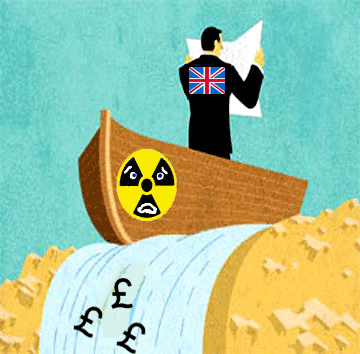
The government is to plough another £170million of taxpayers’ cash into the
proposed Sizewell C nuclear plant. The Department for Energy Security and
Net Zero said the cash was in addition to the £679 million the government
invested in the Suffolk power station late last year, when it took joint
control of the project with EDF, of France.
Last year’s investment included about £100 million to buy China General Nuclear out of its 20 per cent stake. EDF said: “This is another big endorsement and will put us in an
even stronger position to begin full construction.” The government said
the money would be used “to prepare the Sizewell C site for future
construction, procure key components from the project’s supply chain and
expand its workforce”. It said it was “previously allocated funding for
development work”.
The government pledged in the budget in 2021 to
provide up to £1.7 billion “to enable a final investment decision in a
large-scale nuclear project this parliament”.
Stop Sizewell C, a campaign group, said: “It sticks in the throat to see ministers splashing more taxpayers’ cash months before a final investment decision, while maintaining total secrecy about whether Sizewell C can achieve value for money.”
Times 25th July 2023
https://www.thetimes.co.uk/article/cash-boost-for-construction-of-sizewell-c-nuclear-plant-rg6rr5slv
Aware people in Suffolk are astonished that very few people or organisations are consulted about changes to Sizewell C Nuclear’s Emergency Plan

Sizewell C has quietly submitted its construction Emergency Plan to Suffolk
County Council (you need to accept the disclaimer statement to see the
application). This Plan lays out adaptations to the existing Emergency
Plan, to cope with a situation where there are thousands of construction
workers in the vicinity of Sizewell B.
Given that the Plan’s primary
purpose is to keep the public safe and therefore affects everyone in the
local area, we (Stop Sizewell C) are astonished that Suffolk County Council
is consulting very few individuals and organisations over a short time
period.
Suffolk County Council 25th July 2023
http://suffolk.planning-register.co.uk/Planning/Display?applicationNumber=SCC%2F0051%2F23SC%2FDOR
Scottish CND hit out over ‘nuclear threat’ in MPs’ military report
ANTI-NUCLEAR campaigners have criticised a report from MPs on defence in Scotland – accusing politicians on focusing on the “capacity for war”.
A new report from the Scottish Affairs Committee, chaired by SNP MP Pete Wishart, called on the UK Government to outline how the military presence in the High North of Scotland could be increased in response to potential security threats.
While noting the opposition of SNP committee members to Trident, the report said MPs recogised the “serious implications for the UK and Nato should the nuclear fleet ever be removed from Faslane”.
The report, which focused on the strategic importance of Scotland’s geography in light of perceived threats from China and Russia, also made the case for “devolved diplomacy from Edinburgh”.
Lynn Jamieson, chair of the Scottish CND, told the Morning Star: “It focuses on capacity for war fighting backed by nuclear threat, not collaboration to build peace, to strengthen international law and to mitigate climate change.
“Scotland is a ‘physical asset’ with military hardware and space for more and bigger bases.
“The nuclear weapons Scottish people did not vote to host are taken for granted.
“Their existential threat to the world and their everyday risks and harms in Scotland are ignored.
Former chair of UK CND and Alba Party member Marjorie Thompson said: “This report is the complete opposite of what the Scottish independence movement should be advocating, never mind actively promoting on behalf of the UK Parliament and Government.
“The national movement of Scotland has a proud anti-war tradition and has been at the forefront of the disarmament movement.
“All pro-independence parties should distance themselves from this report and ensure that the independence movement stays on the side of peace and disarmament – not the side of the military complex of failed Westminster foreign policy.”
Speaking when the report was published last week, Wishart said: “Because of its geography Scotland is home to a number of the UK’s strategic military assets and in our report we call on the UK Government to look at how the defence presence in Scotland could be scaled up if required to meet future threats. We are also calling for a review of the UK’s cold weather capabilities.”
Tory nuclear expansion programme

Renew Extra Weekly, 22 July 23
“…..a bit delayed, the secretary of state for energy security and net zero, Grant Shapps, has officially launched Great British Nuclear (GBN), the new ‘arm’s-length’ government agency that is meant drive the delivery of new nuclear energy projects- especially small modular reactors (SMRs). The press release was very up tempo…………………………………………
………talk of a ‘massive revival’ of UK nuclear may be a bit premature. In all about £233m has been allocated to new SMR work so far, plus £700m for the big Sizewell C., and it’s far from clear whether either of these options, big or small, will get the go ahead. Funding Sizewell C will not be easy, according to a review in Nuclear Engineering International, with few investors coming forward, and a review of SMR options concluded that ‘none of the tested concepts is able to compete economically with existing renewable technologies’.
Nevertheless, a tender for procurement contracts for SMRs has been launched which states that between one and four awards could be made for grant funding, and, ultimately, up to £20bn spent on developing designs and funding construction. However, that’s all a bit speculative. ……………………………the £20bn will mostly presumably involve GBN seeking partnerships with private sector companies and private finance. Shapps stressed that this was ‘not a spending commitment’ by government.
……… It will in any case take a while for GBN to get fully established, at present it hardly exists, and even longer for SMRs to exist- the Guardian noted that, in relation to the SMR competition, ‘a final decision on each project will not occur before 2029’.
……..the Rolls Royce isalso not exactly a small reactor. At 470MW, it is actually larger than unit 1 at Fukushima and most of the old UK Magnox reactors.
…………………………..chided by Labour, with Shadow energy minister Alan Whitehead saying ‘it’s shambolic that after 13 years of Tory government, not one of the 10 nuclear sites approved by the last Labour government have been built,’ the UK does now have an ambitious nuclear programme, at least on paper, with a commitment to build a massive 24GW of nuclear capacity, the equivalent of a quarter of total generating capacity, by 2050. But, as I have indicated, it is far from clear if it can be achieved, especially given the low cost of renewables.
……………………….Leaving aside the cost issue and the still unresolved issue of long term radioactive waste disposal, nuclear enthusiasts do sometimes claim that we will need nuclear to back up variable renewables. However, there are cheaper ways to do that, including advanced batteries,………………………….
Given options like these, the whole idea of needing ‘baseload plants’ has become redundant. Certainly building new large inflexible nuclear plants for backup would be very expensive and inefficient, and we have no idea if SMRs would be any better. ………………………………………………….. more https://renewextraweekly.blogspot.com/2023/07/tory-nuclear-expansion-programme.html
Is the UK Government unable to fund its promised nuclear renaissance?
- “Great British Nuclear has no legal basis – the Energy Bill has been delayed till the autumn, so it can’t do anything legally.
- “Great British Nuclear has no budget, so it can’t buy anything or commission anything.
- “Great British Nuclear has no premises.
- “Great British Nuclear has no paid staff.”
Great British Nuclear officially launched, sparks funding doubts.
Electrical Review 18th July 2023
“………………… So we’ve heard that Great British Nuclear has high hopes to kickstart a renaissance period for nuclear power in the UK, but how does it plan on achieving that? Well, thanks to the official launch, we now have more concrete information as to what the body plans to do.
The UK Government has officially launched Great British Nuclear, a new Government agency that is designed to support the growth of nuclear energy in the UK.
The official launch of Great British Nuclear was initially tipped for July 13, although the launch was pushed back due to “unforeseen circumstances.” Despite the delayed start, the Government has high hopes for the new department, with it hoping to create a renaissance for nuclear energy in the UK.
One of Great British Nuclear’s first acts will be to kickstart a competition for small modular reactor (SMR) technology, which it believes could help boost energy security, create cheaper power, and grow the economy through well-paid jobs.
Many in the industry have been calling for the UK Government to do more to encourage the construction of more nuclear power, including SMRs, as the UK transitions towards cleaner power generation. The UK Government has even gone so far as to claim that nuclear will be essential to our net zero future, noting that it will provide a ‘baseload’ to cover more intermittent renewable energy generation – something that our Gossage Gossip columnist recently described as a ‘load of cobblers’.
How will Great British Nuclear Help?
So we’ve heard that Great British Nuclear has high hopes to kickstart a renaissance period for nuclear power in the UK, but how does it plan on achieving that? Well, thanks to the official launch, we now have more concrete information as to what the body plans to do.
From today, companies can register their interest with Great British Nuclear to participate in a competition to secure funding support to develop their SMRs. Additionally, the Government body is eager to explore future sites for new large gigawatt-scale nuclear power plants, such as those at Hinkley Point C and Sizewell C.
That’s about as much as we know about Great British Nuclear’s initial plans – although the UK Government is throwing its weight behind the nuclear industry with a brand-new funding package totalling up to £157 million.
This includes:
Up to £77.1 million of funding for companies to accelerate advanced nuclear business development in the UK and support advanced nuclear designs to enter UK regulation, maximising the chance of small and advanced modular reactors being built during the next ParliamentUp to £58 million funding for the further development and design of a type of advanced modular reactor (AMR) and next generation fuel. AMRs operate at a higher temperature than SMRs and as a result they could provide high temperature heat for hydrogen and other industrial uses alongside nuclear power. This includes:
- Up to £22.5 million to Ultra Safe Nuclear Corporation UK in Warrington to further develop the design of a high temperature micro modular reactor, a type of AMR suited to UK industrial demands including hydrogen and sustainable aviation fuel production.
- Up to £15 million to the National Nuclear laboratory in Warrington to accelerate the design of a high temperature reactor, following its success in Japan.
- Up to £16 million to National Nuclear Laboratory in Preston to continue to develop sovereign coated particle fuel capability, a type of robust advanced fuel which is suitable for high temperature reactors.
A further £22.3 million from the Nuclear Fuel Fund will enable eight projects to develop new fuel production and manufacturing capabilities in the UK, driving up energy security and supporting the global move away from Russian fuel. This will include:
- Over £10.5 million to Westinghouse Springfields nuclear fuel plant in Preston to manufacture more innovative types of nuclear fuel for customers both in the UK and overseas, boosting jobs and skills in the North West.
- Over £9.5 million to Urenco UK in Capenhurst Chester, an international supplier of nuclear materials, to enrich uranium to higher levels, including LEU+ and high assay low enriched uranium (HALEU). LEU+ will allow for current reactors and SMRs to run for longer between refuelling outages, improving reactor efficiency and economics both in the UK and abroad. HALEU development will ensure that the UK remains at the forefront of fuel development for future advanced reactors.
- Over £1 million has also been awarded to Nuclear Transport Solutions, a subsidiary of the Nuclear Decommissioning Authority, to develop transport solutions to facilitate a supply chain for highly enriched uranium in the UK and internationally.
- Over £1.2 million to support MoltexFLEX, a UK molten salt reactor developer based in the North West, to build and operate rigs for the development of molten salt fuel. Molten Salt Reactors (MSRs) are an AMR type that use a molten salt as a coolant and fuel, leading to intrinsic safety compared with conventional fuels.
Is the UK Government unable to fund its promised nuclear renaissance?
Despite announcing £157 million in investment for the nuclear industry in the UK, many experts will argue that the UK Government’s funding plans are woefully inadequate to meaningfully move the needle.
Recent nuclear projects within the UK have been unable to get off the ground without significant Government intervention, including Hinkley Point C, which the Government has committed at least £679 million towards, despite the new reactor facing constant delays – with its opening date now set for September 2028.
Rolls-Royce, which is currently undergoing regulatory testing on its small modular reactor technology, has suggested that SMRs will be cheaper – although the company still believes each SMR will carry a price tag of at least £1.8 billion when they start rolling out of factories in 2030. That is expected to get you around 440 MW of generation – which for the same price, you could purchase 782 Enercon E82 onshore wind turbines, netting you up to 2346 MW of generation.
One industry insider suggested that the UK Government’s woeful funding figures was “the best example I have ever seen of what a Government on its last legs sounds like when it has nothing to say and no money to spend.” Adding that, “All this amount will buy you, literally, is a very large pile of paper and possibly a few more headlines.”
Given the Conservative Party’s performance in recent polls, it’s likely the UK Government is unwilling to commit large amounts to Great British Nuclear when it’s unlikely to be in Government for much longer. Unfortunately, large infrastructure projects of this nature require huge investment across multiple parliamentary terms – and the short-sighted nature of the country’s leaders got us into this situation in the first place. In fact, by the time Hinkley Point C comes online, it will be 20 years since the Government of the day supported a new reactor.
Will the launch of Great British Nuclear move the needle?
The UK Government is hopeful that Great British Nuclear will move the needle in the development of nuclear power technology in the UK. While it may not have the budget to invest in new nuclear reactors itself – it could potentially foster an environment that is ultimately friendly to nuclear power.
Unfortunately, as our industry insider notes:
- “Great British Nuclear has no legal basis – the Energy Bill has been delayed till the autumn, so it can’t do anything legally.
- “Great British Nuclear has no budget, so it can’t buy anything or commission anything.
- “Great British Nuclear has no premises.
- “Great British Nuclear has no paid staff.”
So, the chance of meaningfully moving the needle is essentially nil. But at least the current Government can capture headlines and act like it’s trying to help. https://electricalreview.co.uk/2023/07/18/great-british-nuclear-officially-launched-sparks-funding-doubts/
Don’t believe the UK government’s hype about small nuclear reactors and Great British Nuclear.

In response to Energy Security Secretary Grant Shapps’ announcements
relating to ‘Great British Nuclear’, Dr Doug Parr, Chief Scientist for
Greenpeace UK, said – “As the government tries to whip up investment for
the latest generation of reactors, it is striking how many of the nuclear
industry’s speculative claims are being repeated by ministers as fact.
The hype seems to have been enough to convince our government that nuclear’s
last gasp is in fact a new dawn, but at their radioactive cores SMRs remain
the same bad bet. SMRs have no track record, but initial indications are
that the familiar problems of cost overruns and delays will be repeated,
and the accumulation of unmanageable waste will continue.
Maybe the hope is that splitting one big mistake into several smaller mistakes means each
reactor’s inevitable problems receive less scrutiny?
By continually obsessing about nuclear the government is taking its eye off the net zero
ball, which will have to be delivered through a predominantly renewable,
modern electricity grid. No number of SMRs will fix the government’s
lacklustre effort to address issues of delayed connections, smart local
grids and home efficiency.
The government may argue that renewables can
compete in the market unaided, while nuclear still needs state support to
survive, but atomic power has been showered with money and support for the
best part of a century without ever working well enough to pay its way.
This is a technology that has gone straight from adolescence to
obsolescence without passing through maturity.”
Greenpeace 18th July 2023
Great British Nuclear: High on hype, Low on substance

“How is Great British Nuclear meant to take forward the SMR competition when it has no operating budget, no legal powers, no permanent staff team, and no base from which to operate?”
“How is GBN meant to take forward the SMR competition when it has no operating budget, no legal powers, no permanent staff team, and no base from which to operate?”
https://www.nuclearpolicy.info/news/great-british-nuclear-high-on-hype-low-on-substance/ 18 Jul 23
Energy Secretary Grant Shapps finally launched ‘Great’ British Nuclear today (18 July), but whilst the minister’s announcement was big on hype, the UK/Ireland Nuclear Free Local Authorities noticed that it was short on substance.
Great British Nuclear was the new body announced by former Prime Minister Boris Johnson in April 2022 as part of his revised energy strategy. GBN is supposed to be front and centre of a ‘rapid expansion of nuclear power at an unprecedented scale and pace’, but the formal launch of the initiative has been put on hold several times, including humiliatingly at the eleventh-hour last week.
Nuclear in the UK has made little progress since April 2022. EDF Energy, which is building the only nuclear plant under construction at Hinkley Point C, has recently announced a further delay in delivery and a huge increase in costs, whilst its reactor design – the EPR-1 – has been beset with serious safety and reliability issues, with an accident at Taishan-1 in China and repeated delays to the start-up of its reactor in Olkiluoto in Finland. And the UK government has so far failed to engender any interest within the financial markets to back its Sizewell C development, meaning that the British and French governments (and ultimately taxpayers) continue to carry the can.
More faith is being placed by ministers on the development of so-called Small and Advanced Modular Reactors, with GBN’s role being to provide oversight to a competition amongst rival designs to select those deemed worthy of government funding to take forward through the regulatory approvals process and onto deployment. Such reactors would be fabricated remotely and then taken in parts for assembly on site, but all is not rosy – developments costs are rising exponentially, none of the designs are proven to be safe or reliable, none have been built, the financial position of some developers is becoming uncertain, and there remains the intractable radioactive waste problem.
NFLA Chair, Councillor Lawrence O’Neill identified some of the remaining challenges following today’s press conference:
“Like much concerning nuclear, once again when we look at GBN there is a noticeable disconnect between the upbeat speech of the Energy Secretary and the actual reality on the ground.
“Mr Shapps announced a further £157 million in government funding for nuclear, but this sum is small beer relative to the billions required to get any plant up and running, and strangely absent, yet again, was any clear indication of where the money to fund the operation of Great British Nuclear would come from. Figures of up to £500 million per year have been bandied about, and the NFLA has previously pointed out that this funding shortfall was also noticeable in the Chancellor’s Spring Budget where much was made of the ‘promise’ of GBN, but with no money to follow it.
“Furthermore, Great British Nuclear still does not have all its legal powers to function, including the power to award funding for future nuclear development. Its powers are contained within the Energy Bill currently in its Reporting Stage before the House of Commons in Parliament, and this still needs to clear its final hurdles before receiving Royal Assent and becoming legislation. As the recess is almost upon us, with MPs leaving for their summer holidays, no further progress can be made before the autumn. In addition, GBN only has an interim staff team and no real headquarters.
“How is GBN meant to take forward the SMR competition when it has no operating budget, no legal powers, no permanent staff team, and no base from which to operate?”
Mostly damningly, Emeritus Professor of Energy Policy at the University of Greenwich, Stephen Thomas, has poured scorn on the ‘promise’ of Small and Advanced Modular Reactors in his recent paper:
which includes quotes:
‘The much-hyped Small Modular Reactors are a long way from being commercially available and the claims for them being cheaper than large reactors are not credible’.
‘Advanced Modular Reactors have all been talked about for 50 years or more. However, they have either been built as unsuccessful prototypes or demonstration plants or not been built at all as power reactors. All AMR designs will require major innovations if they are to be technically viable’.
The NFLAs are at one with Professor Thomas in condemning the British Government’s continued foolhardy obsession with unproven, unreliable and potentially unsafe new nuclear, when renewable technologies already exist that can deliver affordable, sustainable electricity far more quickly and far more cheaply.
Councillor O’Neill concluded:
“Every pound spent on the vainglorious pursuit of nuclear power means a pound denied to investment in a national programme of insulation and energy efficiency measures to bring down energy usage and customer bills or a pound denied to investment in solar, wind, hydro, biomass, geothermal, tidal or wave power projects that, in combination with energy storage solutions, can provide more affordable, sustainable electricity to meet our nation’s energy needs right now.”
Best foot forward: Campaigners are marching again for a Nuclear Free Wales
Nuclear Policy info 19 July 23
Campaigners from anti-nuclear campaign groups in Wales and beyond will be pulling on their walking boots to march the 44 miles (72 kms) from Trawsfynydd to the Eisteddfod at Boduan next month in support of a nuclear free Wales.
The march is being organised by CND Cymru (the Welsh Campaign for Nuclear Disarmament), CADNO (the Society for the Prevention of Everlasting Nuclear Destruction) and PAWB (People against Wylfa B). The marchers will also receive the full support of the Welsh Nuclear Free Local Authorities which are equally opposed to the plans being hatched in Westminster and Cardiff to redevelop new nuclear plants at inland Trawsfynydd in Gwynedd and at the coastal Wylfa site in Ynys Mon (Anglesey).
Since former Prime Minister Boris Johnson announced in April of last year his ill-judged intention to develop 24 gigawatts of nuclear power generating capacity in the UK by 2050, at Trawsfynydd, the Welsh Government has established a new company, Cwmni Egino, to attract inward investment in nuclear, whilst at Wylfa, following the abandonment of a nuclear power plant plan led by the Horizon consortium in 2021, a British government minister and the local Member of Parliament have both been courting US nuclear operators Bechtel and Westinghouse to bring their large reactors to the island.
There has also been persistent agitation within the nuclear industry, the media, and most recently from Parliament’s Welsh Affairs Committee to bring so-called Small Modular Reactors to the two sites, however none of the SMR designs have so far received the necessary licencing approvals to be deployed in the UK or none have even been built.
Since former Prime Minister Boris Johnson announced in April of last year his ill-judged intention to develop 24 gigawatts of nuclear power generating capacity in the UK by 2050, at Trawsfynydd, the Welsh Government has established a new company, Cwmni Egino, to attract inward investment in nuclear, whilst at Wylfa, following the abandonment of a nuclear power plant plan led by the Horizon consortium in 2021, a British government minister and the local Member of Parliament have both been courting US nuclear operators Bechtel and Westinghouse to bring their large reactors to the island.
There has also been persistent agitation within the nuclear industry, the media, and most recently from Parliament’s Welsh Affairs Committee to bring so-called Small Modular Reactors to the two sites, however none of the SMR designs have so far received the necessary licencing approvals to be deployed in the UK or none have even been built.
Since April of last year, Welsh anti-nuclear campaigners have also been especially active with an exhibition highlighting 40 years of nuclear free Wales touring the nation, with rallies held and declarations made at events in Caernarfon and Cardiff, and with actions opposing the dumping of radioactive water at Fukushima in Japan. A key part of the 2022 campaign was a first successful march, organised in the summer of last year from Trawsfynydd to Wylfa.
This time again the intrepid marchers will set off from Trawsfynydd on 2 August, but this year they are Eisteddfod bound!
……………………………………………………………………………………………………………….. For more details, and to book your place on the march, please contact Organiser Sam Bannon by email to sampbannon@gmail.com or telephone 07482536264. https://www.nuclearpolicy.info/news/best-foot-forward-campaigners-are-marching-again-for-a-nuclear-free-wales/
UK Government announces fantasy small modular reactor programme as a cover for Sizewelll C failure

By David Toke, https://100percentrenewableuk.org/government-announces-fantasy-small-modular-reactor-programme-as-a-cover-for-sizewelll-c-failure 19 Jul 23
What is really most significant about the Government’s new announcement for £137 million funding for research into so-called small modular reactors (SMRs), is the failure to move forward with plans to finance Sizewell C. This latest nonsense about SMRs can best be seen as a cover for this lack of movement.
The Government and EDF have both taken small part shares in the Sizewell C project. Most people know that the project cannot move forward unless the Government takes more or less the rest of the equity (with maybe EDF making a token extra small gesture). However the Treasury does not like this since then the Government (read taxpayer/electricity consumer) will be mainly on the hook for the inevitable massive cost overruns that will result.
So the Government continues to go through the motions of encouraging private investment in the project that will never occur. The consultants who advise the pension funds etc on whether such an investment is a good thing feel obliged to live in the real world and tell them that this would be a terrible idea. Only action from the Prime Minister can force the Treasury’s hand, but evidently, the PM feels that this can wait to be implemented after the General Election.
Meanwhile, in the real world, as many people have always known but did not want to say, Hinkley C’s construction becomes later and later and more and more incredibly ruinous for EDF. The Chief Finance Officer of EDF resigned when the company gave the final go-ahead for the project in 2016, fearing that it would become the financial disaster that it has now become. But then maybe people always knew that the French Government would end up paying for the project. As in the UK, the British Government will end up paying for the horrendous costs and incredibly late delivery of Sizewell C, albeit passed on to consumer energy bills.
The French, whose electricity system is collapsing because of nuclear power failure have even abandoned any hope in the EPR design that is being planned for Sizewell C (and which is sinking slowly into the Hinkley mud). They now want a simpler design. But we are still plodding on with the old EPR design for Sizewell C.

Meanwhile the Government distracts people’s gaze with fantasy announcements about small modular reactors. They are throwing good money in the direction of bad technologies (high-temperature reactors, molten salt reactors) that were discarded around 60 years ago. Little will happen as a result of this research. Apparently, according to the press release, investments of £20 billion are to follow. Really? On which planet is this happening? Not this one for sure, and certainly not budgeted by the Treasury.
Meanwhile, news about the (rather large) so-called small modular reactors that Rolls Royce was planning has petered out. The Government were supposed to be producing hundreds of millions of pounds to push that boat along. However this earlier (now apparently no longer operative) piece of nuclear fantasy has seemed to disappear to be replaced by a brand new fantasy-packed press release from the Government this very morning.
I never fail to be surprised by how gullible people are when faced by these press releases from the Government when they talk about nuclear power. People obviously have a mixture of very short memories and a huge appetite for wanting to believe wishful thinking about nuclear power.
But the sad thing is that when (let’s assume) Keir Starmer comes in as Prime Minister he will have these fantasy nuclear plans stacked on his desk, or pushed that way by an unwilling Chancellor. How will he deal with them? By pushing much of the funding for otherwise sensible green energy investments into a (Sizerwell C) nuclear black hole?
Read about the 100%RenewableUK energy model and how it compares to the Government’s net zero plan. 100%RE gives lower emissions for much lower overall cost! Our new report concludes that a 100% renewable energy mix for the UK would save well over £100bn in achieving net zero by 2050, compared to the UK Government’s current strategy. It would also mean more than 20% lower cumulative carbon emissions in the process. The study, carried out by renowned energy modelling academics at LUT University in Finland, involves hour-by-hour simulation of different scenarios for reaching net zero for UK energy systems. Click HERE for more information, including links to the report itself and accompanying material
You can see the youtube recording of our seminar on 100percent renewable energy for the UK held in London on April 22nd HERE
Campaign for Nuclear Disarmament (CND) condemns additional billions for Britain’s nuclear arsenal

https://cnduk.org/cnd-condemns-additional-billions-for-britains-nuclear-arsenal/ 19 Jul 23
CND condemns the multi-billion pound announcement for additional spending on Britain’s nuclear weapons, as outlined in the Defence Command Paper 2023 by the Defence Secretary on Tuesday.
It notes that further to the extra £3 billion over the next two years, already announced in this year’s budget, the MoD is receiving “a further £6 billion over the subsequent three years, which will be invested across the defence nuclear enterprise. This is in addition to our current levels of investment.”
CND has regularly highlighted that it is a political choice made by governments to possess nuclear weapons – and a political choice to deny crumbling public services vital funds while spending billions of pounds on maintaining and investing in these weapons of mass destruction.
CND General Secretary Kate Hudson said:
“A week ago, the Prime Minister was announcing a below-inflation pay rise for public sector workers, insisting it was their best and final offer. Now, the Defence Secretary is finding billions of pounds of new money for nuclear weapons seemingly without any pushback. They say there’s no magic money tree to fix the NHS, our schools, or the planet, but there always seem to be billions more pounds of tax payers’ money available for weapons of mass destruction that can destroy us all.”
UK government launches”Great British Nuclear” with big bribes, and big promises, for the “small nuclear reactor” industry

Shapps announces £157m in grants at launch of new UK nuclear body
Guardian, Joe Middleton, Tue 18 Jul 2023
The UK government is to offer grants of £157m as part of its launch of a new body to support the nuclear power industry.
Great British Nuclear (GBN) will be tasked with helping deliver the government’s commitment to provide a quarter of the UK’s electricity from nuclear energy by 2050.
The new body will help drive rapid expansion of nuclear power plants in the UK, boost energy security and reduce dependence on fossil fuel imports, said the energy security secretary, Grant Shapps.
It is hoped that a competition to develop small modular reactors (SMRs) will drive billions of pounds of investment into the technology, which the government hopes will be cheaper and quicker to build than traditional large nuclear power plants.
However, environmental campaigners and academics have argued that SMRs have no track record and that time and resources would be better spent on renewables such as more offshore wind.
The launch at the Science Museum in London on Tuesday was delayed from last week after it clashed with the government’s public sector pay deal announcement.
The government’s previous attempts to attract funding for conventional large reactors have so far only yielded the much delayed and over-budget Hinkley Point C nuclear plant in Somerset.
Shapps is expected to announce the winners of the competition in the autumn, with a number of manufacturing firms such as Rolls-Royce and Hitachi interested in developing SMRs.
The government said it was still committed to Hinkley Point C and also Sizewell C, a nuclear power plant in Suffolk that was announced last year and has been backed with £700m of public funds.
In addition to the competition launch, Shapps announced that up to £157m of grant funding would be available. There will be up to £77m to accelerate the development of a nuclear business in the UK and support new designs, and a further £58m for the development and design of a new advanced modular reactor that operates at higher temperatures……………………………………….
Dr Doug Parr, the chief scientist for Greenpeace UK, accused the government of “obsessing” over nuclear power and decried SMRs.skip past newsletter promotion.
“As the government tries to whip up investment for the latest generation of reactors, it is striking how many of the nuclear industry’s speculative claims are being repeated by ministers as fact,” he said. “The hype seems to have been enough to convince our government that nuclear’s last gasp is in fact a new dawn, but at their radioactive cores SMRs remain the same bad bet.
“SMRs have no track record, but initial indications are that the familiar problems of cost overruns and delays will be repeated, and the accumulation of unmanageable waste will continue.”
Parr added: “By continually obsessing about nuclear, the government is taking its eye off the net zero ball, which will have to be delivered through a predominantly renewable, modern electricity grid. No number of SMRs will fix the government’s lacklustre effort to address issues of delayed connections, smart local grids and home efficiency.”
Steve Thomas, an emeritus professor of energy policy at the University of Greenwich, said: “Yet again, the British government has proved credulous to the claims of the nuclear industry that a new generation of technology will solve all the problems of its predecessors.
“SMRs are a long way from being commercially ready and at best will be as uneconomic as existing technology and at worst won’t even be technically feasible. The answers to reaching net zero with electricity are already available – energy efficiency and renewables. This announcement will only divert time and resources from these.” https://www.theguardian.com/business/2023/jul/18/grants-of-157m-offered-in-support-of-uks-nuclear-power-industry
Nuked blood: PM Rishi Sunak is urged to uncover the truth on veterans’ missing health records

The PM has been told to fix his “broken promises” as MPs urge an investigation into missing blood records of nuclear veterans
Rishi Sunak promised to meet test veterans and back a police investigation into possible crimes committed against them, but has yet to do either
Mirror UK, By Susie Boniface, Reporter, 14 Jul 2023
Rishi Sunak has been told to fix his “broken promises” to nuclear test veterans by telling Parliament the full truth of their missing medical records.
Labour and Tory MPs have asked the Defence Select Committee to hold its own inquiry into the blood tests that Cold War veterans say are being illegally withheld from them.
Labour peer Lord Watson of Wyre Forest has written to the Prime Minister asking him to correct Ministry of Defence claims in Parliament that it does not hold the blood data, and fulfil the promise made last year to meet the test veterans in person.
“Given the series of misleading statements, broken promises, and unwarranted delays, the onus rests upon the PM to rectify this matter,” Lord Watson said……………….
Lord Watson added: “It is an affront to expect elderly veterans to navigate the labyrinthine corridors of the MoD, merely to ascertain partial truths.”
It followsthe Mirror’s revelations yesterday that veterans’ service records appear to have had health data, including blood and urine analysis which may have showed radiation damage during their time at the weapons tests, removed from the files.
It is potentially a criminal offence for any healthcare provider to withhold, falsify or destroy medical records, due to the likely impact on the health of patients who cannot later be properly diagnosed or treated.
A timeline of denial…
December 2018: Defence Minister Tobias Ellwood tells Parliament “the MoD is unable to locate any information AWRE staff took blood samples for radiological monitoring”
October 2022: Atomic Weapons Establishment confirmed in Freedom of Information requests it held the results of “a small number” of blood and urine tests; the same information is given to Parliament
February 2023: Royal Navy tells veteran’s son that “the AWE does not hold any evidence that such tests ever happened”
March 2023: Defence Minister Andrew Murrison tells Parliament “AWE does not hold the blood test results for Nuclear Test Veterans” but only “references” to them, which are “included in scientific documentation related to nuclear weapons trials”. He says veterans can request any information held, individually
June 2023: Murrison tells one Tory MP that AWE only has information about blood tests of “one individual”; 10 days later he tells a second Tory MP it holds “blood test data for a small number of individuals”……………………………………
Labour MP Emma Lewell-Buck, who sits on the Commons defence committee, has urged it to consider launching an investigation. She said yesterday: “There is enough evidence to show blood tests were ordered, arranged, and taken, from large numbers of people. The results were stored and analysed. The veterans have always had a right to that information, and failing to provide it can cost lives.
“We must find out when and why they were removed from the medical records.”
Support has come from Tory backbencher Dr Julian Lewis, on behalf of a test veteran constituent, who has asked the committee chairman Tobias Ellwood to question the MoD further.
We have uncovered more than 200 pages of archive documents, ordering blood to be taken from servicemen at all of Britain’s nuclear weapons tests, from 1952 onwards.
They show:
- The MoD had a “Director of Hygiene and Research” who organised blood tests of personnel and kept a “master record” of results
- Orders from the Air Ministry and War Office telling unit medical officers to arrange repeated “blood testing of personnel working regularly with radioactive sources”, from 1952 onwards
- The medical forms used and instructions on how to duplicate and store them
- Officers seeking guidance from government ministers on testing troops and civilians
- A task force commander demanding all RAF sampling and decontamination personnel, and 25% of other trades under his command, have blood tests
- RAF crews being blood-screened before leaving the UK, with some rejected for service as a result
- Proof that army blood tests were copied “from AWRE records” to be put into soldiers’ main medical files – where they can no longer be found
- Pathologists attached to the weapons trials were told to create a “special health register” to log the data, with “safety limits” set for the blood counts, and instructions to send home or withdraw from service anyone who tested below those levels.
We have uncovered documentary evidence that urine was taken from men ordered into the forward area after Britain’s first atomic bomb in 1952, and analysed by scientists. Everyone who served at nine subsequent bomb tests on the Australian mainland had their blood tested. And for another three atom bombs, and six hydrogen bombs, detonated at Christmas Island in the South Pacific, there is evidence that RAF and Army soldiers were tested too.
Almost 22,000 men took part in the weapons tests, which were the biggest tri-service operation since D-Day.
Alan Owen, who founded campaign group LABRATS, said: “It is inconceivable that with all these orders, and thousands of men involved over more than a decade, there isn’t a warehouse somewhere filled with the results. We understand they were held on microfiche at the AWE in Aldermaston, and may have been recently reclassified or moved.
“We are certain these records exist and are being withheld, and the only possible reason to do that is to limit compensation claims to those injured by the radiation the government has always denied they were exposed to.”
All the documents are available to view online at www.labrats.international/blood https://www.mirror.co.uk/news/politics/nuked-blood-rishi-sunak-promises-30464869
Nothing to see here: Great British Nuclear farce once again postponed

To the UK/Ireland Nuclear Free Local Authorities, Great British Nuclear appears to be an initiative which follows the pattern established for new nuclear projects the world over – being large on hype and delivered late.
Originally ‘launched’ as part of former Prime Minister Boris Johnson’s much vaunted Energy Security Strategy in April 2022, Great British Nuclear is a government-funded arm’s-length body that was supposedly created to drive delivery of new nuclear projects.
In his Spring Budget earlier this year, Chancellor Phillip Hammond alluded to its ‘relaunch’ without attaching any new public money to the venture, but subsequently an interim Chief Executive, Chair and senior staff have been appointed to keep up the appearance of progress.
Today (13 July) it was anticipated that Energy Secretary Grant Shapps would – third time lucky – finally ‘do the business’, and in so doing begin the delayed competition to assess and take forward into full evaluation prospective designs for new Small Modular Reactors.
However once more the rug was pulled from under the poor minister’s feet, as the gig at the Science Museum was cancelled at the eleventh hour, with Rishi Sunak’s increasingly beleaguered government being more focused on the fallout over public sector pay and with rumours that there is insufficient public finance to push forward his nemesis’ 24 GW nuclear generation dream.
Councillor Lawrence O’Neill, Chair of the NFLA Steering Committee said: “Great British Nuclear appears to be a farce like the Ealing comedies of old, but this time the script is written by 10 Downing Street.
“Whilst the world witnesses increasingly dramatic changes in weather that are in large measure the legacy of mankind’s obsession with burning fossil fuels, more precious months slip by in which the government could be investing in the insulation that are needed in many British homes to reduce fuel usage and consumer bills and in the proven renewable technologies that can deliver the green and affordable electricity that we need right now.
“Instead, government ministers, from the Prime Minister down, continue to waste time and public money chasing the vapid and impossible dream of having in place 24 GW of nuclear electricity generating capacity by 2050.
“Once more today, when it comes to GBN, the verdict must be ‘nothing to see, move along here’.”
UK to see biggest increase in ‘uncomfortably hot’ days in the world as climate change bites.
Researchers warn Britain is ‘dangerously
underprepared’ for the change, which could increase deadly heat health
risks. The UK is likely to see the biggest increase in the number of days
with temperatures of 25°C or more in the world – and it is not prepared
for it, a study suggests.
Researchers at Oxford University forecast that
Britain will see a 30 per cent rise in “uncomfortably hot” days if
global warming exceeds 1.5°C and reaches 2°C, as is expected. This would
be the highest percentage rise in hot days of any country on the planet.
A day becomes uncomfortable when the average mean temperature hits 18°C over
the course of 24 hours. During this time temperatures could, as a rough
guide, “peak at about 25°C, with a low of around 11°C at night” –
although the precise highs and lows around the 18°C average temperature
would vary from day to day, researchers say.
Uncomfortably hot days
typically require “cooling interventions” such as window shutters,
ventilation, fans or air conditioning. MPs on the Environmental Audit
Committee last week began an inquiry into heat and sustainable cooling,
looking at what the UK can learn from other countries, and how it can
protect vulnerable populations from extreme heat – “so there’s definitely
good steps forward in this area”.
Dr Nicole Miranda, of Oxford
University, added: “One large risk [in the UK] is further stressing our
energy grid. If our homes are overheated and the first solution that we run
to is air conditioners. “If we all have air conditioners and if we all
turn them on at the same time that is going to drain our energy systems and
it’s just going to pose a huge stress. I’m not saying there are going to be
shortages but it’s a risk that we need to control.”
iNews 13th July 2023
https://inews.co.uk/news/environment/uk-biggest-increase-uncomfortably-hot-days-world-2476037
1 This Month
26 September – International Day for the Total Elimination of Nuclear Weapons





PLEASE OPPOSE HR 8255 AND S.3639 – bills would accelerate satellite deployment, with no environmental review or safeguards – https://ncstd5li.quorum.us/campaign/169331/
To see nuclear-related stories in greater depth and intensity – go to https://nuclearinformation.wordpress.com
-
Archives
- September 2026 (291)
- August 2026 (330)
- July 2026 (355)
- June 2026 (287)
- May 2026 (306)
- April 2026 (356)
- March 2026 (251)
- February 2026 (267)
- January 2026 (308)
- December 2025 (358)
- November 2025 (359)
- October 2025 (375)
-
Categories
- 1
- 1 NUCLEAR ISSUES
- business and costs
- climate change
- culture and arts
- ENERGY
- environment
- health
- history
- indigenous issues
- Legal
- marketing of nuclear
- media
- opposition to nuclear
- PERSONAL STORIES
- politics
- politics international
- Religion and ethics
- safety
- secrets,lies and civil liberties
- spinbuster
- technology
- Uranium
- wastes
- weapons and war
- Women
- 2 WORLD
- ACTION
- AFRICA
- Atrocities
- AUSTRALIA
- Christina's notes
- Christina's themes
- culture and arts
- Events
- Fuk 2022
- Fuk 2023
- Fukushima 2017
- Fukushima 2018
- fukushima 2019
- Fukushima 2020
- Fukushima 2021
- general
- global warming
- Humour (God we need it)
- Nuclear
- RARE EARTHS
- Reference
- resources – print
- Resources -audiovicual
- Weekly Newsletter
- World
- World Nuclear
- YouTube
-
RSS
Entries RSS
Comments RSS

