Poseidon: The Ultimate Weapon of Vengeance [i]

“To wipe out the enemy coast…”
Very long article, with excellent illustrations.
Black Mountain Analysis Mike Mihajlovic, Nov 10, 2025
A weapon system on its own
The Poseidon, designated 2M39 in Russian service and known to NATO as Kanyon, is among the most enigmatic and controversial strategic systems developed in recent years. It resists conventional classification: neither a conventional torpedo nor a crewed submarine, it represents a novel class of autonomous, nuclear-powered underwater vehicle designed to carry a nuclear warhead.
This autonomous, nuclear-powered underwater vehicle, formerly designated Status-6, has been described in open sources as capable of carrying a very large thermonuclear warhead (some reports even cite yields as high as 100 megatons)1 and of transiting intercontinental distances at depths that would place it beyond the reach of most conventional antisubmarine weapons, arguably leaving only exceptionally large-yield nuclear depth charges as a theoretical counter. Open reporting also suggests it can adopt multiple mission modes: a high-speed transit phase at depth, which offers rapid repositioning but is more readily detectable by advanced acoustic sensors, and a prolonged low-speed, low-observability cruise that exploits nuclear endurance to remain submerged for effectively indefinite periods before conducting a final approach to a target.
As with many novel Russian weapons, most technical details remain classified; nevertheless, a synthesis of open-source analysis and official Russian statements permits a broad—albeit uncertain—reconstruction of Poseidon’s design philosophy, capabilities, and potential strategic effects.
………………………………………………………………………………………………………………………………………………………………………………………………………………... Summary
In summary, the Poseidon system represents a technically feasible but strategically extreme extension of known nuclear and naval technologies. It most likely uses a compact liquid-metal-cooled fast reactor to achieve long-range, high-speed operation at great depths, carries a warhead of 2-100 Mt, and could inflict catastrophic local damage and contamination on any coastal target. Yet the notion that it could raise ocean-wide radioactive tsunamis is unsupported by physical science. Its true significance may lie less in its physics than in its symbolism: a weapon designed to project the image of ultimate deterrence by threatening entire coastal societies, even if the practical mechanics of such annihilation are more limited than popular imagination suggests.
Politically, the deployment of Poseidon adds a new dimension to strategic deterrence. Its autonomous nature and perceived “doomsday” capability suggest a weapon intended more for psychological and geopolitical signaling than for practical battlefield use. Its mere existence challenges traditional arms control frameworks and complicates stability calculations by introducing a new underwater axis of nuclear deterrence.
Despite the growing public literature, many details remain unknowable. The reactor’s design, actual performance, warhead configuration, and even deployment status are tightly held secrets. Modeling the hydrodynamics of a multi-megaton underwater detonation is inherently uncertain, as no full-scale tests have ever been conducted at such yields or depths. Extrapolations from smaller historical tests provide useful guidance but cannot capture all nonlinear effects of deep-water bubble dynamics or coastal interactions. Moreover, the strategic intent behind Poseidon, whether as a second-strike deterrent, a terror weapon, or an anti-access denial system, remains speculative and politically sensitive. https://bmanalysis.substack.com/p/poseidon-the-ultimate-weapon-of-vengeance?utm_source=post-email-title&publication_id=1105422&post_id=177880124&utm_campaign=email-post-title&isFreemail=true&r=1ise1&triedRedirect=true&utm_medium=email
Russia deliberately ‘endangering nuclear safety in Europe’ says Kyiv
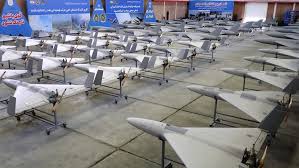
Ukraine says drones are targeting substations that power the Khmelnytskyi and Rivne nuclear plants. What we know on day 1,355
Guardian staff and agencies, 9 Nov 25
- Russia is again targeting substations that power the Khmelnytskyi and Rivne nuclear power plants in Ukraine, the country’s foreign minister Andrii Sybiha said on X on Saturday. Sybiha said drone attacks on the weekend were not accidental but well-planned strikes. “Russia is deliberately endangering nuclear safety in Europe,” he said.
- Russia launched a barrage of drones and missiles at Ukraine over the weekend, killing at least seven people and damaging energy infrastructure in three regions, according to Ukrainian officials. Ukraine’s president, Volodymyr Zelenskyy, said Russia had launched more than 450 drones and 45 missiles, most of which were shot down. Three people were killed and 12 wounded when a drone hit an apartment building in Dnipro, and another person was killed in the Kharkiv region. Three were killed in the south-eastern Zaporizhzhia region, regional officials said. https://www.theguardian.com/world/2025/nov/09/ukraine-war-briefing-russia-deliberately-endangering-nuclear-safety-in-europe-says-kyiv
Ukraine accuses Russia of targeting its nuclear substations.
A large Russian missile and drone attack that overwhelmed Ukrainian air
defences overnight targeted substations that power two of Ukraine’s nuclear power plants, according to the country’s foreign minister and a person with knowledge of the barrage.
Andriy Sybiha, Ukraine’s top diplomat, said the
substations which power the Khmelnytskyi and Rivne nuclear power plants
were targeted in “well planned strikes”. “Russia is deliberately
endangering nuclear safety in Europe,” he said in a statement.
FT 9th Nov 2025, https://www.ft.com/content/474e7f27-87fb-4fb1-9899-d62778a611a4
Russia urges Trump administration to clarify ‘contradictory’ signals on nuclear testing
By Dmitry Antonov, November 7, 2025, https://www.reuters.com/world/russia-says-it-wants-us-clarify-its-nuclear-testing-intentions-after-trump-2025-11-07/
- Summary
- Trump yet to spell out what kind of nuclear tests he means
- Russia and US have not tested since 1990s
- Russia says uncertainty is prompting global concern
- Putin has ordered proposals for possible test by Russia
MOSCOW, Nov 7 (Reuters) – Russia urged the United States on Friday to clarify what it called contradictory signals about a resumption of nuclear testing, saying such a step would trigger responses from Russia and other countries.
President Donald Trump last week ordered the U.S. military to immediately restart the process for testing nuclear weapons. But he did not make clear if he meant flight-testing of nuclear-capable missiles or a resumption of tests involving nuclear explosions – something neither the U.S. nor Russia has done for more than three decades.
“If it is the latter, then this will create negative dynamics and trigger steps from other states, including Russia, in response,” Russian Foreign Ministry spokeswoman Maria Zakharova told reporters.
“For now, we note that the signals emanating from Washington, which are causing justified concern in all corners of the world, remain contradictory, and, of course, the real state of affairs must be clarified.”
Citing the lack of clarity around U.S. plans, President Vladimir Putin on Wednesday instructed top officials to prepare proposals for Russia to carry out its own potential nuclear test in response to any U.S. test.
Security analysts say a resumption of testing by any of the world’s nuclear powers would be a destabilising step at a time of acute geopolitical tension, notably over the war in Ukraine, and would likely prompt other countries to follow suit.
Russia and the U.S. possess the world’s largest nuclear arsenals.
The last remaining treaty between them that limits the number of strategic nuclear warheads on both sides is due to expire in three months, potentially fuelling an arms race that is already in progress.
Putin has proposed that both sides continue to observe the treaty limits for another year, but Trump has yet to respond formally to the idea.
Putin considers nuclear tests after Trump threat.

8 Nov 25 https://www.politico.eu/article/russian-president-vladimir-putin-nuclear-tests-donald-trump-weapons/
The Russian president has asked for a feasibility study on resuming nuclear testing following a surprise announcement by his American counterpart.
3Russian President Vladimir Putin on Wednesday ordered top officials to come up with proposals for the potential resumption of nuclear testing for the first time since the end of the Cold War more than three decades ago.
Last week, U.S. President Donald Trump instructed the Pentagon to “immediately” start testing nuclear weapons “on an equal basis” with nuclear testing programs in other nations.
Putin, speaking at Russia’s Security Council, told the country’s foreign and defense ministers, its special services and the relevant civilian agencies to study the matter and “submit coordinated proposals on the possible commencement of work to prepare for nuclear weapons testing.”
Defense Minister Andrei Belousov told Putin at the meeting that it would be “appropriate to immediately begin preparations for full-scale nuclear tests.”
Kremlin spokesperson Dmitry Peskov later clarified that “the president did not give the order to begin preparations for the test” but merely ordered a feasibility study.
Russia announced last week that it had successfully tested a nuclear-powered torpedo, dubbed Poseidon, that was capable of damaging entire coastal regions as well as a new cruise missile named the Burevestnik, prompting Trump to respond. The U.S. today launched an intercontinental ballistic missile, Minuteman III, in a routine test.
The Cold War was characterized by an intense nuclear arms race between the U.S. and the Soviet Union as the superpowers competed for superiority by stockpiling and developing nuclear weapons. It ended in 1991 with the collapse of the Soviet Union and the signing of nuclear treaties such as START, which aimed to reduce and control nuclear arsenals. The Soviet Union conducted its last test in 1990 and the U.S. in 1992.
A report this year by the SIPRI think tank warned that the global stockpile of nuclear weapons is increasing, with all nine nuclear-armed states — the U.S., U.K., Russia, France, China, Pakistan, India, Israel and North Korea — upgrading existing weapons and adding new versions to their stockpiles.
‘Nothing revolutionary’ about Russia’s nuclear-powered missile: Experts
Putin has touted cruise missile Burevestnik and torpedo Poseidon as game-changing weapons as the war in Ukraine rages on.
Aljazeera, By Mansur Mirovalev, 5 Nov 2025
Kyiv, Ukraine – The collective West is scared of Moscow’s new, nuclear-powered cruise missile because it can reach anywhere on Earth, bypassing the most sophisticated air and missile defence systems, the Russian Ministry of Foreign Affairs has claimed.
“They’re afraid of what we’ll show to them next,” Foreign Ministry spokeswoman Maria Zakharova told the RIA Novosti news agency on Sunday.
Days earlier, she said Moscow was “forced” to develop and test the cruise missile, which is named the Burevestnik, meaning storm petrel – a type of seabird, in response to NATO’s hostility towards Russia.
“The development can be characterised as forced and takes place to maintain strategic balance,” she was quoted by the Itar-Tass news agency as saying. Russia “has to respond to NATO’s increasingly destabilising actions in the field of missile defence”.
With much pomp, Russian President Vladimir Putin on Tuesday handed state awards to Burevestnik’s developers.
Also awarded were the designers of Poseidon, an underwater nuclear-powered torpedo which Putin has also claimed has been successfully tested.
Russia says Poseidon can carry nuclear weapons that cause radioactive tsunamis, wiping out huge coastal areas. The “super torpedo” can move at the speed of 200km/h (120mph) and zigzag its way to avoid interception, it says.
“In terms of flight range, the Burevestnik … has surpassed all known missile systems in the world,” Putin said in his speech at the Kremlin. “Same as any other nuclear power, Russia is developing its nuclear potential, its strategic potential … What we are talking about now is the work announced a long time ago.”
But military and nuclear experts are sceptical about the efficiency and lethality of the new weapons.
It is not unusual for Russia to flaunt its arsenal as its onslaught in Ukraine continues. Analysts say rather than scaring its critics, Moscow’s announcements are merely a scare tactic to dissuade Western powers from supporting Kyiv.
“There’s nothing revolutionary about,” the Burevestnik, said Pavel Podvig, director of the Russian Nuclear Forces Project at the the United Nations Institute for Disarmament Research.
“It can fly long and far, and there’s some novelty about it, but there’s nothing to back [Putin’s claim] that it can absolutely change everything,” Podvig told Al Jazeera. “One can’t say that it is invincible and can triumph over everything.”
The Burevestnik’s test is part of Moscow’s media stratagem of intimidating the West when the real situation on the front lines in Ukraine is desperate, according to a former Russian diplomat.
The missile is “not a technical breakthrough but a product of propaganda and desperation”, Boris Bondarev, who quit his Russian Foreign Ministry job to protest against the 2022 full-scale invasion of Ukraine, wrote in an opinion piece published by the Moscow Times.
Few details about ‘unique’ missile
The problem is that officials have so far unveiled very little about the Burevestnik, which NATO has dubbed the SSC-X-9 Skyfall – a missile that has a nuclear reactor allegedly capable of keeping it in the air indefinitely………………………………………………………………………… https://www.aljazeera.com/news/2025/11/5/nothing-revolutionary-about-russias-nuclear-powered-missile-experts
The moment of truth: The West confronts Russian military advances.
on October 20th, Russia informed the United States that it had no intention of yielding on territorial concessions, the reduction of the Ukrainian armed forces, or guarantees that Ukraine would never join NATO.
Thierry Meyssan, Voltairenet.org, Tue, 04 Nov 2025
For two years, we in the West have been living in the myth that we will bring Russia to its knees and bring Ukraine into the European Union and the Atlantic Alliance. We will try Vladimir Putin and make Russia pay. Today, this myth is colliding with reality: Moscow now possesses devastating weapons, unparalleled in the West. They make any hope of victory for our coalitions impossible. We will have to acknowledge our mistake. This is not about apologizing for our errors, but about freeing ourselves from them.
On October 26, Russian President Vladimir Putin and his Chief of Staff, Valery Gerasimov, announced the completion of a project to miniaturize a nuclear reactor and install it on a missile. They reported conducting a test launch of the 9M730 Burevestnik missile, which traveled 14,000 kilometers. The unique feature of this nuclear-powered weapon (which has an unlimited range) is its ability to be guided in such a way as to bypass interceptor sites.This, according to Russian authorities, makes it an unstoppable missile.
On October 29, President Putin tested a Status-6 Poseidon torpedo, a nuclear-powered weapon. Throughout the Soviet Union, Eurasian military researchers believed that underwater nuclear explosions could trigger massive tsunamis. To achieve this, they needed to be able to launch torpedoes much farther than was possible at the time, in order to avoid the cataclysms they intended to unleash. This has now been accomplished. Mega-tsunamis could devastate cities like Washington, D.C., or New York City, or even naval groups like those of the U.S. aircraft carriers. However, the Poseidon torpedo is significantly longer than others: 21 meters. It cannot be launched from operational submarines and required its own dedicated vessel for launch. Its ability to operate underwater almost indefinitely more than compensates for this limitation. In any case, this torpedo ensures that Russia can launch a second strike in the event of a US attack. Until now, the first to launch a nuclear strike was guaranteed to cripple its enemy’s main means of retaliation.
No weapon is ever truly definitive. Each exists within a continuum of technological advancements; each is superseded by another; and each eventually encounters effective defenses or predators. But for the moment, there seems to be no answer to these weapons, any more than there is to Russian supersonic missiles.
In about twenty years, Russia has acquired a whole host of new weapons that surpass all Western technologies.……………………………………………………..
Russia possessed the capability to disconnect NATO orders from its own weapons. This wasn’t a form of jamming; the weapons simply stopped responding to commands………………………………………
The Westerners were also testing numerous weapons, such as the tactical atomic bomb that later devastated the port of Beirut.
In 2018, once the Syrian war had ended, President Vladimir Putin presented his weapons program to parliament [ 1 ] . This program comprised six advanced weapons:the Sarmatian (which leaves the atmosphere, orbits the Earth, and re-enters the atmosphere at will) and Kinzhal (dagger) missiles; the nuclear-powered 9M730 Burevestnik and Status-6 Poseidon launchers; the Avantgarde missiles, which combine the characteristics of the Sarmatian and Kinzhal missiles with added maneuverability; and finally, anti-missile lasers.Only the latter are not yet complete.
What were only prototypes in the 2010s became operational and were mass-produced during the war in Ukraine.
The Western response was almost inaudible. Only US President Donald Trump spoke out. He regretted that his Russian counterpart had seen fit to reveal his exploits because, in doing so, he was reigniting the arms race. Furthermore, he announced that the United States was resuming its nuclear tests. Donald Trump could hardly do otherwise: deploring Russia’s renewed arms race is a way of explaining that the Pentagon’s military research is lagging far behind and of asserting Washington’s peaceful stance. Announcing that he will resume nuclear tests is a way of shifting the focus, since none of the new Russian weapons represent an advance in nuclear terms, but only in terms of atomic bomb launchers. To say that he will do this to maintain parity with Russia and China is a blatant lie: Russia has not conducted nuclear tests since 1990 and China since 1996. Moreover, it will take at least two years to rebuild or rehabilitate Cold War-era facilities, and therefore to begin these tests. Until then, the United States is nothing more than a “paper tiger.”
We are now reaching the end of hostilities in Ukraine. The Russian army is on the verge of a decisive victory in the Donbas. It will not only capture Pokrovsk, but will also inflict a third defeat on the White Führer, Andriy Biletsky, whose 10,000 men are surrounded. …………………
..on October 20th, Russia informed the United States that it had no intention of yielding on territorial concessions, the reduction of the Ukrainian armed forces, or guarantees that Ukraine would never join NATO.
Whether the West likes it or not, it no longer has a choice. It simply cannot afford to continue supplying weapons to Russia in Ukraine on its own. The EU’s plan to eventually confiscate Russian assets frozen in Belgium and spend them immediately could spell the end of the Union. In any case, neither Belgium, nor Slovakia, nor Hungary will participate in this theft, which even the Soviets, the staunch opponents of private property, never perpetrated.
The EU’s grandiose ambitions are about to collide with reality: it can only continue this war by betraying the very ideals it claims to uphold………….
All of this is coming to an end, otherwise the EU will be directly drawn into the war against the Slavs that the UK and Germany instigated in 1933: the Second World War. And the EU’s armies, stripped of their arsenals, have no hope of resisting for more than two days. This is not about bowing down to a new master, Russia, but simply about acknowledging our mistakes before it’s too late. https://www.sott.net/article/502778-The-moment-of-truth-The-West-confronts-Russian-military-advances
Trump doubles down on nuclear tests as Russia issues warning.

By Reuters, November 1, 2025 , https://www.smh.com.au/world/north-america/trump-doubles-down-on-nuclear-tests-as-russia-issues-warning-20251101-p5n6z4.html
Washington: President Donald Trump has reaffirmed that the United States will resume nuclear testing, but he would not answer directly when asked whether that would include underground nuclear tests that were common during the Cold War.
“You’ll find out very soon, but we’re going to do some testing,” Trump told reporters aboard Air Force One on Friday (Saturday AEDT) as he flew to Palm Beach, Florida, when asked about underground nuclear tests.
“Other countries do it. If they’re [going] to do it, we’re going to do it, OK?”
Trump said on Thursday that he had ordered the US military to immediately restart the process for testing nuclear weapons after a halt of 33 years, a move that appeared to be a message to rival nuclear powers China and Russia, whose last known tests were in the 1990s.
Trump made that surprise announcement on social media while aboard his Marine One helicopter flying to meet Chinese President Xi Jinping for a trade-negotiating session in Busan, South Korea.
It was not immediately clear whether Trump was referring to nuclear-explosive testing, which would be carried out by the National Nuclear Security Administration, or flight testing of nuclear-capable missiles.
Continue readingDonald Trump’s nuclear testing order sparks pushback from Russia, China and the UN.
SBS World News, 31 Oct 25
Trump said the Pentagon will immediately resume testing the US nuclear arsenal on an “equal basis” with other nuclear powers.
United States President Donald Trump has landed back in the US after a surprise directive to begin nuclear weapons testing that has raised the spectre of renewed superpower tensions.
Trump announced the order on social media, just as he was entering a summit with Chinese leader Xi Jinping in South Korea on Thursday.
It came days after Russia declared it had tested nuclear-capable, nuclear-powered cruise missiles and sea drones.
The blunt statement from Trump, who boasts frequently about being a “peace” president, left much unanswered.
Chiefly, it was unclear whether he meant testing weapons systems or actually conducting test explosions — something the US has not done since 1992.
“Because of other countries’ testing programs, I have instructed the Department of War to start testing our Nuclear Weapons on an equal basis,” Trump said in a post on his Truth Social platform.
Trump also said that the US has more nuclear weapons than any other country and that he had achieved this in his first term as president.
The Stockholm International Peace Research Institute said in its latest annual report that Russia possesses 5,489 nuclear warheads, compared to 5,177 for the United States and 600 for China.
In his post, Trump said — minutes ahead of his meeting with Xi — that China was expected to “be even within 5 years”, without substantiating the claim.
China, Russia express concerns
In response to Trump’s announcement, Chinese foreign ministry spokesperson Guo Jiakun urged the US to “earnestly abide” by a global nuclear testing ban.
Russia questioned whether Trump was well-informed about its activities.
“President Trump mentioned in his statement that other countries are engaged in testing nuclear weapons. Until now, we didn’t know that anyone was testing,” Kremlin spokesman Dmitry Peskov told reporters.
Russia’s recent weapons drills “cannot in any way be interpreted as a nuclear test”, Peskov said. “We hope that the information was conveyed correctly to President Trump.”
Peskov then implied that Russia would conduct its own live warhead tests if Trump did it first.
“If someone departs from the moratorium, Russia will act accordingly,” Peskov said.
Russian President Vladimir Putin has repeatedly said that if any country tests a nuclear weapon, then Russia will do so too.
Both countries observe a de facto moratorium on testing nuclear warheads, though Russia and the United States do regularly run military drills involving nuclear-capable systems.
The US has been a signatory since 1996 to the Comprehensive Nuclear-Test-Ban Treaty, which bans all atomic test explosions, whether for military or civilian purposes.
United Nations secretary-general António Guterres said through his deputy spokesman that “nuclear testing can never be permitted under any circumstances”………………………………………… https://www.sbs.com.au/news/article/trump-nuclear-testing-order-pushback/a21zghnl1
How Russia is risking nuclear catastrophe with attempts to syphon power from Ukraine’s biggest plant
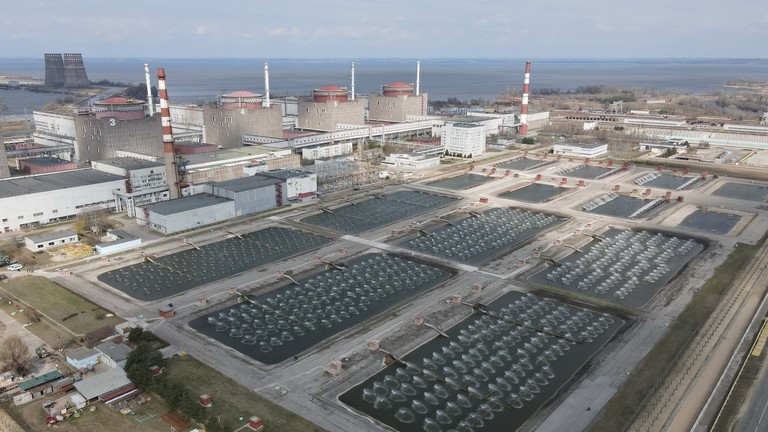
The exiled mayor of Enerhodar, close to Zaporizhzhia, reveals his fear of an ecological catastrophe
Sam Kiley, In Zaporizhzhia, Wednesday 29 October 2025, https://www.independent.co.uk/news/world/europe/zaporizhzhia-nuclear-plant-ukraine-russia-war-b2855001.html
Europe’s biggest nuclear reactor has become a battlefield in Ukraine’s defence against Russian invaders as they risk a catastrophic meltdown in its efforts to connect it to Moscow’s national grid.
The Zaporizhzhia nuclear power plant (ZNPP), which has six reactors, was captured by Russian troops early in the invasion of Ukraine in 2022. It has remained a dangerous potential flashpoint for a nuclear disaster ever since.
Fighting and bombardments by both sides of the complex and the power station itself, which has been entirely occupied by Russian forces who base troops in its buildings, have forced the “cold shutdown” of the reactors.
This means that its nuclear material is not used to generate power but needs to be constantly cooled.
The fighting cut electricity from Ukraine, meaning that the cooling system had to rely entirely on diesel generators and a skeleton staff for a month.
Regular power was only restored in the last week, after the longest period the ZNPP had been disconnected from electricity to drive its cooling systems.
Russia needs to cut the Ukrainian power link in order to install its connection into the Russian network – a long-stated ambition.
“The Russian Federation is putting in its power line, but elements of it have been successfully damaged by Ukraine,” explained Mykhailo Shuster, nuclear expert and former director of procurement at Energoatom – Ukraine’s nuclear power agency.
“Russia is now at a high level of readiness, and to connect it, the power supply from Ukraine must be interrupted.”
It is unclear whether Russia has been able to connect the Ukrainian plant to its own network during the 30-day outage. If it did so, it would then have to install converter stations to synchronise the two grids.
But the power cuts to the cooling systems, combined with the near collapse of the water supplies there after Russia blew up the Kakhova Dam – the main water source for the ZNPP – is causing jitters among local leaders.
The exiled mayor of the now-occupied Enerhodar, the town next to Zaporizhzhia, told The Independent he fears nuclear fallout could melt into the groundwater around the plant, contaminate the Dnipro River and eventually the Black Sea.
“Kakhovka Dam is destroyed; there is nothing to cool it with – even if they miraculously restore the equipment in the future,” he said.
“Worst case scenario: the water will eventually evaporate from the cooling pond, and there will be nothing to cool nuclear fuel.”
“It can melt the concrete and go into the groundwater,” Dmytro Orlov added from his office in Zaporizhzhia. Mayor Orlov runs humanitarian programmes for the thousands of people, mostly nuclear power workers, who fled the advancing Russians from his town to safety here.
The mayor recalled the 1986 Chernobyl disaster, which remains the worst nuclear disaster in history.
“The estimated amount of nuclear fuel there is about 10 times more than in Chernobyl,” he warned.
A small team of inspectors from the International Atomic Energy Authority regularly inspects the power station and has reported military training and explosions in and around the facility.
Russian artillery and mortars have been seen shelling and bombing Ukrainian towns and villages on the opposite bank of the Dnipro.
After power was restored, IAEA director general Mario Grossi said: “What was once virtually unimaginable – a nuclear power plant regularly losing off-site power – has unfortunately become a common occurrence during this devastating war. However, this was the most challenging loss of power event we have experienced so far.
“There is still much work to do to further reduce the risks of a nuclear accident.”
The anti-Russia, pre-SMO, Timeline of Which Legacy Media Won’t Speak
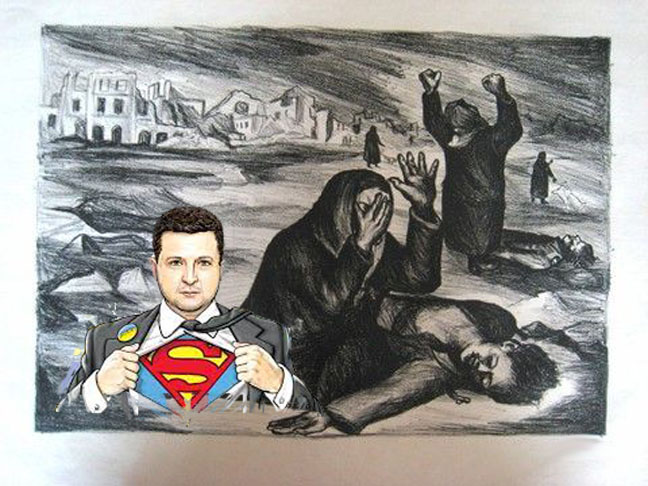
timeline of events leading up to the commencement in February 2022 of Russia’s Special Military Operation
Eva Karene Bartlett, Oct 28, 2025, https://evakarenebartlett.substack.com/p/the-anti-russia-pre-smo-timeline?utm_source=post-email-title&publication_id=3046064&post_id=177345476&utm_campaign=email-post-title&isFreemail=true&r=1ise1&triedRedirect=true&utm_medium=email
Very useful written timeline of events leading up to the commencement in February 2022 of Russia’s Special Military Operation.
Jacques Baud discussed much of this (see bottom of this post), but this written account is worth bookmarking.
Alan Watson:
“Vladimir Putin did not wake up on 24 February 2022 and decide, “I think I’ll invade eastern Ukraine today,” nor was the US campaign to expand NATO into Ukraine a last-minute maneuver. (US State Department documents show Ukraine’s future membership was discussed as early as 1994.)
9 Feb 1990: In a deal approved by Mikhail Gorbachev, the last leader of the Soviet Union, as a quid pro quo for accepting German reunification within NATO, Secretary of State James Baker pledged that NATO would not expand “one inch to the east.”
US, European and German leaders made explicit assurances to Gorbachev against any future eastward NATO expansion. Gorbachev understood the assurances as a “binding agreement.” Subsequently, Soviet leaders made decisions on that basis and acted on them – withdrawing the Red Army from Germany and dissolving the Warsaw Pact.
12 March 1999: Clinton is president. The Czech Republic, Hungary and Poland became members of NATO. A weakened post-Soviet Russia, led by Boris Yeltsin, controlled by a cabal of Oligarchs, could do nothing to prevent it. Powerless, Yeltsin was said to be “infuriated” with “his friend Bill Clinton…”
29 March 2004: George W. Bush is president. Seven more Eastern European countries join NATO: Bulgaria, Estonia, Latvia, Lithuania, Romania, Slovakia and Slovenia – largest wave of NATO enlargement ever.
April 2008: At the Bucharest NATO summit, George W. Bush announced that Ukraine and Georgia are on an “immediate path to NATO.” Bill Burns, ambassador to Russia, sent a memo to Secretary of State Condoleezza Rice. “Across the board,” he wrote, the Russian political class told him, “Ukraine is the reddest of red lines” – “Nyet means nyet.”
22 Feb 2014: Just as the Sochi Winter Olympics were underway, Kiev erupted in violence. State Department official Virginia Nuland boasted that since the 2004-2005 “Orange Revolution,” the US had spent $5 billion on regime change in Ukraine. NATO rooftop snipers killed both protestors and police, forcing Ukraine’s democratically elected president Viktor Yanukovych to flee the country.
2 May 2014: Bussed to Odessa from Kiev, Right Sector thugs carrying baseball bats confront ethnic Russians protesting the coup. When protestors fled into the city’s Trade Unions House, the building was set on fire. Forty-eight people were burned or bludgeoned to death – the Donbass civil war point of no return.
11 Feb 2015: Putin and Ukrainian President Poroshenko meet with French President Francois Hollande and German Chancellor Angela Merkel in Belarus to negotiate the Minsk ceasefire accords. The leaders agreed to a deal that would have ended the fighting – granting autonomy to the Russian-speaking Donbass, but successive Ukrainian governments refused to implement the accord.
German Chancellor Merkel later admitted that Minsk was a stall tactic to allow the West to build Ukraine’s army up to NATO standards. [Ed. note – Zelensky also admitted that he lied in his campaign for President, in pledging to uphold the Minsk agreement]
17 Dec 2021: Team Biden rejects Putin’s proposed mutual security accords that would have left a “neutral” Ukraine intact. For years, Russia had tried to convince US administrations that Ukraine was off-limits to NATO membership, but Russian concerns were brushed aside. December 2021, Team Biden insisted, “Russia doesn’t say who can join NATO.”
18 Feb 2022: During the Winter Olympics in China, the Organization for Security and Co-operation in Europe (OSCE) documented that Ukraine had ramped up artillery attacks along the Line of Contact.
(Since the 2014 coup in Kiev, the Armed forces of Ukraine, including the Neo-Nazi Banderites, had killed thousands of ethnic Russians in the Donbass.
19 Feb 2022: Invited to speak at the Munich Security Conference, Ukrainian President Zelensky said, “Ukraine will get and deploy nuclear missiles.”
20 Feb 2022: On CBS 60 Minutes, Ukraine’s Minister of Foreign Affairs Dmytro Kuleba said, “Ukraine will never honor the Minsk cease fire.”
21 Feb 2022: Russia captured a Ukrainian soldier, killed five others as they crossed over the border into Rostov. Russia learned the invasion of Donetsk city was imminent and recognized the breakaway Donbass and Luhansk oblasts as independent republics.
24 Feb 2022: With about 90,000 troops, Russia launched its “Special Military Operation” – not a “full scale invasion.” Citing the UN principle, “Responsibility to Protect,” Russia intervened in the eight-year Donbass civil war after all prospects for diplomacy had failed.
April 2022, week six of the war, Russian and Ukrainian negotiators convened peace talks in Istanbul. Later, Ukrainian diplomat Oleksandr Chalyi recalled, “Putin tried to do everything possible to conclude an agreement…” [The tentative accord would have left a “neutral” #Ukraine intact.]
On 1 April, USAID revealed photographic evidence of a “massacre” in Bucha and financed a press tour featuring US public figures. Problem: Four days earlier at a press conference, the mayor had announced that the Russians had retreated from the city [and he did not report there had been a massacre].
After the Russians voluntarily retreated, the regime scattered bodies in the streets that included both actors in body bags and recently killed “Russian collaborators” from around Bucha – giving an “outraged” Joe Biden and Boris Johnson, who flew unannounced to Kiev, the justification to order Zelensky to “keep fighting.”
If the US, UK and EU continue rejecting Russian proposals for a long term, European wide peace accord – as Putin proposed in December 2021 – the Russian army will continue advancing toward Kharkiv in the north and Odessa on the Black Sea. As Putin and Foreign Minister Sergei Lavrov emphasized: There will be no Minsk III.”
From a September 2024 interview I did with Jacques Baud (former Swiss intelligence & author). In this clip, Jacques lays out the history of events related to Ukraine prior to 2022, prior even to the 2014 coup which brought fascism to power in Ukraine, & how it was the NATO-Ukraine alliance which brought war, not Russia.
Full interview: https://rumble.com/v5fjhrh-jacques-baud-nato-threatened-russia-decades-before-2022.html https://odysee.com/@EvaKareneBartlett:9/JacquesBaudNATOThreatenedRussia:5
ATOMIC BLACKMAIL? The Weaponisation of Nuclear Facilities During the Russia-Ukraine War.
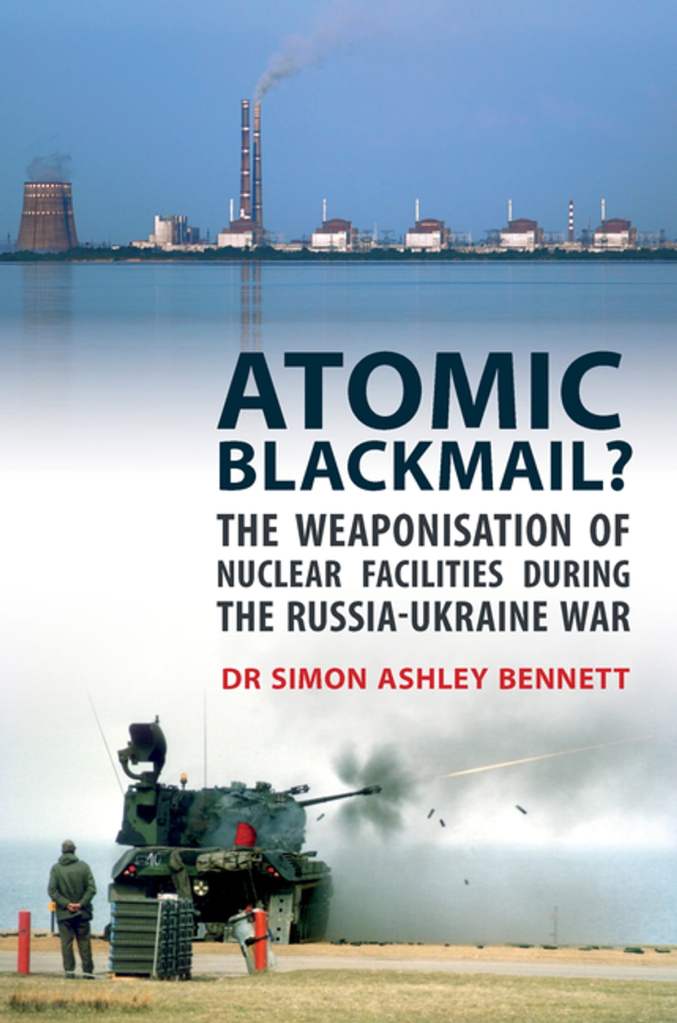
a protagonist could use long-range munitions to turn a NPP into a dirty bomb that would spread radioactive contamination over a wide area, dispersing or diverting army formations, rendering civilian infrastructure and farmland unusable, contaminating groundwater and creating a radioactive cloud that would – if the wind was blowing in a convenient direction – cause transborder harms.
Simon Ashley Bennett, https://www.libripublishing.co.uk/Products/CatID/16/ProdID=292
In Atomic Blackmail? Simon Bennett examines the very real possibility of the ‘weaponisation’ of nuclear facilities during the Russia-Ukraine War. The Russia-Ukraine War has several unique aspects, the most striking of which is that it is being fought in proximity to nuclear facilities and working nuclear power stations, including the six-reactor Zaporizhzhia Nuclear Power Plant (NPP), Europe’s largest, and the decommissioned four-reactor Chernobyl NPP that, in 1986, suffered a catastrophic failure that released radioactive contamination across much of Europe. Some experts claim the contamination caused several thousand excess cancer deaths.
In 1985, foreign affairs and nuclear expert Bennett Ramberg published Nuclear Power Plants: An Unrecognised Military Peril, with a second edition of the book published in 1992. In his visionary discourse, Ramberg posited that in future wars, regional or global, nuclear facilities and powerplants might be weaponised, to gain political traction over an opponent and/or neutralise opposing forces’ capacity for battlefield manoeuvre.
In one scenario, Ramberg described how a protagonist could use long-range munitions to turn a NPP into a dirty bomb that would spread radioactive contamination over a wide area, dispersing or diverting army formations, rendering civilian infrastructure and farmland unusable, contaminating groundwater and creating a radioactive cloud that would – if the wind was blowing in a convenient direction – cause transborder harms. As demonstrated by the Chernobyl disaster, a reactor malfunction can generate serious and long-lasting environmental impacts. Radioactive particles released from Chernobyl’s devastated Reactor Number Four were deposited as far afield as the Cumbrian hills in north-west England.
While, at the time of writing, none of Ukraine’s fifteen reactors had been damaged in an exchange of fire, the possibility remains that this could happen during Ukraine’s 2023, and subsequent, offensives to expel Russian forces from sovereign Ukrainian territory. Much to the consternation of the International Atomic Energy Agency (IAEA), there have been several near-misses, with weapons fired in and around both the decommissioned Chernobyl NPP and working Zaporizhzhia NPP. Further, Russian long-range precision munitions (cruise missiles) have been tracked flying either close to, or over Ukraine’s NPPs. The Pivdennoukrainsk (South Ukraine) NPP has been overflown. On 20 September, 2022, a missile landed some 300 metres from the NPP.
While Ramberg’s nightmare vision of destroyed NPPs rendering a country uninhabitable has not, yet, been realised in the Russia-Ukraine War, the longer and more intense the conflict, the greater the likelihood that one or more of Ukraine’s NPPs will be damaged or, via a credible sabotage threat, used to leverage tactical or strategic advantage. Atomic blackmail finally exampled.
Ukraine Says It Struck a Chemical Plant Inside Russia With British-Provided Storm Shadow Missiles

The Ukrainian military requires US targeting data to fire Storm Shadow missiles
by Dave DeCamp | October 21, 2025, https://news.antiwar.com/2025/10/21/ukraine-says-it-struck-a-chemical-plant-inside-russia-with-british-provided-storm-shadow-missile/
Ukraine’s military said on Tuesday that it used British-provided Storm Shadow missiles to strike a chemical plant inside Russia’s Bryansk Oblast, signaling the US is again supporting Ukrainian missile strikes on Russian territory.
“A massive combined missile-and-air strike was carried out, including with air-launched Storm Shadow missiles that penetrated Russia’s air defence system,” the General Staff of Ukraine’s Armed Forces said in a statement, according to Reuters. So far, the attack hasn’t been confirmed by Russia.
Storm Shadows are produced jointly by the UK and France and have a range of about 150 miles. Ukraine first began firing them into Russia last year, along with US-provided ATACMS missiles, which can hit targets up to 190 miles away.
In August, The Wall Street Journal reported that the Trump administration was not allowing Ukraine to fire ATACMS into Russia, a policy that also applied to Storm Shadows, since the Ukrainian military requires US targeting data to fire the British missiles. But another report from the outlet this month said that President Trump reversed the policy and signed off on providing Ukraine with intelligence for long-range missile strikes on Russian territory.
The Financial Times has also reported that the Trump administration has been providing intelligence for long-range drone attacks on Russian energy infrastructure since July.
US-backed missile and drone attacks on Russian territory always risk a major escalation from Moscow. When President Biden first gave Ukraine the green light to fire ATACMS and Storm Shadows into Russia, Moscow responded by altering its nuclear doctrine to lower the threshold for the use of nuclear weapons.
Russia to Raise Cold War Nuclear Submarines From Arctic—What’s Hiding on the Seabed?
Ivan Khomenko, Oct 20, 2025 , https://united24media.com/latest-news/russia-to-raise-cold-war-nuclear-submarines-from-arctic-whats-hiding-on-the-seabed-12644
Russia plans to begin preparations in 2026 for raising two Soviet-era nuclear submarines that sank in Arctic waters, according to RBC on October 18. The recovery work itself is scheduled to start in 2027.
As RBC reported, the draft federal budget for 2026 and the planned period of 2027–2028 includes allocations for rehabilitating Arctic sea areas contaminated by sunken or submerged radiation-hazardous objects.
These activities are part of Russia’s state program Development of the Atomic Energy and Industrial Complex.
According to the explanatory note cited by RBC, the section titled “Safe Handling of Federal Radioactive Waste and Decommissioning of Nuclear and Radiation-Hazardous Legacy Facilities” earmarks 10.5 billion rubles for 2026, 10.7 billion for 2027, and 10.6 billion for 2028.
The project reportedly focuses on two of the seven sunken Soviet nuclear submarines—K-27 and K-159.
K-27, introduced in 1963, was an experimental submarine equipped with liquid-metal cooled reactors using a lead-bismuth alloy. In 1968, during its third voyage, a reactor accident exposed more than 140 crew members to radiation, killing nine.
The vessel was scuttled in the Kara Sea in 1981 and now lies at a depth of about 75 meters.
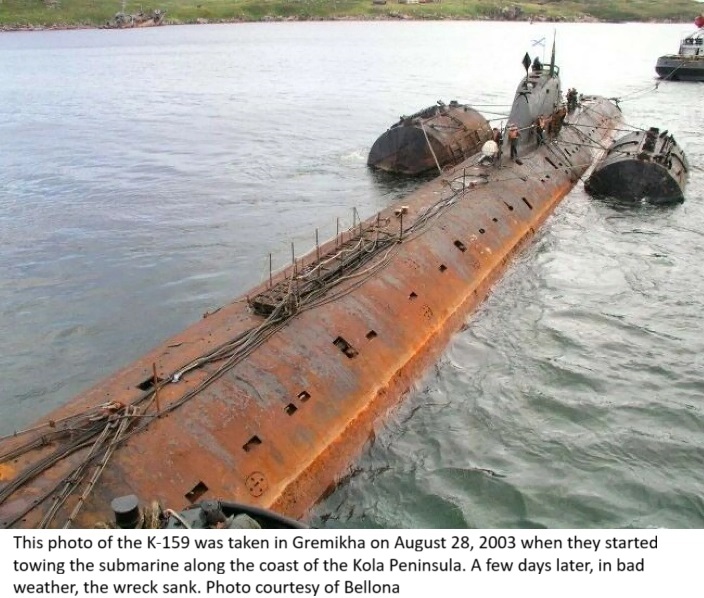
K-159 entered service the same year as K-27 and remained operational until 1989. It sank in 2003 in the Barents Sea while being towed for dismantling near Kildin Island, resulting in the deaths of nine crew members. The wreck rests at approximately 250 meters.
Plans to lift these submarines have been discussed for more than a decade but were repeatedly postponed due to the lack of specialized equipment, qualified personnel, and safety concerns. In 2021, Rosatom estimated that raising the vessels would cost around 24.4 billion rubles.
The renewed inclusion of the project in Russia’s 2026 budget marks the first concrete step since 2012 toward removing the radioactive wrecks from the Arctic seabed, though the exact reasons for the timing remain unclear, RBC noted.
Earlier in October, Russia’s Novorossiysk submarine—armed with Kalibr cruise missiles—was forced to abandon its Mediterranean mission and return to Saint Petersburg after a fuel leak disabled its underwater capability.
The incident highlighted Russia’s growing naval limitations following the loss of its Syrian logistics hub in Tartus and Turkey’s blockade of the Bosphorus Strait.
Moscow puts money on the table to raise nuclear subs from Arctic seabed
Both the K-27 and the K-159 represent ticking radioactive time-bombs for the Arctic marine environment.
The Government’s draft budget for 2026, and the planned budget for 2027-2028, include funding to lift the K-27 and K-159, two wrecked submarines that are resting on the seabed in the Barents Sea and Kara Sea.
Thomas Nilsen, 20 October 2025 –https://www.thebarentsobserver.com/news/moscow-puts-money-on-the-table-to-raise-nuclear-subs-from-arctic-seabed/439056
It is the state nuclear corporation Rosatom that told news outlet RBK about the plans to finally do something about the ticking radioactive time-bombs.
“The draft federal budget for 2026 and the 2027-2028 planning period includes funding for the rehabilitation of Arctic seas from sunken and dumped radiation-hazardous objects, beginning in 2027. Preparations for the planned work will begin in 2026,” the press service of Rosatom said.
An explanatory note to Rosatom’s budget post for disposal of nuclear and radiation-hazardous nuclear legacy sites details how 30 billion rubles for the three-year period are earmarked for planning and lifting of the Cold War era submarines left on the Arctic seabed.
The K-27 and the K-159 are the most urgent to raise and bring to shore for safe scrapping.
While the K-27 was dumped on purpose in 1982 in the Stepovoy Bay on the Kara Sea side of Novaya Zemlya, the sinking of the K-159 in the Barents Sea was an accident.
Lifting a nuclear submarine from the seabed is nothing new. It is difficult, but doable.
In 2002, the Dutch salvage company Mammoet managed to raise the ill-fated Kursk submarine from the Barents Sea. A special barge was built with wires attached underneath. The wreck of the Kursk was safely brought in and placed in a floating dock where the decommissioning took place.
Aleksandr Nikitin, a nuclear safety expert with the Bellona Foundation in Oslo, said to the Barents Observer that it is too early to conclude that the lifting actually will happen, or whether this is a preliminary plan that needs to be developed before concluding.
“As far as I understand, there’s no concrete plan,” Nikitin said.
Before Russia’s full-scale war against Ukraine, Aleksandr Nikitin was member of Rosatom’s Public Chamber, a body that worked with non-governmental organisations to foster transparency and civic engagement on nuclear safety related issues in Russia.
Nikitin believes there still is infrastructure on the Kola Peninsula to deal with the two submarines if they are lifted from the seabed.
“Rosatom is currently trying not to destroy what the French built in Gremikha, hoping to dismantle the K-27 there if it’s raised. This is a special facility where this nuclear submarine with a liquid metal coolant reactor can be dismantled,” he explained.
“As for the K-159, it could be dismantled, for example, at Nerpa.”
Nerpa is a shipyard north of Murmansk that decommissioned several Cold War submarines at the time when Russia maintained cooperation with European partners, including Norway.
Ticking radioactive time-bombs
Both the K-27 and the K-159 represent ticking radioactive time-bombs for the Arctic marine environment.
The K-159 is a November-class submarine that sank in late August 2003 while being towed in bad weather from the closed naval base of Gremikha on the eastern shores of the Kola Peninsula towards the Nerpa shipyard north of Murmansk.
Researchers have since then monitored the wreck, fearing leakages of radioactivity from the two old nuclear reactors onboard could contaminate the important fishing grounds in the Barents Sea. A joint Norwegian-Russian expedition examined the site in 2014 and concluded that no leakage has so far occurred from the reactors to the surrounding marine environment.
However, the bad shape of the hull could eventually lead to radionuclides leaking out.
The two onboard reactors contain about 800 kilograms of spent nuclear fuel, with an estimated 5,3 GBq of radionuclides.
A modelling study by the Norwegian Institute of Marine Research said that a pulse discharge of the entire Cesium-137 inventory from the two reactors could increase concentrations in cod in the eastern part of the Barents Sea up to 100 times current levels for a two-year period after the discharge. While a Cs-137 increase of 100 times in cod sounds dramatic, the levels would still be below international guidelines. But that increase could still make it difficult to market the affected fish.
The K-27, the other submarine that it is urgent to lift, was on purpose dumped in the Kara Sea in 1982. In September 2021, divers from the Centre for Underwater Research of the Russian Geographical Society conducted a survey of the submarine’s hull. Metal pieces were cut free, the thickness of the hull was measured, along with other inspections of the submarine that has been corroding on the seabed for more than 40 years.
In aditionl to the K-27 and K-159, there are also the other dumped reactors in the Kara Sea, including from the K-11, K-19 and K-140, as well as spent nuclear fuel from an older reactor serving the icebreaker Lenin.
In Soviet times, thousands of containers with solid radioactive waste from both the civilian icebreaker fleet and the military Navy were dumped at different locations in the Kara Sea.
1 This Month
23-25 October – on Zoom – World BEYOND War’s annual global conferenc


Shut down the radiation-damaged Heysham nuclear reactors now
To see nuclear-related stories in greater depth and intensity – go to https://nuclearinformation.wordpress.com

Say No to NASA’s Reckless Nuclear Reactor on the Moon
Say No to NASA’s Reckless Nuclear Reactor on the Moon

-
Archives
- October 2026 (219)
- September 2026 (339)
- August 2026 (330)
- July 2026 (355)
- June 2026 (287)
- May 2026 (306)
- April 2026 (356)
- March 2026 (251)
- February 2026 (267)
- January 2026 (308)
- December 2025 (358)
- November 2025 (359)
-
Categories
- 1
- 1 NUCLEAR ISSUES
- business and costs
- climate change
- culture and arts
- ENERGY
- environment
- health
- history
- indigenous issues
- Legal
- marketing of nuclear
- media
- opposition to nuclear
- PERSONAL STORIES
- politics
- politics international
- Religion and ethics
- safety
- secrets,lies and civil liberties
- spinbuster
- technology
- Uranium
- wastes
- weapons and war
- Women
- 2 WORLD
- ACTION
- AFRICA
- Atrocities
- AUSTRALIA
- Christina's notes
- Christina's themes
- culture and arts
- Events
- Fuk 2022
- Fuk 2023
- Fukushima 2017
- Fukushima 2018
- fukushima 2019
- Fukushima 2020
- Fukushima 2021
- general
- global warming
- Humour (God we need it)
- Nuclear
- RARE EARTHS
- Reference
- resources – print
- Resources -audiovicual
- Weekly Newsletter
- World
- World Nuclear
- YouTube
-
RSS
Entries RSS
Comments RSS

