nuclear-news

The News That Matters about the Nuclear Industry Fukushima Chernobyl Mayak Three Mile Island Atomic Testing Radiation Isotope

USA abandoned the Nuclear-Powered Missile long ago due to its extreme danger. It seems that Russia just tried it again.

Why the U.S. Abandoned Nuclear-Powered Missiles More Than 50 Years Ago

President Donald Trump says the U.S. has a missile like the one that killed seven in the Russian arctic. That’s untrue, because the U.S. abandoned the idea decades ago.

August 15, 2019 Posted by | Russia, Small Modular Nuclear Reactors, technology, weapons and war | 1 Comment

‘Dirty bomb’: Mystery Russian ‘superweapon’ kills five

An on-board reactor would give an engine almost unlimited range. In the case of a guided cruise missile, it could circle the world before receiving orders to attack from out of the blue.

But they’re not easy to control.

They operate at extremely high temperatures. They use explosive fuels, such as liquid hydrogen. And any accident could have devastating, long-lasting effects.


August 12, 2019 Posted by | incidents, Reference, Russia, weapons and war | 1 Comment

Russia says small nuclear reactor blew up in deadly accident

August 12, 2019 Posted by | incidents, Russia, Small Modular Nuclear Reactors | 1 Comment

Putin’s silence on mysterious radiation accident

Russia nuclear leak: Mysterious footage of hazmat officials escalates radiation panic https://www.express.co.uk/news/world/1164125/Russia-nuclear-leak-radiation-Putin-iodine-hazmat

CHILLING footage from Russia has intensified fears of a nuclear radiation accident after ambulances were spotted lined with protective chemical sheets and hospitals workers were seen wearing hazmat suits.

By OLI SMITH, Sun, Aug 11, 2019  Russian President Vladimir Putin has remained silent, amid growing speculation that a nuclear missile accident has caused a dangerous radiation leak at a naval base. The Kremlin have confirmed that a “rocket engine explosion” at the Archangelsk base in northern Russia killed five people and injured three. Last night, Russia’s nuclear energy agency Rostam admitted that they had been involved in the aftermath of the incident, raising concern of a radiation leak.

Rostam added that the explosion took place during the testing of an “isotope power source”.

The official said five of its employees had died as a result of the accident and three more were being treated for burns.

However, the extent of the incident and threat of radiation  has not been disclosed, amid growing global concern.

The Archangelsk naval base has been placed under emergency lockdown for a month, with the nearby White Sea also closed to commercial shipping.

sudden radiation spike detected in the region following the explosion prompted the initial speculation that the incident was related to a nuclear missile test.

The radiation level was recorded as 20 times higher than the normal level in the nearby city of Severodvinsk.

This has been reinforced by chilling footage filmed in the aftermath of the incident.

One video showed hospital workers wearing hazmat suits while they loaded the injured into an ambulance. Another terrifying video revealed a security escort of ambulances transporting the injured to Moscow.

In this footage, one of the ambulance is clearly coated in a chemical protection film.

A defence ministry source said that the worker’s clothes had been burned as soon as they were hospitalised with suspected radiation. Experts have linked the incident to the testing of the new nuclear-powered cruise missile Burevestnik mentioned during a speech by Vladimir Putin last year.

Local people have reportedly been urged to take precautions against radiation, with children from local kindergartens taken indoors after the blast.

There has also been a rush to buy iodine in Russia’s far north.

Russian expert Dr Mark Galeotti said the incident was “clearly a bigger issue than the Russians are letting on”.

He told the BBC: “Despite what the Kremlin have said, there must have been some sort of radiation leak – and they want people to not just stay out of harm’s way, but also don’t want people coming to the site with Geiger Counters.”

August 12, 2019 Posted by | incidents, Russia, secrets,lies and civil liberties | Leave a comment

Five people were killed following Russian rocket explosion

Russia explosion: Five confirmed dead in rocket blast,  BBC 10 Aug 19, Five people were killed and three injured following a rocket explosion on a naval test range in Russia on Thursday, state nuclear company Rosatom confirmed.

Rostacom said the accident occurred during tests on a liquid propellant rocket engine.

The three injured staff members suffered serious burns in the accident.

Authorities had previously said that two people died and six were injured in the blast at the site in Nyonoksa.

The company told Russian media that its engineering and technical team had been working on the “isotope power source” for the propulsion system.

The Nyonoksa site carries out tests for virtually every missile system used by the Russian navy, including sea-launched intercontinental ballistic missiles, cruise missiles and anti-aircraft missiles.

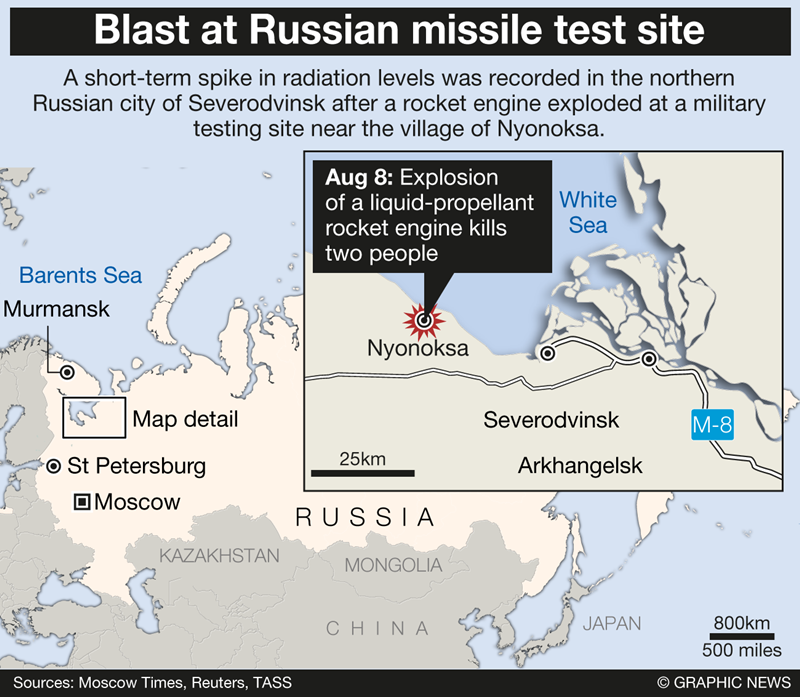
Authorities in Severodvink, 47km (29 miles) east of Nyonska said that radiation levels shortly after the blast were higher than normal for about 40 minutes but returned to normal……..

Ammunition dump blaze

It is the second accident involving Russia’s military this week.

On Monday, one person was killed and eight others were injured in a blaze at an ammunition dump in Siberia.

Flying munitions damaged a school and a kindergarten in the area. More than 9,500 people were evacuated.https://www.bbc.com/news/world-europe-49301438

August 10, 2019 Posted by | incidents, Russia | Leave a comment

Nuclear fuel carrier “Serebryanka” is still at anchor near Russian military test site

Nuclear fuel carrier “Serebryanka” remains inside closed-off waters near missile explosion site

Authorities confirm mysterious brief radiation spike a few hours after the missile engine blast, but the source of release is still unknown. Greenpeace Russia demands greater transparency.  Barents Observer, By Thomas Nilsen, 9 Aug 19,

It is still a mystery what prompt the jump in radiation and why the nuclear fuel carrier “Serebryanka” is still at anchor in the closed-off waters a few nautical miles outside Nenoksa military test site in the White Sea.

It was Thursday at 9 am a missile engine exploded at the naval test range west of Severodvinsk.

Radiation levels were several times higher than background for about half an hour around noon on Thursday, according official data from a paper published by the Nuclear Safety Institute of the Russian Academy of Science. The data is based on the public automated monitoring system in Severodvinsk with eight sensors in town and at the Zvezdockha shipyard.

While normal background in the town with a population of 190,000 is around 0.11 µSv/h (microsivert per hour), the levels measured at the monitor on the Lomonosov Street near Lake Teatralnoye peaked at 2 µSv/h, nearly 20 times higher gamma radiation than normal. That, though, is still way within permissible levels for population exposure.

Radiation increase peaked between 11.50 and 12.30 local time and was back at normal levels at all location by 14.00, head of the Civil Protection Department of the administration in Severodvinsk, Valentin Megomedov, told regional news agency in Arkhangelsk 29.ru on Thursday.

Interesting, the information about the increased radiation, first published on Thursday at 14.23, was removed from the city authorities’ portal Friday afternoon and is now just a dead-link. One user at a blog forum saved a copy of the original message, regional news-site 7×7 journal reports.

Russia’s Defense Ministry was shortly after the explosion informing media that no “dangerous substances” were released to the atmosphere and that the radiation level is “normal.”

Nenoksa is about 25 kilometers northwest from Severodvinsk (about 45 km by road). The military testing area is closed for outsiders. A few mobile video- and photos, however, have appeared on social media.

Scary photos

Some photos published by Mash internet news-channel show emergency services personnel in radiation protection suits coming out of a helicopter, checking the surroundings with what appears to be a Geiger counter, before a injured person is transferred to a waiting ambulance.

Two people died in the explosion, while seven were injured and brought to hospitals in Severodvinsk and Arkhangelsk, according to official sources, quoted by TASS news agency.

Sent to Moscow hospital

A unconfirmed Telegram message says six of the injured are diagnosed with radiation exposure and were transferred with two planes to the Burnasyan Federal Medical Biophysical Cente in Moscow.

A tweet posted Friday shows a film of the victims being transported in ambulances. The text reads: “The drivers of the ambulances are dressed in chemical protection suits and the cars are wrapped in film… The victims of the explosion test in Severodvinsk were brought to Moscow. … Well you understand.”

Greenpeace wants openess

“2 µSv/h in Severodvinsk might mean that the levels at the location of the incident, which is tens of kilometers from Severodvinsk, were even higher, and this increase might mean that beta- and alpha radionuclides were released into the atmosphere,” says Senior Nuclear Campaigner with Greenpeace Russia, Rashid Alimov to the Barents Observer.

He now calls for transparent information from authorities.

“Information on radionuclides present in the air, fall-out, in samples of soil and research into external and internal doses in the settlements closer to the place of discharge should be made public,” Alimov says.

Greenpeace has appealed to Rosportrebnadzor, Russia’s consumer watchdog, to establish how high the radiation has risen and whether it pose a health risk to people.

High demand for iodine

In Arkhangelsk, more than 60 kilometers east of the explosion site, pharmacies reported about extra high demand for iodine on Thursday, 29.ru reports. Journalists from the agency visited 15 pharmacies and noted great demand for iodine, some even sold out, apparently due to the news about the explosion.

No radiation measured in Norway

In Norway, the Radiation and Nuclear Safety Authority (DSA) says in a press release Friday evening that the agency has reasons to believe the incident in Arkhangelsk [region] caused releases of radiactivity. DSA first said it had not got any official information about releases from Russia.

None of the Scandinavian measurement stations for radioactivity have seen anything unnormal, the agency says, but underlines that the monitoring will be intensified.

The village of Nenoksa is only one kilometer from the boundaries to the naval test site and some three kilometers from the shoreline of the closed area. A video from the time of the accident might indicate that the explosion happened near the shore and some media also reported that the explosion happened on a missile test from or onboard a barge close to the shore.

Secrecy

Many details of the accident at the naval test range remain unclear. The Defense Ministry says the cause of the accident was an explosion while testing a liquid propulsion system, and the explosion triggered a fire.

Nenoksa is well known for testing naval ballistic missile engines and cruise missiles of various types. There are, however, no logic reasons for any such missiles to have a source of radioactivity, unless it is an industrial source of radioactive Cobalt or Cesium in use for one or anther research reason during the testing.

If so, traces of the isotope(s) should be easy to discover.

After the fatal explosion, port authorities in Arkhangelsk informed all civilian vessels on the Dvina River basin and in the White Sea that the waters north of Nenoksa is closed-off to shipping for the coming month.

Serebryanka

One ship, though, stayed at anchor inside the close area for more than 30 hours until it slowly started to move Friday afternoon: the special radiological service vessel “Serebryanka

Serebryanka” has been at anchor a few nautical miles north of Nenoksa since before the explosion Thursday morning.

The ship belongs to Rosatomflot and is normally at port at the base for nuclear-powered icebreakers in Murmansk. In the 1980s and very early 90s, “Serebryanka” was used to transport liquid radioactive waste from the Atomflot facility in Murmansk to dedicated dumping areas in the Barents Sea.

In recent years, the ship has transported liquid radioactive waste from Atomflot to a treatment facility in Severodvinsk, as well as operated between Nerpa and Skhval naval yards on the Kola Peninsula and Atomflot in Murmansk. The ship has also transported containers with spent nuclear fuel from the closed-down naval base of Gremikha.

More interesting, the “Serebryanka” was sailing the waters west of Novaya Zemlya at the time after it is believed that Russia carried out a flight test of the Burevestnik nuclear-powered cruise missile (NATO name SSC-X-9 Skyfall) in November 2017.

Barents Sea

As reported by CNBC, the missile crashed and was lost at sea shortly after launch from the temporary facilities at Pankovo south of the Matochin Shar at Novaya Zemlya. According to The Diplomat, “Serebryanka” was likely taking part in the recovery operation last summer.

The flight path starts at Pankovo, continues over shore for the first few seconds, then turn north over the waters at the inlet of the Matotchkin Shar dividing the northern and southern islands of Novaya Zemlya, before continuing towards the Sukhoy Nos, which is believed to be the impact area for the test, the Barents Observer reported at the time.

The last test shooting of the Burevestnik missile at Pankovo took place in February 2018 and the facility was dismantled and shiped away during last summer.

One problem, it appeared, was the presence of American WC-135 special-purpose aircraft frequently flying the easter Barents Sea close to Russian airspace. The WC-135’s mission is to collect samples from the atmosphere for the purpose of detecting and identifying radionuclides.

The White Sea area on the other hand, is Russian airspace. Since October 2018, satellite images show that a new construction has been erected at the Nenoksa test site, which resemble the facilities removed from Pankovo on Novaya Zemlya.

Serebryanka”, which left port in Murmansk towards the White Sea on August 4th, could have been in the area to either transport the missile or to pick it up from the sea after testing.

The Burevestnik missile is equipped with a small nuclear reactor.

If the missile fuel that exploded at Nenoksa site happened while testing a nuclear-powered cruise missile which uses a propellant engine in the start, radioactivity could have been released from possible damages of the small reactor.

The existence of the nuclear-powered cruise missile was first made public by President Vladimir Putin in his annual speech last year, as reported by the Barents Observer.

The President sent a clear message to the United States. Russia has developed new missiles and an underwater torpedo that would be immune to ballistic missiles shields and other means to stop a nuclear attack.

“Nobody has anything like this,” Putin said simultaneously as a video film of the test shooting from Novaya Zemlya as well as an animation was displayed on big screens. One of the screened weapons Putin presented was the new nuclear-powered cruise missile.

………https://thebarentsobserver.com/en/security/2019/08/severodvinsk-authorities-confirm-mysterious-brief-radiation-spike-after-missile


August 10, 2019 Posted by | Russia, safety, secrets,lies and civil liberties | Leave a comment

Test rocket explosion causes radiation spike in northern Russian city

Test rocket explosion causes radiation spike in northern Russian city, killing two,  https://thenewdaily.com.au/news/world/2019/08/09/rocket-radiation-explosion-russia/?fbclid=IwAR1udqv3rSjTDZE5hZpDHPDo-r7Q-zPhdnuvA-Ejqwu4iButecBmHPW2QdU    Locals have been urged to take iodine tablets and stay indoors after a liquid-propellant rocket engine exploded at a nuclear test site, spiking radiation levels, killing two people and injuring another six.

Greenpeace cited data from the Emergencies Ministry that it said showed radiation levels had risen 20 times above the normal level in Severodvinsk, which is about 30 kilometres from Nyonoksa.

The environmental group said it had appealed to Russia’s consumer watchdog to establish how high radiation had risen, whether it posed a health risk to people and what had actually caused the spike.
According to Norway’s Barents Observer, the explosion happened about 9am on Thursday local time.

The paper reported the site is used for the testing of liquid-fuelled engines of ballistic missiles “for strategic nuclear-powered submarines”.

Authorities in Severodvinsk, which has a population of 185,000, reported the spike, forcing a bay in the White Sea to shut down to shipping.

“A short-term rise in background radiation was recorded at 12 o’clock in Severodvinsk,” Ksenia Yudina said on Thursday local time.   However, Russia’s defence ministry was quoted earlier by state media as saying radiation was normal.

August 10, 2019 Posted by | incidents, Russia | Leave a comment

Scientists found evidence that Russia covered up – a major nuclear accident in 2017

A group of scientists called the ‘Ring of 5’ found evidence of a major nuclear accident that went undeclared in Russia, https://www.insider.com/nuclear-accident-unreported-russia-2017-2019-8  

  • In 2017, a group of scientists known as the “Ring of Five” detected “an unprecedented release” of radiation in Europe and Asia.
  • At the time, no country claimed responsibility for the release, but a new study from the Ring of Five attributes it to a nuclear accident at Russia’s Mayak nuclear facility.
  • The facility was previously the site of the 1957 Kyshtym explosion, the world’s third-worst nuclear accident, behind Fukushima and Chernobyl.

A group of scientists called the “Ring of Five” has been scouring Europe’s atmosphere for elevated levels of radiation since the mid ’80s.

In July, the group released a study detailing evidence of an undisclosed nuclear accident that may have taken place less than two years prior. The likely culprit, the scientists said, was the Mayak nuclear facility in Russia, which was once the center of the Soviet nuclear-weapons program.

At the time of the alleged accident in 2017, Russian officials said the facility wasn’t the source of the release, even though the nation showed elevated levels of a radioactive isotope called ruthenium-106. Instead, officials in Russia attributed the radiation to an artificial satellite that burned up in the atmosphere.

But the latest Ring of Five study contradicts that account. Continue reading

August 10, 2019 Posted by | Russia, secrets,lies and civil liberties | Leave a comment

Barents Observer report on Russian nuclear reactors in the Arctic

Nuclear fuel carrier “Serebryanka” remains inside closed-off waters near missile explosion site, Barents Observer, By Thomas Nilsen. August 09, 2019      “………Barents Observer report 

The Barents Observer has recently published an overview (pdf) listing the increasing number of reactors in the Russian Arctic. The paper is part of Barents Observer’s analytical popular science studies on developments in the Euro-Arctic Region.

According to the list there are 39 nuclear-powered vessels or installations in the Russian Arctic today with a total of 62 reactors. This includes 31 submarines, one surface warship, five icebreakers, two onshore and one floating nuclear power plants.

Looking 15 years ahead, the number of ships, including submarines, and installations powered by reactors is estimated to increase to 74 with a total of 94 reactors, maybe as many as 114. Additional to new icebreakers and submarines already under construction, Russia is brushing dust of older Soviet ideas of utilizing nuclear-power for different kind of Arctic shelf industrial developments, like oil- and gas exploration, mining and research.  “By 2035, the Russian Arctic will be the most nuclearized waters on the planet,” the paper reads.

Also, existing icebreakers and submarines get life-time prolongation. The average age of the Northern Fleet’s nuclear-powered submarines has never been older than today. Several of the submarines built in the 1980s will continue to sail the Barents Sea and under the Arctic ice-cap until the late 2020s.   https://thebarentsobserver.com/en/security/2019/08/severodvinsk-authorities-confirm-mysterious-brief-radiation-spike-after-missile
 

August 10, 2019 Posted by | ARCTIC, Russia, technology | Leave a comment

RUSSIAN naval base is on mysterious lockdown after an accidental missile explosion

What is Putin hiding? Emergency lockdown of Russian base after ‘nuclear missile’ accident, https://www.express.co.uk/news/world/1163716/Russia-latest-news-Putin-military-explosion-nuclear-missile-radiation-leak-world-war-3

A RUSSIAN naval base is on a mysterious month-long lockdown after an accidental missile explosion at the base was linked to a sudden radiation spike in the region. By OLI SMITH, Aug 9, 2019 The world is on alert after a rocket engine explosion on a naval test range in northern Russia was linked to a shock radiation spike. The Kremlin have confirmed the “rocket engine explosion” killed two people and injured six. There are mounting concerns that the explosion took place during the testing of a new nuclear missile.

Local people were reportedly urged to take precautions against radiation.

Adding to the fears, the Archangelsk base where the explosion took place has since been placed on emergency lockdown, with the nearby White Sea also closed.

A Russian expert told the BBC that the Russian Ministry of Defence has refused to disclose the details behind the mysterious lockdown of the base.

Dr Mark Galeotti said the incident was “clearly a bigger issue than the Russians are letting on”.

While the Ministry of Defence has rejected claims of a radiation leak, city officials in nearby Severodvinsk reported a radiation spike between 11:50 and 12:30 before falling and normalising by 14:00.

Dr Galeotti said: “This depot seems to have been used for the testing of one of Russia’s new liquid-propelled nuclear missiles – it is a highly secretive.

“The official response from the Defence Ministry has been ‘nothing to see here, no spike in radiation, no leak in radiation’.

“All we seem to know is the number of dead and injured, and that it was a rocket test. The rest is gossip.”

he Russian expert added: “They have closed off a large swath of the adjoining White Sea to shipping for a month.

“Despite what the Kremlin have said, there must have been some sort of radiation leak – and they want people to not just stay out of harm’s way, but also don’t want people coming to the site with Geiger Counters.

“The Defence Ministry is trying to play this down. It is clearly a bigger issue than they are letting on.”

He went to claim “we know the Russian authorities have a tendency to lie in a crisis situation”, but highlighted in the modern age they are “able to get away with much less”.

Dr Galeotti also suggested that, in his opinion, “this was an accident that clearly involved a nuclear missile , which has led to a radiation leak”.

A woman in Severodvinsk named only Alina told Russian news site lenta.ru: “I work in the hospital where they’re bringing the injured.

“They advise everyone to close their windows and drink iodine, 44 drops per glass of water.”

Children in local kindergartens were taken indoors after the blast and parents were advised not to take them outside in the evening.

August 10, 2019 Posted by | Russia, secrets,lies and civil liberties | Leave a comment

Explosion at Russian missile test, kills two, releases spike of radiation

Radiation spike reported after rocket engine explosion during Russian missile test https://www.independent.co.uk/news/world/europe/russia-radiation-spike-explosion-rocket-engine-missile-test-latest-a9046721.html  

Two killed and four injured after blast, defence ministry say, A short-term spike in radiation levels has been recorded after a rocket engine exploded during a test in Russia, regional authorities said.Moscow’s defence ministry said two were killed and four others wounded after the blast at a military shooting range in the northwestern region of Arkhangelsk.

The ministry said there was no release of radioactivity or any toxic substances.

However, Ksenia Yudina, a spokeswoman for the city of Severodvinsk, which has a population of around 185,000, said: “A short-term rise in background radiation was recorded at 12 o’clock in Severodvinsk.”

The defence ministry confirmed six servicemen and civilian engineers were injured, and two died of their injuries. It said the explosion took place during the test of a liquid-propellant rocket engine.

City officials said background radiation levels had fully “normalised”.

An Arkhangelsk port official said the Dvina Bay area of the White Sea would be closed off to shipping for a month following the explosion, the Interfax news agency reported.

The rocket engine explosion occurred at a weapons testing area near the village of Nyonoksa in the Arkhangelsk region, 800 miles north of Moscow, said the Interfax news agency.

Russian media said an area near Nyonoksa is used for tests on weapons including ballistic and cruise missiles used by the navy.

It came two days after 16,500 people were forced to flee their homes when massive blasts rocked an arms depot in Siberia.

Powerful explosions went on for about 16 hours, killing one person and injuring 13.

August 9, 2019 Posted by | incidents, Russia | Leave a comment

Russia’s planned dangerous expansion into the Arctic with nuclear icebreakers, Rosatom in control, increasing climate change

Russia to build two more nuclear icebreakers   https://bellona.org/news/arctic/2019-08-russia-to-build-two-more-nuclear-icebreakers

Russia has said it will build two new nuclear icebreakers in a bid to make a rapidly melting trade route through the Arctic accessible to shipping traffic on a year round basis.  August 7, 2019 by Charles Digges

August 8, 2019 Posted by | ARCTIC, climate change, Russia, technology | Leave a comment

Putin And Trump are ‘normalising’the increasing numbers, and the use, of nuclear weapons

The more that Putin and Trump revalidate the role of nuclear weapons in strengthening national security, the more they normalise the discourse of nuclear weapons use and embolden calls for nuclear weapon acquisition in other countries. 

A nuclear world in disarray   https://www.aspistrategist.org.au/a-nuclear-world-in-disarray/ 7 Aug 2019, Ramesh Thakur  We are in a uniquely dangerous period in the atomic age. Geopolitical tensions have spiked in Europe, in the Middle East, on the subcontinent and in East Asia. The nuclear arms control architecture is fraying and crumbling, but no negotiations are underway to reduce global nuclear stockpiles.

A hostile international security environment, the proliferation of nuclear weapons and the emergence of new space, cyber and AI technologies have increased the risk of accidental or deliberate use of nuclear weapons. The growing strategic risks and uncertainty in turn fuel the vicious cycle of renewed interest among US allies in a nuclear deterrent as a hedge against receding US primacy and reliability.

At the conclusion of a United Nations conference on 7 July 2017, 122 states parties of the Nuclear Nonproliferation Treaty adopted a new Treaty on the Prohibition of Nuclear Weapons. All nine countries that possess the bomb (China, France, India, Israel, North Korea, Pakistan, Russia, the UK and the US) boycotted the conference and rejected the treaty. They have done their very best since then to invalidate the concerns behind the drive to adopt it.

The 2018 US nuclear posture review will guide the Trump administration’s nuclear decision-making, modernisation, targeting and signalling. With an expansive vision of the role of nuclear weapons, its threefold effect is to enlarge the US nuclear arsenal, lower the threshold for the use of nuclear weapons, and broaden the contingencies in which the threat of nuclear weapons can be wielded as a tool of diplomatic coercion.

The 2015 Iran nuclear deal established a robust dismantlement, transparency, inspections and consequences regime. Last year, President Donald Trump pulled the US out of the agreement and reimposed sanctions on Iran, despite its still being in compliance with its obligations. That put Washington in breach of the multilaterally negotiated and UN-endorsed Joint Comprehensive Plan of Action. Trump’s decision will have reconfirmed North Korea’s belief that the one thing standing between its security and a US attack is the bomb. It has also caused the recent surge in tensions in the Persian Gulf.

On 1 February, Trump decided to suspend US participation in the Intermediate-Range Nuclear Forces  Treaty—an arms control agreement with Russia that contributed to the end of the Cold War and underpinned European strategic stability for three decades. It lapsed on 2 August. Trump has also rebuffed Russian overtures to discuss a five-year extension of New START beyond 2021. His second summit with North Korea’s leader Kim Jong-un in Hanoi in Februarycollapsed without agreement and Pyongyang now seems to be expanding its nuclear arsenal. Still, at least the US and North Korea are engaged in high-level and working-level discussions and the fear of an imminent war has faded.

The altered US nuclear posture will have cascading effects on the arsenals, doctrines and deployments of other nuclear-armed states. On 1 March 2018, Russian President Vladimir Putin boasted of a new array of invincible nuclear weapons that can penetrate any defences anywhere in the world. He noted the US had not heeded Russian warnings when it pulled outof the 1972 anti-ballistic missile treaty in 2002. ‘You didn’t listen to our country then. Listen to us now’, he said. Putin’s language was reminiscent of the Cold War.

After the US–Russian suspensions of the INF Treaty, Putin warned that Russia could place hypersonic nuclear weapons on submarines deployed near US waters to match the time in which US missiles based in Europe could strike Russia. He also warned of a radioactive tsunami that could be triggered in densely populated coastal areas by a new nuclear-powered underwater drone dubbed ‘Poseidon’.

The more that Putin and Trump revalidate the role of nuclear weapons in strengthening national security, the more they normalise the discourse of nuclear weapons use and embolden calls for nuclear weapon acquisition in other countries. In Australia, this debate has been restarted most recently by Hugh White.

Meanwhile, the official newspaper of the People’s Liberation Army has called for China to strengthen its nuclear deterrence and counterstrike capabilities to match the US’s and Russia’s developing nuclear strategies. China is upgrading its relatively small nuclear arsenal. It rejected Germany’s request to save the INF Treaty by agreeing to trilateralise it, emphasising that its warheads in the low hundreds cannot be compared with US and Russian arsenals in the several thousands.

India and Pakistan are enlarging, modernising and upgrading stockpiles, while investing in battlefield tactical nuclear weapons and systems to counter them. The INF Treaty was the first disarmament agreement of the nuclear age. In an unwelcome symmetry, on 26 February we witnessed the first airstrikes by one nuclear-armed state against another, and the two engaged in a deadly dogfight above the skies of Kashmir the next day. Another India–Pakistan war is a question of when, not if.

The US, described by former Canadian disarmament ambassador Paul Meyer as ‘the high priest of nuclear orthodoxy’, has left its allies looking rather foolish. Washington had led them in dismissing the nuclear weapon ban treaty as impracticable virtue-signalling, instead extolling the decades-long efforts at step-by-step measures to advance the cause of nuclear disarmament that had seen global stockpiles plummet by over two-thirds from their Cold War peak.

When unkind critics noted that the only steps that were visible were leading backwards, Washington responded by launching a new initiative on ‘creating the conditions for nuclear disarmament’. Lest some conditions be specified and met, however, Washington suddenly embraced the more nebulous and inherently subjective language of ‘creating an environment for nuclear disarmament’.

During the Cold War, Soviet citizens who kept to the straight path as the communist party veered sharply to the left or right were denounced as ‘deviationists’. For decades, US allies have been singing from the same hymn book, joining it in the insistence that the step-by-step, progressive approach was the only realistic path to nuclear disarmament. Instead of embracing the new orthodoxy from their fallible high priest, they should do a hard-nosed analysis of the merits of the changing risk–reward calculus of integrating more deeply with the nuclear alliance structure or joining the majority of countries in trying to rid the world of nuclear weapons.

August 8, 2019 Posted by | Russia, USA, weapons and war | Leave a comment

Sunken Soviet Sub leaking high levels of radiation, Norwegian researchers say

August 6, 2019 Posted by | environment, radiation, Russia | Leave a comment

The nuclear disasters that we don’t hear about – The Kyshtym Disaster

5 Unknown Nuclear Disasters: Chernobyl Is Far from the Only One, Chernobyl is not the world’s only nuclear disaster, there are plenty of others to keep you up at night., Interesting Engineering, By  

The Kyshtym Disaster

In September 1957, Ozyorsk, Russia was a closed city, built around the Mayak plant which produced plutonium for both nuclear weapons and fuel.

After scrambling to build the Mayak plant between 1945 and 1948, all six of its reactors initially dumped high-level radioactive waste directly into Lake Kyzyltash. When it became contaminated, they moved on to dumping into Lake Karachay, which also became contaminated.

In 1968, the Soviet government disguised the EURT area by creating East Ural Nature Reserve, with access allowed to only authorized personnel. Documents describing the disaster were only declassified in 1989.

On the International Nuclear Event Scale (INES), Kyshtym is rated a 6, making it the third-most serious nuclear accident behind only the Fukushima Daiichi nuclear disaster and the Chernobyl disaster, which are both Level 7

In 1953, workers built a storage facility for liquid nuclear waste, but that waste was being heated by residual decay heat from the nuclear reaction. The coolers around one of the tanks failed, and on September 29, 1957, that tank exploded with the force of between 70 to 100 tons of TNT.

While there were no immediate casualties, the explosion released an estimated 20 MCi (800 PBq) of radioactivity into the air. A plume containing 2 MCi (80 PBq) of radionuclides, primarily caesium-137 and strontium-90, moved toward the northeast and contaminated an area of more than 52,000 square kilometers (20,000 sq miles).

At least 270,000 people lived in that area, which is referred to as the East-Ural Radioactive Trace (EURT).

In an attempt to maintain secrecy, no evacuation was ordered, but a week later, on October 6, 1957, 10,000 people were removed from their homes.

Estimates of the death toll caused by the accident go from 200 to more than 8,000, depending on the study. A 2001 work stated that the accident caused 66 diagnosed cases of chronic radiation syndrome.

Amazingly, it wasn’t until 18 years later, in 1976, that the full scope of the disaster was disclosed by Zhores Medvedev in the publication the New Scientist.

In 1968, the Soviet government disguised the EURT area by creating East Ural Nature Reserve, with access allowed to only authorized personnel. Documents describing the disaster were only declassified in 1989.

On the International Nuclear Event Scale (INES), Kyshtym is rated a 6, making it the third-most serious nuclear accident behind only the Fukushima Daiichi nuclear disaster and the Chernobyl disaster, which are both Level 7……  https://interestingengineering.com/5-unknown-nuclear-disasters-chernobyl-is-far-from-the-only-one

K-19: The Widowmaker   Trailer 

August 3, 2019 Posted by | incidents, Reference, Russia | Leave a comment