Russia claims to have successfully tested an “unstoppable” nuclear missile
Russia tests ‘unstoppable’ nuclear missile after worrying threat to the US
Russia claims to have successfully tested an “unstoppable” nuclear missile, with state media saying it has the ability to hit US cities in minutes. news.com.auAlly Fosterallyjfoster 27 Nov 20,
The Russian military has claimed to have successfully tested an “unstoppable” nuclear missile, with the weapon almost reaching speeds of 10,000km/h.
The hypersonic weapon, known as the Mach 8 Zircon or Tsirkon, has been touted as President Vladimir Putin’s “weapon of choice”, with Russian media even claiming it could destroy prominent US locations within five minutes.
The Russian Ministry of Defence recently performed a test launch of the nuke in the White Sea, with officials claiming to have successfully hit a target located 450km away in the Barents Sea.
In a statement, the Russian Ministry of Defence claimed the missile reached speeds of more than 8 March, or about 9878 km/h.
It reportedly took just over four minutes to reach its target.
Though Russia has continually claimed success in testing and creating these nuclear missiles, the country has also recently been reminded of the dangers such weapons can pose if something goes wrong.
On August 8, 2019, an explosion at a weapons testing range in Nyonoksa killed seven people and injured multiple others.
Intelligence officials quickly came up with multiple theories about the cause of the deadly explosion, with some believing a test of a new nuclear powered missile had gone wrong and others claiming a nuclear reactor blew up.
………Russian officials remained tight lipped about the incident, simply claiming the explosion was the result of a failed test of an “isotope power source for a liquid-fuelled rocket engine”.
The country’s weather agency later confirmed the blast ejected radioactive material into the air.
Reports claimed radiation levels temporarily soared to 20 times above the normal level in Severodvinsk, a city about 30 km from the weapons testing site in Nyonoksa. https://www.news.com.au/technology/innovation/military/russia-tests-unstoppable-nuclear-missile-after-worrying-threat-to-the-us/news-story/6dfc0365ac9fcd29d22c3bb5157455e1
Russia and the United States Nuclear Industry
Trump’s Impact on Nuclear Proliferation, Treating Foreign Policy as a Business, Just Security, by Tamsin Shaw, November 18, 2020 “…………….Russia and the United States Nuclear Industry
It’s only relatively recently that the public and private U.S. institutions have begun to examine seriously the intricate financial network that lies behind and links Russian nuclear business dealings in the United States. Public perception of these dealings has been dominated by the false Uranium One conspiracy theory. This distraction has diverted attention from the extent to which Russia has established a strong foothold in the US nuclear industry in a way that suggests an aspiration to vertical control.
The grain of truth in the Uranium One story is that in 2010 Canadian company Uranium One, which was responsible for mining 20% of the currently licensed uranium in the United States, made an agreement with JSC Atomredmetzoloto, or ARMZ, the mining arm of Rosatom, giving them a controlling stake (51%). In 2013 Rosatom acquired full ownership. Uranium One continues to mine approximately 10% of that licensed in-situ uranium.
The United States also relies, both for civilian utilities and defense purposes, on nuclear fuel supplied by Russian subsidiary of Rosatom called Techsnabexport (TENEX). No U.S. uranium enrichment facilities are currently in operation. The U.S. company, Centrus has a new centrifuge design but it will likely be over a decade before it goes into action.
Nor does the United States currently have a company that builds commercial nuclear reactors. The only U.S. company now aiming to construct them is Bill Gates’s TerraPower, which is working on what will likely be the next generation of reactors, small modular reactors (SMRs), but again these won’t be commercially viable for a decade. Commercial nuclear reactors were previously designed and built by US company Westinghouse. But on March 24, 2017, Westinghouse declared Chapter 11 bankruptcy. The sale of that company naturally has serious national security implications. But the story of the sale and of the role that the Trump administration played in it raises many questions.
Trump’s friend and adviser, Tom Barrack, seized on the opportunity presented by the Westinghouse bankruptcy to put together a new version of the Marshall Plan for the Middle East, producing his own document setting out the details. In his March 2017 white paper, Barrack refers to the plan interchangeably as the “Trump Marshall Plan” and the “Trump Plan.” The July 2019 House Oversight and Reform Committee report details the ambitious deal Barrack tried to put together to purchase Westinghouse. Barrack had permission from the highest levels at the White House for a US-led consortium involving Colony Capital, IP3, and financial firms Blackstone and Apollo. Barrack assured Blackstone CEO Steve Schwartzman,
Our GCC [Gulf Cooperation Council] allies in Saudi Arabia and the UAE have committed to invest in the Westinghouse acquisition and are willing to concurrently lock in Westinghouse as the primary partner on the 30+ reactors expected to be constructed in their countries in the coming decade.
IP3 officials were very optimistic. President Trump and Jared Kushner had met with MBS on March 14, and IP3 boasted that this meeting prepared the way for a “partnership to acquire Westinghouse between IP3 and Saudi Arabia.” They eagerly arranged meetings with officials in the administration to promote the plan, including then-CIA Director Mike Pompeo, Director of the National Economic Council Gary Cohn, and top National Security Council (NSC) Staff officials. They also briefed Jared Kushner.
But in January, 2018 it was announced that Canadian company, Brookfield Business Partners, a subsidiary of investing giant Brookfield Asset Management, would purchase Westinghouse. And Westinghouse promptly and unilaterally decided to sever ties with IP3. ProPublica discovered that Kushner was the one who prevented the IP3-led deal from happening, reporting that Kushner “wanted to table the nuclear question in favor of simpler alliance-building measures with the Saudis, centered on Trump’s visit in May, according to a person familiar with the discussions.”
The Westinghouse sale went through on August 1, 2018. Three days later it was announced that Brookfield Properties, another subsidiary of Brookfield Asset Management that had just purchased Westinghouse, would buy Jared Kushner out of his catastrophic real estate deal involving 666 Fifth Avenue.
Who Owns Westinghouse?
The Westinghouse purchase was naturally considered an extremely sensitive deal, deserving scrutiny by the Committee on Foreign Investment in the United States (CFIUS), which at the time included Steve Mnuchin, Rex Tillerson, Jeff Sessions, Wilbur Ross and Dan Coats. The committee approved the transaction but with a Nuclear Regulatory Committee (NRC) Requirements Notice forbidding transfer of their licenses and insisting on compliance with all applicable statutory and regulatory requirements. But the NRC filing submitted to CFIUS is fairly thin. It tells us that Westinghouse would be “ultimately controlled” by Brookfield Asset Management, but little about the money behind the deal. According to their 2018 20-F annual report, BBU acquired 44% of the company, while having a 100% voting interest, having put in $405m of equity totaling $920m, with the balance coming from “institutional partners.” The rest of the purchase price was funded with approximately $3b of long-term debt financing. The sources of the equity and financing aren’t disclosed.
Immediately prior to the Westinghouse sale, prominent foreign policy experts Thomas Duesterberg and William Schneider wrote an article expressing serious concerns about the opacity………….https://www.justsecurity.org/73422/trumps-impact-on-nuclear-proliferation/
Russia’s latest nuclear icebreaker had to abort maiden Arctic voyage
|
Russia’s latest nuclear icebreaker had to abort maiden Arctic voyage The powerful “Arktika” set off from Murmansk on Saturday for a three-week assignment to the Northern Sea Route. Mid-Barents Sea, though, the icebreaker turned around and sailed back to port. Barents Observer, By Thomas Nilsen. November 17, 2020
Following last month’s test voyage to the North Pole, and formal launch ceremony in Murmansk, the new giant icebreaker was now supposed to embark on her first real-working tour to the Northern Sea Route.“Arktika” left from Atomflot’s service base in the Kola Bay on Saturday, according to the state-owned operator Rosatomflot. “On November 14, the leading universal nuclear-powered icebreaker “Arktika“ left the port of Murmansk on its maiden voyage. The vessel headed towards the Kara Sea. Until mid-December, the nuclear-powered icebreaker “Arktika“ will operate in the Northern Sea Route,” a press release posted November 16 said. The Northern Sea Route Administration’s permission granted for ”Arktika” to enter the Kara Gate, where the Northern Sea Route starts, is valid from November 16. Online ship tracking service VesselFinder.com shows the path of the icebreaker sailing out the Kola Bay on a steady course towards the Kara Sea. Halfway in the Barents Sea, the ship suddenly makes a 180 degrees turnaround and sails back on a northwestern course before turning south on Tuesday directly towards Murmansk. Asked about the hastily return to port, Head of the Communication department with Atomflot, Evgeny Sviridov says to The Barents Observer that “Staff is conducting adjustment works onboard.” He would not elaborate but adds: “The icebreaker will leave the port of Murmansk in the nearest future.” In Murmansk, people have already started to post speculations on the regional Vkontakte page on what could have gone wrong. Unconfirmed reports hint at “mechanical problems” onboard, and nothing related to the two nuclear reactors. “Arktika” is the lead of five vessels of Project 22220, the world’s most powerful nuclear-powered icebreakers. Construction of two similar vessels, the “Ural“ and “Sibir” are currently well underway at the yard in St. Petersburg, while keel-laying of the fourth icebreaker, the “Yakutia” took place in May this year. The contract for the fifth, the “Chukotka” is signed. When sailing north from the shipyard on September 22, there was already a problem with the propulsion. During sea trials in the Baltic Sea in February this year, a short circuit caused serious damage to the winding in one of the three electro engines. The damaged propulsion motor is 50 % functional and can deliver 10 megawatts of propulsion power to the starboard wing propeller. It’s a tandem unit and only one half of it was damaged during the sea trials….. https://thebarentsobserver.com/en/arctic/2020/11/russias-latest-and-most-powerful-nuclear-icebreaker-had-abort-maiden-arctic-voyage |
Putin and officials discuss huge new underground bunker almost completed
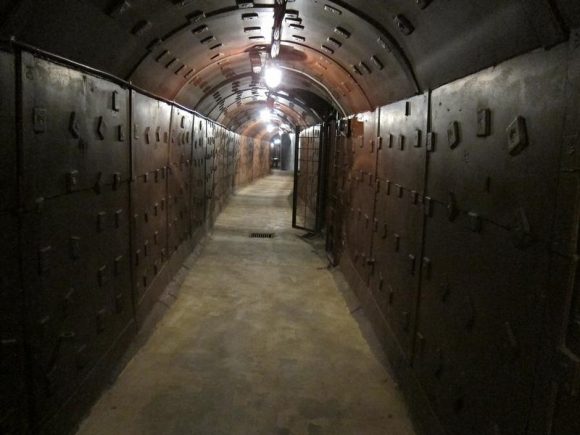
Putin Reveals Existence Of New Nuclear Command Bunker
Russia already has two very large bunker complexes built underneath mountains, including one housing a key nuclear doomsday command system. The Drive, BYJOSEPH TREVITHICK NOVEMBER 11, 2020, The Kremlin has released an unusual transcript of a meeting between Russian President Vladimir Putin and senior defense and other government officials, as well as representatives of Russia’s defense industries, regarding the modernization of the country’s nuclear command and control infrastructure. In it, among other things, Putin disclosed that work on a new hardened strategic command post, possibly a deeply buried underground bunker, is nearing completion.
Putin held the meeting in Sochi on Nov. 11, 2020. Russian Minister of Defense Sergei Shoigu and Russian Army General Valery Gerasimov, Chief of the General Staff of the country’s military, were also in attendance, among others. The day before, the Russian President had held another meeting, which touched on the country’s general nuclear deterrence policy, where he indicated that he would only authorize a nuclear strike in response to one against Russia. This apparent declaration of a so-called “no first use” policy would seem to conflict with previous official statements in recent years.
“It is absolutely clear that the combat capability of the nuclear triad, and the capability of the army and navy on the whole to adequately and quickly respond to potential military challenges directly depend on the stability, effectiveness and reliability of these systems under any circumstances,” Putin said at the Nov. 11 gathering. “I would like to point out that a great deal has been done during the past few years to maintain all the command elements of our strategic nuclear forces at the highest possible level.”……..
It’s not completely clear from these comments whether Putin was talking about an entirely new facility or the refurbishment, improvement, and/or expansion of an existing one. His remarks about the need to protect the overall command and control infrastructure against any threats, including a nuclear attack, strongly point to the site he’s talking about being deeply buried underground bunker of some kind. Russia already understood to have two sites that would match this general description, one at Kosvinsky Kamen in the Northern Ural Mountains and another under Mount Yamantau in the Southern Ural Mountains.
The construction of both sites reportedly began in the late 1970s. It’s worth noting that no facility on earth is totally survivable in the face of strikes by modern nuclear weapons, but deeply buried sites offer probably the best possible defense. As such, the Soviets and the United States both, among others, invested heavily in such bunker complexes during the Cold War, ………
Kosvinsky Kamen, at least some portions of which are believed to be buried under around 1,000 feet of solid granite, is probably the better known of the two, due to its connection to a semi-automated nuclear command and control system first developed under the Soviet Union called Perimeter. This system was long described as a “dead hand” doomsday machine akin to the fictional one in Stanley Kubrick’s famous Cold War black comedy film Dr. Strangelove that could carry out an entirely automatic retaliatory launch of Russian nuclear-tipped intercontinental ballistic missiles (ICBM) after an attack.
More recent reporting has indicated that actual humans, who could be pre-authorized in a crisis to launch nuclear strikes if certain conditions were met, were still very much involved in the operation of Perimeter and operated its central components from within the Kosvinsky Kamen complex. That being said, reports still indicate that this main Perimeter bunker was like something you’d find in a villain’s lair in a James Bond movie………
Less is known about the facility at Mount Yamantau, which reportedly lies, at least in part, under some 3,000 feet of rock, primarily made up of quartz, and has been said to be absolutely massive, encompassing an area “as big as the Washington area inside the Beltway,” or around 400 square miles. The complex is situated within Mezhgorye, which is what is known in Russia as a closed town, where only authorized individuals are allowed to live and work………
President Donald Trump’s Administration also announced in 2018 that it had decided to maintain an operational stockpile of B83-1 nuclear gravity bombs, which have very large yields, reported to be around 1.2 megatons, as an alternative nuclear means of striking at especially hardened facilities. These weapons had previously been slated for retirement……..
It is worth noting that there are understood to be at least two underground bunker complexes in Moscow, one under the Kremlin and another nearby, similar to ones in Washington, D.C., plus to more nearby in the Russian capital’s suburbs, but these are nowhere near as deeply buried as the ones at Kosvinsky Kamen and Mount Yamantau. In 2016, there was also a report that Russia was building “dozens” of new bunkers under the Kremlin and elsewhere to support its nuclear command and control infrastructure…… https://www.thedrive.com/the-war-zone/37569/putin-reveals-existence-of-new-nuclear-command-bunker-and-says-its-almost-complete
Russia shuts down West Russian nuclear reactor
Russia retires Leningrad 2 RBMK, 10 November 2020
The Leningrad 2 nuclear power unit in in Sosnovy Bor in Western Russia was shut down permanently today. The RBMK, which has been in operation for 45 years, is to be replaced by Leningrad II-2, a VVER-1200, which on 6 November received regulatory approval to start pilot operation…… https://www.world-nuclear-news.org/Articles/Russia-retires-Leningrad-2-RBMK
U.S and Russia battling it out to market new nuclear reactors to Eastern Europe countries

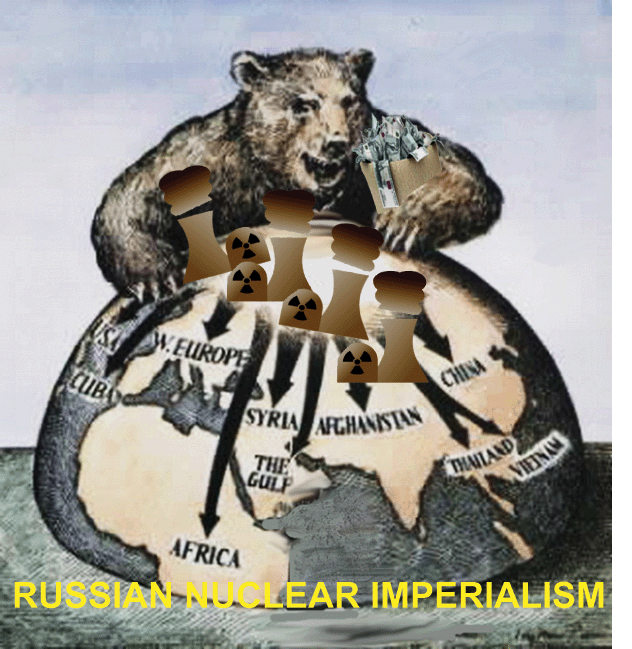 China and Russia lead world ranking for supplying new nuclear reactors, Bloomberg, 9 Nov 20, Source: UxC ResearchThe former Cold War frontier of eastern Europe is becoming a battleground in the $500 billion business of building nuclear power plants.
Four months after lifting a prohibition on financing nuclear-energy deals overseas, the U.S. is finding an opening for companies such as General Electric Co., Westinghouse Electric Co. and Bechtel Group Inc.
In the span of a few weeks, the U.S. signed a memorandum with Romania for the financing of a new reactor and other accords with Poland as well as Bulgaria, which plans to revive an older reactor project.
The plan to win business for U.S. companies in this geopolitically key market started under Donald Trump is poised to survive the transition to a new U.S. administration under President-elect Joe Biden. That may nudge eastern European partners to move forward with stalled nuclear projects.
Greater access to financing may be the chief advantage on the American side as it pushes back against Russian and Chinese interests in the region.
“The projects in countries such as Romania, Bulgaria and Poland could be accelerated if the U.S. helps them come up with funding sources at competitive costs and, eventually, without the need for state aid or guarantees,” said Razvan Nicolescu, a Bucharest-based partner at Deloitte specializing in the energy industry.
Eastern European nations, which are dependent on fossil fuels from Russia and their own coal deposits, have even more reasons than others to seek nuclear options. Being subject to stringent European Union emissions standards also creates additional incentives.
The recent change in regulation is allowing the U.S. to compete for a larger share of the market, whose value it estimates at $500 billion-$740 billion over the next 10 years.
Barriers to expansion remain formidable.
Westinghouse, which was one of the leading nuclear industry suppliers in the U.S., went bankrupt in 2017 as it faced billions in potential liabilities related to domestic projects in Georgia and South Carolina. After the South Carolina project was canceled in 2017, the two at Southern Co.’s Plant Vogtle remained the only reactors under construction in the world using Westinghouse’s flagship AP1000 technology, though that is also behind schedule and over budget.
Political rhetoric may prevail over actual investment decisions, said Martin Vladimirov, an analyst at the Sofia-based Center for the Study of Democracy.
“While the U.S. seeks to counter Russian and Chinese economic interference, those projects may not follow the market logic and will need significant state support,” Vladimirov said.
Nuclear Love Affair in Europe’s Poorer East Is Hitting the Rocks
Russia doesn’t see current U.S. nuclear deals in Europe as a threat to its flagship Rosatom Corp. because the U.S. companies don’t have the bandwidth to build new plants now, a government official close to Russia’s nuclear industry said. The U.S. projects in Europe will likely be limited to servicing agreements, the official added, asking for anonymity as they’re not authorized to speak publicly.
State-owned Rosatom itself also played down the risk from increased competition, saying there’s room for many projects in the region.
“We believe that the U.S. nuclear sector has a great potential,” Rosatom said. “The most important thing now for the U.S. vendors is to grow skills by building more in the markets where they have presence and experience.”
Romania’s need to refurbish an existing reactor makes it the most likely candidate to tap U.S. funding or start work with backing from the U.S., Canada and France. There are bigger doubts over the economics and political will behind the nuclear push announced by Poland and Bulgaria.
Some have stuck by Russia as their main technological and financing partner, such as Hungary for its 10 billion-euro ($12 billion) nuclear expansion deal, though GE will get a chance to supply turbines there.
Others have turned away from the long-standing deals with Russia and rebuffed newer attempts by China to step in as financier and supplier.
Funding will be the key determinant whether these projects can get off the ground, according to Bloomberg Intelligence analyst Elchin Mammadov.
“It’s a very risky and expensive venture that is unlikely to be funded by anyone but the state,” Mammadov said.
Even with state backing, most of the projects flagged across eastern Europe may face years of delay and many may be eventually abandoned.
Russia and China have an edge because they offer package deals. The U.S. is “entirely absent” from the global new build reactor market, the U.S. Energy Department said in an April report.
The U.S. has “lost its competitive global position as the world leader in nuclear energy,” the American department concluded.
— With assistance by Will Wade, Zoltan Simon, Maciej Martewicz, Daryna Krasnolutska, Stepan Kravchenko, and Zoe Schneeweiss https://www.bloomberg.com/news/articles/2020-11-09/u-s-goes-nuclear-to-compete-with-russia-china-in-europe-s-east
Putin orders Russian government to try to meet Paris climate goals
Putin orders Russian government to try to meet Paris climate goals
President Vladimir Putin has signed a decree ordering the Russian government to try to meet the 2015 Paris Agreement to fight climate change, but stressed that any action must be balanced with the need to ensure strong economic development.
Russian company with powerful connections withdraws from Turkish nuclear plant operation
|
Russian company with powerful connections withdraw from Turkish nuclear plant operation, Greek City Times,
by PAUL ANTONOPOULOS, 2 Nov 20, A Russian company withdrew from plans to build Turkey’s first nuclear power plant following tensions between Moscow and Ankara over issues including the conflicts in Libya, Syria, and Artsakh, a columnist for Turkish newspaper Dünya, and translated by Ahval, said on Saturday.The construction of the Akkuyu Nuclear Power Plant to the north of Cyprus is a joint project between Turkey and Russia.Although Turkish President Recep Tayyip Erdoğan and his Russian counterpart Vladimir Putin signed the deal in 2010, major construction only started in March 2018 and the first unit of the four to be constructed will not become operational until at least 2023. According to Dünya columnist Kerim Ülker, Inter RAO, one of Russia’s largest public energy companies, withdrew from the project following a board meeting on October 26 partly because of the Turkish-sponsored invasion attempt of Artsakh by the Azerbaijani military and Syrian mercenaries. ……..https://greekcitytimes.com/2020/11/02/russian-turkish-nuclear-plant/ |
|
USA should accept Russia’s offer of a one-year extension of the Strategic Arms Reduction Treaty
 Russia and the U.S. Need a Timeout on Nuclear Weapons, With New START about to expire, the U.S. should accept Moscow’s offer of a one-year extension. Bloombeerg By James Stavridis, 31 October 2020, “…….. The stakes are vastly higher when it comes to negotiations involving the possible use of strategic nuclear weapons, such as those on intercontinental ballistic missiles, which have the potential to end civilization as we know it. In my final military job, as supreme allied commander at NATO, I argued contentiously with senior Russian officials that U.S. Aegis missile systems in Eastern Europe — which are intended primarily to avert an Iranian attack on the continent — could not threaten their strategic nuclear force. It was a debate that went around and around in circles.
The administration’s goals are overambitious for now — particularly given that Trump may not be in office in three months — so it would be smart to take up Russia’s offer.
Russia’s nuclear doctrine – both Russia an USA benefit from nuclear weapons control agreements
A Closer Look At Russia’s Nuclear Doctrine, https://www.globalzero.org/updates/a-closer-look-at-russias-nuclear-doctrine/ June 4, 2020 Emma Claire Foley On June 1, Russia released a document detailing its nuclear doctrine. Though the 7-page document is much shorter than U.S. Nuclear Posture Reviews, it plays a similar role as a publicly available statement of the situations under which a country would use its nuclear weapons.
In some ways, this release is unprecedented. Though Russia has released information about its nuclear posture before, this is the longest and most comprehensive public statement of that posture to date. A similar document, signed in 2010, was classified.
Until now, much of what is publicly known about Russia’s nuclear doctrine was drawn from its 2014 Military Doctrine. The new document draws heavily from the sections of the 2014 document that dealt with nuclear weapons, but sheds new light on some issues, particularly having to do with Russia’s weapons developed after its withdrawal from New START.
The document confirms Russia’s adherence to a launch-on-warning posture, as discussed by President Putin in 2018. That means Russia would launch a nuclear strike once it received information that another country had launched missiles at Russia, leaving open the possibility that a technical failure or mistaken intelligence could lead to an unintended first strike.
It also leaves open a broad range of situations in which Russia could respond to an attack with nuclear weapons, including “critical state or military facilities of the Russian Federation, the failure of which will lead to the disruption of the retaliatory action of nuclear forces,” an attack with a nuclear weapon or other weapon of mass destruction, or a conventional attack that threatens “the existence of the state.” Though this largely corresponds with what experts had gathered from previous statements, it leaves open to interpretation the definition of “critical state or military facilities.”
The document’s release must be viewed in context. It articulates a launch-on-warning posture as part of a larger defensive role for nuclear weapons, yet history has shown that nuclear “false alarms” that might compel Russia to launch an inadvertent first-strike are not only possible—they’re relatively common. A global No-First-Use agreement, accompanied by changes to nuclear force structure so that nuclear weapons are not kept ready to launch at a moment’s notice, would eliminate this very real risk.
In recent months, Russia has repeatedly, explicitly conveyed its willingness to extend the New Strategic Arms Reduction Treaty (New START), which expires in 2021 and would leave the world without key limits on the two largest nuclear arsenals. These overtures seem to have fallen on deaf ears in the Trump administration, which has expressed its intention to replace the treaty with a trilateral agreement with China despite China’s persistent rejections of the idea. In light of U.S. withdrawals from the Intermediate-Range Nuclear Forces (INF) Treaty and the Open Skies Treaty, the prospects for a New START renewal look dim.
Despite the lack of U.S. participation in international arms control efforts, however, it’s clear that the rest of the world sees the value in maintaining these hard-won agreements. Other signatories have worked hard to maintain the Iran Deal’s frameworks, even after the U.S. withdrew and in the face of its ongoing attempts to start a conflict with Iran. The Trump administration’s knee-jerk rejection to any international agreement reveals a fundamental inability to understand that an international agreement could be in the interest of all of its signatories.
Russia’s step to increase transparency while remaining clear about its faith in its nuclear deterrent, on the other hand, may be another acknowledgment that both countries stand to win from a return to arms control. The only way to make sure that nuclear weapons are never used is to eliminate them. But extending New START maintains progress made by earlier generations and leaves the door open for more ambitious negotiations in the future. It’s a key next step toward making sure nuclear weapons are never used again.
Putin’s Russia keen to exploit the Arctic for fossil fuels: more nuclear-powered icebreakers on the way
|
Putin decrees development of Arctic with more nuclear icebreakers – This will help Russia cash flow from fossil fuels. Russian President Vladimir Putin has signed an executive order, On the Strategy for Developing the Russian Arctic Zone and Ensuring National Security until 2035, which foresees the construction of at least five new nuclear-powered icebreakers of the Project 22220 series, and three of the Project 10510 series. The vessels are needed to ensure year-round navigation along the Northern Sea Route. Project 10510, also known through the Russian type size series designations LK-110Ya and LK-120Ya or the project name Leader, will supersede Project 22220 icebreakers as the largest and most powerful in the world…….. https://www.oilandgas360.com/putin-decrees-development-of-arctic-with-more-nuclear-icebreakers-this-will-help-russia-cash-flow-from-fossil-fuels/ |
|
|
Hope for nuclear arms control with Russia?
|
Hope for nuclear arms control with Russia? Brookings Steven Pifer, Monday, October 26, 2020 Editor’s Note: The U.S.-Russia nuclear arms treaty, New START, is set to expire in February 2021. Little progress was made during the summer and it was unclear if the two countries would reach an agreement. However, a breakthrough has given the arms control treaty a new lease on life, albeit with a lot of questions, writes Steven Pifer. This piece originally published by the Freeman Spogli Institute’s Center for International Security and Cooperation at Stanford University.
While concern had grown over the past several weeks about a breakdown in U.S.-Russian arms control, it appears the 2010 New Strategic Arms Reduction Treaty and nuclear arms control more broadly may have a new lease on life, albeit with lots of questions. Washington’s negotiation with Moscow on New START hit a roadblock on October 16. President Putin said Russia would agree to a one-year extension, which U.S. negotiators had proposed instead of five years, but without the conditions sought by the American side. National Security Advisor O’Brien summarily rejected the Russian position because it ignored the U.S. demand for a freeze on all nuclear warhead numbers.
Things changed recently. The Russians announced that they would agree to a one-year extension of New START and said they are “ready to assume a political obligation together with the United States to freeze the sides’ existing arsenals of nuclear warheads during this period.” The Russian statement added that this presumed no additional U.S. conditions. The Department of State spokesperson quickly and positively reacted, saying U.S. negotiators are “prepared to meet immediately to finalize a verifiable agreement.” New START constrains U.S. and Russian strategic nuclear forces to their lowest levels since the 1960s. However, when it comes to nuclear warheads as opposed to delivery systems, the treaty limits only “deployed” strategic warheads—that is, warheads on deployed intercontinental ballistic missiles (ICBMs) or submarine-launched ballistic missiles (SLBMs). The treaty does not cover reserve strategic warheads or any non-strategic (tactical) nuclear weapons. If Russian acceptance of a one-year freeze means that the Trump administration has succeeded in persuading Moscow to negotiate a treaty limiting all U.S. and Russian nuclear weapons, that is a commendable breakthrough. Indeed, a treaty covering all the two sides’ nuclear arms has long seemed the logical next step after New START (President Obama proposed such a negotiation in 2010). Questions remain, however. The Russian statement indicates that Moscow is ready to undertake, as a political obligation, a one-year freeze on nuclear warhead numbers. It remains unclear whether Russian officials, beyond that freeze, are prepared to negotiate a legally-binding and verifiable treaty constraining all nuclear warheads that would be in effect for a number of years (New START is in force for 10 years, with the possibility of its extension for an additional five years). ……
it appears that U.S. and Russian negotiators still have issues to resolve. Irrespective of the freeze, New START is worth saving and extending to 2026 (the treaty’s terms provide that there could be multiple extensions). Extension to 2026 would mean five more years of limits on Russian strategic nuclear forces. It would mean five more years of information about those forces provided by the treaty’s verification measures, including data exchanges, notifications and on-site inspections. And extending the treaty would require no change in U.S. strategic modernization plans, as those plans were designed to fit within the treaty’s limits. One last observation: New START requires that, if a side wishes to withdraw from the treaty, it must give the other three months’ notice before doing so. It is now October 21, which means that, if negotiations with the Russians do not go well and the Trump administration were to give notice, the United States could not actually withdraw from the treaty until after January 20, 2021—when Donald Trump will be starting his second term or Joe Biden will have become the 46th U.S. president. Mr. Biden is on record as supporting New START’s extension for five years, with no conditions. https://www.brookings.edu/blog/order-from-chaos/2020/10/26/hope-for-nuclear-arms-control/ |
|
Russian hacking group Energetic Bear have hacked nuclear stations, now threaten USA election
 Russians Who Pose Election Threat Have Hacked Nuclear Plants and Power Grid . The hacking group, Energetic Bear, is among Russia’s stealthiest. It appears to be casting a wide net to find useful targets ahead of the election, experts said. NYT, By Nicole Perlroth, Oct. 23, 2020
Cybersecurity officials watched with growing alarm in September as Russian state hackers started prowling around dozens of American state and local government computer systems just two months before the election.
The act itself did not worry them so much — officials anticipated that the Russians who interfered in the 2016 election would be back — but the actor did. The group, known to researchers as “Dragonfly” or “Energetic Bear” for its hackings of the energy sector, was not involved in 2016 election hacking. But it has in the past five years breached the power grid, water treatment facilities and even nuclear power plants, including one in Kansas………
Energetic Bear typically casts a wide net, then zeros in on a few high-value targets. In Germany and the United States, the group has infected websites popular in the energy sector, downloading malware onto the machines of anyone who visited the sites, then searching for employees with access to industrial systems.
In other attacks, it has hijacked the software updates for computers attached to industrial control systems. It has also blasted targets with phishing emails in search of employees, or co-workers, who might have access to critical systems at water, power and nuclear plants.
And it has done so with remarkable success. A disturbing screenshot in a 2018 Department of Homeland Security advisory showed the groups’ hackers with their fingers on the switches of the computers that controlled the industrial systems at a power plant.
The group has thus far stopped short of sabotage, but appears to be preparing for some future attack. The hackings so unnerved officials that starting in 2018, the United States Cyber Command, the arm of the Pentagon that conducts offensive cyberattacks, hit back with retaliatory strikes on the Russian grid…………… https://www.nytimes.com/2020/10/23/us/politics/energetic-bear-russian-hackers.html
Putin suggests extending the START nuclear weapons control treaty for another year
Russia’s Vladimir Putin proposes yearlong extension of New START nuclear treaty with U.S. “It would be extremely sad if the treaty ceases to exist without being replaced by another fundamental document of the kind,” Putin said. Oct. 17, 2020, NBC News, By The Associated Press, MOSCOW — Russian President Vladimir Putin on Friday made a strong call to save the last existing nuclear arms control pact between his country and the United States, proposing to extend it at least for one year.Putin’s statement comes amid conflicting signals from Russian and U.S. diplomats about the fate of the New START treaty that is set to expire in February unless Moscow and Washington agree on its extension.
Speaking at a meeting of his Security Council, Putin said that “it would be extremely sad if the treaty ceases to exist without being replaced by another fundamental document of the kind.”
“All those years, the New START has worked, playing its fundamental role of limiting and containing an arms race,” he noted.
The New START treaty was signed in 2010 by U.S. President Barack Obama and Russian President Dmitry Medvedev. The pact limits each country to no more than 1,550 deployed nuclear warheads and 700 deployed missiles and bombers, and envisages sweeping on-site inspections to verify compliance.
After both Moscow and Washington withdrew from the 1987 Intermediate-range Nuclear Forces Treaty last year, New START is the only nuclear arms control deal between the two countries still standing.
Russia previously offered its extension for five years without any conditions, while the U.S. administration pushed for a new arms control agreement that would also include China. Moscow has described that idea as unfeasible, pointing at Beijing’s refusal to negotiate any deal that would reduce its much-smaller nuclear arsenal.
Putin on Friday proposed to “extend the existing treaty without any conditions for at least one year” to allow for “substantive talks,” instructing Russian Foreign Minister Sergey Lavrov to get a quick U.S. answer to the offer. He emphasized that Russia is ready to discuss the new weapons it deployed in future arms talks with the United States.
Earlier this week, Lavrov voiced skepticism about reaching a deal on New START, noting that Russia can’t accept the conditions put forward by the United States for its extension.
Lavrov specified that Russia can’t agree to the U.S. proposal to limit battlefield nuclear weapons alongside nuclear warheads that arm strategic missiles and bombers until the U.S. agrees to withdraw its tactical nuclear weapons from Europe.
He also noted that Moscow wouldn’t accept the U.S. demand to have intrusive verification measures like those that existed in the 1990s when inspectors were positioned at missile factories……… https://www.nbcnews.com/news/world/russia-s-vladimir-putin-proposes-yearlong-extension-new-start-nuclear-n1243741
Confusion as USA- Russia nuclear arms talks fail
Nuclear arms talks spiral into confusion as Russia rejects US ‘delusion’, Top US negotiator claimed there was ‘an agreement in principle’ between Trump and Putin, Guardian, Julian Borger in WashingtonWed 14 Oct 2020 US-Russian nuclear arms control talks have sunk into confusion after the top American negotiator claimed there was “an agreement in principle” between Donald Trump and Vladimir Putin, a claim Moscow quickly rejected as a “delusion”. ………
The US had previously insisted that China be included in any future arms control negotiations rather than extending the bilateral arrangements in New Start, but Billingslea has dropped that demand in recent weeks, accepting that trilateral talks could be arranged later.
Alexandra Bell, a former state department official and now senior policy director at the Center for Arms Control and Non-Proliferation, said the pre-election urgency followed “literally months of the Trump administration saying there’s plenty of time to do this – there’s no rush”.
Senior parliamentarians from across Europe wrote to their US counterparts on Tuesday urging them to support a New Start extension.
1 This Month

of the week – Shut Down Drone Warfare!


Tell the Ukrainian Government to Drop Prosecution of Peace Activist Yurii Sheliazhenko

Petition to revoke the licensing of the Near Surface Nuclear Disposal Facility (NSDF) at Chalk River. https://www.ourcommons.ca/petitions/en/Petition/Details?Petition=e-7247
To see nuclear-related stories in greater depth and intensity – go to https://nuclearinformation.wordpress.com
-
Archives
- April 2026 (57)
- March 2026 (251)
- February 2026 (268)
- January 2026 (308)
- December 2025 (358)
- November 2025 (359)
- October 2025 (376)
- September 2025 (257)
- August 2025 (319)
- July 2025 (230)
- June 2025 (348)
- May 2025 (261)
-
Categories
- 1
- 1 NUCLEAR ISSUES
- business and costs
- climate change
- culture and arts
- ENERGY
- environment
- health
- history
- indigenous issues
- Legal
- marketing of nuclear
- media
- opposition to nuclear
- PERSONAL STORIES
- politics
- politics international
- Religion and ethics
- safety
- secrets,lies and civil liberties
- spinbuster
- technology
- Uranium
- wastes
- weapons and war
- Women
- 2 WORLD
- ACTION
- AFRICA
- Atrocities
- AUSTRALIA
- Christina's notes
- Christina's themes
- culture and arts
- Events
- Fuk 2022
- Fuk 2023
- Fukushima 2017
- Fukushima 2018
- fukushima 2019
- Fukushima 2020
- Fukushima 2021
- general
- global warming
- Humour (God we need it)
- Nuclear
- RARE EARTHS
- Reference
- resources – print
- Resources -audiovicual
- Weekly Newsletter
- World
- World Nuclear
- YouTube
-
RSS
Entries RSS
Comments RSS
 nuclear-news