Russia Adds ‘Unrivaled’ Nuclear-Powered Missile Cruisers To Its Arsenal; Putin Says Has No Analogs In The World
https://eurasiantimes.com/russia-adds-unrivaled-nuclear-powered-missile-carriers/ By Ashish Dangwal, January 1, 2023
Russian President Vladimir Putin stated at a naval commissioning ceremony on December 29 that Russia’s latest nuclear-powered missile cruisers have no counterparts anywhere else in the world.
Regarding the Sevmash Shipyard and Rubin Design Bureau’s contributions to the production of the nation’s nuclear submarines, Putin stated that “the latest nuclear-powered missile carriers being designed and built there have no analogs in the world in many characteristics.”
He stated the vessels have advanced underwater acoustics, navigation, and communication systems in addition to high-precision weapons and robotic systems.
The flag hoisting signifies that the ships have been accepted into the Russian Navy. Defense Sergey Shoigu announced at the end of the ceremony that “the ships have been accepted into the Navy.”
The President of Russia also thanked the designers, engineers, and employees of the Sevmash, Zelenodolsk, and Sredne-Nevsky shipyards for their diligent work and timely, high-quality completion of duties.
Never mind about sanctions – Russia’s export of nuclear products and services is soaring
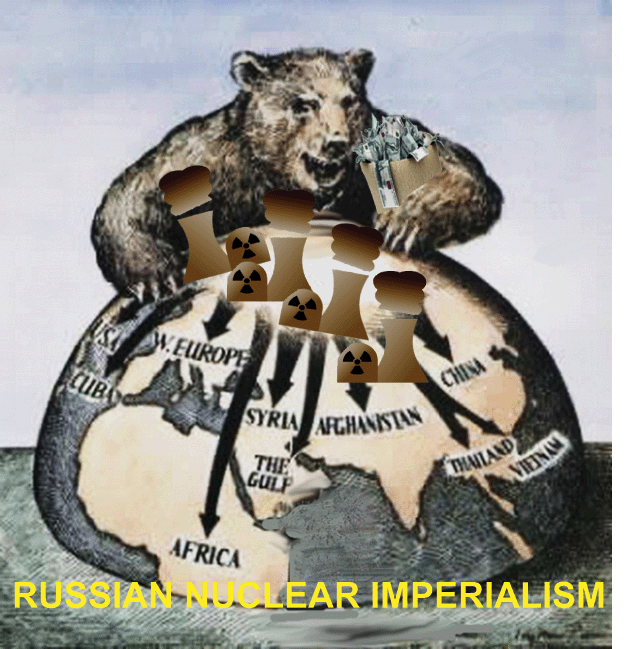
Russia’s state nuclear energy company Rosatom expects its exports to have
increased by 15% this year, chief executive Alexey Likhachev was quoted as
saying by Russian newspaper Izvestia on Monday. Rosatom’s portfolio of
foreign orders is set to remain stable at $200 billion, “even in the
current geopolitical situation,” Likhachev said.
Supply of Rosatom products and services abroad is expected to top $10 billion this year, the
top executive of Russia’s state nuclear energy corporation said. The rise
in exports this year is due to contracts Rosatom was already implementing,
as well as its supplying of fuel, conversion services, and enriched uranium
products, according to Likhachev.
Rosatom has avoided sanctions since
Russia’s invasion of Ukraine because of its importance in the supply chain
of the global nuclear power industry. Yet, many Western governments and
customers have been looking to procure alternative nuclear fuel supply,
where possible, so as not to rely on a Russian state corporation for part
of their energy needs.
Oil Price 26th Dec 2022
Vladimir Putin open to talks on Ukraine if West accepts Moscow’s demands

ABC News 3 Dec 22
Russian President Vladimir Putin is “open to negotiations” on Ukraine but the West must accept Moscow’s demands, the Kremlin says, a day after US President Joe Biden said he was willing to talk with the Russian leader.
Key points:
- The Kremlin says the US’s refusal to recognise annexed territory in Ukraine as Russian was hindering a search for ways to end the war
- The IAEA wants to establish a protective zone around the Zaporizhzhia nuclear plant, which has been repeatedly shelled over the last few months
- An investigation into whether the Moscow branch of the Orthodox church is entitled to operate in Kyiv is underway
Speaking after talks on Thursday at the White House with French President Emmanuel Macron, Mr Biden said he was ready to speak with Mr Putin “if in fact there is an interest in him deciding he’s looking for a way to end the war”, adding the Russian leader “hasn’t done that yet”.
Mr Biden has not spoken directly with Mr Putin since Russia invaded Ukraine on February 24.
In March, Mr Biden branded Mr Putin a “butcher” who “cannot stay in power”.
In Moscow’s first public response to Mr Biden’s overture, Kremlin spokesman Dmitry Peskov told reporters: “The president of the Russian Federation has always been, is and remains open to negotiations in order to ensure our interests.”
Mr Peskov said the US refusal to recognise annexed territory in Ukraine as Russian was hindering a search for ways to end the war.
Moscow has previously sought sweeping security guarantees, including a reversal of NATO’s eastern enlargement………………………………….. more https://www.abc.net.au/news/2022-12-02/russia-open-to-talks-on-ukraine-if-west-accepts-moscows-demands/101730102
War and Nuclear Power: Stakes Are High for People, Environment, and Industry
Power, by Aaron Larson, 1 Dec 22, John Stevens Cabot Abbott, the 19th century American historian perhaps best known for writing History of Napoleon Bonaparte and History of the Civil War in America, is attributed with the quote, “War is the science of destruction.” In truth, however, I don’t think most combatants really think about science when going into battle; they have enough on their minds just trying to stay out of harm’s way. Nonetheless, there are many consequences, some that could require serious science to solve, that can result from the actions soldiers take during wartime.
The war in Ukraine has brought to light a few of the more significant risks associated with war in a modern world powered by nuclear energy. Ukraine is heavily dependent on nuclear power for its supply of electricity. The country is home to 15 reactors, which have provided more than half of Ukraine’s electricity in recent years. Among the nuclear power stations is the six-unit Zaporizhzhya facility, Europe’s largest nuclear power plant (NPP) with a total capacity of 6 GW (Figure 1). It is located in the “steppe zone” of Ukraine, a natural grassland plain in the southern part of the country.
Russian Troops Occupy Ukrainian Nuclear Site
Russian troops took control of the Zaporizhzhya NPP during the first week of March. International Atomic Energy Agency (IAEA) Director General Rafael Mario Grossi reported on March 4 that in the conflict leading up to the takeover, a projectile had hit a training/construction building within the plant site, causing a fire, which was extinguished by the local fire brigade at the power station. While none of the safety systems for the six reactors were affected and there was no release of radioactive material, the incident was significant in that it demonstrated the vulnerability both of the staff and the plant.
At the time, Grossi outlined “seven indispensable pillars for ensuring nuclear safety and security.” ……………….
It’s obviously easy for everyone to agree to maintain these pillars during peacetime, but during a war, the lines can be blurred. It’s understandable why the Russians, for example, might want to take the plant down, putting a crimp on the Ukrainian power grid. With some thought, and perhaps a little science, they could do so without jeopardizing the plant or the environment. But as I said in the beginning, soldiers don’t always think about things like that. Furthermore, many of the troops on the ground may not have a complete understanding of how a nuclear reactor works or what it needs to remain safe, which presents significant risk to everyone involved……………………………….
perhaps the most serious infringement on the IAEA pillars during the Russian occupation has been the multiple times off-site power has been lost at the plant. The site is equipped with 20 emergency diesel generators that can provide the required power for safe operation of the reactors and the ability to bring them to cold shutdown should off-site power be lost, but the loss of off-site power violates defense-in-depth principles and adds significant risk to plant operations.
Russia, of all countries, should have a firm understanding of the importance of safety in the nuclear power industry. It has 37 reactors in operation with a total net capacity of about 27.7 GW and three more units under construction. Russia also has significant interest in exporting its nuclear goods and services around the world.
Today, Rosatom claims to be in “first place in terms of the number of simultaneously implemented nuclear reactor construction projects” with its three units in Russia and 34 abroad at various stages of implementation. In 2021, Rosatom’s package of foreign orders exceeded $139.9 billion, according to the company. It doesn’t take a scientist to conclude that NPP projects would be seriously stalled by a nuclear incident in Ukraine. While I don’t really care if Russia ever sells another reactor abroad, it’s still in everyone’s best interest to maintain plant safety at Zaporizhzhya and prevent a nuclear catastrophe.
—Aaron Larson is POWER’s executive editor
Putin touts Russia’s ‘Arctic power’ with new nuclear icebreaker
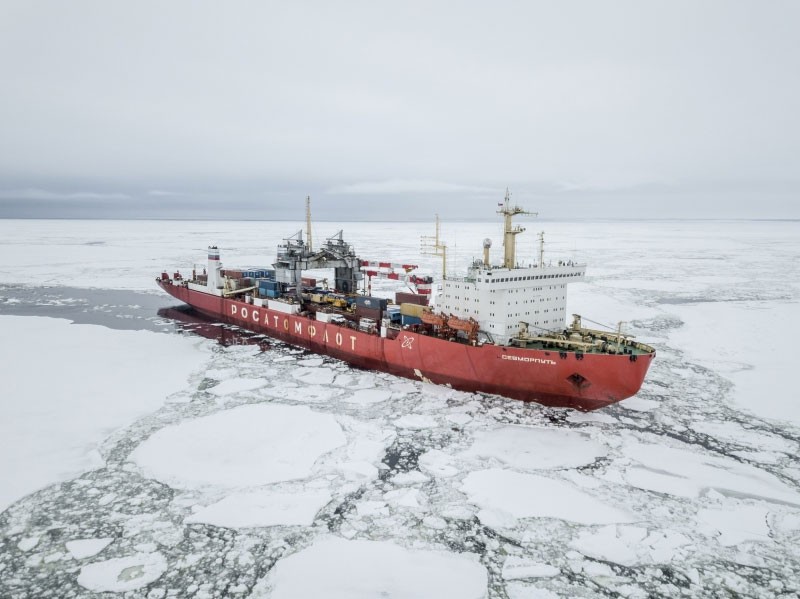
President vows to develop his country’s nuclear fleet despite current difficulties in Russia’s economy and production.
Aljazeera, 22 Nov 22,
President Vladimir Putin on Tuesday touted Russia’s Arctic power at a flag-raising ceremony and dock launch for two nuclear-powered icebreakers that will ensure year-round navigation in the Western Arctic.
Presiding via video link from the Kremlin at the launch ceremony in St Petersburg in northern Russia, Putin said such icebreakers were of strategic importance for the country.
“Both icebreakers were laid down as part of a large serial project and are part of our large-scale, systematic work to re-equip and replenish the domestic icebreaker fleet, to strengthen Russia’s status as a great Arctic power,” Putin said.
The Arctic is taking on greater strategic significance due to climate change, as a shrinking ice cap opens up new sea lanes.
Vast oil and gas resources lie in Russia’s Arctic regions, including a liquefied natural gas plant on the Yamal Peninsula.
The Kremlin chief pledged to develop his country’s nuclear fleet despite current difficulties in Russia’s economy and production, in an apparent reference to Western sanctions over Moscow’s offensive in Ukraine……………………..
The 173.3-metre (569 feet) Yakutia, with a displacement of up to 33,540 tonnes, can smash through ice of up to three metres. It will enter service in 2024.
Two other icebreakers in the same series, the Arktika and the Sibir, are already in service, and another, the Chukotka, is scheduled for 2026.
Putin said a super-powerful nuclear 209-metre icebreaker known as “Rossiya”, with a displacement of up to 71,380 tonnes, would be completed by 2027. It will be able to break through ice four metres thick………………………………….. more https://www.aljazeera.com/news/2022/11/22/putin-touts-russias-arctic-power-with-new-nuclear-icebreaker
Putin’s nuclear grip on Europe could spark another energy crisis, expert warns
Russian President Vladimir Putin controls about 42 percent of the world’s nuclear fuel, and may be able to send electricity prices soaring if he withholds supplies.
https://www.express.co.uk/news/science/1698529/putin-nuclear-power-energy-uranium-gas-prices By JACOB PAUL, Nov 20, 2022, As global gas prices have been sent to record highs over the last year due to Russian President Vladimir Putin’s war in Ukraine and his supply cuts to Europe, nations across the continent have been scrambling to wean themselves off Russian fossil fuels to weaken Moscow’s tight grip on the energy market. But an expert has told Expess.co.uk that countries which have hedged bets on nuclear power as a means of gaining energy independence may not actually be able to escape Putin’s clutches as the Kremlin has dominance over nuclear fuel supplies, which could potentially trigger another price crisis.
While policymakers across Europe have argued that nuclear power stations can boost homegrown supplies of energy, they have failed to mention these plants require uranium to fuel them.
This is the crux of the issue as Russia, and Russia-controlled Kazakhstan currently supplies 42 percent of all uranium for all reactors worldwide. And when compared with the gas crisis, the statistics look eerily similar.
The EU for instance, got around 40 percent of its gas from Russia before Putin sent his troops into Ukraine. And when he withheld supplies to Europe, prices in Britain shot up too, despite the UK only getting four percent of its gas from Russia. This is due to the integrated nature of the gas market.
With the EU relying on Russia for 20 percent of its uranium needed to fuel supplies if Russia decided to curtail uranium deliveries to the bloc, it may spark the same problem and trigger another energy crisis.
Prof Paul Dorfman, an Associate Fellow from the Science Policy Research Unit (SPRU) at the University of Sussex told Express.co.uk: “The argument goes that nuclear provides a security of supply. In other words, ‘you don’t need to worry about Putin’s gas or the Middle East’s oil’. But this point of view is hugely problematic.
“There is no question that the whole business about the Russian invasion of Ukraine has turned the nuclear industry on its head. This whole idea of security of supply, that nuclear won’t leave us dependent on foreign problems is false.
“Putin, Russia and Russia-controlled Kazakhstan supply 42 percent of all uranium of all reactors worldwide. 20 percent for the EU, 14 percent of the US and nearly 30 percent of their enrichment services.
“The UK is different. We get our uranium from Australia and Canada and we don’t rely on Russia so we are ok.”
However, while nuclear fuel may not run short in the event of a supply cut from Russia, Prof Dorfman warned, it could send the cost of electricity in Britain soaring too.
Asked if the nuclear market was similar to the gas market in this regard, Prof Dorfman told Express.co.uk: “In my view, it certainly would have a significant impact on UK electricity prices because we live in a market world. Absolutely, yes.”
This could be a concern for the UK, given that Britain is planning to dramatically expand its number of nuclear power plants, a desire unveiled in the April energy strategy under former Prime Minister Boris Johnson.
It included the plan to set up new government body, Great British Nuclear, and a £120milion Future Nuclear Enabling Fund in a bid to build eight new reactors across the UK. Mr Johnson said: “We’re setting out bold plans to scale up and accelerate affordable, clean and secure energy made in Britain, for Britain – from new nuclear to offshore wind – in the decade ahead.
“This will reduce our dependence on power sources exposed to volatile international prices we cannot control, so we can enjoy greater energy self-sufficiency with cheaper bills.”
While it is recognised that renewable energies like wind and solar power are cheaper than other sources like oil and gas, Mr Johnson appeared to fail to take into account Putin’s grip on the global nuclear market and the prospect of sending electricity bills soaring in the UK.
Poland missile incident is step towards World War III – Medvedev
Rt.com 16 Nov 22A hybrid war waged by the West against Russia could lead to disastrous consequences, the former Russian leader warns.
Former Russian president Dmitry Medvedev has warned that incidents like the missile explosion which killed two people in Poland risk prompting a major global conflict.
The incident “proves just one thing: waging a hybrid war against Russia, the West moves closer to the World War”, the ex-president, who is now the deputy chair of Russia’s Security Council, wrote on Twitter on Wednesday. He also put the words “missile strike” in quotation marks…………………………………..
Ukrainian President Vladimir Zelensky was quick to blame Russia for the incident late on Tuesday, urging NATO, of which Poland is a member, to act against this “attack on collective security.” Despite not being backed by any proof, the claims were picked by the media in Poland and by some of the country’s officials.
Warsaw put its military on alert, and said it was discussing whether to invoke NATO’s Article 4, which would require consultations on the situation with the other 29 member states and a consensus decision on how to proceed.
However, US President Joe Biden said soon afterwards: “it is unlikely, in the minds of the trajectory, that it [the missile] was fired from Russia.” The Associated Press also cited three US officials as saying preliminary data suggested the missile was actually Ukrainian, fired by the country’s air defenses amid a large-scale Russian attack on Ukraine’s energy infrastructure.
Russia’s Defense Ministry has insisted that it did not carry out any strikes near the Ukrainian-Polish border on Tuesday. It later clarified that analysis of photos from the site showed that the debris were from a missile for the S-300 air defense system operated by Ukraine’s military. https://www.rt.com/russia/566619-poland-missile-ukraine-medvedev/
Russia and US hold secret talks in Ankara – Kommersant
https://www.rt.com/russia/566501-russia-us-secret-talks/ 14 Nov 22, Moscow is reportedly represented by the country’s top spy at the negotiations.
A leading Moscow newspaper claimed, on Monday, that secret US-Russian talks are being hosted by Türkiye. Kommersant, a privately owned title which is known to have good sources in Moscow, reported, citing anonymous sources, that the un-announced meeting was taking place in Ankara.
The outlet alleged that Russia had sent Sergey Naryshkin, director of the Foreign Intelligence Service (SVR) to the talks.
Kremlin spokesperson Dmitry Peskov later confirmed to Russian media that bilateral talks had taken place in Ankara, adding that they were held at the initiative of the US.
CNN claimed that CIA Director Bill Burns had represented Washington at the gathering, citing a “National Security Council spokesperson.”
Earlier this month, Western media reported that top Russian and US officials were engaging in undeclared contacts. According to the Wall Street Journal, US national-security adviser Jake Sullivan has been engaged with Yury Ushakov, a senior foreign policy aide to President Vladimir Putin, and with Nikolay Patrushev, Sullivan’s counterpart in the Russian government.
The White House did not deny the talks, with spokesperson Karine Jean-Pierre telling journalists that the contacts focused on “risk reduction.” Meanwhile, Peskov told the WSJ at the time that the British and American press tended to print “hoaxes.”
Türkiye emerged as a principal mediator during the Ukraine crisis. In late March, it hosted Russia-Ukraine talks, during which the two parties made significant progress towards settling on a peace agreement.
The negotiations were reportedly torpedoed by the UK, when then-Prime Minister Boris Johnson traveled to Kiev in April. According to Ukrainian media, he told President Vladimir Zelensky that Western nations would not support the proposed security pact that was discussed with Russia.
Ankara also helped the UN to launch the Black Sea Initiative, an arrangement that allows Ukraine to export its grain via commercial ships. The agreement, which was signed in July, expires on Friday. Moscow has repeatedly stated that it may not agree to a renewal, unless the UN delivers on its promise to facilitate Moscow’s export of Russian grain and fertilizers, which was part of the deal.
Russia maintains its grip on global nuclear energy landscape
Increasing use of atomic power would not necessarily free economies from Moscow’s
influence. Faced with a global energy crisis and a race to slash emissions,
advanced economies are starting to reconsider nuclear power after a period
of declining investment. The incentive is all the greater among European
countries, which are urgently seeking to move away from Russian fossil
fuels to starve the Kremlin of funds for its assault on Ukraine.
But an atomic shift does not necessarily free a country from energy dependence on
Russia, given the scale of the country’s presence in the nuclear sector.
There were 437 operational reactors around the world as of 2021 excluding
those suspended, according to the International Atomic Energy Agency. About
10 per cent or 42 reactors outside of Russia were using Soviet-designed
VVER technology, with others using designs from countries including the US,
Canada, Germany and France.
Ukraine has by far the largest number of VVER
fleets outside Russia, with all 15 of its operating reactors using the
technology, with the Czech Republic next on six. Similarly, of the 52
reactors currently being built around the world excluding Russia, 21 use
VVER. China, India and Turkey have the largest number with 4 each, with
countries like Bangladesh, Egypt and Iran also taking in Russian
technology.
The prevalence of Russian-designed reactors currently being
built is in part a matter of timing, according to Jonathan Cobb, analyst at
the World Nuclear Association, who said “the Russian reactor programme
itself was very active” over the past decade when many of the contracts
for these projects were signed.
Russia was also the seventh-largest
producer of uranium in 2021. State-owned Rosatom accounts for about 40 per
cent of the world’s uranium enrichment capacity, making it a crucial
supplier as most nuclear power stations use enriched fuel.
FT 13th Nov 2022
https://www.ft.com/content/ffe76530-8fcb-45c3-aade-dc307af9c82f
On Nuclear Treaty, at Least, Biden Aims for Fresh START With Russia
Washington and Moscow look set to keep New START alive with working-level talks, despite historic tensions.
Foreign Policy, By Robbie Gramer, a diplomacy and national security reporter at Foreign Policy. 11 Nov 22
The Biden administration has announced that it will restart nuclear arms control talks with Russia, even as tensions spike over the latter’s war in Ukraine, coupled with the threat of Moscow using nuclear weapons.
The talks are expected to take place in Cairo in the near future, current and former U.S. officials said, and represent the first move by both sides to revive their mutual arms control agenda since U.S. President Joe Biden first halted dialogue after Russia launched its invasion of Ukraine in February…………………………………
The existing arms reduction treaty, New START, caps the number of intercontinental-range nuclear weapons in both Washington’s and Moscow’s arsenals and allows each side to conduct on-site weapons facility inspections in the other country. This allows experts from each country to visit the other country’s weapons sites to view the number of nuclear weapons, launch vehicles, and other details to confirm that both sides are adhering to the treaty. The treaty allows up to 18 on-site inspections per year.
It is the last remaining arms control treaty in place between Russia and the United States, which respectively have the first- and second-largest nuclear arsenals in the world. Under the terms of the treaty, which was first signed in 2010, both countries agreed to cap the number of nuclear warheads they could deploy on delivery systems to 1,550…………………..
Reviving the New START talks has been a quiet goal of the White House and State Department since at least this summer, according to current and former U.S. officials familiar with the matter, and scheduling a new meeting with the Russians on the issue has been in the works for months. Rose Gottemoeller, a former NATO deputy secretary-general and top U.S. arms control envoy who helped negotiate New START in 2009-10, welcomed the move and said the latest nuclear discussions shouldn’t be seen as any sort of concession to Russia.
“We don’t always get to choose with whom we negotiate, but if we’ve got an issue that’s in our national security interest, we have to work it,” said Gottemoeller, now a scholar at Stanford University. “We’ve achieved agreements with the Russians during some very dark hours in our bilateral relationship in the past.” …………….. https://foreignpolicy.com/2022/11/10/nuclear-talks-russia-us-biden-putin-new-start-treaty/
Russia, U.S. Eye Nuclear Arms Reduction Talks in Coming Weeks – Kommersant
https://www.themoscowtimes.com/2022/11/08/russia-us-eye-nuclear-arms-reduction-talks-in-coming-weeks-kommersant-a79313 9 Nov 22, Russia and the United States are discussing resuming nuclear arms reduction negotiations in the coming weeks in the first face-to-face contact since Russian forces invaded Ukraine, the Kommersant business daily reported Tuesday, citing three unnamed sources.
The Strategic Arms Reduction Treaty (New START) talks could take place in an unnamed Middle Eastern country, instead of their traditional venue of Geneva, in late November or early December, Kommersant reported.
The report follows weeks of concern over a possible Russian nuclear escalation in Ukraine fueled by President Vladimir Putin’s thinly veiled threats. Moscow later tamped down its rhetoric following reported talks with U.S. officials.
The last remaining arms reduction pact between the Cold War foes, New START is one of the few areas where Moscow and Washington have said they were open to cooperation despite tensions over the invasion of Ukraine and Western sanctions.
According to Kommersant, Washington is expected to raise the resumption of on-site inspections under New START.
Moscow formally suspended physical inspections by the U.S. in August 2022 after President Joe Biden called on Russia and China to demonstrate their commitment to limiting nuclear weapons.
Russia’s Foreign Ministry indicated at the time that Western sanctions, visa restrictions and airspace closures over the war in Ukraine made it difficult for Moscow to carry out inspections on U.S. soil.
According to Kommersant, Russia and the U.S. have continued to hold remote discussions on New START in lieu of in-person talks.
At one of these remote talks last month, Kommersant reported that Moscow accused Washington of skirting the treaty’s terms by withholding weapons and sites that Russia suspects are still nuclear-capable despite their announced conversions and reclassifications.
Moscow and Washington last year extended New START, which caps the number of deployable nuclear warheads at 1,550, until Feb. 5, 2026.
Russia suspends participation in grain deal after Ukrainian attack
The decision was made following a Ukrainian assault on Moscow’s Black Sea fleet. Rt.com 28 Oct 22
Russia announced on Saturday that it has halted its compliance with a grain deal, brokered by the UN and Türkiye earlier his year. The move came after Ukraine launched a major drone attack on ships involved in securing safe passage for agricultural cargo, the Russian Defense Ministry explained.
In a post on its Telegram channel, the ministry said Russia “is suspending its participation in the implementation of agreements on the export of agricultural products from Ukrainian ports”.
It explained that the move was prompted by “a terror attack” against the ships of the Black Sea Fleet and civilian vessels involved in ensuring the security of the grain corridor. The ministry also alleged that the bombing was organized with the involvement of British military………………………………..
Earlier on Saturday, Russia’s Agriculture Minister Dmitry Patrushev signaled that Moscow is ready, with Türkiye’s help, to send the world’s poorest countries up to 500,000 tons of grain within the next four next months.
He noted that considering this year’s harvest, Russia “is fully ready to replace Ukrainian grain” and arrange deliveries to “all interested countries” at a reasonable price.
……………………… following the blast on the strategic Crimean Bridge, Russian President Vladimir Putin said that if turns out that Ukraine – the country that Moscow accused of carrying out the attack – used grain corridors to transport explosives, “it would put the very existence of these corridors in question”.
The breakthrough deal between Moscow and Kiev was reached in Istanbul in July with mediation by the UN and Türkiye. It aimed to unlock agricultural exports via the Black Sea from Russia and Ukraine – two of the world’s leading grain exporters – which had ground to halt due to the conflict between the two nations. https://www.rt.com/russia/565588-russia-suspends-grain-deal/
Kremlin reveals possible basis for Putin-Biden talks
https://www.rt.com/news/565611-russia-talks-biden-putin/ 28 Oct 22, Russia’s proposals on security guarantees could serve as a springboard for re-engagement, Dmitry Peskov says
Potential talks between Russian President Vladimir Putin and his US counterpart Joe Biden would depend on Washington’s willingness to hear Moscow’s security concerns, the Kremlin press secretary said on Sunday.
Speaking to the Rossiya-1 TV channel, Dmitry Peskov said high-level re-engagement could happen if the United States “pays heed to our concerns.”
It would be contingent on “the US desire to go back to the state of things as of December-January and ask the question: what the Russians are offering may not suit all of us, but maybe we should still sit down with them at the negotiating table?”
The spokesman explained that he was referring to the draft documents on security guarantees that Moscow submitted to both Brussels and Washington before the Ukraine conflict broke out in late February.
In mid-December last year, the Russian Foreign Ministry published the drafts of two treaties – one with the US and one with NATO – with a list of Moscow’s security demands, in a bid to lower tensions in Europe.
At the time, Russia wanted the West to ban Ukraine from entering NATO and limit the deployment of troops and weapons on the bloc’s eastern flank. It also insisted that the military alliance retreat to its borders as of 1997, before it expanded eastwards.
While neither the US nor NATO gave written responses to Russia’s proposals, they both rebuffed Moscow’s demand that Ukraine should be barred from the bloc.
Earlier this month, Putin said he saw no need for talks with his US counterpart, explaining that “there is no platform for any negotiations yet.” The statement was echoed by the White House, which stated that Joe Biden does not plan to meet with the Russian leader at the G20 summit next month, despite earlier refusing to rule out the possibility.
The last time the two leaders met in person was in June 2021 in Geneva, Switzerland. The talks were followed up by a virtual summit in December, with Ukraine being one of the topics on the agenda.
‘No need’ for nuclear strikes on Ukraine, Putin says
9 News, By Associated Press Oct 28, 22
Russian President Vladimir Putin has denied having any intentions of using nuclear weapons in Ukraine but described the conflict there as part of alleged efforts by the West to secure its global domination, which he insisted were doomed to fail.
Speaking at a conference of international foreign policy experts, Putin said it’s pointless for Russia to strike Ukraine with nuclear weapons.
“We see no need for that,” Putin said.
“There is no point in that, neither political, nor military.”
Putin said an earlier warning of his readiness to use “all means available to protect Russia” didn’t amount to nuclear sabre-rattling but was merely a response to Western statements about their possible use of nuclear weapons.
He particularly mentioned Liz Truss saying in August that she would be ready to use nuclear weapons if she became Britain’s prime minister, a remark which he said worried the Kremlin.
“What were we supposed to think?” Putin said.
“We saw that as a coordinated position, an attempt to blackmail us.”……………………………………………….
US Defence Secretary Lloyd Austin told reporters today that the US has still not seen anything to indicate that Putin has decided to use a dirty bomb……………………………………………………. more https://www.9news.com.au/world/russia-ukraine-vladimir-putin-says-kremlin-not-intending-to-use-nuclear-weapons/7ab0234c-cadb-41f9-b8c2-05305c1eb464
1 This Month





PLEASE OPPOSE HR 8255 AND S.3639 – bills would accelerate satellite deployment, with no environmental review or safeguards – https://ncstd5li.quorum.us/campaign/169331/
To see nuclear-related stories in greater depth and intensity – go to https://nuclearinformation.wordpress.com
-
Archives
- October 2026 (40)
- September 2026 (339)
- August 2026 (330)
- July 2026 (355)
- June 2026 (287)
- May 2026 (306)
- April 2026 (356)
- March 2026 (251)
- February 2026 (267)
- January 2026 (308)
- December 2025 (358)
- November 2025 (359)
-
Categories
- 1
- 1 NUCLEAR ISSUES
- business and costs
- climate change
- culture and arts
- ENERGY
- environment
- health
- history
- indigenous issues
- Legal
- marketing of nuclear
- media
- opposition to nuclear
- PERSONAL STORIES
- politics
- politics international
- Religion and ethics
- safety
- secrets,lies and civil liberties
- spinbuster
- technology
- Uranium
- wastes
- weapons and war
- Women
- 2 WORLD
- ACTION
- AFRICA
- Atrocities
- AUSTRALIA
- Christina's notes
- Christina's themes
- culture and arts
- Events
- Fuk 2022
- Fuk 2023
- Fukushima 2017
- Fukushima 2018
- fukushima 2019
- Fukushima 2020
- Fukushima 2021
- general
- global warming
- Humour (God we need it)
- Nuclear
- RARE EARTHS
- Reference
- resources – print
- Resources -audiovicual
- Weekly Newsletter
- World
- World Nuclear
- YouTube
-
RSS
Entries RSS
Comments RSS

