Russia says West is sponsoring ‘nuclear terrorism’ after Ukrainian drone strike
By Andrew Osborn, July 14, 2023 https://www.reuters.com/world/europe/russia-says-west-is-sponsoring-nuclear-terrorism-after-ukrainian-drone-strike-2023-07-14/
MOSCOW, July 14 (Reuters) – Russia accused the West on Friday of sponsoring “nuclear terrorism” after authorities said a Ukrainian drone had struck the western Russian town of Kurchatov, where a nuclear power station similar to the ill-fated Chernobyl plant is located.
Roman Starovoit, the governor of Russia’s Kursk region which borders Ukraine, said the Ukrainian drone had struck a residential apartment building in Kurchatov, a Soviet-era town built on the banks of a cooling pond for the Kursk nuclear power station which is still in service.
A drone crashed in the town of Kurchatov overnight,” Starovoit said on the Telegram messaging app. “Fortunately, none of the residents were injured. Critical facilities were not damaged as a result of the drone crash and its subsequent detonation.”
The only damage was to the facade and glazing of one apartment building, he added, saying the authorities would help residents restore their homes.
There was no immediate reaction from Ukraine, which is regularly subjected to massed Russian drone attacks and seldom comments on its own suspected drone and sabotage attacks inside Russia.
RUSSIAN FURY
The incident, which comes after Russia said it had destroyed two Ukrainian drones near the Kremlin in May, drew a furious reaction from the Russian Foreign Ministry given the drone’s proximity to a nuclear power station.
“Are the countries that supply them (the drones) to the Kyiv regime planning to retire to Mars if there is a nuclear disaster? They won’t have time,” Foreign Ministry spokeswoman Maria Zakharova said sarcastically.
“People in NATO countries should realise that their governments are sponsoring nuclear terrorism by the Kyiv regime.”
Kremlin spokesman Dmitry Peskov said Russia’s air defence systems were working effectively amid unconfirmed social media reports that such systems had been used to repel the drone attack, but said it was obvious that Ukraine was continuing to try to strike targets inside Russia.
Russia’s FSB security service said in August last year that security around nuclear facilities had been beefed up after people it said were Ukrainian saboteurs destroyed electricity lines supplying the Kursk nuclear power plant, temporarily disrupting its functioning.
Alexei Likhachev, the head of Russia’s Rosatom state nuclear corporation, told state TV on Thursday that security at nuclear power plants was “under control” and that all necessary measures had been taken, including air defence capabilities.
Russia and Ukraine have long accused each other of risking a nuclear catastrophe at another facility – the Zaporizhzhia nuclear power plant on Russian-controlled territory in southern Ukraine – through shelling.
Reporting by Andrew Osborn Editing by Gareth Jones and Peter Graff
Uranium Plant Explosion in Russia Sparks Nuclear Radiation Fears
An explosion at a uranium enrichment plant in Russia’s Urals region on
Friday prompted Russia’s state nuclear corporation to publish a statement
to ease fears. At around 9 a.m. local time, a cylinder with depleted
uranium hexafluoride “depressurized” in a workshop at the Ural
Electrochemical Combine in Novouralsk, the statement from Rosatom, which
owns the plant—the largest uranium enrichment plant in the world—said.
Uranium hexafluoride is a chemical used during the uranium enrichment
process.
Newsweek 14th July 2023
https://www.newsweek.com/uranium-plant-explosion-russia-nuclear-radiation-fears-1812966
Russia prevents Ukraine attack on Crimea’s Sevastopol
Russian forces claim to have shot down nine Ukrainian drones over the Crimean port of Sevastopol on Sunday.
Jerusalem Post, By REUTERS, JULY 16, 23
Russia’s Sevastopol Naval baseRussian forces claim to have shot down nine Ukrainian drones over the Crimean port of Sevastopol on Sunday.
Russia’s defense ministry said its forces had prevented Ukraine from attacking the Black Sea port of Sevastopol on Sunday, destroying seven aerial and two underwater drones.
“This morning, an attempt by the Kyiv regime to carry out a terrorist attack by seven unmanned aerial vehicles and two unmanned underwater vehicles on objects on the territory of the Crimean Peninsula near the city of Sevastopol was thwarted,” the ministry said on the Telegram messaging app.
There were no casualties and no damage, the ministry added.
It said that two aerial drones were shot down over the Black Sea at a great distance from the coastline, while five were intercepted by Russia’s electronic warfare forces.
Two unmanned underwater vehicles (UUV), known as underwater drones were discovered in the northern part of the Black Sea, and destroyed by fire, the ministry said………………………
No comment from Ukraine
…….Ukraine almost never publicly claims responsibility for attacks inside Russia or on Russian-controlled territory in Ukraine but has been saying in recent months that destroying Russia’s military infrastructure helps Kyiv’s counteroffensive. https://www.jpost.com/international/article-750213
Russia’s Northern Fleet will not send nuclear sub to main Navy parade
Amid Baltic Sea NATO expansion and growing east-west mistrust, Russia has decided not to sail a nuclear-powered submarine from the Kola Peninsula to the annual high-profile naval parade taking place in St. Petersburg on July 30.
Barents Observer, By Thomas Nilsen, July 14, 2023
State-controlled TASS news agency quotes unnamed military officials confirming the non-appearance of Russia’s most potent naval assets.
“Nuclear submarines of the Northern Fleet will not take part in the Main Naval Parade 2023, unlike previous parades,” the new agency’s source said.
This is the first time since the current Navy Day format was established in 2017 that no nuclear subs from the Northern Fleet sail south to participate. ………………………………………………….
With Finland joining NATO in April and Sweden given the green light just ahead of this week’s NATO Summit in Vilnius, Russia is surrounded by NATO members in the Baltic Sea. Previous Northern Fleet subs at Naval Parade in St. Petersburg:
Drone crashes in Russian ‘atomic city’ – governor
Rt.com 14 July 23
There were no injuries or damage to critical infrastructure resulting from the incident in Kurchatov, Roman Starovoyt says
A drone went down and exploded early on Friday in the Russian city of Kurchatov, an industrial hub adjacent to the Kursk Nuclear Power Plant, the governor of Kursk Region has said.
“Fortunately, none of the residents were hurt. Critical facilities weren’t damaged,” Roman Starovoyt wrote on his Telegram channel.
…….. Earlier, several Telegram channels reported a loud explosion in Kurchatov. Videos from the scene also captured locals finding what appear to be parts of a drone on the ground.
The city of Kurchatov is located in Kursk Region, which shares a border with Ukraine. It was founded in the late 1960s and named after physicist Sergey Kurchatov, dubbed the “father” of the Soviet atomic bomb.
The Kursk Nuclear Power Plant sits roughly 4 kilometers (2.4 miles) outside urban areas in Kurchatov. The Energotex company, which makes equipment for nuclear reactors, is also based in the city, home to 40,000 people.
A “powerful explosion” was also reported by local media overnight in the city of Voronezh, the capital of the region to the east of Kursk. ……………………………………… more https://www.rt.com/russia/579676-kurchatov-drone-attack-reports/
Daniel Kovalik: Why Russia’s intervention in Ukraine is legal under international law

One must begin this discussion by accepting the fact that there was already a war happening in Ukraine for the eight years preceding the Russian military incursion in February 2022. And, this war by the government in Kiev against the Russian-speaking peoples of the Donbass – a war which claimed the lives of around 14,000 people, many of them children, and displaced around 1.5 million more even before Russia’s military operation – has been arguably genocidal. That is, the government in Kiev, and especially its neo-Nazi battalions, carried out attacks against these peoples with the intention of destroying, at least in part, the ethnic Russians precisely because of their ethnicity.
The argument can be made that Russia exercised its right for self-defense
10 July 23 https://www.rt.com/russia/554166-international-law-military-operation-ukraine/
Daniel Kovalik teaches International Human Rights at the University of Pittsburgh School of Law, and is author of the recently-released book Nicaragua: A History of US Intervention & Resistance.
For many years, I have studied and given much thought to the UN Charter’s prohibition against aggressive war. No one can seriously doubt that the primary purpose of the document – drafted and agreed to on the heels of the horrors of WWII – was and is to prevent war and “to maintain international peace and security,” a phrase repeated throughout.
As the Justices at Nuremberg correctly concluded, “To initiate a war of aggression … is not only an international crime; it is the supreme international crime differing only from other war crimes in that it contains within itself the accumulated evil of the whole.” That is, war is the paramount crime because all of the evils we so abhor – genocide, crimes against humanity, etc. – are the terrible fruits of the tree of war.
In light of the above, I have spent my entire adult life opposing war and foreign intervention. Of course, as an American, I have had ample occasion to do so given that the US is, as Martin Luther King stated, “the greatest purveyor of violence in the world.” Similarly, Jimmy Carter recently stated that the US is “the most war-like nation in the history of the world.” This is demonstrably true, of course. In my lifetime alone, the US has waged aggressive and unprovoked wars against countries such as Vietnam, Grenada, Panama, the former Yugoslavia, Iraq (twice), Afghanistan, Libya, and Somalia. And this doesn’t even count the numerous proxy wars the US has fought via surrogates (e.g., through the Contras in Nicaragua, various jihadist groups in Syria, and through Saudi Arabia and the UAE in the ongoing war against Yemen).
Indeed, through such wars, the US has done more, and intentionally so, than any nation on earth to undermine the legal pillars prohibiting war. It is in reaction to this, and with the express desire to try to salvage what is left of the UN Charter’s legal prohibitions against aggressive war, that a number of nations, including Russia and China, founded the Group of Friends in Defense of the UN Charter.
In short, for the US to complain about Russia’s invasion of Ukraine as a violation of international law is, at best, the pot calling the kettle black. Still, the fact that the US is so obviously hypocritical in this regard does not necessarily mean Washington is automatically wrong. In the end, we must analyze Russia’s conduct on its own merits.
One must begin this discussion by accepting the fact that there was already a war happening in Ukraine for the eight years preceding the Russian military incursion in February 2022. And, this war by the government in Kiev against the Russian-speaking peoples of the Donbass – a war which claimed the lives of around 14,000 people, many of them children, and displaced around 1.5 million more even before Russia’s military operation – has been arguably genocidal. That is, the government in Kiev, and especially its neo-Nazi battalions, carried out attacks against these peoples with the intention of destroying, at least in part, the ethnic Russians precisely because of their ethnicity.
While the US government and media are trying hard to obscure these facts, they are undeniable, and were indeed reported by the mainstream Western press before it became inconvenient to do so. Thus, a commentary run by Reuters in 2018 clearly sets out how the neo-Nazis battalions have been integrated into the official Ukrainian military and police forces, and are thus state, or at least quasi-state, actors for which the Ukrainian government bears legal responsibility. As the piece relates, there are 30-some right-wing extremist groups operating in Ukraine, that “have been formally integrated into Ukraine’s armed forces,” and that “the more extreme among these groups promote an intolerant and illiberal ideology… ”
That is, they possess and promote hatred towards ethnic Russians, the Roma peoples, and members of the LGBT community as well, and they act out this hatred by attacking, killing, and displacing these peoples. The piece cites the Western human rights group Freedom House for the proposition that “an increase in patriotic discourse supporting Ukraine in its conflict with Russia has coincided with an apparent increase in both public hate speech, sometimes by public officials and magnified by the media, as well as violence towards vulnerable groups such as the LGBT community.” And this has been accompanied by actual violence. For example, “Azov and other militias have attacked anti-fascist demonstrations, city council meetings, media outlets, art exhibitions, foreign students and Roma.”
As reported in Newsweek, Amnesty International had been reporting on these very same extremist hate groups and their accompanying violent activities as far back as 2014.
It is this very type of evidence – public hate speech combined with large-scale, systemic attacks on the targets of the speech – that has been used to convict individuals of genocide, for example in the Rwandan genocide case against Jean-Paul Akayesu.
To add to this, there are well over 500,000 residents of the Donbass region of Ukraine who are also Russian citizens. While that estimate was made in April 2021, after Vladimir Putin’s 2019 decree simplified the process of obtaining Russian citizenship for residents of the Donetsk and Lugansk People’s Republics, this means that Russian citizens were being subjected to racialized attack by neo-Nazi groups integrated into the government of Ukraine, and right on the border of Russia.
And lest Russia was uncertain about the Ukrainian government’s intentions regarding the Russian ethnics in the Donbass, the government in Kiev passed new language laws in 2019 which made it clear that Russian speakers were at best second-class citizens. Indeed, the usually pro-West Human Rights Watch (HRW) expressed alarm about these laws. As the HRW explained in an early-2022 report which received nearly no coverage in the Western media, the government in Kiev passed legislation which “requires print media outlets registered in Ukraine to publish in Ukrainian. Publications in other languages must also be accompanied by a Ukrainian version, equivalent in content, volume, and method of printing. Additionally, places of distribution such as newsstands must have at least half their content in Ukrainian.”
And, according to the HRW, “Article 25, regarding print media outlets, makes exceptions for certain minority languages, English, and official EU languages, but not for Russian” (emphasis added), the justification for that being “the century of oppression of … Ukrainian in favor of Russian.” As the HRW explained, “[t]here are concerns about whether guarantees for minority languages are sufficient. The Venice Commission, the Council of Europe’s top advisory body on constitutional matters, said that several of the law’s articles, including article 25, ‘failed to strike a fair balance’ between promoting the Ukrainian language and safeguarding minorities’ linguistic rights.” Such legislation only underscored the Ukrainian government’s desire to destroy the culture, if not the very existence, of the ethnic Russians in Ukraine.
Moreover, as the Organization of World Peace reported in 2021, “according to Ukraine’s National Security and Defense Council Decree no. 117/2021, Ukraine has committed to putting all options on the table to taking back control over the Russian annexed Crimea region. Signed on March 24th, President Zelensky has committed the country to pursue strategies that . . . ‘will prepare and implement measures to ensure the de-occupation and reintegration of the peninsula.’” Given that the residents of Crimea, most of whom are ethnic Russians, are quite happy with the current state of affairs under Russian governance – this, according to a 2020 Washington Post report – Zelensky’s threat in this regard was not only a threat against Russia itself but was also a threat of potentially massive bloodshed against a people who do not want to go back to Ukraine.
Without more, this situation represents a much more compelling case for justifying Russian intervention under the Responsibility to Protect (R2P) doctrine which has been advocated by such Western ‘humanitarians’ as Hillary Clinton, Samantha Power, and Susan Rice, and which was relied upon to justify the NATO interventions in countries like the former Yugoslavia and Libya. And moreover, none of the states involved in these interventions could possibly make any claims of self-defense. This is especially the case for the United States, which has been sending forces thousands of miles away to drop bombs on far-flung lands.
Indeed, this recalls to mind the words of the great Palestinian intellectual, Edward Said, who opined years ago in his influential work, ‘Culture and Imperialism’, that it is simply unfair to try to compare the empire-building of Russia with that of the West. As Dr. Said explained, “Russia … acquired its imperial territories almost exclusively by adjacence. Unlike Britain and France, which jumped thousands of miles beyond their own borders to other continents, Russia moved to swallow whatever land or peoples stood next to its borders … but in the English and French cases, the sheer distance of attractive territories summoned the projection of far-flung interest …” This observation is doubly applicable to the United States.
Still, there is more to consider regarding Russia’s claimed justifications for intervention. Thus, not only are there radical groups on its border attacking ethnic Russians, including Russian citizens, but also, these groups have reportedly been funded and trained by the United States with the very intention of destabilizing and undermining the territorial integrity of Russia itself.
As Yahoo News! explained in a January 2022 article:
“The CIA is overseeing a secret intensive training program in the U.S. for elite Ukrainian special operations forces and other intelligence personnel, according to five former intelligence and national security officials familiar with the initiative. The program, which started in 2015, is based at an undisclosed facility in the Southern U.S., according to some of those officials.
The program has involved ‘very specific training on skills that would enhance’ the Ukrainians’ ‘ability to push back against the Russians,’ said the former senior intelligence official.
The training, which has included ‘tactical stuff,’ is ‘going to start looking pretty offensive if Russians invade Ukraine,’ said the former official.
One person familiar with the program put it more bluntly. ‘The United States is training an insurgency,’ said a former CIA official, adding that the program has taught the Ukrainians how ‘to kill Russians.’”
(emphasis added).
To remove any doubt that the destabilization of Russia itself has been the goal of the US in these efforts, one should examine the very telling 2019 report of the Rand Corporation – a long-time defense contractor called upon to advise the US on how to carry out its policy goals. In this report, entitled, ‘Overextending and Unbalancing Russia, Assessing the Impact of Cost-Imposing Options’, one of the many tactics listed is “Providing lethal aid to Ukraine” in order to “exploit Russia’s greatest point of external vulnerability.”
In short, there is no doubt that Russia has been threatened, and in a quite profound way, with concrete destabilizing efforts by the US, NATO and their extremist surrogates in Ukraine. Russia has been so threatened for a full eight years. And Russia has witnessed what such destabilizing efforts have meant for other countries, from Iraq to Afghanistan to Syria to Libya – that is, nearly a total annihilation of the country as a functioning nation-state.
It is hard to conceive of a more pressing case for the need to act in defense of the nation. While the UN Charter prohibits unilateral acts of war, it also provides, in Article 51, that “[n]othing in the present Charter shall impair the inherent right of individual or collective self-defense… ” And this right of self-defense has been interpreted to permit countries to respond, not only to actual armed attacks, but also to the threat of imminent attack.
In light of the above, it is my assessment that this right has been triggered in the instant case, and that Russia had a right to act in its own self-defense by intervening in Ukraine, which had become a proxy of the US and NATO for an assault – not only on Russian ethnics within Ukraine – but also upon Russia itself. A contrary conclusion would simply ignore the dire realities facing Russia.
‘Kiev inflating regional conflict into World War III’, Russian envoy warns US
Hindustan Times, By Prapti Upadhayay, Jul 07, 2023
Russian Ambassador Anatoly Antonov denies involvement in false-flag provocation at Ukraine’s nuclear plant, warns of grave consequences.
Russia’s ambassador to the United States, Anatoly Antonov, has vehemently dismissed media reports suggesting Moscow’s involvement in a false-flag provocation at Ukraine’s largest nuclear power plant. In an exclusive interview with Newsweek, Ambassador Antonov alleged that Ukraine was using this narrative to draw NATO into a devastating conflict, cautioning against the grave repercussions that such a situation could entail.
We call on the curators of the Kiev regime to exercise responsibility and exert influence on their ‘wards’ in order to avoid a large-scale catastrophe, Antonov told Newsweek. He further emphasized that the failures of the Ukrainian counter offensive were driving them to create a pretext for NATO deployment, potentially inflating a regional conflict into World War III……………………………………… more https://www.hindustantimes.com/world-news/kiev-inflating-regional-conflict-into-world-war-iii-russian-envoy-warns-us-101688712799513.html—
Russian K-278 sub sank 30 years ago but continues to leak radiation
By Boyko Nikolov On Jul 7, 2023 https://bulgarianmilitary.com/2023/07/07/russian-k-278-sub-sank-30-years-ago-but-continues-to-leak-radiation/
Imagine a Russian nuclear submarine, resting at the bottom of the Arctic sea for over 30 years, still leaking radiation. It may sound like a plot from a sci-fi movie, but according to Norwegian researchers, this is indeed reality.
For several years, a joint team of Russian and Norwegian scientists has been investigating this phenomenon. They found that the water around the K-278 Komsomolets submarine is 100,000 times more radioactive than uncontaminated water. The results of their research revealed in 2019, raise alarming questions about the potential short and long-term effects of radioactive water surrounding the vessel beneath the Barents Sea.
An essay in The Drive from 2019 suggests that the submarine may now be actively leaking radiation. This could be from its reactor or a pair of nuclear-armed torpedoes, both having remained submerged in the Barents Sea for over three decades.
The researchers collected samples from 5,500 feet below the sea surface, around 100 miles southwest of Norway’s Bear Island. This incident, and its potential long-term effects, highlight the importance of managing and disposing of radioactive material responsibly. This is even more crucial given the current geopolitical tensions between the US and Russia.
The submarine, known as Soviet Project 685, is believed to be leaking radiation either from its reactor or from its nuclear-armed torpedoes. This leakage is likely due to the submarine’s prolonged stay at the bottom of the Barents Sea.
The contaminated water was collected by the Egir 600, a Norwegian-designed remotely operated submersible. The research was carried out by Norway’s Institute of Marine Research and Norway’s University of Bergen.
One of the samples showed a significantly elevated radiation level. While the findings were preliminary, researchers stressed the need for continued monitoring of the sunken submarine. The ongoing analysis likely examines the extent of potential contamination and its possible impact on wildlife, ships, and coastal regions. The currents, water flow, and concentrations of radioactive material were probably scrutinized to minimize damage and contamination.
In conclusion, a plan was likely set in motion to mitigate the leakage of radioactive materials. Perhaps the nuclear-armed torpedoes were safely removed, or the contaminated materials were disposed of in a manner that would prevent any further leakage.
War can be ended quickly either through peace treaty or nuclear weapons: Top Russian official
Deputy head of Security Council, ex-president says war in Ukraine will be over in days if NATO stops supplying weapons to Kyiv
Elena Teslova |05.07.2023 https://www.aa.com.tr/en/europe/war-can-be-ended-quickly-either-through-peace-treaty-or-nuclear-weapons-top-russian-official/2937713
Any war can be ended quickly either through signing a peace treaty or using nuclear weapons, deputy head of the Russian Security Council Dmitry Medvedev said on Wednesday.
In an interview with Russian state-run TASS news agency, Medvedev said Japan capitulated after the US dropped nuclear bombs on the cities of Hiroshima and Nagasaki.
“In general, any war, even a world war, can be ended very quickly. Either if a peace treaty is signed, or if you do what the Americans did in 1945, when they used their nuclear weapons and bombed two Japanese cities Hiroshima and Nagasaki. They (the Japanese army), indeed, then curtailed the military campaign. The price is the life of almost 300,000 civilians,” he said.
As for the Russian “special military operation” in Ukraine, it will be over in days if NATO stops supplying Kyiv with weapons, the official claimed.
If NATO, the US, and their vassals stopped supplying weapons and means of destruction to Ukraine, then the special military operation would be completed in just a few months, and if they stop supplying their weapons now, then their military operation will be over in a few days,” he said.
Medvedev, who served as the Russian president from 2008-2012, also praised the Russian army, calling it “heroic.”
Russia and Ukraine step up rhetoric around Zaporizhzhia nuclear power plant
By Euronews Digital 05/07/2023 https://www.euronews.com/2023/07/05/russia-and-ukraine-step-up-rhetoric-around-zaporizhzhia-nuclear-power-plant
President Zelenskyy and other senior Ukrainian officials have intensified warnings that Russian forces plan to sabotage the Zaporizhzhia power plant, the largest nuclear facility in Europe.
Russian and Ukrainian officials have escalated the rhetoric surrounding the situation at the Zaporizhzhia Nuclear Power Plant.
The plant has been under Russian control since the early days of the full-scale invasion in 2022. All six reactors have since been shut down.
The Ukrainian Armed Forces are now warning of a “possible provocation in the near future” saying “items similar to explosive devices were placed on the external roof of the third and fourth power units of ZNPP.”
A few days earlier, Ukraine’s military intelligence directorate claimed that Moscow had approved a plan to blow up the station and has mined four out of six power units, as well as the cooling pond.
Key moments of aborted Wagner revolt in Russia
https://www.rt.com/russia/578650-recap-failed-coup-wagner/ 25 June 23
RT breaks down how the private military company’s attempted rebellion unfolded
The Wagner private military company led by Evgeny Prigozhin launched an insurrection in Russia that began on Friday evening and lasted through Saturday.
The armed contractors managed to seize an army headquarters in the southern part of the country.
However, they failed to rally other units and eventually aborted their advance towards Moscow after a deal was reached with the authorities.
The agreement, which includes an amnesty for Prigozhin, was brokered by Belarusian leader, Aleksandr Lukashenko.
Simmering Wagner-MOD tensions
The private military company Wagner Group was founded by restaurateur and catering tycoon Evgeny Prigozhin. The group’s members fought alongside regular Russian troops and distinguished themselves in the bloody battle for the Donbass city of Artyomovsk, known to Ukrainians as Bakhmut.
Prigozhin is a vocal critic of the country’s top military brass. He has publicly accused Defense Minister Sergey Shoigu and General Valery Gerasimov, the Chief of the General Staff, of mishandling the military operation in Ukraine. Prigozhin has also refused to sign an official contract with the Russian Defense Ministry.
Prigozhin begins ‘march on Moscow’
Late on Friday, Prigozhin accused the Russian military of striking Wagner’s field camps. The MOD quickly rejected his claim as “informational provocation.” Nevertheless, Prigozhin announced that his forces were beginning a “march for justice” with a plan to reach Moscow.
In the early hours of Saturday, an armored Wagner convoy, which included tanks, rolled into the southern city of Rostov-on-Don. In the city, Wagner members took control of the headquarters of the Southern Military District without a fight. Several gunshots were heard in Rostov later during the day, but no casualties were reported.
Putin condemns revolt
Shortly after Prigozhin declared his “march,” the Federal Security Service accused the Wagner boss of inciting an armed rebellion and opened a criminal case against him. In a video address on Saturday morning, President Vladimir Putin said Wagner’s actions were tantamount to treason, describing them as the “backstabbing of our country and our people.” He called for unity and stated that all necessary steps were being taken to restore order.
Meanwhile, counter-terrorism measures were enacted in Moscow and the surrounding Moscow Region. All public events were canceled in several cities, and traffic along major highways leading to Moscow was suspended.
Meanwhile, Prigozhin’s endeavor failed to attract support from other military units. On the contrary, several high-profile commanders and officials called on Wagner to lay down their arms.
Mutinous unit turns back after deal reached
On Saturday evening, Belarusian President Aleksandr Lukashenko, who had spoken to Prigozhin on Putin’s behalf, said the Wagner boss agreed to end his attempted insurrection in exchange for security guarantees. Prigozhin stated hours later that the Wagner convoys were halting their advance towards Moscow and returning to their bases. After some time, the regional authorities confirmed that Wagner fighters had left Rostov-on-Don.
The Kremlin said that, in order to avoid bloodshed, the case against Prigozhin would be dropped, and that he would “leave for Belarus.” Putin’s spokesman Dmitry Peskov added that Wagner members would not be prosecuted due to “their achievements on the frontline” in Ukraine.
Russia asks IAEA to ensure Zaporizhzhia nuclear plant security
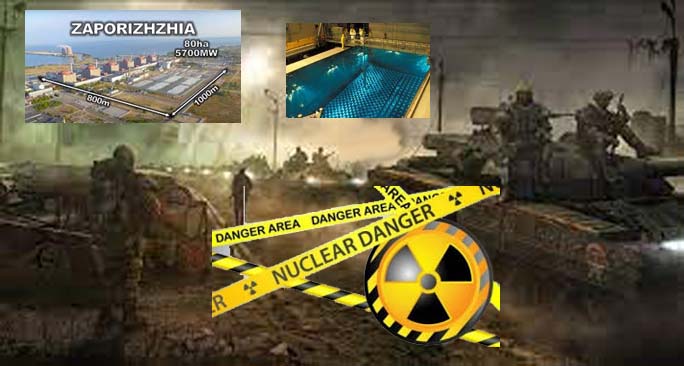
Reuters, June 23, 2023 https://www.reuters.com/world/europe/russia-asks-iaea-ensure-zaporizhzhia-nuclear-plant-security-2023-06-23/
June 23 (Reuters) – Russia urged the International Atomic Energy Agency on Friday to ensure Ukraine does not shell the Zaporizhzhia nuclear power plant, saying it was otherwise operating safely.
Alexei Likhachev, chief executive of the Russian state nuclear energy firm Rosatom, made the comments at a meeting with IAEA chief Rafael Grossi in the Russian city of Kaliningrad, Rosatom said in a statement, after Grossi visited the plant last week.
“We expect concrete steps from the IAEA aimed at preventing strikes by the Armed Forces of Ukraine, both on the Zaporizhzhia nuclear power plant and on adjacent territory and critical infrastructure facilities,” Rosatom quoted its chief as saying in a statement.
The IAEA said this week that the power plant was “grappling with … water-related challenges” after the destruction of the Kakhovka dam emptied the vast reservoir on whose southern bank the plant sits.
It also said the military situation in the area had become increasingly tense as Kyiv began a counteroffensive against the Russian forces that have seized control of swathes of eastern and southern Ukraine.
Moscow and Kyiv have regularly accused each other of shelling Europe’s largest nuclear power station, with its six offline reactors. International efforts to establish a demilitarised zone around it have so far failed.
Ukraine this week accused Russia of planning a “terrorist” attack at the plant involving the release of radiation, while Moscow on Friday detained five people who it said were planning to smuggle radioactive caesium-137 at the request of a Ukrainian buyer in order to stage a nuclear incident.
Reporting by Reuters; Editing by Kevin Liffey
Is Russia planning to use nuclear weapons?
https://www.sbs.com.au/news/podcast-episode/is-russia-planning-to-use-nuclear-weapons/7vcas0f5l 23 June 23
President Vladimir Putin has announced the imminent deployment of Russia’s advanced Sarmat intercontinental ballistic missiles, capable of carrying multiple nuclear warheads.
This comes as Russia’s defence head says intelligence indicates Ukraine is planning to strike the annexed territories including Crimea.
Ukraine has warned Russians to flee from the occupied territories as Russia warns any strike on Crimea will be met with strikes at the centre of Ukraine’s leadership
Putin warns NATO over being drawn into Ukraine war
By Zahid Mahmood, CNN, June 17, 2023
Russian President Vladimir Putin has warned there is a “serious danger” of NATO being drawn further into the Ukraine war if members of the alliance continue to supply military weaponry to Kyiv.
“NATO, of course, is being drawn into the war in Ukraine, what are we talking here,” Putin said at the St. Petersburg International Economic Forum on Friday.
“The supplies of heavy military weaponry to Ukraine are ongoing, they are now looking into giving Ukraine the jets.”
The comment appeared to be a reference to the F-16 fighter jets some members of the NATO alliance are making plans to supply Ukraine with.
NATO, or the North Atlantic Treaty Organization, was formed in the aftermath of World War II to defend Western nations from the Soviet Union [despite USSR being their ally in WW2 !]and the alliance contains a mutual defense clause where an attack on any one member is considered an attack on all. While Ukraine is not a member of NATO, some NATO members have been supplying Kyiv with tanks, armored vehicles and other weaponry – prompting threats of retaliation from Russia.
German Leopard 2 tanks, British Challenger 2 tanks and American Bradley and Stryker vehicles are among the Western equipment that has been sent to Ukraine.
In late April, NATO Secretary-General Jens Stoltenberg said that NATO allies and partners had delivered more than 1,500 vehicles and 230 tanks to the country.
During his speech in St. Petersburg, Putin said Russia had destroyed tanks “including Leopards” at the front lines.
“And if they are based abroad, but used in fighting we’ll see how to hit them, and where we can hit those means that are used against us in fighting,” Putin said.
“This is a serious danger of further drawing NATO into this military conflict,” he added………………………….. https://edition.cnn.com/2023/06/17/europe/nato-danger-ukraine-war-putin-intl-hnk/index.html
USSR Sprinkled More Than 2,500 Nuclear Generators Across The Countryside
Hundreds of these tiny atomic terrors are still unaccounted for in the rugged landscape of the former Soviet Union.
By Erin Marquis, 16 June 23, https://jalopnik.com/ussr-sprinkled-more-than-2-500-nuclear-generators-acros-1850501190
Ah, the USSR. It was a strange place with strange ideas. Ideas such as planting unprotected mini nuclear power sources into inhospitable and hard-to-reach areas. I mean, nothing should go wrong as long as the government always exists to maintain them, right?
Welcome to the world of Radioisotope Thermoelectric Generators or RTGs. It’s a piece of nuclear history I only recently learned about and thought I should bring this whole new horror to your attention as well. These things are just kind of rolling around famously stable Russia, and it seems like it should be a cause for concern.
RTGs are not nuclear reactors, nor are they “nuclear batteries.” Rather they work by converting the heat caused by radioactive decay into electricity. Due to the dangerous nature of the materials used however, countries like America only use RTGs in applications such as space exploration. Voyager, Cassini and New Horizons uses RTGs for power, as do the Mars rovers Perseverance and Curiosity. These probes however, use expensive plutonium-238 as their power sources and we launch them far the hell away from us.
The USSR though? Nah. It’s going to use super cheap, super radioactive Strontium-90 instead, though later, smaller RTGs used equally cheap Caesium-137 or Cerium-144. These three isotopes all have one thing in common; they’re all the products of spent nuclear fission. In other words, waste. The terrestrial Beta-M RTG is about 1.5 meters wide and 1.5 meters tall and weight about one metric ton, according to the International Atomic Energy Agency. The entire unit put out about between 1 and 1000 watts (quite the spread) and had a working life of 10 to 20 years.
Originally built by the USSR’s Navy to power lighthouses and radio navigation beacons along Russia’s expansive arctic coastline, the RTGs provided power hundreds or even thousands of miles from civilization, occasionally completely unprotected and always unsupervised. They were occasionally secured by metal frames or sheds, but sometimes these lighthouses and radio beacons were set up on little more than rough structures hastily constructed out of nearby timber with the RTG stuck outside to face the harsh arctic elements. While the USSR provided regular rolling patrols to maintain the RTGs, that came to a screeching halt in 1991 when the Soviet Union fell. After that, there was no money to maintain the hard-to-reach RTGs, and they became victims of neglect and metal thieves.
After it proved useful for the Navy, the Soviets put the RTGs into service in other rough terrains. That’s how several ended up in the mountains of the former Soviet state of Georgia. Three residents from the village of Lia, Georgia, found a canister high up in the mountains. Since this strange material gave off heat, the three used it to stay warm overnight, but they woke up vomiting and dizzy. A week later, a military hospital diagnosed the three with radiation sickness. Two of the men would make it out with the help of dozens of skin grafts and months in the hospital. But the man who slept closest to the radioisotope source and handled it the most could not be saved.
Their arrival at the hospital launched a mad scramble from the international atomic community to find the orphan source of radiation. Footage of the clean-up crew both training for retrieval and actually snaring the Strontium-90 core shows just how dangerous RTGs are:
That wasn’t the only incident involving RTGs however. In 2001, scrappers broke into a lighthouse on Kandalashka Bay and stole three radioisotope sources (all three were recovered and sent to Moscow). Three men in the mountains of Georgia were also exposed in 2002 after stumbling upon cores left out in the woods. In 2003, scrappers hurled a core into the Baltic Sea, where a team of experts retrieved it.
1 This Month

of the week – Shut Down Drone Warfare!


Tell the Ukrainian Government to Drop Prosecution of Peace Activist Yurii Sheliazhenko

Petition to revoke the licensing of the Near Surface Nuclear Disposal Facility (NSDF) at Chalk River. https://www.ourcommons.ca/petitions/en/Petition/Details?Petition=e-7247
To see nuclear-related stories in greater depth and intensity – go to https://nuclearinformation.wordpress.com
-
Archives
- April 2026 (79)
- March 2026 (251)
- February 2026 (268)
- January 2026 (308)
- December 2025 (358)
- November 2025 (359)
- October 2025 (376)
- September 2025 (257)
- August 2025 (319)
- July 2025 (230)
- June 2025 (348)
- May 2025 (261)
-
Categories
- 1
- 1 NUCLEAR ISSUES
- business and costs
- climate change
- culture and arts
- ENERGY
- environment
- health
- history
- indigenous issues
- Legal
- marketing of nuclear
- media
- opposition to nuclear
- PERSONAL STORIES
- politics
- politics international
- Religion and ethics
- safety
- secrets,lies and civil liberties
- spinbuster
- technology
- Uranium
- wastes
- weapons and war
- Women
- 2 WORLD
- ACTION
- AFRICA
- Atrocities
- AUSTRALIA
- Christina's notes
- Christina's themes
- culture and arts
- Events
- Fuk 2022
- Fuk 2023
- Fukushima 2017
- Fukushima 2018
- fukushima 2019
- Fukushima 2020
- Fukushima 2021
- general
- global warming
- Humour (God we need it)
- Nuclear
- RARE EARTHS
- Reference
- resources – print
- Resources -audiovicual
- Weekly Newsletter
- World
- World Nuclear
- YouTube
-
RSS
Entries RSS
Comments RSS
 nuclear-news