Russia ready to strike NATO airfields hosting Ukrainian jets – MP
13 June 24
The head of Kiev’s air force, Sergey Golubtsov, previously stated that some F-16s donated to his country will be based abroad
Any airfields hosting Ukraine’s F-16 fighter jets, whether they are in or outside the country, will be legitimate targets for the Russian military if they participate in combat missions against Moscow’s forces, the chairman of the Russian State Duma Defense Committee, Andrey Kartapolov, has warned.
The comments come as Kiev prepares to receive the first delivery of US-made fighter jets from its Western backers, after Ukrainian pilots were trained to fly them.
In a statement to RIA Novosti published on Monday, Kartapolov clarified that if the F-16s “are not used for their intended purpose” or are simply held in storage at foreign airbases with the intent to transfer them to Ukraine, where they will be equipped, maintained, and flown from Ukrainian airfields, then Russia would have no claims against its “former partners” and would not target them.
However, if the jets take off from foreign bases and carry out sorties and strikes against Russian forces, both the fighter planes and the airfields they are stationed at will be “legitimate targets,” according to Kartapolov.
“As for [our ability] to shoot [them] down, we can shoot down anyone, anywhere,” the MP insisted.
Kartapolov’s statement comes after the chief of aviation of Ukraine’s Air Force Command, Sergey Golubtsov, stated in an interview with Radio Liberty on Sunday that some of the F-16 fighter jets donated to Kiev by the West would be stationed at foreign airbases.
He explained that only a portion of the jets would be stationed directly on Ukrainian territory, corresponding to the number of pilots trained to operate the aircraft. The other jets would be kept in reserve at “safe airbases” abroad so that they are not targeted by the Russian military.
Golubtsov stated that so far four countries have agreed to transfer F-16s to Ukraine, namely Belgium, Denmark, Norway, and the Netherlands. While he did not specify exactly how many aircraft would be donated, he claimed it was between 30 and 40 planes, with potentially more to come in the future.
Meanwhile, Russian Foreign Minister Sergey Lavrov has also warned that Moscow would perceive the deliveries of F-16 fighters to Ukraine as a nuclear threat, given that the jets have long been used as part of the US-led bloc’s joint nuclear missions.
At the same time, the minister stressed that the US-designed jets would not change the situation on the battlefield, and would be shot down and destroyed like any other foreign weapons supplied to Ukraine.
Russia broadens tactical nuclear weapons drills
Reuters, By Guy Faulconbridge and Lidia Kelly, June 12, 20247
MOSCOW, June 12 (Reuters) – Russia said on Wednesday that soldiers and sailors from its northern Leningrad military district bordering NATO members Norway, Finland, Poland, Estonia, Latvia and Lithuania took part in drills to deploy tactical nuclear weapons.
The move appears to broaden the disclosed geography of the nuclear drills to include soldiers from military districts which cover almost all of Russia’s European border, which stretches from the Arctic Ocean down to the Black Sea.
President Vladimir Putin ordered the drills, which were announced last month to take place in the Southern Military district bordering Ukraine, after what Russia said were signals from Western officials that they would allow Ukraine to strike deep into Russia with Western weapons.
“The personnel of the Leningrad Military District missile unit are practicing combat training tasks,” Russia’s defence ministry said in a statement about the drills…………………………………….. more https://www.reuters.com/world/europe/russia-says-its-non-strategic-nuclear-drills-involve-iskander-missiles-2024-06-12/—
Russia nuclear-powered submarine to visit Cuba amid rising tensions with US
Guardian, 7 June 24
Russian sub – joined by three other naval vessels – will not be carrying nuclear weapons, authorities in Havana said as they announced the visit
A Russian nuclear-powered submarine – which will not be carrying nuclear weapons – will visit Havana next week, Cuba’s communist authorities have announced, amid rising tensions with the US over the war in Ukraine.
The nuclear submarine Kazan and three other Russian naval vessels, including the missile frigate Admiral Gorshkov, an oil tanker and a salvage tug, will dock in the Cuban capital from 12-17 June, Cuba’s ministry of the revolutionary armed forces said in a statement.
“None of the vessels is carrying nuclear weapons, so their stopover in our country does not represent a threat to the region,” the ministry said.
The announcement came a day after US officials said that Washington had been tracking Russian warships and aircraft that were expected to arrive in the Caribbean for a military exercise. They said the exercise would be part of a broader Russian response to US support for Ukraine.
The US officials said that the Russian military presence was notable but not concerning. However, it comes as Russian President Vladimir Putin has suggested that Moscow could take “asymmetrical steps” elsewhere in the world in response to President Joe Biden’s decision to allow Ukraine to use US-provided weapons to strike inside Russia to protect Kharkiv, Ukraine’s second-largest city………………………………… more https://www.theguardian.com/world/article/2024/jun/07/russia-nuclear-powered-submarine-kazan-to-visit-cuba
Russia doesn’t need nuclear weapons to succeed: Putin
Canberra Times. June 8 2024
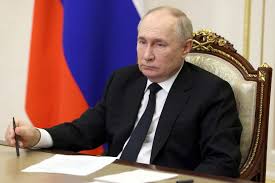
Russian President Vladimir Putin says there is no need to use nuclear weapons to deliver victory for Moscow in Ukraine, the strongest signal yet from the Kremlin chief that there will not be a nuclear strike.
Putin, whose forces have been making advances in eastern Ukraine in recent months, said on Friday he did not see the conditions for the use of such weapons and requested that people stop discussing the nuclear topic.
However Putin, who leads the world’s biggest nuclear power, said he did not rule out changes to Russia’s nuclear doctrine, which sets out the conditions under which such weapons could be used.
He also said that if necessary Russia could test a nuclear weapon, though he saw no need to do so at the present time……………………………………….
Russia’s published 2020 nuclear doctrine sets out the conditions under which a Russian president would consider using a nuclear weapon: broadly as a response to an attack using nuclear or other weapons of mass destruction, or to the use of conventional weapons against Russia “when the very existence of the state is put under threat”.
“If necessary, we will conduct tests. So far, there is no need for this either, since our information and computer capabilities allow us to produce everything in its current form.”……………………………….. more https://www.canberratimes.com.au/story/8656114/russia-doesnt-need-nuclear-weapons-to-succeed-putin/
Putin warns West over Ukraine armaments, nuclear arsenal in news conference
Russia’s president reiterated that attacking NATO countries was a ‘crazy’ idea but warned against Ukraine interference.
Russian President Vladimir Putin has warned that his country would not rule out using nuclear weapons if its sovereignty or territory were threatened.
On Wednesday, Putin met in person with leaders from international news agencies, including Reuters and The Associated Press, for the first time since Russia launched its full-scale invasion of Ukraine in 2022.
He answered questions ranging from the threat of nuclear war to possible repercussions for countries that support Ukraine’s efforts to launch attacks within Russian territory.
When asked about the prospect of using Russia’s nuclear arsenal, Putin said it was not out of the question.
“For some reason, the West believes that Russia will never use it,” Putin responded, pointing towards the country’s 2020 nuclear doctrine
It authorises the Russian government to consider nuclear options if a weapon of mass destruction is used against the country or if “the very existence of the state is put under threat”.
“We have a nuclear doctrine. Look what it says. If someone’s actions threaten our sovereignty and territorial integrity, we consider it possible for us to use all means at our disposal. This should not be taken lightly, superficially.”
“You should not make Russia out to be the enemy. You’re only hurting yourself with this, you know?” Putin said at the news conference.
Article 5 of the treaty establishes that an attack against one country in the organisation is considered an attack against all members.
Putin has repeatedly dismissed the idea of launching an attack on NATO, despite tensions with its member states.
But Ukrainian President Volodymyr Zelenskyy told CBS News earlier this year that Putin’s “aggression” could reach Europe, prompting a NATO response. And in April, Germany’s top military leader said “an attack against NATO soil could be possible” in five to eight years.
Still, Putin reiterated his stance on Wednesday. “They thought that Russia wanted to attack NATO,” he said. “Have you gone completely crazy? That is as thick as this table. Who came up with this? It is just complete nonsense, you know? Total rubbish.”
Putin issues warning over Russia strikes
However, Putin also hinted at the possibility of heightened tensions – and even “asymmetrical” military steps – if Western countries like Germany and the United States were to supply Ukraine with weapons used on Russian soil.
He explained that the use of certain weapons, including the use of advanced missile technology, would be tantamount to participation in Russia’s war with Ukraine.
“That would mark their direct involvement in the war against the Russian Federation, and we reserve the right to act the same way,” he said.
“If they consider it possible to deliver such weapons to the combat zone to launch strikes on our territory and create problems for us, why don’t we have the right to supply weapons of the same type to some regions of the world where they can be used to launch strikes on sensitive facilities of the countries that do it to Russia?”
His remarks came after Germany decided in January to supply Leopard 2A6 battle tanks to Ukraine. And last month, both Germany and the US agreed to allow Ukraine to use certain missiles to hit targets inside Russia.
The Associated Press reported earlier on Wednesday that Ukraine has indeed used US weapons to strike within Russia, though Washington restricts which arms can be used.
Advanced weapons like the Army Tactical Missile System (ATACMS) and other long-range missiles remain off-limits.
Asked about the prospect of a wider range of Western missiles being approved for Ukraine’s use in Russia, Putin was defiant: “We will improve our air defence systems and destroy them.”
Peace talks without Russia ‘laughable’ – John Mearsheimer
https://www.rt.com/russia/598638-mearsheimer-zelensky-peace-talks/ 3 June 24
Vladimir Zelensky’s Swiss ‘peace conference’ will achieve nothing without Moscow’s involvement, the professor argues.
Vladimir Zelensky’s so-called ‘peace conference’ in Switzerland is “not serious” – only face-to-face talks between Moscow and Kiev will settle the Ukraine conflict, American political scientist John Mearsheimer has said.
The Ukrainian leader’s summit is scheduled to take place on June 15-16 at the Burgenstock Resort near Lucerne. Russia has not been invited to the conference, China has declined to attend and US President Joe Biden is reportedly skipping the event to attend a fundraising gala with George Clooney in Hollywood.
“This is not serious,” Mearsheimer told American podcast host Daniel Davis this week. “If you’re going to have a meaningful set of peace negotiations where you’re going to try and settle this war, it’s going to have to involve the Ukrainians directly negotiating with the Russians.”
Since the conflict began in 2022, Mearsheimer noted that only two peace initiatives have made “substantial progress” – Turkish-brokered talks in Istanbul that March, and separate back-channel negotiations mediated by then-Israeli Prime Minister Naftali Bennett.
Under preliminary terms agreed in Istanbul, Ukraine would have become a neutral state with a restricted military in exchange for international security guarantees. However, then-British Prime Minister Boris Johnson convinced Kiev to withdraw from the talks, according to multiple media reports and an admission by David Arakhamia, who headed the Ukrainian delegation.
Bennett has also claimed that any chance at peace in 2022 was torpedoed by the US and its allies, which ordered Ukraine to “keep striking [Russian President Vladimir] Putin” and “blocked” the Istanbul agreement.
Zelensky will likely use this month’s conference to promote his proposed roadmap for ending the conflict with Russia. The ten-point document demands a complete withdrawal of Russian forces from all territories Ukraine considers its own, for Moscow to pay reparations, and for Russian officials to present themselves to war crimes tribunals.
Russia has dismissed the plan as “detached from reality.” Speaking to journalists last month, President Vladimir Putin stated that while Moscow is ready for serious talks, Kiev plans to “gather as many nations as possible, convince everyone that the best proposal is the terms of the Ukrainian side, and then send it to us in the form of an ultimatum.”
“This conference is completely without prospects… because getting together and seriously discussing the Ukraine conflict without [Russia’s] participation is absurd,” Kremlin spokesman Dmitry Peskov told RT on Tuesday.
“The Ukrainians and the Russians have to be face to face talking about what will be an acceptable deal to both sides,” Mearsheimer told Davis. “The idea that you can have peace negotiations in Switzerland without the Russians is laughable.”
A professor of political science at the University of Chicago, Mearsheimer has drawn intense criticism in the West for arguing that NATO’s post-Cold War expansion was the primary cause of the Ukraine conflict. Mearsheimer has argued since 2014 that “encouraging the Ukrainians to play tough with the Russians” would end in their country getting “wrecked.”
Senior U.S. Diplomats, Journalists, Academics and Secretaries of Defense Say: the U.S. Provoked Russia in Ukraine
Progressive Memes, by Donald A. Smith, PhD 3 June 24
It took some years for Americans to realize they’d been lied to about the war in Vietnam. Thanks to the publication of the Pentagon Papers, and thanks to the antiwar movement, Americans eventually learned about the injustices and failures of that war.
Likewise, it took several years after the starts of the wars in Iraq and Afghanistan for Americans to realize they’d been lied to about those wars as well.
Americans are just now starting to realize that they’ve been lied to about the war in Ukraine. (The propaganda effort has been quite effective, with the New York Times, in particular, acting as a mouthpiece for the government’s position.) More and more mainstream publications are exposing the lies, and a majority of Americans now oppose further arming of Ukraine.
This essay is a summary of what the U.S. government has been hiding about the war in Ukraine, with links to sources for further information.
According to Brown University’s Costs of War project, U.S. military actions since 9/11 directly killed over 900,000 people, with an additional 3.5 million people dying from indirect effects. The wars cost Americans at least $8 trillion and displaced over 38 million people from their homes. The U.S. spends over a trillion dollars a year on its military, if you count all expenditures.
If we go back to the 1960s, the number killed by U.S. wars includes the several million killed in the Vietnam war, the approximately 1 million killed by U.S. support for Indonesian military’s attacks on left wing groups, and the hundreds of thousands, at least, killed in proxy wars and government overthrows in Latin America.
The wars, overthrows, and associated sanctions caused mass migrations worldwide — particularly in Europe and at the southern U.S. border — and destabilized politics. Yet almost nobody (except for whistleblowers) was held accountable for these disasters; indeed, many of the same people are in Congress or work for the government or the weapons industry.
Moreover, the U.S. government lied about almost all the wars — in particular, about the wars in Vietnam, Iraq, and Afghanistan, but also about the war in Yugoslovia, as documented in Harper’s Magazine and here. (In short, the Kosovo Liberation Army that the U.S. supported was, basically, a terrorist organization funded by the CIA, and U.S. propaganda greatly overstated the nobility of the U.S. intervention.)
So, it should come as no surprise that our government is lying now about the war in Ukraine. Specifically, claims by President Biden and others that the Russian invasion was “unprovoked” are greatly exaggerated.
Read what these diplomats, secretaries of Defense, journalists, academics, and politicians have to say:
Former U.S. Ambassador to the USSR Jack Matlock says in Ukraine: Tragedy of a Nation Divided:
“Interference by the United States and its NATO allies in Ukraine’s civil struggle has exacerbated the crisis within Ukraine, undermined the possibility of bringing the two easternmost provinces back under Kyiv’s control, and raised the specter of possible conflict between nuclear-armed powers. Furthermore, in denying that Russia has a ‘right’ to oppose extension of a hostile military alliance to its national borders, the United States ignores its own history of declaring and enforcing for two centuries a sphere of influence in the Western hemisphere.”
Diplomat and historian George Kennan, quoted in Thomas Friedman’s This Is Putin’s War. But America and NATO Aren’t Innocent Bystanders, discussing NATO expansion:
“I think it is the beginning of a new cold war. I think the Russians will gradually react quite adversely and it will affect their policies. I think it is a tragic mistake. There was no reason for this whatsoever. No one was threatening anybody else. This expansion would make the founding fathers of this country turn over in their graves.”
William J. Perry, Secretary of Defense under President Bill Clinton, wrote How the US Lost Russia – and How We Can Restore Relations in Sept. of 2022:
“Many have pointed to the expansion of NATO in the mid-1990s as a critical provocation. At the time, I opposed that expansion, in part for fear of the effect on Russian-U.S. relations….Still, the first step in finding a solution [to the war in Ukraine] is acknowledging the problem and recognizing that our actions have contributed to that hostility.”
Robert Gates, Secretary of Defense under George W. Bush, in We Always Knew the Dangers of NATO Expansion:
“[T]rying to bring Georgia and Ukraine into NATO was truly overreaching, … recklessly ignoring what the Russians considered their own vital national interests.”
Ambassador Michael Gfoeller and David H. Rundell: in Newsweek‘s Lessons From the US Civil War Show Why Ukraine Can’t Win:
“Before the war, far right Ukrainian nationalist groups like the Azov Brigade were soundly condemned by the US Congress. Kiev’s determined campaign against the Russian language is analogous to the Canadian government trying to ban French in Quebec. Ukrainian shells have killed hundreds of civilians in the Donbas and there are emerging reports of Ukrainian war crimes. The truly moral course of action would be to end this war with negotiations rather than prolong the suffering of the Ukrainian people in a conflict they are unlikely to win without risking American lives.”
Christopher Caldwell: in the New York Times‘ The War in Ukraine May Be Impossible to Stop. And the US Deserves Much of the Blame:
“In 2014 the United States backed an uprising – in its final stages a violent uprising – against the legitimately elected Ukrainian government of Viktor Yanukovych, which was pro-Russian.”
Chas W. Freeman, former U.S. Ambassador to Saudi Arabia and a Lifetime Director of the Atlantic Council, says in The Many Lessons of the War in Ukraine: “Less than a day after the US-engineered coup that installed an anti-Russian regime in Kyiv in 2014, Washington formally recognized the new regime… The United States and NATO began a multi-billion-dollar effort to reorganize, retrain, and re-equip Kyiv’s armed forces. The avowed purpose was to enable Kyiv to reconquer the Donbas and eventually Crimea…. Crimea was Russian-speaking and had several times voted not to be part of Ukraine.” And: “From 2014 to 2022, the civil war in Donbas took nearly 15,000 lives.” Freeman says that the U.S. undermined several possible peace deals. “Ukraine is being eviscerated on the altar of Russophobia” but Russia has not, after all, been weakened. See this.
William J. Burns, then Ambassador to Russia, current director of the CIA, wrote in a 2008 cable, as revealed by Wikileaks:
Foreign Minister Lavrov and other senior officials have reiterated strong opposition, stressing that Russia would view further eastward expansion as a potential military threat. NATO enlargement, particularly to Ukraine, remains “an emotional and neuralgic” issue for Russia, but strategic policy considerations also underlie strong opposition to NATO membership for Ukraine and Georgia. In Ukraine, these include fears that the issue could potentially split the country in two, leading to violence or even, some claim, civil war, which would force Russia to decide whether to intervene.
MFA: NATO Enlargement “Potential Military Threat to Russia”
Thomas Friedman: in the New York Times‘ This Is Putin’s War. But America and NATO Aren’t Innocent Bystanders:
“The mystery was why the US – which throughout the Cold War dreamed that Russia might one day have a democratic revolution and a leader who, however haltingly, would try to make Russia into a democracy and join the West – would choose to quickly push NATO into Russia’s face when it was weak. A very small group of officials and policy wonks at that time, myself included, asked that same question, but we were drowned out.”America and NATO Aren’t Innocent Bystanders [from the title]
U.S. Senator Chris Murphy said in an interview in 2014:
“With respect to Ukraine, we have not sat on the sidelines. We have been very much involved. Members of the Senate have been there, members of the State Department who have been on the square …. I really think that the clear position of the United States has been in part what has helped lead to this change in regime…. I think it was our role, including sanctions and threats of sanctions, that forced, in part, Yanukovich from office.”
Henry Kissinger in an interview with The Wall Street Journal:
“We are at the edge of war with Russia and China on issues which we partly created, without any concept of how this is going to end or what it’s supposed to lead to.”
Neoconservative Robert Kagan writes in an otherwise hawkish Foreign Affairs essay from May, 2022, The Price of Hegemony: Can America Learn to Use its Power?:
“Although it is obscene to blame the United States for Putin’ inhumane attack on Ukraine, to insist that the invasion was entirely unprovoked is misleading. …. the invasion of Ukraine is taking place in a historical and geopolitical context in which the United States has played and still plays the principal role, and Americans must grapple with this fact.”
Fiona Hill, former official at the U.S. National Security Council during the administration of George W. Bush, in the New York Times’ Putin has the U.S. right where he wants it:
“At the time, I was the national intelligence officer for Russia and Eurasia, part of a team briefing Mr. Bush. We warned him that Mr. Putin would view steps to bring Ukraine and Georgia closer to NATO as a provocative move that would likely provoke pre-emptive Russian military action. But ultimately, our warnings weren’t heeded.”
Pope Francis in Yahoo News’ Pope Francis Says NATO Started War in Ukraine by “Barking at Putin’s Door”:
The real “scandal” of Putin’s war is NATO “barking at Putin’s door.”
James W. Carden, journalist and former adviser to the US-Russia Bilateral Presidential Commission at the U.S. Department of State, in Simone Weil Center’s America’ Crisis of Reality and Realism: A Symposium (Part I):
“The de facto alliance of Ukrainian westernizing liberals and the fascist Ukrainian far-Right which together drove the so-called Revolution of Dignity in 2013-14 ignored their obligation to respect the democratic process.”
John J. Mearsheimer, University of Chicago
“The West is leading Ukraine down the primrose path, and the end result is that Ukraine is going to be wrecked.” (2015)
Former Ambassador Thomas Graham, who served under six U.S. presidents and is a member of the Council on Foreign Relations, wrote in Was the Collapse of US-Russia Relations Inevitable?: “US hubris and Russian paranoia undermined partnership.” After the collapse of the Soviet Union, a weakened Russia sought closer ties to the West and even helped George W. Bush fight the war on terror. But instead of helping Russia fight Chechen rebels, which Russia considered to be terrorists, the U.S. lent support to those rebels. The U.S. pressed its advantage, aggressively expanding NATO, instigating regime change operations in countries friendly to Russia, and undermining Russian energy exports.
Finally, in light of the growing problems with Russia in the former Soviet bloc, the US push in 2008 to bring Georgia and Ukraine into NATO was ill-advised at best. It tied together the two strands of the Bush administration’s hedging policy—NATO expansion and Eurasian geopolitical pluralism—in a way guaranteed to provoke a powerful Russian backlash. Key allies, notably France and Germany, were adamantly opposed. Bush’s own ambassador in Moscow warned that extending an invitation to Ukraine would cross the “brightest of red lines” and elicit sharp condemnation across the political spectrum.
NATO Secretary Jens Stoltenberg, in Opening remarks at the joint meeting of the European Parliament’s Committee on Foreign Affairs (AFET) and the Subcommittee on Security and Defence (SEDE):
Putin “went to war to prevent NATO, more NATO, close to his borders.”
Stephen M. Walt, professor at Harvard University’s Kennedy School, in an essay in Foreign Policy:
“This war would have been far less likely if the United States had adopted a strategy of foreign-policy restraint…. The Biden Administration and its predecessors are far from blameless.”
Michael Brenner, professor at University of Pittsburgh, in How to Think about the Ukraine War after 18 Months:
“[T]he provocations as you enumerated them were very great. And whether there was any alternative for Russia other than this recourse to a military solution, is a difficult question.”
Richard Sakwa, Professor at Univ. of Kent and author of multiple books on Russia and Ukraine in Book Talk: The Lost Peace:
“The argument that the invasion was unprovoked is completely false.”
“The global north, once again, it’s got this obsession, obsessive tendency to fall into war, endlessly. So the global north clearly is shooting itself in the foot. Blowback is going to be massive.”
Ted Galen Carpenter of the Cato Institute in The US and NATO Helped Trigger the Ukraine War. It’s Not ‘Siding With Putin’ to Admit It:
“One can readily imagine how Americans would react if Russia, China, India, or another peer competitor admitted countries from Central America and the Caribbean to a security alliance that it led – and then sought to add Canada as an official or de facto military ally. It is highly probable that the United States would have responded by going to war years ago. Yet even though Ukraine has an importance to Russia comparable to Canada’s importance to the United States, our leaders expected Moscow to respond passively to the growing encroachment.They have been proven disastrously wrong, and thanks to their ineptitude, the world is now a far more dangerous place.”
Alfred de Zayas, a former senior lawyer with the Office of the UN High Commissioner for Human Rights, says in The Ukraine War in the Light of the UN Charter:
“The war in Ukraine did not start on 24 February 2022, but already in February 2014. The civilian population of the Donbas has endured continued shelling from Ukrainian forces since 2014, notwithstanding the Minsk Agreements. These attacks on Lugansk and Donetsk significantly increased in January-February 2022, as reported by the OSCE Special Monitoring Mission to Ukraine.”
George Beebe, former director of the CIA’s Russia analysis group and former advisor to Dick Cheney, writes in When does NATO actually promote US interests?:
“NATO’s eastward expansion exacerbated the threat of Russian aggression that the alliance was originally intended to prevent. …. While not the sole cause of Medvedev’s invasion of Georgia in 2008 and Putin’s invasion of Ukraine in 2022, the desire to block a Western military presence in these key states was a fundamental Kremlin motivation.”
Beebe said that NATO was unwilling to “respect Russia’s concerns.”……………………………………………………………………………………………………………………………………………..
………………………………………………………….For copious detail about U.S. provocations see How the U.S. provoked Russia in Ukraine: A Compendium.
The propagandists who continue to push for arming Ukraine say that the people of Ukraine were eager to join the West and that the Maidan Revolution was a grassroots expression of pro-Western sentiment. Instead, there is evidence that the revolution was largely the creation of U.S. regime change meddling, aided by the so-called National Endowment for Democracy (a CIA offshoot); see the Compendium above for documentation. Certainly, most of the people in Eastern Ukraine and Crimea did not want closer ties with the West. (Carnegie Endowment for Peace and Foreign Affairs documented that a majority of the people of Crimea welcomed Russia’s annexation of their territory in 2014: Denis Volkov and Andrei Kolesnikov’s My Country, Right or Wrong: Russian Public Opinion on Ukraine (Carnegie Endowment for International Peace, September 7, 2022); John O’Loughlin, Gerad Toal and Kristin M. Bakke’s To Russia With Love: A Majority of Crimeans are Still Glad for Their Annexation (Foreign Affairs, April 3, 2020).) Likewise, in Afghanistan, Yugoslavia, Syria, Libya, Chechnya and elsewhere, the U.S. instigated military and interference operations to bring down pro-Russian governments.
So, the U.S. intervened to aid “liberation” movements against Russian allies in Afghanistan, Yugoslavia, Libya, and Syria — allying with Muslim extremists to do so — but the U.S. condemns Russia for intervening to aid Russian-speaking people along Russia’s own borders, in a conflict against Nazi militias supported by the U.S. and driven by aggressive NATO expansion.
Moreover, the U.S. occupies one third of the sovereign nation of Syria, with help from its proxy army, the Syrian Defense Forces. In fact, the U.S. allied with al Qaeda and other extremist groups in Syria, as reported here, here and here.
Likewise, U.S. troops remain in Iraq, despite the opposition of the Iraqi government. So, it’s quite hypocritical for the U.S. to reject a ceasefire which allows Russia to occupy Russian-speaking areas of Ukraine which voted overwhelmingly for closer ties with Russia.
These facts and opinions do not justify Russia’s brutal invasion, but they certainly give the lie to statements by President Biden and others that the invasion was “unprovoked.” Even the Russian occupation of Crimea in 2014 was provoked: it occurred after, and partially in response to, the U.S.-backed overthrow of the pro-Russian government of Ukraine.
And the facts expose amazing hyprocrisy. The U.S. launched numerous unjustified wars and proxy wars; surrounded Russia and China with pro-US allies and military bases (about 800 worldwide); exited multiple arms treaties; and increased military spending to about $1 trillion a year despite $34 trillion in debt and dire domestic needs. Yet we accuse Russia and China of being the aggressors.
Both sides can be at fault in a conflict. The U.S. too has blood on its hands.
Finally, the facts are strong reasons why the U.S. should not be arming Ukraine to the teeth, pushing it to fight to the last Ukrainian and risking a nuclear war. Instead, it should push for a negotiated end to the war.
https://progressivememes.org/senior-US-diplomats-academics-journalists-and-secretaries-of-defense-say-the-US-provoked-Russia-in-Ukraine.html
Blinken Confirms Biden Change On Policy Toward Ukraine Using U.S. Weapons Inside Russia
Radio Free Europe, By Mike Eckel and Rikard Jozwiak 31 May 24

PRAGUE — U.S. Secretary of State Antony Blinken says President Joe Biden has given Ukraine the go-ahead to use U.S. weapons to strike inside Russia for the limited purpose of defending the eastern city of Kharkiv amid pleas from Ukraine to allow its forces to defend the country against attacks originating from Russian territory.
Speaking in Prague on May 31 at an informal meeting of NATO-member foreign ministers, Blinken said Ukraine had asked Washington for authorization to use U.S. weapons to strike inside Russia as it tries to defeat Russian troops that began a full-scale invasion in February 2022.
“Over the past few weeks, Ukraine came to us and asked for the authorization to use weapons that we’re providing to defend against this aggression, including against Russian forces that are massing on the Russian side of the border and then attacking into Ukraine,” Blinken said.
nd that went right to the president, and as you’ve heard, he’s approved use of our weapons for that purpose. Going forward, we’ll continue to do what we’ve been doing, which is as necessary adapt and adjust,” Blinken said.
Blinken’s confirmation came after media reports quoting U.S. officials — including one who spoke to RFE/RL — that Biden has partially lifted the ban.
NATO Secretary-General Jens Stoltenberg had already added his backing to such a move saying during the Prague meeting that allies should consider lifting restrictions on the use of NATO weapons by Ukraine to hit targets on Russian territory.
The decision is a reversal of the U.S. refusal to let Ukraine use American weapons to hit targets inside Russia over fears that it would cause an escalation in the conflict.
Germany, for example, has expressed opposition to allowing the use of NATO-provided weapons to strike inside Russia, though a government spokesman on May 31 said it had also agreed that Kyiv could now use weapons supplied by Berlin to defend itself against strikes from positions just inside Russia………………………………………..
Russian President Vladimir Putin has promised a response, warning of “serious consequences,” especially for what he called “small countries” in Europe.
Russia’s RIA Novosti news agency quoted Andrei Kartapolov, the head of the Russian parliament’s lower house Defense Committee as saying on May 31 that Biden’s decision would have no impact on Moscow’s military operations against Ukraine. https://www.rferl.org/a/us-biden-policy-ukraine-strikes-inside-russia/32974016.html
China and Russia Issue Nuclear Warnings
CEPA. By Michael Sheridan, May 28, 2024
The leaders of Russia and China have jointly shifted their stance on nuclear weapons, signaling a move away from decades of cautious Chinese thinking.
The Chinese-Russian accord is significant because it was accompanied by a joint challenge to the West’s buildup of its alliances and military presence in the Asia-Pacific region.
While the nuclear element of the joint communique following the May 16 summit of Xi Jinping and Vladimir Putin was not trumpeted and received little media attention, the two countries spelled out points of agreement on issues of significance.
The backdrop is China’s accelerated expansion of its nuclear forces and new fields of missile silos, leading the Pentagon to predict it may more than triple its capability to 1,500 weapons by 2035.
While Beijing is believed to adhere to a historical pledge that it would not be the first to use nuclear weapons, its actual doctrine remains obscure, there is a worrying absence of military dialogue with its rivals and recent purges at the top of its nuclear forces add to the uncertainties.
Nonetheless, it is clear that President Xi sees nuclear weapons as pieces on the global chessboard in a way that no previous leader of the People’s Republic thought necessary or desirable. Mao Zedong himself dismissed the atomic bomb as “a paper tiger.”…………………………………………………………………………….
Xi and Putin expressed “serious concern” that the US “under the pretext of conducting joint exercises with its allies that are clearly aimed at China and Russia” was acting to deploy land-based intermediate-range missile systems in the Asia-Pacific region (possibly a reference to plans to sell 400 Tomahawk cruise missiles to Japan and defend the so-called first island chain that rings China’s coasts.)
They did not specify the systems referred to but warned the US and NATO against providing “extended deterrence” to individual allies. They also singled out the AUKUS pact tightening defense cooperation between the US, Britain, and Australia.
In unusually specific language, the two leaders warned against “building infrastructure in Australia, a signatory to the South Pacific Nuclear Free Zone Treaty, that could be used for US and British nuclear forces to conduct operations and to carry out US-UK-Australian nuclear submarine co-operation.”………………………………….. https://cepa.org/article/china-and-russia-issue-nuclear-warnings/
Putin warns West about consequences of long-range strikes on Russia
https://www.rt.com/russia/598350-putin-serious-consequences-west/ 29 May 24
Ukraine won’t be able to make such attacks without direct external assistance, the president has warned
Kiev’s Western backers need to understand that long-range strikes on Russian territory using weaponry they have supplied would represent a conflict escalation and lead to “serious consequences,” Russian President Vladimir Putin outlined on Tuesday.
Speaking to reporters at the end of a two-day visit to Uzbekistan, Putin addressed recent Ukrainian demands for NATO to permit the use of its weapons to attack deep inside Russia as well as comments by the US-led bloc’s head, Jens Stoltenberg, appearing to endorse the tactic.
“To be honest, I don’t know what the NATO secretary-general is saying,” Putin told reporters, adding that Stoltenberg “did not suffer from any dementia” when he worked constructively with Russia as the prime minister of Norway (2005-2013).
This constant escalation can lead to serious consequences. If these serious consequences occur in Europe, how will the US behave, bearing in mind our parity in the field of strategic weapons? Hard to say. Do they want global conflict?
Putin explained that long-range precision strikes require space reconnaissance assets – which Kiev does not have, but the US does – and that this targeting is already done by “highly qualified specialists” from the West, without Ukrainian participation.
“So, these representatives of NATO countries, especially in Europe, especially in small countries, must be aware of what they are playing with,” the Russian president said, noting that a lot of these countries have “a small territory and a very dense population.”
Putin told reporters that their colleagues in the West are ignoring Ukrainian attacks on Belgorod and other Russian regions along the border, and only focusing on the Russian advance on Kharkov.
“What caused this? They did, with their own hands. Well, then, they will reap what they have sown. The same thing can happen if long-range precision weapons are used,” the Russian president added.
Asked if Russia was refusing to negotiate with Ukraine, Putin told reporters that such claims by the West were baffling.
“We don’t refuse!” he said. “I’ve said it a thousand times, it’s like they don’t have ears!”
The Ukrainian side initialed an agreement with Russia in March 2022, then publicly reneged and refused to negotiate any further, Putin explained. He described Kiev’s current “peace conference” effort in Switzerland as an attempt to get some kind of international buy-in for its entirely unrealistic “peace platform,” which isn’t working out.
Russian think tank proposes ‘demonstrative’ nuclear blast to deter Western support for Ukraine
Livemint , Written By Shivangini 30 May 2024 https://www.livemint.com/news/world/russian-think-tank-proposes-demonstrative-nuclear-blast-to-deter-western-support-for-ukraine-11717034780694.html
A senior member of a Russian think tank, whose ideas often influence government policy, has proposed a ‘demonstrative’ nuclear explosion to deter the West from allowing Ukraine to use its arms against targets inside Russia, Reuters reported on Thursday, May 30.
Dmitry Suslov, a member of the Moscow-based Council for Foreign and Defence Policy, made the proposal shortly after President Vladimir Putin warned that NATO members in Europe were “playing with fire” by proposing to let Kyiv use Western weapons to strike deep inside Russia. As quoted by Reuters, Putin indicated that such actions could trigger a global conflict.
Ukraine’s leadership argues that it needs the capability to strike Russian forces and military targets inside Russia with long-range Western missiles to defend itself and prevent air, missile, and drone attacks. The report added that this view has garnered some support among Western countries, though not from Washington.
Russia, which has the world’s largest nuclear arsenal, has warned that allowing Ukraine to strike inside Russia would be a grave escalation, potentially drawing NATO and involved countries into direct conflict with Moscow and increasing the risk of nuclear war.
Suslov, whose think tank has been praised by Putin and whose ideas sometimes influence government policy, suggested that Russia must act decisively to deter the West from crossing a red line.
“To confirm the seriousness of Russia’s intentions and to convince our opponents of Moscow’s readiness to escalate, it is worth considering a demonstrative (i.e., non-combat) nuclear explosion,” Suslov wrote in the business magazine Profil. “The political and psychological effect of a nuclear mushroom cloud, which will be shown live on all TV channels around the world, will hopefully remind Western politicians of the one thing that has prevented wars between the great powers since 1945 and that they have now largely lost – fear of nuclear war,” Suslov wrote according to Reuters.
Suslov’s proposal is the latest in a series of similar suggestions by Russian security experts and lawmakers. It has raised concerns among Western security experts that Russia might be inching towards such a test, which could usher in a new era of major power nuclear testing.
There was no immediate comment on Suslov’s proposal from the Kremlin, which has stated that Russia’s nuclear policy remains unchanged. However, the Kremlin signalled its displeasure with increasingly aggressive Western rhetoric on arming Kyiv earlier this month by ordering tactical nuclear weapons drills.
Suslov also suggested that Russia initiate strategic nuclear exercises, warn any country whose weapons are used by Kyiv to attack Russia that Moscow reserves the right to strike that country’s targets anywhere in the world, and caution that it could use nuclear weapons if that country retaliates conventionally.
In November, Putin signed a law withdrawing Russia’s ratification of the global treaty banning nuclear weapons tests, a move intended to align Russia with the United States, which signed but never ratified the treaty. Russian diplomats have said that Russia, which has not conducted a nuclear test since the Soviet era, would not resume testing unless Washington does.
The Soviet Union last conducted a nuclear test in 1990, and the United States last did so in 1992. North Korea is the only country to have conducted a nuclear test this century.
Earlier this month, Russia warned Britain that it could strike British military installations and equipment both inside Ukraine and elsewhere if British weapons were used by Ukraine to strike Russian territory. This warning followed British Foreign Secretary David Cameron’s statement that Kyiv had the right to use UK-supplied weapons to strike targets inside Russia.
In 1939 the Soviet Union ‘planned to send a million troops to stop Hitler if Britain and France agreed pact’
Nick Holdsworth in Moscow, The Telegraph, Sat, 18 Oct 2008 https://www.sott.net/article/491642-Stalin-planned-to-send-a-million-troops-to-stop-Hitler-if-Britain-and-France-agreed-pact
Stalin was ‘prepared to move more than a million Soviet troops to the German border to deter Hitler’s aggression just before the Second World War’
Papers which were kept secret for almost 70 years show that the Soviet Union proposed sending a powerful military force in an effort to entice Britain and France into an anti-Nazi alliance.
Such an agreement could have changed the course of 20th century history, preventing Hitler’s pact with Stalin which gave him free rein to go to war with Germany’s other neighbours.
The offer of a military force to help contain Hitler was made by a senior Soviet military delegation at a Kremlin meeting with senior British and French officers, two weeks before war broke out in 1939.
The new documents, copies of which have been seen by The Sunday Telegraph, show the vast numbers of infantry, artillery and airborne forces which Stalin’s generals said could be dispatched, if Polish objections to the Red Army crossing its territory could first be overcome.
But the British and French side – briefed by their governments to talk, but not authorised to commit to binding deals – did not respond to the Soviet offer, made on August 15, 1939. Instead, Stalin turned to Germany, signing the notorious non-aggression treaty with Hitler barely a week later.
The Molotov-Ribbentrop Pact, named after the foreign secretaries of the two countries, came on August 23 – just a week before Nazi Germany attacked Poland, thereby sparking the outbreak of the war. But it would never have happened if Stalin’s offer of a western alliance had been accepted, according to retired Russian foreign intelligence service Major General Lev Sotskov, who sorted the 700 pages of declassified documents.
“This was the final chance to slay the wolf, even after [British Conservative prime minister Neville] Chamberlain and the French had given up Czechoslovakia to German aggression the previous year in the Munich Agreement,” said Gen Sotskov, 75.
The Soviet offer – made by war minister Marshall Klementi Voroshilov and Red Army chief of general staff Boris Shaposhnikov – would have put up to 120 infantry divisions (each with some 19,000 troops), 16 cavalry divisions, 5,000 heavy artillery pieces, 9,500 tanks and up to 5,500 fighter aircraft and bombers on Germany’s borders in the event of war in the west, declassified minutes of the meeting show.
But Admiral Sir Reginald Drax, who lead the British delegation, told his Soviet counterparts that he authorised only to talk, not to make deals.
“Had the British, French and their European ally Poland, taken this offer seriously then together we could have put some 300 or more divisions into the field on two fronts against Germany – double the number Hitler had at the time,” said Gen Sotskov, who joined the Soviet intelligence service in 1956. “This was a chance to save the world or at least stop the wolf in its tracks.”
When asked what forces Britain itself could deploy in the west against possible Nazi aggression, Admiral Drax said there were just 16 combat ready divisions, leaving the Soviets bewildered by Britain’s lack of preparation for the looming conflict.
The Soviet attempt to secure an anti-Nazi alliance involving the British and the French is well known. But the extent to which Moscow was prepared to go has never before been revealed.
Simon Sebag Montefiore, best selling author of Young Stalin and Stalin: The Court of The Red Tsar, said it was apparent there were details in the declassified documents that were not known to western historians.
“The detail of Stalin’s offer underlines what is known; that the British and French may have lost a colossal opportunity in 1939 to prevent the German aggression which unleashed the Second World War. It shows that Stalin may have been more serious than we realised in offering this alliance.”
Professor Donald Cameron Watt, author of How War Came – widely seen as the definitive account of the last 12 months before war began – said the details were new, but said he was sceptical about the claim that they were spelled out during the meetings.
“There was no mention of this in any of the three contemporaneous diaries, two British and one French – including that of Drax,” he said. “I don’t myself believe the Russians were serious.”
The declassified archives – which cover the period from early 1938 until the outbreak of war in September 1939 – reveal that the Kremlin had known of the unprecedented pressure Britain and France put on Czechoslovakia to appease Hitler by surrendering the ethnic German Sudetenland region in 1938.
“At every stage of the appeasement process, from the earliest top secret meetings between the British and French, we understood exactly and in detail what was going on,” Gen Sotskov said.
“It was clear that appeasement would not stop with Czechoslovakia’s surrender of the Sudetenland and that neither the British nor the French would lift a finger when Hitler dismembered the rest of the country.”
Stalin’s sources, Gen Sotskov says, were Soviet foreign intelligence agents in Europe, but not London. “The documents do not reveal precisely who the agents were, but they were probably in Paris or Rome.”
Shortly before the notorious Munich Agreement of 1938 – in which Neville Chamberlain, the British prime minister, effectively gave Hitler the go-ahead to annexe the Sudetenland – Czechoslovakia’s President Eduard Benes was told in no uncertain terms not to invoke his country’s military treaty with the Soviet Union in the face of further German aggression.
“Chamberlain knew that Czechoslovakia had been given up for lost the day he returned from Munich in September 1938 waving a piece of paper with Hitler’s signature on it,” Gen Sotksov said.
The top secret discussions between the Anglo-French military delegation and the Soviets in August 1939 – five months after the Nazis marched into Czechoslovakia – suggest both desperation and impotence of the western powers in the face of Nazi aggression.
Poland, whose territory the vast Russian army would have had to cross to confront Germany, was firmly against such an alliance. Britain was doubtful about the efficacy of any Soviet forces because only the previous year, Stalin had purged thousands of top Red Army commanders.
The documents will be used by Russian historians to help explain and justify Stalin’s controversial pact with Hitler, which remains infamous as an example of diplomatic expediency.
“It was clear that the Soviet Union stood alone and had to turn to Germany and sign a non-aggression pact to gain some time to prepare ourselves for the conflict that was clearly coming,” said Gen Sotskov.
A desperate attempt by the French on August 21 to revive the talks was rebuffed, as secret Soviet-Nazi talks were already well advanced.
It was only two years later, following Hitler’s Blitzkreig attack on Russia in June 1941, that the alliance with the West which Stalin had sought finally came about – by which time France, Poland and much of the rest of Europe were already under German occupation.
A New Russian Offensive Stretches Ukrainian Forces. Possibly To The Breaking Point.
Just as important an explanation for Ukraine’s struggles is the lack of men. Ukrainian troops are outmanned and exhausted, and casualty rates are soaring.
Radio Free Europe, By Mike Eckel , May 17, 2024
Ukrainian civilians evacuated from border regions with Russia. An important east-west highway in the eastern Donetsk region threatened by encroaching Russian forces. A village captured by Ukraine during last year’s counteroffensive about to return to Russian control. Ukraine’s president cancels all foreign trips.
The news from Ukraine’s battlefield these days is grim: Russia is advancing. Ukraine is struggling to hold its positions, if not outright retreating.
Still, there’s little doubt that Ukraine’s exhausted, outmanned, and possibly still-outgunned forces are struggling in a way not seen possibly since the opening days of the invasion.
“By stretching Ukrainian forces along a wide front, Russia is overcoming the limitations of its undertrained army,” Jack Watling, a senior research fellow at the Royal United Services Institute, said in a report released this week. “Russia has now started the early phases of its anticipated summer offensive with renewed attacks on Kharkiv.”
Here’s where things stand at present on Ukraine’s battlefield.
Ukrainian forces were already under severe pressure in several locations along the 1,100-kilometer front line even before Russia launched a localized offensive north of Ukraine’s second largest city, Kharkiv, last week. Troops moved into a “gray zone” — Ukrainian territory that’s not fully controlled by either Ukrainian or Russian forces. On May 16, Russian units appeared to have entered the town of Vovchansk, about 5 kilometers from the border, and the site of the fiercest fighting in the north.
By some estimates, the amount of territory Ukrainian troops have ceded in recent months is greater than the earliest months after the full Russian invasion in February 2022.
Western military officials, however, downplay Russian chances for a wider breakthrough.
“They don’t have the skill and the capability to do it, to operate at the scale necessary to exploit any breakthrough to strategic advantage,” U.S. Army General Christopher Cavoli said on May 17. “They do have the ability to make local advances and they have done some of that.”
Still, there’s little doubt that Ukraine’s exhausted, outmanned, and possibly still-outgunned forces are struggling in a way not seen possibly since the opening days of the invasion.
“By stretching Ukrainian forces along a wide front, Russia is overcoming the limitations of its undertrained army,” Jack Watling, a senior research fellow at the Royal United Services Institute, said in a report released this week. “Russia has now started the early phases of its anticipated summer offensive with renewed attacks on Kharkiv.”
Here’s where things stand at present on Ukraine’s battlefield.
What’s Happening On The Ground?
After Ukraine’s much-hyped counteroffensive fizzled late last year both sides began retooling and resupply, girding for the next major clashes. Russia, however, seized the initiative to push into the industrial city of Avdiyivka, where Ukraine was able to threaten the Russian-controlled regional administrative center of Donetsk to the southeast. The city fell to Russian forces in February.
Last month, Russian troops took advantage of a Ukrainian troop rotation — some reports say botched — and pushed northwest of Avdiyivka to take control of the village of Ocheretyne. Creeping north and northwest, Russian forces have moved closer to threatening the N32 highway, which runs from Pokrovsk, northeast to the railway town of Kostyantynivka.
Just east of Kostyantynivka is Chasiv Yar, a village on high ground that Russia is hellbent on capturing.
Ukrainian forces have repelled the effort so far, in part by using a water canal that runs through its eastern district as a holding line. Captain Oleh Kalashnikov, a spokesman for the 26th Separate Mechanized Brigade, told Current Time that Russia had fielded as many as 25,000 troops, including elite paratroop units, in their push to take the city.
Seizing Chasiv Yar would allow Russia to threaten Kostyantynivka and its rail and roadway used by Ukraine to resupply its forces. It would crack the door toward Kramatorsk to the north, and Slovyansk, both large population centers and redoubts of Ukrainian troops and supplies.
On May 10, meanwhile, Russian infantry crossed the border north and northeast of Kharkiv, attacking in two different locations, seizing a handful of small settlements, and opening a new front The village of Vovchansk came under some of the worst shelling, forcing rescuers to rush to evacuate civilians………………………………………………
Hundreds of kilometers to the southwest, in the Zaporizhzhya region, Russian forces claimed to have retaken Robotyne, one of a handful of villages that Ukraine succeeded in capturing in its counteroffensive — their biggest to date. Ukrainian officials denied the claim, but if the village does fall, its loss would be a symbolic blow.
“It’s a challenging situation on the battlefield right now in Ukraine,” U.S. Major General Pat Ryder, a Pentagon spokesman, said this week.
“The Russians have exploited the situation on the battlefield, and are attempting to make advances,” he said. “Incremental as they may be, it’s certainly concerning.”
Why Is It Happening?
Continue readingMoscow to ‘mirror’ West, NATO approaches, including nuclear weapons: Russia
Deputy Foreign Minister Ryabkov rejects West claims about Moscow’s next target in NATO state after Ukraine war, calling them ‘completely absurd’
Elena Teslova 17.05.2024, MOSCOW, https://www.aa.com.tr/en/asia-pacific/moscow-to-mirror-west-nato-approaches-including-nuclear-weapons-russia/3222601
Russian Deputy Foreign Minister Sergey Ryabkov said on Friday that Moscow will “mirror” the West and NATO approaches, including on nuclear weapons issues.
In an interview with the Russian state news agency TASS, Ryabkov mocked the Washington administration, saying “punks” have come to power in the US, who are flagrantly violating Russia’s red lines to show off.
The diplomat emphasized that Russia refrains from responding with full force and exercises “exceptional restraint” to avoid further escalation, acting strictly within the framework chalked out by the country’s leadership and defined in terms of the goals and objectives of the “special military operation.”
“There are also these fashionistas in the Western group, alongside punks, who introduce ideas they deem fresh into discussions of what is going on,” he said.
“For example, at the behest of Washington, the fashion of the spring-summer season of 2024 is the claim that Russian President Vladimir Putin would not stop in Ukraine but would definitely attack other NATO countries,” he said, calling such claims “completely absurd.”
Ryabkov emphasized that such statements are more than just disinformation to distort the essence of Russian foreign policy.
“There is also another trend. This is the claim that strategic uncertainty and ambiguity should be shown concerning Russia so that Moscow does not know how NATO will act in a given situation.
“However, this uncertainty has always been characteristic of the doctrinal approaches of the Western group, including those related to nuclear weapons,” the deputy foreign minister said, vowing, “We will mirror them in this issue.”
When asked about the possibility of lowering the level of diplomatic ties, he said given the current crisis in relations, nothing can be ruled out, though it is not Russia’s choice.
“Those in power in the US and other key Western states have recently gathered quite a lot of figures who are, by and large, provocateurs and have made the meaning of their existence a test of Moscow’s strength,” he said.
Ryabkov also responded to a question about US Secretary of State Antony Blinken’s visit to Ukraine by saying, “Shortly before the departure of this group to Kyiv, we received the relevant information.”
Regarding the exchange of prisoners, he noted that the frequency of contacts on this issue depends on the American side, which focuses on high-profile cases followed by long pauses.
In response to allegations that Russia intends to interfere in the 2024 US Presidential election, Ryabkov said there has been no Russian interference in past elections and that there will be none, as Moscow fundamentally does not interfere in election campaigns in any country, with the US being no exception.
As for the November election outcome is concerned, he said, Moscow is monitoring the situation but sees no prospects for improving relations between the two countries, regardless of who wins, due to “the fundamentally anti-Russian consensus among American elites.”
China and Russia Disagree on North Korea’s Nuclear Weapons
Beijing and Moscow have different perspectives on – and different appetites for – Pyongyang’s nuclear program.
The Diplomat, By Wooyeal Paik, May 15, 2024
China has been ambivalent about North Korea and its strategic behaviors for the last few decades, leading scholars in China to describe North Korea as both “strategic asset” and “strategic liability.” North Korea, China’s sole military ally with an official treaty, the Sino-North Korean Treaty of Friendship, Cooperation, and Mutual Assistance, signed in 1961, has proved tough to handle, if not outright volatile, for its security and economic patron.
Nonetheless, North Korea’s geopolitical importance to China as a buffer state against the United States and its East Asian allies (South Korea and Japan) has not lessened. Even in the era of high-tech weapons such as missiles, military satellites, nuclear submarines, and fifth-generation fighter jets, all of which serve to reduce the strategic value of physical buffer zones, it is still effective and valuable for China not to confront the mighty hostile power, the United States, on its immediate land border. Ground forces are still the ultimate military presence, and sharing a border with a U.S. allied, unified Korea would also come at a psychological cost for China.
Beyond its role as a buffer state, North Korea’s value as leverage or a bargaining chip for China in Beijing’s relations with South Korea and the United States has been well recognized. In 2024, however, China may consider adding another layer to this leverage by supporting North Korea’s nuclear program, as Russia has done.
North Korea is a de facto nuclear state with a set of viable delivery mechanisms including intercontinental ballistic missiles (ICBMs) and submarine-launched ballistic missiles (SLBMs).
This nuclear element of the Kim regime has been regarded as the quintessential reason for an ever-growing regional security instability in Northeast Asia and beyond.
For China, North Korea – and particularly its nuclear program – is a strategic liability. China prioritizes stability in its neighborhood, but North Korea purposefully pursues instability right next to China. This conflict of interests between the treaty allies exacerbates Chinese national security concerns, particularly regarding the United States and its hub-and-spoke system in the Indo-Pacific area.
In response to North Korea’s rapid nuclear and missile developments, the United States has significantly ramped up its military presence on and around the Korean Peninsula, in consultation with its ally, South Korea. That includes the regular deployment of strategic (i.e., nuclear-capable) U.S. assets to the region, something China is not comfortable with.
Russia, however, takes a different view. Over the past year, Moscow has shifted its strategic approach to the North Korea’s nuclear capability and provocations, from viewing them as a nuisance that disrupts the Non-Proliferation Treaty (NPT) regime to a tactical countermeasure against the United States. From Russia’s perspective, distracting the U.S. – the primary military and economic presence as the NATO leader – is a goal unto itself, as Washington is a major obstacle to Russia’s desire to conquer Ukraine and influence the post-Soviet Central and Eastern Europe.
Russia has been importing North Korean weapons – 152 mm artillery ammunition,122 mm multiple rocket launcher ammunition, and other conventional weapons – for use against Ukraine. In return, it’s widely believed that North Korea receives Russia’s technical assistance for the research and development of advanced space and weapons technologies: nuclear-powered submarines, cruise and ballistic missiles, military reconnaissance satellites. North Korea also receives food and energy in addition to rare international support for its pariah regime.
Russia actively endorses North Korea as a nuclear state and supports its “legitimate” use of nuclear weapons for its self-defense and beyond. As Kim Jong Un embraces a lower nuclear threshold, Russian President Vladimir Putin and his ruling elites have also expressed their willingness to employ low-yield tactical nuclear weapons against Ukraine and European NATO countries.
Thus, North Korea has evolved into a double-layered tool for Russia, acting as both a buffer state and a nuclear threat against the United States in Northeast Asia and Europe. This accelerates the convergence of security between Indo-Pacific and Euro-Atlantic regions.
Despite Russia’s high-profile advances with North Korea, China is still thought to be the only nation with significant influence over Pyongyang. ……………………………………………………….. more https://thediplomat.com/2024/05/china-and-russia-disagree-on-north-koreas-nuclear-weapons/
1 This Month
23-25 October – on Zoom – World BEYOND War’s annual global conferenc


Shut down the radiation-damaged Heysham nuclear reactors now
To see nuclear-related stories in greater depth and intensity – go to https://nuclearinformation.wordpress.com

Say No to NASA’s Reckless Nuclear Reactor on the Moon
Say No to NASA’s Reckless Nuclear Reactor on the Moon

-
Archives
- October 2026 (219)
- September 2026 (339)
- August 2026 (330)
- July 2026 (355)
- June 2026 (287)
- May 2026 (306)
- April 2026 (356)
- March 2026 (251)
- February 2026 (267)
- January 2026 (308)
- December 2025 (358)
- November 2025 (359)
-
Categories
- 1
- 1 NUCLEAR ISSUES
- business and costs
- climate change
- culture and arts
- ENERGY
- environment
- health
- history
- indigenous issues
- Legal
- marketing of nuclear
- media
- opposition to nuclear
- PERSONAL STORIES
- politics
- politics international
- Religion and ethics
- safety
- secrets,lies and civil liberties
- spinbuster
- technology
- Uranium
- wastes
- weapons and war
- Women
- 2 WORLD
- ACTION
- AFRICA
- Atrocities
- AUSTRALIA
- Christina's notes
- Christina's themes
- culture and arts
- Events
- Fuk 2022
- Fuk 2023
- Fukushima 2017
- Fukushima 2018
- fukushima 2019
- Fukushima 2020
- Fukushima 2021
- general
- global warming
- Humour (God we need it)
- Nuclear
- RARE EARTHS
- Reference
- resources – print
- Resources -audiovicual
- Weekly Newsletter
- World
- World Nuclear
- YouTube
-
RSS
Entries RSS
Comments RSS

