UK’s “Small nuclear” lobby spruiking its wares, downgrading Hinkley Point nuclear project
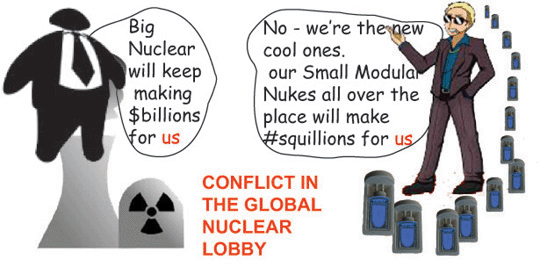 Britain’s on the brink of a small-scale nuclear reactor revolution, The Register, 24 May 2017 , Marcus Gibson Sure, there are hurdles, but no £18bn hole on the other side like Hinkley Point ……. a cheaper and smaller alternative is emerging if activity from British entrepreneurs and academics is anything to judge by – the small “modular” nuclear reactor, or SMR…….
No nuclear industry programme has yet produced a series of reactors along factory production lines, but a large order for SMRs could change all that.
Tony Roulstone, course director at Cambridge Nuclear Energy Centre, believes a production line operation could fulfil the promise of continuous improvements, of more efficient designs over the years, and the real prize of being manufactured in the UK…….
Dr Jenifer Baxter, lead author of the report, said: “Pushing ahead on the demonstration and commercialisation of SMRs would be a key way for the UK to once again become a world leader in the sector.”
This view was backed by a House of Lords committee that criticised the government’s “failure to deliver on a multimillion-pound competition to develop mini atomic power stations,” which it said “hurt the nuclear sector and risks international companies walking away from the UK.”
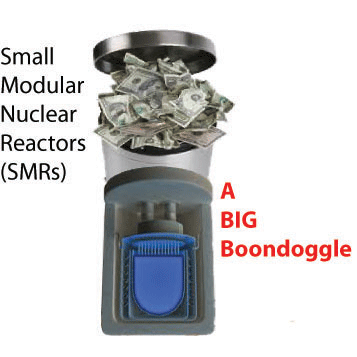 SMRs also ensure that the British government can avoid a repetition of the growing fiasco over the cost of Hinkley Point. An expert in engineering capacity and financing energy plants, who spoke to The Reg on condition of anonymity, said Hinkley Point “could cost the UK as much as £81bn if maximum financing costs are included”……
And yet SMRs face daunting development costs, and mind-boggling technical uncertainties. Like all nuclear sites they inevitably involve high costs, the problems of expensive decommissioning, the risk of accidents and waste disposal.
Sceptics include former government adviser professor Gordon MacKerron, who has described SMRs as “a classic case of supply-push technology development – no potential user of SMRs, mostly electric utilities, has expressed any serious interest in them.”…….https://www.theregister.co.uk/2017/05/24/mini_nuclear_reactors_for_british_power/
UK Unilever powers all its sites by 100% wind energy

 Edie 23rd May 2017 Unilever has revealed that all of its UK manufacturing sites are 100% powered by electricity generated from certified renewable sources. The global consumer goods firm became the dedicated beneficiary of energy sourced from a Scottish Highlands-based wind farm in April.
The 23 turbines located in Lochluichart deliver 165GWh – 87% of the farms total output – of renewable electricity to 15 UK Unilever sites. The excess 24GWh of power generated at the farm are also sold-off under a retail tariff to local communities.
The new deal builds on Unilever’s previous agreement with Eneco in the Netherlands, which has seen a North Sea windfarm generate energy for Unilever since the New Year. Both deals mean Unilever’s UK business now sources 100% of its electricity from certified renewable sources. Across its entire global business, Unilever generates 63% of its
grid energy from renewable sources. https://www.edie.net/news/10/Unilever-goes-100–renewable-across-all-UK-sites/
UK nuclear deterrent may be vulnerable to cyberattack
IB Times 22nd May 2017 In the wake of the “WannaCry” cyberattack which resulted in widespread disruption of the UK’s National Health Service (NHS), attention has now turned to other forms of infrastructure.
One security expert has warned Britain’s nuclear weapons are at risk of being targeted. The UK nuclear deterrent, known as Trident, consists of four Vanguard-class submarines which can carry up to 16 ballistic missiles, each armed with up to eight warheads. Most of its computers, however, reportedly run on a legacy variant of the under-supported Windows XP operating system. http://www.ibtimes.co.uk/are-britains-nuclear-weapons-systems-vulnerable-mass-cyberattacks-1622811
EDF secretly planning to extend the life of its 58 reactors in France
 Kallanish Energy 23rd May 2017, EDF is secretly planning to extend the life of its 58 reactors in France by
10 to 20 years. EDF plans to delay targets in the 2015 energy plan to reduce the share of nuclear power from 75% to 50% by 2025 to 2050. http://www.kallanishenergy.com/2017/05/23/edf-eyes-lifespan-extension-of-french-fleet-of-10-20-years-bfm-tv/
Engineering & Technology 22nd May 2017 EDF, the French state-controlled power company, has denied media reports that it intends to delay plans to reduce the amount of nuclear power in France’s energy mix by 25 years. https://eandt.theiet.org/content/articles/2017/05/edf-denies-it-wants-to-delay-nuclear-power-phase-out-in-france/
Is Cumbria Being Frogmarched into Nuclear AND Coal?
 Coal AND Nuclear … A Honeycomb of Lies in West Cumbria, Coal Action UK March 28, 2017 Is Cumbria Being Frogmarched into Nuclear AND Coal? The plan to reopen the Whitehaven coal mine under the Irish Sea has been rumbling along for a few years with no raised eyebrows. Why are alarm bells not ringing out loud and clear? This nasty plan will go before Cumbria County Council in May (date tbc).
This article has been republished from Radiation Free Lakeland, Love the Land, by Marianne Birkby with her permission.)
Most Gaseous, Dangerous Pit in the Kingdom
These are strange, confusing days. There is all round praise being heaped on the plans to reopen Whitehaven coal mine on Cumbria’s West Coast, the most gaseous, dangerous pit in the Kingdom. In 1815, Sir Humphrey Davy’s invention of the miner’s safety lamp was first tested in Whitehaven Coking Coal Mine because of its reputation for “firedamp” (methane) and fatal explosions. By 1816 the Davey lamp was in full use in collieries around Great Britain. A letter of gratitude was written by Whitehaven Miners to Sir Humphrey Davy in 1816…. many of the miners signing the letter later lost their lives in the mine.
Honeycomb
The West Coast of Cumbria below both ground and sea is a labyrinthine honeycomb of mines. Not only coking coal but iron ore and many other minerals. This vast honeycomb of mines stretches to Sellafield. One of the earliest records of coal mining in West Cumberland dates to 1560, the last pit, the Haig, closed in 1986. There are old mine maps but these are far, far from complete. Understandably so, given the length of time that this area has been extensively mined. Many of the miners are still there in the dangerous honeycomb. Entombed in the same collapsed and sea inundated mine pits that the West Cumbria Mining Company wants to reopen.
Infamous Copeland By Election
In the recent infamous Copeland by election the candidates without exception declared themselves to be “big fans” of reopening the West Cumbria Coal Mine. They did this in true Alice in Wonderland style, expressing concerns about climate change while praising the plan to reopen the coal mine. For many years UK citizens have been subjected to a constant bombardment of disingenuous propaganda: ‘nuclear power is the answer to climate change and coal is far worse than nuclear for the climate’. The purpose of this propaganda being that we should welcome nuclear with open arms, while shunning coal. . George Monbiot has consistently and aggressively set the pace: “Nuclear scare stories are a gift to the truly lethal coal industry.” Monbiot’s constant mantra in the last several years is that those who oppose nuclear power are uninformed, bigoted idiots. Now it appears that the idiots in Cumbria are being groomed to welcome both coal AND nuclear…….http://coalaction.org.uk/2017/03/coal-and-nuclear-a-honeycomb-of-lies-in-west-cumbria-guest-blog/
Offshore wind energy booming in Britain
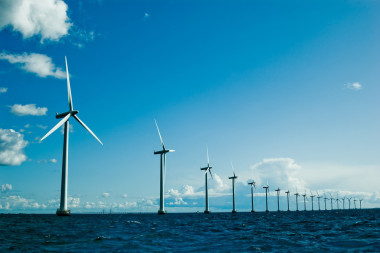 Telegraph 21st May 2017, The sound made by 100 tonnes of steel and carbon fibre rotating 400 feet overhead is surprisingly understated. Each whoosh of the 260 foot blades spans an area the size of the London Eye and generates enough electricity to power the average British home for 24 hours.
There are 32 of these 8MW turbines in the second phase of Dong Energy’s Burbo Bank wind farm spinning off the Merseyside coast. They are the most powerful ever, dotting an area the size of almost 6,000 football pitches within the Irish Sea, each one a beacon of Britain’s global dominance in the booming offshore wind industry.
http://www.telegraph.co.uk/business/2017/05/21/britains-wind-turbines-catch-breeze-rising-industry/
Jersey Evening Post 22nd May 2017, A FLOATING offshore wind farm that would cost £108 million to install is currently the frontrunner in work to develop renewable energy in Guernsey. A preliminary feasibility study was released this week and now more equipment will be installed at Mont Cuet, in the north of Guernsey, to help move the project forward.
The study by Xodus Group concluded that a 30MW offshore wind project could be viable. It shortlisted three preferred sites for five turbines. One option is 5km off Guernsey’s north coast and another is 15km away, west of Schole Bank, between Guernsey and Alderney. The third – the only floating option – is 25km north-west of the island. The offshore floating option is the most costly, but is seen as preferable because of the visual impact of the other two which have estimated capital costs of £68.23m and £80.98m respectively. http://jerseyeveningpost.com/news/2017/05/22/guernsey-considers-floating-offshore-wind-farm/
British solar power surge. Batteries becoming cheaper
FT 23rd May 2017 On May 10, the UK reached a fresh high for the amount of electricity generated by solar. Early on that Wednesday afternoon, solar output hit 8.5 gigawatts, according to Electric Insights, a website that tracks
Britain’s power.
At its peak, the green energy source was supplying more than 22 per cent of the 38GW being handled by the national grid, as solar for some hours exceeded the steady output from the UK’s fleet of nuclear power stations. The growing contribution of green energy to grids — particularly wind and solar — brings with it the problem of managing the
unpredictability and intermittency of these supplies.
Storage is still a very small part of the energy industry but it is developing quickly both at the domestic level — where homeowners can use batteries in tandem with solar panels on their roofs — and on a much larger scale, with the development of battery parks aimed at smoothing supplies to the grid. The popularity of storage systems to capture the electricity generated by domestic solar panels is helped by a generous subsidy in Germany that helps homeowners meet the initial costs of buying a battery, which is also true of other countries.
While costs of batteries are coming down, Mr Wilkinson acknowledges that in most cases “incentives are required” to expand the market for battery storage to help balance the grid. “Costs have come down dramatically but there is still a long way to go before they are going to be truly embedded everywhere in the grid and we’ll see huge volumes of them,” Mr Wilkinson says. Meanwhile, growth in the electric vehicle market has helped lower costs and improve the design of lithium-ion batteries. A battery pack that can be used in an electric vehicle has fallen from $1,000 per kilowatt hour in 2010 to $273 per kWh last year, according to BNEF, which is forecasting a further 73 per cent fall in costs by 2030.
https://www.ft.com/content/a6e01984-3567-11e7-99bd-13beb0903fa3
Switzerland’ binding referendum – voted to ban nuclear plants, shift to renewable energy
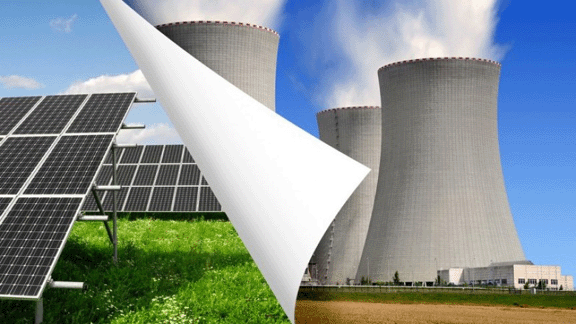
 Switzerland votes to ban nuclear plants, shift to renewable energy, in referendum ABC News 22 May 17 Swiss voters have backed the Government’s plan to provide billions of dollars in subsidies for renewable energy, ban new nuclear plants and help bail out struggling utilities in a binding referendum.
Key points:
- Provisional data shows nearly 60 per cent backed Government plan
- Solar and wind account for less than 5 per cent of Switzerland’s energy output
- Voters get final say on major policy issues in Switzerland
Provisional final figures showed support at 58.2 per cent under the Swiss system of direct democracy, which gives voters final say on major policy issues.
The Swiss initiative mirrors efforts elsewhere in Europe to reduce dependence on nuclear power, partly sparked by Japan’s Fukushima disaster in 2011.
Germany aims to phase out nuclear power by 2022, while Austria banned it decades ago.
“The results shows the population wants a new energy policy and does not want any new nuclear plants,” Energy Minister Doris Leuthard said, adding the law would boost domestic renewable energy, cut fossil fuel use and reduce reliance on foreign supplies……. http://www.abc.net.au/n
China’s State Nuclear Power Technology Corporation (SNPTC) wanting to take over Britain’s Moorside nuclear project?

 Times 21st May 2017 A Chinese state-owned power giant has set its sights on the £15bn nuclear plant planned for the Cumbrian coast. State Nuclear Power Technology Corporation (SNPTC) is considering investing in Toshiba’s troubled NuGen
project at Moorside — risking a collision with Theresa May and her new interventionist approach to foreign takeovers.
Industry sources said a delegation from SNPTC and its parent, State Power Investment Corporation, was due in London. Eight senior officials will meet executives from NuGen and Britain’s atomic power trade body, the Nuclear Industry Association, on Tuesday.
It is unclear whether the election hiatus will hinder meetings with Whitehall officials. The talks underline China’s ambitions in nuclear power after another state-owned giant, China General Nuclear, bankrolled the £18bn Hinkley Point plant in Somerset. CGN took a 33% stake in Hinkley but its ultimate ambition is to build a power station, fuelled
with its own home-grown reactors, at Bradwell in Essex.
Sources said SNPTC could seek to power NuGen with its own reactor — a derivative of Westinghouse’s AP1000 model, which is planned for the site. SNPTC could not be reached for comment. NuGen said it was exploring a “universe of
options” for investment. https://www.thetimes.co.uk/edition/business/chinese-eye-rescue-of-nuclear-plant-qlj09k5wn
Costly consequences for UK nuclear industry, following Brexit
 UK nuclear industry faces Brexit fall-out, Climate News Network, May 17, 2017, by Paul Brown, Leaving the EU treaty that prevents radioactive materials falling into the wrong hands could prove costly for the UK nuclear industry.
LONDON, – The UK’s vote to leave the European Union has put the country’s nuclear industry at risk because its trade in radioactive materials will be forbidden under international law.
In the worst case scenario, legal experts say, the lights could go out in the UK, but they think the more probable outcome is simply that the government will find itself with an expensive industrial problem and an embarrassing diplomatic mess.
The unintended consequence for the British nuclear industry of last year’s referendum vote to leave the EU is that the decision will also take the UK out of the Euratom treaty that protects the EU’s nuclear industry against radioactive material falling into the hands of rogue states or terrorist groups.
Nuclear power stations already provide about one-fifth of the UK’s electricity, and the government has ambitious plans to build at least 10 more reactors as part of its strategy to cut carbon emissions.
It has withdrawn subsidies from onshore wind and solar power, and underwritten new nuclear stations instead.
However, the industry relies on foreign companies − based both in the EU and outside − that provide parts, fuel and raw materials. When the UK leaves Euratom, this trade will be contrary to international law.
Tom Greatrex, chief executive of the Nuclear Industries Association, which represents 260 companies, says: “There is scope for real and considerable disruption.”
Nuclear materials
The Euratom safeguards are applied by the European Commission to provide confidence that nuclear materials in the EU are not diverted from their declared end use, which is producing electricity from uranium and plutonium, and dealing with the waste that results.
This enables countries inside the EU to trade with other member states in construction and providing parts and staff for nuclear power stations. It also allows trade in such dangerous materials as plutonium, uranium and spent fuel, provided it is both safe and for peaceful purposes.
There is no precedent for a member state leaving the EU. But, in theory, when the UK does so − and therefore leaves Euratom − possibly as soon as two years from now, this trade must cease, otherwise member states will be breaking the terms of the treaty.
This would effectively paralyse not only the UK industry, which relies on international trade to survive, but also many of its trading partners in the EU, and also Japan, China and the US, all of which the UK has nuclear deals with that would need a new safeguard regime in place in order to continue…….
Dame Sue Ion, chair of the Nuclear Innovation and Research Advisory Board, which was established by the UK government in 2013, said a whole lot of new international agreements would have to be in place before anything in the nuclear sector could be transferred between countries.
“We would be crippled without other agreements in place,” she said. – Climate News Network http://climatenewsnetwork.net/uk-nuclear-industry-fall-brexit/
UK election: party policies signal the end of new nuclear power
 It now looks increasingly as if the Hinkley C project may be quietly shelved, or even cancelled, with the agreement of both UK and French governments.
And beyond that the prospects for new nuclear power in the UK have never been gloomier. The only way new nuclear power stations will ever be built in the UK is with massive political and financial commitment from government. That commitment is clearly absent.
 So yes, this finally looks like the end of the UK’s ‘nuclear renaissance’. Not with a bang, nor even with a whimper, but with a deep and profoundly meaningful silence. Not a moment too soon.
Conservative election manifesto signals the end of new nuclear power, Ecologist, Oliver Tickell & Ian Fairlie, 18th May 2017 After years of pro-nuclear bombast from the Conservative Party, its 2017 manifesto hasn’t got a single word to say about nuclear power, write Oliver Tickell & Ian Fairlie. Instead it announces a renewed focus on cutting energy costs, and a big boost for increasingly low-cost wind power; while both Labour and Libdems offer only weak, highly qualified support for new nuclear build. And so the great British ‘nuclear renaissance’ reaches its timely end.
All of a sudden the UK’s political parties want to have nothing to do with nuclear power.
This much is clear from the party manifestos – notably that of the Conservative Party, published yesterday.
OK, it does not announce an end to Britain’s massive 10GW nuclear power programme set out in the Cameron-Osborne years of government.
In fact, it does not even mention nuclear power. Instead it states that a future Tory government will remain sublimely indifferent to how our electricity is generated, so long as it’s reliable, cheap and low carbon:……
now, it’s all about keeping costs down, says the 2017 manifesto: “We want to make sure that the cost of energy in Britain is internationally competitive, both for businesses and households … Our ambition is that the UK should have the lowest energy costs in Europe, both for households and businesses. So as we upgrade our energy infrastructure, we will do it in an affordable way, consistent with that ambition.”
And one sure way not to deliver cheap energy to the UK is to build new nuclear power stations. if Hinkley C is ever built, UK energy users will be paying more than double the current wholesale power price, inflation adjusted, for 35 years from the time it opens, something that could cost the UK economy £50-100 billion.
Labour and the Libdems: a pocketful of mumbles
By contrast, Labour does give nuclear power a specific mention it is manifesto – just a rather small one that adds up to no real commitment to anything.
“The UK has the world’s oldest nuclear industry, and nuclear will continue to be part of the UK energy supply. We will support further nuclear projects and protect nuclear workers’ jobs and pensions. There are considerable opportunities for nuclear power and decommissioning both internationally and domestically.”
Let’s decipher. Yes, nuclear power will continue to be part of energy supply as we still have quite a few old nuclear power stations that we are not about to shut down.
What about “We will support further nuclear projects”? What kind of nuclear projects? How about decommissioning, nuclear waste management, production of medical isotopes … ? Do these projects include nuclear power? They’re not telling. Most likely (after all we know that Labour leader Jeremy Corbyn is firmly anti-nuclear) these are warm but empty words to placate powerful nuclear-supporting trades unions like the GMB and Unite.
And what kind of ‘support’? Speeches in the House of Commons? Or tens of billions of pounds of hard cash. It’s hard to say. Does this add up to a firm commitment to build a fleet of new nuclear power stations at massive public cost? Hardly.
The Libdem position is similarly weak, promising only that “We will … Accept that new nuclear power stations can play a role in electricity supply provided concerns about safety, disposal of waste and cost are adequately addressed, new technology is incorporated, and there is no public subsidy for new build.”
We know perfectly well that nuclear power is hugely expensive, intrinsically unsafe due to its potential for massive harm (look only to Fukushima), can only operate with enormous public subsidies, and that no one has yet figured out a way to keep nuclear wastes safely contained for tens of thousands of years, an informed interpretation of this statement might go: “Nuclear power? Not on your nelly!”…….
Meanwhile the SNP says it wants no new nuclear power stations in Scotland; and Plaid Cymu leader Leanne Wood is opposed to new nuclear power, but her executive supports Wylfa because of the jobs. Got that?
Why the turnaround?
It has surely become clear to politicians that nuclear power is in a death spiral, terminally afflicted by:
- very high costs, at least double those of conventional generation, which can only be carried by governments, taxpayers and energy users at the expense of more deserving and productive investments;
- apparently unconstructable reactor designs hit by massive cost overruns and delays in France, Finland and the USA;
- the bankruptcy of the world’s biggest nuclear power contractor, the Toshiba-owned Westinghouse – lined up to build a massive new nuclear complex at Moorside in Cumbria with three AP1000 reactors – mainly as a result of these cost overruns and delays on AP1000 projects in the USA;
- the parlous condition of the French parastatals EDF and Areva, which survive only thanks to the inexhaustible largesse of French taxpayers;
- investor reluctance to have anything to do with new nuclear power stations unless returns are guaranteed in cast iron contracts at huge expense to taxpayers;
- the continuing lack of a long term solution for nuclear waste storage / disposal;
- the inflexibility of nuclear power stations, which means that they overproduce when electricity is in surplus, while being unable to keep up with demand when power is desperately needed;
- the continuing precipitous decline in the cost of disruptive ‘new energy’ technologies such as solar, wind, including offshore wind, grid-scale batteries, power to gas, smart grid, set to continue and gather pace for many years to come.
So what’s the alternative? Given that onshore wind is already the cheapest new source of power generation, and offshore wind costs are falling rapidly (and are already far cheaper than new nuclear), wind power really should have a big role. So check out this statement from the Conservative manifesto:
“While we do not believe that more large-scale onshore wind power is right for England, we will maintain our position as a global leader in offshore wind and support the development of wind projects in the remote islands of Scotland, where they will directly benefit local communities.”
This commits a future Tory government to maintaining a strong pipeline of large offshore wind projects, while opening the door to medium and small scale onshore wind power in England, as well as to large scale wind on Scottish islands and elsewhere in the devolved nations. What it ultimately means is that wind power has a great future in the UK – in stark contrast to previous policy…….
Not with a bang, nor even a whimper
It now looks increasingly as if the Hinkley C project may be quietly shelved, or even cancelled, with the agreement of both UK and French governments.
And beyond that the prospects for new nuclear power in the UK have never been gloomier. The only way new nuclear power stations will ever be built in the UK is with massive political and financial commitment from government. That commitment is clearly absent.
So yes, this finally looks like the end of the UK’s ‘nuclear renaissance’. Not with a bang, nor even with a whimper, but with a deep and profoundly meaningful silence. Not a moment too soon.http://www.theecologist.org/News/news_analysis/2988965/conservative_election_manifesto_signals_the_end_of_new_nuclear_power.html
France names ex Green candidate as energy minister
 http://reneweconomy.com.au/france-names-ex-greens-candidate-and-solar-advocate-as-energy-minister-16021/By Emiliano Bellini on 19 May 2017 PV Magazine Newly appointed energy minister Nicolas Hulot is a well-known journalist and environmentalist which has had a leading role in the French Green Party (Europe Écologie-Les Verts) in the past, and has always supported solar through his foundation.
Nicolas Hulot has been named new France’s new energy and environment minister in the cabinet led by the new prime minister Edouard Philippe. Hulot’s ministry, which under the previous government was named Ministry of Energy, Ecology and Sustainable Development (MEEM), has been renamed into Ministry of the Ecological and Solidarity-based Transition.
Hulot, who was a candidate in the primary of the Green Party (Europe Écologie-Les Verts) to the 2012 French presidential election, is a well-known journalist and environmentalist who became popular thanks to his documentary tv show “Ushuaïa Nature”, whose slogan is “wonder is the first step towards respect.”
He is also the president of the Fondation Nicolas-Hulot, an environmental organization created by him in 1990.
The new minister has always been a supporter of solar energy in the French political debate.
In 2011, after the French government introduced a moratorium on solar projects which paralyzed the sector for several years, Hulot’s foundation released a study containing a series of proposals on how to further develop PV, and on how to involve all of the country’s interested parties, including government, media, enterprises and associations, in the transition to a clean energy economy.
In a more recent study published in 2015, Hulot’s foundation said that solar must be deployed “at human scale” everywhere in the world, and that it must be adopted especially in countries with low access to electricity. As for PV in France, the foundation said that the country has the potential to install a further 20 GW and 25 GW in addition to the 5.8 GW installed at the time.
This, the reports stressed, can occur without putting pressure on the national grid. If achieved, the target proposed by Hulot’s foundation would enable the country to raise the share of solar in the country power mix from 1% to 8%.
As for the outgoing energy minister, Ségolène Royal, it must be acknowledged that she performed an extraordinary job for the solar sector.
Immediately after her appointment, she started several initiatives aimed at restoring investor confidence, a clear and stable regulatory framework, and a reasonable level of incentives. Under her mandate, solar saw its target by 2023 being tripled to 20.2 GW. Royal’s energy strategy also decided that nuclears share of the French energy mix should fall to 50% by 2025.
Note: Reuters reports that news of the appointment sent the share price of nuclear utility EDF down as much as seven per cent, as the appointment raised doubts in investors’ minds about the strength of Macron’s commitment to a pro-nuclear energy policy.
“There is a fear of a stricter ecological line given Hulot’s history as an environmental campaigner,” said Andrea Tueni, markets analyst with Saxo Bank. Hulot, who scores high in popularity polls, said he hoped the job would allow him to bring about change.
In an interview with Liberation newspaper last month, Hulot said one of France’s main challenges will be to reposition EDF on a path that is compatible with a transition from dependence on nuclear power towards the use of more renewables.
“As renewable energy becomes more and more competitive, the nuclear industry business model belongs to the past,” he said.
Sweden cancels arrest warrant for Julian Assange, closes investigation
 Sweden shuts down Julian Assange rape investigation, TT/The Local news@thelocal.se 19 May 2017, Swedish prosecutors have decided to end the rape investigation into Julian Assange and lift the Europe-wide arrest warrant against him, but UK police say they will still arrest him.In a statement on its website, the Swedish prosecution authority said that the “Director of Public Prosecution, Ms Marianne Ny, has today decided to discontinue the investigation regarding suspected rape (lesser degree) by Julian Assange”.
In a press conference later in the day, Ny elaborated that it was not possible to formally serve Assange with notice of the suspicions against him, a prerequisite under Swedish law if the investigation was to progress further:
“Ecuador granted legal assistance and made it clear that all measures would be performed with full voluntary participation of Mr. Assange (…) Formal issues are important in a legal system in terms of legal certainty, it is important to be able to serve the suspect with suspicions. The decision to discontinue the investigation is not because we’ve been able to make a full assessment of the evidence, but because we didn’t see possibilities to advance the investigation. So we won’t make any statements on the issue of guilt”………
Assange’s lawyer Per Samuelsson said his client was now considering suing Sweden.
“It’s not about money but redress,” Samuelsson told news agency TT.
He added that he believed Assange would eventually try to move to Ecuador.
The WikiLeaks founder’s lawyer filed a request at Stockholm District Court earlier in May asking for an end to the arrest warrant against his client, arguing it should be dropped now that the US has expressed a desire to charge the 45-year-old.
Assange had been remanded in custody by Sweden ‘in absentia’ over a 2010 rape allegation, and has been taking refuge inside Ecuador’s embassy in London since 2012 in order to escape the warrant, citing fears he may be extradited to the US to be tried over WikiLeaks’ publication of thousands of classified documents.
One of Assange’s lawyers, Melinda Taylor, indicated earlier on Friday that the preliminary investigation into him being closed or the lifting of the European arrest warrant would not necessarily mean the Australian would make a hasty exit for Ecuador.
“The first thing one likely needs to do is seek guarantees from the British authorities that he won’t be seized in some other way,” she told news agency TT.
Both British and American authorities have “consistently refused to confirm or deny” if there is a request for extradition to the US, she said. Assange is also accused of breaching his bail conditions in the UK for fleeing to Ecuador’s embassy, she noted.
And in a statement released on Friday afternoon, the Metropolitan Police confirmed it is obliged to arrest Assange should he leave the embassy…….
When the Swedish announcement was made on Friday, WikiLeaks commented through its Twitter account that the “focus now moves to the UK”……
After refusing to travel to Sweden for questioning, Assange was grilled last December by an Ecuadorian prosecutor on questions provided by Swedish officials, with Swedish prosecutor Ingrid Isgren present.
He has always maintained that he is innocent of the rape accusation from 2010….https://www.thelocal.se/20170519/breaking-sweden-lifts-arrest-warrant-against-julian-assange-and-ends-investigation
Delay for Finland’s Fennovoima nuclear project
Fennovoima nuclear project faces delays over safety clearance, building permit yle uutiset , 19 May 17, The Finnish Radiation and Nuclear Safety Authority STUK will not deliver a safety assessment and related building permit for the Fennovoima nuclear project slated for Pyhäjoki in northwest Finland this year. According to the daily Kaleva, the nuclear watchdog has said that the evaluation and permit will be delayed by one year to the end of 2018.
Finland’s nuclear safety watchdog STUK will not provide a safety assessment and building permit this year for the Fennovoima nuclear power plant to be built by Russian state-owned nuclear contractor Rosatom in northwest Finland, reports the daily Kaleva. Rosatom also owns 34 percent of the venture.
Finland’s Ministry of Economic Affairs originally hoped that STUK would be able to provide the clearances this year. However the authority now says that it won’t be able to deliver them before the end of 2018. It noted that completing the safety assessment depends on factors such as Fennovoima’s ability to update information about the project’s delivery timetable. STUK’s ability to furnish the approvals will also depend on the adequacy and comprehensiveness of the information provided……..
Investor haemorrhage
Meanwhile on Wednesday, the Helsinki city council launched moves to disconnect Vantaa Energy – in which it owns 40 percent of shares — from the Fennovoima nuclear power plant. However, Vantaa Energy chief executive Pertti Laukkanen said that the city of Vantaa, which owns the remaining 60 percent of the power company, is not likely to support selling off its holdings in the project.
A number of other Finnish investors have also bailed on the project over the years. The German-based power behemoth E.ON as well as duopolist retailer S Group both shed their stake in the project in 2012. Later in 2013, 15 members of the power consortium Voimaosakeyhtiö SF pulled out of the venture, while a subsidiary of the other duopolist retailer K Group left in 2014. Meanwhile local dairy giant Valio exited in 2015 during a rocky period caused by losses over western sanctions applied against Russia, one of its main markets.
Financing controversy
The Fennovoima nuclear power plant has faced a rocky road since it received a decision-in-principle for construction during the administration of ex-PM Matti Vanhanen back in 2010. The contentious project also saw the departure of the Green Party from Alexander Stubb’s coalition government in 2014, when it decided to proceed with the proposed plant.
The project also stirred up controversy over financing arrangements when a murky Croatian firm – later found to be a front for Russian investors — emerged as a backer to help Fennovoima make up the 60-percent domestic- EU ownership required by the Finnish government. There was also speculation that state energy giant Fortum had been pressured to come forward as an investor following initial resistance to the project.
The project has faced opposition from environmentalists in Finland and Sweden and has also come under intense scrutiny over concerns about Finland’s energy dependence on Russia. http://yle.fi/uutiset/osasto/news/daily_fennovoima_nuclear_project_faces_delays_over_safety_clearance_building_permit/9622096
European Commission scheduled to decide on EDF to gain controlling stake in AREVA nuclear corporation
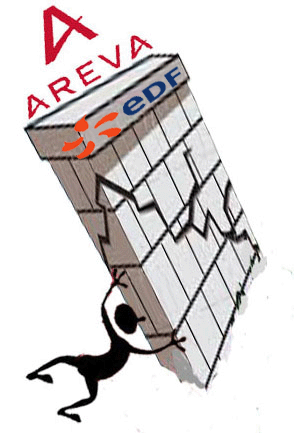 EDF set to win EU approval for Areva nuclear reactor deal – source , Reuters, | BRUSSELS, 19 May 17, French utility EDF (EDF.PA) is set to gain unconditional approval from the EU competition authorities for its plan to acquire a controlling stake in ailing nuclear power engineering group Areva’s (AREVA.PA) reactor business, a person familiar with the matter said on Friday.
State-controlled EDF wants to acquire 51 to 75 percent of Areva NP, which designs, manufactures and services nuclear reactors and is worth about 2.5 billion euros ($2.8 billion).
The deal is crucial for France, which has Europe’s largest network of nuclear plants, and uses EDF and Areva to spearhead its export efforts against competition from Russia’s Rosatom and Japan’s Hitachi Ltd (6501.T).
The European Commission, which is scheduled to decide on the deal by May 29, declined to comment. EDF and Areva had no immediate comment….http://www.reuters.com/article/us-areva-m-a-edf-eu-idUSKCN18F23I
1 This Month



Shut down the radiation-damaged Heysham nuclear reactors now
To see nuclear-related stories in greater depth and intensity – go to https://nuclearinformation.wordpress.com

Say No to NASA’s Reckless Nuclear Reactor on the Moon
Say No to NASA’s Reckless Nuclear Reactor on the Moon
-
Archives
- October 2026 (268)
- September 2026 (339)
- August 2026 (330)
- July 2026 (355)
- June 2026 (287)
- May 2026 (306)
- April 2026 (356)
- March 2026 (251)
- February 2026 (267)
- January 2026 (308)
- December 2025 (358)
- November 2025 (359)
-
Categories
- 1
- 1 NUCLEAR ISSUES
- business and costs
- climate change
- culture and arts
- ENERGY
- environment
- health
- history
- indigenous issues
- Legal
- marketing of nuclear
- media
- opposition to nuclear
- PERSONAL STORIES
- politics
- politics international
- Religion and ethics
- safety
- secrets,lies and civil liberties
- spinbuster
- technology
- Uranium
- wastes
- weapons and war
- Women
- 2 WORLD
- ACTION
- AFRICA
- Atrocities
- AUSTRALIA
- Christina's notes
- Christina's themes
- culture and arts
- Events
- Fuk 2022
- Fuk 2023
- Fukushima 2017
- Fukushima 2018
- fukushima 2019
- Fukushima 2020
- Fukushima 2021
- general
- global warming
- Humour (God we need it)
- Nuclear
- RARE EARTHS
- Reference
- resources – print
- Resources -audiovicual
- Weekly Newsletter
- World
- World Nuclear
- YouTube
-
RSS
Entries RSS
Comments RSS

