 Politico 18th July 2017, Negotiations over Britain’s exit from the EU got underway in earnest this
week, but that doesn’t mean that the U.K. is withdrawing from other EU
business. Far from it. It has emerged that British ministers and officials
lobbied hard against a European Commission plan on energy efficiency, even
though the rules might never apply to the U.K.
Assuming it leaves the EU as planned in March 2019. Britain opposed a compromise deal on future EU
energy efficiency rules during a long and difficult meeting of EU energy
ministers last month, pushing the Commission to water down its proposals.
Richard Harrington, a junior minister at the U.K.’s Department for
Business, Energy and Industrial Strategy, told the Energy Council meeting
in June that the U.K. was “disappointed” with Brussels’ proposal to
boost the target to 30 percent.
He said the British government “cannot support” the proposed compromise on energy efficiency because “we do
not believe it strikes the right balance to provide sufficient flexibility to reach our ambitions.”
The energy efficiency rules are part of a wider package of proposals meant to accelerate the EU’s transition to clean
energy, and while the European Commission is pushing for an inter-institutional deal on all eight parts of the package by the end of 2018, officials doubt that is realistic.
The move to block strong energy efficiency rules is creating “a lot of bad feelings” among other EU
countries, especially since Britain “will need all the friends it can
get” after Brexit, said Jonathan Gaventa, director at think tank E3G. http://www.politico.eu/article/brexit-uk-fights-energy-plans-that-wont-kick-in-until-after-brexit/amp/
July 22, 2017
Posted by Christina Macpherson |
ENERGY, politics international, UK |
Leave a comment
 France’s EDF cuts output at two nuclear reactors due to heatwave PARIS, July 18 (Reuters) – French utility EDF cut output at two reactors at its Tricastin nuclear plant in southern France on Tuesday, due to scorching temperatures, to reduce the amount of heated water from the reactors’ cooling system flowing into the Rhone river.
The Tricastin plant has four pressurised water reactors with an installed capacity of 915 megawatts (MW) each. EDF said on its website that output at reactors 1 and 3 was reduced by 735 MW and 651 MW respectively.
It said this was done for “environmental issues,” without giving further details.
A company spokeswoman said that, due to a heatwave in France on Tuesday, the company decided to reduce the amount of heated non-radioactive water from the cooling systems that flows into a canal near the plant and into the Rhone river.
“This was done so as not to increase the temperature of the already heated water and thus preserve plant and animal life,” she said, adding that a heavy thunderstorm forecast for the area later on Tuesday was expected to cool the situation…….http://www.reuters.com/article/edf-france-nuclearpower-idUSL5N1K94RO
July 21, 2017
Posted by Christina Macpherson |
climate change, France |
Leave a comment
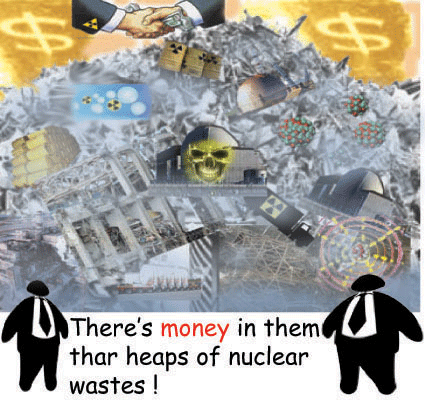
NDA 19th July 2017, The Nuclear Provision is the best estimate of how much it will cost to clean up 17 of the UK’s earliest nuclear sites over a programme lasting around 120 years. The 2017 forecast is that future clean-up across the UK will cost around £119 billion spread across the next 120 years or so. This is broadly unchanged (increased by £2bn) from the previous year’s estimate.
https://www.gov.uk/government/publications/nuclear-provision-explaining-the-cost-of-cleaning-up-britains-nuclear-legacy/nuclear-provision-explaining-the-cost-of-cleaning-up-britains-nuclear-legacy
July 21, 2017
Posted by Christina Macpherson |
UK, wastes |
Leave a comment

Burying the atom: Europe struggles to dispose of nuclear waste Political opposition, not technical hurdles, poses biggest challenge to finding permanent storage sites for deadly radioactive material.
Politico, By KALINA OROSCHAKOFF AND MARION SOLLETTY, 7/19/17, URE, France — Half a kilometer underground in floodlit tunnels, a French government lab is testing the safety of a site intended to hold 80,000 cubic meters of deadly radioactive waste.
Crews drill barrel-sized openings into the sides of the shafts, dug deep into the earth not far from the small town of Bure, in northeastern France. The containers will have to be retrievable for a century, in case better technologies for dealing with radioactive materials are developed. Barring such a discovery, the idea is for the waste to spend the next 100,000 years underground.
The technical hurdles will be the easy bit. Far more difficult for France’s radioactive waste management agency, Andra, will be overcoming political opposition to the construction of the site — of any site — intended to serve as the final resting place for tons of radioactive waste.
Six decades after the construction of the first wave of nuclear power plants, no country has opened a permanent storage site. Spent nuclear fuel and other contaminated material — deadly byproducts of electricity generation — remain stockpiled in temporary locations around Europe and the world, sometimes alongside the reactors where they were used.
The problem is only getting more urgent as power plants across the world near the end of their lives and Western Europe cuts back on nuclear electricity generation.
In the EU alone, more than 50 of the 129 reactors currently in operation could shut down by 2025, Energy and Climate Action Commissioner Miguel Arias Cañete said recently. “These reactors will need to be decommissioned, and the radioactive waste generated in this process will need to be safely managed.”
The stakes are less technical than political. The dispute goes to the heart of a running debate over the sustainability of nuclear power. Failing to resolve it would leave the industry vulnerable to its critics, who argue that the technology is so inherently risky — and dirty — that it cannot be relied on to generate electricity, even to combat climate change.
The European Commission is keen to hurry countries along. On July 13, it escalated an infringement procedure against Austria, Croatia, the Czech Republic, Italy and Portugal, pushing them to fully comply with the bloc’s radioactive waste rules and inform Brussels of their national nuclear waste management programs, which were originally due by August 23, 2015. Only Finland, set to open the world’s first final repository early in the next decade, has a plan it can implement.
Experts agree that today’s stop-gap solutions are unsustainable — and more dangerous than building long-term depositories deep underground where radioactive material can spend tens of thousands of years decaying, protected from natural disasters and out of reach of criminals and terrorists………
The issue is a headache for Nicolas Hulot, France’s new environment minister and a former green campaigner, who is part of the government that will have to give the final approval for the site. France is scaling back nuclear from 75 percent of power production to 50 percent by 2025, but it will still need to find a permanent storage site for the waste its plants produce.
Hulot expressed concerns about the site in Bure in 2016. “We can’t impose [such a project] on a local population just because they live in a remote area, without consulting them, without transparency,” he said on French TV.
On June 2, anti-nuclear campaigners wrote an open letter to Hulot asking him to stop the project. Since taking office, he has mostly kept quiet about the subject, but in a recent interview with Ouest-France, a regional newspaper, he vowed to ensure the waste will be stored with “absolute safety.”
The project still faces serious safety challenges, including fire risks, the French nuclear safety authority concluded in a recent assessment. On July 17, Andra pushed back a self-imposed deadline to submit a formal authorization request for the project by a year, to mid-2019.
Outreach
The government has responded to the protest with careful — and very public — safety tests, and an emphasis on its economic benefits for the region. “The project relies on 20 years of research,” said David Mazoyer, the site’s director. “Every scenario is studied with maximum security margins.” Some tests even involve releasing radioactive particles to track their movement in the surrounding clay.
The government has also splashed cash around — €30 million a year as “accompanying measures” for each of the two districts neighboring the site. “People don’t support the project for free,” said Gérard Longuet, a senator from the region and a key project supporter. “They support it because it boosts the area.”
So far, the effect of the outreach is, at best, mixed.
A 2016 poll commissioned by Andra found that 59 percent of local residents said they trust the agency to manage the site. But 63 percent expressed concerns over safety issues, and 76 percent said they think the project is dangerous for the environment.
“When you are listening to Andra, everything is all fine and rosy,” said Jean-Francois Bodenreider, an anti-nuclear campaigner and local resident. But, “they have no control over this,” said his wife Marie-Eve Bodenreider. An anti-nuclear sign hangs outside their physiotherapy practice in Gondrecourt-le-Château.
The site currently employs 370 people, with construction work foreseen to employ more than 2,000. But opponents say the jobs have yet to materialize. “The only jobs here are for security guards,” said Labat, the local resident and demonstrator. “They are everywhere!”
Birth of a movement
If German history is any guide, the French government will not have an easy time at the Bois Lejuc………..
‘Back on the streets’
German Chancellor Angela Merkel’s decision, after Japan’s 2011 Fukushima disaster, to shutter the country’s last reactor by 2022 has taken some of the wind out of the opposition’s sails.
The challenge facing the anti-nuclear movement now will be “whether you can switch gears from blockade mode to having a constructive argument about how to best deal with the final storage issue,” Harms said…….. http://www.politico.eu/article/europes-radioactive-problem-struggles-dispose-nuclear-waste-french-nuclear-facility/
July 21, 2017
Posted by Christina Macpherson |
EUROPE, wastes |
Leave a comment
 Brexit department warns EU counterparts it will ‘return waste to
 its country of origin’ if an agreement on nuclear cooperation cannot be reached, Guardian, Daniel Boffey 20 July 17, Britain has warned the EU that it could return boatloads of radioactive waste back to the continent if the Brexit talks fail to deliver an agreement on nuclear regulation.
In what is being taken in Brussels as a thinly veiled threat, a paper setting out the UK position for the negotiations stresses the right “to return radioactive waste … to its country of origin” should negotiations collapse.
The UK paper, detailing the British government’s hopes for future cooperation once it leaves the Euratom treaty, at the same time as leaving the EU, further stresses the “strong mutual interest in ensuring close cooperation in the future”.
Britain currently has a 126-tonne stockpile of radioactive materials originating from EU countries such as Germany, Italy and Sweden.
The state-owned Sellafield plant in Cumbria has been reprocessing spent nuclear field from across Europe since the 1970s, producing reusable uranium, plutonium and radioactive waste. Almost a fifth of the UK’s stockpile of civilian plutonium at Sellafield originates from overseas…….
Britain has signalled that while it is leaving the Euraotom treaty, of which it has been a member since 1957, it wants to continue to cooperate on nuclear regulation after the UK leaves the union in March 2019. The treaty regulates the civilian use of atomic technology and critics of the government’s position fear there is a threat of disruption to UK supplies of nuclear reactor parts, fuel and medical isotopes vital for the treatment of cancer if a new agreement outside membership of the EU is not reached……
The EU insist, however, that such cooperation on nuclear regulation would require the UK to recognise the jurisdiction of the European court of justice, which is a red line for Theresa May…….https://www.theguardian.com/environment/2017/jul/19/uk-threatens-to-return-radioactive-waste-to-eu-without-nuclear-deal
July 21, 2017
Posted by Christina Macpherson |
politics international, UK |
1 Comment
German nuclear damage shows atomic and renewable power are unhappy bedfellows, Euractiv, By Dagmar Dehmer | Der Tagesspiegel | translated by Sam Morgan 20 July 17 A Germany nuclear plant was damaged because its operators increased and decreased its output to respond to energy grid fluctuations. The incident supports the theory that nuclear and renewable energy generation are incompatible. EURACTIV’s partner Der Tagesspiegel reports.
The Brokdorf nuclear power station, located in northern Germany, was taken offline in February after maintenance showed its reactor’s fuel rods had begun to unexpectedly oxidise.
A regional nuclear supervisory body has now ruled that the plant can be booted back up but only in “safe mode”, according to Schleswig-Holstein’s energy transition minister.
State Minister for Energy Robert Habeck (Greens) added that the power plant’s output should not be increased or decreased at short notice to adapt to the supply of renewable energies on the electricity grid. The minister warned that “atomic energy is not a bridging technology”.
A 2011 study by Greenpeace also concluded that renewables and nuclear are not compatible and that fuel rod damage is a possible consequence.
Kiel’s nuclear supervisory authority explained that the corrosion of Brokdorf’s fuel rods was a result of the reactor’s capacity being increased from 1,440 MW to 1,480 MW in 2006.
The investigation also concluded that the decision to run the plant as a load-following power station, where output was tailored to grid fluctuations, contributed to the damage.
“According to our findings, this stress has contributed to the unexpected oxidisation of the upper parts of some of the fuel rods,” Habeck explained.
The practice of quickly increasing or decreasing electricity generation to compensate for excessive or reduced renewable output has been particularly prevalent since 2015…….
The German Greens’ nuclear policy spokesperson, Sylvia Kotting-Uhl, warned that Berlin’s environment ministry should share the findings from Brokdorf with the Swiss nuclear authority.
Switzerland’s Leibstadt facility is located on the German border and reportedly has the same problems as its northern German cousin. Kotting-Uhl accused Bern of “closing its eyes and leaving Leibstadt on, even though the problems are not solved”.
The German lawmaker insisted that the Swiss power plant is temporarily switched off “until complete clarity prevails”…..https://www.euractiv.com/section/electricity/news/german-nuclear-damage-shows-atomic-and-renewable-power-are-unhappy-bedfellows/
July 21, 2017
Posted by Christina Macpherson |
Germany, renewable |
Leave a comment
, Reuters 19 Jul 17
*Olkiluoto nuclear project almost decade late* Finnish TVO, French Areva claim billions from each other
* Final decision seen coming in early 2018 (Adds comments, detail)
By Jussi Rosendahl and Benjamin Mallet HELSINKI/PARIS, July 20 – Finnish utility Teollisuuden Voima (TVO) said on Thursday it had received another favourable partial decision from the International Chamber of Commerce (ICC) in its long-running dispute with nuclear reactor supplier Areva.
The companies are claiming billions of euros from each other due to years of delays and cost overruns on the Olkiluoto 3 EPR reactor project in southwest Finland.
The new partial ruling addressed preparation, review, submittal, and approval of design and licensing documents on the project…..
The cost of Olkiluoto 3 was initially estimated at 3.2 billion euros ($3.7 billion), but Areva in 2012 estimated the overall cost at closer to 8.5 billion euros……http://www.reuters.com/article/tvo-areva-arbitration-idUSL5N1KB1V4
July 21, 2017
Posted by Christina Macpherson |
Finland, Legal |
Leave a comment
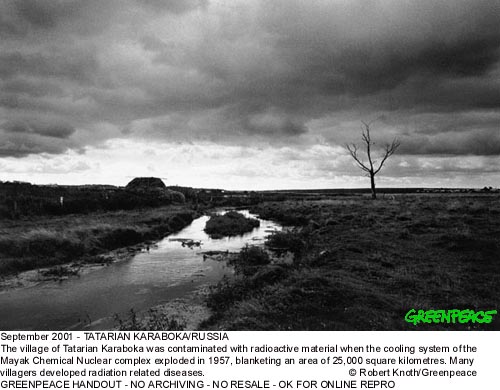
 Russia’s nuclear nightmare flows down radioactive river, http://www.concordmonitor.com/Russia-s-nuclear-nightmare-flows-down-radioactive-
 river-1834751 Monitor, By KATHERINE JACOBSEN Associated Press. Friday, April 29, 2016 At first glance, Gilani Dambaev looks like a healthy 60-year-old man and the river flowing past his rural family home appears pristine. But Dambaev is riddled with diseases that his doctors link to a lifetime’s exposure to excessive radiation, and the Geiger counter beeps loudly as a reporter strolls down to the muddy riverbank.
Some 30 miles upstream from Dambaev’s crumbling village lies Mayak, a nuclear complex that has been responsible for at least two of the country’s biggest radioactive accidents. Worse, environmentalists say, is the facility’s decades-old record of using the Arctic-bound waters of the Techa River to dump waste from reprocessing spent nuclear fuel, hundreds of tons of which is imported annually from neighboring nations
At first glance, Gilani Dambaev looks like a healthy 60-year-old man and the river flowing past his rural family home appears pristine. But Dambaev is riddled with diseases that his doctors link to a lifetime’s exposure to excessive radiation, and the Geiger counter beeps loudly as a reporter strolls down to the muddy riverbank.
Some 30 miles upstream from Dambaev’s crumbling village lies Mayak, a nuclear complex that has been responsible for at least two of the country’s biggest radioactive accidents. Worse, environmentalists say, is the facility’s decades-old record of using the Arctic-bound waters of the Techa River to dump waste from reprocessing spent nuclear fuel, hundreds of tons of which is imported annually from neighboring nations.
The results can be felt in every aching household along the Techa, where doctors record rates of chromosomal abnormalities, birth defects and cancers vastly higher than the Russian average – and citizens such as Dambaev are left to rue the government’s failure over four decades to admit the danger.
“Sometimes they would put up signs warning us not to swim in the river, but they never said why,” said Dambaev, a retired construction worker who like his wife, brother, children and grandchildren have government-issued cards identifying them as residents of radiation-tainted territory. “After work, we would go swimming in the river. The kids would too.”
Thousands already have been resettled by Russia’s Rosatom State Atomic Energy Corp. to new homes a mile inland from the river, leaving Dambaev’s village of Muslyumovo in a state of steady decay as shops close and abandoned homes are bulldozed. The evacuations began in 2008, two decades after Russia started to admit disasters past and present stretching from Mayak’s earliest days in the late 1940s as the maker of plutonium for the first Soviet atomic bombs.
The question, 30 years after the former Soviet Union’s greatest nuclear disaster in Chernobyl, is whether Mayak is truly cleaning up its act or remains primed to inflict more invisible damage on Russians. Nuclear regulators say waste no longer reaches the river following the last confirmed dumping scandal in 2004, but anti-nuclear activists say it’s impossible to tell given the level of state secrecy.
Vladimir Slivyak, an activist for the Russian environmentalist group EcoDefense, has visited villages downstream from Mayak many times to help document the poor health of locals in the area, 870 miles east of Moscow near Russia’s border with Kazakhstan.
“My opinion is they’re still dumping radioactive waste,” he said, “but proving that is impossible unless Mayak says: ‘Yes, we’re dumping radioactive waste.’“
The Nuclear Safety Institute at the Russian Academy of Sciences, which oversees safety standards for the country’s nuclear industry, told the AP that Mayak’s nuclear waste processing system presents no danger to the surrounding population. The plant also manufactures a range of radioactive isotopes of use for specialist equipment, medical research and cancer treatments that generate lucrative contracts worldwide.
Rosatom spokesman Vladislav Bochkov, in response to several Associated Press requests seeking an interview to discuss Mayak’s safety standards and operations, sent an email Thursday denying Mayak dumps nuclear waste in the river. Bochkov said the complex “follows all the environmental protection guidelines and has all the approvals it needs for operation.”
“The level of pollution in the Techa River today completely complies with the sanitary standards of the Russian Federation,” he wrote. He said the river water is clean: “You can drink it endlessly.”
But when the AP took a Geiger counter to the riverbank outside Dambaev’s home, the meter reading surged at the water line and the machine began beeping loudly and continuously. Measurements ranged from 8.5 to 9.8 microsieverts — 80 to 100 times the level of naturally occurring background radiation. A typical chest X-ray involves a burst of about 100 microsieverts.
Nuclear Safety Institute member Leonid Bolshov bills these levels as safe, saying: “The level of pollution in the water today is incomparably less to what it used to be.”
What it used to be is pretty bad. Environmentalists estimate that Mayak tossed 76 million cubic meters (2.68 billion cubic feet) of untreated waste — enough to fill more than 30,000 Olympic-sized swimming pools — into the river from 1948 to the mid-1950s as nuclear scientists scrambled to catch up to the U.S. nuclear program.
In September 1957, underground storage tanks of overheating nuclear waste exploded, sending a cloud of nuclear fallout 300 kilometers (200 miles) northeast across 217 towns and villages containing 272,000 people, a minority of which were quietly evacuated over the following two years.
A decade later, a nearby lake used to dispose of nuclear waste dried up amid a summer drought, and high winds whipped the exposed powdery residue to many of the same population centers. Greenpeace estimates the fallout reached 68 towns and villages containing 42,000 people.
Russia suppressed all news of both disasters until the late 1980s, when it acknowledged the two accidents and the Mayak site’s very existence.
In 1993, Russia said the two accidents combined with longer-term dumping of waste into the river meant that an estimated 450,000 people had been exposed to excess radiation from Mayak. It offered no breakdown of immediate deaths, accelerated deaths or increased rates of illness and disease in the populace.
A 2005 criminal case against Mayak’s then-director, Vitaly Sadovnikov, revealed that the plant continued to dump at least 30 million cubic meters (1 billion cubic feet) of untreated nuclear waste into the river from 2001 to 2004. Prosecution documents said the dumping quadrupled the volume of the radioactive isotope strontium-90 in the river.
A study by Greenpeace in 2007, citing hospital records and door-to-door surveys of Muslyumovo residents, reported cancer rates 3.6 times higher than the Russian national average. Russian scientists have reported residents suffer 25 times more genetic defects than the general population.
A decades-long Radiation Research Society study of people living near the Techa River conducted jointly by Russian and American scientists has linked radiation particularly to higher rates of cancer of the uterus and esophagus. In their latest 2015 report, the scientists analyzed 17,435 residents born before 1956, among them 1,933 with cancer. They found that the vast majority of residents had accumulated heightened deposits of strontium-90 in their bones and such “radiation exposure has increased the risks for most solid cancers.”
Such figures come as no surprise to one of Muslyumovo’s longest-serving doctors, Gulfarida Galimova, a gynecologist and family general practitioner who started work in the village’s hospital in 1981. Galimova says she was immediately struck by the exceptional volume of pediatric emergencies involving miscarriages, early and still births, and newborns with malformed limbs and other defects.
Still, like others she did not know Mayak —unmarked on any map at the time and still off-limits to the public today — even existed. She recalls 1980s mornings of blissful ignorance washing her hair in the deceptively soft waters of the Techa.
“The water was nice and not calcified. Soft water. Your hair would be so fluffy,” Galimova recalled.
She was among some 280 households that accepted Rosatom’s offer to abandon their homes in Muslyumovo for new two-story homes away from the river in what today is called New Muslyumovo. But her 2012 move came too late for her own family. A son born in the village in 1985, and a grandson born last year, both have birth defects that she blames on Mayak radiation. Her son has a club foot; her grandson has heart deformities.
One of her neighbors in New Muslyumovo, with its rows of pastel yellow homes with red roofs, blames the new location for her family’s health problems. Alfia Batirshina, 28, says a radon deposit beneath the topsoil of the new settlement gives her chronic headaches and her 8-year-old daughter recurring nosebleeds.
She is loath to discuss her daughter’s own birth defect, a deformed leg, and keeps her out of view of journalists. Her 62-year-old father, Vakil Batirshin, struggles to say anything at all. His neck is painfully swollen from lymph nodes that have grown triple their normal size, leaving his words nearly unintelligible.
The homemaker says she and neighbors are resigned to their medical fate living in Mayak’s nuclear shadow.
“I don’t hope for anything anymore,” she said. “If we get sick, we get sick.” Associated Press reporters Iuliia Subbotovska in Muslyumovo, Jim Heintz in Moscow and Shawn Pogatchnik in Dublin contributed to this story.
July 19, 2017
Posted by Christina Macpherson |
environment, Reference, Russia, wastes |
Leave a comment
 Times 19th July 2017, The storm surrounding the construction of the Hinkley Point C nuclear plant was set to break out anew today after it emerged last night that the cost to consumers could mushroom to £50 billion.
The new official estimate is more than eight times higher than the £6 billion that the National Audit
Office estimated the plant would cost consumers when ministers first struck a subsidy deal to support it in 2013. The spark that ignited the explosion in the estimate is a decline in electricity prices, which in turn have hugely inflated the subsidies that the project is expected to require.
Under the terms of the deal, which was confirmed, after some delay, last autumn by Theresa May, the nuclear developers EDF, of France, and CGN, of China, will foot the up-front construction cost in return for a guaranteed price of £92.50 for every megawatt- hour of power that the plant generates for 35 years.
If wholesale prices are below that level, the difference will be subsidised by consumers through levies on their energy bills. Wholesale prices and projections of future prices have both fallen significantly
since 2013 as the cost of fossil fuels used in conventional power generation has plunged. This has increased the estimates of the subsidy payments that will be required for Hinkley Point, making the project appear increasingly poor value. Government figures show that, as of September last year, the lifetime costs of Hinkley Point C were estimated at £49.9 billion. That compares with an estimate of £36.9 billion in 2015 and £14.5 billion in 2014. https://www.thetimes.co.uk/edition/business/hinkley-point-cost-could-soar-to-50bn-6brnph9q7
July 19, 2017
Posted by Christina Macpherson |
business and costs, politics, UK |
2 Comments

 Times 15th July 2017, Hackers backed by the Russian government have attacked energy networks
running the national grid in parts of the UK, The Times has learnt. The
hackers, who targeted the Republic of Ireland’s energy sector, intended
to infiltrate control systems, security analysts believe.
This would also have given them the power to knock out parts of the grid in Northern
Ireland. Senior engineers at Ireland’s Electricity Supply Board (ESB)
were targeted last month by a group understood to have ties to the
Kremlin’s GRU intelligence agency.
The hackers sent emails designed to trick staff by drawing on extensive surveillance of ESB practices and
contained malicious software. There is no evidence of disruption to the
network, but security analysts monitoring Russia’s cyberintelligence
groups said that the hackers probably stole information including
passwords. Ireland’s National Cyber Security Centre confirmed that it was
working on the matter. https://www.thetimes.co.uk/article/russia-backed-hackers-try-to-hijack-britain-s-power-supply-55bj9790r
July 19, 2017
Posted by Christina Macpherson |
ENERGY, secrets,lies and civil liberties, UK |
Leave a comment
 Express 18th July 2017, The Government admitted an agreement made in September last year over theHinkley Point C nuclear power station means operators EDF can claim
compensation if there is a change in British, EU or international law,
policy or guidance, which forces the £24bn project to close early.
Richard Harrington, the energy and industry minister, confirmed the payments could
be “up to around £22bn” in a written answer to Labour’s Dr Alan
Whitehead at the beginning of July. Mr Harrington said: “We remain firmly
committed to bringing forward the UK’s first new nuclear power plants in
a generation. http://www.express.co.uk/news/uk/830098/Brexit-EDF-Hinkley-Point-C-compensation-nuclear-power-Euratom-Treaty
July 19, 2017
Posted by Christina Macpherson |
business and costs, Legal, UK |
Leave a comment
Scottish Energy News 19th July 2017, Former arch-rival Scottish Tory and Labour MPs have attack delays to the UK
government’s plan to commission the new Hinkley Point C nuclear power plant. Michael (now Lord) Forsyth criticised the plans for the £18 billion project in an Economic Affairs debate in the House of Lords on the UK energy market, warning the delayed project was a “severe risk” to security of supply.
Former Tory MP Forsyth said the report amounted to a
“big red warning light” for ministers, and former Labour MP Alistair
(now Lord) Darling said he agreed with almost everything the former
minister had said.
Darling said there was a big question mark over the
future of nuclear power and challenged ministers to set out a “plan B”
should Hinkley C not go ahead. Energy security was the “number one
priority” but the public had been “short-changed” by the Hinkley C
project, which was 10 years late and facing rapidly rising costs.
http://www.scottishenergynews.com/
July 19, 2017
Posted by Christina Macpherson |
politics, UK |
Leave a comment
Utility Week 1`7th July 2017, The newly elected chair of parliament’s business select committee has
pledged to make an inquiry into the government’s plans to leave Euratom
one of her top priorities. Rachel Reeves, who was voted chair of the
business, energy and industrial strategy select committee last week, said
in a BBC radio interview that she wanted to hold a probe into Britain’s
departure from the pan-European nuclear energy community.
Reeves, who is a former shadow chief secretary to the Treasury, described the nuclear sector
as “hugely important” to the UK economy. She said: “We need to do an
inquiry into Euratom because 65,000 jobs are in the civil nuclear sector.
“When we are up and running, I want to do an inquiry into this because so
many jobs and research depends on it.”
She made her comments as the European Commission published its position paper on negotiations into the
UK’s withdrawal from Euratom, which kicked off today (Monday). In its
position paper, the commission states that the Euratom treaty will cease to
apply to Britain from the date when the UK withdraws from the EU.
http://utilityweek.co.uk/news/BEIS-committee-to-scrutinise-Euratom-exit/1307532
July 18, 2017
Posted by Christina Macpherson |
politics, UK |
Leave a comment
RPT-One of worst droughts in decades devastates South Europe crops,
* Crops damaged include olives, almonds and durum wheat
* Farmers in southern Europe question their long term future.
By Isla Binnie and Paul Day ROME/MADRID, July 14 (Reuters) – Italian durum wheat and dairy farmer Attilio Tocchi saw warning signs during the winter of the dramatic drought to come at his holding a mile away from the Tuscan coast.
“When it still hadn’t rained at the beginning of spring we realised it was already irreparable,” he said, adding that he had installed fans to try and cool his cows that were suffering in the heat.
Drought in southern Europe threatens to reduce cereal production in Italy and parts of Spain to its lowest level in at least 20 years, and hit other regional crops including olives and almonds.
Castile and Leon, the largest cereal growing region in Spain, has been particularly badly affected, with crop losses estimated at around 60 to 70 percent……By Isla Binnie and Paul Day
ROME/MADRID, July 14 (Reuters) – Italian durum wheat and dairy farmer Attilio Tocchi saw warning signs during the winter of the dramatic drought to come at his holding a mile away from the Tuscan coast.
“When it still hadn’t rained at the beginning of spring we realised it was already irreparable,” he said, adding that he had installed fans to try and cool his cows that were suffering in the heat.
Drought in southern Europe threatens to reduce cereal production in Italy and parts of Spain to its lowest level in at least 20 years, and hit other regional crops including olives and almonds.
Castile and Leon, the largest cereal growing region in Spain, has been particularly badly affected, with crop losses estimated at around 60 to 70 percent.
July 18, 2017
Posted by Christina Macpherson |
climate change, EUROPE |
Leave a comment
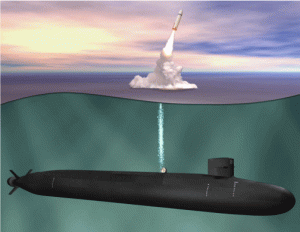 Using Trident would be illegal, so let’s phase it out https://www.theguardian.com/commentisfree/2016/jul/15/trident-illegal-nuclear-britain-arsenal?CMP=share_btn_fb, Geoffrey Robertson Nuclear doom is nearer than most of us believe, experts warn. Britain must set a moral lead by becoming the first of the ‘big five’ powers to reduce its arsenal. The most portentous decision for every new prime minister is what to write in the secret “letter of last resort” to Trident submarine commanders telling them what to do with their nuclear missiles if the British government is wiped out. In Monday’s debate on the renewal of Trident, Theresa May should tell parliament what life-or-death decision she has made in her letters of last resort.
It is said that Margaret Thatcher ordered our nukes, trained on Moscow, to be fired so as to cause maximum destruction to the enemy – ie to its civilians. That order, even for a nuclear “second strike”, would today be illegal.
It is ironic that although Chilcot produced so much condemnation of Blair for joining an unlawful war, MPs are now being asked to vote for a weapons system that cannot be used without committing a crime against humanity. This was defined in 1998 by the Rome Statute, which set up the international criminal court, as “a systematic attack directed against a civilian population, resulting in extermination or torture, or an inhumane act intentionally causing great suffering”.
The same statute additionally makes it a war crime to intentionally launch an attack in the knowledge that it would cause incidental loss of civilian life or severe damage to the natural environment, out of proportion to military advantage.
Trident’s 200 thermonuclear bombs, each 10 times more powerful than those that struck Hiroshima and Nagasaki, are illegal because they cannot discriminate between military targets and hospitals, churches and schools; because of their capacity to cause untold human suffering for generations to come; and because their consequences (eg ionising radiation, which tortures victims and lingers for half a century) are beyond the control or knowledge of the attacker, who cannot judge the proportionality of their use.
As the international court of justice put it, back in 1996: “The destructive power of nuclear weapons cannot be contained in space or time. They have the potential to destroy all civilisation and the entire ecosystem of the planet.”
So why is our law-abiding government spending tens of billions on a weapons system that cannot lawfully be used?
First, because its advisers wrongly think that nuclear weapons are legal in certain circumstances. Back in that 1996 case, the UK argued that it could lawfully drop “a low-yield nuclear weapon against warships on the high seas or troops in sparsely populated areas”.
This scenario has now been shown up as fantastical: “first use” in these circumstances by the UK would trigger a nuclear reprisal with inevitable damage to the atmosphere, the oceans and the “sparsely populated” area (which would henceforth be entirely unpopulated). In any event, Trident’s weapon-bays will not carry “low-yield” bombs, and if they did the result would be better achieved by conventional weapons, making nuclear deployment unnecessary and disproportionate.
The world court ruled that the threat or use of nuclear weapons would “generally” be contrary to war law but might be lawful “in extreme circumstances of self-defence, in which the very survival of a state would be at stake”. This was a time-warped view of war law in 1996 that is not tenable today. The court, to be fair, predicted as much, saying that it expected international law to “develop” towards a total ban on the use of the bomb. It soon did, with the Rome Statute and subsequent development of the principle that a state has no right to preserve itself at the expense of damage to other states and to the rights to life of millions of citizens.
It is absurd to suggest that it would have been lawful for Hitler, his back to the bunker wall, to start a nuclear Götterdämmerung to save the Nazi state (Nuremberg decided it was not lawful for him even to fire doodlebugs). Given what we now know about the uncontrollable and devastating propensities of modern nuclear weapons, it is unlawful to fire them at all.
There is a further legal reason for allowing Trident to wear out. It is Article VI of the nuclear proliferation treaty (NPT), by which parties undertake to proceed in good faith to “general and complete” nuclear disarmament.
The world court’s 1996 ruling decided that this imposed not a “mere” obligation but a binding legal obligation on existing nuclear states to reduce the number of their bombs gradually, to zero. It is contrary to the spirit of article VI to upgrade rather than downgrade the fleet.
A decision to phase out Trident would help Britain recover some of the clout it has lost through Brexit. It would show moral leadership, and shame other nuclear powers that have failed to live up to their NPT obligations (especially the US; President Obama’s Nobel prize was prematurely awarded in part for envisaging “a world without nuclear weapons”).
Moral leadership from a nuclear-weapons state is urgently needed. The latest US defence budget allocates $1tn for future modernisation of its nukes and it has acquired new sites for them, in Poland and Romania. President Putin has promised in return a new generation of nuclear-tipped intercontinental ballistic missiles. The American most knowledgeable on the subject – Bill Clinton’s defence secretary William J Perry – has just published a book warning that “nuclear doom” is closer today than it ever was during the cold war.
Although possession of nuclear weapons is not per se unlawful, the UK is under a duty to reduce its arsenal: the vice of refurbishing Trident is that it encourages other states to do the same, and remains a constant stimulus for countries – particularly in the Middle East and Asia – to acquire arsenals of their own.
When negotiating to buy Polaris (Trident’s predecessor), back in 1962, Harold Macmillan confided in his diary that “the whole thing is ridiculous”, but consoled himself with the thought that “countries which have played a great role in history must retain their dignity”.
A half-century later, the best way for Britain to regain its dignity post-Brexit is not to throw vast sums of money away on a weapon that cannot lawfully be used, but rather to appear as the first of the “big five” powers to shoulder its legal obligation to disarm under article VI of the NPT. It will be many years before the mushroom cloud becomes a hallucination, but at least Britain would be able to boast that it had led the way.
July 17, 2017
Posted by Christina Macpherson |
Legal, politics international, Religion and ethics, UK |
Leave a comment