UK politician criticises nuclear workers’ union as “the voice of big business”
 Politics Home 28th Sept 2017, A powerful trade union has labelled Clive Lewis “anti-working class” after
he launched an extraordinary attack on their defence of the nuclear
industry. The GMB said the former Shadow Cabinet member’s remarks were
“offensive to our members”.
Speaking at a fringe event at the Labour party
conference, Mr Lewis said the unions, and the GMB in particular, had become
“the voice of big business”. He also accused them of fighting “to the
bitter end” for the arms industry, but failing to speak up for the
renewable energy sector because it didn’t generate union members.
The Labour MP for Norwich South said: “One of the problems with where trade
unions are at the moment is that they have been so weakened that I think
they have become, and have been used by big business as, a voice for big
business.
“Because big business understands that if you have a unionised
workforce they also become spokespeople for you. They create a situation
where you have a wide and broad spectrum politically of people supporting
your particular position.
“On nuclear, yes, GMB and other unions are staunchly supporting it because the jobs there generate union members.
Contrast that to the highly self-employed solar sector: the unions have no
trade unions there. They are not speaking up at all for them…
https://www.politicshome.com/news/uk/political-parties/labour-party/news/89369/clive-lewis-accused-being-%E2%80%98anti-working-class%E2%80%99
European Commission to invest €222 to promote Europe’s transition to clean energy
 European Commission 28th Sept 2017, The European Commission has approved an investment package of €222
million from the EU budget to support Europe’s transition to more
sustainable and low-carbon future under the LIFE programme for the
Environment and Climate Action. The EU funding will mobilise additional
investments leading to a total of €379 million going towards 139 new
projects in 20 Member States.
http://europa.eu/rapid/press-release_IP-17-3429_en.htm
French nuclear monitoring group wants to prevent approval of EPR nuclear reactor vessel at Flamanville
L’Usine Nouvelle 25th Sept 2017, [Machine Translation] The nuclear watchdog announced Monday that it has
filed an application for interim measures to prohibit the French Nuclear
Safety Authority (ASN) from validating the EPR reactor vessel under
construction in Flamanville.
A hearing is scheduled for Tuesday 10 October
at the Paris tribunal de grande instance, the anti-nuclear association said
in a statement.
“This is probably the last chance to avoid an irresponsible
commissioning of the EPR with its defective tank and the prospect of a
catastrophe affecting the whole of Europe,” according to the Observatory
which calls for the appointment of an independent expert.
At the end of June, the ASN gave a green light to the commissioning of the EPR tank in
Flamanville – before a definitive opinion was expected in October – but
warned that the lid of this equipment could not be used at beyond 2024.
https://www.usinenouvelle.com/article/nucleaire-refere-contre-un-feu-vert-a-la-cuve-de-flamanville.N592068
British govt reveals a new record for renewable energy generation
Independent 28th Sept 2017, Nearly a third of all UK electricity came from renewable sources in the
second three months of this year, setting a new record for clean energy
generation, the Government has revealed. Wind, solar and other forms of
low-carbon power were responsible for 29.8 per cent of the total amount of
electricity generated in the UK, beating the previous record of 26.9 per
cent set in the first three months of 2017.
In a statement, the Government said: “Renewables’ share of electricity generation was a record 29.8
per cent in [the second quarter of] 2017, up 4.4 percentage points on the
share in [the second quarter of] 2016, reflecting both increased wind
capacity and wind speeds, as well as lower overall electricity generation.
“Onshore wind generation increased by 50 per cent, the highest increase
across the technologies, … while offshore wind rose by 22 per cent.
“Generation from biodegradable waste was up 30 per cent, due to much
increased capacity.”
http://www.independent.co.uk/news/business/news/renewable-energy-electricity-new-record-uk-wind-solar-a7972266.html
Concern over plan to dump 300,000 tonnes of potentially radioactive mud into the sea off Cardiff
BBC 25th Sept 2017, Plans to dredge 300,000 tonnes of mud from near a disused nuclear plant and
dump it off Cardiff and Vale of Glamorgan’s coast have been criticised. A
pollution consultant claims the mud from near Hinkley Point in Somerset
could expose people to radioactivity. EDF Energy, the company behind the
plans, said the work was not harmful to humans or the environment. The
Welsh Government said all applications were considered in line with legal
requirements.
Dredging is proposed in Bridgewater Bay near the
decommissioned Hinkley Point A and B as part of construction work for the
new £19.6bn Hinkley Point C nuclear power station. Welsh ministers granted
permission in 2013 for developers to dispose of the sediment at a site know
as Cardiff Grounds, previously used to deposit waste from Cardiff and
Newport docks.
But consultant Tim Deere-Jones, who specialises in marine
radioactivity, claimed sampling of the mud to check for potentially harmful
contaminates had been “inadequate”. He told BBC Wales low level waste from
the nuclear plant had entered the site for more than 50 years and there was
a lack of knowledge about the potential harm of moving the mud.
“Rather than being relatively stable at the Hinkley site it is being churned up and
brought over here to be dumped,” he said. “Radioactive and non-radioactive
pollutants will inevitably enter inshore waters and coastal environments.
“Several studies have shown that wastes dumped into the sea transfer to the
land in sea spray and episodes of coastal flooding.
France to invest 20 billion euros in energy transition from nuclear to renewables

 Reuters Staff, PARIS (Reuters) 27 Sept 17, – The French government plans to invest 20 billion euros in an energy transition plan, including 9 billion euros towards improved energy efficiency, 7 billion for renewables and 4 billion to precipitate the switch to cleaner vehicles.
The environment-related investments, drafted by economist Jean Pisani-Ferry and presented by Prime Minister Edouard Philippe on Monday, are part of a 57 billion-euro investment plan to run from 2018 to 2022.
Buildings are responsible for 20 percent of greenhouse gas emissions, so the government plans a 9 billion-euro thermal insulation programme that will focus on low-income housing and government buildings, the government said in a statement.
The programme aims at financing the renovation of 75,000 dwellings per year, or 375,000 over the government’s five-year term.
The government will also invest 7 billion euros ($8.31 billion) to boost the growth of French renewable energies by 70 percent over the next five years.
Investments will include research and innovation to combat climate change, and will speed up France’s transition to low carbon and greater energy efficiency…… https://www.reuters.com/article/us-france-renewables-investments/france-to-invest-20-billion-euros-in-energy-transition-idUSKCN1C027P
Dangers of radioactivity in the dumping off Cardiff, of mud from old nuclear site
Wales Online 25th Sept 2017, Hundreds of thousands of tonnes of mud from the site of a disused nuclear
power station is to be dumped off Cardiff’s coast when the UK’s newest
nuclear power station is built.
EDF Energy, which is building the Hinkley
Point C reactor in north Somerset, has a marine licence to dump up to
200,000 cubic metres of dredged material close to Cardiff Bay.
One expert has raised concerns about the proposed dumping, saying he fears that the
mud may have a higher level of radioactivity that is currently believed.
Expert Tim Deere-Jones has been analysing data about the tests conducted on
mud and waste which could be dumped off the coast of Wales.
He says he has three concerns about the waste. Mr Deere-Jones says that there are 50
different radionuclides and that testing has only taken place on three of
those. Secondly, he says that he believes only surface samples have been
taken. He says that while samples of from between 0 and 5cm have been
taken, research from other sites has shown that if samples are taken from
five times deeper, there can be a five times higher collection of
radioactivity. Thirdly, he says tides in Wales mean that waste could be
transferred from the sea into land, that can be through coastal flooding or
even sea spray heading up to 10 miles inland. However, it is understood
dredging has not yet begun and no date set for it to begin.
http://www.walesonline.co.uk/news/wales-news/hundreds-thousands-tonnes-radioactive-mud-13673203
Britain’s new solar farm to sell energy to the grid, without government subsidy

 Times 26th Sept 2017,In rural Bedfordshire today, Claire Perry, the climate change minister,
will open the first solar farm in Britain to sell power to the grid without
a direct subsidy.
It will perform this trick thanks partly to banks of
batteries that enable it to transmit electricity even when the sun is not
shining, and partly to the plummeting price of both batteries and solar
panels in recent years. Clayhill Farm is a landmark achievement. It will
provide power for 2,500 homes without pumping out any pollution, making any
noise or killing any birds. It will come onstream less than a month after
an auction for wholesale energy contracts in which wind power operators
underbid even gas-fired energy producers for the first time.
And it was built in 12 weeks flat. A renewable energy revolution is gathering steam,
so to speak, but Clayhill Farm poses a troubling question for government
and the rest of the British solar industry.
Why is it, so far, alone? There are three reasons.
First, one of the biggest obstacles to setting up a new
solar farm is securing a connection to the grid, and Clayhill has been able
to piggyback on a neighbouring facility whose connection is already in
place.
Second, few sites in Britain are so lucky, because solar power
installation slumped when subsidies were withdrawn two years ago while
still being available for wind.
Thirdly, Britain is not very sunny. The
Clayhill project shows that solar power has a future here despite
everything. Moreover, battery and solar panel prices are expected to keep
falling thanks to a global glut created by China. This oversupply is a
result of mass Chinese production initially to meet subsidised German
demand in the 1990s, and later to meet domestic Chinese demand. Beijing now
dreams of building and controlling a global solar-powered grid. If Britain
wants its own, the time to build is now.
https://www.thetimes.co.uk/edition/comment/sun-trap-hppsxdcsp
Chance of nuclear war with North Korea? 10% Conventional war 20-30% – says ex NAT O military chief
 Former NATO military chief: there’s a 10% chance of nuclear war with North Korea
And a 20-30% chance of a conventional one. Vox by Retired Navy Adm. James Stavridis spent 37 years in the military, including four years as the supreme allied commander of NATO. Hillary Clinton vetted him as a possible running mate. President-elect Donald Trump considered naming him secretary of state. He is a serious man, and about as far from an armchair pundit as it’s possible to be.
And that’s precisely what makes his assessment of the escalating standoff with North Korea so jarring. Stavridis believes there’s at least a 10 percent chance of a nuclear war between the US and North Korea, and a 20 to 30 percent chance of a conventional, but still bloody, conflict.
“I think we are closer to a significant exchange of ordnance than we have been since the end of the Cold War on the Korean peninsula,” he said during a panel I moderated Tuesday at the University of Pennsylvania’s Perry World House.
His estimate of the potential death toll from even a nonnuclear war with North Korea is just as striking. North Korea has at least 11,000 artillery pieces trained on Seoul, South Korea’s capital of 25 million people, and would be certain to use them during any conflict. The US would be just as certain to mount a sustained bombing campaign to destroy those artillery pieces as quickly as possible.
The result? “It’s hard for me to see less than 500,000 to 1 million people, and I think that’s a conservative estimate,” he said.
Remember: That’s assuming North Korea doesn’t use its arsenal of nuclear weapons, which can already hit Seoul and much of Japan.
Speaking at the same event, Michèle Flournoy, formerly the No. 3 official at the Pentagon in the Obama administration, said Trump’s harsh rhetoric toward Pyongyang — which has included deriding North Korean leader Kim Jong Un as “Little Rocket Man” — created the real risk of an accidental war between the two countries.
“My worry is that all of this heated rhetoric has really charged the environment so that it’s much more likely now that one side or the other will misread what was intended as a show of commitment or a show of force,” she said. “It could be the basis of a miscalculation that actually starts a war that wasn’t intended at that moment.”…….
Here’s why the odds of war with North Korea are rising
Both Stavridis and Flournoy see Kim as a fundamentally rational leader whose overriding goals are to ensure the survival of his regime and his personal control over North Korea. Nuclear weapons, in Flournoy’s words, are “the ace that he could play if there was a conflict to say, ‘Stop, you’re not going to take me out without risking nuclear war.’”
Stavridis stressed on the panel that the odds were still against an open military conflict with North Korea, let alone nuclear war. But he also made clear that both were definitely possible — and that the odds were rising……..https://www.vox.com/2017/9/28/16375158/north-korea-nuclear-war-trump-kim-jong-un
Pictures show the tragedy of Russian villages contaminated by 1957 nuclear explosion
‘Left To Die As Guinea Pigs’: Tatar Village Struggles On, 60 Years After Nuclear Catastrophe https://www.rferl.org/a/russia-nuclear-mayak/28755780.html, September 28, 2017 An explosion at a Soviet nuclear plant 1,400 kilometers east of Moscow remains the world’s third-largest nuclear disaster, after Chernobyl and Fukushima. At the time, in 1957, it was the worst ever. Sixty years on, nearby Tatar villagers are still struggling for official recognition of their plight. (RFE/RL’s Tatar-Bashkir Service) TEXTS BELOW DESCRIBE EACH OF THE EXCELLENT PICTURES ON THE ORIGINAL
The sign says “Danger Zone.” An explosion on September 29, 1957, contaminated an area of 23,000 square kilometers and exposed more than 270,000 people to significant levels of radiation.
The village of Karabolka is 30 kilometers from the Mayak nuclear plant, where the explosion occurred. For decades afterwards, it did not appear on maps, only reappearing 20 years ago. But life there continued.
 Gulshara Ismagilova has lived in Karabolka all her life. She is campaigning for official recognition for the suffering of the villagers. Rates of cancer and genetic abnormalities here are significantly higher than the national average. “We are all handicapped here,” she says.
These are Ismagilova’s relatives who have died over the last 60 years. It includes an aunt, her mother, and her brother, who all died of cancer. Ismagilova herself has liver cancer.
In 1957, the village had about 4,000 residents; in 2010, just 423. The village had two distinct parts: a mostly Tatar part, which was not evacuated, and a mostly Russian part, which was. Some locals say they were used in an experiment on the effects of radiation.
The village has eight cemeteries. Seven of them are a resting place for residents who died of cancer. Children here are often born with cancer and die before reaching adulthood.
Only Muslims are buried here. Following their beliefs, some relatives prevent autopsies being performed. This can prevent some deaths being classified as cancer-related.
A pile of coffins at the ready. Families usually bury their dead by noon of the day following their death. “People don’t know what to eat and how to survive,” Ismagilova says. “They have been left here to die as guinea pigs.”
This house has a pile of firewood outside. In the 1990s, local people were warned that wood stored radiation and should not be used for burning. But the village was not connected to a gas supply until 2016.
A water pump outside a house. “The authorities prohibited drinking water from local wells but couldn’t arrange supplies of clean water. A couple of months later, they took samples and said the local water was good enough to drink,” says Ismagilova.
A Greenpeace report 10 years ago said the Mayak site was “one of the most radioactive places on Earth.” It added that thousands of people in surrounding towns and villages still lived on contaminated land
Britain’s hydrogen nuclear bomb tests in Pacific Kiribati not acknowledged – no compensation for affected islanders
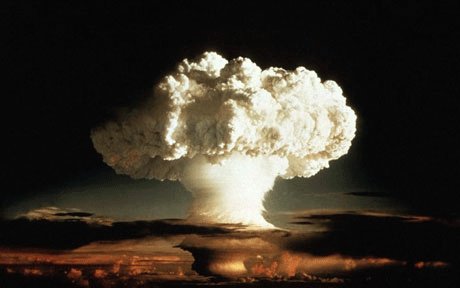 Author challenges British denial over Pacific nuclear legacy http://www.radionz.co.nz/international/pacific-news/340397/author-challenges-british-denial-over-pacific-nuclear-legacy The author of a new book on Pacific nuclear weapons testing says he hopes it will shed more light on Britain’s tests in the region. US and French nuclear tests at Bikini atoll in the Marshall Islands and Murorua and Fangataufa atolls in Tahiti feature regularly in discussions about the environmental and social legacy of Pacific nuclear testing.
But the author Nic McLellan says the fallout of Britain’s hydrogen bomb tests at Kiritimati island in Kiribati isn’t as well documented.
Mr McLellan says unlike the US and France, Britain refuses to accept any responsibility for the negative impacts of its tests on the health of local men, women and children as well as its own soldiers and those from Fiji and New Zealand who observed the tests.
“The British of course tested in my own country Australia with atomic weapons and yet the hydrogen bomb tests in Kiribati are not very well known. And so the book is compiling a lot of information gathered and presents portraits of people who are opposed to the tests. It is really important to recognise that in the 1950s there was widespread opposition to these tests going ahead.”
Wind power is now cheaper than nuclear
– the energy revolution is happening, Guardian, John Sauven, 27 Sept 17 Far-sighted government policy means the cost of offshore wind energy has halved. The benefits in terms of climate change and UK jobs will be enormous “…….. the price of offshore wind energy has dropped by half in less than two years. By the 2020s, it will be as cheap or cheaper than any other form of power generation. It’s just become much cheaper than nuclear, even taking into account the additional costs associated with the wind’s intermittency. And in any case, this is less of an issue at sea where the winds are more constant……on the cusp of a quiet revolution. From being the most expensive form of renewable energy, offshore wind was fast becoming the cheapest form of large-scale, low-carbon generation bar none. ……..
This month’s contracts for the next round of offshore wind farms to be built in the North Sea should have the champagne corks popping in No 10. They mean billions more in foreign investment coming into the UK. They will be playing a major role in regenerating regions in the north-east of the country. And they will create a thriving export market in contracts for offshore wind developments. But we at Greenpeace are not sure the government has noticed the full potential that their policies have created.
To bring it to their attention, some of the world’s biggest players, including Vattenfall and General Electric, have come together alongside environmental organisations including WWF and the Marine Conservation Society. A campaign is being launched today at Westminster with the help of creative agency Mother, which is working pro bono. They explained to us that when you’re selling the future of energy generation at 50% off, all you really need to do is get this fact in front of your customers. MPs using Westminster tube station will find it hard to miss.
The UK needs affordable and secure energy. We have to replace our obsolete power stations and meet growing demand from the electric vehicle revolution. Offshore wind, alongside a smart energy system including storage and interconnectors, should be the backbone of how the UK generates its power in future. Short term, as part of the transition, gas back up might be required (but only when needed, unless it’s green like biogas). Such a system could help us meet our climate change commitments and speed up the move to a low-carbon economy. It could provide jobs and regional regeneration as well as provide export markets. It could be the cheapest form of large-scale power available. It’s shown to be wildly popular in all opinion surveys. We urge the government to come clean on this issue and publicly admit that they got this right! https://www.theguardian.com/commentisfree/2017/sep/26/offshore-wind-power-energy-price-climate-change
Time to cancel Britain’s Hinkley Point C nuclear power project – says energy expert
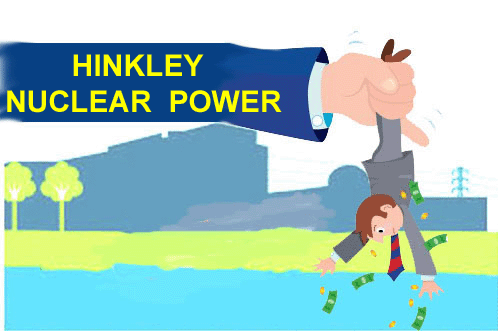 No2 Nuclear Power 25th Sept 2017, A new report by Emeritus Professor of Energy Policy, Steve Thomas, says it
is time to cancel Hinkley Point C. EDF and the French and UK governments
may try to suggest that it’s too late to stop and will talk up the costs
which have already been incurred. But the start of construction, when the
first structural concrete is poured, is still between 2 and 4 years away.
Preliminary works are conspicuous but relatively cheap. EDF Energy will
have incurred expenses since signing the deal with the UK Government in
October 2016 and some of these may be compensatable. But these costs would
be dwarfed by the costs of going ahead.
http://www.no2nuclearpower.org.uk/news/campaign-update/time-to-cancel-hinkley-point-c/
Britain’s Small Modular Nuclear Reactors – really happening, or vapourware?
 Is The UK Really Planning To Approve “Mini Nuclear Reactor” Rollout? https://cleantechnica.com/2017/09/22/uk-really-planning-approve-mini-nuclear-reactor-rollout/ by James Ayre It was reported last week in The Telegraph that ministers in the UK were “ready” to approve the rapid development and testing of a fleet of “mini nuclear reactors” — to be used as baseload capacity and meant to make up for older soon-to-be-decommissioned nuclear facilities.
Is there any truth to this assertion? What about the assertion that such mini nuclear facilities will provide electricity that’s one-third cheaper than that provide by the nuclear facilities currently in use in the UK?
That sounds a bit “too good to be true” (which means that it probably is), but that is the sales pitch that’s being used.
I haven’t been able to find out too much about what’s going on, as many news outlets haven’t been covering the matter apparently, but it seems that “Rolls-Royce, NuScale, Hitachi, and Westinghouse have held meetings in past weeks with civil servants about Britain’s nuclear strategy and development of ‘small modular reactors’ (SMRs)” in recent days — if The Telegraph is to be believed.
Here’s more from that coverage: “Whitehall sources confirmed that officials from the Department for Business were whittling down proposals from consortia keen to work with government to develop SMRs, with an announcement on the final contenders for funding expected soon.
“The report to be published by Rolls-Royce, entitled ‘UK SMR: A National Endeavour’, which has been seen by The Telegraph, claims SMRs will be able to generate electricity significantly cheaper than conventional nuclear plants.
“The mini reactors are each expected to be able to generate between 200 megawatts and 450 megawatts of power, compared with the 3.2 gigawatts due from Hinkley, meaning more of them will be required to meet the UK’s energy needs.”
The Rolls Royce report claims that its projects would be able to generate electricity at a strike price of £60 per megawatt-hour — a fair bit higher than a number of other electricity generation modalities can offer. Though, I guess that the sales pitch is based on the idea of its use as baseload capacity?
Holtec planning to build small nuclear reactors in Ukraine
 HOLTEC TO START ACTIVE PHASE OF BUILDING SMALL REACTORS SMR-160 IN 2023 WITH POSSIBILITY OF LOCALIZATION IN UKRAINE http://open4business.com.ua/holtec-start-active-phase-building-small-reactors-smr-160-2023-possibility-localization-ukraine/ 11 SEP , 2017
KYIV. Sept 11 (Interfax-Ukraine) – Holtec International (the United States) in 2023 will start the active phase of building small module reactors SMR-160, President of Ukrainian National Nuclear Generating Company Yuriy Nedashkovsky said at a ribbon-cutting ceremony for a new plant of the company in New Jersey (the United States).
According to a posting on the website of Energoatom, Nedashkovsky said that earlier President of Holtec International Chris Singh made a proposal to Ukrainian President Petro Poroshenko to create a hub in Ukraine to sell small module reactors to Europe, Asia and Africa with localization of production facilities and the large amount of equipment at Ukrainian enterprises.
Nedashkovsky said that Kharkiv-based Turboatom has turbines suiting SMR-160. There is a chance of attracting other Ukrainian enterprises to the project.
He said that the start of licensing of SMR-160 could start in 2018.
He said that SMR-160 reactors are rather cheap compared to more powerful reactors. They can be installed in small areas and do not require powerful lines. Nedashkovsky said that the need in SMR-160 after 2025 is estimated at $1 trillion.
“These reactors have an increased level of safety due to the fact that they use passive safety systems: that is it has no pumping equipment, reinforcement and other things which require external power supply,” the president of Energoatom said.
The plant, built by Holtec in New Jersey, is mainly focused on two spheres: production of container fleet for spent nuclear fuel, as well as vessels for small modular reactors of the SMR-160 project.
1 This Month



Shut down the radiation-damaged Heysham nuclear reactors now
To see nuclear-related stories in greater depth and intensity – go to https://nuclearinformation.wordpress.com

Say No to NASA’s Reckless Nuclear Reactor on the Moon
Say No to NASA’s Reckless Nuclear Reactor on the Moon
-
Archives
- October 2026 (256)
- September 2026 (339)
- August 2026 (330)
- July 2026 (355)
- June 2026 (287)
- May 2026 (306)
- April 2026 (356)
- March 2026 (251)
- February 2026 (267)
- January 2026 (308)
- December 2025 (358)
- November 2025 (359)
-
Categories
- 1
- 1 NUCLEAR ISSUES
- business and costs
- climate change
- culture and arts
- ENERGY
- environment
- health
- history
- indigenous issues
- Legal
- marketing of nuclear
- media
- opposition to nuclear
- PERSONAL STORIES
- politics
- politics international
- Religion and ethics
- safety
- secrets,lies and civil liberties
- spinbuster
- technology
- Uranium
- wastes
- weapons and war
- Women
- 2 WORLD
- ACTION
- AFRICA
- Atrocities
- AUSTRALIA
- Christina's notes
- Christina's themes
- culture and arts
- Events
- Fuk 2022
- Fuk 2023
- Fukushima 2017
- Fukushima 2018
- fukushima 2019
- Fukushima 2020
- Fukushima 2021
- general
- global warming
- Humour (God we need it)
- Nuclear
- RARE EARTHS
- Reference
- resources – print
- Resources -audiovicual
- Weekly Newsletter
- World
- World Nuclear
- YouTube
-
RSS
Entries RSS
Comments RSS

