Power Mag 1st Oct 2017, Scientists at the Nuclear Research and Consultancy Group (NRG) in Petten,
Netherlands, have commenced the world’s first thorium molten salt reactor
(TMSR) experiment in more than 45 years (Figure 1). The SALt Irradiation
ExperimeNT, or SALIENT, was developed in cooperation with the European
Commission Joint Research Center’s Institute for Transuranium Elements,
which is located near Karlsruhe, Germany.
http://www.powermag.com/thorium-molten-salt-reactor-experiment-underway-in-the-netherlands/
October 2, 2017
Posted by Christina Macpherson |
EUROPE, technology, thorium |
Leave a comment
Ipswich Star 30th Sept 2017, A former nuclear power station employee has accused EDF Energy of being
“disingenuous” over plans to use off-site land to relocate Sizewell B
buildings in the way of the C plant.
Terry Hodgson, a former district and
county councillor for Leiston, worked at Sizewell A for 32 years until he
retired in 2007 and now represents the Suffolk Association of Local
Councils on the Sizewell Stakeholder Group (SSG). He told the latest SSG
meeting that assurances had originally been given that certain areas near
the nuclear site would not be used for development. “Now we are told they
are to be used. This is disingenuous to the local community,” he said.
Under plans being considered, part of a woodland planted to commemorate the
coronation of George V will be bulldozed to make way for the relocation of
some of the Sizewell B power station buildings. The existing buildings,
including a visitors’ centre and training centre, are in the way of plans
for a £16billion Sizewell C nuclear power station.
http://www.ipswichstar.co.uk/news/edf-accused-over-moves-to-fell-woodland-next-to-sizewell-b-1-5216389
October 2, 2017
Posted by Christina Macpherson |
secrets,lies and civil liberties, UK |
Leave a comment
 Russian Nuclear Company Sees Success in Latin America,
1 October 2017New branches of the company will be constructed in El Alto, Bolivia and should be in operation by 2020.
Two years since its move to Latin America, Rosatom, Russia’s main nuclear power company, has seen great success, the company’s Latin American representative, Ivan Dybov, said.
“Rosatom has several projects in Latin America, but the main one is in Bolivia. Last September 19 we signed the contract for the construction of the Center for Research and Development in Nuclear Technology,” Dybov said.
The new branches will be constructed in El Alto and should be in operation by 2020…..https://www.telesurtv.net/english/news/Russian-Nuclear-Company-Sees-Success-in-Latin-America-20171001-0005.html
October 2, 2017
Posted by Christina Macpherson |
marketing, Russia, SOUTH AMERICA |
Leave a comment
Those words were spoken to me by the Russian human rights lawyer, Nadezhda Kutepova. For years she, with her NGO, Planet of Hopes, defended people who suffer in one of the most radioactively polluted places on this planet: the area surrounding the nuclear waste and reprocessing complex, Mayak, in Russia’s Southern Urals. Kutepova continues to stand up for her people from Paris where she has been exiled to because she was no longer safe in her home town. She made the comment when we were discussing the latest radiation measurement findings that Greenpeace published this week.
The people around Mayak are suffering from the third biggest nuclear catastrophe in history: The Kyshtym disaster that happened 60 years ago today. The radioactive pollution from Mayak continues to this day.
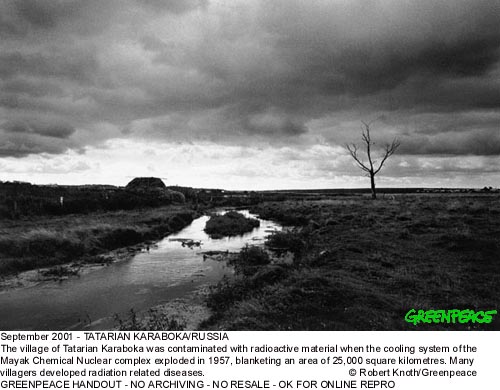
The Kyshtym Disaster is named after the nearest known town on the map. In 1957 a mistake in the reprocessing plant led to an explosion that contaminated 20,000 square kilometres – an area that did not appear on any map. Nor did the nearby town of Chelyabinsk, which was a so-called “secret” or “closed town” for Mayak nuclear complex workers. It is also Kutepova’s birth place. Around 270,000 people were directly affected by the disaster.
Only in the 1990s, after the fall of the Soviet Union, did the true impact of the accident become apparent. Only then did the Russian nuclear industry, now known as Rosatom, take some responsibility. Only after Kutepova started supporting local victims and photographer, Robert Knoth, who recorded the the lives of those affected, did Rosatom concede to evacuating those who suffered most.
Well, kind of.
First of all, not everyone in the village was moved. Some of the people’s documents were not in order. They had to stay in a ghost town without services. And five other villages were not evacuated at all.
The pollution from Mayak never really stopped, either. Radioactive waste-water continues to be dumped in ponds around and connected to the Techa river. In all the local villages Greenpeace Russia found highly elevated strontium-90 levels. The same levels as found in the evacuated village of Muslyumovo.
Rosatom already acknowledged several times that water is seeping out of the ponds into the Techa river system. And the people of Muslyumovo and it’s surroundings are still depending on that water for their gardens. Still, Rosatom continues to dump its waste into the ponds. But, they are not called “ponds” anymore. They are now called “special industrial ponds”, “objects of nuclear energy use”, and the dumping is called “inserting liquid radioactive waste for storage”.
Mayak is everywhere. Rosatom may be polluting a Mayak near you: by reprocessing spent nuclear fuel from your nearby nuclear power station, by building a nuclear power station that will later send its spent fuel to Russia for reprocessing, or by loading your neighbouring nuclear plant with reprocessed uranium fuel from Mayak.
Rosatom’s operation in Mayak illustrates that the nuclear industry is not interested in people. After all, 60 years since the disaster the people around Mayak are “a sort of radioactive waste”.
Jan Haverkamp is an expert consultant nuclear energy and energy policy for GreenpeaceCentral and Eastern Europe and part of Greenpeace’s Radiation Protection Advisors team.
September 30, 2017
Posted by Christina Macpherson |
environment, Russia, social effects |
Leave a comment
Business Green 27th Sept 2017, Jeremy Corbyn has closed this year’s Labour Party Conference by aiming
fierce criticism for US President Donald Trump over his plans to withdraw
the US from the Paris climate change agreement, arguing the President is
wrong to think climate action comes at the expense of economic growth.
TheLabour leader used his conference speech to stress the opportunities of
low-carbon investment, saying it can help create the jobs of the future and
build strong economies.
https://www.businessgreen.com/bg/news/3018189/corbyn-takes-aim-at-trump-as-he-trumpets-low-carbon-opportunity
September 30, 2017
Posted by Christina Macpherson |
politics, UK |
Leave a comment
 Australian Aborigines move to block shipments of Scottish nuclear waste http://www.heraldscotland.com/news/15554758.Australian_Aborigines_move_to_block_shipments_of_Scottish_nuclear_waste/?ref=fbshr ABORIGINES in South Australia are fighting a plan to ship nuclear waste from Scotland amid fears it will be dumped on land regarded as culturally and spiritually sacred.
Wallerberdina, around 280 miles north of Adelaide, has been earmarked as a possible location for Australia’s first nuclear waste dump despite claims that it is a priceless heritage site rich in archaeological treasures including burial mounds, fossilised bones and stone tools.
Some have claimed the impact would be similar to “building a waste dump at the heart of the Vatican”.
Now campaigners have appealed to the Scottish Government to halt controversial plans to ship nuclear waste processed at Dounreay in Caithness to Australia, amid concerns that it will eventually end up on the culturally sensitive land.
The waste transfer is part of a deal with saw spent fuel from nuclear reactors in Australia, Belgium, Germany and Italy processed at Dounreay – the nuclear facility in Caithness currently being decommissioned – to enable it to be safely stored after being returned to its country of origin.
The UK government has previously confirmed that “a very small quantity of Australian-owned radioactive waste” is currently stored in the country.
Scottish Government policy allows for the substitution of nuclear waste with a “radiologically equivalent” amount of materials from Sellafield in Cumbria.
The Herald understands that a shipment of such material is due to take place by 2020.
While the waste will be initially stored at a facility near Sydney, concern is growing that it could end up at Wallerberdina, one of two areas under consideration as a nuclear waste dump site.
As well as sparking anger over the site’s cultural and sacred connections, the proposed location has angered local people who still recall British atomic bomb tests in the area in the 1950s without permission from the affected Aboriginal groups.
Thousands were adversely affected with many Aboriginal people left suffering from radiological poisoning
Gary Cushway, a dual Australian/British citizen living in Glasgow, has now written to the First Minister asking that the Scottish Government review the agreement to transfer the material “until a satisfactory final destination for the waste is finalised by the Australian Government.”
He argues that doing so would allow the government to “take the lead in mitigating mistakes of the past that the UK government has made in regards to indigenous Australians.”
The proposed dump site is next to an Indigenous Protected Area where Aborigines are still allowed to hunt, and is part of the traditional home of the Adnyamathanha people, one of several hundred indigenous groups in Australia.
September 30, 2017
Posted by Christina Macpherson |
AUSTRALIA, indigenous issues, opposition to nuclear, UK, wastes |
Leave a comment
 Cheap Offshore Wind Won’t Make UK Give Up on Nuclear, Nukes to play “an important role for many years to come,” says the government. Greentech Media, by Jason Deign September 29, 2017 A pricing record for offshore wind this month won’t change Britain’s nuclear plans, government sources confirmed.
“We need a diverse energy mix to ensure that demand for energy can always be met, and both nuclear and renewables will play an important role in this for many years to come,” a spokesperson for the U.K. Department for Business, Energy & Industrial Strategy said.
The statement follows widespread speculation about the future of the U.K.’s new nuclear program in the wake of an auction that saw offshore wind prices drop to just £57.50 (USD $76.34) per megawatt-hour.
That’s almost 38 percent below what the U.K. government has agreed to pay for nuclear generation at Hinkley Point C, a contentious 3.2-gigawatt plant slated for construction in Somerset, southwest England.
The project, which has already been criticized for increasing costs, was called into question after the renewables auction result, which awarded 11 competitive projects that ranged from offshore wind to waste-to-energy conversion.
As renewable energy becomes more affordable, the government’s decision on the new nuclear project may come under additional scrutiny,” Bloomberg reported.
Since Hinkley Point C was approved in September 2015, developer Électricité de France has increased the cost estimate for the project from £18 billion ($24 billion) to more than £20 billion ($27 billion), said Bloomberg.
In contrast, said Giles Dickson, CEO of industry body WindEurope: “Offshore wind has now shown it provides excellent value for taxpayers’ money.”
“In light of these latest price reductions, we call on the U.K. and other European governments to make ambitious commitments on future deployment volumes for offshore wind. To sustain these cost reductions, the industry needs to be able to plan ahead,” said Dickson.
Caught off-guard by the auction result, the nuclear industry hit back against the narrative…….
It remains to be seen whether Hinkley Point C will make it into that [energy] mix. The project, based on a French design which has seen cost and schedule overruns in France and Finland, has been beset by other problems.
This month, workers threatened to walk out over a pay dispute. And the BBC slammed plans to dump potentially radioactive waste from dredging works near Hinkley Point’s two existing reactors. https://www.greentechmedia.com/articles/read/cheap-offshore-wind-wont-make-uk-give-up-on-nuclear#gs.ThDT6VE
September 30, 2017
Posted by Christina Macpherson |
business and costs, ENERGY, politics, UK |
Leave a comment
 National Assembly for Wales (accessed) 28th Sept 2017,
Petition “We call on the National Assembly for Wales to urge the Welsh
Government to direct Natural Resources Wales to suspend the licence it has
granted to NNB Genco, which permits up to 300,000 tonnes of radioactively
contaminated material, dredged from the seabed at the Hinkley Point Nuclear
power station site, to be dumped into Welsh inshore waters.
We further request that the suspension of the licence is used to ensure that a full
Environmental Impact Assessment, complete radiological analysis and core
sampling are carried out under the auspices of Natural Resources Wales, and
that a Public Inquiry, a full hearing of independent evidence and a Public
Consultation take place before any dump of the Hinkley sediments is
permitted.”
https://www.assembly.wales/en/gethome/e-petitions/Pages/petitiondetail.aspx?PetitionID=1243
September 30, 2017
Posted by Christina Macpherson |
politics, UK, wastes, water |
Leave a comment
 Politics Home 28th Sept 2017, A powerful trade union has labelled Clive Lewis “anti-working class” after
he launched an extraordinary attack on their defence of the nuclear
industry. The GMB said the former Shadow Cabinet member’s remarks were
“offensive to our members”.
Speaking at a fringe event at the Labour party
conference, Mr Lewis said the unions, and the GMB in particular, had become
“the voice of big business”. He also accused them of fighting “to the
bitter end” for the arms industry, but failing to speak up for the
renewable energy sector because it didn’t generate union members.
The Labour MP for Norwich South said: “One of the problems with where trade
unions are at the moment is that they have been so weakened that I think
they have become, and have been used by big business as, a voice for big
business.
“Because big business understands that if you have a unionised
workforce they also become spokespeople for you. They create a situation
where you have a wide and broad spectrum politically of people supporting
your particular position.
“On nuclear, yes, GMB and other unions are staunchly supporting it because the jobs there generate union members.
Contrast that to the highly self-employed solar sector: the unions have no
trade unions there. They are not speaking up at all for them…
https://www.politicshome.com/news/uk/political-parties/labour-party/news/89369/clive-lewis-accused-being-%E2%80%98anti-working-class%E2%80%99
September 30, 2017
Posted by Christina Macpherson |
employment, politics, UK |
Leave a comment
 European Commission 28th Sept 2017, The European Commission has approved an investment package of €222
million from the EU budget to support Europe’s transition to more
sustainable and low-carbon future under the LIFE programme for the
Environment and Climate Action. The EU funding will mobilise additional
investments leading to a total of €379 million going towards 139 new
projects in 20 Member States.
http://europa.eu/rapid/press-release_IP-17-3429_en.htm
September 30, 2017
Posted by Christina Macpherson |
EUROPE, renewable |
Leave a comment
L’Usine Nouvelle 25th Sept 2017, [Machine Translation] The nuclear watchdog announced Monday that it has
filed an application for interim measures to prohibit the French Nuclear
Safety Authority (ASN) from validating the EPR reactor vessel under
construction in Flamanville.
A hearing is scheduled for Tuesday 10 October
at the Paris tribunal de grande instance, the anti-nuclear association said
in a statement.
“This is probably the last chance to avoid an irresponsible
commissioning of the EPR with its defective tank and the prospect of a
catastrophe affecting the whole of Europe,” according to the Observatory
which calls for the appointment of an independent expert.
At the end of June, the ASN gave a green light to the commissioning of the EPR tank in
Flamanville – before a definitive opinion was expected in October – but
warned that the lid of this equipment could not be used at beyond 2024.
https://www.usinenouvelle.com/article/nucleaire-refere-contre-un-feu-vert-a-la-cuve-de-flamanville.N592068
September 30, 2017
Posted by Christina Macpherson |
France, safety |
Leave a comment
Independent 28th Sept 2017, Nearly a third of all UK electricity came from renewable sources in the
second three months of this year, setting a new record for clean energy
generation, the Government has revealed. Wind, solar and other forms of
low-carbon power were responsible for 29.8 per cent of the total amount of
electricity generated in the UK, beating the previous record of 26.9 per
cent set in the first three months of 2017.
In a statement, the Government said: “Renewables’ share of electricity generation was a record 29.8
per cent in [the second quarter of] 2017, up 4.4 percentage points on the
share in [the second quarter of] 2016, reflecting both increased wind
capacity and wind speeds, as well as lower overall electricity generation.
“Onshore wind generation increased by 50 per cent, the highest increase
across the technologies, … while offshore wind rose by 22 per cent.
“Generation from biodegradable waste was up 30 per cent, due to much
increased capacity.”
http://www.independent.co.uk/news/business/news/renewable-energy-electricity-new-record-uk-wind-solar-a7972266.html
September 30, 2017
Posted by Christina Macpherson |
renewable, UK |
Leave a comment
BBC 25th Sept 2017, Plans to dredge 300,000 tonnes of mud from near a disused nuclear plant and
dump it off Cardiff and Vale of Glamorgan’s coast have been criticised. A
pollution consultant claims the mud from near Hinkley Point in Somerset
could expose people to radioactivity. EDF Energy, the company behind the
plans, said the work was not harmful to humans or the environment. The
Welsh Government said all applications were considered in line with legal
requirements.
Dredging is proposed in Bridgewater Bay near the
decommissioned Hinkley Point A and B as part of construction work for the
new £19.6bn Hinkley Point C nuclear power station. Welsh ministers granted
permission in 2013 for developers to dispose of the sediment at a site know
as Cardiff Grounds, previously used to deposit waste from Cardiff and
Newport docks.
But consultant Tim Deere-Jones, who specialises in marine
radioactivity, claimed sampling of the mud to check for potentially harmful
contaminates had been “inadequate”. He told BBC Wales low level waste from
the nuclear plant had entered the site for more than 50 years and there was
a lack of knowledge about the potential harm of moving the mud.
“Rather than being relatively stable at the Hinkley site it is being churned up and
brought over here to be dumped,” he said. “Radioactive and non-radioactive
pollutants will inevitably enter inshore waters and coastal environments.
“Several studies have shown that wastes dumped into the sea transfer to the
land in sea spray and episodes of coastal flooding.
http://www.bbc.co.uk/news/uk-wales-41347137
September 30, 2017
Posted by Christina Macpherson |
environment, UK |
Leave a comment

 Reuters Staff, PARIS (Reuters) 27 Sept 17,
– The French government plans to invest 20 billion euros in an energy transition plan, including 9 billion euros towards improved energy efficiency, 7 billion for renewables and 4 billion to precipitate the switch to cleaner vehicles.
The environment-related investments, drafted by economist Jean Pisani-Ferry and presented by Prime Minister Edouard Philippe on Monday, are part of a 57 billion-euro investment plan to run from 2018 to 2022.
Buildings are responsible for 20 percent of greenhouse gas emissions, so the government plans a 9 billion-euro thermal insulation programme that will focus on low-income housing and government buildings, the government said in a statement.
“The number of badly insulated low-income housing and social housing will be divided by two, and a quarter of government buildings will be renovated in line with environmental norms,” it said.
The programme aims at financing the renovation of 75,000 dwellings per year, or 375,000 over the government’s five-year term.
The government will also invest 7 billion euros ($8.31 billion) to boost the growth of French renewable energies by 70 percent over the next five years.
Investments will include research and innovation to combat climate change, and will speed up France’s transition to low carbon and greater energy efficiency…… https://www.reuters.com/article/us-france-renewables-investments/france-to-invest-20-billion-euros-in-energy-transition-idUSKCN1C027P
September 30, 2017
Posted by Christina Macpherson |
France, politics, renewable |
Leave a comment
Wales Online 25th Sept 2017, Hundreds of thousands of tonnes of mud from the site of a disused nuclear
power station is to be dumped off Cardiff’s coast when the UK’s newest
nuclear power station is built.
EDF Energy, which is building the Hinkley
Point C reactor in north Somerset, has a marine licence to dump up to
200,000 cubic metres of dredged material close to Cardiff Bay.
One expert has raised concerns about the proposed dumping, saying he fears that the
mud may have a higher level of radioactivity that is currently believed.
Expert Tim Deere-Jones has been analysing data about the tests conducted on
mud and waste which could be dumped off the coast of Wales.
He says he has three concerns about the waste. Mr Deere-Jones says that there are 50
different radionuclides and that testing has only taken place on three of
those. Secondly, he says that he believes only surface samples have been
taken. He says that while samples of from between 0 and 5cm have been
taken, research from other sites has shown that if samples are taken from
five times deeper, there can be a five times higher collection of
radioactivity. Thirdly, he says tides in Wales mean that waste could be
transferred from the sea into land, that can be through coastal flooding or
even sea spray heading up to 10 miles inland. However, it is understood
dredging has not yet begun and no date set for it to begin.
http://www.walesonline.co.uk/news/wales-news/hundreds-thousands-tonnes-radioactive-mud-13673203
September 30, 2017
Posted by Christina Macpherson |
environment, UK |
Leave a comment