Jeremy Corbyn’s shadow minister for peace has said a Labour government would sign a global anti-nuclear weapons treaty that would effectively confine the Royal Navy’s Trident submarines to port. Fabian Hamilton MP, in comments that risk reigniting the party’s internal divisions over the future of the UK’s nuclear deterrent, told i that while the issue of
Trident was “dead in the water” as it had been approved by Parliament,
a future Corbyn government would sign a UN treaty that bans nuclear weapons
and prohibits their use.
Labour included a promise to renew Trident in its
election manifesto, but Hamilton said that Corbyn’s leadership of the
Labour party presented a “golden opportunity” for opponents of nuclear
weapons, admitting the issue was still a “thorn in the side” of the
party.
https://inews.co.uk/essentials/news/trident-labour-sign-un-treaty-banning-nuclear-weapons/
October 29, 2017
Posted by Christina Macpherson |
politics, UK, weapons and war |
Leave a comment
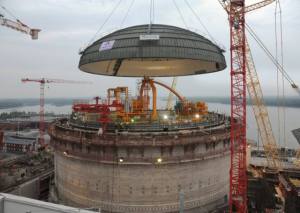 L’Usine Nouvelle 27th Oct 2017[Machine translation] Areva in the quagmire of the Finnish EPR. A further
delay in commissioning the Olkiluoto EPR in Finland is further complicating
the task of Areva SA, the new entity dedicated mainly to the end of the
project.
At this rate, the EPR Flamanville (Channel) will be put into
service before that of Olkiluoto in Finland. On October 9th, the
Areva-Siemens consortium informed the Finnish electrician Teollisuuden
Voima Oyj (TVO) that he was still cutting back the connection to the
reactor network in May 2019. It was initially planned for 2009!
And the penultimate postponement fixed the end of the test period at the end of
2018. After ten years of overtaking and 5 billion euros of additional cost,
the consortium Areva-Siemens and the Finnish electricity company TVO accuse
each other of the delay. The first claims 3.5 billion euros in compensation
to TVO, which continues for 2.6 billion.
https://www.usinenouvelle.com/article/areva-dans-le-bourbier-de-l-epr-finlandais.N604108
October 29, 2017
Posted by Christina Macpherson |
business and costs, Finland |
Leave a comment
British navy sailors on nuclear Trident submarine fired after failing drug tests, ABC News, 29 Oct 17, Britain’s navy has fired nine sailors serving on a nuclear-armed submarine after they tested positive for cocaine, the country’s defence ministry says.
The crew were from HMS Vigilant, one of four Royal Navy submarines which operate the Trident nuclear missile system.
“We do not tolerate drugs misuse by service personnel. Those found to have fallen short of our high standards face being discharged from service,” a Royal Navy spokesman said.
The Daily Mail newspaper reported that the sailors had failed drugs tests while the submarine was docked in the United States to pick up nuclear warheads and undergo work, and the sailors had been accommodated in hotels on shore……http://www.abc.net.au/news/2017-10-28/british-navy-sacks-nuclear-submariners-over-cocaine-use/9096396
October 29, 2017
Posted by Christina Macpherson |
incidents, UK, weapons and war |
Leave a comment
Bomb disposal experts are continuing controlled explosions of chemicals at
the Sellafield nuclear reprocessing plant. It follows a routine audit of
chemicals stored in a laboratory. The Army’s explosive ordnance disposal
team have been on-site since last weekend dealing with a canisters of
solvents present since 1992.
Sellafield Ltd said there were concerns they
could become hazardous if exposed to oxygen. A spokeswoman said the
solvents are “widely used in industry” but “extreme caution” is being
exercised. The disposal will continue over the weekend with the site
operating as normal with the exception of the laboratory.
http://www.bbc.co.uk/news/uk-england-cumbria-41783748
October 29, 2017
Posted by Christina Macpherson |
safety, UK |
Leave a comment

 WEST Somerset Council’s cabinet is being asked to challenge Hinkley Point
C power station’s plans to change the way it will deal with waste nuclear
fuel until the council gets more information.
At its meeting next Wednesday, the cabinet committee will be recommended to object to EDF
Energy’s application to the Government’s planning inspectorate for
“non-material changes” to the £19.6 billion project. This would allow
an interim spent nuclear fuel store with a life of 120 years to be
increased in size – up in length from 150 to 229 metres, eight metres wider
and five metres higher, making it one of the biggest buildings on the site.
EDF claims a larger building is needed because it has been decided to keep
the nuclear waste dry in concrete and steel cannisters rather than, as
originally planned, in wet storage in a pool.
http://www.wsfp.co.uk/article.cfm?id=108485&headline=Concern%20over%20bigger%20Hinkley%20waste%20fuel%20building§ionIs=news&searchyear=2017
October 29, 2017
Posted by Christina Macpherson |
UK, wastes |
Leave a comment
France to decide by end 2018 how many nuclear plants to shut: minister PARIS (Reuters) 29 Oct 17, – France will detail at the end of 2018 how many nuclear reactors will close to meet a target on reducing atomic energy, Environment Minister Nicolas Hulot told French daily Le Monde on Saturday.
France aims to cut the share of atomic energy in power generation to 50 percent by 2025 from 75 percent now.
Nuclear plant closures represent a touchy topic, as the sector employs thousands of people and renewable energy alternatives struggle to grow fast enough to ensure energy needs are fulfilled.
According to France’s National Council of Industry, the nuclear sector supports about 220,000 jobs, directly and indirectly.
Hulot will lay out his so-called “green deal” on energy transition in the first half of 2018, he told Le Monde in an interview.
“In order to reduce to 50 percent the share of nuclear power, we will have to close a number of reactors,” he said, adding that he would detail the exact figure under a multi-year plan to be presented at end of 2018……https://www.reuters.com/article/us-france-nuclearpower/france-to-decide-by-end-2018-how-many-nuclear-plants-to-shut-minister-idUSKBN1CX0KP
October 29, 2017
Posted by Christina Macpherson |
France, politics |
Leave a comment
Independent 27th Oct 2017,German power producers are poised to pay customers to use electricity this
weekend. Wind generation is forecast to climb to a record on Sunday,
creating more output than needed and driving electricity prices below zero,
broker data compiled by Bloomberg show.
It would be the first time this year that the average price for a whole day is negative, not just for
specific hours. Germany’s grid operators can struggle to keep the balance
between how much energy people are using and how much is being produced
when there are high amounts of wind generation. Negative prices mean that
producers must either shut down power stations to reduce supply or pay
consumers to take the electricity off the grid.
http://www.independent.co.uk/environment/germany-grids-paying-electricity-customers-renewable-energy-power-surplus-wind-solar-generation-a8022576.html
October 29, 2017
Posted by Christina Macpherson |
Germany, renewable |
Leave a comment
Environmental Research Web 28th Oct 2017, In his wide ranging review of energy costs for the UK government, Prof.Dieter Helm says ‘the cost of energy is too high, and higher than
necessary to meet the Climate Change Act (CCA) target and the carbon
budgets. Households and businesses have not fully benefited from the
falling costs of gas and coal, the rapidly falling costs of renewables, or
from the efficiency gains to network and supply costs which come from smart
technologies. Prices should be falling, and they should go on falling into
the medium and longer terms’. And he sets out his ideas for enabling that
to happen.
To simplify things, he wants to combine support systems and
taxes into a universal carbon price and a unified equivalent firm power
auction process. http://blog.environmentalresearchweb.org/2017/10/28/the-helm-energy-cost-review/
October 29, 2017
Posted by Christina Macpherson |
renewable, UK |
Leave a comment
Soviet submarine officer who averted nuclear war honoured with prize https://www.theguardian.com/science/2017/oct/27/vasili-arkhipov-soviet-submarine-captain-who-averted-nuclear-war-awarded-future-of-life-prize
Vasili Arkhipov, who prevented escalation of the cold war by refusing to launch a nuclear torpedo against US forces, is to be awarded new ‘Future of Life’ prize A senior officer of a Soviet submarine who averted the outbreak of nuclear conflict during the cold war is to be honoured with a new prize, 55 years to the day after his heroic actions averted global catastrophe.
On 27 October 1962, Vasili Alexandrovich Arkhipov was on board the Soviet submarine B-59 near Cuba when the US forces began dropping non-lethal depth charges. While the action was designed to encourage the Soviet submarines to surface, the crew of B-59 had been incommunicado and so were unaware of the intention. They thought they were witnessing the beginning of a third world war.
Trapped in the sweltering submarine – the air-conditioning was no longer working – the crew feared death. But, unknown to the US forces, they had a special weapon in their arsenal: a ten kilotonne nuclear torpedo. What’s more, the officers had permission to launch it without waiting for approval from Moscow.
Two of the vessel’s senior officers – including the captain, Valentin Savitsky – wanted to launch the missile. According to a report from the US National Security Archive, Savitsky exclaimed: “We’re gonna blast them now! We will die, but we will sink them all – we will not become the shame of the fleet.”
But there was an important caveat: all three senior officers on board had to agree to deploy the weapon. As a result, the situation in the control room played out very differently. Arkhipov refused to sanction the launch of the weapon and calmed the captain down. The torpedo was never fired.
Had it been launched, the fate of the world would have been very different: the attack would probably have started a nuclear war which would have caused global devastation, with unimaginable numbers of civilian deaths.
“The lesson from this is that a guy called Vasili Arkhipov saved the world,’’ Thomas Blanton, director of the National Security Archive at George Washington University, told the Boston Globe in 2002, following a conference in which the details of the situation were explored.
Now, 55 years after he averted nuclear war and 19 years after his death, Arkhipov is to be honoured, with his family the first recipients of a new award.
The prize, dubbed the “Future of Life award” is the brainchild of the Future of Life Insitute – a US-based organisation whose goal is to tackle threats to humanity and whose advisory board includes such luminaries as Elon Musk, the astronomer royal Prof Martin Rees, and actor Morgan Freeman.
“The Future of Life award is a prize awarded for a heroic act that has greatly benefited humankind, done despite personal risk and without being rewarded at the time,” said
Max Tegmark, professor of physics at MIT and leader of the Future of Life Institute.
Speaking to Tegmark, Arkhipov’s daughter Elena Andriukova said the family were grateful for the prize, and its recognition of Arkhipov’s actions.
“He always thought that he did what he had to do and never considered his actions as heroism. He acted like a man who knew what kind of disasters can come from radiation,” she said. “He did his part for the future so that everyone can live on our planet.”
The $50,000 prize will be presented to Arkhipov’s grandson, Sergei, and Andriukova at the Institute of Engineering and Technology on Friday evening.
Beatrice Fihn, executive director of the Nobel peace prize-winning organisation, the International Campaign to Abolish Nuclear Weapons, said Arkhipov’s actions were a reminder of how the world had teetered on the brink of disaster. “Arkhipov’s story shows how close to nuclear catastrophe we have been in the past,” she said.
The timing of the award, Fihn added, is apt. “As the risk of nuclear war is on the rise right now, all states must urgently join the treaty on the prohibition of nuclear weapons to prevent such catastrophe.”
Dr Jonathan Colman, an expert on the Cuban missile crisis at the University of Central Lancashire, agreed that the award was fitting.
“While accounts differ about what went on on board the B-59, it is clear that Arkhipov and the crew operated under conditions of extreme tension and physical hardship. Once the nuclear threshold had been crossed, it is hard to imagine that the genie could have been put back into the bottle,” he said.
“President Kennedy had been very worried about the possibility of a clash between American warships and Soviet submarines in the Caribbean, and it is absolutely clear that his fears were justified,” Colman added, noting that certain decisions at the operational level were out of his control. “Ultimately, it was luck as much as management that ensured that the missile crisis ended without the most dreadful consequences.”
October 28, 2017
Posted by Christina Macpherson |
Russia, weapons and war |
Leave a comment
 Wales Online 26th Oct 2017, Nearly 60,000 people sign petitions to stop radioactive mud being dumped
off Cardiff. Campaigners say not enough research has been done on the
dangers of the mud from the decommissioned Hinkley A nuclear reactor.
http://www.walesonline.co.uk/news/wales-news/nearly-60000-people-sign-petitions-13817765
Somerset Live 25th Oct 2017, Concerns have been raised after more than 200,000 tonnes of ‘radioactive’
mud from Hinkley Point power station will be dumped in the Bristol Channel.
EDF Energy, the company behind Hinkley Point C development in Bridgwater,
has obtained a marine licence to dump up to 200,000 cubic metres of dredged
material in the Bristol Channel – just a mile off Cardiff Bay. The
dredging licence was granted to the French energy giant in 2013 and it
gives them the right to discharge materials at Cardiff Grounds, a sandbank
in the Bristol Channel.
http://www.somersetlive.co.uk/news/somerset-news/radioactive-mud-hinkley-point-dumped-672554
October 28, 2017
Posted by Christina Macpherson |
environment, opposition to nuclear, UK |
Leave a comment
To shore up the INF, the United States could propose something the Russians have already advocated—that the INF Treaty be expanded to ban this category of ballistic missiles globally.Such a move would not immediately apply to the most troubling nuclear-tipped missiles, those with ranges far in excess of 1,000 kilometers. But a worldwide INF could be a first step toward an eventual goal of banning all ballistic missiles.
Ballistic missiles have beneficial purposes; they place satellites in orbit, and those satellites provide the world with vital communications capabilities and navigation and weather information. Ballistic missiles send astronauts and space stations into Earth orbit and research probes far across the solar system.
But ballistic missiles armed with nuclear warheads are enablers of apocalypse. There is no effective defense against these missiles, even though the United States has spent more than 30 years and $500 billion trying to build radars that can track them and interceptor missiles that will shoot them down.
Military ballistic missiles have other negative characteristics. The short time needed for them to reach target (if the United States and Russia are the assumed combatants, 10 to 30 minutes) creates pressure to launch first in a conflict. In a crisis, ballistic missiles on high alert can wind up becoming the leading edge of a devastating war begun by miscalculation.
Because of the obvious dangerousness of ballistic missiles, there is a long history of official efforts to limit or eliminate them. Those efforts have shown that agreements to reduce the dangers of ballistic missiles can catalyze improved relations between potential adversaries. The landmark 1987 Intermediate-Range Nuclear Forces (INF) treaty required Washington and Moscow to eliminate all ballistic missiles with ranges between 500 and 1,000 kilometers. Both nations recognized that these missiles could not be defended against and their proximity to the Cold War boundaries of Europe meant they were highly destabilizing in a crisis. A total of 2,692 missiles (including a small number of cruise missiles) were eliminated under the treaty.
Acknowledging the danger of nuclear ballistic missiles, President Reagan proposed an agreement requiring their total elimination to Soviet leader Gorbachev at their summit in Reykjavik, Iceland in 1985. The Soviets did not accept the proposal because Reagan insisted that America’s program to build missile defenses remain unconstrained. That program—known then as the Strategic Defense Initiative and today as the National Missile Defense Program—has yet to develop effective means to defeat ballistic missiles.
In the mid 1990s, Alton Frye, then Washington director of the US Council on Foreign Relations, advocated an international ban on offensive ballistic missiles, an idea whose time has perhaps come again. Many political and technical challenges would need to be addressed to negotiate and enforce new international limitations on ballistic missiles. But model institutional and scientific mechanisms for such efforts exist in the form of preceding treaties, including INF and New START. Procedures and technologies for inspection, verification, and enforcement of agreements limiting or banning all types of ballistic missiles have already been proven. Political will, as usual is the major missing ingredient.
Former Defense Secretary William Perry and several other experts have recently advocated the elimination of the United States’ nuclear-armed, land-based intercontinental ballistic missiles (ICBMs). According to Perry, this component of America’s nuclear triad is no longer necessary to deter adversaries and is inherently dangerous, fueling instability during crises and arms races with Russia and China.
While Perry proposes to eliminate only land-based ballistic missiles and retain submarine-based missiles, such a move could create powerful international momentum to negotiate new international limits or bans on certain types of ballistic missiles—with an ultimate goal of banning all nuclear-armed ballistic missiles. If a united international community were to seriously consider such a course, it could bring increased pressure on North Korea, Iran, and other nations to suspend or roll back their offensive ballistic missile programs. If they refused, the possibility of using military force against their nuclear and ballistic missile programs would gain legitimacy and support.
One place to start seeking new limits on ballistic missiles has been in the news for months: the INF Treaty, which the United States and Russia have accused one another of violating. Russia’s support of the treaty has weakened over the years because it is forbidden to deploy ballistic missiles with ranges between 500 and 1,000 kilometers, but its neighbors who are not party to the treaty are permitted to do so. China has many such missiles, and Turkey, South Korea, and Japan could develop them in the future. To shore up the INF, the United States could propose something the Russians have already advocated—that the INF Treaty be expanded to ban this category of ballistic missiles globally.
Such a move would not immediately apply to the most troubling nuclear-tipped missiles, those with ranges far in excess of 1,000 kilometers. But a worldwide INF could be a first step toward an eventual goal of banning all ballistic missiles. A renewed focus on the danger of these weapons—accompanied by US statements that it is willing to eliminate its land-based ICBMs under the right conditions—might elicit greater support from Russian and China in efforts to defuse the North Korean crisis and control Iranian missile testing.
Like the nuclear weapons ban treaty the UN recently adopted, a ballistic missile ban would require sustained, long-term effort to achieve anything like full success. But the United States has everything to gain from taking a leadership role and asserting that offensive ballistic missiles are dangerous and destabilizing weapons that should eventually be eliminated from the arsenals of all nations.
October 28, 2017
Posted by Christina Macpherson |
Russia, USA, weapons and war |
Leave a comment
La Tribune 27th Oct 2017,[Machine Translation] The postponement of the generic Nuclear Safety
Authority (ASN) opinion on the continued operation of certain reactors
beyond the age of 40, revealed on 24 October, could have serious
consequences for the implementation of the law. And,
beyond, on the image of nuclear power in the public opinion, and the
perception of the role of the State in terms of energy strategy.
http://www.latribune.fr/entreprises-finance/industrie/energie-environnement/nucleaire-la-trajectoire-energetique-francaise-se-complique-755755.html
October 28, 2017
Posted by Christina Macpherson |
France, politics |
Leave a comment
French power group EDF lowers 2017 earnings and nuclear output targets, Reuters Staff, PARIS, Oct 27 (Reuters) – French state-controlled power group EDF lowered its 2017 targets for nuclear power output and for earnings before interest, tax, depreciation and amortisation (EBITDA), following restart delays at its Tricastin nuclear plant.
October 28, 2017
Posted by Christina Macpherson |
business and costs, France |
Leave a comment

Small nuclear reactors are a 1950s mirage come back to haunt us http://www.theecologist.org/News/news_analysis/2989401/small_nuclear_reactors_are_a_1950s_mirage_come_back_to_haunt_us.html, Oliver Tickell, 24th October, 2017
The government is due to announce a £250 million support package for ‘small modular reactors’ his week, just as the price of wind and solar power contracts fall 10% below UK wholesale prices. OLIVER TICKELL argues that the Britain’s ‘civilian’ nuclear power expenditure is actually a camouflaged subsidy to the UK’s Trident nuclear missile system.
It’s easy to see why Rolls Royce and other companies in the nuclear engineering business are pushing the UK government finance the development a new generation of ‘small modular reactors’ or SMRs. Whether the project succeeds or fails, there are juicy profits to be had for them at taxpayers expense.
Rather harder to understand is why the government should see the slightest merit in the idea.
According to a recent report by Rolls-Royce and its partners in the ‘SMR Consortium’ (SMRC), a UK SMR program could create 40,000 skilled jobs, contribute £100 billion ($132 billion) to the economy and open up a potential £400 billion global export market.
Nuclear Industries Association chairman Lord (John) Hutton claims in the foreword that a UK SMR programme could “help the UK become a vibrant, world-leading nuclear nation.” He asserts his belief that “it is fundamental for the UK to meet its 2050 decarbonisation targets and will deliver secure, reliable and affordable electricity for generations to come.”
The SMRC report envisages an approximate doubling of the UK’s 9.5 GW existing nuclear capacity by 2030, then another doubling by 2050 to around 40GW. That implies that come 2050, SMRs would be delivering some 30GW – the output of 100 300MW units scattered around the UK.
There are just two problems with the rosy scenario. First, the techno-optimism that oozes from every page is a fantasy. Nuclear power stations have got bigger to achieve economies of scale: it’s much cheaper to build a single 1.2GW unit than four 300MW units, or a dozen 100MW units.
As an illustration of the principle, take a look at the wind power industry. One of the main reasons why offshore wind has come down so much in cost is the move to ever-larger wind turbines. A single new 8MW turbine may now be bigger than an entire wind farm of 20 years ago.
This story goes all the way back to the 1950s …
But first we must realise – there is nothing new about SMRs! They have been powering submarines and aircraft carriers ever since the since USS Nautilus was launched in 1955, over 60 years ago. And the world’s first purely civilian nuclear plant, at Shippingport in the USA, a 60MW SMR, went live in 1957. While civilian reactors got bigger, many hundreds of SMRs have been built and deployed for naval use.
Now if there really are huge cost savings to be achieved from the mass production of SMRs, how come they have not already been achieved? What is that that generations of super-smart nuclear engineers have missed? Industry claims of less complex financing and ‘process engineering’ may ring a little hollow, but – for the sake of argument – let’s accept that all the claimed cost reductions can be achieved. On the SMRC’s projections,
“The levelised cost of electricity (LCOE) generated by a FOAK [first of a kind] UK SMR power station is forecast under £75 per MWh and this reduces to a forecast £65 per MWh by station number five. In the medium term the target is even lower at £60 per MWh.”
This is a good bit cheaper than the inflation-proof £92.50 / MWh (in 2013 money) the government has promised to pay for Hinkley C’s power for 35 years following the plant’s opening. But it’s a lot higher than current wholesale power prices of around £42 / MWh.
The ever shrinking cost of renewable energy
Last month the price of offshore wind power reached a new low of £57.50 per MWh in an auction for contracts, guaranteed for just 15 years. Onshore wind is even cheaper: contracts awarded in Germany in May reached another new low of €42.80 / MWh (£38.24) – less than current UK wholesale power prices. And Germany’s latest solar auction, a few days ago, delivered bids as low as €42.90 per MWh. Both these technologies appear viable with no subsidy at all.
The cost of solar PV panels continues its precipitous decline. Recent figures show the cost of panels in the Netherlands declining at 11% per year, or 50% every five years. The trend may continue for a long time to come.
Extrapolate these declining renewable cost trends to 2030, and we can expect solar power to cost around £10 per MWh, with wind at £20-30 per MWh. By 2050, wind power costs will surely have halved again, with solar around £1 per MWh. So what will be the use of nuclear power at £60-75 per MWh?
Of course there will be costs in integrating large volumes of variable, non-despatchable power supply into the grid. It will mean using ‘dynamic demand’ or ‘smart grid’ technologies, energy storage in giant batteries and hydropower stations, large scale power-to-gas and power-to-liquid-fuel conversion (in turn displacing fossil fuels from transport) … and the base cost of power will be astonishingly low by current standards, not just in the UK but all over the world.
So Lord Hutton’s hyperbolic claims are wholly erroneous. Nuclear power will be utterly irrelevant in meeting decarbonisation targets. There is no £400 billion export market. Who would want SMRs in 2050, when their power will be 50-100 times more expensive than solar?
The ‘nuclear deterrent’
 We now know (thanks to Andy Stirling and Philip Johnstone of Sussex University) that the government wants to use civilian nuclear programme to generate expertise, technology, for military use, especially reactors for Trident nuclear submarines. What better way than to pour billions of pounds into SMRs under the pretence that the technology is for civilian use?
Actually Lord Hutton himself gave the game away when he wrote: “A UK SMR programme would support all 10 ‘pillars’ of the Government’s Industrial Strategy and assist in sustaining the skills required for the Royal Navy’s submarine programme.”
More recently, on 10th October, defence procurement minister Harriet Baldwin MP replied to a question by Caroline Lucas MP that, “[i]n all discussions it is fully understood that civil and defence sectors must work together to make sure resource is prioritised appropriately for the protection and prosperity of the United Kingdom.”
But there are signs that BEIS Secretary Greg Clarke may be getting tired of subsidising the UK’s nuclear missiles. In 2015 former Chancellor George Osborne announced a £250 million SMR competition for the most promising ideas. The outcomewas to be published last autumn. it wasn’t. By May 2017, the nuclear industry and its backers in the House of Lords were panicking. Then the SMRCs report ‘UK SMR: A National Endeavour‘ was issued this 20th September in a desperate attempt to ginger up the process. It has failed – so far.
Could a sudden fit of common sense, logical thinking and sound economics have come across senior UK ministers? Probably not. The Telegraph reports today that BEIS is to publish the competitions ‘results’ in a study this week, announcing Rolls Royce and its SMRC partners as the winners. “We are currently considering next steps for the SMR programme and we will communicate these in due course”, a BEIS spokesman said.
This Author
Oliver Tickell is contributing editor at Resurgence & Ecologist magazine and a former editor of The Ecologist.
October 27, 2017
Posted by Christina Macpherson |
technology, UK |
Leave a comment
 Cumbrians Opposed to a Radioactive Environment (CORE) 25th Oct 2017 Over the coming months, in remembering this epic and historic case in theLondon High Court when West Cumbrian families sued Sellafield over cancersin children of radiation workers, CORE will be publishing the 1992/93 daily court transcripts.
The initial two test cases were brought by Leigh Day & Co. The first by Elizabeth Reay whose 10-month-old baby, Dorothy, died ofleukaemia in 1962. George Reay, the baby’s father, died of cancer in the mid- 1980s and had received one of the highest radiation doses of any of the Sellafield workers.
The second by Vivien Hope, 28, who had been diagnosed in 1988 with non-Hodgkin’s lymphoma, another blood cancer. Her father, David, was a fitter at the plant for more than 20 years.
Up to 40 further cases were depending on the outcome. Legally, the case would test
for the first time the concept of genetic damage: whether radiation from
Sellafield damaged the sperm of workers, resulting in leukaemia and related
illnesses in their children (Gardner theory).
http://corecumbria.co.uk/news/down-memory-lane-25th-anniversary-of-leukaemia-high-court-case-261092/
October 27, 2017
Posted by Christina Macpherson |
Legal, UK |
Leave a comment