The British government has offered 2 trillion yen ($18 billion) to Hitachi to built Wylfa nuclear power station
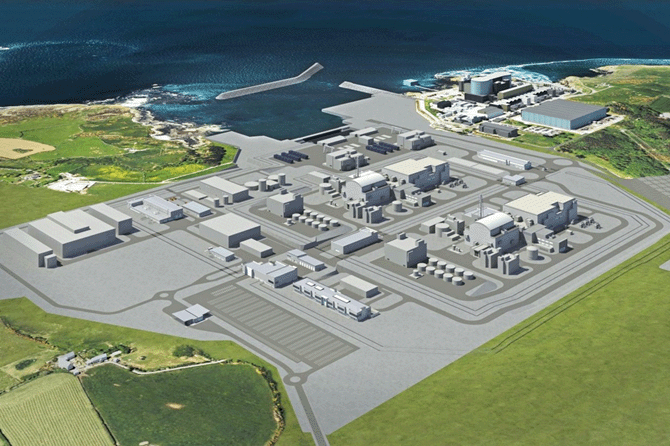
British government offers $18 billion to Hitachi’s UK nuclear project: Kyodo, Reuters Staff TOKYO (Reuters) 17 May  18 – The British government has offered 2 trillion yen ($18 billion)in financial support to a unit of Japan’s Hitachi Ltd (6501.T) to build nuclear reactors in Wales, Kyodo News reported on Thursday.
…….. The British government is offering support in loans and other ways to Hitachi unit Horizon Nuclear Power to cover a large proportion of the cost of its Wylfa Newydd project in Wales, Kyodo reported, citing a source close to the matter.
…….. Hitachi could decide as early as this week whether to go ahead, Kyodo said. It said the government’s offer was aimed at easing concerns about rising cost expectations, which have increased to 3 trillion yen.
A Hitachi spokesman declined to comment when contacted by Reuters.
The Kyodo report cited unidentified observers questioning whether the government would be able to carry out the offer, due to parliamentary opposition.
The British government played down a Japanese media report last week which said it would guarantee loans for the construction of the two reactors in Wales.
Britain is seeking new ways to fund nuclear projects after drawing criticism over a deal awarded to France’s EDF (EDF.PA) to build the UK’s first nuclear plant for 20 years, which could cost 30 billion pounds ($40 billion).
Hitachi’s Horizon plans to construct at least 5.4 gigawatts of nuclear capacity at two sites in Britain – the first at Wylfa Newydd, and the second at Oldbury-on-Severn in England…….. Reporting by Aaron Sheldrick and Kiyoshi Takenaka; additional reporting by Nina Chestney in London; editing by Christian Schmollinger, Jason Neely and Dale Hudson https://www.reuters.com/article/us-britain-nuclear-hitachi/british-government-offers-18-billion-to-hitachis-uk-nuclear-project-kyodo-idUSKCN1II17C
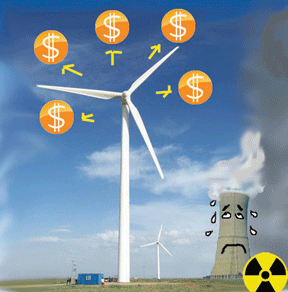
Britain’s wind power stations providing more electricity than its nuclear stations, in first quarter of 2018
 Wind power overtakes nuclear for first time in UK across a quarter https://www.theguardian.com/environment/2018/may/16/wind-power-overtakes-nuclear-for-first-time-in-uk-across-a-quarterNews of milestone comes as MPs say policy changes have caused collapse in investment in renewables, Guardian, Adam Vaughan, 16 May 18,
Britain’s windfarms provided more electricity than its eight nuclear power stations in the first three months of 2018, marking the first time wind has overtaken nuclear across a quarter.
The renewable energy industry hailed the milestone as a sign the UK was well on its way to an electricity system powered by cheap, domestic green energy.
Across the first quarter, wind power produced 18.8% of electricity, second only to gas, said a report by researchers at Imperial College London.
At one point overnight on 17 March, wind turbines briefly provided almost half of the UK’s electricity. Wind power helped during the cold snaps, too, supplying 12-43% of electricity during the six subzero days in the first three months of the year.
Two nuclear plants were temporarily offline for routine maintenance, while another was shut because of seaweed in the cooling system.
While wind together with solar supplied more power than nuclear in the final three months of 2017, thiswas the first time wind has managed the feat alone.
Dr Rob Gross, one of the authors of the Drax Electric Insights report, said: “There’s no sign of a limit to what we’re able to do with wind in the near future.”
The opening in December of a new power cable between Scotland and north Wales also helped unlock electricity from Scottish windfarms, some of which would normally be turned off to help National Grid cope.
The Western Link connection has drastically cut the amount of money paid by National Grid to windfarm owners for that curtailment. The company paid £100m in 2017 for curtailment. This year payments are already down by two-thirds.
Emma Pinchbeck, the executive director at industry group RenewableUK, said: “It is great news for everyone that rather than turning turbines off to manage our ageing grid, the new cable instead will make best use of wind energy.”
News of the quarterly milestone came as MPs said UK emissions targets were threatened by government policy changes, which had caused a collapse in clean energy investment since 2015, including a 56% fall in 2017.
Mary Creagh, Labour MP and chair of the environmental audit committee, said: “Billions of pounds of investment is needed in clean energy, transport, heating and industry to meet our carbon targets. But a dramatic fall in investment is threatening the government’s ability to meet legally binding climate change targets.”
Separately, the spending watchdog concluded that £23bn spent on a government subsidy scheme for low-carbon heating had been poor value for money and did not deliver its aims.
The public accounts committee said the renewable heat incentive had “wildly optimistic” goals and that the government failed to understand what consumers wanted.
Leaked document shows Britain’s nuclear fuel supply at risk after Brexit
 UK missing deadlines for post-Brexit nuclear safeguards, leak shows
Failure to put safeguards in place could disrupt flow of materials needed to fabricate nuclear fuel after Brexit, Guardian, Lisa O’Carroll, 17 May 18,
Brexit deadlines have put the supply of nuclear raw material for power stations at risk, a leaked government document has suggested.
The document, obtained by Sky News, shows that the UK is already missing critical deadlines to put full safeguards in place to keep the flow of components and raw material needed to fabricate nuclear fuel after Brexit.
The UK does not produce uranium. It must have its own safety measures in place, including a governing body to regulate the safe transport of the raw material, once it leaves the European safeguarding body Euroatom after Brexit.
Five “high-level risks” in setting up this government body have been identified by the UK’s Office for Nuclear Regulation, according to an internal “risk register” paper obtained by Sky.
Work on a new IT system, which should have started by the end of March, is already behind and the deadline has already been “irretrievable lost”, the document says.
The other four areas categorised as “red” on a red, amber, green (RAG) project management ranking including recruitment, lack of training for inspectors and funding.
Failure to arrange the “comprehensive handover” of hardware from Euratom are also cited in the document.
Russia’s state nuclear corporation Rosatom trying to market nuclear power to Chile, China, Cuba, Finland, Hungary, Iran, Italy, Kazakhstan, Saudi Arabia, Serbia, Spain and Zambia
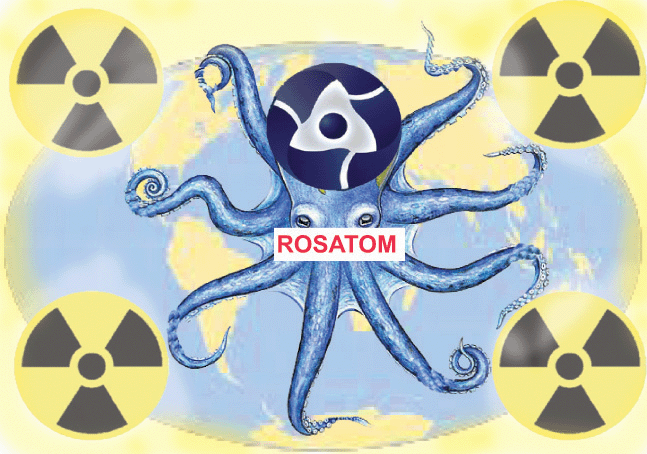 World Nuclear News 16th May 2018 Rosatom, the Russian state nuclear corporation, yesterday signed a series of agreements with overseas companies during the Atomexpo conference and exhibition being held this week in Sochi, Russia. The agreements, with Chile, China, Cuba, Finland, Hungary, Iran, Italy, Kazakhstan, Saudi
Arabia, Serbia, Spain and Zambia, include the engineering and medical
sectors, among others.
http://www.world-nuclear-news.org/C-Rosatom-expands-overseas-links-with-new-agreements-16051801.html
Electricite de France (EDF) is lying about renewable energy: it’s really dedicated to nuclear power

Greenpeace France 14th May 2018 [Machine Translation] On the eve of EDF’s Annual General Meeting,
Greenpeace France points to the deception that EDF’s CEO has been driving for several months and will present the shareholders of the company tomorrow.
With a lot of communication on the energy transition, the company is far from developing renewable energies and directs almost all of its investments in nuclear power. That is a losing strategy, both for the company, and for France, which is lagging far behind the implementation of its energy transition.
Faced with EDF shareholders, Jean-Bernard Lévy will no doubt say tomorrow that the company plays a central role in the energy transition, with its solar plan for 2035 presented in December 2017. ” In reality, when we compare the calendars and EDF budgets, we realize that the company will mainly give priority to investments in the nuclear fleet and
postpone its investments in solar …
In general, the company is already behind the targets that she fixed herself. And yet, in 2017, it devoted only 10% of its investments to renewables! ” Exclaims Alix Mazounie, energy campaigner for Greenpeace France.
https://www.greenpeace.fr/espace-presse/ag-dedf-3-intox-jean-bernard-levy-presentera-demain-aux-actionnaires/
Timothy Mousseau to lead research into radiation in Chernobyl dogs
South Carolina researcher wants to learn about radiation by researching stray dogs near Chernobyl https://www.postandcourier.com/features/south-carolina-researcher-wants-to-learn-about-radiation-by-researching/article_eee33baa-5454-11e8-89c1-17da43576a65.html By Mary Katherine Wildeman mkwildeman@postandcourier.com May 14, 2018
In UK Parliament Greens Party demands the government comes clean about funding Hitachi for nuclear project
 Daily Post 14th May 2018 , Demands have been made by the Green Party for an ‘urgent debate’ on whether
the UK Government is offering a package of financial support to build Wylfa Newydd.
The Daily Post reported this month that Prime Minister Theresa May
was meeting Hitachi Chairman Hiroaki Nakanishi for crunch talks on funding
for nuclear reactors. There were warnings Hitachi could withdraw from the
multi-billion pound Horizon Nuclear Power ventures on Anglesey and in
Gloucestershire unless assurances were made on finances.
There have been reports in the Japanese press that the UK government has agreed to offer
financial guarantees for the project. But a spokesman for the Department
for Business, Energy, and Industrial Strategy(BEIS), said: “We don’t
recognise these reports.”
Now Green MP Caroline Lucas has demanded a
meeting to clarify the Government’s position. She tweeted: “This is
absolutely outrageous. “The government is planning to plough billions of
pounds of taxpayers’ money into failing nuclear without any transparency
or scrutiny. I’m calling for an urgent debate on this in parliament.”
https://www.dailypost.co.uk/business/business-news/demand-urgent-debate-whether-uk-14656243
Nuclear Industry Association (NIA) Chief Executive Tom Greatrex warns on Britain’s nuclear problem in leaving EU
Express 15th May 2018 , BRITAIN could be left with no fuel to supply power stations after Brexit if it cannot replicate a series of nuclear safeguards currently governed by the European Union, warned Nuclear Industry Association (NIA) Chief Executive Tom Greatrex.
The former Labour minister claimed Britain’s
decision to quit Euratom – the body that governs the transportation of
radioactive materials needed in nuclear energy and research – could
result in no fuel for British power stations after Brexit. Speaking
exclusively to Express.co.uk, Mr Greatrex warned that Britain cannot
produce fuel in the UK without the raw materials from around the world,
which can only be obtained if necessary safety measures are in place –
including a governing body on the transport, trade and regulation of
nuclear matter.
https://www.express.co.uk/news/uk/959639/Brexit-news-UK-EU-European-Union-nuclear-industry-referendum-Euratom-power-station
New problem is troubling Finland’s Olkiluoto 3 nuclear project
 Tekniik & Talous 14th May 2018 , [Machine Translation] New problems have arisen in TVO’s hot tests at
Olkiluoto 3. The connection line of the main pipework of the plant, the reactor cooling circuit, vibrates more than allowed. The problem is reported by the supervising authority Stuk in its recent monitoring report.
The problem has emerged in hot tests where the reactor and turbine plant systems are heated by the heat generated by the main circulation pumps to the correct operating temperatures. Heat tests ensure that the facility is safe to charge nuclear fuel. Before that, the body still needs a government license. According to Stuk, the reason for the vibration is still under way. Stuk explains the following. In Stucco’s Executive Director Petteri Tiippana, the problem is not negligible.
https://www.tekniikkatalous.fi/tekniikka/energia/olkiluoto-3-n-tarkein-putkisto-varahtelee-liikaa-stukin-mukaan-korjaaminen-on-mittava-tyo-6724597
Bulgaria’s struggle to find the money for building Belene nuclear power project
Reuters 12th May 2018 , Bulgaria’s government will ask parliament to give it the authority to
negotiate with investors to build the Belene nuclear power project on the
Danube River, the prime minister said on Saturday.
The Black Sea state initially canceled the project, estimated to cost about 10 billion euros,
in 2012 after failing to find foreign investors and bowing to U.S. and
European Union pressure to limit the country’s energy dependence on
Russia, which would have supplied some equipment.
The current government of Prime Minister Boyko Borissov, however, is renewing the search for private
investors to build the plant after an arbitration court ruled in 2016 that
Bulgaria must pay more than 600 million euros ($717 million) in
compensation to Russian state nuclear company Rosatom due to the
cancellation.
https://www.reuters.com/article/us-bulgaria-nuclear-belene/bulgarian-government-to-seek-mandate-for-talks-with-investors-over-nuclear-plant-idUSKCN1ID0TE
UK Nuclear-Free Local Authorities group (NFLA) slams decision to spend £2.5 billion on nuclear-armed submarines
Morning Star 14th May 2018 , A GOVERNMENT decision to spend £2.5 billion on nuclear-armed submarines
was slammed today by local authorities committed against nuclear weapons
and nuclear power. Defence Minister Gavin Williamson announced at the BAE
dockyard in Barrow that he has signed a £1.5bn contract to build a seventh
Astute “hunter-killer” submarine for the Royal Navy. And £960 million
worth of contracts have also been signed for the construction for
Britain’s four nuclear-armed Trident Dreadnought submarines.
The Manchester-based Nuclear-Free Local Authorities group (NFLA) condemned the
spending as being “against the ‘good faith’ commitments for nuclear
disarmament enshrined in the Nuclear Non-Proliferation Treaty.”
https://www.morningstaronline.co.uk/article/h-250-nfla-against-new-nuclear-submarines-contract
Latest UK bribe for storing nuclear waste is “completely inadequate”.
 Campaigners slam £1m incentive to store nuclear waste https://www.theguardian.com/environment/2018/may/12/incentive-compensation-nuclear-waste-boreholes-communities
Compensation offered to encourage local communities to allow test boreholes is described as ‘completely inadequate’
MPs from both major parties have attacked the government’s latest incentive to entice communities into volunteering to host Britain’s first deep underground store for nuclear waste as “completely inadequate”.
Ministers have offered up to £1m per community for areas that constructively engage in offering to take part in the scheme, and a further sum of up to £2.5m where deep borehole investigations take place.
The aim is to find a permanent underground geological disposal facility (GDF) that could store for thousands of years the waste from Britain’s nuclear energy and bomb-making programmes. The scheme could involve building stores under the seabed to house highly radioactive material. It is predicted that the UK is likely to have produced 4.9m tonnes of nuclear waste by 2125.
But critics say the inducements offered by the government – part of the consultations it launched this year – to ensure local cooperation are “simply not good enough”, and point to the example of France, which has a similar amount of nuclear waste. It offers around €30m (£26.5m) a year as local support for districts neighbouring the site at Bure, in north-east France, and has also offered €60m in community projects.
“The government’s offer in its consultation is simply not good enough. These communities are being asked to perform an important public service and should be properly recompensed,” said Rebecca Long-Bailey, the shadow business secretary.
However, local campaigners fear that a waste site could affect tourism, on which Cumbria is heavily reliant. “For the sake of a few hundred jobs and a few million pounds, we risk thousands of jobs in the tourism sector, which contributes £2.7bn a year to Cumbria’s economy,” said Geoff Betsworth, chairman of the Cumbria Trust. “Even a 10% dent in tourism would cost £270m a year. The offer of £1m in community benefits, rising to £2.5m when boreholes begin, is absurdly low.”
The government is seeking to dispose of the UK’s nuclear waste underground because current storage facilities are both ineffective and expensive to maintain. A GDF would involve sealing the waste in rock for as long as it remains a hazard.
 The plan was also criticised by the Conservative MP Zac Goldsmith, who said the UK should stop making nuclear waste and stop building new reactors.
“We are still pouring untold billions of taxpayer money into propping up an industry that the free market would have killed off years ago,” he said. “In return, we will be compounding the catastrophe of a nuclear waste build-up, which we are no closer to solving than we were when the industry was born.”
Nina Schrank, energy campaigner at Greenpeace UK, added: “The lack of seriousness with which the UK government treats nuclear legacy issues makes it predictable that their quest for a suitable site has been so unsuccessful that they are looking again at the Irish Sea, which Sellafield turned into one of the most radioactively contaminated seas in the world.”
A government spokesperson said: “The GDF will be a multibillion-pound project that can provide substantial benefits to host communities. This includes skilled employment for hundreds of people for decades to come, spin-off benefits such as infrastructure investment, as well as positive impacts on local service industries that support the facility and its workforce.”
Nuclear cargo on the same route as fracking lorries – Springfield UK’s secret danger
Radiation Free Lakeland 11th May 2018 The nuclear industry and Cuadrilla have a vested interest in not putting the spotlight on Springfields. They have a vested interest in not highlighting the thousands of lorryloads of for example uranium hexaflouride arriving at and leaving the plant.
The Springfields site is the spinning spider at the centre of the web of the Government’s new nuclear build and continuing nuclear weapons agenda. Adding fracking to this toxic brew is obsene and it does the campaign against fracking no
favours in keeping quiet about it.
Does the Inspector of the Roseacre Wood inquiry have details of the HGV movements to and from Springfields site –
If not why not? Certainly fracking campaigners have been kept in the dark about it. If only Radiation Free Lakeland have raised the issue of nuclear cargo on the same route as fracking lorries then something is wrong . The recent public inquiry into fracking at Roseacre Wood should have had Springfields dangerous nuclear and chemical transports at the centre of the inquiry.
https://mariannewildart.wordpress.com/2018/05/11/transports-of-uranium-hexaflouride-on-the-same-road-as-fracking-lorries-what-could-go-wrong/
In secret meeting, Theresa May promises that UK will cover Hitachi’s nuclear debt for Wylfa staion

 The Canary 11th May 2018 , Theresa May has reportedly just agreed to loan a Japanese firm £13.4bn to
spend on a nuclear power plant. But according to Caroline Lucas, she’s doing it “without any transparency or scrutiny”, effectively lending out public money behind closed doors.
The government has given the go-ahead for a replacement plant at the Wylfa Newydd nuclear power site on Anglesey.
It will be constructed by a consortium of three companies: Hitachi Nuclear Energy Europe, US-based Bechtel Management Company, and Japanese firm JGC Corporation (UK). Horizon Nuclear Power will oversee the £14bn project.
On 11 May, the Nikkei Asian Review reported that May has agreed to loan Hitachi $18.2bn (£13.4bn) for the project. She reportedly agreed to the loan during a meeting on 3 May with Hitachi chairman Hiroaki Nakanishi. A report in the Mainichi on 9 May said that the UK government had effectively offered to underwrite the debt.
https://www.thecanary.co/discovery/news-discovery/2018/05/11/theresa-may-has-reportedly-just-agreed-to-spend-13-4bn-on-a-nuclear-power-plant/
1 This Month
23-25 October – on Zoom – World BEYOND War’s annual global conferenc


Shut down the radiation-damaged Heysham nuclear reactors now
To see nuclear-related stories in greater depth and intensity – go to https://nuclearinformation.wordpress.com

Say No to NASA’s Reckless Nuclear Reactor on the Moon
Say No to NASA’s Reckless Nuclear Reactor on the Moon

-
Archives
- October 2026 (199)
- September 2026 (339)
- August 2026 (330)
- July 2026 (355)
- June 2026 (287)
- May 2026 (306)
- April 2026 (356)
- March 2026 (251)
- February 2026 (267)
- January 2026 (308)
- December 2025 (358)
- November 2025 (359)
-
Categories
- 1
- 1 NUCLEAR ISSUES
- business and costs
- climate change
- culture and arts
- ENERGY
- environment
- health
- history
- indigenous issues
- Legal
- marketing of nuclear
- media
- opposition to nuclear
- PERSONAL STORIES
- politics
- politics international
- Religion and ethics
- safety
- secrets,lies and civil liberties
- spinbuster
- technology
- Uranium
- wastes
- weapons and war
- Women
- 2 WORLD
- ACTION
- AFRICA
- Atrocities
- AUSTRALIA
- Christina's notes
- Christina's themes
- culture and arts
- Events
- Fuk 2022
- Fuk 2023
- Fukushima 2017
- Fukushima 2018
- fukushima 2019
- Fukushima 2020
- Fukushima 2021
- general
- global warming
- Humour (God we need it)
- Nuclear
- RARE EARTHS
- Reference
- resources – print
- Resources -audiovicual
- Weekly Newsletter
- World
- World Nuclear
- YouTube
-
RSS
Entries RSS
Comments RSS

