Many years before massive nuclear power station could be built at Bradwell, UK
 Maldon Standard 23rd May 2018 , THE site of the new nuclear power station at Bradwell is staggering in
size. Measuring the length of six football pitches, it sits on land near to
the existing station, now being decommissioned. The Standard was given
exclusive access to see how work was progressing at Bradwell B. EDF Energy
and the China General Nuclear Power Group have been carrying out early site
investigations into the site since December. Since then, the company has
been drilling and digging sampling holes and testing the soil. While work
is underway, the project is still very much in the beginning stage. Once
all groundwork is complete proposals for what the new power station could
look like will be drawn up. Then, a huge public consultation will be held,
alongside a generic design assessment, environmental assessment, and
nuclear site licence being sought. In short, we are many years away from
any station being built.
http://www.maldonandburnhamstandard.co.uk/news/16242529.Digging_deep__A_look_into_the_site_for_a_new_nuclear_power_station_in_Bradwell/
Hitachi’s build of Wylfa nuclear power station delayed – may never happen
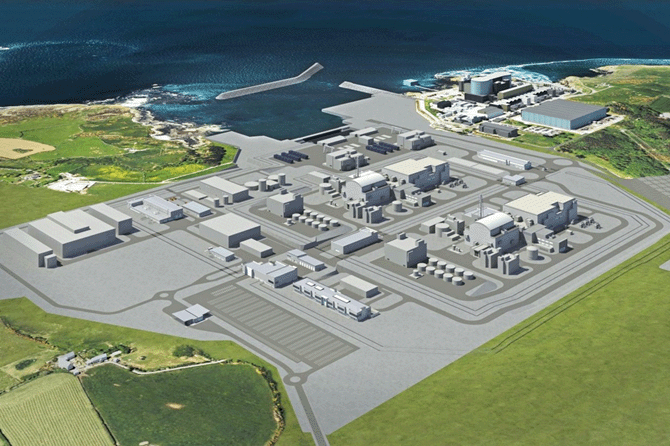
Asahi Shimbun 20th May 2018 [Machine Translation] Hitachi announced plans to delay the goal of starting
nuclear power plans planned in the UK for about two years to 2027. The collection of funds necessary for the project is difficult, and reconsideration of sharing has started between companies that undertake design and construction.
The continuation of the project itself is increasingly uncertain.
In the plan, two nuclear reactors will be built on Anglesey island in the UK. The goal of starting operation has been
announced as “early 20’s”.However, according to officials, the Hitachi side recently proposed a new goal “April 27” to companies and others involved in the plan. It is planned to decide whether to start construction in 2019,
but it seems to be assuming a case where this time is delayed.
https://www.asahi.com/articles/ASL5M4HZ3L5MULFA001.html
European Union remains committed to the Iran nuclear agreement, reassures Iran

 Europe reassures Iran of commitment to nuclear deal without U.S, Alissa de Carbonnel 19 May 18 TEHRAN (Reuters) – The European Union’s energy chief sought to reassure Iran on Saturday that the bloc remained committed to salvaging a nuclear deal with Tehran despite U.S. President Donald Trump’s decision to exit the accord and reimpose sanctions.
Miguel Arias Canete delivered the message on a visit to Tehran and also said the 28-nation EU, once the biggest importer of Iranian oil, hoped to strengthen trade with Iran.
“We have sent a message to our Iranian friends that as long as they are sticking to the (nuclear) agreement the Europeans will… fulfill their commitment. And they said the same thing on the other side,” Arias Canete, European Commissioner for energy and climate, told reporters after talks with Iran’s nuclear chief Ali Akbar Salehi.
Salehi said it would be disastrous if EU efforts fail to preserve the 2015 deal, in which Tehran agreed to curb its nuclear work in return for the lifting of most Western sanctions. “The ball is in their (EU leaders) court,” Salehi said. “We hope their efforts materialize.”
Since Trump’s announcement of the U.S. exit on May 8, EU leaders have pledged to try to keep Iran’s oil trade and investment flowing but admitted that will not be easy to do so.
Britain, France and Germany back the deal as the best way of stopping Tehran getting nuclear weapons but have called on Iran to limit its regional influence and curb the missile program……..https://www.reuters.com/article/us-iran-nuclear-eu/europe-reassures-iran-of-commitment-to-nuclear-deal-without-us-idUSKCN1IK063
UK’s contentious new arrangement for nuclear safeguards, following exit from Euratom
 David Lowry’s Blog 17th May 2018 , Brexit correspondent missed the main issue arising from the UK nuclear
regulator’s report leaked to Sky News. On July 13 last year, the UK
Government position paper on “Nuclear materials and safeguards issues,”
included the key proposal that the UK will: “take responsibility for
meeting the UK’s safeguards obligations, as agree with IAEA
(International Atomic Energy Agency).”
Currently “ safeguards” are applied in the UK under a ‘voluntary ‘trilateral treaty between the UK,
Euratom and the IAEA. It comprises 36 pages in total, opening with the key
element in the treaty stating in A r t i c l e 1(a) “The United Kingdom
shall accept the application of safeguards, in accordance with the terms of
this Agreement, on all source or special fissionable material in facilities
or parts thereof within the United Kingdom, subject to exclusions for
national security reasons only (my emphasis)
The exclusion opt out is explained at Article 14 which reads in part: “If the United Kingdom
intends to make any withdrawals of nuclear material from the scope of this
Agreement for national security reasons …. it shall give the Community
(ie Euratom) and the Agency (IAEA) advance notice of such withdrawal…”
The ONR has been given unprecedented responsibility for policing a
diplomatically contentious new arrangement, which will increase suspicion
among member states of the 1968 nuclear nonproliferation treaty ( for which
the UK , as a co-drafter of the treaty text, is one of three depositary
states) – which ministers pray-in-aid whenever they discuss the rationale
for a UK nuclear safeguards system. However, ministers routinely
cherry-pick those parts of the NPT that suite their purposes: but the NPT
is an integrated diplomatic agreement, with its articles all relevant and
related.
Cherry-picking is both diplomatically unwise, as it normalises
abrogation for other signatory nations, and undermines the very treaty for
which the UK is supposed to act as a protective depositary state!
http://drdavidlowry.blogspot.co.uk/2018/05/uk-nuclear-safeguardsare-dangerously.html
Hitachi’s nuclear export transfers risks to both Japanese and British people while companies get profits
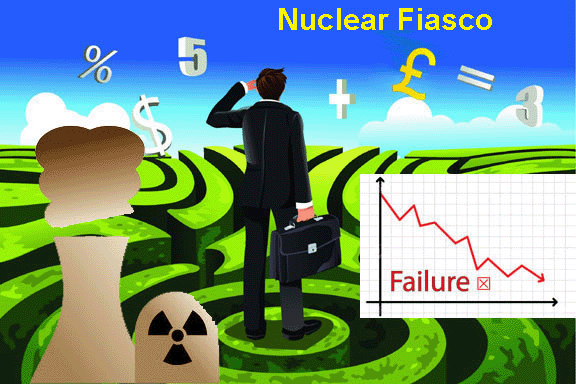 Urgent Joint Statement: Hitachi’s nuclear export transfers risks to both Japanese and British people while companies get profits http://www.foejapan.org/en/energy/doc/180502.html
Hitachi’s Chairman Nakanishi is reportedly going to visit British Prime Minister Teresa May on 3rd May to ask the U.K. government to take a direct stake in Wylfa Newydd nuclear power project in Anglesey, Wales. The report says Hitachi is going to ask not only for direct investment but also an assurance for a power purchase agreement(1). Hitachi’s struggle just shows the risks of the nuclear power project is simply huge.
In February, Mr. Nakanishi already expressed the view that the project would not happen without government commitment and stated “Both UK and Japanese governments understand that the project would not go on without the commitment by the governments”(2). To reduce the risk of the project, the project is said to be insured by Nippon Export and Investment Insurance(NEXI), 100 percent Japanese government owned export credit agency(3).
In addition to huge construction cost, nuclear projects are associated with various risks such as accidents, increased cost for tougher regulations, opposition from local people, radioactive waste management and so on. Risks are too huge to manage. Thus, it is clear that companies should decide to retreat from the project. While transferring risks of the project to people, it is unacceptable that the companies and banks take profits.
Electricity generated from Hinkley Point C nuclear power, which is currently under construction in UK will be purchased at £92.5/MWh, which is approximately twice as expensive as the average market price. National Audit Office of UK warned that this would increase ratepayers burden (4). If UK government gives an assurance for expensive price of electricity to Hitachi, the project will put more burden not only Japanese taxpayers with huge risks, but also British ratepayers with huge costs. For whose sake is this project?
The project site for Wylfa Newydd is surrounded by pristine nature. Colonies of protected bird such as Arctic terns was discovered near the site(5). The National Welsh Coastal Path borders the land bought by Hitachi which is in an area of Otstanding Natural Beauty. The project would put a heavy burden on the social and economic infrastructure on the island rather than benefitting the local economy(6) .
“Don’t pour good money in to the bottomless black hole of nuclear power. This is an old fashioned, dirty, dangerous and extortionately expensive technology. The Fukushima triple explosions and meltdowns has and will continue to cost the people of Japan greatly. There is no end in sight for this continuing tragedy, which means that no new nuclear reactors are going to be built in Japan. It is unacceptable that Japan wish to export this deadly technology to another state in order to keep Japan in the nuclear club.”
TEPCO’s Fukushima Daiichi nuclear accident is not over. Globally the cost of renewable energy decreases dramatically and energy efficiency is also improved. Exporting nuclear power is against that trend. This is morally and economically the wrong direction. Moreover, pouring public money to a handful of private companies without consulting the public or having discussion at a parliament is unacceptable.
Japanese government and companies should seek and promote nuclear phase out and sustainable and democratic energy systems based on thorough reflection on the lessons learned from the nuclear accident. We strongly oppose Hitachi’s Wylfa Newydd project. No money from Japanese and British taxpayers should be used to save this totally outdated and dangerously wasteful project.
1. “Hitachi seeks assurance from UK’s May on shared stake in nuclear project” Nikkei Asia Review, 29th April 2018.
2. ”Committements by both UK and Japanese government necessary fro Hitachi’s nuclear project, says next chair of Keidanren” (In Japanese) Reuters, 13th Feb 2018.
3.“Japanese and UK government to support Hitachi’s nuclear project, loss may result in public financial burden (in Japanese)” Asahi Shimbun, 11th Jan 2018.
4. “Hinkley Point C” National Audit Office, 23th June 2017
5.“Plans for Welsh nuclear power plant delayed by concerns over seabirds” Guardian, 9th Apr 2018.
6.“Wylfa Newydd: Nuclear plant ‘increases homelessness risk’” BBC, 27th Mar 2018.
Contact:
Friends of the Earth Japan
fukakusa@foejapan.org
+81-3-6909-5983
Ayumi Fukakusa
People Against Wylfa B
pawbcymru@gmail.com
Dylan Morgan
Indian and Russian governments getting together to market nuclear power globally
PM Modi, Vladimir Putin May Discuss Energy, Nuclear Issues At ‘No-Agenda’ Summit
With China, reducing the tension on the border was important but with Russia, a trusted all-weather partner, increasing trade ties and stepping up defence and atomic energy cooperation could be on agenda
……. The meltdown of the Iranian nuclear deal after the US unilaterally pulled out of it would come up for sure, especially since India has ‘civilizational links’ with Iran. The patch up happening between North and South Korea over nuclear weapons is also going to be on the table. But closer home, atomic talks related to Kudankulam Nuclear Power Plant are also likely to be part of the summit.
PM Modi is expected to reassert India’s avowed position of complete denuclearisation of these weapons of mass destruction from the world.
Indo-Russian atomic energy cooperation could also be reviewed at the highest level. Reports suggest that India has invested nearly $5 billion in the Russian energy sector. Bilateral civil nuclear co-operation could be very high on the agenda.
……… atomic experts say, discussion on the second site for the Russian Nuclear Park would be on the anvil. In the 2014 Indo-Russian ‘Strategic Vision’ document on nuclear cooperation, the two countries have committed themselves to building in all 16 nuclear reactors in the next two decades. In all, six reactors will come up at Kudankulam and the remaining six at another site.
Today, it seems the next set of six reactors could come up in Andhra Pradesh. It is hoped that later this year in October, at the proposed formal summit, the two countries will announce the allotment of the second nuclear park site to Russia.
……… The Indo-Russian nuclear deal is well worth over Rs. 4,50,000 crores and could be the mother of all deals.
It may be worth noting that as part of the agreement for the Indo-US Civilian Nuclear Deal, India has committed to buy 10,000 MW of reactors from USA and France. But unfortunately, both the French nuclear company Areva and the American atomic giant Westinghouse ran into financial trouble and declared bankruptcy, and the new owners are still taking charge in both the countries. In all possibility, India may not order either French or American reactors for the next three to four years till these ‘new technologies’ are safely operating.
India is getting to partner in these Bangladeshi reactors by providing training to Bangladeshi atomic engineers at Indian reactor sites. The three countries have signed a tripartite nuclear agreement on Rooppur, confirmed Anwar Hussain, Secretary of the Ministry of Science and Technology in Dhaka, who spoke exclusively to NDTV on the sidelines of the 10th edition of the Atomexpo exhibition held at Sochi. At least 3,000 participants from 68 countries presented an upbeat picture of the global nuclear industry at the exhibition. https://www.ndtv.com/india-news/pm-modi-vladimir-putin-may-discuss-energy-nuclear-issues-at-no-agenda-summit-1854710
UK govt worried about nuclear security – wants to train security officers for overseas reactors
Contract offer to counteract global threat to nuclear sites, https://www.telegraph.co.uk/business/2018/05/20/contract-offer-counteract-global-threat-nuclear-sites/ 20 MAY 2018
The Government is so concerned about the global threat to nuclear power stations that it is seeking a company to provide security training to foreign operators.
The Department for Business, Energy and Industrial Strategy (BEIS) has published a £6m tender for a private company to deliver what it calls a National Security Culture Programme. It is part of a wider push to make sure that chemical, biological, radiological and nuclear materials are out of reach to terrorist groups or hostile states.
The successful company will be sent to overseas nuclear facilities to deliver training on attack prevention by helping organisations to increase security and better protect sensitive information. According to the tender documents, found by procurement company Tussell, the job will be aimed at overseas civil nuclear sites.
It will also cover a range of organisations, including those holding radioactive material, such as hospitals, and sensitive knowledge or information, such as academic or scientific institutions, as well as regulators and government departments.
The contract is expected to start in July 2018 and will run until March 2022. This work is the first external tender relating to the Government’s global threat reduction programme, hinting at the level of concern among top officials about the possibility of an attack on nuclear power plants.
Nuclear facilities have long been considered a target for groups looking to disrupt power supplies.
Last year, Britain’s nuclear power stations were told to tighten their defences against terrorist attacks after concerns were raised that terrorists had worked out how to bypass electronic security systems.
A spokesman for BEIS said the tender was part of “a continuing education programme about encouraging greater awareness of nuclear security issues and best practice overseas”.
Russia building an underwater drone that can carry nuclear warheads
Russia building underwater nuclear drone that could cause TSUNAMIS as big as 2011 disaster
MOSCOW is in the process of constructing an underwater drone that can carry nuclear warheads, destroy naval bases and cause tsunamis, according to a Russian state news agency. Express UK, By CAITLIN DOHERTY18 May 18, A source told TASS news agency the Poseidon drone will be able to carry nuclear weapons of up to two megatonnes.
The drone will operate at under-sea depths of more than 1 kilometre, and will have a speed of between 60 and 70 knots.
The source said: “It will be possible to mount various nuclear shares on the ‘torpedo’ of the Poseidon multipurpose seaborne system, with the thermonuclear single warhead. They added it will “have the maximum capacity of up to two megatonnes in TNT equivalent”….
The Russian President said the machine would have “hardly any vulnerabilities” and would carry “massive nuclear ordinance”.
“There is simply nothing in the world capable of withstanding them.”
The name Poseidon was chosen after open voting on the Russia’s Defence Ministry website.
TASS news agency has not been able to confirm the information provided by the source.
One physicist has said a machine of this magnitude could cause as much damage as the tsunami that hit Japan in 2011.
Rex Richardson told Business Insider: “A well-placed nuclear weapon of yield in the range 20 MT to 50 MT near a sea coast could certainly couple enough energy to equal the 2011 tsunami, and perhaps much more.
“Taking advantage of the rising-sea-floor amplification effect, tsunami waves reaching 100 meters [330 feet] in height are possible.”…https://www.express.co.uk/news/world/961500/Russia-building-underwater-nuclear-drone-that-could-cause-tsunami-japan-2011
UK Nuclear Subsidies – We Told You So – Hinkley Point C
 NuClear News No.107 May 2018
Ten years ago Steve Thomas, Professor of Energy Policy at Greenwich University predicted that nuclear companies would eventually insist on receiving subsidies to build new reactors, and the government would be forced to drop its refusal to give subsidies or abandon its nuclear ambitions. Regrettably his prediction has come true. (1)
Hitachi Chairman Hiroaki Nakanishi had a face-to-face with Prime Minister Theresa May earlier this month, and according to the Japanese media the UK government has offered to shoulder 2 trillion yen (£13.3 billion) in loans and other means to cover a huge portion of the cost of new reactors at Wylfa. Whether that will be enough to persuade Hitachi to go-ahead remains to be seen. The Company is reported to be planning to decide week ending 19th May according to the Mainichi newspaper. (2)
Horizon was supposed to be submitting its application for Development Consent to the Planning Inspectorate by the end of March, but this has now been delayed until spring or summer. (3) Officially the application has been delayed by concerns over the plant’s impact on colonies of protected seabirds. The Company said it needs to thrash out the impact building the power station will have on colonies of sandwich, Arctic and common terns. The species are protected under the EU birds and habitats directive. Nearby Cemlyn nature reserve is home to thousands of sandwich terns, which account for about fifth of the birds’ UK population and is the biggest on the country’s west coast. Wildlife groups are concerned about the effect of noise and light from the power station’s construction, as well as a reduction in food for the birds to forage on. Land clearance for the vast site is also expected to displace potential predators, such as rats and foxes. The company says it hopes to resolve the issues and submit the Development Consent Order (DCO) application before the end of June. The delay is expected to be a bump in the road rather than major headache for Horizon, which, rather optimistically believes Wylfa could be generating electricity by the mid-2020s. (4)
Horizon might be telling the truth about the need to resolve these wildlife issues, but the delay gives the Company more time to lobby the Westminster Government for more financial support to build the reactors.
Hitachi now says it wants to slash its Horizon shareholding. The Chairman was apparently planning to ask Theresa May to take direct stake in Horizon. According to the Nikkei Asian review Hitachi expects the U.K. government to invite private British companies to participate and hopes to reduce its own stake to less than 50%.
Hitachi has recently concluded that the risk of proceeding with the Anglesey project, at an estimated cost of more than 3 trillion yen (£20 billion), is too great to manage on its own as a private company. It plans to withdraw from the project if restructuring negotiations fall through. Such a move would have significant repercussions for nuclear power policy for both Britain and Japan. In response to Hitachi’s concerns, the British government earlier this month proposed that U.K. interests and Japanese public and private interests join with Hitachi to move Wylfa forward. The three sets of shareholders would each put 300 billion yen into the project, giving each a one-third stake. According to sources, the company and the Japanese government.
see it as too risky for Japanese interests to retain a majority shareholding and hope that British interests will acquire a controlling stake. (5)
Number 10 remained tight-lipped over its negotiations with Hitachi, and a spokesman declined to comment on the latest talks. Hannah Martin, of Greenpeace, said the “information blackout” is “unjustifiable” because of the high costs to be paid by energy users to support the projects. “The public have a right to know what the government is planning to do with their money and why,” she said. “Major Western economies are reducing their exposure to nuclear, so why is Britain doing the exact opposite? It would make no sense to waste yet more on expensive and outdated nuclear when technologies such as offshore wind can do the same job faster and cheaper”. (6)
The Times reports that the entire £15bn-plus cost of Wylfa could land on the government’s balance sheet, even though taxpayers are expected to hold only a minority stake. The final deal with Hitachi may see taxpayers take an equity stake in Wylfa, possibly as much as 33%, alongside Hitachi and the Japanese government. Direct state exposure to the construction of a nuclear plant has faced stiff resistance from the Treasury because of fears about cost overruns and the impact on government debt. Industry insiders said a minority taxpayer stake could result in the entire liability landing on the state’s books, despite the Japanese partners, because official statisticians now take a more conservative approach to accounting for risk where the government is concerned. Any state stake in Horizon would be sold on once construction was completed. (7)
The Japanese Mainichi newspaper reported that Hitachi had received an assurance from the British government that it will guarantee loans for the construction of two reactors in Wales. But Hitachi is still pushing for the British government to take a stake in the project and guarantee electricity prices to ensure it is profitable, the Mainichi said. The cost of the Hitachi project in Wales has ballooned to 3 trillion yen (£20 billion) due to the tougher safety measures, the newspaper said. But BEIS said “We don’t recognise these reports. Nuclear power remains a crucial part of the UK’s energy future but we have always been clear that this must be delivered at the right price for consumers and taxpayers.” (8)
The Times concluded that Britain’s plans to offer financial support for Wylfa were mired in confusion amid conflicting reports of the meeting between the prime minister and Hitachi. Duncan Hawthorne, chief executive of Horizon, told The Times last year that loan guarantees would not make the plant viable and the company had been seeking direct government investment as well as a subsidy contract. Mainichi reported that the plant would cost more than £20 billion, making it even more expensive than EDF’s Hinkley Point C project. A Horizon source distanced itself from that figure. (9)
Caroline Lucas says if Theresa May has agreed to a £13.3 billion loan she’s doing it “without any transparency or scrutiny”, effectively lending out public money behind closed doors. (10) The SNP demanded the Government rule out public money on “failing nuclear projects”. Drew Hendry, their business spokesman, said: “This is yet another damning report of the UK government’s misguided nuclear obsession. Hinkley Point is already set to cost consumers a fortune because of the appalling strike price deal the UK government made with EDF. The Prime Minister must now categorically rule out any public bail out of this, or any other nuclear project and put an end to secret discussions behind closed doors.” (11)
Hannah Martin, Head of Energy at Greenpeace UK, said: “No bank, hedge fund or insurer will touch the UK’s new nuclear programme with a bargepole. So Hitachi has no option but to ask the government for a taxpayer bailout to keep their collapsing reactor programme afloat. This would leave the British public to carry much of the cost and all of the risk. Any prudent investor would laugh at this request. After the Hinkley debacle, it’s vital that the government stops trying to keep our energy policy a secret and presents any offer of a deal to Parliament before the Hitachi board meeting at the end of May. Otherwise it’s difficult to know where their generosity to the nuclear industry might end.”
Prof Stephen Thomas says Wylfa could provide a new model for UK nuclear projects. The Government needs something to demonstrate that Hinkley is the exception rather than the rule. Wylfa has 3 big advantages – support of the Japanese Government; unlike Areva and Westinghouse Hitachi-GE is not bankrupt and disgraced; and it is claimed that the ABWR is a proven technology. The project is a little bit cheaper than Hinkley but only because it’s smaller. Loan guarantees will be essential, and will reduce interest payable to banks. Hitachi is too small to own and operate a facility that is going to cost £25bn. And they don’t have the experience to operate it. The ABWR is actually quite an old reactor design. There are no other prospects for Hitachi to sell the ABWR. 4 reactors in Japan were completed in 4 to 5 years, but that’s the same for other reactors in Japan. There are 2 uncompleted reactors in Japan; and 2 reactors ordered for Taiwan but work suspended. The lifetime load factor of the 4 reactors has been very poor 47 – 71%. All have suffered long shutdowns. In 3 cases this was down to seismic issues. Two reactors had big turbine problems. Even if you take out those years when the reactors were shut performance was still poor. It’s a pre-Chernobyl; pre 9/11; pre-Fukushima design that we have a track record for. (12)
Steve Thomas’ briefing for Greenpeace on “The failings of the Advanced Boiling Water Reactor (ABWR) proposed for Wylfa Nuclear Power Station” is available here: https://www.greenpeace.org.uk/wp-content/uploads/2018/05/ABWR-briefing-final.pdf
Greenpeace has also published a briefing on “Hitachi’s nuclear safety breaches and the case against public funding for the proposed Wylfa Nuclear Power Station.” https://www.greenpeace.org.uk/wp-content/uploads/2018/05/hitachi-briefing-final.pdf http://www.no2nuclearpower.org.uk/wp/wp-content/uploads/2018/05/NuClearNewsNo107.pdf
Trial of French activists who entered Cruas nuclear plant to demonstrate vulnerability of spent fuel storage pools
 Liberation 17th May 2018 [Machine Translation] At Greenpeace activists’ trial, nuclear safety is no exception. At the trial of 22 activists of Greenpeace, the court tried Thursday to limit the debates to the facts – their intrusion in November in the nuclear site of Cruas-Meysse (Ardèche) – without being able to avoid the question of the safety of the power plants, that the NGO is
 questioning.
This action, preceded by a first in Cattenom (Moselle), had the same objective for its authors: to show flaws in the safety of spent fuel storage pools. The hearing was held under high police protection while a rally to support these “whistleblowers” was held all day in front of the courthouse. http://www.liberation.fr/societe/2018/05/17/au-proces-de-militants-greenpeace-la-securite-nucleaire-n-echappe-pas-aux-debats_1650850
Mediapart 18th May 2018 Against Greenpeace, state prosecutes civil disobedience. Sentences of reprieve and imprisonment were required against the twenty-three activists of Greenpeace who illegally entered the Cruas nuclear power plant in November 2017. For the public prosecutor, as for EDF, “it is time it stops. It is no longer possible to tolerate these repeated intrusions . ”
https://www.mediapart.fr/journal/france/180518/contre-greenpeace-l-etat-fait-le-proces-de-la-desobeissance-civile
Nuclear Subsidies – We Told You So – Moorside and Sizewell UK
 NuClear News No.107 May 2018, Moorside Seeking a Government stake in Horizon has been a key lobbying strategy for Hitacji for well over a year now, but the UK government’s refusal to make even a commitment in principle on that front has many in the UK nuclear industry worried. None more so than those invested in the success of another nuclear developer: NuGen, the company Toshiba hopes to sell to exclusive bidder Korea Electric Power Co. (Kepco). Kepco appears to be losing enthusiasm for the project in the absence of support from the UK government — especially with prospects of a reactor deal in Saudi Arabia. (13)
The state-run Korea Electric Power Corp. (KEPCO) is now saying that it will finalise its purchase of NuGen by September after analyzing its potential profits and viability. Yet in December, when KEPCO was selected as a preferred bidder by Toshiba, the company said it would finalise the deal in early 2018.The Seoul government is involved in the negotiation and is delving into the nuclear project’s profitability and potential risks, while the two companies have been discussing the detailed terms of contracts. Unlike KEPCO’s UAE project, which only involves the construction of nuclear reactors, market watchers say the Moorside project is more risky because KEPCO has to come up with financial solutions for construction and operation. The state-utility firm plans to build two of its APR-1400 reactors on the site, which would have a combined capacity of up to 3 gigawatts. (14)
Back home KEPCO is struggling with snowballing losses because of the South Korean government’s plan to shift to renewable energy from nuclear and coal power. (15)
 Sizewell
Meanwhile EDF Energy appears to be going through the same process as Hitachi – demanding huge government subsidies to continue with the project and threatening to pull out if it doesn’t get them; then denying that it was threatening and starting negotiations with a government obsessed with building new reactors. EDF Energy told the Times at the start of April that it would reconsider plans for Sizewell C if it is unable to agree a viable financing model with the UK government. EDF threatened to abandon work unless it receives assurances from the government this year that a viable funding model exists. Simone Rossi, EDF Energy’s UK chief executive, said that rapid progress was needed because promised cost savings would not materialise if there was a significant delay between work on Hinkley and work on Sizewell. Mr Rossi has promised that Sizewell should be a fifth cheaper to build than Hinkley Point because EDF will be able to replicate much of the design work and will have a fully qualified workforce and supply chain ready to transfer across. However, he warned that a delay could jeopardise this. A lull of six months could be surmountable, but two years or more would be a problem. (16)
Later EDF denied it had threated to abandon work on Sizewell C and distanced itself from a report that it may pull the plug on the project unless it receives financial assurances from the Government. (17) Emily Gosden, author of the Times story tweeted “apparently EDF has ‘distanced itself’ from my story this morning… which reported what its chief executive told me on the record.”
In May Le Monde reported that EDF had launched discussions with the British government to find a new way of financing new reactors in Sizewell. (18)
The GMB called on the government to stop dithering and get Sizewell built. It’s an absolute no brainer that Britain will need at least six new nuclear plants, it said, because the National Grid has forecast up to 35 million pure electric vehicles will be on the roads by 2050 needing an extra 30 gigawatts of power — the equivalent of 10 Hinkley Point power stations. (19)
Dr Simon Evans of Carbon Brief tweeted in response: Energy-related press releases from GMB union are a sight to behold. They constantly repeat the same talking points, many of which are misleading or just plain wrong. Also of note: with rare exceptions, the quotes never end up in the papers. GMB union keeps saying National Grid has forecast a need for 30GW of extra power for EVs. At best, this is hopelessly misleading. We explained why last year, but that hasn’t stopped GMB. (See https://www.carbonbrief.org/factcheck-how-much-power-will-uk-electricvehicles-need )
It is worth noting that Framatome (formally Areva NP, which is now owned by EDF, Mitsubishi Heavy Industries (MHI) and Assystem), is working on a ‘new model’ EPR, the EPR-NM, “offering the same characteristics” as the EPR but with simplified construction and significant cost reduction – about 30%. The basic design was 30% complete by March 2016, and EDF has said that it, not the complex EPR being built at Flamanville, would be the model that replaced the French fleet from the late 2020s. (20) EDF has already said it hopes to reduce the costs of Sizewell C by 20-30%. (21)
Since Sizewell C isn’t expected to become operational until 2031, with construction starting around 2021, (22) it seems highly unlikely that EDF would try building anything other than an EPR-NM design. The question then is whether the EPR-NM would be required to undertake a new Generic Design Assessment.
In April Caroline Lucas asked the Secretary of State for Business, Energy and Industrial Strategy, whether the Design Acceptance Certificate for the European Pressurised Reactor (EPR) could be used for a re-designed EPR. Energy Minister, Richard Harrington, replied that a GDA is not a statutory requirement of the nuclear licensing regime and any site specific elements of EPR design will be assessed by the Office for Nuclear Regulation as part of a site specific safety case ahead of any construction. (23) The DAC for the European Pressurised Reactor (EPR) was issued on 13 December 2012 and is valid for a period of ten years. Renewal of the DAC is not mandated. Harrington also noted that ONR expect to complete its assessment of the EPR sitespecific safety case for Hinkley Point C in 2018. DAC renewal is not mandated and EDF has not informed Government that it plans to seek a renewal.
It is hard to see how such big cost reductions can be achieved without some dramatic changes sufficient to require a new safety case
According to the FT the Labour party is divided over whether to back new nuclear power stations. The high cost of Hinkley has prompted questions across Westminster about whether nuclear still represents value for money. Some MPs favour the industrial benefits of building power stations, while a growing faction wants to support only renewable wind and solar energy programmes. “It’s like a wasp’s nest, the differences are really bad,” said one shadow minister. “The jury is out and personally I’m still not convinced that nuclear should be part of the mix.” Rebecca Long-Bailey, shadow business secretary, remains adamant that Labour should continue to support Wylfa, as well as Moorside. “Public investment in nuclear energy would bring huge benefits through the nuclear supply chain and energy security,” she said. Ms Long-Bailey’s position is also supported by Sue Hayman, shadow environment secretary, whose constituency is in Cumbria. Large unions, including Unite and the GMB, are also strong advocates of nuclear energy. But other senior Labour figures are arguing for a U-turn, unless the cost of new nuclear plants can be reduced sharply. One compromise under consideration could see Labour keep the commitment it made in last year’s manifesto by supporting smaller “modular” reactors. Senior people in the nuclear industry said they remained confident about Labour’s continued support for their projects, because of the strength of union backing. (24)
- For a nice short Q&A on ‘What’s happening with UK’s new nuclear power projects?’ see the Greenpeace Unearthed website: https://unearthed.greenpeace.org/2018/05/16/wylfa-hitachi-build-wales-newnuclear-project/ http://www.no2nuclearpower.org.uk/wp/wp-content/uploads/2018/05/NuClearNewsNo107.pdf
Hinkley point nuclear project grinds onwards through a sea of problems
NuClear News No.107 May 2018
EDF has detected quality deviations on certain welds at its new Flamanville-3 reactor – an EPR – the same type of reactor as the two being built at Hinkley Point. It has informed the French nuclear safety regulator ASN. Possible adjustments to the start-up timetable and costs can only be made after further checks and the licensing process by the ASN.
Flamanville-3 is currently expected to reach full power in Q4 2019 with fuel loading and first hot tests scheduled at the end of 2018. The quality deviations concern the welding of pipes on the main secondary system and are in addition to a deviation with respect to the correct application of “high-quality” requirements of the main secondary system that EDF flagged on February 22 to the ASN.
EDF has decided to carry out additional controls on the 150 welds in question and has ordered a full report into the causes and nature of the deviations. The additional controls and report will be completed by the end of May. The construction cost is currently estimated at £9.2bn. (1)
When EDF first reported welding problems on Feb. 22, it initially said there would be no impact on safety, costs or the reactor start-up schedule. However, France’s ASN nuclear regulator warned on Feb. 28 that the substandard welding could well have an impact the start-up. Even before the welding problems emerged, ASN had warned several times the reactor’s construction schedule was tight. “Following the current checks and the licensing process by the ASN, EDF will be able to specify whether the project requires an adjustment to its timetable and its costs,” (2)
The welding revelations come just a few short weeks after Britain’s nuclear regulator raised concerns about substandard quality control checks on EDF’s supply chain for Hinkley Point (See nuclear News No.106)
25 years after French engineers began working on the EPR, they have yet to get one running. Flamanville was due to start up in 2012 at a cost of €3.3 billion. EDF now hopes to switch it on next year and says that the reactor will cost €10.5 billion, though these targets could slip further in light of the latest setback.
Flamanville has faced several other setbacks, the most serious of which was the discovery that the reactor vessel was weaker than planned because of an excess carbon content. A raft of quality control failings at the Creusot Forge plant that made the vessel were found, including falsified documents. This triggered the Office for Nuclear Regulation’s decision to review the Hinkley Point supply chain, leading to a critical report last month.
The Times said one Flamanville is quite enough: The 1,650 megawatt European pressurised reactor is a mere six years late and three times over budget. And all the more exciting for it being the prototype for an even bigger nuclear disaster: the £20 billion, 3,200MW Hinkley Point C. At least the French nuclear guinea pig is finally on its home run, due to be loaded up with nuclear fuel in the last quarter of this year. Always assuming that EDF can sort out the dodgy welding on the cooling pipes. Anyway, it’s another EDF success story, up there with the carbon spots on the steel for Flamanville’s nuclear dome, the ones that potentially weakened it. Or the lost safety records from its Creusot Forge supplier. And it does make you think. It’s bad enough Theresa May signing us up to the world’s most financially radioactive energy project, without monthly reminders of EDF’s technical ineptitude. (4)
Hannah Martin, head of energy at Greenpeace UK, said: “The reactor destined for Hinkley Point was supposed to be cooking turkeys by Christmas 2017. As yet more construction flaws are revealed at its sister plant under construction in France, it’s starting to look like the only turkey the EPR reactor design is going to cook is EDF.”
Commenting on the news about defects in welding Stop Hinkley spokesperson Roy Pumfrey said
“The European Pressurised Water Reactor (EPR) reactor proposed for Hinkley Point C is like watching a car crash in slow motion. It is the unloved, unwanted, and unbuildable child of former EDF boss Vincent de Rivas. We can still stop this before it gets even worse. Although abandoning this ill-fated project now would incur cancellation costs consumers could still save almost £1.5bn per year for 35 years from 2027 onwards. Flamanville is seven years late, one in Finland is ten years late and even two in China will be at least five years late.” (5)
Dave Toke, reader in Energy Policy at Aberdeen University says the welding problems could spell the end for Hinkley C. Treasury backed loan guarantees have been linked to a target date for commissioning of the Flamanville plant of the end of 2020. Yet the current target date of completion by the end of 2019 has been thrown in doubt by the freshly announced problems. According to the analyst Professor Steve Thomas, the rules agreed between the European Commission and the British Government stipulate that until Flamanville 3 was in commercial service, there would be a cap on the guaranteed loans effectively meaning funding would be primarily through equity. It is very difficult to see how EDF could build the plant without the Treasury loan guarantee – something like £17 billion (probably more) would be needed as a loan. EDF just won’t have the ability to raise anything like £17 billion on the bond markets. Indeed the decision to go ahead with preliminary works on the site (building a jetty and a cement works) alone, without the loan guarantee being in place, was regarded as so risky that the firm’s Finance Officer resigned in protest at the decision. But EDF will not start building the main parts of the power station until it has the necessary finance. (6)
New problems have arisen at the EPR in Finland where TVO is carting out hot tests at Olkiluoto 3. The connection line of the main pipework of the plant, the reactor cooling circuit, vibrates more than allowed. According to the Finnish regulator, STUK, the reason for the vibration is still under investigation. (7)
China has begun loading fuel at its EPR at Taishan – a sign that the long-delayed project could finally be close to completion. Fuel loading could take several months, meaning the reactor could go into full operation and be connected to the grid before the end of the year. China began building the EPR in Taishan in 2009, with the first of two units originally scheduled to be completed in 2013. (8)
Meanwhile, the Irish Parliament’s (Oireachtas) Joint Committee on Housing, Planning and Local Government decided to investigate the possible transboundary effects on Ireland of Hinkley Point C. Professor John Sweeney of the National University of Ireland at Maynooth, Professor Stephen Thomas of Greenwich University and Attracta Ui Bhroin of the Irish Environmental Network were invited to give evidence. The meeting coincided with a recent consultation, organised by the Irish Government and facilitated by Irish Councils, that allowed environmental groups and concerned members of the public to put forward their concerns to the UK Government over the transboundary effects of the proposed Somerset new nuclear site. (9)
Attracta Uí Bhroin, of the Irish Environmental Network told the Committee that her intention was not to panic people or cause unnecessary concern, but her organisation wants to ensure Irish people’s rights are upheld. Although the process for the new nuclear site at Hinkley Point, which is 250km from the coast of Ireland, began five years ago, it was only in 2016 that the news about the plans broke. Hinkley Point C was given the final investment approval by French energy giant EDF, which has a two-thirds share and which is building the plant in conjunction with a Chinese company. Speaking to TDs and senators Uí Broin pointed out that of the eight power plants the UK has planned as part of its energy expansion, “five are on the west coast of the UK, facing Ireland on the most densely populated east coast”. Some of these plants are planned in locations closer than Hinkley Point C. The potential economic impact of a nuclear leak or meltdown could be very serious, she explained.
A 2016 ESRI report considered a scenario where there was a nuclear incident, but with no radioactive contamination reaching Ireland. “Even then they estimated that impact economically could be in the order of €4 billion,” she said, explaining that an incident such as this would have serious implications for the agrifood and tourism industries in Ireland. In the event of an incident where there is a risk of contamination, she said there are no detailed plans in place to protect Irish people, the water supply, or the country’s farm animals and produce.
Uí Bhroin was joined by Professors John Sweeney and Steve Thomas, who outlined some of the specific concerns around safety assessment and treatment of waste. Sweeney was critical of the models used in risk assessments – some older models were used in calculations, for example, despite the fact that more modern ones exist. Thomas spoke about some of the parts of the plant which are being made in France and which French regulatory authorities will not a clear for use in French nuclear plants. Uí Bhroin said there was an “extraordinary level of frustration, anger and disappointment” among environmental groups at the government’s reaction to these plans. (10)
Prof Thomas added that the reputation of both Flamanville and Hinkley’s supplier “is in tatters” after it emerged in 2015 that parts of the safety-critical reactor vessel supplied to Flamanville did not meet specification, he said. The French nuclear safety regulator, ASN, ordered the company to review its quality control procedures and “it has emerged that quality control documentation had been falsified at Creusot” for several decades, he added. In April 2018, EDF Energy also announced that up to 150 welds in key parts of Flamanville did not meet the required specification. Prof Thomas added: “This has created major concerns about parts manufactured there for nuclear plants in France and elsewhere.” (11)
John Sweeney, emeritus professor of geography at Maynooth University and a climate change expert, told the Oireachtas committee on planning yesterday that estimates used by the UK to assess its impact were not credible. “Combinations of rare events do occur, as was demonstrated by Fukushima [the nuclear incident in Japan in 2011], where total atmospheric releases are now estimated to be between 5.6 and 8.1 times that of Chernobyl,” Professor Sweeney said. Meteorological data used was “inadequate”, he added, arguing they relied on wind figures for three years when 30 years was the standard period required. “It’s rather dangerous to draw conclusions from a very short period. Three No2NuclearPower nuClear news No.107, May 2018 12 years of data, even ten years of data, is insufficient to characterise the wind climate at an individual location, and any modelling based on this is highly suspect.” He claimed the UK government failed to take account of climate change in estimating extreme high and low water levels when the difference between the annual high water mark and a once in a 10,000-years high water level at the site of the plant was just 1.3 metres. The Intergovernmental Panel on Climate Change predicted sea levels would continue to rise for centuries, with increases of up to three metres possible, which meant the UK’s estimates were not credible, he said. He claimed the failure to acknowledge that there was a known flood risk meant there were “serious implications for the safety of spent fuel which is intended to be stored on site for up to a century” (12) http://www.no2nuclearpower.org.uk/wp/wp-content/uploads/2018/05/NuClearNewsNo107.pdf
UK’s Radioactive Waste and Deep Geological Disposal

 NuClear News No.107 May 2018 The deadline for responding to the Government’s two consultations on a Geological Disposal facility (GDF) has now passed. According to the GDF Watch website there was a lot of discussion around three particular areas: the role of Local Authorities; earlier funding for community engagement; and readiness of RWM to engage with communities. (1
) BEIS produced two FAQ briefings in response to a number of common and recurring questions raised at their regional consultation workshops.
MPs from both major parties have attacked the government’s latest incentive to entice communities into volunteering to host Britain’s first deep underground store for nuclear waste as “completely inadequate”. Ministers have offered up to £1m per community for areas that constructively engage in offering to take part in the scheme, and a further sum of up to £2.5m where deep borehole investigations take place.
Critics say the inducements offered by the government are “simply not good enough”, and point to the example of France, which has a similar amount of nuclear waste. It offers around €30m (£26.5m) a year as local support for districts neighbouring the site at Bure, in north-east France, and has also offered €60m in community projects. “The government’s offer in its consultation is simply not good enough. These communities are being asked to perform an important public service and should be properly recompensed,” said Rebecca Long-Bailey, the shadow business secretary.
Geoff Betsworth, chairman of the Cumbria Trust points out that a 10% dent in tourism in Cumbria “would cost £270m a year. The offer of £1m in community benefits, rising to £2.5m when boreholes begin, is absurdly low.”
The plan was also criticised by the Conservative MP Zac Goldsmith, who said the UK should stop making nuclear waste and stop building new reactors. “We are still pouring untold billions of taxpayer money into propping up an industry that the free market would have killed off years ago,” he said. “In return, we will be compounding the catastrophe of a nuclear waste build-up, which we are no closer to solving than we were when the industry was born.” (2)
Burial under National Parks? Ministers have also been attacked for refusing to rule out burying nuclear waste under national parks. The government’s response to a question in the House of Lords was branded “absolutely shocking” by Green Party co-leader Caroline Lucas. Labour peer Lord Judd asked ministers to promise national parks, protected areas and areas of outstanding natural beauty will be excluded from the search. But energy minister Lord Henley said he was “not excluding” those areas yet while a National Policy Statement is finalised. He insisted: “Development for a Geological Disposal Facility should only be consented in nationally designated areas in exceptional circumstances and where it would be in the public interest to do so. “Even if such development were consented, the developer would be required to take a number of measures to protect and where possible improve the environment.” (3)
Burial under the seabed In response to another written question, Lord Henley said a GDF could also be placed under the sea: “The design could allow the underground facilities to extend offshore if accessed from onshore surface sites.” (4)
The former chair of the Cumbria Managing Radioactive Waste Partnership, Tim Knowles, mentions that the idea of looking for a site under the sea off the coast of Cumbria has been discussed. Cumbria Trust says “while we have had expert advice that West Cumbria does not contain an adequate onshore site, we accept that it is possible that a good site may be found further offshore.” (5)
The Trust says: “It is quite possible that an onshore GDF is simply politically undeliverable anywhere in the UK, so the expansion of the offshore search area is to be welcomed. An offshore GDF would need significant surface facilities on land, occupying around one square kilometre. The obvious location for these would be on the Sellafield site, but only if the offshore geology proves suitable, and if the local population agrees. The tunnel to the offshore GDF should begin at Sellafield to avoid the need to package radioactive waste for transportation outside a nuclear site.
This would also minimise any blight on local businesses, properties and tourism – the waste would remain on the Sellafield site until it was ready to enter the GDF via the tunnel.” (6)
Folkestone & Hythe District Council (FHDC) has asked the Government for more information on its Geological Disposal Facility (GDF). It is apparently considering volunteering Romney Marsh as a site for nuclear waste. This isn’t the first time nuclear waste has been up for debate on the marsh, the Department for Energy and Climate Change (DECC) asked councils to come forward as potential sites four years ago, but after some deliberation Shepway council scrapped the plans. Then, councillors voted 21 to 13 against formally expressing interest in the project. The issue had split residents, with 63% of people rejecting it in a survey. (7)
Fears have also been raised Derbyshire, Leicestershire and Nottinghamshire. A sedimentary basin known as the Widmerpool Gulf – which extends across the three East Midland Counties could be a potential site A response to a Government package of incentives designed to get communities to agree to ‘host’ a storage complex has been discussed by Leicestershire County Council, according to the Leicester Mercury. Any facility would look to bury waste at least 200 metres below ground somewhere in a geological area which stretches from the eastern fringes of Derby across the countryside to the south of Nottingham and on to the west of Melton Mowbray in north Leicestershire. Leicestershire County Council has said there are no specific proposals for a GDF in Leicestershire at this stage but it has asked for further information on the issue from the Department of Business, Energy and Industrial Strategy. A Leicestershire County Council report said: “Building and operating a GDF is a multi-billion pound, intergenerational, national infrastructure project, which is likely to bring substantial benefits to its host community, with skilled jobs for hundreds of people over many decades.”(8) http://www.no2nuclearpower.org.uk/wp/wp-content/uploads/2018/05/NuClearNewsNo107.pdf
Serbia to set up commission to examine health effects of NATO’s use of depleted uranium
Serbia to Probe Health Impact of NATO Depleted Uranium Balkan Insight 18 May 18 The Serbian parliament will establish a commission to examine the alleged effects on public health of NATO’s use of depleted uranium ammunition during the 1999 bombing of Yugoslavia. Serbian MPs are expected to vote on Friday to establish a parliamentary commission to determine whether NATO’s use of depleted uranium ammunition in 1999 has increased the number of cancer sufferers – despite scepticism from medical experts……..
But Kyle Scott, the US ambassador to Belgrade, said that the World Health Organisation and the UN determined that depleted uranium does not pose a serious health risk……..http://www.balkaninsight.com/en/article/serbia-to-examine-depleted-uranium-effects-from-nato-bombing-05-18-2018
EDF pinning its hopes for EPR nuclear reactor on the Taishan reactor, China
The French stress test for nuclear power, Ft.com 18 May 18
Years late and billions over budget the first European Pressurised Reactor is set to become operational. Its success is critical for France Andrew Ward in London and David Keohane in Paris MAY 17, 2018 “….. fuel loading at Taishan — one of the last steps before it starts producing electricity — carries wider significance beyond China. Taishan, operated by China General Nuclear Power Corp, the state-owned energy company, is on course to become, within months, the first plant in the world to operate a European Pressurised Reactor — the Franco-German technology plagued by delays and cost overruns since it was designed in the 1990s. “The Taishan 1 fuel loading is a very important milestone,” says Xavier Ursat, head of new nuclear projects for EDF, the French state-backed utility which owns 30 per cent of the project. “It will bring a new image to the EPR.”
1 This Month
23-25 October – on Zoom – World BEYOND War’s annual global conferenc


Shut down the radiation-damaged Heysham nuclear reactors now
To see nuclear-related stories in greater depth and intensity – go to https://nuclearinformation.wordpress.com

Say No to NASA’s Reckless Nuclear Reactor on the Moon
Say No to NASA’s Reckless Nuclear Reactor on the Moon

-
Archives
- October 2026 (199)
- September 2026 (339)
- August 2026 (330)
- July 2026 (355)
- June 2026 (287)
- May 2026 (306)
- April 2026 (356)
- March 2026 (251)
- February 2026 (267)
- January 2026 (308)
- December 2025 (358)
- November 2025 (359)
-
Categories
- 1
- 1 NUCLEAR ISSUES
- business and costs
- climate change
- culture and arts
- ENERGY
- environment
- health
- history
- indigenous issues
- Legal
- marketing of nuclear
- media
- opposition to nuclear
- PERSONAL STORIES
- politics
- politics international
- Religion and ethics
- safety
- secrets,lies and civil liberties
- spinbuster
- technology
- Uranium
- wastes
- weapons and war
- Women
- 2 WORLD
- ACTION
- AFRICA
- Atrocities
- AUSTRALIA
- Christina's notes
- Christina's themes
- culture and arts
- Events
- Fuk 2022
- Fuk 2023
- Fukushima 2017
- Fukushima 2018
- fukushima 2019
- Fukushima 2020
- Fukushima 2021
- general
- global warming
- Humour (God we need it)
- Nuclear
- RARE EARTHS
- Reference
- resources – print
- Resources -audiovicual
- Weekly Newsletter
- World
- World Nuclear
- YouTube
-
RSS
Entries RSS
Comments RSS

