Planning application for Wylfa nuclear plant examined, despite project halt due to lack of investment
Officials will rule on a development consent order (DCO) application for
the project in three months. If the Planning Inspectorate approves the DCO,
the project must also be approved by business secretary Greg Clark before
it can go ahead. Introduced in 2008, DCOs are designed to streamline
construction planning for projects designated as nationally significant by
rolling other individual consents such as planning permission, listed
building consent and compulsory purchase orders into one. The decision to
continue with the DCO application for Wylfa comes despite work on the site
remaining suspended – work was stopped in January when Hitachi struggled
to secure additional private investment in the project.
Wastes from other nuclear stations could be dumped at Hinkley Point A

 Somerset Live 23rd April 2019 Fears ‘skips of nuclear waste’ could be transported through Bridgwater to be stored at Hinkley Point A. Dozens of skips full of nuclear waste could
soon be transported through Bridgwater from other parts of the UK. Magnox
Ltd currently operates the Hinkley Point A site near Stogursey, which
includes a small area where nuclear waste is stored before being moved
elsewhere for processing. Currently, only waste which is generated on the
Hinkley site can legally be stored there. But the company is putting
forward plans to allow waste from other nuclear power stations to be
transported to Hinkley by road – via Bridgwater.
https://www.somersetlive.co.uk/news/somerset-news/fears-skips-nuclear-waste-could-2788091
Germany launches public meetings, in search of nuclear waste repository solution
Public info event kicks off search for nuclear waste repository https://www.cleanenergywire.org/news/public-info-event-kicks-search-nuclear-waste-repository
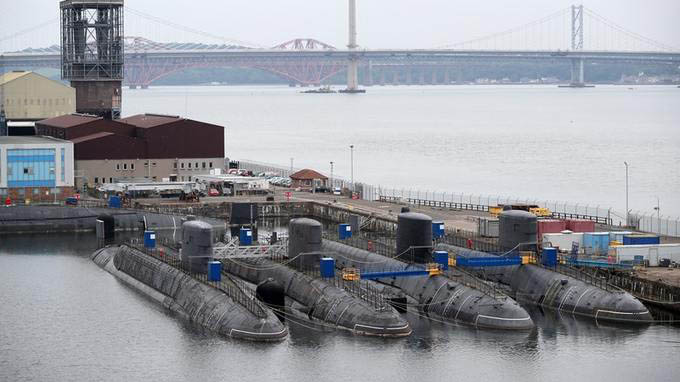
UK is stuck with 20 dead nuclear submarines – what to do with them?
|
How do you scrap a nuclear submarine? https://www.chemistryworld.com/news/how-do-you-scrap-a-nuclear-submarine/3010405.article, The UK is facing a £7.5 billion bill to dismantle its 20 defunct vessels
What is a nuclear submarine?A ‘nuclear’ submarine can refer to a submarine that carries nuclear warheads, one that is powered using nuclear energy, or both. In the UK, the Vanguard, Astute and Trafalgar class submarines are all powered using a nuclear reactor, but only the four Vanguard class submarines carry nuclear warheads – Astute and Trafalgar submarines are ‘hunter-killers’ designed to sink other ships. The UK’s current fleet relies on a reactor typically seen in power stations across the world – the pressurised water reactor (PWR). These compact power plants produce vast amounts of heat through the splitting of uranium-235 (235U). This fissile isotope exists in very small quantities (less than 1%) in natural uranium, which mainly consists of uranium-238 (238U). To use it as fuel, the 235U is increased relative to the 238U in a process known as enrichment. In the PWR, waste fission products are made, such as caesium, xenon and krypton, as neutrons split the 235U fuel, with 238U also absorbing neutrons to form plutonium. These fission products can damage the ceramic fuel and reduce the reactor’s efficiency. The vessel that contains this whole process is also bombarded with high levels of radiation over its operational life. What happens to a nuclear submarine once it is removed from service?Once a nuclear-powered submarine is decommissioned, it is placed into long-term storage. Only after monitoring the vessel will engineers begin to defuel and dismantle it. However, over the past four decades, this second part hasn’t happened in the UK.
Since 1980, the UK Ministry of Defence has taken 20 nuclear-powered submarines out of service. Of these 20 subs, the UK has not fully disposed any of them and nine still contain highly radioactive nuclear fuel. The vessels have languished at dockyards in Plymouth and Rosyth.
This is not a sustainable solution, but it is in stark contrast with other countries’ past policies. During the Cold War, the Soviet Union dumped 19 ships containing nuclear waste in the Kara Sea, as well as 14 reactors and the K-27 nuclear submarine. With such vessels continuing to rust on the seabed, there are concerns these sites could harbour a potential environmental crisis. However, the subs stored in the UK are constantly monitored in a controlled environment. Although a far cry from the Arctic submarine graveyards, the UK fleet still lies exposed to salty water, with the vessels rusting in the dockyards.
Why are the submarines still in storage?It is an incredibly complex situation, but the government stopped defueling its disbanded fleet back in 2004. The UK’s nuclear regulator deemed that the facilities were not up to standards, and the UK has been working to improve them ever since. Mired in delays and inflating budgets, the defueling may not restart until 2023 – the original start date was 2012. Even when the subs are ready for their next voyage through the disposal process, it is a journey fraught with complexity.
What is the plan for the nuclear waste?Once defueling starts, the sub will be moved to a ‘reactor access house’ on rails. In this facility, engineers will remove the spent nuclear fuel from the sub, which contains various actinides and radionuclides. The fuel is highly radioactive and generates heat, so needs to be cooled in water before any further work can begin. To cool the fuel rods, the waste is sent to a specialised plant at Sellafield, where it is stored in vast water ponds. The water acts as both an efficient coolant and radiation barrier. Historically, this spent fuel would have then been recycled to form new nuclear fuel.
During reprocessing, the fissile uranium and plutonium is separated through solvent extraction, before converting the remaining liquid waste into a glass for long-term storage. However, it is now unclear whether this will still happen. It is more likely that the spent nuclear fuel will be stored indefinitely after cooling. The current UK strategy is to bury this waste in a highly-engineered geological disposal facility, which would see more than 650,000m3 of waste stored in an underground cavern, according to recent government estimates. But plans are still ongoing and a facility is yet to be built.
What happens to the submarine after defueling?After defueling, the sub will return to the ‘wet’ dock for another period of storage and monitoring. Following this, the submarine is dismantled. Components such as pipes and pumps exposed to radiation are taken away and the reactor vessel removed. However, engineers do not simply remove the reactor. In many countries, the reactor is lifted out with the two empty compartments either side of it and then sealed off to minimise the risk of exposure. After removing this ‘three-compartment unit’, the submarine is cast off for its final voyage to a commercial shipyard for recycling. But it will be a costly endeavour. The UK may face costs of up to £7.5bn if it wants to take the entire fleet through this voyage of defueling and disposal. It remains unclear whether the plans will stay on course, but the defence department has committed to dismantling the fleet ‘as soon as reasonably practicable’.
|
|
|
Netherlands’ creative solar power initiative – archipelago of islands made up of sun-tracking solar panels
Guardian 21st April 2019 Dutch engineers are building what will be the world’s largest archipelago of islands made up of sun-tracking solar panels. Growing resistance to the
construction of wind turbines or fields of solar panels on land has led the
renewable energy industry to look for alternative options. Large islands of
solar panels are under construction or already in place in reservoirs and
lakes across the Netherlands, China, the UK and Japan. In a development
that is to become the largest of its type in the world, construction will
begin this year on 15 solar islands on the Andijk reservoir in north
Holland. The islands, containing 73,500 panels, will have the
sunflower-like ability to move to face the light.
Pumped storage hydro could fill nuclear nuclear energy gap
 Pumped storage hydro could fill nuclear nuclear energy gap https://www.thenational.scot/news/17588663.pumped-storage-hydro-could-fill-nuclear-nuclear-energy-gap/, A SCOTTISH company has called for the UK Government to put pumped storage hydro (PSH) at the heart of its strategy to meet the challenge of providing a secure, low-carbon electricity supply in the coming decades. |
|
Together Against Sizewell C (TASC) feeling encouraged: public opinion turning against Sizewell nuclear project
Suffolk coast have been “exposed as entirely inadequate” – and believe it cannot be built.
way on its Hinkley Point C new build and plans for the Suffolk project are
progressing well.
recent plans shown in the company’s stage three consultation for Sizewell C
have been “exposed as entirely inadequate”. He said: “Since the
delivery of a 1,500-signature petition to the Leader of Suffolk County
Council, we have seen a surge in support for our position of outright
opposition to Sizewell, local artists and actors voicing their concerns and
the RSPB warning that the most important bird reserve in the country,
Minsmere, is potentially threatened by the Sizewell development.
the hurdles to building such a complicated and dangerous plant in such a
confined and remote area will be recognised as overwhelming and terminal.
to the sheer scale of the environmental and infrastructure changes the
plant will require and they are becoming more and more vocal in opposition.
It is very encouraging.” TASC has voiced concerns over the suitability of
the Sizewell site, claiming it is too small for the proposed development,
potential loss of SSSI, visual intrusion, noise and light pollution and the
negative impact it will have on the Suffolk Coast and Heaths AONB and
Heritage Coast.
clearly demonstrates three things: we require much more information from
EDF before we can fully appreciate the impact of their plans; even on the
information available, it is clear that the dis-benefits associated with
Sizewell C far outweigh the putative benefits, and EDF must plan for a
fourth round of consultation.”
https://www.eadt.co.uk/news/tasc-pete-wilkinson-szc-cannot-be-built-1-6009732
Nearly 1000 climate protestors arrested in London – and Extinction Rebellion is changing tack
|
Extinction Rebellion: The People Risking Their Freedom For Climate Change | HuffPost Reports: UK Extinction Rebellion arrests close to 1,000 as protesters ‘pause rebellion’ ITV 21 Apr 19 Climate change protesters who have stopped traffic in a series of peaceful demonstrations across London will “pause” their rebellion in a bid to achieve their political aims, as the arrest total nears 1,000.Extinction Rebellion (XR) have announced they are switching disruptive tactics for political negotiations as they enter a second week of campaigning to have the Government declare a climate emergency. The number of people arrested in connection with the protests has hit 963 and 40 people have been charged. Continue reading |
We will never stop fighting’: Greta Thunberg joins London climate protest
Humanity is at a crossroads, Greta Thunberg tells Extinction Rebellion, Guardian, Vikram Dodd , Damien Gayleand Mattha Busby 22 Apr 2019
Swedish climate activist’s speech comes amid police action to clear protesters from Waterloo Bridge, Governments will no longer be able ignore the impending climate and ecological crisis, Greta Thunberg, the teenage climate activist, has told Extinction Rebellion protesters gathered at Marble Arch in London.
In a speech on Sunday night where she took aim at politicians who have for too long been able to satisfy demands for action with “beautiful words and promises”, the Swedish 16-year-old said humanity was sitting at a crossroads, but that those gathered had chosen which path they wish to take…….
Her speech came amid police efforts to forcibly clear Extinction Rebellion protesters from Waterloo Bridge as the group debated whether to continue its campaign of mass civil disobedience. Police said on Sunday night they had cleared all the protesters from Parliament Square ……. https://www.theguardian.com/environment/2019/apr/21/extinction-rebellion-london-protesters-offer-pause-climate-action
Britain’s Nuclear Free Local Authorities (NFLA) notes that over 70 Welsh councils formally reject hosting nuclear waste dump
 NFLA 18th April 2019 The Nuclear Free Local Authorities (NFLA) notes that over 70 Welsh unitary, county, city, town and community councils have passed resolutions formally opposing taking any interest in hosting a deep underground radioactive waste repository.
The figure was noted at a joint meeting in Menai Bridge organised by the NFLA Welsh Forum in conjunction with the groups PAWB, CADNO and CND Cymru. At a presentation provided by the NFLA Secretary, he noted that there had been real anger and frustration raised across Welsh and Northern Irish Councils in particular to the request made by the UK
Government for considering hosting a large deep underground repository to store over 60 years of higher activity radioactive waste, as well as possibly additional waste should new nuclear power stations ever be built.
Even in England, a number of nuclear site Councils have indicated their public opposition to hosting a repository. NFLA have noted some of these issues in its response to RWM regarding its consultation on how any proposed sites will be evaluated.
Britain’s slow path to zero carbon emissions
Extinction Rebellion: what pushes people to drastic action on climate change?
Slow burn? The long road to a zero-emissions UK, Guardian, Robin McKie, Observer science editor, Sun 21 Apr 2019
Extinction Rebellion protesters want a carbon-free UK by 2025. But can the financial and political hurdles be overcome?
Many experts disagree, however. They argue that such an imminent target is completely impractical. “Yes, you could decarbonise Britain by 2025 but the cost of implementing such vast changes at that speed would be massive and hugely unpopular,” says Lord Turner, former chairman of the climate change committee.
Most expect the climate change committee will plump for 2050 as Britain’s ideal decarbonisation date. “2050 is do-able and desirable and would have an insignificant overall cost to the economy,” states Turner, who is now chairman of the Energy Transitions Commission. According to this scenario, developed nations, including Britain, would aim to achieve zero-emissions status by 2050 and then use the decarbonising technologies they have developed to achieve this goal – hydrogen plants, carbon dioxide storage vaults and advanced renewable generators – to help developing nations halt their greenhouse gas emissions by 2060.
And the change has already been reflected in Britain’s power statistics. In 2013, 62.5% of UK electricity was generated by oil, coal and gas stations, while renewable provided only 14.5%. In 2018, the figure for oil, coal and gas had been reduced to 44% while renewables were generating 31.7%. It is a distinct improvement – though we have yet to be given a date when engineers expect the last UK fossil-fuelled power plant to produce its final watts of electricity and to emit its last puffs of carbon dioxide
“Decarbonising UK power production is going well,” says George Day, head of policy for the technology and innovation centre Energy Systems Catapult. “There is a clear path forward.” But as he points out, there are many other sources of carbon dioxide in the UK. “The next big challenge will be heating. Gas boilers are major carbon emitters and dealing with them is going to be very difficult.”
According to Day, about 90% of British people have gas boilers in their homes, most having been fitted relatively recently …
………In the end, it will simply not be possible to reduce Britain’s fossil-fuel emissions to zero, say scientists. To compensate, we will have to take carbon dioxide back out of the atmosphere. “That is the logical, inevitable consequence of trying to achieve zero net emissions in this country,” argues Corinne Le Quéré, of the University of East Anglia. “If you are looking for any net zero target then you have to remove carbon dioxide from the atmosphere.”
This can be done in three ways: naturally, by planting trees and shrubs that absorb carbon dioxide. Or artificially – on a larger scale – the gas can be removed as it is produced at a factory or power station that burns trees for energy.
Or it can be removed by huge numbers of man-made air filters, known as direct air capture. The carbon dioxide can be liquefied and stored underground in underground caverns, or old, depleted gas fields under the North Sea. This is known as carbon capture utilisation and underground storage (CCUS).
“In the end, your choice of replanting or of building underground storage facilities depends on how much carbon you will need to remove,” says Le Quéré. “Most calculations suggest Britain will need to take quite a lot of carbon dioxide out of the atmosphere to keep its net emissions at zero.”……….
UK carbon emissions have fallen for the sixth year running
This need for speed is shared by many other parts of the zero-emissions programme, as we have seen. It may seem odd given it is unlikely it will reach its conclusion for another three decades. Nevertheless, scientists are adamant that even if choose 2050 for our decarbonisation date, we need to act now.
This urgency of the task is emphasized by Joeri Rogelj at Imperial College London. “If the world limits emissions of carbon dioxide to no more than 420 billion tonnes this century, we will have a two in three chance of keeping global warming down to around 1.5C.
“However, if we go above to 580 billion tonnes then our chances will be reduced to 50-50. The problem is that in 2017 alone, a total of 42 billion tonnes of carbon dioxide was emitted in a single year. By that calculation, we clearly do not have a lot of time to waste.”https://www.theguardian.com/environment/2019/apr/21/long-road-to-zero-emissions-uk
Putin’s new super-dooper longest submarine packed with nuclear torpedoes
Putin reveals world’s longest submarine packed with nuclear torpedoes capable of destroying an entire city The super sub’s weapons can dodge Nato’s underwater defences to hit cities, naval bases or aircraft carriers anywhere in Europe or on America’s eastern coast The Irish Sun, By Patrick Knox 21st April 2019, A GIANT Russian submarine which measures a staggering 604ft is due to be moved out of its secret construction shed as it nears completion.
The 14,700-ton Belgorod, which is twice the size of the Royal Navy’s Astute-class attack submarines, bristles with nuclear-tipped underwater drone torpedoes which are guided by artificial intelligence.
Russia’s president Vladimir Putin has boasted these “Poseidon” drones can completely destroy coastal targets 6,000 miles away.
They are specifically designed to thwart Nato underwater defences as it heads to targets in cities, naval bases or aircraft carriers anywhere in Europe or on America’s eastern coast.
The sub is also fitted with an underwater dock.
This allows it to launch a 180ft mini-sub and intelligence gathering drones……. https://www.thesun.ie/news/4009866/putin-reveals-worlds-longest-submarine-packed-with-nuclear-torpedoes-capable-of-destroying-an-entire-city/
Finland to start constructing nuclear plant with Russian reactor in 2021
|
New Europe By Kostis GeropoulosEnergy & Russian Affairs Editor,19 Apr 19 SOCHI, Russia – Fennovoima is proceeding with plans to build the Hanhikivi 1 nuclear power plant in the northern Finnish city of Pyhäjoki and expects to receive the construction license in 2021, Fennovoima CEO Toni Hemminki told New Europe in an interview on the sidelines of the 2019 Atomexpo XI in Sochi on 15 April. Fennovoima had originally expected to start construction of the plant in 2019.
“At the end of the year, the supplier, RAOS Project, communicated to us that, according to the estimation, we can start the construction in 2021 and then that means commercial operational date would be the 2028,” he said, referring to RAOS Project Oy, a subsidiary of Rosatom Energy International. “Those are the milestones that we are working on accordingly at the moment and we are also fine tuning the detailed schedule for it with the supplier,” he said, adding that the structure with the supplier is the same but there have been some organizational changes within Fennovoima. …… Hemminki argued that building the plant in Finland would be a showcase for the Rosatom State Atomiс Energy Corporation. “We might be the only customer of Rosatom that is commercial. ……
He noted that Russia would provide nuclear fuel to the Finnish plant for at least 10 years. Turning to sanctions against Russia, he said they did not affect the nuclear industry. “Globally, there are a few supplies going to different countries from Russia. I think this is functioning and for our project as well, we have not seen any direct effect at the moment,” Hemminki said……
He acknowledged that nuclear waste is a long-term fundamental issue, saying: “We are going to select the locations for final disposal in 2040 so that’s a very long-term project so it’s not acute at the moment.” https://www.neweurope.eu/article/finland-to-start-constructing-nuclear-plant-with-russian-reactor-in-2021/
|
|
|
UK’s EPA concerned over proposals for Sizewell new nuclear power station in Suffolk
ENDS 16th April 2019 The Environment Agency has flagged a series of concerns over proposals for a new nuclear power station in Suffolk, warning that a lack of detail means
that the impacts and proposed suitability of mitigations “cannot be
assessed at this time”. Energy firm EDF plans to build and operate the new
Sizewell C nuclear power station in Suffolk on land immediately to the
north of the Sizewell B power station. The application – which has yet to
be submitted – will be determined via the fast-track Planning Act 2008
regime for nationally significant infrastructure projects, with the
business secretary responsible for making a final decision.
https://www.endsreport.com/article/1582216/environment-agency-concerned-lack-detail-sizewell-c-plans
1 This Month
23-25 October – on Zoom – World BEYOND War’s annual global conferenc


Shut down the radiation-damaged Heysham nuclear reactors now
To see nuclear-related stories in greater depth and intensity – go to https://nuclearinformation.wordpress.com

Say No to NASA’s Reckless Nuclear Reactor on the Moon
Say No to NASA’s Reckless Nuclear Reactor on the Moon
-
Archives
- October 2026 (180)
- September 2026 (339)
- August 2026 (330)
- July 2026 (355)
- June 2026 (287)
- May 2026 (306)
- April 2026 (356)
- March 2026 (251)
- February 2026 (267)
- January 2026 (308)
- December 2025 (358)
- November 2025 (359)
-
Categories
- 1
- 1 NUCLEAR ISSUES
- business and costs
- climate change
- culture and arts
- ENERGY
- environment
- health
- history
- indigenous issues
- Legal
- marketing of nuclear
- media
- opposition to nuclear
- PERSONAL STORIES
- politics
- politics international
- Religion and ethics
- safety
- secrets,lies and civil liberties
- spinbuster
- technology
- Uranium
- wastes
- weapons and war
- Women
- 2 WORLD
- ACTION
- AFRICA
- Atrocities
- AUSTRALIA
- Christina's notes
- Christina's themes
- culture and arts
- Events
- Fuk 2022
- Fuk 2023
- Fukushima 2017
- Fukushima 2018
- fukushima 2019
- Fukushima 2020
- Fukushima 2021
- general
- global warming
- Humour (God we need it)
- Nuclear
- RARE EARTHS
- Reference
- resources – print
- Resources -audiovicual
- Weekly Newsletter
- World
- World Nuclear
- YouTube
-
RSS
Entries RSS
Comments RSS

