nuclear-news

The News That Matters about the Nuclear Industry Fukushima Chernobyl Mayak Three Mile Island Atomic Testing Radiation Isotope

Hinkley nuclear project: UK govt faces questions about involvement of US export blacklisted Chinese firm

Telegraph 15th August 2019 The government faces renewed questions over its decision to allow a
state-owned Chinese firm to be involved in the UK’s power generation
programme after the business was placed on a US export blacklist. China
General Nuclear Power Group (CGN), which has partnered with EDF to help
fund a third of the £20bn cost of the nuclear power station at Hinkley
Point, was on Thursday added to the US commerce department’s so-called
“entity list”. The placement effectively blocks American firms from
selling products and services to the company without written approval.

https://www.telegraph.co.uk/technology/2019/08/15/questions-raised-chinas-involvement-hinkley-point-us-trade-blacklist/

August 19, 2019 Posted by | politics international, UK | Leave a comment

Russia’s ‘flying Chernobyl’ – mystery new nuclear weapon

Russia’s mysterious ‘new’ nuclear weapon a ‘flying Chernobyl’,  https://www.smh.com.au/world/europe/russia-s-mysterious-new-nuclear-weapons-a-flying-chernobyl-20190816-p52ho5.html, By Gregg Herken, August 16, 2019 Washington: Last week, Vladimir Putin’s government cryptically announced that there had been an explosion at a missile test centre in remote northern Russia that involved the release of radioactive materials. Initially, two people were said to have been killed; the death toll was subsequently raised to seven. A nearby village was ordered evacuated, then the villagers were told to stay put.

US analysts think the accident involved the prototype of a nuclear-powered cruise missile that the Russians call Burevestnik, or Petrel, but is known in the West by its NATO designation, Skyfall. Putin has called it “a fundamentally new type of weapon” – an “invincible missile” with virtually unlimited range, easily able to evade US defences.

When Skyfall was first announced, early last year, some Western military analysts started hyperventilating. “That’s a technological breakthrough and a gigantic achievement,” claimed one. “These weapons are definitely new, absolutely new.”

But in fact, these “new” missiles are a throwback to the early days of the Cold War. And back then, it was the United States that developed a nuclear-powered cruise missile, in the early 1960s.

“Project Pluto” was part of a Pentagon program known as Supersonic Low Altitude Missile, a clunky name almost certainly designed to yield its catchier acronym, SLAM. The missile was cancelled in 1964, never having taken flight. Nuclear-powered cruise missiles were not a good idea then, and they are not a good idea now.

That’s not to say that such weapons are not impressive, in a way.

SLAM envisioned a locomotive-sized missile flying at three times the speed of sound near treetop level, tossing out hydrogen bombs along the way and spewing radiation in its wake. (In 1990, when I worked at the National Air and Space Museum, I researched the history of the project for an article in Air and Space magazine.)

There was a reason Pluto’s inventors, at the Livermore nuclear weapons laboratory in California, dubbed it “the weapon from Hell.” The noise level on the ground when Pluto went by was expected to be 150 decibels. (The Saturn V moon rocket, by comparison, produced 200 decibels at full thrust.)

But ruptured eardrums would have been the least of your worries if you were in the neighbourhood.

The shock wave alone might have been lethal. And since Pluto’s nuclear ramjet engine ran at 2500 degrees Fahrenheit (1371 degrees), portions of the missile would have been red-hot — literally “frying chickens in the barnyard” on the way to its targets.

Indeed, SLAM operated on the same principle as the errant low-flying B-52 bomber in Dr Strangelove. As Major Kong observed to his crew, “they might harpoon us, but they dang sure ain’t going to spot us on no radar screen.”

An alternate idea was to tie Pluto to a tether at the Nevada Test Site. (“That would have been some tether,” dryly observed another scientist at the lab.) Finally, what do you do with a highly radioactive missile once it’s been tested? Dumping it in the ocean was the solution offered back then. And it is probably Putin’s preferred solution now.

Ultimately, in the United States, cooler heads prevailed.  Six weeks after the successful static test of Livermore’s nuclear engine in Nevada in July 1964, the Pentagon pulled the plug on Pluto.

Intercontinental-range ballistic missiles promised to destroy targets in the Soviet Union well before Pluto got to them, with equal certainty and a lot fewer associated risks. SLAM, its critics said, stood for “slow, low and messy.”

But Pluto, it seems, has risen again, this time in a Russian incarnation – a nuclear-powered Frankenstein, a flying Chernobyl.

Putin’s Skyfall cruise missile also has a seagoing sibling: a giant nuclear-powered torpedo, dubbed Poseidon, designed to destroy US port cities with a multi-megaton blast.

Poseidon bears a striking resemblance to the idea that Russia’s Nobel Prize-winning physicist, Andrei Sakharov, came up with in the early 1960s. When Sakharov told a Soviet admiral of his proposal, however, the latter was “shocked and disgusted by the idea of merciless mass slaughter.”

Feeling “utterly abashed,” the physicist abandoned the concept and never raised it again. “I’m no longer worried that someone may pick up on the idea,” Sakharov wrote in his memoirs, published in 1990. “It doesn’t fit in with current military doctrines, and it would be foolish to spend the extravagant sums required.”

Plainly, times have changed. Yet as several experts have since noted, it is also possible that Putin’s amazing new weapons are only part of a propaganda campaign, a response to plans announced by the Trump administration to expand and modernise America’s nuclear arsenal.

If so, Putin’s ploy is reminiscent of Soviet Premier Nikita Khrushchev’s hollow Cold War boast that the USSR was turning out ICBMs “like sausages.” (As Khrushchev’s son, Sergei, later observed, his father wasn’t exactly lying: The Soviets weren’t making sausages then, either.)

Of course, flying nuclear reactors and giant nuclear-armed undersea drones could do a lot of damage to cities if they really existed and were ever used. But the real danger of Putin’s Potemkin arsenal is that it will – as Khrushchev’s boast did decades ago – spark a US overreaction and lead to pressure to revive ideas like Livermore’s Pluto and Sakharov’s Poseidon: forgotten relics of Cold War 1.0 that are best left dead and buried.

Herken is an emeritus professor of American diplomatic history at the University of California. From 1988 to 2003, he was the curator of military space at the Smithsonian’s National Air and Space Museum in Washington.

August 19, 2019 Posted by | Russia | Leave a comment

Russian doctors kept in the dark about patients being nuclear accident victims

Russian Doctors Say They Weren’t Warned Patients Were Nuclear Accident Victims
One doctor was reportedly later found to have a radioactive isotope in their muscle tissue.   https://www.themoscowtimes.com/2019/08/16/exclusive-russian-doctors-say-they-werent-warned-patients-were-nuclear-accident-victims-a66896


August 17, 2019 Posted by | Russia, secrets,lies and civil liberties | Leave a comment

Russia’s fast nuclear reactor project is postponed

Rosatom postpones fast reactor project, report says, WNN, 13 August 2019

Rosenergoatom is expected to receive about RUB280 billion (USD4 billion) less in state funding for the construction of new nuclear reactors in Russia owing to the postponement of its fast neutron reactor programme, Russian newspaper Kommersant reported last week, citing anonymous sources. Rosenergoatom is the nuclear power plant operator subsidiary of Russian state nuclear corporation Rosatom.

Rosatom’s investment plan received preliminary approval during a meeting in the Russian Energy Ministry on 2 August, according to the article, with funding out to 2035 to total RUB880 billion and not the RUB1.16 trillion Rosatom had allocated for the two new VVER-1200 units under construction for the Kursk II project, units 3 and 4 for the Leningrad II project and a BN-1200 fast reactor at Beloyarsk. Commissioning of the BN-1200 has been postponed to 2036, the article said, from the previous target of 2027.

Financing to pay for the new units will be paid back over 20 years, with an average rate of return on investment of 10.5% per year, the article said. Rosatom is prepared to consider a lower rate of return, it added.

Russia’s new investment cycle for its electricity sector will also take into account modernisation work at thermal power plants, the construction of remote energy facilities and the development of renewable energy sources. The funds must however be “distributed among market participants so that wholesale energy market prices do not rise above inflation”, the article said. The reduction in funding reflects “the restriction on tariff growth by inflation”, it added, and thus the launch of the BN-1200 will “most likely be postponed to 2036 in order to reduce energy market spending”……. http://www.world-nuclear-news.org/Articles/Rosatom-postpones-fast-reactor-project-report-say

August 17, 2019 Posted by | Russia, technology | Leave a comment

Germany shows how it can lead the world in neatly shutting down nuclear power

Spectacular Video Shows Nuclear Power Plant Demolition in Germany

How to demolish a nuclear power plant without blowing it up, By Sheena McKenzie, CNN August 16, 2019 London (CNN Business)This is how you demolish a nuclear power plant German-style. No big red button. No dramatic countdown. No “kaboom!”

August 17, 2019 Posted by | decommission reactor, Germany | Leave a comment

Russian Region Orders Gas Masks After Deadly Nuclear Blast

Russian Region Orders Gas Masks After Deadly Nuclear Blast – Reports top https://www.themoscowtimes.com/2019/08/15/russian-region-orders-gas-masks-after-deadly-nuclear-blast-reports-a66856

August 17, 2019 Posted by | Russia, safety | Leave a comment

Confusion and secrecy following Russian explosion, backflip on evacuation of village

Russian military orders village evacuation, then cancels it, following explosion that killed five nuclear scientists, Secrecy surrounding an explosion that killed five nuclear scientists and caused a spike in radiation levels has sparked fears of a cover-up in Russia, with authorities backflipping on orders to evacuate a nearby village. https://www.abc.net.au/news/2019-08-14/russian-nuclear-explosion-mystery/11411470

Key points:

  • Medics who treated victims of an accident have been sent to Moscow for medical examination
  • Russia’s state weather service said radiation levels spiked in Severodvinsk by up to 16 times
  • Many Russians spoke angrily on social media of misleading reports reminiscent of Chernobyl

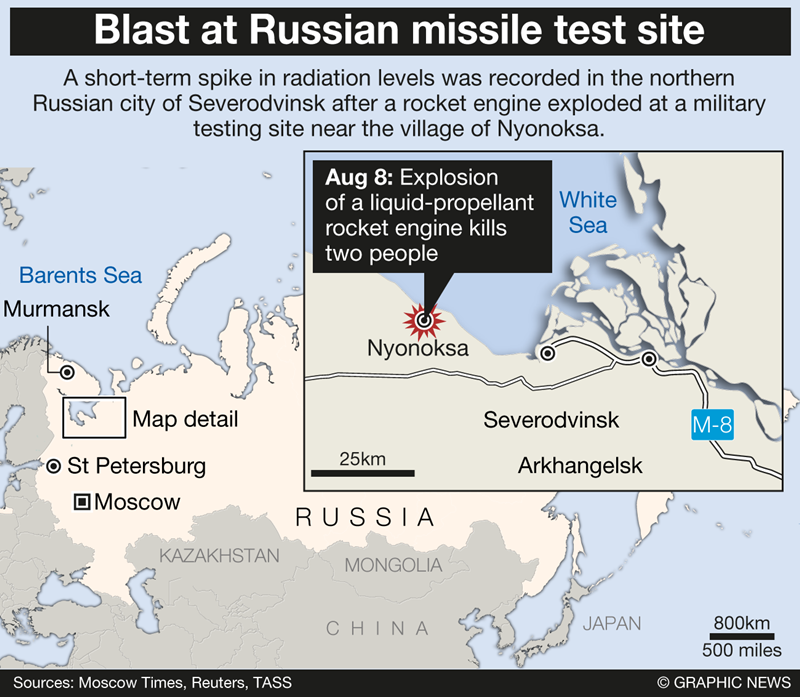
The explosion took place on Thursday at a naval weapons range on the coast of the White Sea in northern Russia.

State nuclear agency Rosatom said the accident occurred during a rocket test on a sea platform.

The rocket’s fuel caught fire after the test, causing it to detonate, it said in a statement carried by Russian news agencies.

Two days later, after a spike in radiation levels was reported, Rosatom conceded the accident involved nuclear materials.

On Tuesday (local time), the Russian military ordered residents of the small village of Nyonoksa to temporarily evacuate, citing unspecified activities at the nearby navy testing range.

But a few hours later, it said the planned activities were cancelled and told the villagers they could go back to their homes, said Ksenia Yudina, a spokeswoman for the Severodvinsk regional administration.

Local media in Severodvinsk said Nyonoksa residents regularly received similar temporary evacuation orders, usually timed to tests at the range.

Russia’s state weather service said radiation levels spiked in the Russian city of Severodvinsk, about 30 kilometres west of Nyonoksa, by up to 16 times following the explosion.

Emergency officials issued a warning to all workers to stay indoors and close the windows, while spooked residents rushed to buy iodide, which can help limit the damage from exposure to radiation.

‘People need reliable information’

Many Russians spoke angrily on social media of misleading reports reminiscent of the lethal delays in acknowledging the Chernobyl accident three decades ago.

US experts said they suspected the cause was a botched test of a nuclear-powered cruise missile commissioned by President Vladimir Putin.

Boris L Vishnevsky, a member of the St. Petersburg City Council, told the New York Times that dozens of people had called asking for clarification about radiation risks.

“People need reliable information,” Mr Vishnevsky told the Times.

“And if the authorities think there is no danger, and nothing needs to be done, let them announce this formally so people don’t worry.”

The five scientists that died in the explosion were buried Monday in the closed city of Sarov — which houses a nuclear research facility and is surrounded by fences patrolled by the military.

While hailing the deceased as the “pride of the atomic sector”, Rosatom head Alexei Likhachev pledged to continue developing new weapons. “The best tribute to them will be our continued work on new models of weapons, which will definitely be carried out to the end,” Mr Likhachev was quoted as saying by RIA news agency.

Medics who treated victims sent to Moscow

Medics who treated the victims of an accident were sent to Moscow for medical examination, TASS news agency cited an unnamed medical source as saying on Tuesday.

The medics sent to Moscow have signed an agreement promising not to divulge information about the incident, TASS cited the source as saying.

US President Donald Trump said on Twitter on Monday the United States was “learning much” from the explosion and the United States had “similar, though more advanced, technology”.

He said Russians were worried about the air quality around the facility and far beyond, a situation he described as “Not good!”

But when asked about his comments on Tuesday, the Kremlin said it, not the United States, was out in front when it came to developing new nuclear weapons.

“Our president has repeatedly said that Russian engineering in this sector significantly outstrips the level that other countries have managed to reach for the moment, and it is fairly unique,” Kremlin spokesman Dmitry Peskov said.Mr Putin used his state-of-the nation speech in 2018 to unveil what he described as a raft of invincible new nuclear weapons, including a nuclear-powered cruise missile, an underwater nuclear-powered drone, and a laser weapon.

Tensions between Moscow and Washington over arms control have been exacerbated by the demise this month of a landmark nuclear treaty.

August 15, 2019 Posted by | incidents, Russia, secrets,lies and civil liberties, weapons and war | Leave a comment

USA abandoned the Nuclear-Powered Missile long ago due to its extreme danger. It seems that Russia just tried it again.

Why the U.S. Abandoned Nuclear-Powered Missiles More Than 50 Years Ago

President Donald Trump says the U.S. has a missile like the one that killed seven in the Russian arctic. That’s untrue, because the U.S. abandoned the idea decades ago.

August 15, 2019 Posted by | Russia, Small Modular Nuclear Reactors, technology, weapons and war | 1 Comment

Revealed: mental health crisis at Hinkley Point C nuclear construction site

Revealed: mental health crisis at Hinkley Point C construction site.
Guardian 13th Aug 2019 Several workers on nuclear plant have killed themselves or attempted to,
says union. Hinkley is grappling with a mental illness crisis, with several
attempted suicides since work began in 2016, a Guardian investigation can
reveal.
More than 4,000 workers are on site delivering the vast decade-long
building project, a central plank in Britain’s future energy strategy. But
according to union officials, there has been a surge in suicide attempts
this year, a rise in the number of people off sick with stress, anxiety and
depression, and an increase in workers suffering from mental distress.
Officials from the Unite union say they have been told of 10 suicide
attempts in the first four months of 2019. The Guardian understands at
least two workers connected to the project have taken their lives since
construction started in earnest in 2016.
The main causes of the distress
appear to be loneliness, relationship breakdown and the struggle of being
sometimes hundreds of miles away from family. At Hinkley, workers live on
special campuses in nearby Bridgwater, or else in converted digs in the
town. They work a variety of shift patterns and are shuttled to and from
the site on scores of buses. Some contractors work as much as 11 days on
with three days off, including an extra weekend day for travelling home.
But the Guardian understands that most people can cope with the stress and
pressure of the work. The problems start once they clock off.

https://www.theguardian.com/uk-news/2019/aug/13/revealed-suicide-alarm-hinkley-point-c-construction-site

Guardian 13th Aug 2019 Angie Young, the health and wellbeing manger at the Hinkley Point C (HPC)
site, does not hesitate when asked what the main cause of mental health
issues there is. “It’s loneliness. You’re living away from home,
living without your family. Loneliness is the big thing.” But a major
complicating factor is that tough men who build stuff are not always great
at talking about feelings. “Our guys are construction guys – they are
macho. The average age is 45-55. They haven’t got someone nagging them to
go and see someone. We’re trying to address that.”

https://www.theguardian.com/uk-news/2019/aug/13/no-more-man-up-better-mental-health-hinkley-point-c

August 15, 2019 Posted by | employment, social effects, UK | Leave a comment

UK’s nuclear waste plans – squabbles in a local Council

Carlisle News & Star 14th Aug 2019 NUCLEAR chiefs in Copeland are split on the creation of controversial
storage vaults for radioactive waste amid “moral” concerns.
The Government launched its search for a host community before Christmas,
prompting the council to come up with a statement that was broadly
supportive of the project but also non-committal in terms of the
authority’s involvement.
But it emerged at a meeting of the borough
council’s Strategic Nuclear and Energy Board (SNEB) this week that panel
members disagreed over the council’s current position. The board heard
that some councillors were “fundamentally” opposed to the very idea of
a multi-million-pound underground Geological Disposal Facility (GDF).
Speaking at the meeting, councillors Sam Pollen and David Banks both
criticised the GDF plans. Mr Pollen said he was not in a position to argue
with experts over the facility but stressed that “morality and ethics”
should also be considered. He questioned the “rush” to develop a GDF
amid concerns over safety and the lack of “retrievability” of the waste
once deposited. The councillor, who works at Sellafield, said the waste was
now stored “extremely safely” on the Sellafield site which he described
as a “big tick in a box for me”.

https://www.newsandstar.co.uk/news/17834550.councillors-split-search-n-waste-site/

August 15, 2019 Posted by | politics, UK | Leave a comment

No it wasn’t the wind turbines that caused a UK blackout

Dave Toke’s Blog 13th Aug 2019 . No it wasn’t the wind turbines that caused the blackout but batteries
likely to benefit from reaction In the aftermath of last Friday’s blackout
the usual suspects are blaming wind turbines’, but that’s not what the
electricity market nerds are saying.
They are pointing to the fact that big
power outages have happened before the age of large-scale renewable energy
penetration and that stories of crisis at the National Grid are well
overblown. I certainly remember the blackout of 2008 which was caused by
the near simultaneous disconnection of Sizewell B (nuclear) and Longannet
(coal), but then of course we did not see anything in the media about how
it was all the fault of nuclear or coal-fired power plant.
This time a large gas fired power plant tripped, followed a little later by a big
offshore windfarm. Now there is talk of how the grid has become more
unstable because of increasing renewable energy penetration (now around 35%
of electricity on an annual basis) and how, depending on people’s interest
a) we ought to stop this nonsense and get back to having real large power
plant or b) we need more batteries and/or other stuff.
In fact such an approach is decried by top electricity system management experts such as
Nigel Cornwall. He tweeted in response to stories that the National Grid
was beset with a splurge of ‘near misses’ and last-gasp efforts: “Near
misses” and “last minute contracts” is the way the system – and all
electricity systems – is designed to operate. (National Grid) has done a
huge amount to modernise its balancing services, and I am struggling to
understand whose agenda this is. Two large power stations failed at the
evening peak, when the system was already calling for more output/demand
turndown. This was almost an occurrence of Titanic probabilities. You can
of course contract for a huge amount of extra reserve but at immense cost
to consumers’

https://realfeed-intariffs.blogspot.com/2019/08/no-it-wasnt-wind-turbines-that-caused.html

August 15, 2019 Posted by | ENERGY, UK | Leave a comment

‘Dirty bomb’: Mystery Russian ‘superweapon’ kills five

An on-board reactor would give an engine almost unlimited range. In the case of a guided cruise missile, it could circle the world before receiving orders to attack from out of the blue.

But they’re not easy to control.

They operate at extremely high temperatures. They use explosive fuels, such as liquid hydrogen. And any accident could have devastating, long-lasting effects.


August 12, 2019 Posted by | incidents, Reference, Russia, weapons and war | 1 Comment

Russia says small nuclear reactor blew up in deadly accident

August 12, 2019 Posted by | incidents, Russia, Small Modular Nuclear Reactors | 1 Comment

Putin’s silence on mysterious radiation accident

Russia nuclear leak: Mysterious footage of hazmat officials escalates radiation panic https://www.express.co.uk/news/world/1164125/Russia-nuclear-leak-radiation-Putin-iodine-hazmat

CHILLING footage from Russia has intensified fears of a nuclear radiation accident after ambulances were spotted lined with protective chemical sheets and hospitals workers were seen wearing hazmat suits.

By OLI SMITH, Sun, Aug 11, 2019  Russian President Vladimir Putin has remained silent, amid growing speculation that a nuclear missile accident has caused a dangerous radiation leak at a naval base. The Kremlin have confirmed that a “rocket engine explosion” at the Archangelsk base in northern Russia killed five people and injured three. Last night, Russia’s nuclear energy agency Rostam admitted that they had been involved in the aftermath of the incident, raising concern of a radiation leak.

Rostam added that the explosion took place during the testing of an “isotope power source”.

The official said five of its employees had died as a result of the accident and three more were being treated for burns.

However, the extent of the incident and threat of radiation  has not been disclosed, amid growing global concern.

The Archangelsk naval base has been placed under emergency lockdown for a month, with the nearby White Sea also closed to commercial shipping.

A sudden radiation spike detected in the region following the explosion prompted the initial speculation that the incident was related to a nuclear missile test.

The radiation level was recorded as 20 times higher than the normal level in the nearby city of Severodvinsk.

This has been reinforced by chilling footage filmed in the aftermath of the incident.

One video showed hospital workers wearing hazmat suits while they loaded the injured into an ambulance. Another terrifying video revealed a security escort of ambulances transporting the injured to Moscow.

In this footage, one of the ambulance is clearly coated in a chemical protection film.

A defence ministry source said that the worker’s clothes had been burned as soon as they were hospitalised with suspected radiation. Experts have linked the incident to the testing of the new nuclear-powered cruise missile Burevestnik mentioned during a speech by Vladimir Putin last year.

Local people have reportedly been urged to take precautions against radiation, with children from local kindergartens taken indoors after the blast.

There has also been a rush to buy iodine in Russia’s far north.

Russian expert Dr Mark Galeotti said the incident was “clearly a bigger issue than the Russians are letting on”.

He told the BBC: “Despite what the Kremlin have said, there must have been some sort of radiation leak – and they want people to not just stay out of harm’s way, but also don’t want people coming to the site with Geiger Counters.”

August 12, 2019 Posted by | incidents, Russia, secrets,lies and civil liberties | Leave a comment

Five people were killed following Russian rocket explosion

Russia explosion: Five confirmed dead in rocket blast,  BBC 10 Aug 19, Five people were killed and three injured following a rocket explosion on a naval test range in Russia on Thursday, state nuclear company Rosatom confirmed.

Rostacom said the accident occurred during tests on a liquid propellant rocket engine.

The three injured staff members suffered serious burns in the accident.

Authorities had previously said that two people died and six were injured in the blast at the site in Nyonoksa.

The company told Russian media that its engineering and technical team had been working on the “isotope power source” for the propulsion system.

The Nyonoksa site carries out tests for virtually every missile system used by the Russian navy, including sea-launched intercontinental ballistic missiles, cruise missiles and anti-aircraft missiles.

Authorities in Severodvink, 47km (29 miles) east of Nyonska said that radiation levels shortly after the blast were higher than normal for about 40 minutes but returned to normal……..

Ammunition dump blaze

It is the second accident involving Russia’s military this week.

On Monday, one person was killed and eight others were injured in a blaze at an ammunition dump in Siberia.

Flying munitions damaged a school and a kindergarten in the area. More than 9,500 people were evacuated.https://www.bbc.com/news/world-europe-49301438

August 10, 2019 Posted by | incidents, Russia | Leave a comment