African countries being conned into nuclear debt, by Russia
 African countries rush to sign nuclear deals with Russia, Daily Maverick By Peter Fabricius• 29 October 2019
But concerns are being raised about whether they can all afford nuclear energy.
The Russian nuclear power corporation Rosatom has already signed nuclear cooperation agreements with about 18 African counties, as Russia accelerates its drive for nuclear business on the continent.
The growing commitment of African countries to high capital cost nuclear energy has raised some concern about whether they are committing themselves to unaffordable debt.
Rosatom director-general Alexey Likhachev revealed a large number of nuclear agreements with African countries after signing an intergovernmental agreement on cooperation in the peaceful uses of nuclear energy with the Ethiopian Minister of Innovation and Technology, Getahun Mekuria Kuma, during the Russia-Africa Summit in Sochi on the Black Sea last week.
Mekuria later told the Russian official news agency Tass that Ethiopia had plants to build a nuclear power plant.
Rosatom later also signed an agreement with Rwanda at the summit on cooperation for the construction of a centre of nuclear science and technology in Rwanda. Rosatom had a strong presence at the economic forum which paralleled the political summit. The Rosatom stand attracted scores of interested African government officials on the sidelines of the forum. …..
Likhachev told journalists after the discussion that Rosatom had now signed memoranda of understanding or intergovernmental agreements with about one-third of countries on the continent – about 18. He could not say how many of these were about scientific cooperation and how many were about producing nuclear energy “because very often those two tracks go hand in hand”.
But he did say in the discussion that about half of the African countries with which Rosatom had signed nuclear agreements were actively discussing joint projects with the corporation, which had been stipulated in contracts. The most advanced joint project is with Egypt, which has contracted Rosatom to build a 4,800MW nuclear power plant……
“We are ready to propose to Ethiopia cutting-edge solutions of nuclear technology. And our Ethiopian partners are invited to visit nuclear facilities in our country.
“Apart from larger capacity nuclear power plants, we also stand ready to offer smaller capacity, modular reactors.”
……..However, the apparent rush to nuclear energy by African countries has raised some concerns that they may be committing themselves to high capital costs of nuclear power production which they will be unable to afford.
Analysts have noted that even South Africa, one of the top two economies on the continent, backed away from an apparent commitment by former president Jacob Zuma to order 9,600MW of nuclear power plant production from Rosatom – at an estimated cost of about R1-trillion.
President Cyril Ramaphosa said after meeting Putin on the sidelines of the summit that the Russian president had once again asked him if South Africa was still interested in building a nuclear power plant and he had told him once again that it still could not afford to.
An African minister at the summit told Daily Maverick that although power plants could be an important source of economic growth, African countries were sinking further into debt and had to be careful to ensure they could afford the infrastructure they built.
Likhachev defended nuclear energy as an economical source of electricity over the long term. ……….
Olivier Nduhungirehe, Rwandan minister in charge of the East African community would not be drawn on the cost and affordability implications, saying the details of the agreement would be announced in due course. https://www.dailymaverick.co.za/article/2019-10-29-african-countries-rush-to-sign-nuclear-deals-with-russia/
UK Government propaganda for nuclear war in the 1980s
Taras Young, author of a new history titled Nuclear War in the UK, estimates he has collected 500 booklets, pamphlets and posters produced by national and local government, volunteers and businesses.
“Until you see them all in one place, it’s hard to appreciate the scale of how much of this stuff was being produced,” he says. “There was so much more going on than Protect and Survive.”…..
“They were essentially advertising campaigns. For me as a marketer, it’s like the ultimate form of marketing – can you convince people that they’re going to survive when they won’t?”
The first pamphlet distributed to the public was Civil Defence and the Atom Bomb, published in 1952. In 1955, the Strath report – a government-commissioned investigation into how Britain would cope after a nuclear war – found that the country would be left on the brink of collapse with millions dead. This made the next pamphlet, 1957’s The Hydrogen Bomb, hugely popular.
By 1963, Advising the Householder on Protection Against Nuclear Attack had a print run of 500,000 copies. Meanwhile, councils across the UK were producing localised guides that imagined nuclear war decimating their high streets, with everywhere from Hull to Bristol getting their own dedicated pamphlets……..
The dilemma for the government since the 1950s, Young says, was that they knew that their guides “weren’t necessarily particularly useful.”
“But at the same time, they had to be seen to be producing something, as they couldn’t just admit that we’d all die,” he says. “If they produce the stuff, people will criticise it as being useless. If they don’t produce it, then they’ll be criticised for not doing anything.”…….
While researching his book, he found a note by one of the civil servants preparing Protect and Survive: “It said something like, ‘We must make people believe that they can survive.’ Not that they could survive, but they needed to believe they could – that kind of sums up the whole thing. And even if you did survive, then what? You’ve survived into hell on Earth. Is there any point in living with envy of the dead?”
……… the legacy of these cold war documents is quite interesting, because it’s just meant that the government no longer communicates with the public in that way any more. They are obviously trying to avoid any public reaction whatsoever.”
• Nuclear War in the UK by Taras Young is published by Four Corners Books. https://www.theguardian.com/books/2019/oct/30/uk-was-primed-for-nuclear-war-in-the-uk-taras-young-interview
Warning on ecological impacts of Sizewell nuclear project
coast will have “significant adverse ecological impacts” which will be very
difficult to mitigate. Creating Sizewell C would mean the loss of
nationally important fen habitat and the Suffolk Wildlife Trust (SWT) says
it could hit water-levels, affect coastal erosion, harm rare bats, and have
a profound impact on wildlife.
consultation as part of its preparations to submit its final plans for the
twin reactor. SWT’s head of conservation, Ben McFarland said the trust had
concerns about the potential impact of Sizewell C on wildlife and a lack of
sufficient information accompanying the plans for the development. The main
areas for concern include loss of rare and protected habitats including
land designated as Sites of Special Scientific Interest, a severe impact on
rare bats and a negative impact on birds with noise and lighting during the
10-year construction period likely to displace many specially protected
birds, such as the marsh harrier.
Brexit’s threat to Scotland’s environmental protection
Environment Protection Agency, the national regulator, said there was a
need for a “new and coherent” governance system to act as a safeguard once
EU protections and oversight disappear after Britain’s departure from the
bloc. Last year, The Herald revealed Scottish Environment LINK’s concerns
that Scotland’s rarest species north of the Border face being obliterated
in the fall-out from Brexit unless urgent new laws and funding are brought
in to safeguard vital conservation work.https://www.heraldscotland.com/news/17996856.scots-natural-environment-risk-inadequate-brexit-plans/
France’s government demands that EDF fix Flamanville nuclear reactor within one month
EDF given a month to draw up a fix for Flamanville’s nuclear woes French energy group under pressure to address faults highlighted in a new report. https://www.ft.com/content/877eedae-f987-11e9-a354-36acbbb0d9b6 David Keohane in Paris, 28 Oct 19.

Worrying legacy of radioactive trash under planned Moscow roadway
|
Locals fear radiation spikes as Moscow plans road across nuclear waste dump: ‘Everything is very bad’ Greenpeace claims radiation levels at the site are already many times above natural levels – and higher than the levels now seen in the Chernobyl exclusion zone, Independent Oliver Carroll, Moscow @olliecarroll 27 Oct 19,
Up a small hill from the Moskvorechye commuter station in southeastern Moscow, there is a hole in a green corrugated fence. Radioactive warning signs, fly-posted by a group of local activists, are a clue to the mystery on the other side. Equipped with rubber boots, air masks and radiation counters, a motley crew is carrying out an inspection of the radioactive waste dumps behind the fence, on the perimeter of Moscow’s decommissioned Polymetal factory. It’s part of a last-gasp attempt to stop local authorities from building a bridge and eight-lane motorway across part of the site – controversial plans, the activists say, that run the risk of releasing buried radioactive material into the air and adjacent Moskva river. Campaigning group Greenpeace has recently published results from new tests of topsoil from the area immediately affected by the highway construction. Those tests showed radiation levels dozens of times above permissible levels, and pose a cancer risk to local residents, the group claimed. Samples at 0.5 metres below the surface showed significantly higher levels of radiation.
|
|
|
Protestors against Sizewell nuclear project get their message out, despite EDF’s blocking tactics
 East Anglian Daily Times 27th Oct 2019, A protest planned to take place in Pillbox Field, Sizewell, on October 26, was thwarted when EDF arranged for metal barriers and security staff to occupy an access road to the site. Undaunted but remaining peaceful, the protest was moved to a new location, Sizewell beach car park, where the activists erected marquees and carried out their planned truth-tellingexercises and people’s assembly.
XR protestor Victoria Proctor said:
“There’s been lots and lots of groups in the past few years that have been
working so hard to bring attention to what’s being planned along the coast.
“We’re trying to get the truth out there for people so they realise what is
under threat.
https://www.eadt.co.uk/news/extinction-rebellion-xr-protest-edf-sizewell-1-6343148
Press freedom in Europe is on the decline
 Q&A: How Europe has Moved Away from Being a Sanctuary for Journalists http://www.ipsnews.net/2019/10/qa-europe-moved-away-sanctuary-journalists/?utm_source=English+-+IPS+Weekly&utm_campaign=2391e81e36-EMAIL_CAMPAIGN_2019_10_24_01_01&utm_medium=email&utm_term=0_eab01a56ae-2391e81e36-5466689
As it released its annual Press Freedom Index earlier this year, the group warned that Europe was “no longer a sanctuary for journalists”, pointing to the murders of three journalists in Malta, Slovakia and Bulgaria in the space of a few months and warning that “hatred of journalists has degenerated into violence, contributing to an increase in fear… the decline in press freedom in Europe… has gone hand in hand with an erosion of the region’s institutions by increasingly authoritarian governments”.
IPS spoke to Pauline Ades-Mevel, Head of European Union & Balkan desk at RSF about why press freedom was deteriorating across the continent and how, while threats to press freedom in Central and Eastern Europe often make headlines, the situation is far from trouble free in Western Europe. Excerpts of the interview follow.
Inter Press Service (IPS): RSF’s most recent surveys and reports suggest that media freedom is on the decline generally in Europe. Is this decline specific for Europe or part of a global trend?
Pauline Ades-Meve (PAM): When working on our most recent Global Press Freedom Index, we looked to see if there was a trend of deterioration of press freedom just in Europe or elsewhere. We found that it was actually a global trend, that we could see that trend in many regions. We looked at why this was the case and, while there are some different reasons in different countries, what we saw in general was that there was a climate of fear in which many journalists were working in. This is why there is this general deteriorating trend. Fear has been causing the most problems for journalists.
In Europe specifically a number of countries have fallen down the Index. This is for a number of reasons and comes with rising populism, anti-media rhetoric from politicians, cyber-harassment of journalists, physical attacks.
IPS: Threats to media freedom in central and eastern Europe and the Balkans have made a lot of headlines in recent years, perhaps understandably due to the nature of those threats, but RSF has made clear that media freedom in western Europe is also declining. What kind of threats are media facing in western Europe today?
PAM: We have seen threats to journalists emerge in recent years in Western Europe. For instance, in Spain, during the Catalan independence protests, leaders of the movement delivered rhetoric which undermined trust in journalists. They did not think journalists were covering the situation properly, or at least not in the way they wanted, and they viewed journalists who were not supporting their cause as people who were working against it and trying to prevent independence.
We recently published a report on the pressures faced by journalists in Spain and people don’t realise that, at the moment, Spain is no longer a heaven to be a journalist when you cover politics.
And then another example is Italy where there are 20 journalists who have around the clock police protection because they are facing threats from criminal networks.
Journalists in Europe are facing cyber-harassment – journalists covering protests in Spain and in France have been attacked online.
There is also a trend we are seeing in Western Europe of journalists being attacked when covering protests themselves. This is because part of the population no longer trusts the media anymore – protest leaders have portrayed them negatively, as untrustworthy, because they are not happy with the coverage. Journalists sometimes face violence and terrible threats from protestors. We have had cases of female journalists being threatened with rape. And sometimes, when they cover demonstrations, journalists are sometimes targeted by both the protestors and the police, which makes their mission even harder.
IPS: Are these threats growing or changing in nature?
PAM: They are growing and new threats are emerging. One of these is growing legal harassment of journalists. Governments and businessmen are chasing journalists legally, through lawyers and courts, trying to stop them reporting and doing their jobs. This is extremely worrying.
IPS: How do they differ, if at all, from the threats faced by media in central and eastern Europe and the Balkans?
PAM: In some ways the threats are the same. There is a lot of legal harassment of journalists in central and eastern Europe and the Balkans. There is also physical intimidation of journalists and cyber-harassment too, while in some countries the independence of public media is under threat as well with governments trying to interfere in editorial independence, to influence them. We tend not to see this in Western Europe.
IPS: Physical intimidation of journalists is not a new phenomenon, especially in some countries in Europe, e.g. Russia or Ukraine. Is it becoming more common in western Europe, though, and if so, who is doing the intimidation?
PAM: Western Europe is certainly not free of this. Journalists in Western European states do face physical intimidation. Places like France, Spain, Italy, fascist groups in Greece. And it is only a few months ago that a journalist, Lyra McKee, was killed in Northern Ireland. Western Europe is not without this problem, even today.
IPS: There have been cases of journalists being attacked by protestors, and sometimes police, at demonstrations in parts of Western Europe in recent years e.g. in France. While this is not a problem specific to just western Europe, or Europe as a whole, in the past press were generally seen as neutral observers at such events and as such, left alone. Is that changing, are journalists now being seen as ‘fair game’ by certain groups?
PAM: One thing we have noticed in recent years is that due to social media and some ‘media’ which frankly should not be labelled as media, people are losing trust in media in general and this has galvanised certain people in certain movements and groups to attack journalists. As an example, when asked many of the Gilets Jaunes protestors in France said that their favourite TV station for news was the Russian state-sponsored channel RT, or people’s Facebook pages where they could read stories. We could then see at protests that protestors were attacking journalists with rocks because they were not happy with them, they did not trust them, did not think they were portraying the protests the way they wanted them to. So they just attacked them and destroyed their things, like cameras.
IPS: Online hatred towards journalists, including incitement to violence against them, appears to have become more of a problem in recent years. Is this the case in Europe and if so, what do you think is driving this rise?
PAM: This is a problem across Europe, but not just Europe. It is worldwide. Being online means that the attacked can remain anonymous and that anonymity emboldens them, makes them feel stronger. Their hatred also makes them feel powerful. Cyber-harassment is one of the major problems facing journalists in a lot of countries in Europe, both in Western Europe and the rest of the continent.
Much has been reported about authoritarian governments in parts of central and Eastern Europe and the Balkans trying to crack down on critical media so they can cement their power e.g. Hungary, Poland, Serbia. Do you think public perception of western Europe with its historical traditions of democracy and freedoms, particularly freedom of speech, means that people can sometimes mistakenly assume that this could never happen in western Europe?
I am often reminded of conversations between journalists in France who remind themselves of how they work in an environment where they are protected by legislation, by institutions, and have the freedom to do their jobs. But while the West is seen as having traditionally good, strong democracies to protect journalists, the situation with press freedom is not as good as it has been. Populist movements have spread across Europe, including Western Europe. We have seen problems with, for example, independence of public media in Spain
IPS: Would you say there are greater legal or constitutional safeguards against an erosion of media freedom in western European states than in other parts of Europe?
PAM: I think that Western European states may have a greater sense of European values and respecting those values. This includes respecting the freedom of the media and some governments in Western Europe have moved to specifically protect journalists, even giving them a special status – in Portugal, there is a legal statute protecting journalists so that if someone attacks a journalists it is actually more serious a charge than attacking a normal member of the public.
Overall the situation in Western Europe with regard for respect of the institution of press freedom is better than in other parts of the Europe. This is why we have seen an erosion of press freedom in places such as Hungary, or Bulgaria, because in those countries there is not the same tradition, or sense of, European values.
Sweden’s wind power to surpass nuclear this year
Sweden’s wind power to surpass nuclear this year: lobby, Lefteris  Karagiannopoulos, STOCKHOLM (Reuters) 35 Oct 19, – Sweden is set to have more wind power capability
The association makes quarterly forecasts based on data it collects from turbine manufacturers and project developers.
Its latest forecast for 2 GW growth was down from 2.2 GW previously.
Investment decisions corresponding to 686 MW of new wind power were made in the third quarter, it said, up from 114 MW in the second quarter. https://www.reuters.com/article/us-sweden-wind/swedens-wind-power-to-surpass-nuclear-this-year-lobby-idUSKBN1X3145Reporting by Lefteris Karagiannopoulos; editing by Jason Neely
Too small for the monstrosity’: Anti-nuclear campaigners to take Sizewell C opposition to public meeting
|
Too small for the monstrosity’: Anti-nuclear campaigners to take Sizewell C opposition to public meeting https://www.eadt.co.uk/news/nuclear-free-local-authorities-meeting-colchester-essex-october-2019-1-6341230
Anti-nuclear campaigners are to voice their “real concern” over the planned building of new nuclear power stations – including at Sizewell C – during a public meeting. EDF Energy has said that building new nuclear reactors across the country, including in Suffolk, is crucial to meeting the country’s future ends – with Sizewell B station director Paul Morton recently saying: “The lights won’t stay on without it.” But that has caused controversy in Suffolk for years, with opponents questioning its environmental benefits while raising fears that building a massive new nuclear power station could have on the area of outstanding natural beauty at Sizewell. The Nuclear Free Local Authorities (NFLA) English Forum is now holding a public meeting at the Firstsite Gallery in Colchester on Saturday, October 26 in association with groups such as Together Against Sizewell C (TASC). NFLA steering committee chairman David Blackburn said it would allow “councillors and the concerned public to understand the real concerns in building new nuclear reactors”. Pete Wilkinson, of Together Against Sizewell C, called the planned Suffolk location “an eroding coastal site, bequeathing future generations an inequitable and intolerable radioactive waste legacy”. He also said it was “a site too small for the monstrosity it is required to contain, hemmed in by precious areas of outstanding natural beauty in a remote, inaccessible and tranquil area”. He added that Sizewell C would be “an unnecessary behemoth” that “electricity bill payers are being asked to subsidise”. EDF Energy was approached for comment. |
|
|
No such thing as a zero- or close to zero-emission nuclear power plant.
 David Lowry, Guardian 21st Oct 2019: in the analysis of MPs’ voting record on bills to combat climate change (Tories five times more likely than other MPs to vote against bills to tackle climate crisis, 12 October), both Jeremy Corbyn and Caroline Lucas are marked as 92% supportive on the basis they voted to
“keep nuclear power subsidies relatively low”.
Proposed Solution to Global Warming, Air Pollution, and Energy Security, in
his forthcoming book, 100% Clean, Renewable Energy and Storage for
Everything, Jacobson argues: “There is no such thing as a zero- or close to
zero-emission nuclear power plant. Even existing plants emit due to the
continuous mining and refining of uranium needed for the plant. Overall
emissions from new nuclear are 78 to 178g of CO2/kWH, not close to 0.”
https://www.theguardian.com/environment/2019/oct/21/tory-boasts-on-climate-action-are-full-of-hot-air
Highly toxic nuclear waste being imported into Russia, from Germany
 Russia Is Importing Toxic Nuclear Waste From Germany, Greenpeace Warns, https://www.themoscowtimes.com/2019/10/23/russia-is-importing-toxic-nuclear-waste-from-germany-greenpeace-warns-a67873 A European uranium enrichment firm has resumed shipments of a highly toxic and radioactive waste product from Germany to Russia, Greenpeace Russia warned Wednesday. Russia Is Importing Toxic Nuclear Waste From Germany, Greenpeace Warns, https://www.themoscowtimes.com/2019/10/23/russia-is-importing-toxic-nuclear-waste-from-germany-greenpeace-warns-a67873 A European uranium enrichment firm has resumed shipments of a highly toxic and radioactive waste product from Germany to Russia, Greenpeace Russia warned Wednesday.
The enrichment firm Urenco and Russia’s state nuclear company Rosatom halted the radioactive waste imports from Germany in 2009 over revelations that the waste was stored in the open. German media reported Tuesday that Urenco had resumed exports of the toxic compound used to enrich uranium, sending up to 3,600 metric tons to central Russia in May-October 2019. “Russia should not become a radioactive burial ground for the rest of the world,” Greenpeace’s energy campaigner Rashid Alimov said, demanding the release of government documents and punishment of officials responsible for resumed shipments. Urenco plans to send 12,000 metric tons of uranium hexafluoride to Russia in 2019-2022, the Die Tageszeitung newspaper reported, citing officials’ communications. Greenpeace estimates that Russia has stored 1 million metric tons of the uranium hexafluoride, a waste product known as “tails.” Vyacheslav Alexandrov, the head of the state-run radioactive waste management operator’s Novouralsk branch where Urelco had reportedly sent the “tails,” said Russia prohibits nuclear-waste imports and expressed surprise over Greenpeace’s warning. In comments to the Znak.com news website, Alimov agreed with Alexandrov that “Russia formally observes the law” but contended that about 90% of the imported toxic “tails” remain in Russia after enrichment. |
|
UK govt postpones decision on Wylfa nuclear project
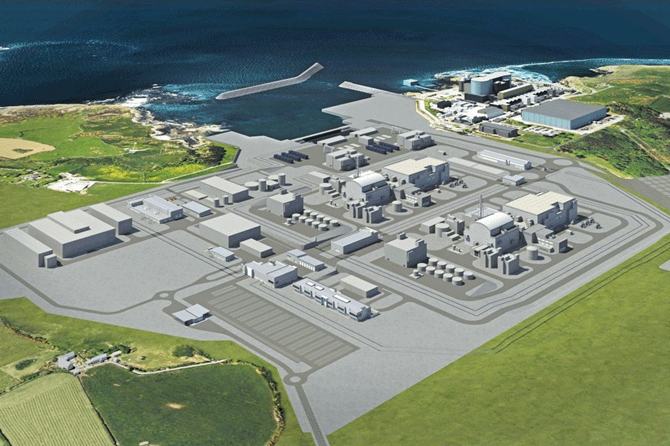 Wylfa: Anglesey nuclear power plant planning decision deferred, BBC,
She had been widely expected to back the proposals, granting what is known as a development consent order (DCO).
Hitachi shelved the scheme, the biggest energy project ever proposed in Wales, over funding issues.
Developers Horizon Nuclear Power had earlier said the decision would “heavily influence” how the project progresses.
Ms Leadsom has now given a deadline by the end of the year – and invited comments from Natural Resources Wales, the Office for Nuclear Regulation, Anglesey council and other bodies. She wants more assurances on various aspects – from biodiversity, visual impact, flooding and construction noise – and any risk to the Sandwich tern, which has a colony nearby.…….
Opponents of nuclear power have called on Ms Leadsom to dismiss the planning application and focus on renewable sources of electricity. Dylan Morgan of People Against Wylfa B said it was “obvious the developers are keen to get planning permission in order to try and sell the site”.
“But that’s easier said than done at the moment given the pretty perilous state of the global nuclear industry and the hopeless economics.”……. https://www.bbc.com/news/uk-wales-50139360
High Radiation Along Planned Moscow Highway Route
Greenpeace Finds High Radiation Along Planned Moscow Highway Route, Moscow Times, Oct. 21, 2019, Soil samples taken along the route of a planned highway in Moscow are emitting radiation levels that pose cancer risks to residents, Greenpeace Russia said Monday.
Activists have warned that the eight-lane highway, which authorities hope to start building next year and finish by 2024, will release buried radioactive dust into the air and the Moscow River.
“We now have official proof that radioactive waste lies on the route and not somewhere nearby,” Greenpeace Russia said Monday.
Greenpeace demanded in July that construction be halted, months after state-run safety tests revealed radiation levels near the planned highway 200 times higher than the norm.
The NGO and hired experts found five locations on the highway route between the Moscow Polymetals Plant and the Moskvorechye commuter rail station where topsoil emitted up to eight times the normal level of radiation.
“Borehole measurements half a meter deep showed greater [radiation] values than on the surface,” Greenpeace said…….https://www.themoscowtimes.com/2019/10/21/greenpeace-finds-high-radiation-along-planned-moscow-highway-route-a67834
Russian obfuscation over nuclear accident is a dangerous precedent
|
|
1 This Month
23-25 October – on Zoom – World BEYOND War’s annual global conferenc


Shut down the radiation-damaged Heysham nuclear reactors now
To see nuclear-related stories in greater depth and intensity – go to https://nuclearinformation.wordpress.com

Say No to NASA’s Reckless Nuclear Reactor on the Moon
Say No to NASA’s Reckless Nuclear Reactor on the Moon
-
Archives
- October 2026 (170)
- September 2026 (339)
- August 2026 (330)
- July 2026 (355)
- June 2026 (287)
- May 2026 (306)
- April 2026 (356)
- March 2026 (251)
- February 2026 (267)
- January 2026 (308)
- December 2025 (358)
- November 2025 (359)
-
Categories
- 1
- 1 NUCLEAR ISSUES
- business and costs
- climate change
- culture and arts
- ENERGY
- environment
- health
- history
- indigenous issues
- Legal
- marketing of nuclear
- media
- opposition to nuclear
- PERSONAL STORIES
- politics
- politics international
- Religion and ethics
- safety
- secrets,lies and civil liberties
- spinbuster
- technology
- Uranium
- wastes
- weapons and war
- Women
- 2 WORLD
- ACTION
- AFRICA
- Atrocities
- AUSTRALIA
- Christina's notes
- Christina's themes
- culture and arts
- Events
- Fuk 2022
- Fuk 2023
- Fukushima 2017
- Fukushima 2018
- fukushima 2019
- Fukushima 2020
- Fukushima 2021
- general
- global warming
- Humour (God we need it)
- Nuclear
- RARE EARTHS
- Reference
- resources – print
- Resources -audiovicual
- Weekly Newsletter
- World
- World Nuclear
- YouTube
-
RSS
Entries RSS
Comments RSS

