Bradwell nuclear power plan – foolish, in view of climate change predictions
 BANNG 8th Jan 2020, As we enter a new year, Andy Blowers muses on the massive challenge of climate change that lies ahead, globally and locally, in the column for Regional Life, January 2020.
In East Anglia, we are increasingly aware of record heatwaves, milder and wetter winters, retreating coastlines and loss of precious habitats and declining and disappearing species. To an extent, these may be tackled by adaptive measures such as managed retreat of the coastline or hard defences. Even then, land loss and inundation will be unavoidable.
The idea of a massive nuclear power station at Bradwell on a
site threatened by the impacts of climate change seems foolish in the
extreme. Far better to go for cheaper, less risky and easily deployable
renewable options. Concerted action worldwide and locally, by governments,
businesses and individuals, is needed now if we are to reduce carbon
emissions to net zero and avert catastrophe. That was a clear message from
the General Election. Now we must get on with it.
UK nuclear weapons programme £1.3bn over budget.
BBC 10th Jan 2020, UK nuclear weapons programme £1.3bn over budget. The Ministry Of Defence’s “poor management” of Britain’s nuclear weapons programme has led to rising costs and lengthy delays, according to the government spending watchdog.
UK Leading Labour leadership candidate Rebecca Long-Bailey would use nuclear weapons
|
8 January 2020 Leading Labour leadership candidate Rebecca Long-Bailey has said she would be prepared to use nuclear weapons as prime minister.It is a marked contrast to the policy of outgoing leader Jeremy Corbyn, a passionate and long-standing advocate of nuclear disarmament. Ms Long-Bailey, a staunch defender of Mr Corbyn’s failed leadership of the party, has previously been accused of being his “continuity candidate”. Asked on BBC Radio 4’s Today programme whether she would be prepared to launch a nuclear strike, Ms Long-Bailey said: “If you have a deterrent you have to be prepared to use it.”…. https://au.news.yahoo.com/rebecca-long-bailey-labour-leadership-nuclear-weapons-134918253.html |
|
|

Britain’s £1.2bn cleanup begins, of Berkeley power station, closed 30 years ago
 Nuclear waste removal begins 30 years after power station closure, https://www.bbc.com/news/uk-england-somerset-50866867 5 Jan 2029, Work has begun on removing nuclear waste from Berkeley power station, 30 years after it was decommissioned.The disused Magnox generator, situated on the banks of the River Severn in Gloucestershire, closed in 1989. Nuclear waste removal begins 30 years after power station closure, https://www.bbc.com/news/uk-england-somerset-50866867 5 Jan 2029, Work has begun on removing nuclear waste from Berkeley power station, 30 years after it was decommissioned.The disused Magnox generator, situated on the banks of the River Severn in Gloucestershire, closed in 1989.
It was the world’s first commercial power station and its laboratories and many of its buildings have already been dismantled. Work emptying its vast concrete vaults of the nuclear waste Berkeley generated is only now able to safely begin. But it will not be safe for humans to go inside its reactor cores until 2074. The BBC has been given a rare glimpse of what is stored under the disused site.For the past 50 years parts of the coastline of the west of England have been dominated by nuclear power stations. The 1960s saw the construction of Hinkley A and Hinkley B in Somerset, with both Oldbury and Berkeley built on the banks of the River Severn in the 1950s. Only Hinkley B is still in use but the nuclear waste the stations generated has remained in place. It takes hundreds of years to decompose and has to be stored underground. It will cost an estimated £1.2bn to fully decommission Berkeley. About 200 people are currently working on the site under strict security. Work emptying waste products from the concrete vaults, eight metres (26ft) underground, is a complicated process. They contain used graphite from the fuel elements in the nuclear generating process, material from the cooling ponds and from the laboratories. The removal is expected to take five or six years to complete. Rob Ledger, waste operations director at Berkeley, said: “When the power stations first started generating I don’t think there was much thought put into how the waste was going to be dealt with or retrieved. “It’s taken a while to develop the equipment and the facilities [to do this]. “A mechanical arm moves the debris into position and then a ‘grab’ comes down through an aperture in the vaults and picks up the debris [and] puts it into a tray. “Each debris-filled tray weighs up to 100kg (220lb). “The automated machinery is controlled by computers [and] tips [the waste] into a cast iron container.” The containers will house the waste in an intermediate storage facility until a long-term solution can be found. “Nuclear waste does take a long time to decay… it’s hundreds of years. And that’s why we have to go to these lengths, to store it safely,” said Mr Ledger. Eventually the boxes will be housed deep underground in a long-term storage facility. The location has not yet been decided by the government. There are currently estimated to be almost 95,000 tonnes of nuclear waste in the form of graphite blocks across the UK. But if the Carbon 14 can be extracted from the blocks, they become much safer and easier to deal with. A new process is being explored, by scientists at Bristol University, to ensure not all of the waste will be discarded. They have developed a process that uses reactor core spent contents in a new power form. Carbon 14 from nuclear reactors is infused into wafer-thin diamonds, man-made in a lab at Bristol University. They then become radioactive and form the heart of a battery that would last for many thousands of years. The tiny batteries could be used in pacemakers, hearing aids or sent into space as part of the space programme. The process is being piloted in association with the UK Atomic Energy Authority in Abingdon. It is hoped the decommissioned Gloucestershire site may be redeveloped to manufacture the new batteries, creating jobs in the region. |
|
UK govt trying to finance new nuclear plants, – complicated relations with China and USA
boss Vincent de Rivaz ill-advisedly said that customers would be using
electricity from the planned Hinkley Point C power plant to cook their
Christmas turkeys by 2017. Two years on from that self-imposed deadline,
the £21bn nuclear power station is still being built over a sprawling site
in the Somerset countryside – while the very future of nuclear power in
the UK is up for debate as other sources of energy snap at its heels and
investment in the sector gets harder to find.
backdrop of wariness about the source of potential investments:
state-backed China General Nuclear (CGN) is one of few investors willing to
pour money into the risky nuclear sector – but the communist
superpower’s involvement has brought political and security concerns as
well as opposition from the US.
beset by controversy, with Theresa May, the former prime minister,
reversing George Osborne’s courting of China in 2016 when she ordered a
review of China’s involvement in the UK’s nuclear industry, amid
concerns about national security.
consultation opened in the summer on the potential new financing mechanism for nuclear power plants which will see consumers pay for nuclear power plants before they start producing, in an attempt to bring down the costs of financing.
https://www.telegraph.co.uk/business/2020/01/05/britain-heading-fallout-nuclear-conundrum/

UK’s Sizewell C nuclear project not viable, due to escalating costs?

Could escalating costs mean ‘game over’ for nuclear power and Sizewell C? East Anglian Daily Times, January 2020, Andrew Hirst
The growing cost of nuclear power could mean ‘game over’ for Sizewell C, experts claim. While much of the debate in Suffolk around EDF Energy’s proposals have focussed on the local impacts, recent reports from energy forums have started to question how viable the industry is for the UK – and globally.
At a recent debate, Paul Dorfman of the University College London’s Energy Institute went head to head with Paul Spence, director of strategy and corporate affairs at EDF to discuss the future of the sector.
Dr Dorfman, who also founded the Nuclear Consulting Forum, said the “massive cost escalations” of nuclear power together with the increasing competiveness of renewables meant there was “little rationale for new nuclear builds”.
Costs for offshore wind have plummeted to around £40 per MWh – making it now one of the cheapest forms of power available.
Meanwhile, the costs government agreed to pay EDF for Hinkley Point C, is more than twice as expensive at £92.50 per MWh.
The latest World Nuclear Industry Status Report warned of “substantial challenges” and a decline in usage, with fewer reactors in operation today than 30 years ago.
Globally, while investment in renewables has increased to around $350bn per year, nuclear fell to just $17bn. Dr Dorfman said: “In this context, nuclear power at the expense of more flexible, safe, productive, cost-effective and affordable technologies really does seem to be rather foolish.”
He said it could mean “game over” for nuclear projects, including Sizewell…….
The government consulted earlier this year on the “Regulated Asset Base model”, which is intended to incentivise private investment in public projects by guaranteeing a return for developers. It would mean developers can raise revenue, potentially though customer bills, and reduces their risk. ……
although EDF claims RAB could save money for consumers – critics say it merely leaves the public with all the risk.
“Under RAB, the plan is for the burden of risk to pass to hard-pressed UK consumers and/or taxpayers labouring under post-Brexit conditions,” said Dr Dorfman.
“Not only that, but the revenue stream will include a variable strike price – with taxpayers and/or electricity consumers forced to write, what is essentially, a ‘blank cheque’.
Earlier this year it was reported a “Sizewell surcharge” could add £6 to annual energy bills under the RAB model. A petition opposing the surcharge was signed by more than 36,000 people.
Concerns were further compounded by EDF’s precarious financial position. The company is €37.4billion net debt and its stock lost 34% of its value this year.
Professor Steve Thomas, a researcher in energy policy at the University of Greenwich, questioned the company’s credentials ahead of a seminar organised by the Nuclear Free Local Authorities in Colchester last month.
“EDF is in deep financial crisis and will only be able to survive with heavy French government support and radical restructuring,” he said. “It is unclear how EDF will be able to finance Hinkley Point C, much less Sizewell C, and the UK government must resist pressures to throw more public money at these ill-conceived projects and abandon them now.”
Environmental and technical worries, as Russia extends the life of old Kola Nuclear Power Plant
One of Russia’s oldest nuclear reactors set to run until 2034 https://bellona.org/news/nuclear-issues/2020-01-one-of-russias-oldest-nuclear-reactors-set-to-run-until-2034
The second reactor unit at the Kola Nuclear Power plant near Murmansk has received the nod from Russian regulators to operate until 2034, making it one of the longest running commercial reactors in the world and raising a host of environmental and technical concerns. January 2, 2020 by Charles Digges
The second reactor unit at the Kola Nuclear Power plant near Murmansk has received the nod from Russian regulators to operate until 2034, making it one of the longest running commercial reactors in the world and raising a host of environmental and technical concerns.
Currently, the longest serving reactor ever is the Oyster Creek Nuclear Generating Station in the United States, which, after running for 49 years, was finally shut down in 2018. Should the Kola plant’s No 2 reactor run out the term of its new lifetime extension, it would be 59 by the time it is retired.
Kola’s No 2 reactor, which came online in 1975, is not alone. The plant’s other three units, which are all VVER-440 reactors, are likewise operating on sometimes numerous lifetime extensions that would bring them to ripe old age before their operations are stopped. The No 1 reactor at the Kola plant, which started generating power 1973, was granted a second runtime extension two years ago, and won’t retire until 2033. The No 3 and No 4 reactors – which came online in the early 1980s – will operate until 2027 and 2029, respectively.
The prolonged operations of these reactors has been cause for concern among some experts, who say that bringing the units into step with current industry safety demands is difficult, given their aging design.
n the shadow of the 2011 Fukushima disaster, which resulted in a triple reactor meltdown, worldwide nuclear building standards have tightened across the board in ways that some fear have left the Kola Nuclear Power Plant’s reactors behind.
Yet more and more often, extending runtime extensions is becoming a general practice throughout the nuclear industry – and not only in Russia. Throughout central and western Europe, there are some 90 nuclear reactors that are currently under review for lifespan extensions, including many in countries like France, the United Kingdom, the Netherlands, Switzerland and Finland. Six of the 15 Soviet-built nuclear reactors in Ukraine are operating on extended lifespans, with the remaining expected to follow.
For its part, Germany has elected altogether to shutter its nuclear power plants – a goal it hopes to reach by 2022. But the move is proving politically and technically complex. The waste resulting from the closures – thought to eventually comprise some 2,000 containers – must be stored in safely the same spot for 1 million years, and experts are short on ideas about where, exactly, to do that. The costs, too, are astronomical, with the phase-out expected to reach nearly $73 billion.
t is expenses like these that are so deviling to Russia’s nuclear industry, which has failed to build up a robust savings account for decommissioning expenses. Like other countries, Russia collects decommissioning funding through electricity tariffs charged to customers. But unlike other countries, Russia has only been doing this since 1995, shortly after the fall of the Soviet regime and the introduction of a market-based economy. As a result, issuing lifetime extension to elderly reactors offers Moscow a cheap – and what many countries consider a safe – alternative to the more costly route of dismantlement.
Still, environmentalists are right to be nervous. Scientific research on how nuclear reactors age – and on the kinds of problems that emerge as they do – has come mostly from studies in research reactors. While these studies have offered some insight on how reactors weather over time, many experts say that the data on how commercial reactors behave in their twilight years are still too inconclusive to be trusted.
But Rosatom officials insist that the extended reactors at the Kola Nuclear Power Plant are safe, and offers figures to back up its claims. According to a report in the Barents Observer, the corporation spent some 4.5 billion rubles – or about $72 million – on upgrades to the No 2 reactor before regulatory officials granted the runtime extension. Plant officials likewise eliminated numerous safety violations and are in the process of eliminating them.
Depleted uranium causing cancer epidemic in Serbia
The number of cancer patients will dramatically increase 20 years after NATO aggression, because that is when uranium has strongest effect, said oncologist Vladimir Cikaric. Now we have 35000 people that suffer from cancer, and in three years that number could climb to 70.000
According to him, there are 35.000 people suffering from cancer, and after 2019 that number could double to 70.000 because the effect of the depleted uranium from Kosovo and from Pcinjski area is spreading over the entire country.
– Serbia is number one in the mortality rate from tumors in Europe, and we have almost three times higher mortality than carcinoma in comparison to the world. The reason is that the dust from the depleted uranium in Pcinski area and Kosovo spread across the entire country. We all breathed it. Because of that we now have drastic increase of leukemia and lymphoma, but also all other types of carcinoma. However, the worst is yet to come. Depleted uranium has the strongest effect after 20 years and it turns healthy cells into cancer cells. That means that from 2019 the number of people who will get sick with cancer will increase, according to some assessments, there will be 70.000 people, which is twice the number we have now. Real health disaster is in front of us, which we can not prevent – warns Cikaric.
The European Pressurised Water Reactor (EPR) is dragging nuclear company EDF into $billions of debt

Climate News Network 31st Dec 2019, The edifice already heading for the status of the largest and most expensive construction project in the world, the Hinkley C nuclear power station (above) in the UK, is dragging its builder, the French giant EDF, into ever-deeper debt: the company’s flagship reactor is facing still more delay.
Although EDF is a vast company, owning 58 reactors in France alone,
and is 85% owned by the French state, it owes around €60 billion ($67bn),
a debt expected to increase by €3 billion ($3.35bn) a year.
This has led some city analysts, notably S&P Global, to downgrade the company’s prospects to “negative” − which is essentially a recommendation to
shareholders to sell.
Apart from the problem that EDF’s fleet of reactors in France is operating well beyond their original design life and are in constant need of safety and maintenance upgrades, the company’s main problem is its flagship, the European Pressurised Water Reactor (EPR), which is getting into ever-greater difficulties.

In Europe there are four EPRs under construction: the two barely begun at Hinkley Point in Somerset in the west of England; one in northern France at Flamanville (below) in Normandy; and the original prototype in Finland, known as Olkiluoto 3 (OL3) (above) . The extraordinary fact is that, although OL3 was due to start up in 2009, it is still incomplete, and its start date has just been put back again – until 2021.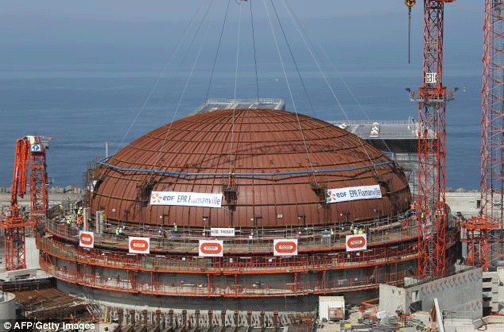
https://climatenewsnetwork.net/flagship-reactor-launch-postponed-again/
Russia, in fear of a USA first strike may now revive its “dead hand” nuclear weapon
 ‘s Nuclear “Dead Hand”
Russia won’t succumb to pressure near its territory. National Interest, by Michael Peck 30 Dec 19,
Key point: Russia is acting out of fear that a U.S. first-strike that would decapitate the Russian leadership before it could give the order to retaliate.
But the system, known as “Perimeter” or “Dead Hand,” may be back and deadlier than ever.
This comes after the Trump administration announced that the United States is withdrawing from the 1987 Intermediate-Range Nuclear Forces Treaty, which eliminated the once-massive American and Russian stockpiles of short- and medium-range missiles.
Donald Trump alleges that Russia has violated the treaty by developing and deploying new, prohibited cruise missiles.This has left Moscow furious and fearful that America will once again, as it did during the Cold War, deploy nuclear missiles in Europe. Because of geographic fate, Russia needs ICBMs launched from Russian soil, or launched from submarines, to strike the continental United States. But shorter-range U.S. missiles based in, say, Germany or Poland could reach the Russian heartland.
Viktor Yesin, who commanded Russia’s Strategic Rocket Forces in the 1990s, spoke of Perimeter/Dead Hand during an interview last month in the Russian newspaper Zvezda [Google English translation here]. Yesin said that if the United States starts deploying intermediate-range missiles in Europe, Russia will consider adopting a doctrine of a preemptive nuclear strike. But he also added this:
Yesin: “The Perimeter system is functioning, it has even been improved. But when it works, we will have little left – we can only launch those missiles that will survive after the first attack of the aggressor.” …….
What is unmistakable is that Perimeter is a fear-based solution. Fear of a U.S. first-strike that would decapitate the Russian leadership before it could give the order to retaliate. Fear that a Russian leader might lose his nerve and not give the order.
And if Russia is now discussing Perimeter publicly, that’s reason for the rest of us to worry.https://nationalinterest.org/blog/buzz/america-driving-return-russias-nuclear-dead-hand-109206
UK: legal action against environmental destruction by Sizewell nuclear project
Crowd Justice (accessed) 30th Dec 2019, Together Against Sizewell C (TASC) is an unincorporated citizens’ group
formed to oppose the building of Sizewell C’s twin nuclear reactors and
associated works in Suffolk Coast & Heaths Area of Outstanding Natural
Beauty (AONB) in a legal open, peaceful and fully accountable manner.
TASC has mounted a legal challenge against East Suffolk Council’s decision to
approve the planning application submitted by EDF, the nuclear developer,
to: – chop down 100-year-old Coronation Wood, turn a large area of priority
habitat acidic grassland, known as Pillbox Field, into a 576 space car
park, relocate over 320,000 sq. feet of 7 largely non-essential and
non-operational Sizewell B buildings and an additional 128 car parking
spaces, that will encroach further into the AONB. Most of these
buildings/facilities could be located outside the AONB. The works are
needed to free up land for the construction of Sizewell C as the existing
site is too small and are clearly integral to the wider Sizewell C
development.
https://www.crowdjustice.com/case/save-coronation-wood/
BBC 30th Dec 2019, Campaigners opposing a new nuclear power station are seeking a judicial review over a “premature” decision to allow woodland to be felled. EDF Energy wants to build two reactors next to Sizewell B in Suffolk and in September was told it could chop down Coronation Wood on the site. TogetherAgainst Sizewell C (Tasc) said the area was vital for wildlife. East
Suffolk Council said it would respond to the campaigners’ challenge in due
course.
Germany To Close All Nuclear Plants By 2022
In the wake of the Fukushima disaster in Japan in 2011, Germany ordered the immediate shutdown of eight of its 17 reactors, and plans to phase out nuclear power plants entirely by 2022.
The Philippsburg 2 reactor near the city of Karlsruhe in southwestern Germany has provided energy for 35 years. The Philippsburg 1 reactor—opened in 1979—was taken offline in 2011.
Over the past few years, nuclear power generation in Germany has been declining with the shutdown of its nuclear plants, while electricity production from renewable sources has been rising.
A government-appointed special commission at Europe’s largest economy announced the conclusions of its months-long review and proposed that Germany shut all its 84 coal-fired power plants by 2038.
Germany, where coal, hard coal, and lignite combined currently provide around 35 percent of power generation, has a longer timetable for phasing out coal than the UK and Italy, for example—who plan their coal exit by 2025—not only because of its vast coal industry, but also because Germany will shut down all its nuclear power plants within the next three years.
The closure of all nuclear reactors in Germany by 2022 means that Germany might need to retain half of its coal-fired power generation until 2030 to offset the nuclear phase-out, German Economy and Energy Minister Peter Altmaier said earlier this year.
Russia extends license for remote nuclear power plant
One of the reactors at Bilibino NPP has got permission for another five years despite the nearby new floating nuclear power plant now is in operation. By Thomas Nilsen– December 29, 2019
Just one week after “Akademik Lomonosov” started to produce electricity to the grid in Pevek, one of the three remaining reactors at Bilibino nuclear power plant (NPP) got a renewed five-years permission until December 31st, 2025.
Bilibino NPP is located in the far remote Bilibinsky District in the Chukotka Autonomous Okrug, Russia’s northeastern corner. The power plant provides electricity to the same Pevek-Chaun-Bilibino grid currently under construction as the new floating nuclear power plant.
One of the four reactors at Bilibino is already shut-down, while the other three were to follow as soon as the grid and the “Akademik Lomonosov” came in place. That would likely not happen before earliest by the end of 2021.
The license was issued by Rosteknadzor, Russia’s Federal Agency for Ecological, Technological and Nuclear Supervision and is valid for reactor No. 2.
It is operator of the plant, state nuclear corporation Rosatom, that informs about the renewed license.
Bilibino nuclear power plant started operation in 1974 with reactors supposed to run for a 30-years period. In 2004, the plant’s operational lifetime was prolonged with 15 years, and now, another five years is added to one of the reactors.
Bilibino NPP, which is located some 240 kilometers from Pevek, would need a prolonged license even if shut down by 2022, since the spent nuclear fuel most likely will stay in the reactors for a much longer period before decommissioning work can start.
Russian nuclear news-site Seogan reports that work is underway aimed at prolonging the lifetime of reactor No. 3 and No. 4 as well.
The reactors are of the EGP-6 type, a scaled down version of the Chernobyl-type RBMK light-water cooled graphite reactors. The plant is both the world’s smallest and most remote located onshore nuclear power plant.
In August this year, Rostechnadzor made a scheduled audit at the plant and discovered 19 violations of norms and rules for operating a nuclear power plant. 3 of the violations were fixed on spot, while the 16 others resulted in administrative protocols and sanctions, the agency reports on its own portal.
Germany’s nuclear phase-out enters final stretch
The 2011 Fukushima nuclear disaster in Japan led to widespread anti-atomic-power protests across Germany. Two months after the accident, Chancellor Angela Merkel announced that all plants would be closed over the next decade, making Germany the second country after Italy to shut down all of its atomic energy stations.
The German Federation for the Environment and Nature Conservation (BUND) welcomed the news. A BUND spokesman said the group hoped to see the end of nuclear power being “conjured up again and again as a supposed healing charm and climate savior.”
However, Wolfram König, who heads the German government’s office for the nuclear phase-out, warned that the country still faced the great “challenge” of trying to phase out both coal and atomic energy at the same time.https://www.dw.com/en/germany-shuts-down-atomic-plant-as-nuclear-phase-out-enters-final-stretch/a-51845616
Britain’s nuclear weapons convoys a disaster waiting to happen

DOZENS of safety failures during nuclear weapons convoys are a “disaster waiting to happen,” campaigners charged as they demanded the Ministry of Defence (MoD) answer for the risks it is exposing the public to.
The Campaign for Nuclear Disarmament (CND) and political campaigners have hit out at the MoD after concerning reports show 40 lapses in safety while nuclear and radioactive materials were being transported across the country over the past five years.
A Freedom of Information request has revealed the 40 operational and engineering issues on convoys carrying bombs and hazardous materials.
These incidents included issues identified with brakes on convoy vehicles, included burning smells during transportation.
On other occasions convoy vehicles were forced to stop, and road lanes closed, after suffering flat tyres.
Among other engineering faults listed were warnings of overheating in convoy vehicles.
Multiple “operational” issues also disrupted transportation of dangerous materials.
Reported in these were rolling road blocks needed to manoeuvre the convoy through busy, congested routes across the UK, causing delays in the journey.
CND general secretary Kate Hudson said: “Nuclear bombs carried on our roads are a disaster waiting to happen.
“This report shows that ‘poor maintenance’ is a factor in these safety lapses.
“The MoD must be brought to book for this disgraceful failure — and our new government must end this cargo of death through our communities.”
Britain’s nuclear weapons are still based in Scotland and those north of the border have said it is time to rid ourselves of the apocalyptic threats.
Scottish Green MSP Mark Ruskell led a debate on the topic last year.
He said: “Like many I’d like to see an end to the housing of nuclear weapons in Scotland, but while they are still here it’s not unreasonable to expect the highest standards of safety to apply to their movement.
“People will be shocked at the thought of nuclear convoys travelling on public roads.
“In Stirling the convoys even park up overnight behind a chain-link fence across the road from a Nando’s and a Vue Cinema. This is an absurd situation that must come to an end.”…… https://morningstaronline.co.uk/article/b/britain-nuclear-weapons-convoys-are-a-disaster-waiting-to-happen-peace-campaigners-warn
1 This Month
23-25 October – on Zoom – World BEYOND War’s annual global conferenc


Shut down the radiation-damaged Heysham nuclear reactors now
To see nuclear-related stories in greater depth and intensity – go to https://nuclearinformation.wordpress.com

Say No to NASA’s Reckless Nuclear Reactor on the Moon
Say No to NASA’s Reckless Nuclear Reactor on the Moon
-
Archives
- October 2026 (170)
- September 2026 (339)
- August 2026 (330)
- July 2026 (355)
- June 2026 (287)
- May 2026 (306)
- April 2026 (356)
- March 2026 (251)
- February 2026 (267)
- January 2026 (308)
- December 2025 (358)
- November 2025 (359)
-
Categories
- 1
- 1 NUCLEAR ISSUES
- business and costs
- climate change
- culture and arts
- ENERGY
- environment
- health
- history
- indigenous issues
- Legal
- marketing of nuclear
- media
- opposition to nuclear
- PERSONAL STORIES
- politics
- politics international
- Religion and ethics
- safety
- secrets,lies and civil liberties
- spinbuster
- technology
- Uranium
- wastes
- weapons and war
- Women
- 2 WORLD
- ACTION
- AFRICA
- Atrocities
- AUSTRALIA
- Christina's notes
- Christina's themes
- culture and arts
- Events
- Fuk 2022
- Fuk 2023
- Fukushima 2017
- Fukushima 2018
- fukushima 2019
- Fukushima 2020
- Fukushima 2021
- general
- global warming
- Humour (God we need it)
- Nuclear
- RARE EARTHS
- Reference
- resources – print
- Resources -audiovicual
- Weekly Newsletter
- World
- World Nuclear
- YouTube
-
RSS
Entries RSS
Comments RSS

