Anti nuclear activists break into France’s Tricastin nuclear station
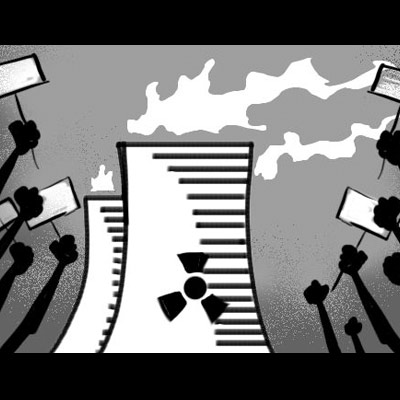 Reuters 21st Feb 2020. Activists from Greenpeace broke into the Tricastin nuclear power plant in southern France in order to demand its closure, the environmental pressure group said on Friday. “Some 50 Greenpeace activists gained access to several points at the Tricastin nuclear power plant this morning,” said Greenpeace spokeswoman Cecile Genot. “We are protesting and drawing attention to an aging nuclear power plant that is dangerous and should be shut down.” Officials for French state-controlled power group EDF, which runs Tricastin, had no immediate comment on the situation.
 |
ReplyForward
|
Nuclear Energy Agency’s “pretend transparency”
| “ |
Nuclear Energy Agency’s Janus-like approach to nuclear transparency: a case study in obstruction, 21 February 2020 By Dr David Lowry, Nuclear Transparency Watch
  “…………. Conclusion “…………. Conclusion
NEA cannot make publicity it is hosting an international meeting on stakeholder engagement, but only allow well-resourced stakeholders to participate, having allocated no budget line for accommodation or travel for civil society organisations (CSOs). Initially, NEA refused to reveal which Civil Society / NGO groups had shown up to participate, because – I believe – they were embarrassed that so few were there. Aside from representatives of civil society groups invited (and remunerated) as speakers, there was virtually no civil society representation. The final list of attendees, released after four months of pressure from me, shows the balance of participants was about 95% pro nuclear institutional interests, 5% civil society or non-aligned interested parties. To label such an imbalanced event a “Stakeholder Engagement” meeting is an abuse of language. The nuclear industry cannot be allowed to pretend they believe in transparency, then practice secrecy, as NEA did in this sorry saga. Because, like a dog with a bone, I refused to let go in this, I finally forced disclosure. But this should have come automatically. NEA needs to learn the lessons: the first is, it needs to abide by the dictionary definition of transparency, and deliver it in future! http://www.nuclear-transparency-watch.eu/activities/transparency-and-public-participation/nuclear-energy-agencys-janus-like-approach-to-nuclear-transparency-a-case-study-in-obstruction.html
|
|
France starts out on the path to withdraw from nuclear energy
|
France Takes First Steps to Reduce Nuclear Energy Dependence https://www.voanews.com/europe/france-takes-first-steps-reduce-nuclear-energy-dependence, By Lisa Bryant, 21 Feb 20
February 21, 2020 France, the world’s most nuclear energy-dependent nation, is taking its first steps to shift to more renewables to power up.
On Saturday, the country begins a gradual shutdown of its aging Fessenheim plant. The move fits into the government’s broader energy strategy to reduce French dependence on nuclear energy from supplying three-quarters of its electricity to about half by 2035. Prime Minister Edouard Philippe says the plant’s first reactor will be closed Saturday, and the second in June. Another dozen reactors must close by 2035 to meet the phase-down target. The plan also sees France closing its remaining coal plants, and moving to renewables like solar and wind to close the energy gap and help fight climate change. For Charlotte Mijeon, spokesperson for anti-nuclear group Sortir du nucléaire, the Fessenheim shutdown is welcome news — but not enough. “It’s great that it’s eventually closed; however, we fear that Fessenheim is something like the tree hiding the forest,” she said. “The government is closing one nuclear power plant, but it should not make us forget that the rest of the nuclear fleet is aging.” France has 58 nuclear power plants, thanks to an energy strategy dating back to the 1970s oil crisis. Supporters say nuclear energy is a clean way to fight climate change while also meeting national energy needs. But critics say the plants have received billions in subsidies and nuclear lobbies are powerful, making it harder for renewables to compete. And they say the remaining plants pose mounting safety concerns as they age. “Regarding the climate emergency, we have no time left,” Mijeon said. “So we have to invest in green climate solutions, not in nuclear power, which is not only dirty, but also very expensive and slow.” While the reactor shutdown is a first for France, other countries, including Switzerland, Sweden and the United States, have also shut plants for a mix of budgetary, safety and environmental reasons. Neighboring Germany aims to phase out of nuclear power completely by 2022. It has been pushing for years for the shutdown of Fessenheim, which is located near its border |
|
Bavaria’s renewable capacity growing as nuclear plant shutdown boosts power imports
|
Bavaria’s renewable capacity growing as nuclear plant shutdown boosts power imports, 21 Feb 2020, Benjamin Wehrmann, Clean Energy Wire
Power generation with solar panels and bioenergy plants has reached a new record level in Bavaria, the German state’s economy ministry has said. Final data for 2018 showed that solar power production grew by 4.5 percent that year to reach nearly 12 terawatt hours (TWh), while production with bioenergy reached 9.2 TWh, 0.2 percent more than in 2017. “The energy transition is right on our doorstep,” said Bavaria’s economy minister Hubert Aiwanger, adding that the looming solar power support cap had to be removed and new land designated for solar panel installation to ensure that renewables could continue to grow in the state. However, the shutdown of nuclear power plant Gundremmingen B and a particularly dry year in 2018, which substantially reduced hydropower production, meant that Bavaria had to import large volumes of electricity for the first time ever in that year. Gross power production dropped from nearly 85 TWh to just under 74 TWh between 2017 and 2018, meaning that the economic powerhouse state had to import 10 TWh to cover its demand, a situation “that has never existed before,” the ministry says. Aiwanger said the “power generation gap” would grow further once Bavaria’s two remaining nuclear plants go offline at the end of 2021 and 2022, respectively. “The figures show that we all need to pull together to ensure a sustainable energy supply,” Aiwanger said…….. https://www.cleanenergywire.org/news/bavarias-renewable-capacity-growing-nuclear-plant-shutdown-boosts-power-imports |
|
France shuts down Fessenheim reactor in first phase of retreat from nuclear power
Reactor No. 1 will be halted on Saturday and the entire complex will come to a halt on June 30, the statement said.
Germany has long called for the plant, France’s oldest, to be shut down. It is the first nuclear complex to be closed under Macron’s plan.
France depends more on nuclear energy than any other country, getting about three-quarters of its electricity from the plants. Macron said in 2018, outlining France’s energy strategy for the next 30 years, that 14 nuclear reactors out of the 58 now running at 19 plants would be shut down by 2035. France would cap the amount of electricity it derives from nuclear plants at 50% by then.
Algeria and French Polynesia suffer from France’s 30 years of nuclear bomb testing
But Jean-Claude Hervieux has other memories. He joined the French testing efforts in Algeria as an electrician. He remembers a nuclear test in 1962 that did not go according to plan.
Radioactive dust and rock escaped from underground. Hervieux and others observing the testing ran for shelter. Two French ministers were among them. The group washed themselves in a military housing area to decontaminate.
France held more than 200 nuclear tests until a later president, Jacques Chirac, ended testing in 1996. Most tests took place in French Polynesia. But 17 took place in Algeria between 1960 and 1966, ending four years after Algeria’s independence from France.
Brahim Oumansour is a North Africa expert at the French Institute of International Relations in Paris. He said, “It’s part of the whole issue of decolonization and Algerians in general asking for recognition of colonization crimes.” He added that official recognition and financial compensation for the Algerian tests could cost millions of dollars.
Hervieux spent 10 years working on nuclear test areas in Algeria and later French Polynesia. Now 80 and living in France’s Lyon area, he says he is physically fine. But he used to receive some questionable radioactive testing results from the French government……
France’s nuclear compensation commission, CIVEN, said more than 1,600 claims have been filed under a 2010 French law that finally recognized health problems related to the testing.
Only about one-third have met the requirements needed to receive financial benefits. The requirements include about 24 possible radiation-related cancers. Almost all the claims came from France and French Polynesia. Of the 51 claims from Algeria, only one has been compensated…. https://learningenglish.voanews.com/a/questions-remain-as-france-marks-60-years-since-nuclear-tests-/5287541.html
Chinese-led nuclear company pretending that Sizewell project is a ‘fait accompli’ – no, it is far from it.
BANNG 1 020, The Blackwater Against New Nuclear Group (BANNG) has learned that GNSL, the Chinese-led company seeking to build a mammoth new nuclear power station at Bradwell, is preparing to launch its pre-application public consultation for planning permission later this year.
This will be long before detailed discussions with the nuclear regulators are concluded. There are major issues and challenges still to be confronted. ‘It seems that the Chinese developers are taking a risk in trying to present the public and politicians with an apparent ‘fait accompli’ well before major design
and environmental hurdles have been crossed’ said Prof. Andy Blowers,
Chair of BANNG.
GNSL greeted the announcement that the Generic Design
Assessment (GDA) for Bradwell B had begun Step 4 as a major milestone,
clearing the path for deployment of Chinese nuclear technology in Britain.
That is far from the case. Moving to Step 4 in the GDA is like reaching a
hurdle, not passing a milestone. It is at this stage that all the tricky
issues facing the Bradwell B project must be confronted, including the
cooling system, site suitability, security, coastal defence, impacts on
marine and terrestrial environments and so on.
Step 4 is a long and intensive process between the developer and the independent regulators, the Office for Nuclear Regulation (ONR) and the Environment Agency (EA). It is not expected to be concluded for another two years. A pre-application should follow, not overlap, Step 4 of the GDA.
https://www.banng.info/news/press-release-18th-february-2020/
UK’s new nuclear projects headed to be submerged due to climate change?
 Speeding Sea Level Rise Threatens Nuclear Plants https://www.ecowatch.com/sea-level-rise-nuclear-plants-2645160125.html?rebelltitem=2#rebelltitem2 Climate News Network, Feb. 15, 2020 By Paul Brown
The latest science shows how the pace of sea level rise is speeding up, fueling fears that not only millions of homes will be under threat, but that vulnerable installations like docks and power plants will be overwhelmed by the waves.
New research using satellite data over a 30-year period shows that around the year 2000 sea level rise was 2mm a year, by 2010 it was 3mm and now it is at 4mm, with the pace of change still increasing.
The calculations were made by a research student, Tadea Veng, at the Technical University of Denmark, which has a special interest in Greenland, where the icecap is melting fast. That, combined with accelerating melting in Antarctica and further warming of the oceans, is raising sea levels across the globe.
The report coincides with a European Environment Agency (EEA) study whose maps show large areas of the shorelines of countries with coastlines on the North Sea will go under water unless heavily defended against sea level rise.
Based on the maps, newspapers like The Guardian in London have predicted that more than half of one key UK east coast provincial port — Hull — will be swamped. Ironically, Hull is the base for making giant wind turbine blades for use in the North Sea.
The argument about how much the sea level will rise this century has been raging in scientific circles since the 1990s. At the start, predictions of sea level rise took into account only two possible causes: the expansion of seawater as it warmed, and the melting of mountain glaciers away from the poles.
In the early Intergovernmental Panel on Climate Change reports back then, the melting of the polar ice caps was not included, because scientists could not agree whether greater snowfall on the top of the ice caps in winter might balance out summer melting. Many of them also thought Antarctica would not melt at all, or not for centuries, because it was too cold.
Both the extra snow theory and the “too cold to melt” idea have now been discounted. In Antarctica this is partly because the sea has warmed up so much that it is melting the glaciers’ ice from beneath — something the scientists had not foreseen.
Alarm about sea level rise elsewhere has been increasing outside the scientific community, partly because many nuclear power plants are on coasts. Even those that are nearing the end of their working lives will be radio-active for another century, and many have highly dangerous spent fuel on site in storage ponds with no disposal route organized.
Perhaps most alarmed are British residents, whose government is currently planning a number of new seaside nuclear stations in low-lying coastal areas. Some will be under water this century according to the EEA, particularly one planned for Sizewell in eastern England.
The agency’s report says estimates of sea level rise by 2100 vary, with an upper limit of one meter generally accepted, but up to 2.5 meters predicted by some scientists. The latest research by Danish scientists suggests judiciously that with the speed of sea level rise continuing to accelerate, it is impossible to be sure.
A report by campaigners who oppose building nuclear power stations on Britain’s vulnerable coast expresses extreme alarm, saying both nuclear regulators and the giant French energy company EDF are too complacent about the problem.
The report said: “Polar ice caps appear to be melting faster than expected, and what is particularly worrying is that the rate of melting seems to be increasing. Some researchers say sea levels could rise by as much as six meters or more by 2100, even if the 2°C Paris target is met.
“But it’s not just the height of the rise in sea level that is important for the protection of nuclear facilities, it’s also the likely increase in storm surges. An increase in sea level of 50cm would mean the storm that used to come every thousand years will now come every 100 years. If you increase that to a meter, then that millennial storm is likely to come once a decade.
Bearing in mind that there will probably be nuclear waste on the Hinkley Point C site [home to the new twin reactors being built by EDF in the West of England] until at least 2150, the question neither the Office of Nuclear Regulation nor EDF seem to be asking is whether further flood protection measures can be put in place fast enough to deal with unexpected and unpredicted storm surges.”
European Pressurised Reactor at Flamanville: nuclear is expensive and it doesn’t work.

 France Culture 14th Feb 2020, EPR: nuclear is expensive and it doesn’t work. A kind of modern replica of the Danaïdes barrel, the EPR at Flamanville, in the Manche department, is once again being talked about: between construction delays (delivery scheduled for 2010, “potentially promised” now in 2022) and additional costs ( estimated three billion, we would exceed 12 billion today), is there ultimately a future for what was sold in the late 90s (1998-2000) as
the new wonder of the genre?
Ultimate Doomsday Weapon: Missiles Powered By Nuclear Reactors
 Ultimate Doomsday Weapon: Missiles Powered By Nuclear Reactors, With disastrous results. National Interest Ultimate Doomsday Weapon: Missiles Powered By Nuclear Reactors, With disastrous results. National Interest
– 17 Feb 20 Key Point: Russia is resurrecting the demons of our shared Cold War past.
After days of speculation by Western analysts that a deadly accident on August 8 that briefly spiked radiation levels in northwestern Russia was tied to tests of an exotic nuclear-powered “Skyfall” nuclear-powered cruise missile, Russian sources confirmed to the New York Times the explosion of a “small nuclear reactor.”
While there’s a tactical rationale behind Russia’s development of a fast, surface-skimming cruise missile with an unlimited range as a means of bypassing American missile defenses, it strikes many analysts as an inordinately expensive, extremely technically challenging, and—evidently!—downright unsafe. That’s because the United States has tried it before sixty years earlier—and even with the fast-and-loose safety culture of the Cold War 1960s, the poison-spewing radioactive mega missile it began developing was considered too dangerous to even properly flight test. This project was most famously described in a 1990 article by Gregg Herken for Air & Space Magazine, which remains well worth the read. …..
The SLAM missile was expected to soar towards its Soviet targets at tree-top level, traveling at three times the speed of sound. The combination of low-altitude (reducing detection range) and Mach 3 speed was thought to make it too fast for interception by fighters or surface-to-air missile. The sonic shock wave produced by the huge missile was believed to be strong enough to kill anyone caught underneath it.
The huge missile, laden with up to twelve thermonuclear bombs, would proceed to race towards one Soviet city after another, visiting Hiroshima-level human tragedies upon each. And once the bombs were exhausted, the nuclear-powered missile would…simply keep on going and going like a murderous Energizer Bunny. Because installing adequate radioactive shielding on such a small reactor would have proven impossible, the SLAM would have spread in its wake trails of cancer-inducing gamma and neutron radiation and radioactive fission fragments expelled by its exhaust. Project Pluto scientists even considered weaponizing this property by programming the missile to circle overhead Soviet population centers, though how exposing even more people to slow deaths by radiation poisoning would be useful in an apocalyptic nuclear war that would likely leave both nations in ruin in a few days is hard to fathom. However, realizing the SLAM concept involved a succession of serious technical challenges. For example, a separate conventional rocket system would be necessary for the missile to reach the supersonic speeds at which its ramjet motor could function. That, in turn, meant the reactor had to be designed to withstand the heat and stress of those powerful booster rockets. In fact, it’s believed precisely that problem may have resulted in the deadly accident in Russia this August. As a result, the Livermore laboratory devised a 500-megawatt reactor so robust it was nicknamed the “flying crowbar.”……. Having established the workability of the nuclear ramjet, Merkle’s team then ran into a serious practical obstacle: where on Earth, literally, could a long-range weapon prone to trailing plumes of radioactive pollution behind it be tested? And what would happen if the supersonic weapon with theoretically nigh-unlimited range “got away”—ie., fell out of control, and potentially irradiated American communities? …….
Deploying the weapon operationally presented even worse dilemmas, as the missile would likely overfly U.S. allies on its approach to Russia. Even deploying an operational weapon to a remote Pacific island seemed to entail an inordinate amount of radiation poisoning for the surrounding environment. ……
Fortunately, the Pentagon was able to assess that the SLAM did nothing to alter the Mutually Assured Destruction dynamic of Moscow and Washington’s Cold War standoff, except perhaps by provoking an equally terrifying response. Furthermore, it presented undesirable budgetary burdens and intolerable safety and political risks.
Despite technical advances since the 1960s, those same fundamental considerations likely remain true for Russia’s Skyfall missile today.
As John Krzyzaniak succinctly put it in a piece for the Bulletin of the Atomic Scientists: “The problems with a nuclear-powered missile are so numerous and obvious that some have questioned whether Putin is being hoodwinked by his scientists, or whether he is bluffing to scare the United States back into arms control agreements. In any case, what was once a terrible new idea is now just a terrible old idea.”
Unfortunately, in a climate of escalating paranoia and nuclear arms competition, Moscow is not merely devising exotic new nuclear weapons, but resurrecting the demons of our shared Cold War past. https://nationalinterest.org/blog/buzz/ultimate-doomsday-weapon-missiles-powered-nuclear-reactors-123231
|
|
Tortuous progress, ever-increasing costs for UK’s Sizewell and Hinkley Point C nuclear projectsy
 Reports: EDF readies plans for £16bn Sizewell C nuclear plant, Business Green , Michael Holder, 17 Feb 20, EDF is gearing up to formally submit plans for a new £16bn-£20bn nuclear power station at Sizewell in Suffolk within weeks, which if approved could generate enough energy for around six million UK homes, according to reports.The French state-controlled energy giant has again teamed up with CGN – the Chinese state-owned company with which it is currently developing Hinkley Point C power station in Somerset – on the project, which would include two new EPR reactors, reports The Telegraph. Reports: EDF readies plans for £16bn Sizewell C nuclear plant, Business Green , Michael Holder, 17 Feb 20, EDF is gearing up to formally submit plans for a new £16bn-£20bn nuclear power station at Sizewell in Suffolk within weeks, which if approved could generate enough energy for around six million UK homes, according to reports.The French state-controlled energy giant has again teamed up with CGN – the Chinese state-owned company with which it is currently developing Hinkley Point C power station in Somerset – on the project, which would include two new EPR reactors, reports The Telegraph.
A planning application is currently being prepared for the new Suffolk nuclear plant, which would be located at the same site as EDF’s existing Sizewell B nuclear plant, and could be lodged by as soon as the end of this month, or potentially in March, the newspaper revealed on Saturday. Due to the size of the development, the project requires a Development Consent Order (DSO) to proceed from the UK’s Planning Inspectorate, which could take around a year to approve or reject the application. …. concerns reportedly remain about flood risk at the site due to its low lying coastal location, while a framework for funding the new Sizewell nuclear plant still needs to be ironed out, which could potentially delay the plant’s development, according to the newspaper. A spokesperson for EDF said work on the DSO application “is continuing” but declined to comment any further when contacted by BusinessGreen. It comes in the wake of criticism over the decision to proceed with the two firms’ other flagship nuclear project Hinkley Point C due to the high cost associated with the project, which is being paid for through a surcharge on consumer energy bills. In September EDF was once again forced to increase its cost estimates for the Somerset project, admitting that costs are likely to soar £2.9bn over the original budget, and that it may not start generating electricity until 2026, 15 months later than previously scheduled. More broadly the UK’s nuclear sector has suffered setbacks over the past couple of years, with two other major projects at Wylfa in North Wales and Moorside in Cumbria having both been shelved by developers over cost concerns…….. https://www.businessgreen.com/news/4010867/reports-edf-readies-plans-gbp16bn-sizewell-nuclear-plant |
|
Climate change to continue hitting UK with bigger storms
 UK must prepare for more intense storms, climate scientists say UK must prepare for more intense storms, climate scientists say
Government urged to create more natural drainage systems to cope with impact of crisis, Guardian, Jonathan Watts 17 Feb 20, Britain must brace for more storms like Dennis and Ciara because rainfall will be more intense in a climate-disrupted future, scientists have warned.They said the government needed to increase the creation of more natural drainage systems if it wanted to avoid having to raise the level of sea and river defences every few years to counter the growing threat of flooding and storm surges. Storm Dennis killed at least three people and flooded many parts of the country at the weekend. Politicians from all parties have acknowledged the link to the climate crisis, but differ over how to respond. The new environment secretary, George Eustice, said on Sunday that the UK was already spending billions of pounds on flood infrastructure, but that there was a limit to how effective this could be in the face of a worsening threat…… Dr Mohammad Heidarzadeh, the head of coastal engineering and resilience at Brunel University, said the UK’s flood defences were not suited to the current situation, which is characterised by high frequency and high intensity climate events. “While the interval for major floods was 15-20 years in the past century in the UK, it has dramatically shortened to two-to-five years in the past decade. Therefore, it is no surprise that several flood defence systems were overtopped or damaged by flood water,” he said…… After Storm Desmond devastated parts of Scotland, the Lake District and Northern Ireland in 2015, scientists estimated human-driven change to the climate made extreme rain about 40% more probable. Similar attribution studies for the latest downpours will need more time, but the overall trends towards more extreme weather are well established. Compared with 50 years ago, the Met Office says the maximum daily deluge each year has risen by 17% from 64mm to 75mm, while the longest wet spell has increased from an average of 12.4 days to 12.9 days. https://www.theguardian.com/uk-news/2020/feb/17/uk-must-prepare-for-more-intense-storms-climate-scientists-say |
|
Iran would return to 2015 nuclear agreement if Europe would provides “meaningful” economic benefits
 Zarif Says Iran Could Reverse Nuclear Breaches If Europe Acts, Sunday, 16 February, 2020 Munich- Asharq Al-Awsat Zarif Says Iran Could Reverse Nuclear Breaches If Europe Acts, Sunday, 16 February, 2020 Munich- Asharq Al-Awsat
Iran would be willing to move back towards the 2015 nuclear deal (JCPOA) if Europe provides “meaningful” economic benefits, announced Iranian Foreign Minister Mohammed Javad Zarif on the sidelines of Munich Security Conference (MSC).
Zarif met with members of the European Council on Foreign Relations (ECFR) in Munich where they discussed the nuclear deal, Europe’s obligations under the deal, and regional and international issues. He pointed out that Iran is ready to return from reducing its nuclear obligations if Europe abides by its obligations and takes practical steps in this field…… https://aawsat.com/english/home/article/2134461/zarif-says-iran-could-reverse-nuclear-breaches-if-europe-acts |
|
Excess radiation level recorded in Moscow

 Belsat 12th Feb 2020, A sensor of the Russian state enterprise Radon, which specializes in handling radioactive waste, has recorded a 60-fold excess of the radiation background at the construction site of the South-East Chord (multi-lane expressway) in Moscow, the Russian service of Radio Liberty reports.
radiation level of 0.3 microsieverts. Residents of the
Moskvorechye-Saburovo district report that this is the seventh time in
three days, but neither Radon nor the MES have taken any action, claiming
that the sensor works in test mode and there are no actual spikes in
radiation.
of radioactive waste on the South-Eastern Chord route. The mayor`s office
said that “in the case of the construction of the chord, the city faced a
unique and exceptional problem — radioactive waste, which the Moscow
Polymetal Plant stored in its backyard in the 1950s and 1960s”. At the
same time, the City Hall called the discovered traces of radioactive
contamination “insignificant”.
https://belsat.eu/en/news/excess-radiation-level-recorded-in-moscow/
French govt considers a “0% nuclear” energy plan: and problems in existing nukes
 Europe1 16th Feb 2020, The government is considering a “0% nuclear” energy plan and the Flamanville EPR, still under construction, should open, at best, ten years behind schedule: in the coming years, there will be no shortage of challenges for the first producer electricity in France. If the group
Electricity of France (EDF), will supply “all the sites of Paris 2024 in
renewable energies” , all is not however rosy on the side of the first
electricity supplier in Europe. Several points are to be reviewed on its
copy in the coming years, especially around the construction of new nuclear
power plants in France, including that of Flamanville.
https://www.europe1.fr/economie/epr-de-flamanville-et-part-du-nucleaire-les-defis-dedf-3949806
1 This Month
23-25 October – on Zoom – World BEYOND War’s annual global conferenc

To see nuclear-related stories in greater depth and intensity – go to https://nuclearinformation.wordpress.com

Say No to NASA’s Reckless Nuclear Reactor on the Moon
Say No to NASA’s Reckless Nuclear Reactor on the Moon
-
Archives
- October 2026 (160)
- September 2026 (339)
- August 2026 (330)
- July 2026 (355)
- June 2026 (287)
- May 2026 (306)
- April 2026 (356)
- March 2026 (251)
- February 2026 (267)
- January 2026 (308)
- December 2025 (358)
- November 2025 (359)
-
Categories
- 1
- 1 NUCLEAR ISSUES
- business and costs
- climate change
- culture and arts
- ENERGY
- environment
- health
- history
- indigenous issues
- Legal
- marketing of nuclear
- media
- opposition to nuclear
- PERSONAL STORIES
- politics
- politics international
- Religion and ethics
- safety
- secrets,lies and civil liberties
- spinbuster
- technology
- Uranium
- wastes
- weapons and war
- Women
- 2 WORLD
- ACTION
- AFRICA
- Atrocities
- AUSTRALIA
- Christina's notes
- Christina's themes
- culture and arts
- Events
- Fuk 2022
- Fuk 2023
- Fukushima 2017
- Fukushima 2018
- fukushima 2019
- Fukushima 2020
- Fukushima 2021
- general
- global warming
- Humour (God we need it)
- Nuclear
- RARE EARTHS
- Reference
- resources – print
- Resources -audiovicual
- Weekly Newsletter
- World
- World Nuclear
- YouTube
-
RSS
Entries RSS
Comments RSS

