Russia’s Poseidon thermonuclear torpedo being tested
Russia’s New Nuclear Torpedo Is A Threat To More Than Just America’s Aircraft CarriersBut its coastal cities as well. National Interest. by Michael Peck, 4 Mar 20, Key point: Or is this just more hype? You make the call. Russia has begun underwater tests of its Poseidon thermonuclear torpedo.
The Poseidon is an 80-foot-long nuclear-powered submersible robot that is essentially an underwater ICBM. It is designed to travel autonomously across thousands of miles, detonate outside an enemy coastal city, and destroy it by generating a tsunami.
“In the sea area protected from a potential enemy’s reconnaissance means, the underwater trials of the nuclear propulsion unit of the Poseidon drone are underway,” an unnamed Russian defense official told the TASS news agency.
The source also said the “the reactor is installed in the hull of the operating drone but the tests are being held as part of experimental design work rather than full-fledged sea trials at this stage.”
TASS also reports the Poseidon, — the name was chosen in a Web contest held by Russia’s Ministry of Defense – will be armed with a 2-megaton warhead. That’s more than enough to destroy a city. But that leaves the question of why Russia would choose to nuke an American city with an underwater drone – even one that allegedly travels 100 miles an hour – when an ICBM can do the job in 30 minutes.
Russia suggests the Poseidon is a retaliatory weapon that would revenge a U.S. first strike even if American missile defenses were capable of stopping hundreds of Russian ICBMs. But even in the unlikely event that the U.S. could intercept 500 or more Russian ballistic missiles, a delivery system that could take days or weeks to reach its target seems hardly an efficient deterrent.
TASS also reports the Poseidon, — the name was chosen in a Web contest held by Russia’s Ministry of Defense – will be armed with a 2-megaton warhead. That’s more than enough to destroy a city. But that leaves the question of why Russia would choose to nuke an American city with an underwater drone – even one that allegedly travels 100 miles an hour – when an ICBM can do the job in 30 minutes.
Russia suggests the Poseidon is a retaliatory weapon that would revenge a U.S. first strike even if American missile defenses were capable of stopping hundreds of Russian ICBMs. But even in the unlikely event that the U.S. could intercept 500 or more Russian ballistic missiles, a delivery system that could take days or weeks to reach its target seems hardly an efficient deterrent…..
The puzzle is why a giant robot submarine would be needed to detonate a nuclear warhead near a U.S. aircraft carrier ….. https://nationalinterest.org/blog/buzz/russias-new-nuclear-torpedo-threat-more-just-americas-aircraft-carriers-129207
Nuclear power project Bradwell B public consultation to go live this week
 Nuclear power project Bradwell B public consultation to go live this week, Maldon Standard , 4 Mar 20, By Pape Gueye @PMGueye “……… Proposals for Bradwell B were unveiled today as the first stage of consultation gets under way.
The consultation will run for 12 weeks until May 27, with exhibitions taking place at 15 venues across Essex…..
Nuclear power project Bradwell B public consultation to go live this week, Maldon Standard , 4 Mar 20, By Pape Gueye @PMGueye “……… Proposals for Bradwell B were unveiled today as the first stage of consultation gets under way.
The consultation will run for 12 weeks until May 27, with exhibitions taking place at 15 venues across Essex…..
The proposals for Bradwell B will be developed over several years before the project submits an application to the UK Planning Inspectorate.
The final decision whether to grant permission will be taken by the Secretary of State.
A group campaigning against Bradwell B is urging residents to attend the EDF energy and Chinese General Nuclear stage one consultation events and make their views known.
Blackwater Against New Nuclear Group (BANNG) has been campaigning against the power station plan.
A spokesman said: “Any support will be gratefully welcome, ranging from just turning up to spending the whole time at a venue demonstrating your concern.”
The first consultation takes place tomorrow at Steeple Village Hall from 2pm until 8pm.
To see the other consultation dates, visit banng.info. https://www.maldonandburnhamstandard.co.uk/news/18280459.nuclear-power-project-bradwell-b-public-consultation-go-live-week/
Visit bradwellb.co.uk.
Poland’s nuclear power development with USA to cost $15.56 billion
|
Poland faces $15 bln nuclear power bill over 20 years – minister , https://www.reuters.com/article/poland-energy-nuclear/poland-faces-15-bln-nuclear-power-bill-over-20-years-minister-idUSL8N2AX3G7 RUDA SLASKA, Poland, March 4 (Reuters) – Poland will have to spend 60 billion zlotys ($15.56 billion) on its planned nuclear power plants over the next 20 years, the Polish minister responsible for energy infrastructure Piotr Naimski said on Wednesday.Poland generates most of its electricity from carbon-intensive coal and is the only EU state that has not pledged to achieve climate neutrality in 2050.
But facing pressure from the European Union to reduce emissions, it has planned to build 6-9 gigawatts (GW) of nuclear generation by 2040. “This will require spending 60 billion zlotys. These are huge amounts but our state can afford it,” Naimski told a conference in Silesia, a coal region in south of Poland. Poland hopes to cooperate with the United States on its nuclear energy project. Also French President Emmanuel Macron said last month that France supports Poland’s transition away from coal by using nuclear technology to produce electricity. ($1 = 3.8564 zlotys) (Reporting by Wojciech Zurawski; writing by Agnieszka Barteczko; editing by Barbara Lewis) |
|
Veterans groups not happy -France wants to abolish the National Commission for Monitoring the Consequences of Nuclear Tests.
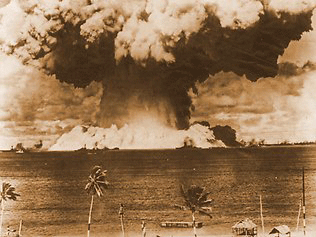 Dismay over plans to scrap French nuclear monitoring commission, https://www.rnz.co.nz/international/pacific-news/410780/dismay-over-plans-to-scrap-french-nuclear-monitoring-commission 2 March 2020 Nuclear test veterans groups in French Polynesia have reacted with dismay at reports that Paris wants to abolish the National Commission for Monitoring the Consequences of Nuclear Tests.
Last week, the French publication Canard Enchaine reported that as part of administrative changes and cost-cutting measures, dozens of commissions would be disestablished.
The commission is the body bringing together state authorities, representatives of the French Polynesian government and veterans associations to work on the list of radiation-induced illnesses deemed to be relevant for compensation.
The head of the group Moruroa e tatou Hiro Tefaarere has told the broadcaster La Premiere the move was inadmissible yet not surprising for the Macron government.
He said the French president on one hand described colonialism as a crime against humanity and on the other everything was suppressed which would recognise the consequences of the tests.
France carried out more than 190 nuclear weapons tests in the Pacific and until 2010 maintained that they were clean and posed no threat to human health.
Kazakhstan local residents may be stuck with costs of decommissioning nuclear reactor
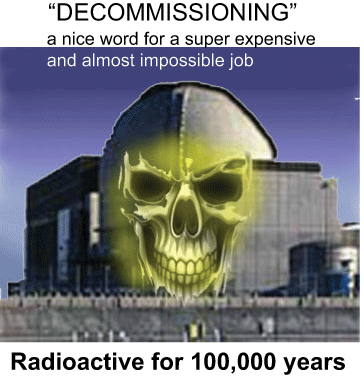 Local residents pay for decommissioning of Kazakhstan’s BN-350 reactor https://www.neimagazine.com/news/newslocal-residents-pay-for-decommissioning-of-kazakhstans-bn-350-reactor-7796914 27 February 2020 During a public hearing of the feasibility study on the environmental impact of decommissioning of the BN-350 fast reactor in Kazakhstan, Bulat Zhumakanov, representative of regional utility MAEK-Kazatomprom, said residents Aktau in Mangystau province, where the reactor is sited, will continue to pay for its maintenance.The BN-350, a sodium-cooled industrial fast neutron reactor, was physically launched in 1972, and was connected to the Mangystau power system in 1973. In 1998, it was closed down and formally began decommissioning the following year. Local residents pay for decommissioning of Kazakhstan’s BN-350 reactor https://www.neimagazine.com/news/newslocal-residents-pay-for-decommissioning-of-kazakhstans-bn-350-reactor-7796914 27 February 2020 During a public hearing of the feasibility study on the environmental impact of decommissioning of the BN-350 fast reactor in Kazakhstan, Bulat Zhumakanov, representative of regional utility MAEK-Kazatomprom, said residents Aktau in Mangystau province, where the reactor is sited, will continue to pay for its maintenance.The BN-350, a sodium-cooled industrial fast neutron reactor, was physically launched in 1972, and was connected to the Mangystau power system in 1973. In 1998, it was closed down and formally began decommissioning the following year.
MAEK-Kazatomprom has supplied Mangystau region of Kazakhstan with electricity, heat and water since 1967. It is responsible for three gas and oil power plants with total installed capacity 1330MWe, a desalination plant and for decommissioning the BN-350 reactor. According to representatives of the development company, METR, preliminary information, puts the total cost of decommissioning the BN-350 at KZT125 billion ($330m) excluding inflation. Zhumakanov said this year Kazakhstani Wealth Fund Samruk-Kazyna has allocated KZT1.2 billion for the maintenance of the reactor. However, funds will still be taken from local residents through the electricity tariff for repair work. An application has been made to the federal budget, but whether money will be allocated from the republican budget in future “remains open”, he said. The tariff has been in place for 20 years and residents have been pressing the government to provide the necessary funding. Decommissioning of the BN-350 reactor is planned in three stages:
From 1999 to 2016, with the financial support of the US government, nuclear fuel was removed, primary circuit sodium was treated to remove from caesium radionuclides, a project was implemented to process the used fuel, to passivate sodium residues in the first circuit, and other work. The decommissioning process must be continued and cannot be delayed, said representatives of MAEK-Kazatomprom. The tanks in which radioactive waste is stored have been in operation since 1972, and need upgrading. Some 3000 cubic metres of liquid radioactive waste, mainly sodium and caesium-137, which has a half-life of 30 years, are stored at MAEK-Kazatomprom. |
|
Sweden now faces years of nuclear reactor shutdowns and waste disposal problems
Sweden prepares for a decade of nuclear decommissioning, NS Energy, By Kristina Gillin 27 Feb 2020 ,
Sweden is preparing to dismantle and demolish six large power reactors on three sites over the coming years.
By the end of 2020, half of Sweden’s nuclear reactors will have been permanently shut down for decommissioning. The six large reactors are expected to undergo nuclear decommissioning in Sweden over the next decade.
Besides these, the Ågesta prototype reactor, a combined heat and power plant is about to commence dismantling.
Nuclear decommissioning at Sweden’s Barsebäck nuclear power plant
The twin units at Barsebäck, a few miles across the straight from Denmark, ceased to generate power in 1999 and 2005, respectively.
After shutdown, all spent fuel was removed and shipped to Sweden’s central interim storage facility (Clab) in Oskarshamn. Major decontamination of systems was also done early. However, dismantling had to wait, due to a lack of facilities for storage or disposal of decommissioning waste………
Funding and nuclear waste disposal in Sweden
Owners of nuclear power plants in Sweden have a statutory duty to dispose of their wastes. They are also required to set aside funding for waste management and nuclear decommissioning in Sweden. The funding is held in the Nuclear Waste Fund, a segregated Swedish government fund.
To fulfil the obligations, they jointly own the Swedish Nuclear Fuel and Waste Management Co (SKB). SKB’s scope covers disposal of most radioactive waste streams, interim storage of spent fuel and transportation between the various sites.
SKB is also responsible for compiling cost estimates for decommissioning and waste management every three years.
This to ensure that payments into the Nuclear Waste Fund are sufficient to cover future costs.
According to the 2019 estimates, the total cost of waste disposal, spent fuel storage and decommissioning is approximately SEK 147 billion (around €14 billion). Of this, about SEK 53 billion (around €5 billion) has been spent to date.
These figures include most of SKB’s scope but exclude the costs of near-surface disposal facilities for very low-level waste at Oskarshamn, Ringhals and Forsmark.
The majority of low- and intermediate-level waste from all Swedish reactors will be disposed of in SFR, a shallow geological repository for short-lived waste on the Forsmark nuclear site.
SFR has been in operation since 1988 but is currently licensed for operational waste only. To accommodate decommissioning waste, SKB plans to expand SFR’s capacity from 63,000 to 180,000 m3. An application for the expansion was submitted in 2014.
Pending regulatory approvals, construction of the new rock vaults will take place from 2023 to 2029. https://www.nsenergybusiness.com/news/nuclear-decommissioning-sweden/?fbclid=IwAR1me9D6hKLIPYP8Hp9tRS7Fgt6ksTbZ9t0Gvpo8IHCHgjIkeBqRnDgO79
Radioactive wastes into River Clyde could have devastating effects on community and wildlife
 Row over MoD River Clyde nuclear waste dump plans Row over MoD River Clyde nuclear waste dump plans
By Herald Scotland Online 1 Mar 20, Scotland’s national environment watchdog has denied claims the Ministry of Defence (MoD) is planning to increase discharges of radioactive waste into the River Clyde.Under the plans, liquid waste from reactors which power Royal Navy submarines at the Faslane and Coulport nuclear bases would be drained into the Gare Loch via a new pipeline.
Campaigners warned the rising discharges could have a devastating effect on surrounding wildlife and communities after a report by investigative journalism platform The Ferret stated emissions of one byproduct, cobalt-60, could rise by more than 50 times. …….. The Ferret reported the discharge of cobalt-60 would rise to 23.4 million units of radioactivity annually – around 52 times the current level. It added emissions of a second substance, known as tritium, would increase by 30 times to around 175,000 units, or ‘megabecquerels’, every year…….. SEPA’s public consultation is open until 13th Match and we welcome all responses. All responses will be reviewed in detail to ensure we continue to safeguard the environment and human health.” The bases are due to receive at least five more submarines in the coming years, including an ageing Trafalgar vessel and three new Astute submersible. The Ferret said a 50-strong group of Nuclear-Free Local Authorities (NFLA) had objected to the discharges. NFLA Scotland convener, Glasgow SNP councillor Feargal Dalton told The Ferret: “NFLA is particularly concerned about the considerable uncertainties in modelling doses and an under-appreciation of the effects of tritium”. “There are effective alternatives to nuclear powered submarines, as pioneered by the likes of Japan, and the Ministry of Defence should make a serious attempt to look at them.” https://www.heraldscotland.com/news/18272691.mod-planning-dump-50-times-nuclear-waste-river-clyde/ |
|
Egypt going into $25 billion debt to Russia, to buy nuclear reactors
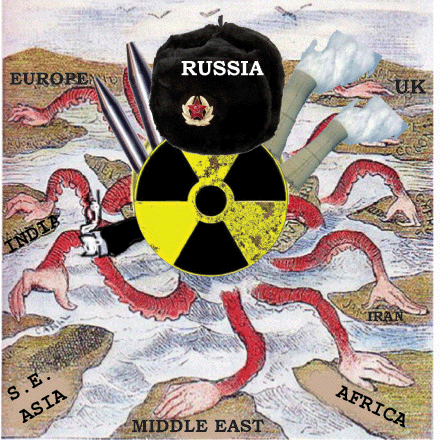
Russia lends Egypt $25 billion for Dabaa nuclear power plant, AL-Monitor, 26 Feb 20, CAIRO — Atomstroyexport, a subsidiary of Russia’s State Atomic Energy Corporation, or Rosatom, announced Feb. 17 that three Egyptian companies were awarded a tender offer for constructing the first phase of Egypt’s Dabaa nuclear power plant.
The three Egyptian companies, competing among 10 others, are Petrojet, Hassan Allam and the Arab Contractors.
The Egyptian government intends to start negotiations within the next few days with the Egyptian Nuclear and Radiological Regulatory Authority to obtain permission to start implementing the Dabaa nuclear plant project. The plant will be constructed in the Dabaa area of Marsa Matrouh governorate in the west of the country.
The Dabaa plant is the first nuclear plant for peaceful uses, with a total capacity of 4.8 gigawatts. The project is financially supported by Rosatom through a Russian loan amounting to $25 billion………….
Yemen al-Hamaki, a professor of economics at Ain Shams University said that under this agreement Egypt will use the loan to finance 85% of the total value of the building, construction, insurance and all other related works. Egypt would bear the remaining 15% in the form of installments. The loan is for 13 years at a 3% annual interest rate. If Egypt fails to repay any of the annual interest within 10 working days, it shall be subject to arrears of 150% of the interest rate calculated on a daily basis
Hamaki also warned that this massive Russian loan of $25 billion could blow up Egypt’s foreign debts. “This loan is a great risk to the future because it burdens the state and should be settled from the wealth and economic assets of the future generations,” she said, adding, “Egypt’s resorting to many loans foretells its inability to attract foreign investments, while tourism revenues continue to decline.” ….. https://www.al-monitor.com/pulse/originals/2020/02/power-plant-nuclear-egypt-russia-loan.html#ixzz6F5iQcolQ
Iran Nuclear Accord Parties Meet to Try to Salvage Deal
|
Iran Nuclear Accord Parties Meet to Try to Salvage Deal https://www.voanews.com/middle-east/voa-news-iran/iran-nuclear-accord-parties-meet-try-salvage-deal By RFE/RL, February 26, 2020 The remaining members of the floundering Iran nuclear deal are set to meet in Vienna Wednesday for the first time since Germany, France, and Britain initiated dispute procedures that could reimpose U.N. sanctions on Tehran.
The talks come as the signatories try to rescue the landmark 2015 accord, which has been faltering since U.S. President Donald Trump unilaterally withdrew from it in 2018 and enforced crippling sanctions on Iran. It will be attended by senior diplomats from Iran, Britain, France, Germany, China, Russia, and the EU. They have promised to uphold the deal that saw Iran agree to reduce its program of developing nuclear weapons in exchange for an easing of sanctions, even without Washington’s support. However, since the U.S. withdrawal, Iran has stepped up its program in defiance of Washington’s “maximum pressure” campaign.“ This is a chance — though not of 100 percent — to stop escalation before it’s too late,” Russian Foreign Minister Sergei Lavrov was cited as saying by the Russian Embassy in Vienna on Twitter. Why EU Powers Rejected Trump’s Call to Leave Iran Nuclear Deal
EU foreign policy chief Josep Borrell said Friday the 28-nation bloc will keep trying to save the Iran nuclear deal despite Trump’s call on EU to join US in breaking away from it
This is a chance — though not of 100 percent — to stop escalation before it’s too late,” Russian Foreign Minister Sergei Lavrov was cited as saying by the Russian Embassy in Vienna on Twitter. Iran has since breached its main limitations, exceeding the stockpiles of heavy water and uranium allowed, the number and types of centrifuges it can operate to enrich uranium, and the purity of uranium. As a result, in mid-January, the three European countries said they had “no choice” but to trigger a dispute mechanism in the accord, citing reduced compliance. The process for ultimately reimposing U.N. sanctions consists of several steps, the final one of which is to notify the U.N. Security Council. The restrictive measures would then automatically be reinstated after 30 days unless the Security Council voted to keep them lifted. Trump has called the deal “fatally flawed,” in part because it did not restrict Tehran’s ballistic-missile program or address its support for terrorist groups in the Middle East. Iran insists its nuclear program is for civilian purposes only and that the Joint Comprehensive Plan of Action (JCPOA) allows the country to run reactors to generate power. |
Is Cumbria about to become the world’s plutonium dump?
 February 24, 2020During the last search process for a burial site for the UK’s nuclear waste, which ended in January 2013, the Nuclear Decommissioning Authority (NDA) offered repeated assurances that only the UK’s nuclear waste would be buried in a UK Geological Disposal Facility (GDF). Many questioned at the time whether the NDA could be trusted to keep its word, and it became apparent in mid-2012 that it could not be trusted. The NDA had accepted 4 tonnes of plutonium from Germany in a ‘commercially advantageous arrangement’ according to Charles Hendry, the UK’s Energy Minister at the time. In other words the NDA had been paid to take ownership of the German plutonium.
Nuclear station Sizewell C will cause environmental damage on an unprecedented scale
Telegraph 23rd Feb 2020 Suffolk Wildlife Trust: We have serious concerns over the effect upon wildlife of Sizewell C and, despite years of working closely with EDF, we are far from convinced that the electricity giant is taking the impacts seriously.
We also believe that it will be impossible wholly to mitigate or
compensate for much of the negative impact on wildlife. The current plans
suggest that we will lose between 20 and 30 acres of nationally important
land that is supposedly protected by its Site of Special Scientific
Interest status. This equates to covering roughly 10 football pitches of
rare fen habitat in concrete. Invariably there will be devastating habitat
loss for birds such as kingfisher and for rare mammals such as water vole
and otters. EDF has made little attempt to minimise these losses.
Suffolk Preservation Society: The proposed nuclear power plant at
Sizewell C will cause environmental damage on an unprecedented scale in a
highly sensitive location, much of which is designated an Area of
Outstanding Natural Beauty. The construction phase will bring massive
disruption to communities in East Suffolk over many years and will
permanently change our landscapes. Suffolk’s environment is remarkably
undeveloped and is characterised by a sense of remote wildness. The
tranquillity provides a high quality of life for residents and is a major
draw for tourists. However, this isolation is fragile and could easily be
lost forever. The impact of a development such as Sizewell C upon heritage
sites – including an abbey, churches, farmhouses and other vernacular
buildings that contribute to the special qualities of Suffolk – will be
considerable. The intrusion of new roads to cope with a massive increase in
HGV traffic, spoil heaps, borrow pits, and accommodation for up to 3,000
workers will be felt across numerous locations. Development of the Sizewell
site cannot be at unlimited cost to the quality and character of our county
and its communities.
Outage’s at EDF’s Hinkley nuclear station extended until June
EDF Energy extends outages at Hinkley Point B nuclear plant https://www.reuters.com/article/edf-energy-nuclear/update-1-edf-energy-extends-outages-at-hinkley-point-b-nuclear-plant-idUSL5N2AO3DT
 LONDON, Feb 24 (Reuters) – EDF Energy has extended two planned outages at Britain’s Hinkley Point B nuclear plant to June to complete further inspections of the reactor cores, the company said on Monday.
|
A planned outage at Britain’s Hinkley Point B-8 nuclear reactor has been extended by three months, data from EDF Energy shows. The 480 megawatt reactor went offline on Friday night and was originally due to return to service on March 17. The restart date has now been extended to June 5.
An upcoming outage from April at Hinkley Point B-7 reactor has been extended to June 20 from May 19.“We have decided to take more time to complete the forthcoming inspection outages at Hinkley Point B to allow for additional analysis and review of the core inspection findings which as always we will share with our regulator, ONR,” a company spokesman said, referring to the Office for Nuclear Regulation. The reactors have to undergo such inspections after cracks developed faster than expected in graphite bricks in the reactor core at another of the company’s nuclear fleet in Britain. Reporting by Nina Chestney; Editing by Edmund Blair and Jane Merriman
|
|
|
Extradition case for Julian Assange – how it will proceed
 Julian Assange’s extradition case is finally heading to
  court – here’s what to expect more https://www.sbs.com.au/news/julian-assange-s-extradition-case-is-finally-heading-to-court-here-s-what-to-expe
February 24, 2020 Holly Cullen, Adjunct professor, University of Western AustraliaThe extradition hearing to decide whether to send Julian Assange to the United States to be tried for publishing classified military documents on Wikileaks is expected to finally begin today in London.Assange is charged with 17 counts under the Espionage Act, involving receipt, obtaining and disclosing national security information. He has also been charged with one count of conspiracy to assist Chelsea Manning to crack a US Department of Defense password to enable her to access classified information.
Assange has been in Belmarsh prison since his arrest in April 2019. He had been in solitary confinement in a prison medical unit, but was recently moved into a less isolated section of the prison due to concerns about his mental health.
From May to September of last year, Assange served a sentence for bail absconding, but since then has been waiting for the extradition hearing.
How will the process play out? Continue reading
Britain buying new nuclear warheads from USA: Pentagon knew about it, UK Parliament did not
|
The revelation has dismayed MPs and experts who question why they have learned of the move – which will cost the UK billions of pounds – only after the decision has apparently been made. It has also raised questions about the UK’s commitment to staunching nuclear proliferation and the country’s reliance on the US for a central plank of its defence strategy. Earlier this month, Pentagon officials confirmed that its proposed W93 sea-launched warhead, the nuclear tip of the next generation of submarine-launched ballistic missiles, would share technology with the UK’s next nuclear weapon, implying that a decision had been taken between the two countries to work on the programme. In public, the UK has not confirmed whether it intends to commission a new nuclear warhead. The Ministry of Defence’s annual update to parliament, published just before Christmas, says only: “Work also continues to develop the evidence to support a government decision when replacing the warhead.” But last week Admiral Charles Richard, commander of the US strategic command, told the Senate defence committee that there was a requirement for a new warhead, which would be called the W93 or Mk7. Richard said: “This effort will also support a parallel replacement warhead programme in the United Kingdom, whose nuclear deterrent plays an absolutely vital role in Nato’s overall defence posture.” Ed Davey, acting leader of the Liberal Democrats, said: “It is totally unacceptable that the government seems to have given the green light to the development of new nuclear weapon technologies with zero consultation and zero scrutiny. Britain under Johnson increasingly looks like putty in Trump’s hands. That Britain’s major defence decisions are being debated in the United States, but not in the UK, is a scandal. Under Johnson, it seems that where Trump leads, we must follow.” ………. https://www.theguardian.com/uk-news/2020/feb/22/pentagon-gaffe-reveals-uk-deal-replace-trident-nuclear-weapon |
|

Huge rise predicted for Britain’s seas and tidal rivers
 Times 23rd Feb 2020, Britain should be preparing for its seas and tidal rivers to rise by up to 6½ ft in the next 80 years, according to the scientist in charge of protecting Holland against flooding and sea level change. Peter Glas, head of Holland’s Delta Programme, which oversees long-term flood risk management, will tell a UK conference that the rise in the level of the Times 23rd Feb 2020, Britain should be preparing for its seas and tidal rivers to rise by up to 6½ ft in the next 80 years, according to the scientist in charge of protecting Holland against flooding and sea level change. Peter Glas, head of Holland’s Delta Programme, which oversees long-term flood risk management, will tell a UK conference that the rise in the level of theNorth Sea may accelerate sharply from 2050, potentially reaching 2 metres (6½ ft) by 2100. That is nearly double the Met Office’s worst-case
predictions. It follows research at Holland’s Deltares centre, commissioned by the Delta Programme, into the impact of rising sea levels on northern Europe. “The rise could potentially accelerate with effect from 2050, entailing far-reaching consequences,” said Glas’s latest report to the Dutch government, which he will cite at this week’s Floodex conference in Peterborough. The Delta report added that effects of “the more rapid melting of Antarctic ice sheets” had not yet been incorporated into the programme’s predictions. |
|
|
1 This Month
23-25 October – on Zoom – World BEYOND War’s annual global conferenc

To see nuclear-related stories in greater depth and intensity – go to https://nuclearinformation.wordpress.com

Say No to NASA’s Reckless Nuclear Reactor on the Moon
Say No to NASA’s Reckless Nuclear Reactor on the Moon
-
Archives
- October 2026 (160)
- September 2026 (339)
- August 2026 (330)
- July 2026 (355)
- June 2026 (287)
- May 2026 (306)
- April 2026 (356)
- March 2026 (251)
- February 2026 (267)
- January 2026 (308)
- December 2025 (358)
- November 2025 (359)
-
Categories
- 1
- 1 NUCLEAR ISSUES
- business and costs
- climate change
- culture and arts
- ENERGY
- environment
- health
- history
- indigenous issues
- Legal
- marketing of nuclear
- media
- opposition to nuclear
- PERSONAL STORIES
- politics
- politics international
- Religion and ethics
- safety
- secrets,lies and civil liberties
- spinbuster
- technology
- Uranium
- wastes
- weapons and war
- Women
- 2 WORLD
- ACTION
- AFRICA
- Atrocities
- AUSTRALIA
- Christina's notes
- Christina's themes
- culture and arts
- Events
- Fuk 2022
- Fuk 2023
- Fukushima 2017
- Fukushima 2018
- fukushima 2019
- Fukushima 2020
- Fukushima 2021
- general
- global warming
- Humour (God we need it)
- Nuclear
- RARE EARTHS
- Reference
- resources – print
- Resources -audiovicual
- Weekly Newsletter
- World
- World Nuclear
- YouTube
-
RSS
Entries RSS
Comments RSS

