Putin orders Russian government to try to meet Paris climate goals
Putin orders Russian government to try to meet Paris climate goals
President Vladimir Putin has signed a decree ordering the Russian government to try to meet the 2015 Paris Agreement to fight climate change, but stressed that any action must be balanced with the need to ensure strong economic development.
Exploring the reasons why Britain is to ‘re-nationalise’ it’s nuclear weapons
UK Government move to ‘re-nationalise’ Britain’s nuclear weapons, The National
|
By Martin HannanMultimedia Journalist 6th NovemberEARLIER this week the UK Government slipped out a story about Britain’s nuclear deterrent in the form of a ministerial statement that hardly anyone noticed.
It indicated that the Atomic Weapons Establishment (AWE) headquartered on the former site of RAF Aldermaston is effectively going to be re-nationalised. Stripped of civil-servant speak, the statement says that the UK Government is exercising its right to end early a 25-year contract with a consortium of companies that run AWE plc. From next year AWE will become an arms-length operation wholly owned by the Ministry of Defence. That will include AWE’s presence at the Royal Naval Armaments depot at Coulport on Loch Long which services the Clyde Submarine Base at Faslane, home to Britain’s Trident submarines. The statement indicates the change is on grounds of efficiency. It read: “The change in Model will remove the current commercial arrangements, enhancing the MoD’s agility in the future management of the UK’s nuclear deterrent, whilst also delivering on core MoD objectives and value for money to the taxpayer. Forgive the cynical view but that all says “in other words, we’re back in complete charge and will spend what we like on the replacement for Trident with no need for reports to shareholders and that public sort of stuff”. WHEN WAS AWE ORIGINALLY PRIVATISED? THE Act to effectively privatise Aldermaston was passed under John Major’s Tory Government in 1991. The transfer of a previously MoD-run facility to the private sector caused some controversy at the time, but went ahead anyway……….. WHY IS THIS HAPPENING? GOOD question. Obviously somebody somewhere is not happy. Ending a 25-year contract four years early is not a usual tactic of HM Government – quite the opposite with contracts often renewed “on the nod”. It could also be an advance move in a long-rumoured possible project for the MoD to take back more sites and facilities and run them as arms-length operations. Babcock and other private contractors at Faslane and elsewhere will have taken note of the move. ARE ALDERMASTON AND SCOTLAND LINKED? THE convoys that take nuclear weapons between Coulport/Faslane and Aldermaston have been a worry for anti-nuclear campaigners for decades. In an independent Scotland, the Westminster Government would be asked to remove Trident and its ilk, which has always begged the question – what is the MoD’s plan B for Trident or its replacement after independence? Answer: there isn’t one. Go on, ask them yourselves. https://www.thenational.scot/news/18850871.uk-government-move-re-nationalise-britains-nuclear-weapons/ |
|
Nuclear Technology Germany Association says Small Nuclear Reactors (SMRs) will always be more expensive than large ones.
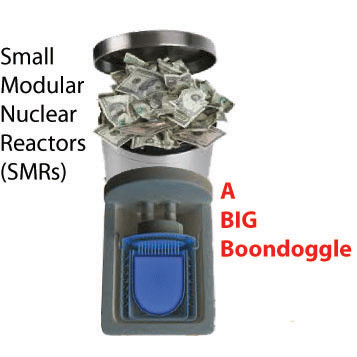 German nuclear industry cautious about usefulness of small reactors for energy transition, Nuclear phase-out Technology, Clean Energy Wire, Süddeutsche Zeitung , 6 Nov 20 Small Modular Reactors (SMR) are increasingly hailed as an effective way for using nuclear power to curb the climate crisis without the major risks associated with conventional nuclear plants, but Germany’s nuclear industry is sceptical whether the small reactors really can help boost international climate action, Christian J. Meier writes for the Süddeutsche Zeitung German nuclear industry cautious about usefulness of small reactors for energy transition, Nuclear phase-out Technology, Clean Energy Wire, Süddeutsche Zeitung , 6 Nov 20 Small Modular Reactors (SMR) are increasingly hailed as an effective way for using nuclear power to curb the climate crisis without the major risks associated with conventional nuclear plants, but Germany’s nuclear industry is sceptical whether the small reactors really can help boost international climate action, Christian J. Meier writes for the Süddeutsche Zeitung
……… Nicolas Wendler of industry association Nuclear Technology Germany (KernD) says SMRs are always going to be more expensive than bigger reactors due to lower power output at constant fixed costs, as safety measures and staffing requirements do not vary greatly compared to conventional reactors. In terms of levelised energy costs, SMRs will always be more expensive than big plants.” In order for SMRs to be profitable, these should run at maximum utilisation most of the time, Wendler argues, concluding that the potential on the German market would not be much greater than what is needed to adjust oscillating renewable power production…. https://www.cleanenergywire.org/news/german-nuclear-industry-cautious-about-usefulness-small-reactors-energy-transition
|
UK govt’s spin to Scotland, promoting nuclear submarines – but the Scots are nae sae daft
 We cannot defeat our real enemies by using nuclear weapons, https://www.thenational.scot/news/18850915.cannot-defeat-real-enemies-using-nuclear-weapons/, Jim Taylor, Edinburgh, 6 Nov 20
At the conclusion of the programme, Rear Admiral John Weale tells us that no-one really wants nuclear weapons … but “we are planning to have them for the next 50 years”.
So it’s a done deal, whether we Scots support it or not. Our UK Union membership means we will be forced against our will to be party to this inhumane weapon system, and the increased danger it puts us in with its continued location at Faslane.
Trident’s replacement is currently reckoned to cost around £200 billion, before any expected design, construction, operational cost overruns and other usual ongoing cost increases. With the potential for a further cycle of replacement during the next 50 years, going forward, the cost to the nation will rise exponentially.
Clearly the Royal Navy took the unprecedented step to permit this programme being made at the behest of the UK Government trying to warm our feelings about nuclear weapons, recognise a “need” for them and in the hope this will drive a wedge in Scotland’s drive to call upon its Claim of Right and independence.
Isn’t the UK Government’s mistake assuredly that Scots are nae sae daft?
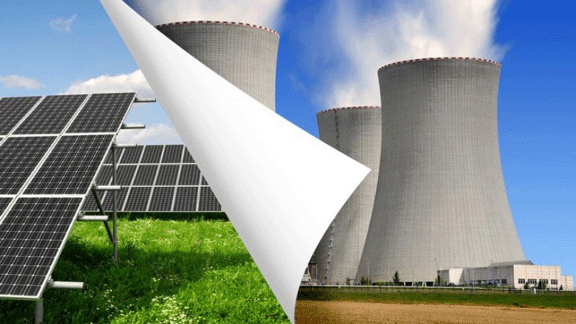
Nuclear now costs twice the price of renewables and the gap is growing. No need for Hinkley C, Sizewell, Bradwell etc

 North writes,
” ………The Green Party have been arguing for many years in recognition of the work by Friends of the Earth, the Centre for Alternative Technology (CAT) in Wales and many others, that we do not need ‘further expansion of nuclear and gas turbines’ but to be far more clever about our energy use, easy to do now that renewables are cheaper than nuclear and new gas.
CAT has been at the forefront of development of research on renewable technology and Green building for some 50 years.
Their latest report ‘Zero Carbon Britain (Rising to the Climate Emergency)’ clearly demonstrates that the UK has the tools and technology to efficiently power this country with 100 per cent renewable technology (read the executive summary, it’s only eight pages long).
By using energy more efficiently we can power down by 60 per cent with particularly large savings in heating buildings and transport.
There is absolutely no need for nuclear power in our energy mix and we cannot afford it, let alone pay for cleaning up the sites at the end which taxpayers always end up paying for.
Nuclear now costs twice the price of renewables and the gap is growing.
How many Herald readers know that the electricity from the Hinkley Point nuclear reactor will cost UK consumers £92.50 per Kwh (the most recent offshore wind turbine fields are half of this)?
The deal was signed by (former Prime Minister) Theresa May and supported by Labour and Lib Dems.
The profits are going to the Chinese government which will run it for 40 years. The French firm (EDF) that has been building Hinkley Point and wants to build more nuclear reactors in the UK wants to cushion the financial blow of future nuclear power stations in this country by charging electricity customers a few extra pounds every month on their bill even now.
This is referred to as a new funding model, I’d call it a rip-off. Are people really happy to put billions of pounds into the coffers of the Chinese government and EDF rather than invest, as part of a Green New Deal, in insulation and draught-proofing of UK homes to keep us warmer, take over two and a half million households out of fuel poverty and permanently reduce everyone’s fuel bills. https://www.cravenherald.co.uk/opinion/opinion_letters/18824349.letter-no-need-nuclear-power/
A new nuclear power plant at Sizewell is the wrong choice for a zero carbon Britain
|
A new nuclear power plant at Sizewell is the wrong choice for a zero carbon Britain, The climate column: The proposed Sizewell C will not produce electricity until about 2040, which it means it cannot reduce the UK’s carbon emissions with the speed necessary to avoid catastrophic tipping points The Independent , Donnachadh McCarthy@DonnachadhMc 6 Nov 20,
Just weeks ago, the Climate Assembly set up by parliament rejected nuclear power as an answer to creating a zero-carbon economy. This was due to cost, safety and difficulties with waste storage and decommissioning. Yet Boris Johnson is reported to be about to commit Britain to buying another hugely expensive nuclear power station. As this new plant would not be producing electricity until about 2040, it means it cannot reduce the UK’s carbon emissions with the speed necessary to avoid catastrophic tipping points, whereas cheaper renewables can be up and running within a couple of years of being commissioned. Consider the following analogy. Four years ago, you needed to replace your gas boiler and a company came along and offered to sell you the world’s most expensive experimental boiler ever. It’s been trying to build the first four of them for over 20 years but had not yet got any actually working. The first one it tried to build, in Finland, is already 13 years behind schedule and has more than tripled in price. The second one it tried to build, in France, is 10 years behind schedule, now costs six times the original quote and has encountered monumental safety issues. They then tell you the boiler was filled with lethal toxins, which if the boiler’s seals broke, could explode and kill everybody in your house. All your neighbours would have to be permanently evacuated immediately without being allowed to collect their lethally contaminated belongings and the area around your boiler would become an exclusion zone for generations. The sales-person added that the boiler will cost up to twice as much to run as your current boiler. They demanded you sign a 35-year inflation-proofed deal that makes it difficult to switch to a cheaper renewable energy supplier or use energy efficiency measures to reduce your need for the boiler. Every single bank refused to lend you the money to install your new boiler, as they believed it was a financially insane project to lend money to. There was another problem. The experimental boiler continuously produces highly-toxic explosive waste that the supplier, after 70 years of trying, still has no idea what to do with. You would have to store it in your cellar, until somebody miraculously comes up with a way to store it safely for millennia. The salesperson neglected to add that you had to pay for the costs of removing the boiler at the end of its life but that the process takes hundreds of years to complete. I tell you this imaginary tale to try and explain the utter insanity of what the UK government did when it signed the contract with EDF Energy to build a new Hinkley Point nuclear power plant in 2016. Hinkley is already a year behind schedule and nearly £3bn over budget.
And now imagine this. Despite all of the above and knowing that renewable energy alternatives have already fallen to less than half of the cost of this experimental boiler and that new renewable electricity storage technologies have been likewise collapsing in price, the same contractor comes back to you to persuade you to buy another of these hugely expensive boilers for your second home. Unlike almost every single government in the world, Boris Johnson’s government is reported to be planning on announcing in the next few weeks that the UK will agree to build a second new EDF nuclear power plant at Sizewell in Suffolk. Why would any supposedly sane country sign such crazy energy contracts? ……… https://www.independent.co.uk/voices/nuclear-power-plant-sizewell-boris-johnson-b1622086.html |
|
Chernobyl’s bumblebees still affected by radiation
This new data shows effects on bumblebees are happening at dose rates previously thought safe for insects, and the current international recommendations will need to be re-evaluated.
|
Chernobyl: bumblebees still at risk from radiation nearly 35 years on, https://theconversation.com/chernobyl-bumblebees-still-at-risk-from-radiation-nearly-35-years-on-149055, Katherine Raines, Fellow and Lecturer, University of Stirling, November 5, 2020 In the early hours of April 26 1986, reactor four of the Chernobyl nuclear power plant in Ukraine exploded, causing the largest nuclear disaster in history. More than 350,000 people were evacuated, and a 4,700km² exclusion zone was formed in Ukraine and Belarus. Despite the intervening 34 years, there is still uncertainty about the effects of the radiation exposure on wildlife living in the Chernobyl exclusion zone (CEZ).
|
Poland’s nuclear energy plans not likely to be supported by the European Commission
Nuclear power is not considered environmentally sustainable, and there is little hope this approach will change. Therefore, the possibilities for bankrolling nuclear energy are very limited.
Brussels’s impact on Poland’s nuclear project, https://biznesalert.com/brusselss-impact-on-polands-nuclear-project/ : Paweł Wróbel, @Pawrobel 4 Nov 20, Poland’s nuclear power plant constrsuction program has been riddled with ambiguity for many years. Neverthele, among the few certainties remains the necessity to abide by the EU law on granting state aid. The project cannot happen without Brussels. Investments in nuclear energy are one of the most expensive in the energy sector, which is why building a nuclear plant in Poland will not be possible without state support. Therefore, the European Commission will have to approve the selected financing model – Paweł Wróbel, CEO of Gate Brussels, writes for BiznesAlert.pl.
Sizewell C – Britain walking into a trap that benefits only the nuclear industry
 Sizewell C – Britain walking into a trap that benefits only the nuclear industry, Sizewell C: Dodgy deals and obscure decision-making https://eciu.net/blog/2020/sizewell-c-dodgy-deals-and-obscure-decision-making By Jonathan Marshall, Head of Analysis@JMarshall_ECIU, 02 November 2020 This weekend the BBC reported that the Government was close to reaching a deal with EDF to construct a new nuclear power station at Sizewell in Suffolk. Sizewell C is expected to be a carbon-copy of the plant under construction at Hinkley Point, and will help fill the gap left as Britain’s existing nukes retire.
There is little point in re-hashing the well-worn arguments about whether we need new nuclear in the UK. No changing of minds on either side looks likely, nor is there much point trying to counter the six-or-so lines from either side about why nuclear is a good or bad choice.
What is worth scrutiny, though, is how the Government appears to be making another hash of agreeing terms and penning a contract.
Just three years ago the National Audit Office delivered a stinging rebuke of the deal with EDF for Hinkley Point C, saying it has ‘locked consumers into a risky and expensive project with uncertain strategic and economic benefits’; that efforts to ensure value for money had been overlooked; and that there remained a risk that the developer would come cap-in-hand for more cash before the project was finished, at which point the Government would not be in the strongest position to say no.
Backroom dealings
And it is hard to see how the Government has let itself be backed into this corner, allowing EDF to present itself as ‘the only option’ for the new nuclear it is no doubt saying is essential to reach net zero.
Sizewell has even received public backing from those usually in favour of a small state and as little Government intervention as possible, a position miles away from what is seemingly imminent.
Endless stalling on policy decisions and lack of support for other plants has seen other proposals evaporate, changing economics have seen developers pull out globally (Japan, for example, has said it will get to net zero without new nuclear), and a constant drumroll of political support for the as-yet-to-exist Small Modular Reactors rather than traditional large plant have left EDF as the only player in town.
The Government, well aware of the benefits of pitting projects against each other, has been lauding the successes of doing exactly that in auctions for offshore wind, in the capacity market and in a host of nascent markets for flexible power. Yet, nuclear remains exempt.
And while there are some factors that would make an auction system more difficult – high project start-up costs, lengthy safety sign-offs, etc, it is surely not beyond the wit of ministers and their advisors, and the civil service, to force something into place.
The only winners from the current behind-closed-doors set-up are the nuclear industry, which is not an effective way to make policy.
Time-Limited Backstop
The desperation to bring costs down for nuclear mean British electricity users are set to be on the hook for the costs of building Sizewell before it starts generating.
This situation would raise eyebrows in many instances, but for a scheme based on projects currently running wildly over budget and embarrassingly behind schedule, this seems like madness.
There are few guarantees in British media, but stories about rising energy bills are about as close as one can get. Extra costs on households to pay back investors, rather than for actually producing energy, mean this deal could be a toxic legacy for years to come.
It remains to be seen what protections from overrunning costs are put in place for consumers, and what guarantees that the cost agreed through a Regulated Asset Base (RAB) model will not increase as the project inevitably runs over budget. Both of these are pretty essential for allaying concerns that the public is being sold another white elephant.
Going Blind
On finances, the latest BEIS assessments of generation costs didn’t include nuclear, apparently for commercial confidentiality reasons. We should now expect these to be updated, especially as the latest iteration included the associated ‘system costs’ of different technologies. Doing this for nuclear (which of course imposes other costs on the power grid due to its inflexibility) is now vital.
Where are the assessments of how new nuclear can fit into increasingly smart and flexible power grids? Churning out a constant stream of electrons is good for keeping the country running, but it would be more useful if there was some data to show how it impedes on the rest of the grid.
What thought has been given to location? The Suffolk coast is set to be the landing point for a huge amount of offshore wind capacity – is it the best place for a new nuclear plant? Or just the only place still in the running?
How could the power output from Sizewell be used most effectively? What are the economics behind building an electrolyser nearby to convert excess power into hydrogen? Can the waste heat be made use of?
Providing answers to these sort of questions (just a few of many more) would help us to have a more grown up debate around nuclear, and would help understand the reasons for signing what, at first sight, looks like another dodgy deal.
Theresa May’s decision to sign off Hinkley was met with widespread dismay, for the reasons above and for many more. Without more clarity on Government thought, it appears our current Prime Minister could be walking into the same trap.
UK nuclear weapons making to be run by the Ministry of Defence
Public Technology 3rd Nov 2020, The government has claimed that bringing the manufacturing of nuclear
warheads back in house will enable it to better “invest in technology”.
Since 1993, the Atomic Weapons Establishment – which is responsible for
developing, manufacturing, and managing the UK’s arsenal of nuclear
weapons – has operated as a private company, under contract from the
government.
Hunting-BRAE held the contract until 1999, at which point a
25-year deal was awarded to AWE Management Ltd, a joint venture led by 51%
shareholder Lockheed Martin, supported by Serco and Jacobs Engineering.
Defence secretary Ben Wallace announced in parliament this week that,
following a review, the “Ministry of Defence has concluded that AWE will
revert to a direct government ownership model”. From as early as next
summer, the nuclear agency will become an arm’s-length government body,
wholly owned by the ministry.
Basingstoke Gazette 3rd Nov 2020, THE government will take control of a nuclear weapons manufacturer in
Aldermaston. AWE, which also has a site in Burghfield, is to be taken over
by ministers to “simplify and further strengthen” the relationship between
the operator and the Ministry of Defence. It means that Lockheed Martin,
which owns 51 per cent of AWE Management Ltd, and Serco, which owns 24.5
per cent, will be stripped of their control of the base when the lucrative
25-year contract comes to an end, with Sky News reporting that it could be
as soon as next year.
https://www.basingstokegazette.co.uk/news/18842320.awe-aldermaston-taken-government/
Europe still without a final disposal solution for its most dangerous nuclear waste
Le Monde 4th Nov 2020, Europe still without a final disposal solution for its most dangerous
nuclear waste. The first edition of the World Report on Nuclear Waste,
published Wednesday in its French version, provides elements of comparison
of management methods in different countries.
Warning to UK government on Sizewell nuclear power project – is it value for money?
|
New Civil Engineer 4th Nov 2020 Energy and Climate Intelligence Unit head of analysis Jonathan Marshall has urged caution as the government looks increasingly likely to approve plans for the Sizewell C nuclear power station.
According to the BBC, talks between the government and Sizewell contractor EDF have “intensified in recent weeks”. However, Marshall emphasised that renewable energy solutions offer more flexibility than nuclear. “If you look at the amount of money involved in building nuclear power stations, it’s pretty easy to come up with something renewables-based that’s as firm and moreflexible,” he said. “There are not many people saying we should have loads of nuclear apart from the nuclear industry. There’s also the risk that by the time power stations are built the grid is running in a different way because they take so long to build.”
|
Anxieties, memories of Chernobyl, as Belarus launches new nuclear power station
|
Chernobyl fears as Belarus launches new nuclear power station: Lithuania distributes iodine tablets to 500,000 close to border over safety concerns
Daily Mail, RACHAEL BUNYAN FOR MAILONLINE and AFP , 4 Nov 20, Belarus today launched its controversial Russia-built nuclear power station despite safety concerns from neighbouring Baltic states three decades after the Chernobyl nuclear disaster. Lithuania’s Foreign Minister Linas Linkevicius criticised the launch saying it had gone ahead despite unresolved safety issues The government in the Lithuanian capital, Vilnius, has also offered free iodine tablets to around half a million people living close to the Belarus border to help protect them from radiation in case of an accident The Astravets nuclear power plant, Belarus’s first nuclear station, is just 30 miles away from Vilnius. ……… Lithuania’s Foreign Minister Linas Linkevicius criticised the launch saying it had gone ahead despite unresolved safety issues and described the energy project as ‘geopolitical’. The EU and the international community ‘simply cannot stay indifferent to such cynical ignorance,’ Linkevicius wrote on Twitter. Lithuania said it had immediately stopped electricity imports from Belarus and neighbouring Latvia said it had also blocked imports of energy generated at the plant.…….. https://www.dailymail.co.uk/news/article-8909665/Chernobyl-fears-Belarus-launches-new-nuclear-power-station-despite-safety-concerns.html |
|
No guarantee that Britain’s £20 billion Sizewell nuclear project will actually go ahead
 Planet Radio 1st Nov 2020, No one should assume Sizewell C is now a foregone conclusion’. Campaign group Stop Sizewell C say there are still many obstacles to overcome, following reports that the Government is ‘close’ to giving the project the green light. The group say they’ve written to the Business, Energy and Industrial Strategy Secretary of State, Alok Sharma, to seek assurances about the due process behind the Sizewell C project.
https://planetradio.co.uk/greatest-hits/norfolk/news/sizewell-not-a-forgone-conclusion/
Before the UK’s govt White Paper, approval to be given for Sizewell nuclear development
 UK to approve new nuclear plant at Sizewell C ahead of White Paper: report, S and P Global Author, Henry Edwardes-Evans Editor, Norazlina Jumaat 3 Nov 20, UK to approve new nuclear plant at Sizewell C ahead of White Paper: report, S and P Global Author, Henry Edwardes-Evans Editor, Norazlina Jumaat 3 Nov 20,
HIGHLIGHTS EDF’s second UK twin reactor EPR plant Details of new funding model awaited 10-point plan and White Paper imminent London — The UK government is close to approving Sizewell C, the 3.2 GW EPR nuclear power station project proposed by EDF Energy in Suffolk, England, the BBC reported late Oct. 30…… Key to the new project would be the funding model, RBC said. “It may be that the government takes a direct stake in the project, and that the construction will be remunerated under some form of RAB [regulated asset base] model with a “regulated” return,” the bank said. RAB modelThe government has been working on a RAB-based funding model for new nuclear plants, but a proposal due last summer has yet to materialize. Under a RAB model, energy regulator Ofgem would establish an estimated allowable cost for the project and set a fixed rate of return for investors. Payments from UK retail power consumers would be made during construction and operation to a project company, with payments increasing over the construction period in line with cumulative spending.Sizewell C could generate power at a cost of GBP40-GBP60/MWh if construction was funded via a RAB model, Sizewell C’s finance director Julia Pyke said on Oct. 21. The final cost of power within the estimated range would be “determined by how government allocates risk in terms of the cost of money,” she said.
Further details on a funding model for Sizewell C were likely to be included in the government’s Energy White Paper, Pyke said.In October, 2015, EDF and China’s CGN signed a heads of terms agreement to develop two 1.65 GW EPR reactors at Sizewell C — EDF taking 80% and CGN 20% during the development phase.
Europe’s first EPRs, being built in Finland and France, are many years behind schedule and billions of euros over budget.,…… https://www.spglobal.com/platts/en/market-insights/latest-news/electric-power/110220-uk-to-approve-new-nuclear-plant-at-sizewell-c-ahead-of-white-paper-report |
|
1 This Month
15 October. Joint Appeal for Nuclear Abolition Day -presentation to the UN on October 15 will be live on UNWebTV
Endorse the Nuclear Abolition Day Appeal
23-25 October – on Zoom – World BEYOND War’s annual global conference

To see nuclear-related stories in greater depth and intensity – go to https://nuclearinformation.wordpress.com
-
Archives
- October 2026 (129)
- September 2026 (339)
- August 2026 (330)
- July 2026 (355)
- June 2026 (287)
- May 2026 (306)
- April 2026 (356)
- March 2026 (251)
- February 2026 (267)
- January 2026 (308)
- December 2025 (358)
- November 2025 (359)
-
Categories
- 1
- 1 NUCLEAR ISSUES
- business and costs
- climate change
- culture and arts
- ENERGY
- environment
- health
- history
- indigenous issues
- Legal
- marketing of nuclear
- media
- opposition to nuclear
- PERSONAL STORIES
- politics
- politics international
- Religion and ethics
- safety
- secrets,lies and civil liberties
- spinbuster
- technology
- Uranium
- wastes
- weapons and war
- Women
- 2 WORLD
- ACTION
- AFRICA
- Atrocities
- AUSTRALIA
- Christina's notes
- Christina's themes
- culture and arts
- Events
- Fuk 2022
- Fuk 2023
- Fukushima 2017
- Fukushima 2018
- fukushima 2019
- Fukushima 2020
- Fukushima 2021
- general
- global warming
- Humour (God we need it)
- Nuclear
- RARE EARTHS
- Reference
- resources – print
- Resources -audiovicual
- Weekly Newsletter
- World
- World Nuclear
- YouTube
-
RSS
Entries RSS
Comments RSS

