The degraded state of France’s nuclear fleet, and concealment of series of accidents.
French nuclear fleet: degraded condition, concealment of serial accidents
in nuclear power plants. The techno-industrial system includes major
accidents in its planning calculations – adapting to its disasters or
fighting to its end?
Ricochets 15th Nov 2021
Over 100 European non government organisations urge the European Commission to block nuclear power from being accepted as a clean green investment

NGOs press Germany to block nuclear, gas green status https://www.montelnews.com/news/1272742/ngos-press-germany-to-block-nuclear-gas-green-status SIOBHAN HALL, Brussels, 16 Nov 2021
Montel) More than 100 NGOs from across Europe have urged Germany to ensure nuclear and natural gas-fired power plants do not qualify as “green” investments under the EU’s sustainable finance taxonomy.
They expressed concern in a letter to future German chancellor Olaf Scholz on Monday that the European Commission was finalising the rules for nuclear and natural gas while Germany was focused on forming its new government.
The country has committed to phase out nuclear power by the end of next year and the NGOs urged Scholz to “take an equally clear stance” against nuclear power and natural gas in EU level rules.
An unofficial draft paper circulating in Brussels recently set out potential criteria for including gas-fired power plants and nuclear as green as part of new taxonomy proposals.
EU pressure
In October, 10 EU countries led by France signed a joint declaration urging the EC to recognise nuclear and natural gas as sustainable activities according to the taxonomy.
Doing so would make it cheaper to finance and build new nuclear power plants, said the Czech Republic’s deputy prime minister Karel Havlicek at the time.
The other countries involved were Bulgaria, Croatia, Finland, Hungary, Poland, Romania, Slovakia and Slovenia.
On Sunday, environmental group Greenpeace attacked the EC over potential plans to define gas and nuclear as green against the backdrop of a “weak” agreement made at the conclusion of COP26 climate talks in Glasgow.
“Over the last two weeks of climate talks, the European Commission has supported fast-track funding for new gas terminals and pipelines, and labelled gas, nuclear energy and industrial farming as sustainable and eligible for green funding,” said the group.
UK’s planned Sizewell nuclear reactor at risk – same design as Taishan reactor which has been shut down since July for safety reasons
Chinese nuclear reactor shutdown hangs over future of Sizewell C. Developers behind Taishan plant, where radiation was found in cooling waters, are also building UK’s Hinkley Point C and planning Sizewell C.
Reports of cracked fuel rods from a Chinese nuclear power station will be examined for any implications for new plants in Britain. Mark Foy, chief nuclear inspector at the Office for Nuclear Regulation, told civil society groups he was in touch with Chinese and other regulators over the plant in Taishan, southeastern China, where a reactor has been shut since July after radiation was found in its cooling waters. The plant is owned by Chinese state nuclear developer CGN along with its French equivalent EDF.
The two companies are also building the Hinkley Point C plant in Somerset and areplanning a second plant, Sizewell C in Suffolk, using the same reactor design as at Taishan. he problems at Taishan emerged in June after CNN reported that Framatome, the part-EDF owned company which helps run the plant, had written to US officials on June 8 asking for permission to share American technical assistance. Experts have said cracked fuel rods are “not uncommon”, albeit undesirable. An Office for Nuclear Regulation spokesman said: “We held one of our regular meetings with the NGO community last week where we reiterated that we remain in contact with the Chinese, French and Finnish regulators on this matter and are likely to be in dialogue again with them before the end of this year. “We will take the opportunity to gain any knowledge from this issue in China to help inform our regulation of nuclear plants in the UK, like Hinkley Point C, where the EPR reactor will be installed.”
Telegraph 14th Nov 2021
Targeting Trident: how divestment is impacting the nuclear weapons industry

investors are adhering to the international norm against nuclear weapons that was established by the Treaty on the Prohibition of Nuclear Weapons, despite that the fact that the UK is not party to the treaty.
More than 100 financial institutions have divested from the nuclear weapon industry since the treaty entered into force in January this year.
Targeting Trident: how divestment is impacting the nuclear weapons industry, https://bellacaledonia.org.uk/2021/11/15/targeting-trident-how-divestment-is-impacting-the-nuclear-weapons-industry/ Every year, the Don’t Bank on the Bomb report profiles the world’s largest nuclear weapons producers and reveals the financial institutions that invest in them. The latest report, published on Thursday, shows that investors around the world made a total of £510 billion available to nuclear weapons companies between January 2019 and July 2021.
UK-headquartered financial institutions account for £23 billion of this total. Scotland’s largest bank, NatWest Group (RBS), provided financing worth £2.2 billion to eight major nuclear arms manufacturers during the period, including BAE Systems, General Dynamics and Raytheon.
The DBOTB report is published by PAX, a Netherlands-based organisation that works to persuade financial institutions to divest from the nuclear weapons industry. Here, the campaign is led by Don’t Bank on the Bomb Scotland. The group focus on Scottish local authority pension funds and universities, as well as financial institutions.
Every year, the Don’t Bank on the Bomb report profiles the world’s largest nuclear weapons producers and reveals the financial institutions that invest in them. The latest report, published on Thursday, shows that investors around the world made a total of £510 billion available to nuclear weapons companies between January 2019 and July 2021.
UK-headquartered financial institutions account for £23 billion of this total. Scotland’s largest bank, NatWest Group (RBS), provided financing worth £2.2 billion to eight major nuclear arms manufacturers during the period, including BAE Systems, General Dynamics and Raytheon.
The DBOTB report is published by PAX, a Netherlands-based organisation that works to persuade financial institutions to divest from the nuclear weapons industry. Here, the campaign is led by Don’t Bank on the Bomb Scotland. The group focus on Scottish local authority pension funds and universities, as well as financial institutions.
Fund managers warned Serco that “working with nuclear weapons might force them to dump Serco shares as a result of non-compliance with Environmental, Social and Governance (ESG) Standards”, the Telegraph says. The fund managers are not named, but Serco has increasingly appeared on investor blacklists in recent years due to its role in the consortium.
Impact of the nuclear ban treaty
The article reports that fund managers rejected Serco’s argument that investing in a Trident contractor is “ethically no different to owning UK sovereign debt, as both are functions of a democratically elected government”. This detail is significant, as it suggests that investors are adhering to the international norm against nuclear weapons that was established by the Treaty on the Prohibition of Nuclear Weapons, despite that the fact that the UK is not party to the treaty.
The ban treaty has made investors increasingly wary of nuclear weapons producers, as the new Don’t Bank on the Bomb Report explains: “[nuclear weapons] are now comprehensively outlawed, as is any assistance with producing, manufacturing or developing them. Financial institutions that continue investing in companies building nuclear weapons face regulatory risks as more countries join the treaty. They also face an increased reputational risk as clients learn of their support for weapons of mass destruction and terminate their relationships.”
More than 100 financial institutions have divested from the nuclear weapon industry since the treaty entered into force in January this year. This includes Bank of Ireland and AIB (Ireland), and South African firm, Investec. The total amount of financing made available to nuclear weapons producing companies has dropped by £47 billion since 2019.
More trouble for Trident
It appears that the prospect of losing investors was enough to persuade Serco – which previously held long-term nuclear weapons contracts as part of AWE Management Ltd – to pull out of the competition for future nuclear-weapons related work. This provides a clear example of how divestment, or the threat of divestment, can change company behaviour.
Furthermore, the story shows how investor action has the potential to undermine the viability of Britain’s nuclear weapons programme. The Telegraph notes that Serco’s decision “leaves defences chiefs with fewer options as they seek to restructure the management of Britain’s nuclear stockpile”. This could hinder the MoD’s ability to complete the Trident renewal project, which is already in serious trouble.
Join the movement
As the Serco story illustrates, divestment is a powerful tool that we can use to advance the goal of a nuclear-weapons-free world. Don’t Bank on the Bomb Scotland is encouraging individuals to contact NatWest Group about its investment policy, as well as their own bank and pension fund. The group has also created a model resolution targeting local authority pension funds that can be sent to local councillors.
The more financial institutions that divest, the more companies will be forced to withdraw from nuclear weapons work like Serco. This will make it harder for nuclear-armed nations to maintain their nuclear arsenals in the long-run.
Industrial action from Tuesday could ‘cripple’ Clyde nuclear base.
Industrial action from Tuesday could ‘cripple’ Clyde nuclear base, The Herald, By Martin Williams @Martin1Williams, Senior News Reporter, 15 Nov 21, SPECIALIST staff are to down tools on Tuesday in an industrial dispute a union says is expected to “cripple” the effective running of UK’s nuclear submarine base on the Clyde.
The Unite Scotland union has confirmed that around 70 of its members who provide specialist services for the UK’s nuclear deterrent submarines will start an overtime at the Royal Naval Armaments Depot (RNAD) Coulport.
The union has severely criticised the “delay tactics” employed by the ABL Alliance after the workers voted to take industrial action in September in what was then described as a “final warning shot” to ABL Alliance, a joint venture which won a 15-year contract from the Ministry of Defence in 2013 to maintain the weapons systems at Coulport.
Unite Scotland said the specialist staff who provide care and maintenance services for the weapons systems on the Royal Navy nuclear armed submarine fleet took the “historic” decision in a dispute over pay that it says will leave the base severely debilitated.
Since then, the union say the ABL Alliance refused to meet over what it called an RPI inflation annual pay claim of 3.8%.
Some 90.5% of Unite members at RNAD Coulport voted in support of strike action, and 95.3% supporting action short of a strike.
The ABL Alliance, made up of AWE plc, Babcock Marine (Clyde) Ltd, and Lockheed Martin UK Strategic Systems Ltd, previously state it was “disappointed” at the industrial action vote………………….
The union is concerned that all the companies could afford the pay rise as they were profitable. AWE Plc had an after tax profit of £17.7m in the year to December, 2020, Babcock Marine (Clyde) Ltd turned a £7.3m profit in 2019/20, while Lockheed Martin UK Strategic Systems Ltd was £41m in the black in 2019.
Babcock have been approached for comment. https://www.heraldscotland.com/news/homenews/19716968.industrial-action-tuesday-cripple-clyde-nuclear-base/
EU Council stresses the need to fully implement and universalise the NPT treaty
Non-proliferation of nuclear weapons: Council stresses the need to fully implement and universalise the NPT treaty
European Council, The Council today approved conclusions welcoming the upcoming tenth review conference of the parties to the Treaty on the Non-Proliferation of Nuclear Weapons (NPT), that will take place in New York on 4 – 28 January 2022.
The conclusions reaffirm the EU’s unequivocal support for the NPT as the cornerstone of the global nuclear non-proliferation regime, the essential foundation for the pursuit of nuclear disarmament, and an important element in the development of nuclear energy applications for peaceful purposes. The conclusions also stress the importance of universalising the NPT, and call on all states that have not yet done so to join the treaty as non-nuclear-weapon states and, pending their accession, to adhere to its terms.
The Council strongly supports all three pillars of the NPT and will continue to promote comprehensive, balanced and substantive full implementation of the 2010 Review Conference Action Plan. The Council underlines the importance of securing a positive and substantive outcome from the Tenth NPT Review Conference. https://www.consilium.europa.eu/en/press/press-releases/2021/11/15/non-proliferation-of-nuclear-weapons-council-stresses-the-need-to-fully-implement-and-universalise-the-npt-treaty/
French unions complicit with EDF in harrassments and other scandals
EDF, the grinding machine: “EDF holds the unions in its hands”. Number 2
in Force Ouvrière at EDF, Rémy Casabielhe has been one of the main
negotiators of the agreements in recent years within the company.
In his
interview with Blast, after the first stages of our investigation, the
union representative bluntly denounces the inaction of management, but also
of the unions, in the face of the problems of harassment, discrimination
and suicide.
And calls into question the agreements concluded for twenty
years, responsible for this phenomenon. Words that detonate and lift the
veil on a complicity that does not speak its name.
Blast 13th Nov 2021
UK’s Regulated Asset Base (RAB) “a very bad deal for consumers” – like the USA’s disastrous system in South Carolina
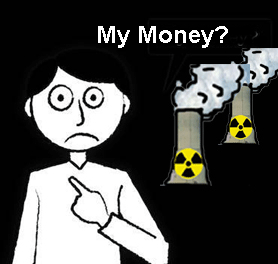
Reaction to the Bill from stakeholders has been mixed. Some environmental bodies have questioned whether the RAB model set out in the Bill offers value for money for consumers and whether it transfers the risk of cost overruns to consumers. Tom Burke, the co-founder of E3G, a climate think-tank, told the Financial Times that the model risked being “a very bad deal for consumers” on the grounds that electricity generated from nuclear power would be more expensive than that from ‘homegrown’ renewables and would simultaneously “inhibit the market in wind, [an] area where we have the opportunity to create a global competitive industry in the UK”.145 The same article included comment from Steve Thomas, Professor of Energy Policy at the University of Greenwich, who questioned whether people would want their pension funds exposed to construction risk cost and whether that meant the consumer would take on all the risk. In an article in the i on the day the legislation was published, Doug Parr, Chief Scientist at Greenpeace, noted that the RAB model had already been used to finance nuclear power in the United States, adding that the “results were disastrous”: “It transfers huge financial risk from the builders to bill payers. In South Carolina, 18 per cent of residents’ energy bills went to pay for a half-built reactor which has been abandoned and will never produce electricity.” House of Commons Library 1st Nov 2021 https://researchbriefings.files.parliament.uk/documents/CBP-9356/CBP-9356.pdf |
Opposition Leader Keresztes accuses Hungarian government of secrecy and errors in approval of Paks Nuclear Power Plant Upgrade

LMP Accuses Govt of Secrecy on Paks Nuclear Power Plant Upgrade https://hungarytoday.hu/lmp-accuses-govt-of-secrecy-on-paks-nuclear-power-plant-upgrade/MTI-Hungary Today 2021.11.13. Publicity, professionalism, and security are the most important principles in the use of nuclear energy, yet the government has chosen secrecy, outsourcing, and political control, the leader of the opposition LMP party’s parliamentary group said on Saturday.
Speaking at an online press conference, László Lóránt Keresztes said the government is unwilling to admit that it has made seriously wrong decisions and it is ready to take further ones.
In addition, “substantive information (.) has been classified in connection with the failure to secure permission for the Paks II [upgrade] project,” he said.
They make wrong decisions such as licensing excavation work in the absence of key permissions, Keresztes said.
The government has reached a dead-end over the final disposal of spent nuclear fuel rods. The decisions made in the recent period are especially detrimental to the city of Pécs and Baranya County, he said.
If the government keeps hiding information, LMP will resort to legal means to finally inform the Hungarian public about the state of the Paks nuclear power plant expansion. The opposition party is convinced that the project should not be negotiated in Moscow, behind closed doors, he added.
LMP is of the view that the deeply flawed project should be stopped, Keresztes said.
József Kóbor, LMP’s municipal councilor of Pécs, said the disposal of radioactive waste is a huge problem throughout Europe.
Scottish MP seeks commitment from UK govt to protect Beaufot’s Dyke from nuclear waste dumping
| MSP concerned about potential for dumping in Beaufort’s Dyke. South Scotland list MSP Emma Harper (SNP) is seeking a commitment from the UK Government that Beaufort’s Dyke will not be used as a dumpsite for nuclear and radioactive waste. Ms Harper has written to the Secretary of State for Scotland and the Defence Secretary following speculation that through committing to upgrading the A75 and building a new nuclear power station, that the Government will once again use Beaufort’s Dyke as dumping site. Previously Ms Harper has also raised concerns over the noted increase in the amount of unexploded ordnance which has washed up on beaches across south west Scotland over recent years. Beaufort’s Dyke became the United Kingdom’s largest offshore dumpsite for surplus conventional and chemical munitions after the Second World War. Galloway Gazette 12th Nov 2021 https://www.gallowaygazette.co.uk/news/environment/msp-concerned-about-potential-for-dumping-in-beauforts-dyke-3456195 |
EX manager sues EDF over safety concerns
A former manager at EDF’s Tricastin nuclear plant in southern France has
filed a complaint in a Paris court alleging the state-owned utility failed
to report or minimised safety concerns at the plant, Le Monde newspaper
reported on Friday.
The newspaper said the plaintiff, whom it did not name,
filed the lawsuit in early October at the Paris judicial court. It said the
plaintiff was also suing EDF for harassment, without detailing those
allegations. EDF declined to comment on the allegations, but said safety at
its nuclear sites was its priority. “Transparency and compliance with
regulations are strictly applied and respected at all sites”, it said.
Yahoo 12th Nov 2021
https://uk.finance.yahoo.com/news/ex-manager-sues-edf-over-123859453.html
France: public inquiry for the authorization to reprocess new fuels
**France – Reprocessing**
A public inquiry for the authorization to reprocess new fuels, particularly from foreign heavy water or MOX reactors, is open until
November 17, 2021. It is closely following another survey for the densification of the C D E swimming pools at La Hague in order to increase spent fuel storage capacity by 30%. Based on files with blackened lines, it only confirmed decisions already taken.
Crilan 12th Nov 2021
http://crilan.fr/densification-des-piscines-de-la-hague-mayak-en-cotentin-non-merci/
EU states split on classifying nuclear energy as ‘green’

EU states split on classifying nuclear energy as ‘green’ DW 12 Nov 21,
“It’s too risky, too slow and too expensive,” Germany says — while other EU members have pushed for the bloc to classify nuclear power as eco-friendly for investors.
Germany, Luxembourg, Portugal, Denmark and Austria spoke out on Thursday against the classification of nuclear energy as a climate-friendly source of power.
The five countries issued a statement on the sidelines of the UN climate summit in Glasgow, COP26. It comes as the European Commission is working on a so-called EU taxonomy, in which it lists what the bloc considers as “environmentally sustainable economic activities.”
Some other EU countries, led by France, are seeking to add modern forms of nuclear energy to that list……
“The current decade will be crucial for our common path toward climate neutrality and an economic system that respects the limits of our planet,” Germany, Luxembourg, Portugal, Denmark and Austria said in a statement.
Therefore, it is crucial to have an EU taxonomy that considers the sustainability of a form of energy “throughout its life cycle,” the signatories added, referring to the radioactive waste generated by nuclear power use.
They also warned that the classification could risk diverting EU funds from renewable energies such as wind and solar power.
“Nuclear power cannot be a solution in the climate crisis,” said German Environment Minister Svenja Schulze.
“It is too risky, too slow and too expensive for the crucial decade in the fight against climate change,” she added.
Austria’s environment minister, Leonore Gewessler, also backed Germany’s stance, saying, “Just because something is not quite so bad doesn’t mean it’s good.”
What about the countries supporting nuclear energy?
France, Poland, Hungary and the Czech Republic have called on the European Commission to classify nuclear power plants and nuclear waste storage facilities as “green.”
They also want the taxonomy to include natural gas-fired power plants.
What is the EU taxonomy?
Compiled by the European Commission, the highly anticipated classification system is a list of “environmentally sustainable economic activities.”
The Commission has said the list should “create security for investors, protect private investors from greenwashing, help companies to become more climate-friendly, mitigate market fragmentation and help shift investments where they are most needed.”
If Brussels classifies nuclear power as “sustainable” in the legal text, it will count as a direct recommendation to financial markets to invest in nuclear plants…..
many environmentalists oppose nuclear power, citing the risk of nuclear meltdowns and the difficulty of properly disposing of nuclear waste.
Germany, Denmark, Luxembourg, Austria and Portugal warn against including nuclear in the proposed EU taxonomy
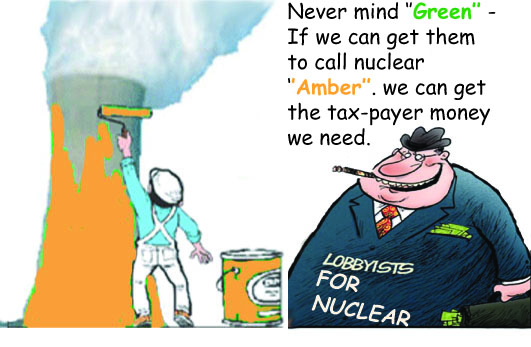
The environment ministers of five EU member states including Germany warned against including nuclear power in the proposed EU taxonomy at the sidelines of the UN Cop 26 climate conference in Glasgow today. In a jointstatement issued by the environment ministers of Germany, Denmark, Luxembourg, Austria and Portugal, the signatories warn that including nuclear in the taxonomy would permanently damage the latter’s “integrity, credibility and therefore its usefulness”. The EU taxonomy is to establish criteria for environmentally sustainable economic practices, steering funding towards these activities. German caretaker environment minister Svenja Schulze said that “nuclear power is too risky, too expensive”, and in any case would come too late to make a notable contribution to mitigating climate warming. Argus Media 11th Nov 2021 https://www.argusmedia.com/en/news/2272872-ministries-reject-nuclear-inclusion-in-eu-taxonomy |
Speaker of UK Parliament refuses debate on motions against Nuclear Energy (Financing) Bill.

Of course, consumers who have signed up to buy 100% renewable electricity could quite rightly feel aggrieved at having to pay the “nuclear tax” as well.
nuClear News, November. 21. Nuclear Energy Finance Bill On Wednesday 3rd November, MPs debated the second reading of the Nuclear Energy (Financing) Bill. The Liberal Democrats and the SNP, bot put forward an amendment, but neither was accepted for debate by the Speaker.
LibDem Motion: That this House declines to give a Second Reading to the Nuclear Energy (Financing) Bill because there is no economic or environmental case for the construction of any further nuclear stations in the UK; because the Bill does nothing to address concerns about costs around nuclear waste disposal and decommissioning; because the Bill fails to bring forward meaningful reforms to accelerate the deployment of renewable power or the removal of restrictions on solar, wind and the building of more interconnectors to guarantee security of supply; and because it fails to remove barriers to investment in renewables or to support investment and innovation in cutting-edge energy technologies, including tidal and wave power, energy storage, demand response, smart grids and hydrogen.
SNP Motion: This House declines to give a Second Reading to the Nuclear Energy (Financing) Bill because it believes there is no longer a justification for a large nuclear power station to provide base load energy, because large scale nuclear is not compatible as a counter to the intermittency of renewable wind as nuclear stations are too inflexible, because pumped storage hydro should be utilised to provide renewable energy that can be dispatched when required and pumped storage hydro should be supported with a minimum electricity price providing better value to bill payers than funding new nuclear, because wave and tidal technologies should be utilised to provide stable and predictable electricity generation and these technologies should be supported to scale up via the provision of a ring fenced pot of funding within the forthcoming contracts for difference auction, because the net zero pathway will be better advanced by supporting the Scottish Cluster as a fast track Carbon Capture, Utilisation and Storage project given that it includes hydrogen production, direct air capture and carbon storage facilities that will serve the wider UK, and because greater support and investment should be directed towards green hydrogen production and emerging storage technologies; and, as the cost of energy increases, this House calls on the Government to spend more money on energy efficiency measures and targeted support for those who suffer from or are at risk of fuel povertyac1
Continue reading-
Archives
- October 2026 (112)
- September 2026 (339)
- August 2026 (330)
- July 2026 (355)
- June 2026 (287)
- May 2026 (306)
- April 2026 (356)
- March 2026 (251)
- February 2026 (267)
- January 2026 (308)
- December 2025 (358)
- November 2025 (359)
-
Categories
- 1
- 1 NUCLEAR ISSUES
- business and costs
- climate change
- culture and arts
- ENERGY
- environment
- health
- history
- indigenous issues
- Legal
- marketing of nuclear
- media
- opposition to nuclear
- PERSONAL STORIES
- politics
- politics international
- Religion and ethics
- safety
- secrets,lies and civil liberties
- spinbuster
- technology
- Uranium
- wastes
- weapons and war
- Women
- 2 WORLD
- ACTION
- AFRICA
- Atrocities
- AUSTRALIA
- Christina's notes
- Christina's themes
- culture and arts
- Events
- Fuk 2022
- Fuk 2023
- Fukushima 2017
- Fukushima 2018
- fukushima 2019
- Fukushima 2020
- Fukushima 2021
- general
- global warming
- Humour (God we need it)
- Nuclear
- RARE EARTHS
- Reference
- resources – print
- Resources -audiovicual
- Weekly Newsletter
- World
- World Nuclear
- YouTube
-
RSS
Entries RSS
Comments RSS

