With the confusing consortium behind it, the UK’s Rolls Royce ”small” nuclear reactor project is running a huge risk

this is a huge risk of public money on a speculative design. By the time we know how much SMRs will cost and whether they are reliable or not, there will be up to 10 reactors being manufactured unless production lines are allowed to sit idle for years waiting until the design is proven enough for new orders to be placed. Realistically the first reactor won’t be complete before the mid-2030s at about the time the last fossil fuel will disappear from the generation mix, so it’s too little, too late and too expensive
What it turns out to amount to is an agreement to spend £400m over the next three years which may produce a design for a reactor which may get approved by the regulators and which may find investors willing to pay what will be at least £2billion to build each one
nuClear News November 21. Rolls Royce’s Small Modular Reactors On 9th November the Government announced that it would back the Rolls-Royce Small Modular Reactor with £210m in funding. Matched by private sector funding of over £250 million, this investment will take forward phase 2 of the Low-Cost Nuclear project to further develop SMR design and take it through the regulatory processes to assess suitability of potential deployment in the UK.
The Government claimed that SMRs have the potential to be less expensive to build than traditional nuclear power plants because of their smaller size, and because the modular nature of the components offers the potential for parts to be produced in dedicated factories and shipped by road to site – reducing construction time and cost. Rolls Royce SMR estimate that each Small Modular Reactor could be capable of powering 1 million homes – equivalent to a city the size of Leeds.
The £210 million grant follows £18 million invested in November 2019, which, according to the Government, has already delivered significant development of the initial design as part of Phase One of the project. (1)
The Rolls Royce SMR design is not exactly small. It was originally conceived as a 440 MW unit, but R-R has found a way of getting 470 MWe out of the core. Each of the proposed 16 reactors is expected to cost around £1.8 billion to £2.2bn and produce power at £40-60/MWh over 60 yrs. (2) Rolls Royce says it has a target cost of £1.8 billion once 5 reactors have been built. (3)
As well as the Government funding, Rolls-Royce has been backed by a consortium of private investors. The creation of the Rolls-Royce Small Modular Reactor (SMR) business was announced following a £195m cash injection from BNF Resources, and Exelon Generation to fund the plans over the next three years. (The Guardian suggests Rolls Royce will top this up with £50m of its own money, which gets us to £245m –not quite the ‘over £250m’ mentioned in the Government Press Release, but it’s not clear whether the £50m is extra money or part of the £195m). It is hoped the new company could create up to 40,000 jobs by 2050. The investment by Rolls-Royce Group, and the government will go towards developing Rolls-Royce’s SMR design and take it through regulatory processes to assess whether it is suitable to be deployed in the UK. It will also identify sites which will manufacture the reactors’ parts and most of the venture’s investment is expected to be focused in the north of the UK, where there is existing nuclear expertise. (4)
BNF Resources UK Limited appears to have been created in June and has two significant employees, Nicholas Fallows and Sean Benson. Benson says: “BNF has an established history of energy market investing and we are proud to be a part of Rolls-Royce SMR in this exciting opportunity. Following reviews of numerous proposals we found that this project, featuring a highly experienced team was the most realistic, affordable and scalable solution for provision of carbon-free baseload and alternative power requirements.” (5)
It appears that BNF Resources UK Limited is a subsidiary of BNF Capital Limited which was created in 2012 (same address) and is registered in Guernsey. These two people seem to have a history in Financial Investment. The Perrodo family, which made its fortune from the private oil company Perenco, is behind BNF Resources UK.
Confusingly there has been no mention of the Rolls Royce SMR Consortium which included Assystem, Atkins, BAM Nuttall, Laing O’Rourke, National Nuclear Laboratory (NNL), Jacobs, The Welding Institute (TWI) and Nuclear AMRC, as well as Rolls Royce. The consortium existed in July of this year when Cavendish signed up to work on the SMR. (6) Assystem has since said it will continue to lead on the design of key areas of power plant infrastructure including the turbine island, cooling water island and balance of plant systems, and is expecting to double the size of its SMR team in the next six months. (7) Similarly Nuclear AMRC has said it will work with Rolls-Royce to help prepare critical components for commercial production in the UK. The centre will also support the design of a new UK factory for large SMR components. (8)
Exelon is contributing under an agreement from a year ago to find international markets. (9)
This new funding will help Rolls-Royce start the SMRs on the Generic Design Assessment (GDA) process. (10) In May, the government declared the Generic Design Assessment (GDA) open to advanced nuclear technologies – including SMRs – for the first time. The process allows the nuclear regulators to assess the safety, security and environmental implications of new reactor designs. Rolls-Royce SMR has stated its intention to enter the GDA process shortly. (11) This could take about 5 years. (The GDA process took 5.75 years for the EPR, 7.5 years for the AP1000, 4.75 years for the ABWR, and process for the UK HPR1000 is continuing after 4 years. (12)) According to the Office for Nuclear Regulation (ONR) the GDA on SMRs was expected to have started by now but there have been delays.
Each of the initial run of reactors is expected to have a generation capacity of 470MW, or enough to power the equivalent of 1.3m UK homes, and cost about £2bn on average, well below the price per MW sought by developers of large-scale nuclear reactors. The consortium hopes to build on an initial run of five SMRs, the first of which could go on line by 2031, to create a multibillion-pound stable of 16 SMRs around the country. (13)
This means that if delivered on budget and to engineering specifications, a single SMR would deliver roughly a seventh of the power of Hinkley for less than a twelfth of the price, while using less land. Each power station is said to be the size of two football pitches, (but this is open to question) and can also be used to create hydrogen by splitting water molecules. The company, primarily a jet engine maker, hopes the hydrogen SMRs could produce would accelerate a move to greener aviation.

Rolls-Royce will be seeking more investment for the project to help fund the building of actual SMRs. The government is currently passing legislation that will allow investors to back projects like SMRs using a regulated asset base (RAB) model, which allows them to recoup up-front costs. The government said this would “attract a wider range of private investment into these projects, reducing build costs, consumers’ energy bills and Britain’s reliance on overseas developers for finance.”
Professor MV Ramana, a nuclear policy expert at the University of British Columbia in Canada, cautioned that this would be a new market for Rolls. He said: “It’s the same technology, but the set of constraints that you will be dealing with in the electricity sector are very different from submarines.” He also said Rolls has some catching up to do against rivals pursuing the same goals. NuScale Power, based in Oregon, received US regulatory approval for its own reactor design last year and could have a plant working by 2026. (14)
Steve Thomas, Emeritus Professor of Energy Policy at Greenwich University said this is a huge risk of public money on a speculative design. By the time we know how much SMRs will cost and whether they are reliable or not, there will be up to 10 reactors being manufactured unless production lines are allowed to sit idle for years waiting until the design is proven enough for new orders to be placed. Realistically the first reactor won’t be complete before the mid-2030s at about the time the last fossil fuel will disappear from the generation mix, so it’s too little, too late and too expensive
Chair of the E3Gthink tank, Tom Burke, points out that this is the third or fourth time this programme has been announced in the past year. What it turns out to amount to is an agreement to spend £400m over the next three years which may produce a design for a reactor which may get approved by the regulators and which may find investors willing to pay what will be at least £2billion to build each one and which may be generating electricity which may be competitive with renewables just before the whole of our electricity system has to be decarbonised to meet the PM’s target. So, six things have to go right before we might see an SMR somewhere.
As expected, Moorside, Wylfa and Trawsfynydd have all been mentioned as potential sites for an SMR. Tees Valley mayor Ben Houchen also wants Hartlepool to be on the list. (15) Dylan Morgan of PAWB (People Against Wylfa B) said: “We have an immediate crisis now. Nuclear power is slow, dangerous and extortionately expensive. It will do nothing to address the current energy crisis, neither will it be effective to counter climate change. The UK and Welsh governments should divert resources and support away from wasteful and outdated nuclear power projects towards developing renewable technologies that are much cheaper and can provide faster and more sustainable solutions to the energy crisis and the challenges of climate change.” (16) https://www.no2nuclearpower.org.uk/wp/wp-content/uploads/2021/11/nuClearNewsNo135.pdf
President Macron does not have the legal power to decide on new nuclear reactors – requires Parliamentary agreement
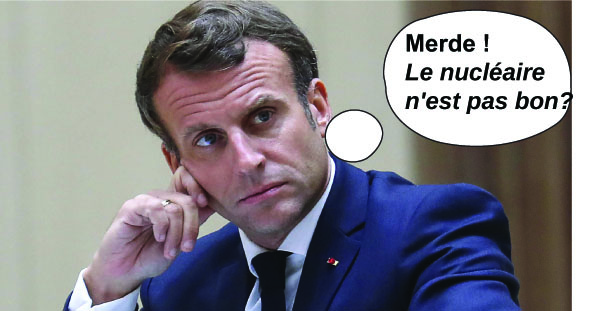
Emmanuel Macron does not have the legal power to decide on his own the order for new nuclear reactors, as he announced he wanted to do, Tuesday, November 9, denounces the former Minister of the Environment, former MEP and famous lawyer specializing in the ecology, Corinne Lepage.
The President of the Republic must first seize the Parliament in order to comply with the multiannual energy programming.
Ouest France 10th Nov 2021
Russia sends nuclear-capable bombers on patrol over Belarus for second day amid migration crisis’
Russia sends nuclear-capable bombers on patrol over Belarus for second day amid migration crisis, ABC12 Nov 21, Russia sent two nuclear-capable strategic bombers on a training mission over Belarus for the second day in a row, in support for its ally amid a dispute over migration at EU borders with Poland and Lithuania . Key points:Russia backed Belarus as thousands of migrants try to enter the EU at its border Belarus President Alexander Lukashenko said the patrols were a necessary response to the migration crisis at the border Thousands of migrants are currently stranded at the Belarus/Poland border as they try to enter the EUTwo Russian Tu-160 strategic bombers practised bombing runs at the Ruzany firing range, about 60 kilometres east of Belarus’ border with Poland on Wednesday and Thursday. The Belarusian Defence Ministry said such Russian flights will now be conducted on a regular basis as part of joint training missions and that Belarusian fighter jets simulated an intercept. Belarusian President Alexander Lukashenko said he needed the bombers to help him navigate what has become a tense border stand-off, as thousands of migrants and refugees gather on the Belarusian side of the Poland border in the hope of crossing into Western Europe. …………….. https://www.abc.net.au/news/2021-11-12/russia-sends-nuclear-capable-bombers-on-patrol-over-belarus/100614600 |
Developers will have an uphill battle to meet environmental protection requirements for Bradwell nuclear project.
Bradwell Action Network said “The planning inspectorate stated that
Maldon District Council had NOT behaved unreasonably in refusing permission
on ecological grounds. The inspector allowed these works to go ahead only
after the developer submitted further data and control measures, and due to
their temporary nature.
While we are disappointed that these destructive
works are set to proceed, we should take heart that this process (the
refusal and appeal) has shown that the developers will have an uphill
struggle meeting environmental protections as this project develops. The
Blackwater Estuary and our shoreline is a critical and sensitive area for
its flora and fauna. We will continue to do what we can to protect it from
the threat of the Bradwell B development.”
BAN 11th Nov 2021
The consortium wanting to develop UK’s min-nuclear plants will have to rely on tax-payer funding.

State support a fallback option for UK’s mini-nuclear plants rollout.
The head of the consortium, which is developing a £ 30 billion fleet of mini-nuclear power stations, has indicated that it will have to rely on UK taxpayers to help fund the construction of the first of the new designs if there is not enough investor interest. Kwasi Kwarteng, business secretary, confirmed on Tuesday that the government is committed to £ 210 million in state funding to a Rolls-Royce-led consortium developing a new generation of small modular reactors (SMRs) as part of a new push into nuclear power
to help achieve the UK’s net zero target.
The government has previously seen that it was prepared to approve up to £ 2 billion in state funding to help start the program, which envisages the construction of at least 16 SMR power stations. Consortium chief executive Tom Samson told the Financial
Times that he had held talks with the government on the possibility of “putting in part of the cost for the first three or four units and then using it as a way to exploit private capital”.
Samson declined to comment on the potential scope of any further government investment and stressed that while it is an option, the aim was to “move forward in line with the
technology that requires the least government funding”. He added: “It is our duty to bring this story to the [capital] markets.”. The first five SMR power stations would cost £ 2.2bn each, with the price of subsequent units dropping to £ 1.8bn, according to Rolls-Royce. The consortium is looking to build the plants at operational and mothballs nuclear power plants in Britain.
FT 10th Nov 2021
https://www.ft.com/content/869279aa-f771-4025-8719-c3b8bdf1f375
The consortium wanting to develop UK’s min-nuclear plants will have to rely on tax-payer funding.
President Macron boosts nuclear industry, but in reality, France’s prospects for new reactors are grim

“too expensive, too slow and too dangerous”.
“Announcing a nuclear revival and the construction of new reactors is totally disconnected from reality”
Macron boosts nuclear power plans to meet France’s net-zero ambitions, The Age, By Bevan Shields, November 10
”…………………in a shift, the French President on Tuesday night, Paris time (Wednesday morning AEDT) said the country would rededicate itself to atomic power.
“…………….we will for the first time in decades revive the construction of nuclear reactors in our country………….” Macron said.
He did not give details but the comments were seen as a reference to the expected green-lighting of as many as 14 next-generation nuclear plants proposed by grid operator RTE.
Macron made the announcement against the background of the COP26 climate summit in Glasgow, where new forms of electricity generation have been identified as a key issue in the fight against climate change, and an energy crisis in Europe triggered by falling gas supplies and an unusually calm summer and autumn which has affected the output of wind turbines.
While confidence in nuclear took a hit in France following the 2011 Fukushima disaster in Japan, it is still a relatively uncontroversial technology compared to other countries such as Australia, where some Coalition MPs are pushing Prime Minister Scott Morrison to explore its feasibility.
Macron sought to tie the new nuclear push to French innovation and national pride – key themes for the President as he enters a tough presidential election campaign in 2022.
His position is in stark contrast to Germany, where nuclear power is on course to be phased out by next year.
The vast majority of France’s nuclear facilities were built in the 1970s and 1980s. A third reactor is being added to a plant in Flamanville, in the Normandy region, but the project which started in 2007 has been plagued by cost overruns and huge delays.
Greenpeace France energy transition campaigner Nicolas Nace condemned Macron’s latest announcement and pointed to the Flamanville project to claim nuclear power was “too expensive, too slow and too dangerous”.
“Announcing a nuclear revival and the construction of new reactors as the nuclear industry is totally disconnected from reality,” Nace said.
A new nuclear facility being constructed in Somerset, England, has also been hit by delays and cost blowouts.
An International Energy Agency analysis released earlier this month found global nuclear capacity would reach 582 gigawatts by 2040 – well below the 730 gigawatts needed to achieve net zero emissions.
“This gap widens even further after 2040, so long-term operation of the existing nuclear fleet and a near-doubling of the annual rate of capacity additions are required,” the report said.
“While some of this additional nuclear capacity will not come online until the late 2030s, policy decisions are required now to put nuclear back on track.”
About 20 gigawatts of new nuclear capacity need to be added each year between now and 2050 to achieve carbon neutrality – a rate of construction is comparable with the pre-Fukushima period. https://www.smh.com.au/world/europe/macron-backs-nuclear-power-to-meet-france-s-net-zero-ambitions-20211110-p597kk.html
In Wales, strong opposition to UK plan for small nuclear reactors – too slow, dangerous, super costly compared to quick cheap renewables.

Nuclear set to return to Wylfa and Trawsfynydd as Rolls-Royce secures funding for mini-reactors. Nuclear power looks set to return to Wales after Rolls-Royce secured £450m for a venture to build mini nuclear reactors. Trawsfynydd and Wylfa are understood to be two of the sites being lined up for the multi-billion pound mini-power stations.The company hopes to build five by 2031, and then another eleven in the years that follow.
The UK Government have announced that they will match a £245m investment made by a consortium made up of Rolls-Royce, BNF Resources and the US generator Exelon Generation with £210 of their own. Rolls-Royce has previously said that there was a “pretty high probability” Trawsfynydd could house the first reactor by the early 2030s.
Plans for new nuclear reactors have however already attracted opposition in Wales. Anti-nuclear groups have already criticised the plans, saying that the emphasis should be placed on green renewable energy instead. Dylan Morgan of PAWB (People Against Wylfa B) said last month: “We have an immediate crisis now. Building huge reactors at a nuclear power station take at least 15 years. “Nuclear power is slow, dangerous and extortionately expensive.
It will do nothing to address the current energy crisis, neither will it be effective to counter climate change.
“The UK and Welsh governments should divert resources and support away from wasteful and outdated nuclear power projects towards developing renewable technologies that are much cheaper and can provide faster and more sustainable solutions to the energy crisis and the challenges of climate change.”
Nation Cymru 9th Nov 2021
https://nation.cymru/news/nuclear-set-to-return-to-wylfa-and-trawsfynydd-as-rolls-royce-secures-funding-for-mini-reactors/
Germany reaffirms its opposition to nuclear power being designated as ”sustainable”
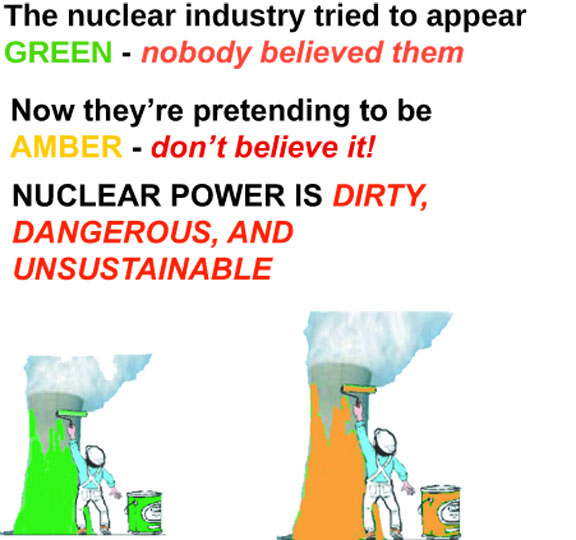
Germany will work towards an exclusion of nuclear power from the EU taxonomy for sustainable investments, the country’s environment minister Svenja Schulze has affirmed. “We don’t want nuclear energy, we don’t think it’s sustainable and we don’t want the EU to support it,“ the acting minister from the Social Democrats (SPD) told newspapers of the Funke Mediengruppe in an article carried by the Frankfurter Allgemeine Zeitung.
Schulze added that the German government is not alone on this position, countering an initiative of several other EU member states under the leadership of France to give nuclear power a greater role in the EU’s plans for decarbonisation and the greening of the financial system.
Building nuclear plants would be much too expensive and time-consuming for effective climate action, with plants commissioned now only being ready for operation by 2045 due to lengthy searches for a location, licensing hurdles and expectable protests against it, she argued. Conservative (CSU) Bavarian state premier Markus Söder backed Schulze’s rejection to make the
technology a tool for climate action, arguing that Germany’s nuclear phase-out “is based on broad societal acceptance.”
Clean Energy Wire 8th Nov 2021
Europe’s dilemma over whether or not to include nuclear power in its sustainabble finance taxonomy
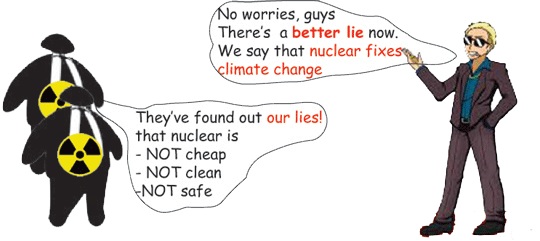
Greenwashing or viable solution? Europe has a big decision to make on nuclear power, CNBC, NOV 9 2021Silvia Amaro @SILVIA_AMARO
It is a long-standing dilemma that the European Commission, the executive arm of the EU, must resolve in the coming weeks.
Ultimately, its decision will have repercussions on its efforts to be a global leader in the area of climate change.
LONDON — The European Union must decide whether nuclear is a clean source of energy, but the decision is tough with countries divided about the right labelling.
Some EU members, notably France, which have big investments in nuclear and are wary of using gas from Russia see the energy resource as a viable option. Other nations, including Germany, believe it is time to move away from it and are worried about nuclear waste.
It is a long-standing dilemma that the European Commission, the executive arm of the EU, must resolve in the coming weeks. The commission is due to publish its sustainable finance taxonomy — rules that will help clarify to investors what the bloc sees as green investments — as an attempt to boost financing in these areas.
Ultimately, its decision will have repercussions on its efforts to be a global leader in the area of climate change……………….
Opponents to inclusion of nuclear power into the EU green taxonomy, led by Germany, argue that the technology is not suitable to achieve sustainability targets, including establishing a transition to a circular economy,” Henning Gloystein, director for energy, climate and resources at consultancy group Eurasia, told CNBC via email.
“The core problem for critics is that there is no solution for long-term storage of nuclear waste. All current solutions are temporary,” he added.
The inclusion of nuclear in the EU’s green taxonomy has also been criticized by activists.
The World Wide Fund for Nature has said that classifying nuclear as somewhat sustainable “would allow the greenwashing of billions of euros of financing for these activities, despite the high emissions from fossil gas and the radioactive waste produced by nuclear power.”
Green image at risk
More broadly, whatever the commission decides will also send a signal to other nations.
The European Commission praises itself for having the most concrete plan on how to cut greenhouse gas emissions — a plan that is still yet to be approved by lawmakers.
The institution has also lobbied other parts of the world, including China, to put forward concrete steps on how they intend to achieve carbon neutrality……….. https://www.cnbc.com/2021/11/09/cop26-europe-has-a-big-decision-to-make-on-nuclear-power.html
Finland’s Greens remain anti-nuclear, despite antics of a breakaway group


‘Which greens, there’s two? One carrying the original Green message, of the 1970s, egalitarian, social democracy, adopted by all other European countries.Green League – The Greens” Known throughout Europe, as the European Greens• Finnish: Vihreä liitto• Swedish: Gröna förbundet
— Paul RichardsNuclear Fuel Cycle Watch Australia, 11 Nov 21, Finland greens are reported to have switched to pro-nuclear power
The other, pro-nuclear group, broke away, branding itself green. Much like the Liberal Party, in Australia, who are hard-right, neocon and neoliberal.Liberal by brand, conservative by demonstrated values. A long con, that thoroughly confuses the Republican idiocracy in the US. A group, who think liberals are, communists. https://www.facebook.com/groups/1021186047913052
Investor backlash predicted, if European Union were to include Nuclear and Gas as ”Green” in its EU Taxonomy

Net-Zero Alliance Plans to Reject Gas, Nuclear as Green Assets, https://www.bloomberg.com/news/articles/2021-11-08/net-zero-alliance-plans-to-reject-gas-nuclear-as-green-assetsBy John Ainger and Alastair Marsh9 November 2021
- UN-convened asset owners weigh in on taxonomy debate
- The group favors separate legislation for energy transition
The European Union will likely face investor backlash if it includes natural gas and nuclear energy in its green rulebook, known as the EU taxonomy.
The United Nations-convened Net-Zero Asset Owner Alliance, which is part of the wider finance industry’s $130 trillion climate agreement announced last week, wrote in a document that hasn’t been finalized that it would oppose such a decision. Instead, fossil fuels should go into an extension or separate piece of legislation for transition technologies, the group said.
“The Alliance supports a taxonomy that is credible, usable, as well as science- and evidence-based,” according to the document seen by Bloomberg News. The inclusion of gas “would be inconsistent with the high ambition level of the EU taxonomy framework overall.” For nuclear, “it will be of utmost importance to apply strict criteria when assessing” the principle of do-no-significant-harm, “with respect to the other environmental objectives to identify a potential taxonomy alignment,” it said.
The development marks a blow to those EU members who’d hoped the bloc would take a softer stance on gas and nuclear. It also sets the tone for other investors keen to put their net-zero pledges to work, less than a week after international financial institutions representing 40% of total global assets pledged to work toward carbon neutrality by the middle of the century.
The European Commission is under pressure from member states such as France, which want to include nuclear and gas as key planks of their green transition strategies. The debate has intensified in recent months as energy prices soar amid a lack of supply. A decision on the so-called complementary delegated act is expected in the coming weeks.
Environmental groups have criticized the potential inclusion of gas, arguing it would undermine the EU’s ambition of setting the “gold standard” for green investing. It also would result in the bloc failing to meet its goal of cutting emissions by 55% by 2030 from 1990 levels and becoming carbon neutral by mid-century, they said. For nuclear, meanwhile, there are concerns over the environmental impacts of radioactive waste.
The Net-Zero alliance, whose members include Allianz SE and the California Public Employees’ Retirement System, urged the EU Commission, member states and their expert bodies to make sure any decision arrived at is “science and evidence-based,” according to the document.
:
France and other pro nuclear countries push for nuclear to be included as ”sustainable” in EU taxonomy.

Mairead McGuinness urged to reclassify nuclear power as possible ‘green’ solution for EU https://www.independent.ie/news/environment/mairead-mcguinness-urged-to-reclassify-nuclear-power-as-possible-green-solution-for-eu-41028296.html
Irish Commissioner under pressure amid global warming and energy crisis, John Downing .
November 08 2021 Ireland’s EU Commissioner Mairead McGuinness is under pressure to reclassify nuclear power as “green energy”, giving it a central role in the battle against global warming and easing Europe’s energy crisis.
Commissioner McGuinness hopes to decide in the coming weeks on a controversial move which could also give natural gas a transition role in scaling down carbon emissions burning the planet.
Decision time comes amid a major EU energy crisis, with spiralling prices in every member state, and an increasing demand for real action on the pledged 55pc reduction in carbon emissions by 2030 with zero carbon by 2050.
If Ms McGuinness gets the move through the policy-guiding Commission, the issue will then pass to member governments and the European Parliament where battle-lines are already drawn.
On one side, pro-nuclear countries like France will promote the change as a “pragmatic solution” – but others will speak of “greenwashing” and creating more problems to solve immediate issues.
Ms McGuinness told the Irish Independent that member states must ultimately decide their own energy mix whatever the outcome.
There is an important debate ongoing about the role of nuclear energy and natural gas in the transformation of the EU energy sector and their potential inclusion in the EU taxonomy – a classification system for sustainable investments,” Ms McGuinness said yesterday.
“To be part of the EU sustainable investment taxonomy, an energy source must make a significant contribution to the fight against climate change. Nuclear energy is low carbon,” she added.
But she also warned that other aspects of nuclear power were still being studied, looking at “the requirement to do no significant harm” to the environment.
“Right now our work is focusing on scientific reports on this aspect of nuclear power,” Ms McGuinness said.
EU Commission President Ursula von der Leyen gave a strong hint on the direction of travel when speaking to reporters after a leaders’ summit in Brussels on October 22.
“The energy mix of the future needs more renewable and clean energy. Alongside this, we also need a stable source, nuclear energy, and during the transition, also natural gas.
“That is why – as called for by many leaders – the Commission is going to come forward with a taxonomy proposal in the near future,” said Ms von der Leyen.
A pivotal issue in all of this will be the attitude taken by the new German government which is expected to be in place by December 6, the feast of St Nicholas and an important national day.
Back in June 2011, the now outgoing German chancellor, Angela Merkel, committed to ending all nuclear power in the state by December 2022.
She will be replaced by Social Democrat leader Olaf Scholz, heading a three-party coalition of the Green Party and the Liberal FBD.
The Green Party is, by definition, committed to ending nuclear power generation in Germany but the current energy crisis, aggravated by undue dependence on Russian natural gas, complicates this matter as coalition negotiations continue.
France gets 70pc of its electricity from nuclear power stations.
Ireland is committed to creating a ‘Celtic Interconnector’, taking power from France via an undersea powerline due for completion by 2026.
France and other pro nuclear countries push for nuclear to be included as ”sustainable” in EU taxonomy.
Ethical Investors press Serco to drop bid for contract with the Atomic Weapons Establishment
Best known for its involvement with NHS test and trace during the
coronavirus pandemic Serco is believed to have had plans to compete for
contracts with the Atomic Weapons Establishment, which makes and maintains
warheads. Serco abandoned its bid after investors warned that if the
FTSE250 company began working on nuclear weapons they may have to dump
shares to meet Environmental, Social and Governance (ESG) standards, the
Telegraph first reported. A spokesperson for Serco declined to comment on
the news.
City AM 7th Nov 2021
UK government considers withdrawing from EU science and research programmes
| The government is considering withdrawing from EU science and research programmes worth £77 billion because of deteriorating relations with Brussels. Ministers are working on alternatives to Horizon Europe, the EU’s research funding scheme, Copernicus, its satellite system, and Euratom, its atomic energy treaty. Withdrawing would pull up to £15 billion in funding from Brussels and deny British researchers the opportunity to participate in its programmes. A government paper circulated to a Brexit cabinet sub-committee last week and leaked to The Sunday Telegraph suggests that the government is considering pulling out of the schemes if relations with Brussels deteriorate further. The UK is to pay £2.1 billion annually to the Horizon programme to maintain access for British scientists and researchers to pan-European projects and funding. It has also secured access to the Copernicus Earth observation programme, important to the UK space sector, and has also agreed to continue its involvement in the Euratom nuclear research programme. Times 8th Nov 2021 https://www.thetimes.co.uk/article/row-with-european-union-puts-77bn-science-and-research-schemes-at-risk-33n82pv9z |
Rapid growth in solar and wind power in UK
| MORE than 10,000 megawatts per hour of renewable energy were produced in Southampton last year. Figures from the Department for Business, Energy and Industrial Strategy show 16,730 megawatts per hour (around 17 gigawatts) of renewable electricity were generated in Southampton in 2020. This was 10% more energy than the 15 GWh produced the year before, and 23% more than the amount produced in 2014 – the earliest year of data available. Across the UK, 134,600 GWh of renewable energy was generated in 2020, a 13% rise on the year before, and above the 9% increase from 2018 to 2019. Climate think tank Ember said huge falls in costs means the growth in offshore wind power is set to go “parabolic” in the coming months. Phil MacDonald, chief operating officer at the organisation, added: “But the Government is still missing the opportunity of cheap onshore wind, and not doing enough to explore earlier-stage technologies like geothermal and tidal. The biggest producer of energy in Southampton last year was solar power, which generated 10 GWh – 62% of the total. Daily Echo 8th Nov 2021 https://www.dailyecho.co.uk/news/19700736.figures-renewable-energy-produced-southampton-yearly/ |
-
Archives
- October 2026 (112)
- September 2026 (339)
- August 2026 (330)
- July 2026 (355)
- June 2026 (287)
- May 2026 (306)
- April 2026 (356)
- March 2026 (251)
- February 2026 (267)
- January 2026 (308)
- December 2025 (358)
- November 2025 (359)
-
Categories
- 1
- 1 NUCLEAR ISSUES
- business and costs
- climate change
- culture and arts
- ENERGY
- environment
- health
- history
- indigenous issues
- Legal
- marketing of nuclear
- media
- opposition to nuclear
- PERSONAL STORIES
- politics
- politics international
- Religion and ethics
- safety
- secrets,lies and civil liberties
- spinbuster
- technology
- Uranium
- wastes
- weapons and war
- Women
- 2 WORLD
- ACTION
- AFRICA
- Atrocities
- AUSTRALIA
- Christina's notes
- Christina's themes
- culture and arts
- Events
- Fuk 2022
- Fuk 2023
- Fukushima 2017
- Fukushima 2018
- fukushima 2019
- Fukushima 2020
- Fukushima 2021
- general
- global warming
- Humour (God we need it)
- Nuclear
- RARE EARTHS
- Reference
- resources – print
- Resources -audiovicual
- Weekly Newsletter
- World
- World Nuclear
- YouTube
-
RSS
Entries RSS
Comments RSS

