The French government asked EDF for earlier restart of nuclear reactors (now on maintenance)
The French government asked Electricite de France SA to restart some
nuclear reactors earlier than planned in order to help with a winter energy
crunch across Europe. Ecology Minister Barbara Pompili said on France Info
radio that she had asked EDF Chief Executive Officer Jean-Bernard Levy in a
meeting on Friday to restart more quickly than planned some reactors that
were halted for maintenance and scheduled to restart in mid-January.
Bloomberg 19th Dec 2021
U.S. congressional delegation arrives in Ukraine to discuss threat of war with Russia — Anti-bellum
US Congress delegation arrives in Ukraine to discuss threat of war with RussiaA group of congressmen announced Washington’s readiness to take tough measures in response to any encroachment on sovereign Ukrainian territory *** “Representative Jason Crow led a U.S. Congressional delegation to Kyiv to discuss Russia’s aggressive military buildup in and around Ukraine and hear […]
U.S. congressional delegation arrives in Ukraine to discuss threat of war with Russia — Anti-bellum
France’s Association for the Control of Radioactivity in the West (ACRO) reveals plutonium pollution in La Hague.

14 Dec 21, Plutonium pollution in La Hague revealed by ACRO. As part of its Citizen’s Observatory of Radioactivity in the Environment, ACRO regularly monitors radioactive pollution around the nuclear installations in La Hague, which enabled it, in 2016, to highlight unusual pollution. in the Ru des Landes
area, with the notable presence of americium-241 and plutonium, which are particularly toxic.
Areva, now Orano, has pledged to take back the contaminated land. But, as of December 2021, no sanitation work has yet been carried out and cows continue to graze there.
ACRO 14th Dec 2021
EU countries at odds over green investment label for nuclear energy
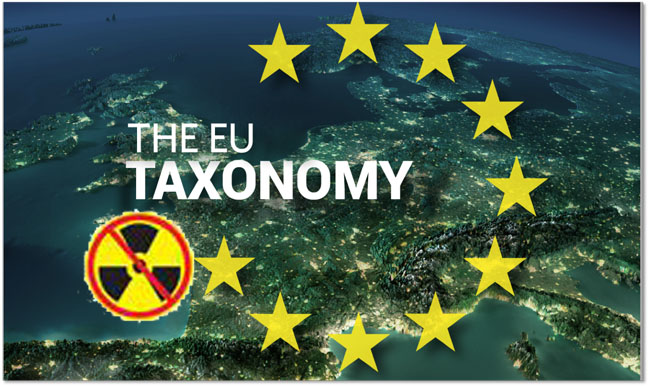
EU countries at odds over green investment label for nuclear energy, CNA, 19 De 21, BRUSSELS: European Union countries disagreed ahead of a summit on Thursday (Dec 16) over whether the bloc should label nuclear energy as a climate-friendly investment, as leaders await a decision on the matter from Brussels.
The European Commission is considering whether to include nuclear and natural gas in its “sustainable finance taxonomy”, a rulebook that will restrict which activities can be labelled as climate-friendly investments.
“We are against a greenwashing of nuclear energy … We have allies, among them Luxembourg, but of course also powerful opponents who are supporters of nuclear energy,” Austrian Chancellor Karl Nehammer said on his arrival at the summit of EU leaders.
“Poland very strongly supports the possibility of financing investments in gas and in nuclear power,” Polish prime minister Mateusz Morawiecki said.
“Others have doubts about that and Poland clearly calls for it and I will be saying that strongly today to adopt that in the conclusions,” Morawiecki said.
The Commission has said it aims to decide this month on whether nuclear and gas are labelled green, but has struggled to resolve in-fighting between the bloc’s countries – including France and Germany, who are split over the fuels……………
The taxonomy does not ban investments in activities not labelled “green”. But by limiting the green label to those activities deemed truly climate-friendly, the EU aims to steer cash into low carbon projects and stop companies or investors from making unsubstantiated environmental claims. https://www.channelnewsasia.com/sustainability/eu-nuclear-energy-clean-green-investment-2384321
France ready to join forces with fossil fuel promoters, in order to put nuclear at the heart of European environment policy.

To put nuclear power at the heart of European environmental policy, France
is ready to join forces with countries which promote fossil fuels.
European taxonomy is a register classifying the different energies with a more or
less green label. Obtaining it may in particular make it possible to
benefit from grants or funding.
For its part, France is pushing for nuclear
power to be recognized by the European Commission as sustainable energy. To
achieve its ends, it is not excluded that it ally with other countries
which, for their part, support natural gas – fossil energy – as shown by a
note revealed by the newspaper Context relayed by many NGOs.
France Inter 17th Dec 2021
French Environment Minister asks EDF to conduct audit on nuclear power availability, following safety shutdowns
French Environment Minister Barbara Pompili asked power utility EDF
(EDF.PA) on Friday to conduct an audit on the availability of its nuclear
power stations after the company shut down some of its reactors due to
technical problems. EDF, whose reactors provide up to 70% of the country’s
electricity needs, said on Wednesday it found faults at a nuclear power
station and shut down another plant using the same kind of reactors.
Reuters 17th Dec 2021
German experts argue that high costs, delays and toxic wastes mean that money for nuclear power would be better spent elsewhere
From CNN 19 Dec 21, ……..German politicians and experts argue that high costs and the time it takes to build new plants — no fewer than five years, and often much longer — mean money would be better spent elsewhere.
German politicians and experts argue that high costs and the time it takes to build new plants — no fewer than five years, and often much longer — mean money would be better spent elsewhere.
German officials also argue that the lack of a global plan for storing toxic waste should disqualify nuclear as a “sustainable” energy source.Christoph Hamann, an official at Germany’s federal office for nuclear waste management, emphasized that government efforts to construct sites below ground where waste can be stored indefinitely remain a work-in-progress.”We’re talking about a very toxic, high radioactive waste, which is producing problems for the next tens of thousands, or even hundreds of thousands of years. And we’re directing this problem, when using nuclear power, to future generations,” Hamann said………..
Heysham 2 nuclear power station to close earlier than planned
Heysham 2 nuclear power station will continue generating electricity
safely until 2028, however, “closing” two years earlier than originally
planned. In 2016, the sites’ operational lives were extended by seven
years to 2030. Operational dates are under constant review and since then
inspection, modelling and operational experience from other sites, have
given EDF a clearer picture of lifetime expectations for the AGR fleet as
the stations age. Heysham 1 will operate until 2024,
Lancaster Guardian 17th Dec 2021
French President says discussions continue with Germany about nuclear power as ”green”
French President Emmanuel Macron said on Thursday France and Germany would
continue discussions in the coming days to find a compromise on whether the
European Union should label nuclear and gas as green investments. France
wants to be able to attract green finance to fund the construction of new
nuclear power plants in France, while Germany is phasing out nuclear and
keen on switching to gas — a fossil fuel. Macron said in a joint news
conference with his German counterpart Olaf Scholz that a decision on the
subject, the so-called green taxonomy, would soon be issued by the European
Commission.
Reuters 17th Dec 2021
European Union’s rift over nuclear power
EU faces nuclear rift in decision on energy funds, future, Ravalli Republic, By SAMUEL PETREQUIN and RAF CASERT – Associated Press By SAMUEL PETREQUIN and RAF CASERT -17 Dec 21,
BRUSSELS (AP) — The leaders of the European Union’s two most important nations faced reporters together during a joint news conference early Friday, a show of unity at the end of the EU’s final summit of the year.
Then two words – “nuclear energy” – intervened.
Heading into the Christmas week, atomic power is a topic on which France and Germany broadly differ, and one that has become a big thorn in the side of the EU as the 27-nation bloc decides whether to include nuclear-generated energy among the economic activities that qualify for sustainable investment.
German Chancellor Olaf Scholz, who took office last week, and French President Emmanuel Macron agreed on most of the issues tackled during Thursday’s summit, including Ukraine-Russia tensions and an immigration dispute with Belarus.
On the the sustainable investment rules, however, the two leaders have yet to reach a compromise. The rift over nuclear energy was enough to scuttle any agreement on energy prices during the summit.
A big rise in energy prices has reignited the debate about whether the EU should promote nuclear power projects as a way of becoming greener and more energy independent.
France has asked for nuclear power to be included in the so-called “taxonomy” by the end of the year, leading the charge with several other EU countries that operate nuclear power plants.
The group initially faced strong opposition from Germany and other members that wanted nuclear power to be ineligible for green financing, but Scholz adopted a peacebuilding tone in the summit’s final hours early Friday.
“We are talking about countries with different business models. It’s important that each EU country can pursue its own approach without Europe becoming disunited,” Scholz said. “At the end of the day, we will have to come together despite the different priorities we may have set.”
Germany’s remaining nuclear power plants are due to go offline next year. France derives about 70% of its electricity from nuclear energy……………..
making future nuclear power projects eligible for billions in euros available as part of the European Green Deal while avoiding “greenwashing” remains a controversial issue.
…….. “The lack of agreement shows how lively this is, not only in our country, but throughout Europe,” Belgian Prime Minister Alexander De Croo, who faces a domestic crisis over how to phase out nuclear plants and still maintain energy security to his citizens.
De Croo suggested that amid the energy price crunch, nuclear energy and gas could be temporarily eligible for funds……..
The ball is now with the EU’s chief, European Commission President Ursula von der Leyen. She is expected to present before the end of the year the list of activities eligible for the green investment funds and must decide whether nuclear energy and natural gas make the cut.
Von der Leyen has been under pressure from environmental groups and Green European lawmakers to resist the inclusion of both.
“Fossil gas and nuclear power have no place in the EU taxonomy” for sustainable activities, said Sven Giegold, a Green lawmaker in the European Parliament……. https://ravallirepublic.com/lifestyles/technology/eu-faces-nuclear-rift-in-decision-on-energy-funds-future/article_9d325652-1272-5667-8c6b-1654e065aa61.html
Natalie Bennett, a Green member of UK Parliament deftly separates nuclear facts from nuclear fantasy

Separating fact from fission, https://theecologist.org/2021/dec/15/separating-fact-fission Natalie Bennett , 15th December 2021 Nuclear is no panacea for the climate crisis – even if we build new power plants they will come on line too late. Natalie Bennett is a member of the House of Lords, and a member of the Green party.
“The role of civil nuclear power in meeting the UK’s electricity needs and energy security” has just been debated by peers in the House of Lords. Had a television inquisitor put that question to me, I’d start by saying that I don’t accept the terms of the question.
New nuclear should have no role in the UK’s electricity generation, and policies promoting new plants – far from offering any hope of security – present a threat to that essential provision in this age of shocks.
The failed 20th century technology that is nuclear power is something I’ve been debating for a long time. So I could go on at length about the failure to find a solution to the pressing issue of nuclear waste – as Lib Dem Lord Oates did very effectively in the debate.
Cleanest
I could talk about safety issues – from Three Mile Island to Chernobyl to Fukushima. And while many in the debate tried to say, well “not so many people died” on those occasions, that fails to address the huge risks, and in our age of shocks, the increasing dangers presented by multiple climate, human and physical threats that could hamper recovery efforts when things start to go wrong.
I could talk to the links of “civil” nuclear to nuclear weapons – those hideous weapons of mass destruction. I could talk about the handing of enormous sums of money to multinational companies – or foreign governments.
But there are two important arguments less often aired that deserve to be put.
First, that new nuclear power plants are a distraction from what we should be doing. Think about how often you hear ministers talking about new nuclear – such as the latest championing of the – rather modest – government investment in the Rolls Royce fantasy of “small” nuclear reactors.

You also rarely hear ministers talking about renewables. And consider how seldom you hear the politicians in government in serious discussion about energy conservation. For the cleanest, greenest, energy you can possibly have is the energy that you don’t need to use.
Resilient
The fact that government ministers are not talking about this is unsurprising, given that the Green Homes Grant was such an utter disaster. But, in fact, the silence predates that particular Rishi Sunak mess.
Talking about – and acting on – new nuclear power swallows up the space where the renewables and conservation should be.
That’s something that’s true on a global scale, as a brilliant University of Sussex study last year demonstrated. There are, in the academic jargon, path dependencies that see renewables and nuclear crowding each other out.
And it is most painfully evident in the UK in the failure to pursue the most obvious, and productive, path for renewables, community energy.
Despite promises – and recommendations from the Environmental Audit Committee, the Net Zero Strategy contained no plan of action for a key means of spreading prosperity around the country, as well as helping to secure a resilient, decentralised energy system and engaging people directly in the essential drive to Net Zero.
Fission
Secondly, nuclear power projects are too slow. This is a killer argument for which nuclear proponents can have no answer.
Continue readingUncertainties persist, as France shuts down the 4 largest nuclear reactors, because of corrosion and cracks

Corrosion and cracks: the four largest French nuclear reactors shut down.
Four reactors were shut down by EDF, at the Civaux and Chooz power plants, due to a failure of an essential part in the event of an accident. Many uncertainties persist on the consequences of this discovery.
Reporterre 16th Dec 2021
Challenges 15th Dec 2021
Accepting nuclear and gas as ”green” (or even ”amber”) would jeopardise the credibility of the entire European Green Deal

Granting nuclear and fossil gas the label of sustainability would undermine the EU’s climate targets, divert much-needed green investments in Central and Eastern Europe and jeopardise the credibility of the entire European Green Deal
Gas and nuclear: a lose-lose scenario for Eastern Europe, https://www.forbes.com/sites/jamesconca/2021/12/17/nuscale-nuclear-developer-goes-public-with-a-spac-but-nrc-is-still-a-drag/?sh=6afeedc82c0d EU Observer, By PATRICK TEN BRINKBRUSSELS, 16. DEC, 21 After a year-long fight over the classification of fossil gas and nuclear energy under the EU taxonomy, the Delegate Act defining whether they’re considered as a sustainable investment will finally be released next week by the European Commission.
Yet a last major battle is taking place this Thursday (16 December) in Brussels. The 27 EU leaders will have a final word at the last European Council of the year on whether fossil gas and nuclear should be part of the EU list of environmentally-sustainable economic activities.
The battle lines are drawn: on one side France supporting nuclear with Poland, the Czech Republic and other Eastern partners who, for the most part, are for the inclusion of fossil gas in the EU green labelling; on the other side Italy, Spain, Denmark, Austria and Luxembourg, who are clearly opposed to considering any of them as a sustainable investment.
Paradoxically, central and eastern European governments have been very vocal in advocating for the inclusion of fossil gas on the EU green investment list, while they have most at stake in terms of climate, energy prices and energy sovereignty……………………………..
Nuclear gamble ‘does harm’
The potential contribution of nuclear power to reducing greenhouse gas emissions is as clear as its non-sustainable nature due to severe safety risks, environmental pollution, huge time investment and the unsolved waste problem.
Several inherent risks of nuclear energy, from the disaster potential, to waste management over hundreds of thousands of years, or uranium mining, were not properly addressed in the broadly-criticised report of the Joint Research Centre commissioned by the European Commission to back a decision on the EU taxonomy. It seems obvious that the current nuclear technology cannot ensure the “do no significant harm” EU principle.
Economically, investing in new nuclear plants does not pay off. Newly added capacities are not realistic due to high investment, competition of renewables and time costs.
For example, the Catalan government estimated that with the same budget of 19 billion euros used for the construction of the new nuclear reactor Flamanville 3 in France, they could invest in photovoltaic solar energy that would generate around 5 times more electricity and be operational in a quarter of the time.
Granting nuclear and fossil gas the label of sustainability would undermine the EU’s climate targets, divert much-needed green investments in Central and Eastern Europe and jeopardise the credibility of the entire European Green Deal……… https://euobserver.com/opinion/153831
France’s EDF takes more nuclear reactors offline after faults found.
| France’s EDF takes more nuclear reactors offline after faults found. French power giant EDF said on Wednesday it had found faults on pipes in a safety system at its Civaux nuclear power station, and it would shut down another plant because it used the same kind of reactors. The setback comes as France plans a major nuclear power station building program, diverging from neighbour Germany which retreated from nuclear power after the Fukushima nuclear disaster in Japan in 2011. Reuters 15th Dec 2021 https://www.reuters.com/markets/europe/edf-extend-civaux-nuclear-outage-shut-down-reactors-chooz-safety-measures-2021-12-15/ |
Cracks cause Torness nuclear plant to close early

Cracks cause Torness nuclear plant to close early, The Ferret Rob Edwards. December 15, 2021
Spreading cracks at the Torness nuclear power station in East Lothian mean that it will have to close two years earlier than planned, according to its operator, EDF Energy.
The power company has told stakeholders it now expects to shut the station down in 2028 instead of 2030 because of “impacts on the graphite cores”.
The Ferret revealed in May 2020 that the cores of the two reactors at Torness were predicted to start cracking in 2022, six years earlier than previous thought. At the time EDF maintained that the station could keep generating electricity safety until 2030…………….
A similar reactor at Hunterston B nuclear power station in North Ayrshire was permanently closed down on 26 November 2021, after 46 years of operation. The station’s second reactor is due to be turned off before 7 January 2022, 15 months earlier than previously planned.
Hunterston is 12 years older than Torness, and has been plagued by increasing cracks in its graphite cores caused by radiation bombardment. The Ferret reported in October 2020 that EDF estimated that one of Hunterston’s reactors could end up with nearly a thousand cracks……………
Torness, near Dunbar, was officially opened in May 1989 by then-Conservative Prime Minister, Margaret Thatcher. The site had been the target of anti-nuclear protests since 1978………….
Campaigners are seeking assurances that nuclear safety is not being compromised. “Problems with cracks in the graphite core which led to the closure of Hunterston B are clearly expected to cause similar problems at Torness,” said Pete Roche, an Edinburgh-based nuclear critic.
But Torness has a significant design difference likely to make the problem worse. Judging by statements made by the nuclear regulator it might be expected that Torness should close in 2024 or soon after.”
Roche suggested that EDF would strive to keep the station open as long as possible. “The Scottish Government should seek assurances from the Office of Nuclear Regulation that EDF will not be allowed to drag things out so long that safety is compromised,” he added.
Friends of the Earth Scotland argued that EDF had had to “admit the inevitable” and close earlier than planned. “The remaining question is whether they will make it even that far,” said the environment group’s director, Dr Richard Dixon.
“Nuclear is incredibly expensive, and suffers from complex problems like these cracks, as well as creating waste which will have to be looked after for thousands of years.”
Edinburgh Green councillor, Steve Burgess, also questioned how safe it was to keep running Torness. “This isn’t very reassuring news from Torness,” he said.
“Announcing that they are closing two years early, with mention of the graphite core, means EDF are acknowledging that they are coming hard up against a time when it really isn’t safe to operate.”………… more https://theferret.scot/torness-nuclear-plant-close-cracks/
-
Archives
- October 2026 (104)
- September 2026 (339)
- August 2026 (330)
- July 2026 (355)
- June 2026 (287)
- May 2026 (306)
- April 2026 (356)
- March 2026 (251)
- February 2026 (267)
- January 2026 (308)
- December 2025 (358)
- November 2025 (359)
-
Categories
- 1
- 1 NUCLEAR ISSUES
- business and costs
- climate change
- culture and arts
- ENERGY
- environment
- health
- history
- indigenous issues
- Legal
- marketing of nuclear
- media
- opposition to nuclear
- PERSONAL STORIES
- politics
- politics international
- Religion and ethics
- safety
- secrets,lies and civil liberties
- spinbuster
- technology
- Uranium
- wastes
- weapons and war
- Women
- 2 WORLD
- ACTION
- AFRICA
- Atrocities
- AUSTRALIA
- Christina's notes
- Christina's themes
- culture and arts
- Events
- Fuk 2022
- Fuk 2023
- Fukushima 2017
- Fukushima 2018
- fukushima 2019
- Fukushima 2020
- Fukushima 2021
- general
- global warming
- Humour (God we need it)
- Nuclear
- RARE EARTHS
- Reference
- resources – print
- Resources -audiovicual
- Weekly Newsletter
- World
- World Nuclear
- YouTube
-
RSS
Entries RSS
Comments RSS

