Push for UK govt to call nuclear power ”green”, so that nuclear industry can get money from theGreen Financing Framework.

Westminster’s Nuclear All Party Parliamentary Group (APPG) has published
a roadmap that calls for 15GW of new nuclear generation by 2035 and 30GW by
2050. In light of the current energy crisis and comments from the prime
minister earlier this week about ‘big new bets on nuclear power’, the
Nuclear APPG set out a five-point plan that urges commitment to both
large-scale plants as well as small modular reactors (SMRs).
Alongside the 15GW and 30GW ambitions, the plan also includes reclassifying nuclear as
green energy to make it eligible under the Green Financing Framework,
accelerating decisions and funding on Sizewell C and SMRs, freeing up
unused nuclear sites for prospective developers, and streamlining the
development and planning processes.
The Engineer 17th March 2022
Why a No-Fly Zone over Ukraine is a bad idea – (lead to World War 3)
No-Fly Zone in Ukraine Would Be “Direct Involvement in the War,” Experts Warn, Amy Goodman, Democracy Now!, March 16, 2022 , Ukrainian President Volodymyr Zelensky continues to demand the U.S. and NATO allies impose a no-fly zone over Ukraine, an idea that President Biden has rejected even as a growing number of Republicans embrace the idea despite the risk it could draw the U.S. directly into the war against Russia and possibly spark a nuclear confrontation.
Stephen Wertheim, a senior fellow in the American Statecraft Program at the Carnegie Endowment for International Peace, co-authored an open letter signed by foreign policy experts who oppose a no-fly zone over Ukraine. It urges leaders to continue diplomatic and economic measures to end the conflict. “As you start thinking about how a no-fly zone would actually unfold, it becomes very obvious this would be direct involvement in the war against Russia, and rather than end the war, a no-fly zone would enlarge the war and escalate the war,” says Wertheim.
TRANSCRIPT……………………
STEPHEN WERTHEIM:………. what it means is that the United States and NATO forces would commit to shoot down enemy planes, any enemy plane that enters the zone. It’s quite clear Russia would not voluntarily comply with our verbal declaration of a no-fly zone, so we’d have to shoot those planes down. ………..
as you start thinking about how a no-fly zone would actually unfold, it becomes very obvious this would be direct involvement in the war against Russia. And rather than end the war, a no-fly zone would enlarge the war and escalate the war. And that’s why the Biden administration has, rightly, been very clear throughout this conflict that a no-fly zone would be escalatory and is not something that it wants to do………..
there is no really limited no-fly zone. A no-fly zone means a commitment not just to declare something, but to enforce it, by making sure that Russian planes cannot fly within that zone. And so, it would clearly be viewed as an act of war and an escalation by Russia………… What it really would be is an intermediate step toward a much wider war.
AMY GOODMAN: So, I wanted to ask you about the state of negotiations to end this war. The Ukrainian President Zelensky suggested earlier today that Russian demands are becoming more realistic. ………….. Zelensky’s remarks came a day after he acknowledged he doesn’t expect Ukraine to join NATO anytime soon, which is very significant.
………… STEPHEN WERTHEIM:……….. there are also some encouraging words coming out of the Biden administration, as well. Secretary of State Tony Blinken just recently suggested that the sanctions that have been imposed on Russia were not intended to be permanent. And what that signals is perhaps a willingness on the part of the United States to drop some of the most draconian sanctions on Russia if that becomes necessary in order to secure a peace settlement that the legitimate government of Ukraine, led by Zelensky, would desire. ………………………………………….. https://truthout.org/video/no-fly-zone-in-ukraine-would-be-direct-involvement-in-the-war-experts-warn/?eType=EmailBlastContent&eId=6141299d-bdd4-4062
Safety fears, as Chernobyl nuclear staff tired and stressed.
As Russian troops hold staff at the Chernobyl nuclear plant ‘hostage’,
the mayor of a nearby town warns ‘complete catastrophe’ could be round
the corner. Yuri Fomichev says fuel is running out at the site, including
for back-up generators supplying its safety systems. With the plant being
besieged for three weeks now, food supplies are also becoming scarce, and
the stress of being held at gunpoint could lead to ‘a new accident’, he
adds. His concerns were echoed by the official in charge of a 19-mile
Exclusion Zone around Chernobyl who warned staff were ‘on the edge of
their human capabilities due to physical and emotional exhaustion’.
Metro 16th March 2022
Mirror 16th March 2022
https://www.mirror.co.uk/news/world-news/fears-chernobyl-in-danger-nuclear-26478660
Chilling warnings that Chernobyl is in danger of a new nuclear accident
because the 100 staff at the stricken plant being kept ‘hostage at
gunpoint’ by the Russians are on the edge of collapse.
Daily Mail 15th March 2022
Extradition looms for Julian Assange, after Supreme Court refuses to hear his appeal.
 | |||
Extradition Looms for Assange After UK Supreme Court Refuses to Hear His Appeal, Marjorie Cohn, Truthout, March 16, 2022
The British judicial system has erected still another barrier to Julian Assange’s freedom. On March 14, the U.K. Supreme Court refused to hear Assange’s appeal of the U.K. High Court’s ruling ordering his extradition to the United States. If extradited to the U.S. for trial, Assange will face 17 charges under the Espionage Act and up to 175 years in prison for revealing evidence of U.S. war crimes.
With no explanation of its reasoning, the Supreme Court denied Assange “permission to appeal” the High Court’s decision, saying that Assange’s appeal did not “raise an arguable point of law.” The court remanded the case back to the Westminster Magistrates’ Court, which is the same court that denied the U.S. extradition request on January 4, 2021.
In all likelihood, the magistrates’ court will refer the case to the British Home Office where Home Secretary Priti Patel will review it. Assange’s lawyers then have four weeks to submit materials for Patel’s consideration. If she orders Assange’s extradition — which is highly likely — his lawyers will file a cross-appeal in the High Court asking it to review the issues Assange lost in the magistrates’ court.
If the High Court refuses to review those additional issues, Assange can appeal to the European Court of Human Rights. That could take years. Meanwhile, he languishes in London’s high-security Belmarsh Prison, in fragile mental and physical health. He suffered a mini-stroke as his extradition hearing began. United Nations Special Rapporteur on Torture Nils Melzer wrote in a Twitter post that the “U.K. is literally torturing him to death.”
The Legal Background……………….
Issues Assange Seeks to Raise on Cross-Appeal
In the cross-appeal, Assange’s lawyers will raise the following points:
*The extradition treaty between the U.S. and the U.K. forbids extradition for a political offense and since espionage is a political offense, the court lacked jurisdiction to hear the case;
*Extradition would be oppressive or unjust due to the passage of time;
*The charges against Assange do not satisfy the “dual criminality test” which requires that they constitute criminal offenses in both the U.S. and the U.K.;
*Extradition is barred because the request is based on Assange’s political opinions;
*Extradition is barred because it would violate Assange’s rights to a fair trial and freedom of expression, as well as the prohibition on inhuman and degrading treatment, under the European Convention on Human Rights; and
*The request for extradition is an abuse of process because it is being pursued for a political motive and not in good faith.
Human Rights Organizations Decry Supreme Court’s Refusal to Hear Appeal…………………..
Assange’s Fiancée Says U.S. Wants to Imprison Him for Exposing Its War Crimes
Stella Moris, Assange’s fiancée, says Assange is being persecuted for carrying out a core journalistic mission: telling the truth.
“Whether Julian is extradited or not, which is the same as saying whether he lives or dies, is being decided through a process of legal avoidance,” Moris said. “Avoiding to hear arguments that challenge the UK courts’ deference to unenforceable and caveated claims regarding his treatment made by the United States, the country that plotted to murder him. The country whose atrocities he brought into the public domain. Julian is the key witness, the [principal] indicter, and the cause of enormous embarrassment to successive US governments.”
Moris added, “Julian was just doing his job, which was to publish the truth about wrongdoing. His loyalty is the same as that which all journalists should have: to the public. Not to the spy agencies of a foreign power.”
According to Moris, the United States wants to imprison Assange for 175 years because he “published evidence that the country that is trying to extradite him committed war crimes and covered them up; that it committed gross violations that killed tens of thousands of innocent men, women and children; that it tortured and rendered; that it bombed children, had death squads, and murdered Reuters journalists in cold blood; that it bribed foreign officials and bullied less powerful countries into harming their own citizens, and that it also corrupted allied nations’ judicial inquiries into US wrongdoing.”
Assange and Moris, who have two small children together, have finally received permission to marry. They will be wed later this month in Belmarsh Prison. https://truthout.org/articles/extradition-looms-for-assange-after-uk-supreme-court-refuses-to-hear-his-appeal/?eType=EmailBlastContent&eId=6141299d-bdd4-4062-8b24-47c47f1bdba5
Silence in the media and Labour “left” on Assange’s extradition danger

Silence in the media and Labour “left” on Assange’s extradition danger, WSWS, 16 Mar 22,
Thomas Scripp, Julian Assange was shunted a step closer to his would-be executioners on Monday. The UK Supreme Court issued a one-line decision refusing to hear the WikiLeaks founder’s appeal against an earlier decision ordering his extradition to the United States.
The case will now be returned to the original court as a formality before being passed to the home secretary, Priti Patel, to give the final order. Once Patel receives the case, Assange could be on a plane to the US in just four weeks’ time, except for inevitable further appeals.The Biden administration intends to prosecute Assange for charges under the Espionage Act with a potential sentence of 175 years in prison. This would be served in barbaric conditions that previous judgements acknowledged could drive him to suicide. His health has already been destroyed by years of incarceration in Britain’s maximum security Belmarsh prison.
Despite the immense danger faced by the most significant journalist of the 21st century, many major newspapers did not cover the Supreme Court decision. Those that did ran entirely perfunctory stories, largely without comment.Britain’s leading liberal newspaper, the Guardian, did not write a single critical line in its cursory 350-word article, quoting just two sentences from his legal team. The US New York Times managed, “If Mr. Assange were extradited to the United States and faced a trial, the case could raise profound First Amendment issues. His prosecution has alarmed advocates of press freedom.”
These are publications which have spent the last weeks screaming about Russian President Vladimir Putin’s censorship and attacks on free speech and journalistic freedoms. When speaking out about democratic rights lines up with imperialist war aims, they are fervent advocates. In the case of Assange, who exposed the systematic crimes of US and British imperialism, the “democratic principles” they so fiercely defend in Russia whither on the vine.
The NATO-Russia war over Ukraine has not only accelerated Assange’s persecution, but intensified his long and deliberate isolation by the corporate media.
At a briefing with the Foreign Press Association last month, to introduce his new book The Trial of Julian Assange: A Story of Persecution, UN special rapporteur on torture Nils Melzer accused the mainstream media of failing in their duty as the “fourth estate” to hold governments to account. Melzer’s book is based on his three years of efforts to end the illegal mistreatment of the WikiLeaks founder.
In it, he criticises the “too little, too late”, “tame and lame” reporting of the British, American and American press, exposing their cynical pseudo-support for Assange:“A handful of half-hearted opinion pieces in the Guardian and the New York Times rejecting Assange’s extradition are not bold enough, and so fail to convince. While both papers have timidly declared that convicting Assange of espionage would endanger press freedom, not a single mainstream media outlet protests the blatant violations of due process, human dignity and the rule of law that pervade the entire trial. None holds the involved governments to account for their crimes and corruption; none has the courage to confront political leaders with uncomfortable questions; none feels dutybound to inform and empower the people—a mere shadow of what was once the ‘fourth estate’.”
Amid the war frenzy and the need to present Britain and the US as champions of global democracy, even the days of the half-hearted opinion piece are over.
Melzer’s point extends far beyond the media. The UN rapporteur is one of just a handful of prominent public figures in any sphere with an honourable record on Assange. At his FPA event, he described his inability to seek redress “through the diplomatic channels at my disposal, or by alerting the General Assembly [of the UN] or the Human Rights Council in Geneva,” describing Assange as “the untouchable case,” kept behind a “wall of silence”.
Among the more significant silences is kept by the British “left”.
In July 2020, only 26 MPs could bring themselves to sign an early day motion, “Julian Assange, press freedom and public-interest journalism”, which asserted, “That this House notes the July 2020 statement by the National Union of Journalists, the International Federation of Journalists, Reporters Without Borders and others in relation to the WikiLeaks founder Julian Assange and affirms its commitment to press freedom and public-interest journalism.”
Among the signatories were 16 Labour MPs, including now former party leader Jeremy Corbyn and several of his shadow front benchers: John McDonnell, Diane Abbott, Rebecca Long-Bailey, Ian Lavery and Clive Lewis.
Of this rump, only one, Claudia Webbe, has spoken on Assange since the Supreme Court decision. Webbe is no longer a Labour MP, having been expelled from the party after a criminal harassment conviction. She tweeted simply, “Julian Assange should be free”……………………. https://www.wsws.org/en/articles/2022/03/16/assa-m16.html?pk_campaign=assange-newsletter&pk_kwd=wsws
What next for Ukraine’s nuclearsites and Wylfa and Trawsfynydd?
Dylan Morgan, on behalf of CADNO a PAWB. What next for Ukraine’s nuclear
sites and Wylfa and Trawsfynydd? The war in Ukraine has highlighted the
danger of the rush to build new nuclear power stations in Wales.
Russia’s miltiary attacks on Ukraine have been terrible. However, there is one
frightening fact about this conflict that isn’t mentioned in the press.
This is the first war to be fought on the land of a country that has
operational nuclear reactors.
In fact, Ukraine gets about 52% of its
electricity from 15 nuclear reactors. During the first days of the Russian
invasion, their chosen path into Ukraine to the south from Belarus was
through the exclusion zone around Chernobyl’s old nuclear reactors.
Higher levels of radioactivity have been reported in the area because
Russia’s heavy military vehicles have stirred up dust and mud releasing
radioactivity in to the environment.
Russian forces succeeded to gain
control of the site. Reports are reaching us suggesting that Ukrainian
workers trying to keep the site as safe as possible are under great strain.
It was reported that about 200 of them had to stay there without rest
facilities for the first fortnight after the arrival of the Russian forces.
Within days, we heard about Russian forces attacking the Zaporizhzhia
nuclear site in south east Ukraine. This is the largest nuclear site in
Europe and is the home to six Soviet 950MW reactors. That is, six Wylfa
size stations alongside each other. Luckily, neither the reactors nor the
waste stores there were hit. But great damage was caused to a training
building on the site. Russian soldiers have also captured this site. It is
logical to presume that work conditions there are very difficult for
Ukrainian workers in trying to run three of the six reactors with movement
to and from the site controlled by the Russians. It appears that the 3
other reactors there are not in operation at the moment.
We can only hope
that the names of the other nuclear sites, Rovno (4 reactors), South
Ukraine (3 reactors) and Khmeinitski (2 reactors) don’t become well known
as military targets hit by Russia over the next weeks. Dr Jim Green from
Friends of the Earth Australia warns us about dangers apart from the
reactors themselves in an article in the Ecologist two weeks ago:-
“radioactive reactor cores whether kept in situ or removed from the
reactors – would remain vulnerable, as would nuclear waste stores. Spent
fuel cooling ponds and dry stores often contain more radioactivity than the
reactors themselves, but without the multiple engineered layers of
containment thar reactors typically have.”
Nation Cymru 15th March 2022
Radiation Free Lakeland protests against plan for a Near Surface Nuclear Waste Dump
PROTESTORS voiced concerns about nuclear waste disposal facility plans at
a drop-in event this week. A new campaign has launched by the Radiation
Free Lakeland group titled Lakes Against Nuclear Dump and supporters held a
peaceful demonstration on Friday. Environmental activists picketed at a
Mid-Copeland Community Partnership drop-in which was designed to discuss
the potential to host a geological disposal facility with residents of the
area. But LAND raised concerns about a the potential for a new development,
a Near Surface Nuclear Waste Facility.
Whitehaven News 16th March 2022
Zelensky Says He’s ‘Cooled’ on Joining NATO, Ready for Talks With Russia on Crimea, Donbas
Russia wants Ukraine to declare neutrality, recognize Crimea as Russian, and recognize the independence of the breakaway Donbas republics. https://news.antiwar.com/2022/03/08/zelensky-says-hes-cooled-on-joining-nato-ready-for-talks-with-russia-on-crimea-donbas/ by Dave DeCamp
Ukrainian President Volodymyr Zelensky told ABC News in an interview that aired Monday night that he had “cooled down” on the idea of Ukraine joining NATO and is open to talks with Russia about the future of the Donbas and Crimea.
“Regarding NATO, I have cooled down regarding this question long ago after we understood that NATO is not prepared to accept Ukraine,” Zelensky said. “The alliance is afraid of controversial things and confrontation with Russia. I never wanted to be a country which is begging something on its knees. We are not going to be that country, and I don’t want to be that president.”
Regarding Crimea and the Donbas, Zelensky said Ukraine is not prepared for Russian “ultimatums” but is ready to discuss the status of the territories. “The people who elected me are not ready to surrender. We are not ready for ultimatums,” he said. “But we can discuss with Russia the future of Crimea and Donbas.”
Ukrainian President Volodymyr Zelensky told ABC News in an interview that aired Monday night that he had “cooled down” on the idea of Ukraine joining NATO and is open to talks with Russia about the future of the Donbas and Crimea.
“Regarding NATO, I have cooled down regarding this question long ago after we understood that NATO is not prepared to accept Ukraine,” Zelensky said. “The alliance is afraid of controversial things and confrontation with Russia. I never wanted to be a country which is begging something on its knees. We are not going to be that country, and I don’t want to be that president.”
Regarding Crimea and the Donbas, Zelensky said Ukraine is not prepared for Russian “ultimatums” but is ready to discuss the status of the territories. “The people who elected me are not ready to surrender. We are not ready for ultimatums,” he said. “But we can discuss with Russia the future of Crimea and Donbas.”
HELEN CALDICOTT: Russia’s war could spell worldwide nuclear disaster
The U.S., as always, standing on its self-righteous dignity, is retaliating with economic sanctions and arming NATO neighbours with murderous weapons. It has rejected outright Russian President Vladimir Putin’s plea to prevent Ukraine from joining NATO and to remove the missiles pointed at Russia in NATO countries that were liberated from the Soviet Union at the end of the Cold War after Secretary of State James Baker promised that the U.S. would not enlarge NATO inch to the east.
HELEN CALDICOTT: Russia’s war could spell worldwide nuclear disaster https://independentaustralia.net/article-display/helen-caldicott-russias-war-could-spell-worldwide-nuclear-disaster,16149
By Helen Caldicott | 14 March 2022, Boasting the world’s biggest nuclear arsenal, Russia’s aggression towards Ukraine could spell catastrophe on a global scale, writes Dr Helen Caldicott.
The unleashed power of the atom has changed everything save our modes of thinking and we thus drift toward unparalleled catastrophe” ~ Albert Einstein
How right he was. Now laced with thousands of nuclear weapons, some on hair-trigger alert, with a
determined leader invading a neighbouring country and threatening to use his nuclear arsenal, planetary life is hovering on the edge of obliteration.
After Hiroshima and Nagasaki, the world witnessed the dreadful human tragedy of atomic bombs:
‘People exposed within half a mile of the Little Boy fireball, that is, were seared to bundles of smoking black char in a fraction of a second as their internal organs boiled away. The small black bundles now stuck to the streets and bridges and sidewalks of Hiroshima numbered in the thousands.’
Knowing man’s propensity to fight, why in God’s name did the U.S. Government and Soviet Union authorise the brilliant scientists and weapons makers to construct thousands of nuclear weapons during and after the Cold War, culminating in more than 70,000 nuclear weapons during the ’70s and ’80s?
About 40 per cent of all U.S. scientists, engineers and technical professionals are engaged in weapons construction and design. And currently, Russia has 6,255 nuclear weapons, the U.S. has 5,550 and China, 350.
I am a physician, so let me describe the medical effects of a single bomb dropping on a city, be it New York or Boston. A Russian 20-megaton bomb would enter at 20 times the speed of sound exploding with the heat of the sun, digging a hole three-quarters of a mile (1.27 kilometres) wide and 88 feet (26.8 metres) deep, converting all buildings, people and earth shot up into the air as a mushroom cloud.
Twenty miles (32.2 kilometres) from the epicentre, all humans would be killed or lethally injured, some converted to charcoal statues. Winds of 500 mph (804 km/h) turn people into missiles travelling at 100 mph (161 km/h). A massive conflagration would follow covering 300 square miles (776.9 km2) and the fires would coalesce across the nation
As cities burn across the world, a massive cloud of toxic black smoke will elevate into the stratosphere blocking out the sun for ten years inducing a short ice age nuclear winter when all humans and most plants and animals will perish.
But the war in Ukraine is more than dangerous, hosting Chernobyl which contaminated 40 per cent of the European land mass with radioactive isotopes, together with 15 nuclear reactors and which could suffer meltdowns during wartime activities, causing unbelievable injury and death to people across Europe.
And a plant with six reactors was recently under attack.
God help us all.
The U.S., as always, standing on its self-righteous dignity, is retaliating with economic sanctions and arming NATO neighbours with murderous weapons. It has rejected outright Russian President Vladimir Putin’s plea to prevent Ukraine from joining NATO and to remove the missiles pointed at Russia in NATO countries that were liberated from the Soviet Union at the end of the Cold War after Secretary of State James Baker promised that the U.S. would not enlarge NATO one inch to the east.
UK government now considering extending life of Sizewell nuclear power station by 20 years
UK looking to extend life of nuclear plant by 20 years amid energy crisis, Ft/com 14 Mar 22, Sizewell B in Suffolk was due to be decommissioned in 2035 and can meet about 3% of Britain’s electricity demand
The UK is looking at a 20-year extension of the Sizewell B nuclear power plant on England’s east coast to 2055 as Boris Johnson aims to bolster domestic energy supplies following Russia’s invasion of Ukraine. The extension is one of several options under consideration as the prime minister draws up a new “energy supply strategy”, which will be published next week against the backdrop of highly volatile international gas prices and an escalating cost-of-living crisis. ……………………….
Britain is set to experience a significant loss in nuclear capacity by the end of the decade as EDF of France and the UK’s Centrica, which own all of the current fleet of reactors, have been forced to close several earlier than planned.
EDF’s 1.2 gigawatt Sizewell B plant in Suffolk, which started operating in 1995 and can meet about 3 per cent of the UK’s electricity demand, is the only one of Britain’s six remaining atomic power plants that will continue generating beyond the end of the decade. Only one new station, the 3.2GW Hinkley Point C in Somerset, is currently under construction. It is due to come on stream in 2026.
Ministers are encouraging investors to build another new plant on a site adjacent to Sizewell B but are also keen for EDF to invest the estimated £500mn-£700mn that would be needed to extend the lifetime of the existing station to 2055.
Kwasi Kwarteng, business secretary, visited Sizewell in January, where he met EDF directors and some of the workforce. Government officials said Kwarteng was supportive towards EDF, which is “actively exploring” a 20-year extension for Sizewell B and is aiming to take a final decision on the project in 2024, for which UK government approval would be required. “It probably will be extended,” said one official. ……………. https://www.ft.com/content/51d4ff8c-f0c0-4082-8db6-11c031be1420
Rolls Royce wants to hurry up the introduction of small nuclear reactors, but UK govt is focussed on a big one for Wylfa

Rolls-Royce calls for accelerated SMR rollout as Boris considers bigger plans for Wylfa
14 MAR, 2022 BY CATHERINE KENNEDY ROLLS-ROYCE IS APPEALING TO THE UK GOVERNMENT TO SPEED UP THE ROLLOUT OF SMALL MODULAR REACTORS (SMRS), WHILE PRIME MINISTER BORIS JOHNSON IS REPORTEDLY KEEN TO REVIVE PLANS FOR THE WYLFA NEWYDD NUCLEAR POWER PLANT IN RESPONSE TO THE UK ENERGY CRISIS.
There is a pressing need to improve the UK’s energy security, with prices soaring due to the Russian invasion of Ukraine, and alternative solutions are being explored to plug the gap.
Rolls-Royce submitted SMR designs for Wylfa and Trawsfynydd for assessment last week. However extensive safety checks are needed and these are not expected to come online until the 2030s. As such, government sources told the Telegraph that Rolls-Royce is frustrated with the lack of progress.
Meanwhile according to The Times, government sources have also said Johnson is determined to press ahead with plans for a large scale nuclear plant at Wylfa, with the government in talks with US nuclear reactor manufacturer Westinghouse and the engineering firm Bechtel about a proposal to develop the site. The government has so far set aside £120M to support the project………..
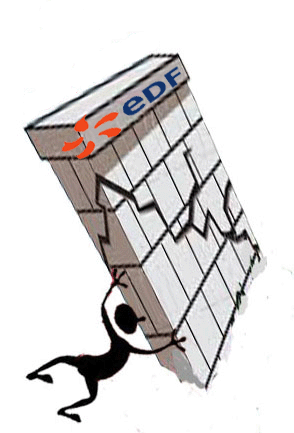
Macron government considering nationalising France’s debt-laden nuclear company EDF
| |||
France looking to nationalise debt-laden power company EDF https://www.power-technology.com/news/france-power-company-edf/ 13 Mar 22
The French Government, which holds an 84% stake in the $30bn energy giant, could retain domestic business but review overseas operations. The Government of France is reportedly weighing options to nationalise multinational electric utility company Electricite de France (EDF), reported Bloomberg.
Citing people familiar with this, the report said that the French Government is considering the option to reorganise the debt-laden business with a focus on nuclear energy production.
French officials have been carrying out talks with advisers on the option to acquire all the stake from EDF’s small stakeholders and delist the company from the stock exchange, people aware of the development said.
The French Government, which owns 84% of EDF, could retain the ownership of the company’s domestic business but review EDF’s overseas operations, the sources added.
If the idea to nationalise EDF is approved, then the move is expected to take place after the French Presidential election, which is slated to take place later this year.
The Government of France is reportedly weighing options to nationalise multinational electric utility company Electricite de France (EDF), reported Bloomberg.
Citing people familiar with this, the report said that the French Government is considering the option to reorganise the debt-laden business with a focus on nuclear energy production.
French officials have been carrying out talks with advisers on the option to acquire all the stake from EDF’s small stakeholders and delist the company from the stock exchange, people aware of the development said.
The French Government, which owns 84% of EDF, could retain the ownership of the company’s domestic business but review EDF’s overseas operations, the sources added.
If the idea to nationalise EDF is approved, then the move is expected to take place after the French Presidential election, which is slated to take place later this year.
However, a spokesperson for the French finance ministry said that the information is ‘false’ and the government isn’t working on such a project.
Last month, French Government announced it will offer $2.4bn to support EDF, as the group sees a hit to profits due to outages at several of its nuclear plants and the impacts of a government power-price cap.
Hopes for Bradwell nuclear power station now fading away like the ebbing tide
Calm After the Storm https://www.banng.info/news/regional-life/calm-after-the-storm/ 3 March 2022
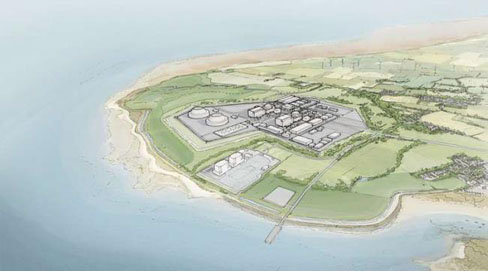
As we emerge from Covid a rather eerie silence descends over Bradwell B. After a tumultuous period of fighting the grotesque prospect of a colossal nuclear power station of Chinese design we are left wondering if the threat is ebbing away or will flow back like the returning tide.
Just two years ago and just before the first frightening lockdown, The Chinese operator launched its pre-Application proposals and the gross scale of the Bradwell B juggernaut was as unexpected as it was threatening. Despite lockdown the local reaction was immediate, widespread and determined. The proposals were summarily repelled and CGN declared a pause and retreated homeward to think again.
At least the China General Nuclear Power Corporation (CGN) has got part of what it came for. The regulators, Environment Agency and Office for Nuclear Regulation, have gifted approval for the Chinese Hualong One UK HPR1000 reactor design as ‘suitable for deployment in the UK’.
But, not necessarily at the Bradwell site. Although the ultimate prize for CGN is to build its reactors at Bradwell gaining the Generic Design Assessment (GDA) approval is not really much help. It doesn’t tackle the issues of cooling water, long-term storage of radioactive waste or the impacts of climate change in anything like the detail needed to gain approval for the Bradwell site. There are many obstacles that must be surmounted before permission to build can be granted.
Perhaps, as BANNG and other commentators have observed, CGN will have to be content with the consolation prize and seek its fortune elsewhere. That may not be in the UK since it is widely felt that the UK will prevent the Chinese state in the guise of CGN having a strategic role in developing sensitive UK infrastructure like a nuclear power station.
And so there is impasse. Opposed by the local Blackwater communities and shunned by the UK Government Bradwell B seems frozen in aspic. The best that may be said is that CGN may not walk away or be pushed immediately but the project is likely to languish in a state of indefinite inanition and will fade away like the ebbing tide.
Investors keen on renewable energy, while UK govt is trapping consumers into paying upfront for nuclear power plants to be built in a decade or more
Gordon Murray: LESLEY Riddoch’s article (The National, March 10)
is eminently sensible. The UK Government wants to build more large nuclear
plants such as Hinkley Point C. The problem for Boris is that investors are
not interested.
Centrica abandoned its plans to build new nuclear, Toshiba
exited the giant 3.3GW plant at Moorside, Cumbria and Hitachi scrapped the
£16 billion Wylfa plant on Anglesey. The current Hinkley development costs
are a whopping £23bn, almost double that projected in 2008 and set to rise
further.
The smart money is now with renewables where the returns are
higher, more immediate and less risky. Notwithstanding these setbacks, the
Conservative government, backed by Labour, is determined to plough on with
Sizewell C.
Their problem is who is going to fund it. The Government is not
keen to involve the Chinese who already get a return of 15% on their
investment at Hinckley Point C.
The Business Secretary Kwasi Kwarteng’s
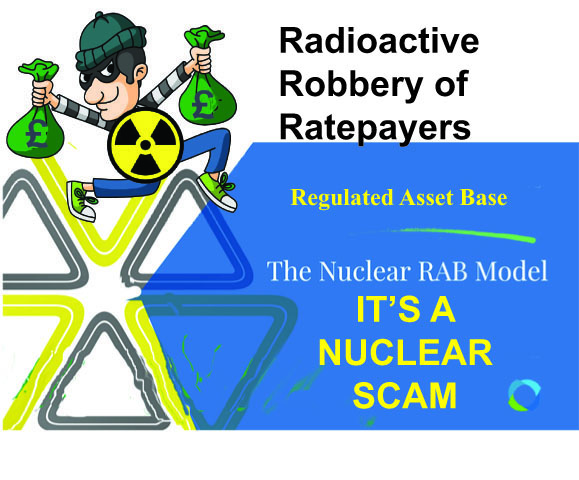
answer is the Regulated Asset Base (RAB) funding model whereby consumers,
that’s us, will pay the construction costs by increasing energy bills. It
is a fanciful type of nuclear subsidy where consumers pay for and
underwrite the construction costs for 10 years before a single watt of
power has been generated.
You have not misread this! The Government is set
to increase our energy bills even further at a time when gas/energy prices
are soaring, pushing even more people into fuel poverty. Perhaps their
spirits will be raised when they learn that RAB, according to Kwarteng,
will give private investors greater certainty through a lower and more
reliable rate of return.
An added bonus is that bill payers can expect
their bills to rise even further when the project is completed since we can
expect the energy strike price for nuclear to be twice that of renewable
– the cheapest form of electricity generation that is now subsidy
free-where consumers only start paying once they start to generate.
TheSmall Modular Reactor programme promises lower energy production costs but
there is no hard evidence to support this claim. What we will get for
certain is large numbers of these power plants spread all over the country
that will raise safety concerns over proliferation of nuclear materials and
terrorist attacks.
The National 12th March 2022
1 This Month





PLEASE OPPOSE HR 8255 AND S.3639 – bills would accelerate satellite deployment, with no environmental review or safeguards – https://ncstd5li.quorum.us/campaign/169331/
To see nuclear-related stories in greater depth and intensity – go to https://nuclearinformation.wordpress.com
-
Archives
- October 2026 (91)
- September 2026 (339)
- August 2026 (330)
- July 2026 (355)
- June 2026 (287)
- May 2026 (306)
- April 2026 (356)
- March 2026 (251)
- February 2026 (267)
- January 2026 (308)
- December 2025 (358)
- November 2025 (359)
-
Categories
- 1
- 1 NUCLEAR ISSUES
- business and costs
- climate change
- culture and arts
- ENERGY
- environment
- health
- history
- indigenous issues
- Legal
- marketing of nuclear
- media
- opposition to nuclear
- PERSONAL STORIES
- politics
- politics international
- Religion and ethics
- safety
- secrets,lies and civil liberties
- spinbuster
- technology
- Uranium
- wastes
- weapons and war
- Women
- 2 WORLD
- ACTION
- AFRICA
- Atrocities
- AUSTRALIA
- Christina's notes
- Christina's themes
- culture and arts
- Events
- Fuk 2022
- Fuk 2023
- Fukushima 2017
- Fukushima 2018
- fukushima 2019
- Fukushima 2020
- Fukushima 2021
- general
- global warming
- Humour (God we need it)
- Nuclear
- RARE EARTHS
- Reference
- resources – print
- Resources -audiovicual
- Weekly Newsletter
- World
- World Nuclear
- YouTube
-
RSS
Entries RSS
Comments RSS

