Boris Johnson all for nuclear power – but there are tensions with the Treasury about this
Boris Johnson will host a meeting with leaders from the nuclear power
industry today as part of efforts to boost domestic energy supplies. The
prime minister wants to remove the barriers to the raising of Britain’s
nuclear power output and sees the industry, along with renewables, as key
to reducing energy imports.
Today’s meeting with nuclear industry bosses
will inform the prime minister’s British Energy Security Strategy, which
has been hit by delays. It is unlikely to be unveiled until early next week
because of tensions with the Treasury and the prime minister’s travel
arrangements, which include a trip this week to a Nato summit in Brussels.
A government source said that the Treasury had delayed Johnson’s plans
for a significant increase in the number of nuclear power plants out of
concern about the feasibility and cost.
Times 21st March 2022
Boris Johnson ‘gung ho’ for new nuclear power, but Chancellor Rishi Sunak applying the brakes
Boris Johnson in ‘gung ho’ push for more nuclear power as energy
crisis starts to bite. Boris Johnson will on Monday sketch out to industry
bosses what one minister called his “gung ho” approach to boosting
Britain’s nuclear power sector, as officials draw up plans that could
target a fivefold increase in capacity by 2050.
The prime minister vowed
this month to make “a series of big new bets on nuclear power” and
government insiders say this could imply the construction of at least half
a dozen big new stations between 2030 and 2050.
Rishi Sunak, chancellor,
last week applied the brakes to Johnson’s plans to set out an energy
security strategy this week, amid Treasury fears about the cost to the
public purse. New nuclear power stations each require close to £ 20bn to
build and the industry is prone to cost overruns.
Sunak, who presents his
Spring Statement this week, is trying to hold down spending to give him
space to cut taxes. “We need to do more work on the nuclear strategy
before we press ahead,” said one ally of the chancellor. But one cabinet
minister said: “Boris has had something of an evangelical conversion, in
the past few months – he has been really gung-ho for nuclear.” The
energy strategy is due before the end of the month.
FT 20th March 2022
https://www.ft.com/content/17852c7c-fd92-40cb-b4ec-9767c6069677
Evangelical fervour for new nuclear power in UK’s Tory government
Wylfa on Anglesey could get three new nuclear reactors as the Prime
Minister is said to be ‘enthusiastic’ about accelerating plans in order
to reach the UK’s future net-zero targets and close an energy black hole.
US nuclear company Westinghouse has put together a consortium with
construction group Bechtel to revive plans for two nuclear reactors at
Wylfa since Hitachi, a Japanese conglomerate, abandoned their own plans in
2019.
A consortium led by Rolls-Royce also wants to place one of their own
‘small’ modular reactors on the site. According to the Financial Times,
Boris Johnson is “enthusiastic about Wylfa’s prospects,” with one
cabinet minister telling the newspaper he “has had something of an
evangelical conversion, in the past few months”.
Ynys Môn MP Virginia
Crosbie has also been enthusiastic about the plans, describing herself in
the House of Commons as “the Atomic Kitten”. However, Chancellor Rishi
Sunak is said to be less enthusiastic given the cost to the taxpayer of
financing such huge projects that would not be operational for decades,
with a target of meeting the UK Government’s ‘net zero’ goal by 2050.
Nation Cymru 21st March 2022 https://nation.cymru/news/wylfa-could-get-three-new-nuclear-reactors-as-boris-johnson-enthusiastic-about-accelerating-plans/
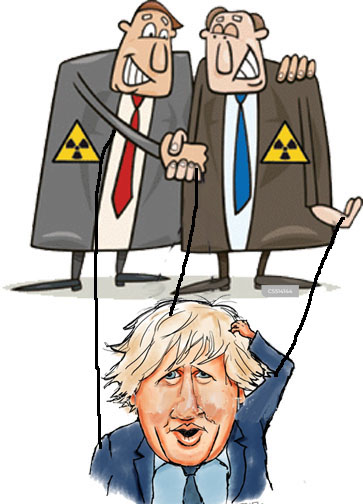
Boris Johnson in the grip of the nuclear lobby
Prime minister Boris Johnson is expected this week to meet the bosses of
leading power and energy development companies to discuss ways of
increasing Britain’s electricity and gas supplies.
Officials from EDF, developer of the proposed Sizewell C nuclear power plant, are expected to
be invited to the talks. Rolls-Royce and nuclear company Westinghouse are
also understood to have been invited. EDF and Sizewell C declined to
comment.
But Stop Sizewell C said the Suffolk power project was not the
solution to the energy crisis as it stepped up its campaign again at the
weekend by projecting messages onto Sizewell B on Saturday night.
East Anglian Daily Times 20th March 2022
https://www.eadt.co.uk/news/business/sizewell-projections-message-on-nuclear-power-8768518
Catholic bishops assert their opposition to nuclear weapons
Catholic bishops assert their opposition to nuclear weapons, THE organisation Justice & Peace Scotland have reaffirmed their opposition to nuclear weapons and have marked the 40th anniversary of the Scottish Bishops 1982 landmark statement entitled Peace and Disarmament.
A video, recorded in conjunction with Sancta Familia Media, features clergy, young people and laity reaffirming their opposition to nuclear weapons, and the reasons for their stance.
The video features Archbishop William Nolan (Glasgow), Archbishop Leo Cushley (Edinburgh), Bishop John Keenan (Diocese of Paisley), Bishop Brian McGee (Diocese of Argyll and the Isles) as well as young people from every Catholic diocese in Scotland…………. https://www.irishpost.com/news/catholic-bishops-assert-their-opposition-to-nuclear-weapons-231766
The energy crisis is now, new nuclear will be (at least) twenty years too late – UK’s Nuclear Free Local Authorities (NFLA)
The energy crisis is now, new nuclear will be (at least) twenty years too late
The Nuclear Free Local Authorities were dismayed to hear that the door of Number 10 will today once more be held open for guests from the nuclear power industry as Prime Minister Boris Johnson hosts a roundtable with prospective commercial partners, ahead of a new energy statement later this week.
Following Johnson’s proclamation that he will look to ‘place big new bets on nuclear’ and with one cabinet member allegedly describing the Prime Minister as ‘really gung ho for nuclear’, the participants are likely to meet with a firm ally. Government resolve will also be bolstered by the publication last week by the All-Party Parliamentary Group on Nuclear Energy of a ‘roadmap’ to make sites, money and a pared-down regulatory environment available to the nuclear industry to enable the development of a further 15 Gigawatts of new nuclear generating capacity by 2035 and 30 GW by 2050.
The NFLA believes that this hyperbole ignores the reality that any new nuclear projects will take too long, cost too much and have too many uncertainties to provide a meaningful solution to the energy and climate crisis that Britain faces now.
“Despite the need to generate ‘more electricity more greenly’ now, the Prime Minister seems determined to ignore the obvious solution that would result from a far greater and more urgent investment in renewable technologies and is instead taking us once more along the increasingly well-trodden and costly road to no-where that is new nuclear”, said Councillor David Blackburn, Chair of the NFLA, in response to the news.
“Every pound spent on nuclear is a pound denied to renewables. New nuclear has a lamentable history of being delivered at far greater cost and far more slowly than was at first predicted. New nuclear plants take decades to deliver with Hinkley Point C currently estimated to cost at least £23 billion. Renewables have been proven to deliver electricity far more cheaply, far more quickly and far more safely than new nuclear ever can – and renewable energy comes without the additional eye-watering cost of decommissioning nuclear plants and managing the legacy of radioactive waste for millennia that comes with it.”
The NFLA would like the government to change tack and look to harness natural energy sources to generate power to meet our needs, whilst saving our environment.
“The irony is that we already have the solutions to our energy and climate crisis to hand. When you live in a country that is surrounded by seas and has unpredictable weather it is surely a far safer bet to invest in tidal energy, hydro power, solar panels and wind turbines to draw energy from Mother Nature. The NFLA believes this, combined with investment in innovative energy storage solutions and in retrofitting our cold and draughty homes to a far higher standard to reduce energy use, could meet Britain’s energy needs, reduce fuel bills, and safeguard our planet in the here-and-now, not the never-never.”
Ends//…For more information please contact Richard Outram, Secretary, NFLA Email Richard.outram@manchester.gov.uk / Mobile 07583 097793
People Against Wylfa-B (PAWB) calls for sanctions on UK importing enriched uranium from Russia
PAWB has written to Ynys Môn MP, Virginia Crosbie, who is a member of the
All Party Nuclear Group in Westminster. We urge the group to call for
sanctions on raw and enriched uranium from Russia, and that such sanctions
are imposed internationally. Russia has 35% of the world market for
enriched uranium.
We also condemn in the strongest terms, the All Party
Nuclear Group’s totally reckless and irresponsible call for 30 Gigawatts
(30,000 Megawatts) of electricity through nuclear by 2050. This shows an
astounding economic and environmental illiteracy. This would be 3 times the
peak of electricity generated by nuclear power in Wales, England and
Scotland during the mid 1990s.
It appears Boris Johnson is listening too
much to this completely misguided nuclear cheerleading by the All Party
Nuclear Group. The Group totally ignores the challenges of climate change,
rising sea levels and the severe threats from storm surges to all coastal
nuclear sites in Wales, England and Scotland. Also, in the context of the
war in Ukraine where 15 operational nuclear reactors are potential dirty
bombs that could poison the whole of Europe with radioactivity, can the All
Party Nuclear Group and Boris Johnson answer how the British state can
justify building new nuclear reactors, obvious targets for hypersonic
missiles by potential enemies?
PAWB 20th March 2022
https://www.stop-wylfa.org/news/
Water supply problems for planned £20billion twin reactor on the Suffolk coast
Sizewell C developer EDF is being asked by government whether a temporary
desalination plant could last for the lifetime of the new nuclear power
plant if it is built. The public examination of the plans for the
£20billion twin reactor on the Suffolk coast was told a permanent water
supply for the proposed development had not yet been secured. However, a
temporary desalination plant would run during the construction of the
project.
Kwasi Kwarteng, secretary of state at the Department of Business,
Energy and Industrial Strategy, is now asking EDF what progress has been
made on securing a permanent water supply solution. But he also says: “The
applicant should confirm if it would be possible for the proposed temporary
desalination plant to permanently meet the full water supply demand for the
lifetime of the proposed development should no alternative water supply
solution be identified.”
East Anglian Daily Times 20th March 2022
https://www.eadt.co.uk/news/business/water-supply-sizewellc-questioned-by-government-8768432
A “no-fly zone” does not becalm the skies

Would put nuclear plants at even greater risk
A “no-fly zone” does not becalm the skies — Beyond Nuclear International 20 Mar 22 , Humanitarian crisis would be worsened if nuclear plants hit
Introduction: There are many views about what the next steps should be to address the ever greater humanitarian tragedy in Ukraine, but virtual unanimity in favor of an immediate end to the war. Ukrainian President, Volodymyr Zelensky, has made frequent pleas for a “no-fly zone.” But what would this mean?
On Saturday, a State Department spokesperson told Reuters that U.S. military support helps put Ukraine “in the strongest possible negotiating position.” But at what cost? ……………
For a ceasefire agreement to be reached, it will be necessary to secure Russian strategic interests. This means confirmation that Ukraine will never be a part of NATO and will be a neutral country. It also means clear pathways — carrots as opposed to only sticks — for sanctions to be lifted. There is no time to waste.
On March 17, US Representative Ilhan Omar said, “As we support Ukraine in their fight against Russia’s brutal invasion, we must avoid the knee-jerk calls that risk nuclear war. A no-fly zone is not simply declared, it must be militarily enforced. It would mean the beginning of World War III. We must reject this completely.” As Code Pink lays out below, a no-fly zone would likely escalate the war exponentially, with the US and NATO involved directly in aerial combat with Russia. That could rain down damage on nuclear power plants indiscriminately. None of the four nuclear power plants sites in Ukraine was built to withstand protracted bombardment.
While the Code Pink article does not address the specific risks to nuclear power plants should a “no-fly zone” be declared (unlikely at this time), it lays out both a preview of such an escalation and a plea for peace, alongside a perhaps uncomfortable short history lesson about the contribution of the US and NATO to the current crisis. While the solutions offered by Code Pink are their own, neither Code Pink nor Beyond Nuclear exonerates in any way the atrocities currently being committed against civilians in a country under invasion. But the precarious situation, poised for a potential escalation — rather than cessation — of war, points up once again the extreme liabilities of nuclear power plants, whose dangers are unequalled by any other power source.
By Medea Benjamin and Code Pink
Ukrainian President Volodymyr Zelensky just addressed both chambers of Congress. He asked for a no-fly zone — a situation in which U.S. fighter jets would shoot down Russian planes — and for MiG-29 fighter jets to be transferred from Poland to Ukraine (the U.S. has so far declined to be a part of such a transfer as it would be received by Russia as U.S. combat entry into the war).
Following Zelensky’s address, President Biden approved $800 million in new aid for Ukraine, bringing the total U.S. assistance to Ukraine to $1 billion in just this past week, and will include Javelin anti-tank and Stinger anti-aircraft missiles.
Standing ovations, such as the one Zelensky just got from Congress, are great, but what Ukraine really needs is vigorous negotiations to reach a ceasefire deal. To this end, we are calling on the U.S. to enter the negotiations by outlining the agreements and compromises the U.S. should support. Add your name.
By breaking promises not to expand NATO into Eastern Europe, by placing offensive missiles in Romania and Poland that could reach Russia in minutes, by arming Ukrainian forces, by continuing to “modernize” the U.S. nuclear arsenal, and by withdrawing from key nonproliferation treaties, the U.S. exacerbated the conflict that led up to Russia’s invasion of Ukraine.
Russia must withdraw its troops and commit to respecting the sovereignty of Ukraine, but the United States must also be clear that it supports and is ready to commit to the following:
- Continued rejection of a no-fly zone over Ukraine;
- No NATO expansion;
- Recognition of Ukraine as a neutral country;
- An off-ramp for sanctions on Russia to be lifted;
- Support for an international security agreement to protect the interests of all people on the European continent to remain free from war and occupation;
- Support for Ukrainian demilitarization to the degree that missiles would be banned;
- Supply humanitarian aid to Ukraine and support Ukrainian refugees.
Beyond increased prices at gas stations, the war in Ukraine is resulting in a silencing of critical anti-war voices inside America. While mainstream U.S. media is providing only a narrow narrative on the war, social media platforms are increasing their censorship.
Along with asking the U.S. to join the war — a move that could mean a nuclear WWIII — Zelensky has been asking the U.S. to be more involved in the Ukraine-Russia negotiations.
On Saturday, a State Department spokesperson told Reuters that U.S. military support helps put Ukraine “in the strongest possible negotiating position.” But at what cost? ……………
For a ceasefire agreement to be reached, it will be necessary to secure Russian strategic interests. This means confirmation that Ukraine will never be a part of NATO and will be a neutral country. It also means clear pathways — carrots as opposed to only sticks — for sanctions to be lifted. There is no time to waste. https://wordpress.com/read/feeds/72759838/posts/3899932178
Shrouded in doubt: safety issues at Russian-occupied nuclear stations in Ukraine

Kate Brown and Susan Solomon: One thing nuclear power plants weren’t built to survive: War. Military strategists commonly target the enemy’s electrical grid. That’s a problem when combat is in a nuclearized country like Ukraine.
Inside the New Safe Confinement at the decommissioned Chernobyl nuclear power plant in Ukraine in 2021, The structure encloses the radioactive remains of the reactor that exploded in 1986. Russian
forces are now in control of the site. The day Russia invaded Ukraine, Russian forces took control of the decommissioned Chernobyl nuclear power plant.
A week later, flares from Russian artillery lit up the Zaporizhzhia plant; Ukrainian media reported that the Russian army had placed land mines around the plant’s perimeter and was stockpiling arms at both nuclear installations. The army is now pointed at yet another nuclear facility, the South Ukraine plant.
But Russia’s is the first invasion of a country that derives more than half its energy from nuclear power. It stands to reason that Russian generals will seek to capture all 15 active reactors in Ukraine. The Russian army appears to be using the nuclear installations as safe havens, calculating that the Ukrainians will not fire on them, but we can still expect plenty more fearful nights spent riveted to scenes of battles over huge concrete towers and rows of basins filled with radioactive spent nuclear fuel:
It turns out that reactor containment buildings have never been stress-tested for blows from heavy artillery or missiles. Even without a direct hit on a reactor, we are learning of the fragility of nuclear power plants. Normal oversight and operations have essentially been replaced by isolation and disorder.
Workers at Chernobyl have been on the job continuously for more than three weeks. They have no
clean clothes (important for nuclear workers), no real beds, no contact with family, no proper meals or rest.
At the Zaporizhzhia plant, according to a Ukrainian official, Russian soldiers have forced employees into
submission. Employee-hostages — exhausted, hungry and stressed — could make mistakes. So could the untrained Russian military personnel who aregiving the orders. Communication to these sites is largely cut off.
Independent oversight experts cannot enter to verify safe operations or deliver spare parts. Russian diplomats continue to enjoy a privileged role at the International Atomic Energy Agency, despite the war. We have to rely on what the IAEA and the Russian army tell us.
In the past, Soviet nuclear information services specialized in secrecy and mistruths. One of us, while
working on a history of Chernobyl, found that the IAEA had difficulty acknowledging the public health impact of the fallout from the 1986 explosion there. Russian information services again appear to be opaque and untrustworthy. If an accident occurs, we don’t have confidence that rescue squads and firefighters can get to captured nuclear installations to deal with infernos and injuries. Nor can we be sure that we will learn the full extent of the damage and spread of radioactive sources.
Washington Post 18th March 2022
https://www.washingtonpost.com/outlook/2022/03/18/chernobyl-zaporizhzhia-nuclear-plant-ukraine/
Zelensky bans 11 political parties, although no evidence linking any to Russian government
Zelensky Announces Ban on 11 Political Parties–At the onset of the Feb. 24 invasion, Zelensky signed a measure that established martial law and general mobilization. | 20 March 2022 | Ukraine President Volodymyr Zelensky announced a measure that bans 11 opposition political parties, alleging they have ties to Russia, he announced in a Telegram video posted on March 20. Zelensky also said “wartime exposes quite well the paucity of personal ambitions of those who try to put their own ambitions” or “their own party or career above the interests of the state,” according to a translation. The National Security Council agreed to suspend the parties, Ukrinform reported, citing Zelensky’s video address. The Ukrainian Ministry of Justice has been told to immediately take measures to ban those political parties, he said. Zelensky didn’t provide evidence that linked the 11 opposition parties to the Russian government.
EU seeks to boost stockpile of iodine pills and nuclear protective gear
EU seeks to boost stockpile of iodine pills and nuclear protective gear The war in Ukraine has prompted Brussels to speed up plans to improve bloc’s response in case of a nuclear incident Ft.com Andy Bounds in Brussels
Brussels has accelerated plans designed to improve the EU’s health response in case of a nuclear incident following Moscow’s invasion of Ukraine, according to EU officials. The European commission is seeking to encourage EU members to stockpile iodine pills, protective suits and other medicine………..
Earlier this month pharmacies in countries including Belgium, Bulgaria and the Czech Republic ran out of iodine pills after Russian forces targeted and damaged a Ukrainian atomic power station. The attack prompted warnings about the risks if a radioactive leak spreads across the continent. Such leaks release radioactive iodine, which concentrates in the thyroid gland when it is inhaled and can lead to cancer. Potassium iodine tablets saturate the gland with iodine, preventing the absorption of the radioactive material.
………….. European parliamentarians say HERA needs to move faster to keep pace with developments in Ukraine. Véronique Trillet-Lenoir, an MEP for French president Emmanuel Macron’s En Marche party, said: “We need to draw strong lessons from Covid. We require specific measures for nuclear sites. We are not ready. We do not have the stocks.” …………… https://www.ft.com/content/bb5e6fde-7b08-41d9-a983-61be53cf2917
Putin set to hold nuclear evacuation drill; moved family to Siberia: Reports
Hindustan Times, 20 Mar 22, ……… Not much is known about Putin’s family members, but since the Russia-Ukraine war started, reports claimed Putin moved unidentified members of his immediate family to a hi-tech underground bunker, which is a whole underground city, in the Altai Mountains of Siberia.
Putin’s Doomsday plan
Kremlin has a Doomsday plan ready and it is no secret. For a nuclear conflict, if any, Russia has Doomsday planes that would be used by Putin and his closes allies to stay above the war. A sky bunker was also under the Doomsday plan but is believed to be not ready yet. All these have been reported by the Russian press earlier and the veracity remains questionable……… https://www.hindustantimes.com/world-news/putin-set-to-hold-nuclear-evacuation-drill-moved-family-to-siberia-reports-101647744184485.html
UK’s Nuclear All-Party Parliamentary Group (APPG) condemned for calling on govt to reclassify nuclear energy as ‘green’

CND condemns Westminster nuclear group’s call for nuclear energy to be re-classified as ‘green’ https://cnduk.org/cnd-criticises-westminster-nuclear-groups-call-for-nuclear-energy-to-be-re-classified-as-green/?fbclid=IwAR3H1WnXXIVuZY0u8smeKP097HzFohe3_Xgonazrwhe1X6sldhOzfhX12T0CND has condemned MPs and Peers from the Nuclear All-Party Parliamentary Group (APPG) for calling on the UK government to reclassify nuclear energy as ‘green’ so it can avail of the Green Finance Initiative.
The informal cross-party group included the demand as part of a five-point plan published this week, after Prime Minister Boris Johnson announced “big new bets on nuclear” as part of efforts to cut reliance on gas and oil imports from Russia .
The APPG is also urging that the government sets out key targets for nuclear energy ambitions such as 15GW of power generated by 2035, and at least 30GW generated by 2050, as well as fast-tracked decisions on both large-scale nuclear plants and small modular reactors (SMRs).
In addition to opening up nuclear energy to green financing, the group wants unused former nuclear sites to be made available for further nuclear development.
CND has long-pointed out that genuinely sustainable alternatives to nuclear power exist in renewable energy sources and calls on the government to invest in these technologies rather than diverting billions of pounds into subsidising the nuclear industry. By doing so, we could secure enough clean energy sources while creating thousands of new jobs
CND Vice-President and nuclear energy expert, Dr Ian Fairlie, said the APPG’s proposals for a nuclear bonanza were ill-considered: “The idea that nuclear power, in any shape or form, was a ‘green technology’ was absurd. Nuclear wastes last for millennia and the government has nothing but hazy ideas and paper plans for its nuclear waste, so these proposals for yet more nuclear power make rational people shake their heads in disbelief. In our view, nuclear power with all its problems is not just unsustainable, it is a veritable insult to any notion of sustainability. It is for this reason that several EU Member States have objected to current proposals to make nuclear power eligible under the EU’s Green Financing Framework.”
Danger of radioactive disaster at Chernobyl and other nuclear sites, with exhausted staff, and risk of loss of remote control
The staff, who are still at the Chernobyl nuclear power plant, came in on
February 23. The enemy has not allowed any opportunity to change the staff,
who are psychologically and physically exhausted due to the lack of
rotation and the constant pressure caused by armed people.
This can lead to loss of control over the safety of the facility and the inability to
respond to internal and external initial events such as fire, which in turn
can lead to severe radiation effects. In case of a complete power outage,
there is a risk of disabling the safety of important systems and equipment,
in particular: ventilation, heat dissipation, technological, and radiation
control systems.
The possibility of remote control over nuclear and
radiation safety indicators at storage facilities, the New Safe Confinement
facility, and other facilities will be lost. Operators will be unable to
control the level and temperature of water in spent nuclear fuel storage
pools. There are long-lived radionuclides in the spent nuclear fuel
storage, which in case of an accident can get into the Kakhovka Reservoir,
and further along the Dnipro river into the Black Sea. A huge area would be
contaminated by radiation for thousands of years. If there is an accident
with one power unit or one container for spent fuel, depending on the
direction of wind the radioactive cloud will affect Russia, Bulgaria,
Greece, Romania, and other border countries.
Time 17th March 2022
https://time.com/6158274/chernobyl-russia-ukraine-nuclear-disaster/
1 This Month





PLEASE OPPOSE HR 8255 AND S.3639 – bills would accelerate satellite deployment, with no environmental review or safeguards – https://ncstd5li.quorum.us/campaign/169331/
To see nuclear-related stories in greater depth and intensity – go to https://nuclearinformation.wordpress.com
-
Archives
- October 2026 (91)
- September 2026 (339)
- August 2026 (330)
- July 2026 (355)
- June 2026 (287)
- May 2026 (306)
- April 2026 (356)
- March 2026 (251)
- February 2026 (267)
- January 2026 (308)
- December 2025 (358)
- November 2025 (359)
-
Categories
- 1
- 1 NUCLEAR ISSUES
- business and costs
- climate change
- culture and arts
- ENERGY
- environment
- health
- history
- indigenous issues
- Legal
- marketing of nuclear
- media
- opposition to nuclear
- PERSONAL STORIES
- politics
- politics international
- Religion and ethics
- safety
- secrets,lies and civil liberties
- spinbuster
- technology
- Uranium
- wastes
- weapons and war
- Women
- 2 WORLD
- ACTION
- AFRICA
- Atrocities
- AUSTRALIA
- Christina's notes
- Christina's themes
- culture and arts
- Events
- Fuk 2022
- Fuk 2023
- Fukushima 2017
- Fukushima 2018
- fukushima 2019
- Fukushima 2020
- Fukushima 2021
- general
- global warming
- Humour (God we need it)
- Nuclear
- RARE EARTHS
- Reference
- resources – print
- Resources -audiovicual
- Weekly Newsletter
- World
- World Nuclear
- YouTube
-
RSS
Entries RSS
Comments RSS

