In the UK’s energy plan, the nation has been sold a dud
Jim Watson, director, UCL Institute for Sustainable Resources: Britain was
promised a bold and visionary energy plan. But we’ve been sold a dud.
Does it deliver what it says on the tin?
The answer is straightforward. It fails. At the heart of most definitions of energy security is reliability
of supplies for households and businesses. This is usually complemented by
a focus on affordability.
The new strategy does very little to deal with the immediate impacts of high fossil fuel prices.
While the government has announced some help for households via loans and a
council tax reduction, this is simply not enough. The energy price cap has
already risen to almost £2,000 a year and a further rise is due in the
autumn.
This comes on top of a wider cost of living crisis and high levels
of inflation.is available, but the price is too high for businesses to
function or households to keep warm. While more money to help people pay
their bills is needed, this must be accompanied by action to prevent these
acute impacts in future. This means making homes more efficient and
switching away from fossil fuels for heating. It is nearly a decade since
effective policies for home energy efficiency were cancelled and replaced
with new approaches, such as the green deal, which have failed
spectacularly.
As a result, the steady improvements in efficiency and
financial benefits to households have virtually stopped. A new programme of
home upgrades is urgently needed. This would not only reduce our dependence
on gas, but would also cut bills and carbon emissions.
According to many headlines, nuclear power is the “centrepiece” of the strategy. The
government’s plans are ambitious, but delivery will be difficult. New
nuclear plants will not have an impact for many years. The Treasury’s
fingerprints are visible in the careful caveats in the strategy, including
an insistence that new projects are “subject to a value for money and
relevant approvals”.
This reflects the long history of rising costs
within the nuclear sector, and the financial risks that consumers or
taxpayers will be exposed to.
In short, the government has pulled its
punches and avoided measures that would have a more immediate impact on
energy security – mainly by reducing the amount of energy we need to use.
Instead, it has produced a mixed bag of energy supply proposals. While some
are credible, a large nuclear power programme will require huge amounts of
political and financial capital. History suggests that this will be very
difficult to deliver.
Guardian 9th April 2022
In France, the nuclear waste keeps piling up: new reactors will add to the dilemma

France inches towards nuclear waste solution as more reactors planned
President Macron’s ‘French Nuclear Renaissance’ aims to provide energy independence and greener electricity for France – but the nuclear waste keeps piling up Connexion, By George Kazolias, 8 Apr 22,
Emmanuel Macron has announced plans to launch construction of six new nuclear reactors by 2050, along with studies for a possible eight further ones.
He also wants to prolong the life of existing reactors beyond 50 years in what he is calling the “French Nuclear Renaissance”.
Mr Macron’s vision to “take back control of [France’s] energy and industrial destiny” might be a winner with his electorate, but it clashes with the proposals of most of the left-wing presidential candidates, who want to reduce reliance on nuclear power.
New reactors will add to waste dilemma
Solutions for dealing with the waste already produced by existing power stations, however, are still struggling to get out of the starting blocks – and there is no plan for what would be done with waste from a potential 14 additional ones…………..At present, however, none of France’s nuclear reactor waste has been dealt with in a long-term way. All waste considered radioactive, almost two million cubic tonnes of it, is stored at surface level, in treatment centres and pools, or shallow repositories.
Some 60% of this comes from reactors and the rest is from medical, research, military and other sources.
The other waste, which includes items such as tools, clothing, mops and medical tubes, is not highly radioactive,
……… More problematic is what to do with France’s intermediate and high-level nuclear waste.
In 1998, a site near the village of Bure in the Meuse in north east France was chosen as the final storage place for most of it. It will be stored half a kilometre below ground in a vast network of tunnels and galleries known as a Deep Geological Repository (DGR).
The facility will be big enough for all the nuclear waste accumulated so far, but on-site studies, administrative procedures and opposition to the programme, including court cases and civil disobedience, have slowed its opening.
Deep underground storage could be three years away
The Bure DGR will store the waste in galleries carved out of 160-million-year-old compacted clay rocks. Known by its French acronym, Cigéo, the project currently holds 84% of the 665 hectares required to build the facility. The prefecture of the Meuse gave it a declaration of public utility (DUP) in December – a formal recognition that a proposed project has public benefits that must be obtained for most large construction and infrastructure projects before work can begin.
Once the Conseil d’Etat gives its consent, the prime minister can sign his own DUP. Andra will then have the power to get the rest of the property it needs.
In the meantime, work has continued with digging of wells and galleries to test reversible techniques of stocking waste for up to 100,000 years.
The prime minister is expected to sign off only after the presidential elections, but the final green light might be three years away as the rigorous and independent Nuclear Security Agency studies the permit request to move and store the spent nuclear fuel and other radioactive matter.
Plans are for existing not future waste
Activity at the Cigéo remains high, nevertheless. This year, a 1,700m² building, called The Eclipse, is being built to house companies working on underground trials.
A 100m-long cavity will also be dug to test technologies and conduct experiments. This is the length each cavity will have to be for intermediate-level waste, which is often solidified into concrete.
The nuclear authority is hoping to start storing this type of waste in 2025.
It is impossible to bury the high-level radioactive waste. This is turned into a glass-like substance, but then requires a cooling period of at least 50 years.
The clay storage facilities cannot handle temperatures above 90C.
Senator Sido said: “It is true that the most recent batches cannot be stocked in their present state. They are too hot and need a cooling-off period of several decades. But the first batches can be stocked now.”
The remaining high-level waste might not arrive before 2060. By then, France will have produced at least as much nuclear waste again. For that, it might have to create a new underground facility.
“As far as I know, there is no project in the pipeline for high-level and long-lived waste which will be produced in the future,” Mr Sido said. https://www.connexionfrance.com/article/Practical/Environment/France-inches-towards-nuclear-waste-solution-as-more-reactors-planned
UK government got its energy strategy so wrong
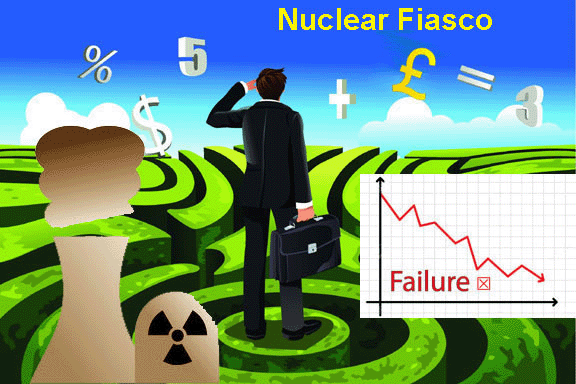
‘Major misjudgment’: how the Tories got their energy strategy so wrong. Analysis: betting big on nuclear, hydrogen, oil and gas while passing over energy saving measures, Johnson’s plan is a huge missed
opportunity.
Government industrial strategies are often derided as attempts to pick winners. The UK’s Conservative government has taken a different approach with its new energy strategy. In terms of dealing with the energybill and climate crises, it’s picking losers.
Nuclear power is the only major energy technology that has increased in cost in the last decade and
routinely suffers from massive time and budget overruns. Even Kwarteng acknowledges that France’s large nuclear fleet “cost a fortune”. The gamble Johnson is making, with taxpayers’ money, is that nuclear power is a more reliable wager to secure clean future power than renewables and fast-developing energy storage technologies. It’s a long shot.
Renewables and storage will develop much faster and get much cheaper due to the rapid learning that comes with small-scale technologies, unlike colossal projects
like nuclear.
Guardian 6th April 2022
Expert warning that UK’s nuclear plans mean that there won’t be room for all the new radioactive wastes.

 | |||
| to me |
Nuclear power plant plans could mean UK might run out of room for radioactive waste, says expert
https://inews.co.uk/news/nuclear-power-plant-plans-uk-could-run-out-room-radioactive-waste-1563015?ito=facebook_share_article-top&fbclid=IwAR2IxsDYG9O8oNJoXYfiKRKF18v2H-zI_l2NqC3VMWj5O8bGLZGYRMLQtss Current policy only allows for disposal of radioactive waste from 16GW of new nuclear capacity, far short of government’s new ambitions
By Madeleine Cuff, 8 Apr 22, Environment Reporter The UK could run out of room to store radioactive waste if the government presses ahead with plans to build eight new nuclear power stations across the country, a nuclear waste expert has warned.
Ministers today set out plans to accelerate the development of new nuclear power stations to bolster the UK’s energy security and push the country to net zero.
The long-awaited energy security strategy set out plans for trebling the UK’s nuclear generation, with up to 24GW of nuclear capacity planned for 2050.
But one of the country’s leading nuclear waste experts has told i the UK could “run out of room” to store the waste produced by so many plants.
Officials have spent the last 50 years hunting for a permanent way to dispose of radioactive waste produced by the UK’s fleet of nuclear plants.
In 2019 fresh search was launched to find a community willing to host the radioactive waste, which would be buried hundreds of metres below the Earth’s surface.
“The policy at the moment is that it can take all of the legacy waste – everything we have generated in the last 70 years, plus up to 16GW of new nuclear build,” said Professor Claire Corkhill, an expert in nuclear waste at the University of Sheffield.
But if the UK builds 24GW of new nuclear it could run into a storage problem, she warns. “My worry is that if we go to 24GW of nuclear energy then we might run out of room to store the radioactive waste,” she said. “We’ve jumped the gun a little bit in saying that we are going to have this much new nuclear energy without thinking really about whether we have got anywhere suitable to put the waste.”
She said it the government could look for a second storage site, but finding one could take decades.
UK’s new energy strategy will accelerate the development of nuclear power generation despite Treasury opposition
| As expected, the Strategy will detail plans to accelerate the development of nuclear power generation. It will target 24GW of installed capacity by 2050, meaning that nuclear will provide 25% of the UK’s electricity demands by mid-century. The Government has stated that it will support the delivery of up to eight large plants this decade, including Wylfa, Hinkley Point C and Sizewell C. It will also support small modular reactors (SMRs). It has been reported that Johnson has pushed hard for these targets on nuclear, despite opposition from the Treasury. Edie 6th April 2022 https://www.edie.net/energy-security-strategy-uk-targets-95-low-carbon-electricity-mix-by-2030-but-will-increase-oil-and-gas-production/ |
People Against Wylfa B (PAWB) to protest against plan for nuclear reactor on Anglesey island

An anti-nuclear campaign group are to protest outside the office of Ynys
Môn’s MPs over plans to build a new nuclear power plant on the island.
The UK Government this morning confirmed its intention to push ahead with a
nuclear project at the Wylfa site on the island of Anglesey. People Against
Wylfa B (PAWB) said that the UK’s energy needs could be met with
renewable energy and that ministerial claims that nuclear was necessary to
support weather-dependent renewables was “simply not true”.
Ynys Môn’s MP who has described herself as an ‘Atomic Kitten’ has been a
persistent advocate of a new nuclear plant on Anglesey.
A spokesperson for PAWB, Neil Crumpton, however said that the Prime Minister should not be
“gung ho” about nuclear power. “It is a complex and radio-toxic
technology,” he said. “The UK should be showing the world how wind and
solar energy, when backed-up by hydrogen-fired power stations, would
provide reliable electricity to consumers no matter what the weather or
season. Nuclear baseload is not needed.
Nation Cymru 7th April 2022
Rosatom, Russia’s nuclear corporation, exports nuclear fuel to Finland and others – has not been sanctioned by USA and Europe
Rosatom, which is the world’s biggest exporter of nuclear reactors and maintains a near-monopoly over the fuel they use to generate electricity, hasn’t been sanctioned by the U.S. and Europe.
it’ll be “three to four years” before Russian fuel currently being used in Finland needs to be swapped out in full for new assemblies.
Europe’s other energy problem: relying on Russian nuclear fuel https://www.mining.com/web/europes-other-energy-problem-relying-on-russian-nuclear-fuel/ Bloomberg News | April 7, 2022 A day before Russia invaded Ukraine, it sent four highly-trained armed guards across the border on a special mission to deliver fuel to an aging nuclear power facility.

Reactors based on Soviet designs generate power across the former Cold War bloc, accounting for more than half of all electricity in Ukraine and around two-fifths in a swath of territory arching from Finland to Bulgaria. So the fuel shipment was routine enough — until President Vladimir Putin ordered his army to war.
Russia and Ukraine agree the small security detachment arrived by train on Feb. 23 and was present as technicians unloaded a new batch of fuel rods at the Rivne Nuclear Power Plant 340 kilometers (210 miles) west of Kyiv. They differ wildly over what happened to the so-called Atomspetstrans guards as fighting began.
Ukraine told the International Atomic Energy Agency last week that they were disarmed and subsequently refused to return home. The Kremlin accused Kyiv of taking the four employees of state-owned Rosatom hostage. The IAEA is assessing the situation as it prepares to return monitors to Ukraine.
The incident was just one nuclear flashpoint of a war that’s being fought amid a fleet of operating reactors as well as the entombed site of the world’s worst atomic accident at Chernobyl.
But it also highlights another looming energy challenge for leaders on Moscow’s European periphery even as the continent moves to bar more Russian fossil fuels: how to cut their reliance on nuclear trade with a heavily-sanctioned Russia that many in the region want to further isolate.
“Countries are taking it a lot more seriously because of the situation,” top U.S. nuclear official Bonnie Jenkins said in an interview last month. “They are aware of their dependence.”
Rosatom, which is the world’s biggest exporter of nuclear reactors and maintains a near-monopoly over the fuel they use to generate electricity, hasn’t been sanctioned by the U.S. and Europe.
Non-proliferation experts have warned that doing so could boomerang back by coaxing more countries to enter fuel markets. U.S. officials said last month sanctions would have to be carefully calibrated to avoid damaging allied economies, as well as other U.S. diplomatic efforts, like the nuclear negotiations with Iran. Those talks foresee continued supply of fuel to the Persian Gulf country’s Russia-built reactor.
For Moscow, atomic exports remain a key geopolitical lever, and it’s using state financing to expand Rosatom’s reach with new units in China, India, Iran and Turkey, none of which have enforced war-penalties so far imposed on Russia.
Nuclear fuel differs from commodities like gas or coal because it requires precision-engineered assemblies that conform to licensing requirements set by safety regulators. Trying to cut ties prematurely with Russia could imperil electricity supplies for almost 100 million Europeans in countries that rely on nuclear plants as their biggest source of clean energy.
Jenkins, 61, the U.S. State Department’s under-secretary for arms control and international security, cautioned the switch could take years.
Still, said Liisa Heikinheimo, deputy director general for energy at Finland’s Economy Ministry, “it’s a fact that an alternative supplier is needed. It’s about to be a problem that’s soon reality.”
Finland, where Fortum Oyj operates two Soviet-built VVER reactors 90 kilometers east of Helsinki, has tried to find alternatives to Russia. It contracted British Nuclear Fuel Ltd., now owned by Westinghouse Electric Co., in the 1990s but ultimately stuck with Rosatom’s competitive prices.
More recently, the U.S. Department of Energy and Ukraine worked with Westinghouse to dislodge Rosatom fuel from 15 operating reactors, which still supply more than half the country’s electricity after six weeks of war wrought billions of dollars in damages to infrastructure.
Fuel made by Westinghouse, owned by private-equity investors at Brookfield Business Partners LP, now generates power at six Ukrainian units, with engineers needing until mid-decade to supply the rest.
“Westinghouse started in Ukraine because of the government-to-government agreement with the U.S.,” said Jose Emeterio Gutierrez, the Spanish nuclear engineer who formerly led the company’s decade-long effort to compete with Rosatom. But nuclear-fuel market peculiarities, along with a Soviet technological legacy, makes diversification difficult, he said.
Few nations possess the vast infrastructure needed to convert and enrich uranium ore into metal, which then has to be engineered into ceramic pellets and inserted into zirconium fuel rods with a safety tolerance measured in millimeters. A catalog of international regulations ensures that material isn’t diverted for weapons.
Rising demand for stable energy supplies, along with the European Union’s green label on nuclear power, could help to speed up the process.
Slovakia, with four Russian-built units, pitched a fuel consortium last month to share costs. The U.S. is also involved, pledging last week to help the Czech Republic diversify fuel for its six Russian-designed reactors.
But moving away from Rosatom will require time, said Heikinheimo, who figures it’ll be “three to four years” before Russian fuel currently being used in Finland needs to be swapped out in full for new assemblies.
(By Jonathan Tirone, Kati Pohjanpalo and Jesper Starn, with assistance from Thomas Hall)
Expensive nuclear power push ignores chance to cut costs of UK’s electricity system
Energy strategy: expensive nuclear power push ignores chance to cut costs of UK’s electricity system
The Conversation, Furong LiReader in Electrical Systems, University of Bath, Nigel TurveyVisiting Senior Industrial Fellow in Electrical Engineering, University of Bath, 8 Apr 22,
”……………………… apart from a promised five-fold increase in solar power generation by 2035, the strategy sets no target for generating electricity from some of the country’s cheapest sources, like onshore wind.
The government may defend its decision to ramp up the production of nuclear power as support for a home-grown and reliable source of energy. But some of that hefty investment would be unnecessary if Britain reorganised its energy system to make the most of the nation’s abundant renewable electricity instead.
When the price of a commodity like a soft drink goes up, production can be ramped up fairly rapidly to respond to spot market conditions, which quickly lowers prices again. Building a new nuclear power plant or offshore wind farm is quite different, requiring major investment and the certainty that there will be a reasonable return on upfront investment from selling energy over 30 to 40 years.
In the UK, governments can intervene in the capacity market to ensure a secure electricity supply by paying for reliable sources, which provides the long-term certainty necessary to build sufficient generating capacity. Financial backing changes to reflect the state’s priorities, and the drive for eight new nuclear reactors is reported to cost the public £13 billion.
Building wind farms and nuclear plants is just the first step though. The speed at which they be can integrated into electrical networks and operated to be in tune with power, transport and heat demand is what will actually decide when energy prices stabilise………………..
How to get inflexible, low-carbon energy to homes and businesses reliably and cheaply is as important as building new, reliable sources. And on that count, making more effective use of renewable sources – and reducing energy demand overall – would mean the country could afford to build less nuclear power, which is one of the few low-carbon sources which hasn’t become substantially cheaper.
New technologies
One way to increase customer demand for renewable and low-carbon energy when it’s abundant and reduce it when generation is tight is to incentivise storage technologies.
For example, if electric vehicles are charged up when there is plenty of wind and solar power being generated, 40GW of offshore renewable energy would be enough to power the country’s entire vehicle fleet without any of it going to waste.
To help harmonise Britain’s energy demand with periods when renewable output is high, the government could invest in digital technologies such as smart meters and set up new tariffs which can send price signals to EV chargers. It could also invest in improving the short-term forecasting of solar and wind output. These changes would make distributors aware of customer needs and help customers alleviate stress on the system.
While electric vehicle batteries can manage the variability of renewable output, Britain’s energy system also needs fixed storage – like grid-scale batteries which, unlike the government’s favoured solution of hydrogen fuel, are capable of very fast response times to manage sudden changes……………………… https://theconversation.com/energy-strategy-expensive-nuclear-power-push-ignores-chance-to-cut-costs-of-uks-electricity-system-180365
Zaporizhzhia is a wake-up call demonstrating the vulnerability of nuclear plants to deliberate acts of war.
| Varrie Blowers, Secretary of BANNG discusses the implications of the war in Ukraine in the latest column for Regional Life, April, 2022. In the early hours of 4 March, fire was reported at Zaporizhzhia, the 6-reactor nuclear power station in Ukraine, Europe’s largest. The Russian army was carrying out a premeditated attack. A few days before, it had seized Chernobyl, the site in April, 1986 of the world’s worst nuclear accident……..to date. It was, mercifully, a training building that was on fire. Nonetheless, this attack on an active nuclear plant was unprecedented and in clear breach of the Geneva Conventions. But Russia was not deterred. Had there been a meltdown in a reactor or fire in the radioactive waste stores, the people of Ukraine would have been subject to a nuclear catastrophe. And the radioactive fallout of a nuclear incident of a magnitude worse than that of Chernobyl, would have had far-reaching and terrifying consequences. The incident shows for the first time the dangers of war in a nuclearised country. Nuclear plants do not seem to have been designed to cope with war. Nor can they just be switched off and abandoned. The workers at Zaporizhzhia, it has been reported, are being forced to work in conditions of exhaustion, hunger and stress – when mistakes could be made. While we hope never to experience such acts on our shores, there is the ever- present threat of terrorism and cyber-attack wreaking havoc on nuclear installations. Given what has happened, the Government should be disengaging from nuclear, not engaging in a gung-ho rush to build new plants, including Bradwell B. Chernobyl and Fukushima alerted the world to the dangers arising from nuclear accidents. Zaporizhzhia is a wake-up call demonstrating the vulnerability of nuclear plants to deliberate acts of war. BANNG 6th April 2022 https://www.banng.info/news/ukraine-nuclear-wake-up-call |
British government launches a new government body – Great British Nuclear.
A new government body, Great British Nuclear, will be set
up immediately to bring forward new projects, backed by substantial
funding, and we will launch the £120 million Future Nuclear Enabling Fund
this month. We will work to progress a series of projects as soon as
possible this decade, including Wylfa site in Anglesey. This could mean
delivering up to eight reactors, equivalent to one reactor a year instead
of one a decade, accelerating nuclear in Britain.
BEIS 6th April 2022
Britain’s ”underwhelming” energy plan – ‘Great British Nuclear, with no policies on saving energy, nor energy efficiency
The government announced that a new body called Great British Nuclear will also
be launched to bolster the UK’s nuclear capacity, with the hope that by
2050 up to 24 GW of electricity will come from that source – 25% of the
projected electricity demand.
It has said the focus on nuclear will deliver
up to eight reactors overall, with one being approved each year until 2030.
It also confirmed advanced plans to approve two new reactors at Sizewell in
Suffolk during this parliament. Wylfa in Anglesey and Oldbury in Cumbria
(sic) have also been named as candidates to host either large-scale plants,
smaller modular nuclear reactors, or possibly both.
Environmentalists and many energy experts have reacted with disbelief and anger at some of the
measures in the strategy. They cannot believe the government has offered no
new policies on saving energy by insulating buildings. They say energy
efficiency would immediately lower bills and emissions, and is the cheapest
way to improve energy security.
A Downing Street source said the strategy
was now being see as an energy supply strategy. Campaigners are also
furious that ministers have committed to seeking more oil and gas in the
North Sea, even though humans have already found enough fossil fuels to
wreck the climate. There is a strong welcome, though, for the promise of
more energy from wind offshore with speedier planning consent.
The same
boost has not been offered to onshore wind. Ed Miliband, Labour’s shadow
climate change and net-zero secretary, said: “The government’s energy
relaunch is in disarray. “Boris Johnson has completely caved to his own
backbenchers and now, ludicrously, his own energy strategy has failed on
the sprint we needed on onshore wind and solar, the cheapest, cleanest
forms of homegrown power.
“This relaunch will do nothing for the millions
of families now facing an energy bills crisis,” he added. Liberal Democrat
leader Sir Ed Davey also described the plans as “utterly hopeless”, while
the SNP’s Stephen Flynn called it a “missed opportunity”. Dr Simon
Cran-McGreehin, head of analysis at the Energy & Climate Intelligence Unit,
told the BBC that he also felt “underwhelmed” following the announcement.
BBC 6th April 2022
Questions Abound About Bucha Massacre

The West has made a snap judgment about who is responsible for the massacre at the Ukrainian town of Bucha with calls for more stringent sanctions on Russia, but the question of guilt is far from decided, writes Joe Lauria. By Joe Lauria, Special to Consortium News 4 Apr 22, Within hours of news Sunday that there had been a massacre at Bucha, a town 63 kms north of the Ukrainian capital, the verdict was in: Russian troops had senselessly slaughtered hundreds of innocent civilians as they withdrew from the town, leaving their bodies littering the streets.
Unlike their judicial systems, when it comes to war, Western nations dispense with the need for investigations and evidence and pronounce guilt based on political motives: Russia is guilty. Case closed……………….
voices are now perilously calling for the U.S. to go to war with Russia over the incident. …….. Russia has categorically denied it had anything to do with the massacre.
Where to Start
If there were to be a serious probe, one of the first places an investigator would begin is to map out a timeline of events.
Last Wednesday, all Russian forces left Bucha, according to the Russian Defense Ministry.
This was confirmed on Thursday by a smiling Anatolii Fedoruk, the mayor of Bucha, in a video on the Bucha City Council official Facebook page. The translated post accompanying the video says:
“March 31 – the day of the liberation of Bucha. This was announced by Bucha Mayor Anatolii Fedoruk. This day will go down in the glorious history of Bucha and the entire Bucha community as a day of liberation by the Armed Forces of Ukraine from the Russian occupiers.”
All of the Russian troops are gone and yet there is no mention of a massacre. The beaming Fedoruk says it is a “glorious day” in the history of Bucha, which would hardly be the case if hundreds of dead civilians littered the streets around Fedoruk.
“Russian Defence Ministry denied accusations by the Kiev regime of the alleged killing of civilians in Bucha, Kiev Region. Evidence of crimes in Bucha appeared only on the fourth day after the Security Service of Ukraine and representatives of Ukrainian media arrived in the town. All Russian units completely withdrew from Bucha on March 30, and ‘not a single local resident was injured’ during the time when Bucha was under the control of Russian troops,” the Russian MOD said in a post on Telegram.
What Happened Next?
What happened then on Friday and Saturday? As pointed out in a piece by Jason Michael McCann on Standpoint Zero, The New York Times was in Bucha on Saturday and did not report a massacre. Instead, the Times said the withdrawal was completed on Saturday, two days after the mayor said it was, and that the Russians left “behind them dead soldiers and burned vehicles, according to witnesses, Ukrainian officials, satellite images and military analysts.”
The Times said reporters found the bodies of six civilians. “It was unclear under what circumstances they had died, but the discarded packaging of a Russian military ration was lying beside one man who had been shot in the head,” the paper said. It then quoted a Zelensky adviser, who said:
“’The bodies of people with tied hands, who were shot dead by soldiers lie in the streets,’ the adviser, Mykhailo Podolyak, said on Twitter. ‘These people were not in the military. They had no weapons. They posed no threat.’ He included an image of a scene, photographed by Agence France-Presse, showing three bodies on the side of a road, one with hands apparently tied behind the back. The New York Times was unable to independently verify Mr. Podolyak’s claim the people had been executed.’”
It is possible that on Saturday the full extent of the horror had yet to emerge, and that even the mayor was unaware of it two days before, though photos now show many of the bodies out in the open on the streets of the town, something that presumably would be difficult to miss.
In Bucha, the Times was close to the neo-Nazi Azov Battalion, whose soldiers appear in the newspaper’s photographs. In his piece, McCann suggests that Azov may responsible for the killings:
“Something very interesting then happens on [Saturday] 2 April, hours before a massacre is brought to the attention of the national and international media. The US and EU-funded Gorshenin Institute online [Ukrainian language] site Left Bank announced that:
‘Special forces have begun a clearing operation in the city of Bucha in the Kyiv region, which has been liberated by the Armed Forces of Ukraine. The city is being cleared from saboteurs and accomplices of Russian forces.’
The Russian military has by now completely left the city, so this sounds for all the world like reprisals. The state authorities would be going through the city searching for ‘saboteurs’ and ‘accomplices of Russian forces.’ Only the day before [Friday], Ekaterina Ukraintsiva, representing the town council authority, appeared on an information video on the Bucha Live Telegram page wearing military fatigues and seated in front of a Ukrainian flag to announce ‘the cleansing of the city.’ She informed residents that the arrival of the Azov battalion did not mean that liberation was complete (but it was, the Russians had fully withdrawn), and that a ‘complete sweep’ had to be performed.”
Ukraintsiva was speaking a day after the mayor had said the town was liberated.
By Sunday morning, the world learned of the massacre of hundreds of people. U.S. Secretary of State Antony Blinken said: “We strongly condemn apparent atrocities by Kremlin forces in Bucha and across Ukraine. We are pursuing accountability using every tool available, documenting and sharing information to hold accountable those responsible.” President Joe Biden on Monday called for a “war crimes” trial. “This guy is brutal, and what’s happening in Bucha is outrageous, and everyone’s seen it. I think it’s a war crime.”
The Bucha incident is a critical moment in the war. An impartial investigation is warranted, which probably only the U.N. could conduct. The Azov Battalion may have perpetrated revenge killings against Russian collaborators, or the Russians carried out this massacre. (Once again the Pentagon is dampening the war hysteria, saying it can’t confirm or deny Russia was responsible.)
A rush to judgment is dangerous, with irresponsible talk of the U.S. directly fighting Russia. But it is a rush to judgment that we are getting.
[Update: Satellite images, published after this article appeared by The New York Times, purportedly showing bodies strewn on a street in mid-March, should be considered by an impartial investigation. It cannot be considered at this point as conclusive evidence.]
Joe Lauria is editor-in-chief of Consortium News and a former U.N. correspondent for The Wall Street Journal, Boston Globe, and numerous other newspapers, including The Montreal Gazette and The Star of Johannesburg. He was an investigative reporter for the Sunday Times of London, a financial reporter for Bloomberg News and began his professional work as a 19-year old stringer for The New York Times. He can be reached at joelauria@consortiumnews.com and followed on Twitter @unjoe https://consortiumnews.com/2022/04/04/questions-abound-about-bucha-massacre/
Incompetence of Britain’s leaders, on energy policy
Jonathon Porritt: This is absolutely the right time for a new Energy
Strategy. Unfortunately, we’ve got absolutely the wrong politicians in
charge of it. The combination of Boris Johnson and Rishi Sunak all but
guarantees that the new Energy Security Strategy will fail on most counts.
– In Boris Johnson, we have a careless showman, drawn unerringly to
‘big ticket’ announcements, groomed by a nuclear industry that knows
exactly how to play to these personality defects. – In Rishi Sunak, we
have a man so detached from the reality of most people’s lives that the
prospect of five million UK citizens finding themselves in fuel poverty by
the end of the year means literally nothing.
Careless Johnson and callous
Sunak is a devastating double-act – with the inconsequential figure of
Kwasi Kwarteng lurking around to pick up the pieces.
Jonathon Porritt 5th April 2022
http://www.jonathonporritt.com/prospects-for-energy-security-marred-by-nuclear-fantasies/
The European Commission Platform on Sustainable Finance concludes that nuclear and gas power are not green

Nuclear and gas power ‘not green’, say EC experts https://environment-analyst.com/global/107948/nuclear-and-gas-power-not-green-say-ec-experts
EC Platform on Sustainable Finance delivers final report on extending sustainable finance rules across the whole EU economy, and includes a bombshell.
A European Commission (EC) expert group has made wide-ranging recommendations on extending the scope of the EU Taxonomy – the classification system that defines environmentally sustainable economic activities – across the European economy.
The EC Platform on Sustainable Finance’s final report will inform important new EU legislation, due in the autumn, which will in turn guide future policy and investment decisions.
The report concludes that gas and nuclear power cannot be described as ‘green’ under the taxonomy’s ‘do no significant harm’ (DNSH) rules – although leaves the final decision to the European Commission.
The expert panel’s final report considers 12 sectors, including manufacturing, transport, agriculture, fishing, building and disaster risk management. It is still finalising criteria for forestry and agriculture.
The report proposes a ‘traffic light’ system, listing red activities requiring urgent transition to avoid significant harm, amber activities that could more easily qualify for taxonomy-recognised investment, and green, low environmental impact (LEnvI) activities.
Welcoming the report, Sebastien Godinot, senior economist at WWF European policy office, commented: “The platform’s recommendations are a crucial step towards the much-needed ‘biodiversity taxonomy’, aimed at driving billions into nature-friendly activities.”
He added: “However, WWF is concerned that some criteria for critical sectors like forestry and agriculture are not [yet] included. The platform must publish recommendations for them no later than May.”
The EU Taxonomy, which came into force earlier this year, provides the technical underpinning for a number of interlinked EU regulations on sustainable finance products, disclosures and reporting. The taxonomy’s purpose is to increase financial flows towards green activities and to reduce green-washing by setting science-based criteria for performance. It is hoped that the taxonomy will become a global ‘gold standard’ for green finance.
The taxonomy is governed by the Taxonomy Regulation, which came into force on 12 July 2020 and identifies activities that improve or diminish six objectives (climate change mitigation, climate change adaptation, sustainable water resources, transitioning to a circular economy, pollution prevention and control and protecting biodiversity and ecosystems). Article 26.2(a) of this regulation requires the commission to report on applying its rules across the wider economy and to define sectors that have no environmental impact or are outside its scope.
At the same time as the taxonomy came into effect, the EC presented the Taxonomy Climate Delegated Act (TCDA). In response to restrictions to Europe’s natural gas supplies at the beginning of the year, the legislation was controversially complemented by a second Delegated Act, which defined nuclear and natural gas powered energy as ‘green’. This caused widespread objections from environmental and climate change groups.
The TCDA is being scrutinised by the European Parliament and the Council, before going back to the EC. The EC is expected to draft a new Delegated Act, building on the platform’s latest recommendations, in the autumn. This should resolve whether nuclear and gas-powered energy will count as sustainable for policy and investment purposes in the EU.
While asserting that nuclear and gas power are not green, the platform’s report gives the commission ‘wiggle room’ by suggesting a “systems-wide approach to the low-carbon transition”.
It says: “The extended Taxonomy framework would acknowledge the reasons why these activities are not green, explaining why, in some cases, [they] may be significantly harmful, but also showing that there is potential for valid and urgent transitions away from significantly harmful performance.”
Nuclear waste management: Is Finland’s Onkalo facility safe?
Nuclear waste management: Is Finland’s Onkalo facility safe? https://www.downtoearth.org.in/news/science-technology/nuclear-waste-management-is-finland-s-onkalo-facility-safe–82252 6 Apr 22,
The facility, set to begin operation in 2024, isn’t based on a foolproof concept
Finland, a nuclear energy champion, claimed it has figured out how to tackle one of the bigger issues with nuclear energy: Safely managing radioactive waste.
The country plans to store its nuclear waste in an underground facility called Onkalo. The structure, named after the Finnish word for “pit”, is a 500-meter-deep underground disposal facility designed to store used nuclear fuel permanently.
The deep geological repository is usually built in places containing a stable rock.Finland can become the first to commission a plant to permanently store spent nuclear fuel. The idea is to encase the waste in corrosion-resistant copper canisters. These will be further encapsulated in a layer of water-absorbing clay. The setup will be buried in an underground tunnel.
The facility is now equipped with 500 sensors to monitor the functioning of the entire system, according to VTT Technical Research Centre of Finland Ltd, a state-owned company and one of the contributors to the project.
“Monitoring brings evidence that the repository will be keeping the outside world safe from the nuclear fuel waste,” Arto Laikari, senior scientist from VTT, said. The state-owned company’s collaborator Posiva, a Finnish nuclear waste management organisation, has submitted the operating license for the facility and is awaiting approval.
In 2023, Posiva will do a final trial run of the disposal mechanism but without radioactive material, Erika Holt, project manager from VTT, told Down To Earth. It is expected to begin operations in 2024.
Problem of disposing nuclear waste
For years, the nuclear industry has been trying to find solutions to the waste problem. They are generated at various steps during the nuclear life cycle: Mining uranium ore, producing uranium fuel and generating power in the reactor.
The waste can remain radioactive for a few hours, several months or even hundreds of thousands of years. Depending on the extent of radioactivity, nuclear wastes are categorised as low-, intermediate- and high-level waste.
About 97 per cent of the waste is either low- or intermediate-level. The remaining is high-level waste, such as used or spent uranium fuel.
A 1,000-megawatt plant creates about 30 tonnes of high-level nuclear waste every year, according to the International Atomic Energy Agency.
“Even at low levels, exposure to this waste will be harmful to people and other living organisms as long as it remains radioactive,” Ramana explained.
Global endeavours
Some nations are storing waste on-site. But it carries the risk of radioactive leakage. In the United States, for instance, spent fuel is stored in a concrete-and-steel container called a dry cask, according to the US Energy Information Administration.
India and a handful of other nations reprocess about 97-98 per cent of the spent nuclear fuel to recover plutonium and uranium, according to data from the Bhabha Atomic Research Centre.
India also recovers other materials like caesium, strontium and ruthenium, which finds application as blood irradiators to screen transfusions, cancer treatment and eye cancer therapeutics, respectively, according to the research institute.
The remaining 1-3 per cent end up in a storage facility. India also immobilises the wastes by mixing them with glass, which is kept under surveillance in storage facilities.
But there are problems with this approach as well. Except for the plutonium and uranium, all the radioactive material present in the spent fuel is redistributed among different waste streams, Ramana said. “These enter the environment sooner or later.”
The plutonium and uranium intended for reuse in other nuclear reactors will also turn into radioactive waste, he added.
Nations like Finland, Canada, France and Sweden are also looking at deep geological repositories to tackle spent nuclear fuel wastes.
In January 2022, the Swedish government greenlit an underground repository for nuclear waste. Construction in Sweden will take at least 10 more years, Johan Swahn, director of MKG Swedish NGO Office for Nuclear Waste Review, a non-governmental environmental organisation, said.
Finland can share its experience with colleagues and partners worldwide, Holt said. “But each country and programme must have their own solutions. Worldwide, we work together to show nuclear energy (and the holistic views for responsible waste management) are viable for meeting CO2 targets,” she added.
Is the approach safe?
Experts associated with the project said that 40-years of theoretical and lab-based studies suggest that the geological repository is safe.
The bedrock provides a natural barrier to protect from radioactive release to the environment, such as water bodies and air, Holt explained.
The use of clay and copper provides a protective layer to ensure no release due to extreme conditions like earthquakes.
But Ramana argues that theoretical safety studies are not foolproof. There are significant uncertainties stemming from various long-term natural processes. These include climate change and the unpredictability of human behaviour over these long periods of time, he added.
Besides, design failure could undermine claims about safety, the expert noted. For instance, a few scientists fear that copper canisters can become corrosive and crack.
Finland’s team chose copper because it corrodes slowly. But Peter Szakálos, a chemist at the KTH Royal Institute of Technology in Stockholm, is not quite sure.
In a 2007 study, Szakálos and his team observed that copper could corrode in pure, oxygen-free water. “It’s just a matter of time — anything from decades to centuries — before unalloyed copper canisters start to crack at Onkalo,” he told Science journal.
On February 14, 2014, radioactive materials such as americium and plutonium leaked out of the Waste Isolation Pilot Plant, a deep geological long-lived radioactive waste repository, following an accident. The facility dealt solely with a special class of wastes from nuclear weapons production.
“If a failure like this happened within two decades of opening the repository, what are the odds that such failures won’t happen over the millennia that these repositories [Finland’s Onkalo] are supposed to operate safely?”
Both the Finnish project and the Swedish decision are very important for the international nuclear industry because the latter can point to these facilities to prove the nuclear waste problem is solved, Swahn said. “But it is very uncertain whether copper as a container material is a good idea.”
The projects may still fail as the understanding of how copper behaves in a repository environment is still developing, the expert added.
1 This Month





PLEASE OPPOSE HR 8255 AND S.3639 – bills would accelerate satellite deployment, with no environmental review or safeguards – https://ncstd5li.quorum.us/campaign/169331/
To see nuclear-related stories in greater depth and intensity – go to https://nuclearinformation.wordpress.com
-
Archives
- October 2026 (91)
- September 2026 (339)
- August 2026 (330)
- July 2026 (355)
- June 2026 (287)
- May 2026 (306)
- April 2026 (356)
- March 2026 (251)
- February 2026 (267)
- January 2026 (308)
- December 2025 (358)
- November 2025 (359)
-
Categories
- 1
- 1 NUCLEAR ISSUES
- business and costs
- climate change
- culture and arts
- ENERGY
- environment
- health
- history
- indigenous issues
- Legal
- marketing of nuclear
- media
- opposition to nuclear
- PERSONAL STORIES
- politics
- politics international
- Religion and ethics
- safety
- secrets,lies and civil liberties
- spinbuster
- technology
- Uranium
- wastes
- weapons and war
- Women
- 2 WORLD
- ACTION
- AFRICA
- Atrocities
- AUSTRALIA
- Christina's notes
- Christina's themes
- culture and arts
- Events
- Fuk 2022
- Fuk 2023
- Fukushima 2017
- Fukushima 2018
- fukushima 2019
- Fukushima 2020
- Fukushima 2021
- general
- global warming
- Humour (God we need it)
- Nuclear
- RARE EARTHS
- Reference
- resources – print
- Resources -audiovicual
- Weekly Newsletter
- World
- World Nuclear
- YouTube
-
RSS
Entries RSS
Comments RSS

