Greenpeace maps Ukraine’s nuclear power risks
The extent of the nuclear threat posed by Vladimir Putin’s illegal
invasion of Ukraine is unprecedented, new Greenpeace International mapping
and technical analysis shows. Created with data from the Institute for the
Study of War and the Centre for Information Resilience among others, and
displaying the proximity of Russian troops and military hardware to each of
Ukraine’s 15 commercial nuclear reactors over time, the interactive map
provides a chilling interactive visualisation of the potential for nuclear
catastrophe at regular intervals since the bloody invasion began on
February 24.
Greenpeace 6th April 2022
” Renewable Energy Foundation (REF)” – strongly linked to anti-wind power lobby

Charity linked to UK anti-onshore wind campaigns active again. While the
name of the Renewable Energy Foundation (REF) suggests it is a charity
dedicated to promoting low-carbon electricity, it appears to spend most of
its time campaigning against onshore wind.
When it was founded in 2004,
with the TV personality Noel Edmonds as its chair, the organisation was
clear it wanted to fight against the “grotesque political push” for
onshore renewable energy in the UK. It styles itself on its website as “a
registered charity promoting sustainable development for the benefit of the
public by means of energy conservation and the use of renewable energy”.
However, many in the energy sector believe the charity to be full of
anti-wind lobbyists. In 2008, the REF had what it described as a
“dialogue” with the Charity Commission over whether it was violating
its charitable status by being too political in its campaigning. The
Charity Commission said it assessed the complaint relating to the REF’s
campaigning activities and determined there was no evidence that it was not
charitable, but also provided guidance about how to achieve its objectives
as an organisation.
The REF has strong links to a group accused of climate
science scepticism, the Global Warming Policy Foundation, started by the
former chancellor Nigel Lawson, who has denied global heating is a problem.
Prof Michael Kelly, a trustee of the REF also has a position on the board
of the GWPF. John Constable, an adviser to the GWPF, has been quoted as an
REF spokesperson and was previously its director of policy and research.
Constable answered the Guardian’s questions for this article on behalf of
the REF.
While the REF has been relatively quiet in recent years, growing
pressure on the government to support wind energy to help solve the energy
crisis seems to have led to it becoming more active again. In recent weeks,
the charity has provided anti-onshore wind research to the Telegraph and
Daily Mail. Colin Davie, a trustee of the REF, has appeared on Radio 4’s
Today programme to oppose onshore wind. Constable added that the REF had
“no blanket policy” on renewables – but that the charity did not see
them as a large part of the net zero strategy. He added: “Each proposal
must be judged on its own merits, and providing that local environmental
concerns offer no obstacle, niche applications may be suitable, as they may
be for all renewables.”
Guardian 5th April 2022
Over 70 Russian soldiers suffering from radiation exposure at Chernobyl nucler site
| Over 70 Russian soldiers exposed to radiation at Chernobyl: Ukraine, KYODO NEWS 6 Apr 22, – About 75 Russian soldiers are receiving medical treatment in Belarus after being exposed to radiation during their temporary control of the Chernobyl nuclear power plant in Ukraine, according to Ukraine’s Energy Minister German Galushchenko. Galushchenko said in an online interview Tuesday that the troops apparently suffered from radiation after digging around the grounds of the plant, the site of a 1986 disaster, to defend themselves from the Ukrainian military.The troops were affected “very heavily and are in a very difficult situation and now (being treated) in clinics” in Belarus, Galushchenko said, citing information made available. “I can’t imagine you could order someone to dig into” areas contaminated with “the high level of radiation with signs saying ‘Don’t come in. Don’t stay near,'” he said, speaking in English.”They’re soldiers, and they just follow the orders.”Galushchenko said Ukraine has regained complete control of the nuclear power plant…………….. https://english.kyodonews.net/news/2022/04/33e77e951e22-over-70-russian-soldiers-exposed-to-radiation-at-chernobyl-ukraine.htm |
Uzbekistan: Nuclear deal with Russia still on the table despite sanctions
Uzbekistan: Nuclear deal with Russia still on the table despite sanctions, eurasianet, Even if Rosatom is not targeted by sanctions, its future projects could still be affected. Apr 6, 2022 When Uzbekistan fired the starting pistol four years ago on plans to go nuclear as a way to address the chronic energy shortages that plague it every winter, the world was a different place.
Russian President Vladimir Putin was not an international pariah. And Shavkat Mirziyoyev, his Uzbek counterpart, was courting him as a guest of honor in Tashkent.
The high point of Putin’s visit was when he and Mirziyoyev symbolically inaugurated the start to a project to build an $11 billion nuclear power plant in an area just east of Bukhara. The work was to be done by Russia’s state-owned Rosatom, a commanding presence in the global nuclear power industry, and to be funded with loans from Moscow………
When Uzbekistan fired the starting pistol four years ago on plans to go nuclear as a way to address the chronic energy shortages that plague it every winter, the world was a different place.
Russian President Vladimir Putin was not an international pariah. And Shavkat Mirziyoyev, his Uzbek counterpart, was courting him as a guest of honor in Tashkent.
The high point of Putin’s visit was when he and Mirziyoyev symbolically inaugurated the start to a project to build an $11 billion nuclear power plant in an area just east of Bukhara. The work was to be done by Russia’s state-owned Rosatom, a commanding presence in the global nuclear power industry, and to be funded with loans from Moscow.
…………………… “It is absolutely the case that projects that have not yet been completed or that still are in the design stages are extremely vulnerable to sanctions difficulties and interference, even if Rosatom is not itself presently subject to such sanctions,” Richard Nephew, the director of the International Security Initiative at Columbia University’s Center on Global Energy Policy, told Eurasianet by email. “Sanctions targeting financial transactions, technology transfers and the like will all undermine efforts to engage in and complete such projects.”
While there are clear risks to proceeding with the project, there are risks to scrapping it, too.
Aside from the certainty that cancellation would antagonize a belligerent Russia, finding a new partner to build a plant that Mirziyoyev said in 2018 would be completed within a decade would take time.
So is building the Russo-Uzbek nuclear power station still viable?
“Possibly, though given the long lead times required to develop and implement nuclear reactor projects, by the time such a project were to begin, it could be covered by sanctions,” said Nephew. “In general, it would not be advisable to start development of such projects now, given this risk.” https://eurasianet.org/uzbekistan-nuclear-deal-with-russia-still-on-the-table-despite-sanctions
Ensuring radiation protection: European Commission takes Portugal to Court to guarantee citizens’ protection from ionising radiation-exposure
Ensuring radiation protection: Commission takes Portugal to Court to guarantee citizens’ protection from ionising radiation-exposure risks https://ec.europa.eu/commission/presscorner/detail/en/IP_22_2215
The Commission is taking legal steps to ensure the protection of citizens, workers and patients against the dangers arising from exposure to ionising radiation. Today, the Commission decided to refer Portugal to the Court of Justice of the European Union for failing to fully transpose the EU’s revised Basic Safety Standards Directive (Council Directive 2013/59/Euratom) into national legislation.
Member States were required to transpose the Directive by 6 February 2018. The Commission has been providing continuous support to the Member States to properly transpose the rules. In November 2019, the Commission sent a reasoned opinion to Portugal requesting it to notify to the Commission all of its transposition measures for the Directive. Since then, Portugal has notified additional transposition measures, but has not yet established a national action plan addressing long-term risks from exposures to radon, as required by the Directive. Therefore, the Commission is referring Portugal to the Court of Justice today.
Background
The Euratom Treaty provides the Commission with the legal basis to establish basic safety standards to protect the health of workers and the general public against dangers arising from ionising radiation. Once fully implemented, the Basic Safety Standards Directive will ensure the highest level of radiation protection of workers, patients and the general public across the EU.
The Directive, which was first adopted in 1959, sets out the requirements on emergency preparedness and response in case of radiological emergency, and provides for radiation protection education, training and provision of information to the public, among others. Emergency preparedness and response provisions were strengthened following the Fukushima nuclear accident in Japan in 2011. The latest revision from December 2013 took account of the scientific and technological progress since the 1990s, and consolidated five earlier legal acts into a single piece of legislation.
Chancellor Olaf Scholz reiterated Germany’s determination to close down all nuclear power stations
Scholz Shoots Down Appeal to Reverse Germany’s Nuclear Exit, Bloomberg, German Power Sources, Michael Nienaber and Arne Delfs, 6 April 2022,
Chancellor Olaf Scholz reiterated his opposition to reversing Germany’s exit from nuclear power to help cut reliance on Russian energy, saying the technical challenges would be too great.
Germany is rushing to end its heavy dependence on Russian fossil fuels following the invasion of Ukraine but the process has been complicated by the decision by former Chancellor Angela Merkel’s previous government to shut down the country’s nuclear power plants. The move was prompted by the disaster at Fukushima, Japan in 2011 and the remaining three reactors are due to go off line this year.
Does EDF really need even more subsidies for Sizewell C nuclear project?
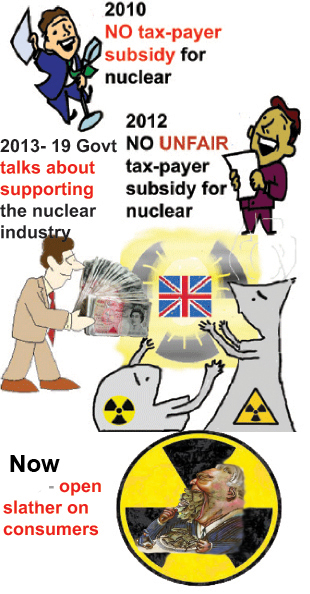
By doing so, our beloved leaders are ensuring
that Sizewell C will now have subsidised development, subsidised
construction, subsidised power production and subsidised waste management,
for a project still being run by Europe’s most subsidised company,
Electricité de France. Free markets? Don’t you believe it.
Does EDF really need even more subsidies for Sizewell C?even more subsidies for Sizewell C? Under new
legislation, our normally parsimonious government has just earmarked a
further £1.7 billion towards meeting their (uncosted) promise to ensure
that another new nuclear fission power plant may possibly begin being built
before the next election.
By doing so, our beloved leaders are ensuring
that Sizewell C will now have subsidised development, subsidised
construction, subsidised power production and subsidised waste management,
for a project still being run by Europe’s most subsidised company,
Electricité de France. Free markets? Don’t you believe it.
Electrical Review 6th April 2022 https://electricalreview.co.uk/2022/04/06/does-edf-really-need-even-more-subsidies-for-sizewell-c/
 | |||
Ukraine is ground zero for the expansion of the U.S.-Russia proxy war, (and the war industry is jubilant)

This six-week war surely has left the war industry jubilant. In Washington, Biden recently proposed what would be the largest U.S. “defense” budget in history, more than $813 billion.
The U.S. Has Its Own Agenda Against Russia Ukraine is ground zero for the expansion of the U.S.-Russia proxy war. The Intercept, Jeremy Scahill, April 2 2022 Ever since Vladimir Putin launched his invasion of Ukraine, there has been an unprecedented cohesion of messaging emanating from the U.S. government, its NATO and other European allies, and large segments of the Western media establishment. As massive quantities of weapons pour into Ukraine, there has been consistent media and political agitation for President Joe Biden and other Western leaders to “do more” or answer for why they are not further escalating the situation, including through the imposition of a no-fly zone.
The White House smells Putin’s blood in the waters of his disastrous invasion. The flow of weapons, the sweeping sanctions, and other acts of economic warfare are ultimately aimed not just at defending Ukraine and making the regime pay for the invasion in the immediate present, but also setting in motion its downfall. “For god’s sake, this man cannot remain in power,” Biden said during his recent visit to Poland. The White House sought to walk back the line and clarify that it did not constitute a change in policy but was merely an expression of the president’s righteous anger. The kerfuffle over what Biden really meant is less important than the very public actions of the U.S. and its allies.
It should not be assumed that the strategies and actions being employed by Washington and its allies in their proxy war against Moscow will always be in the best interest of Ukraine or its people. Likewise, Ukraine’s calls for military support and action from the West — however justifiable and sincere they are — may not be in the best interest of the rest of the world, particularly if they increase the likelihood of nuclear war or World War III. The desire to avoid this scenario by advocating for a negotiated solution to the war that addresses Russia’s stated concerns or its rationale for the invasion is not a capitulation to Putin and it is not appeasement. It is common sense.
While the fate of Ukraine and the lives of its civilian population are evoked in calls for more escalatory action from the West, it is these very people who will suffer and die in large numbers every day the war drags on. Western media coverage is often crafted to portray only one outcome as acceptable: a decisive Ukrainian victory, in which the government of Volodymyr Zelenskyy emerges from the horrors of the Russian invasion in complete control of all of its territory, including Crimea and the Donbas region. Ukraine, as a free and independent state, should be free to join NATO, and Russia has no legitimacy in questioning the implications of such a move. Advocacy for accepting anything short of this outcome is a victory for Russia and therefore traitorous to even consider………………
The routine belligerence exhibited by countless politicians, pundits, and media figures about taking the fight to Putin in Ukraine is largely chickenhawkery. …………
when you listen to the fine details of Ukraine’s own negotiators and leaders, it’s clear that they understand that the war does not end with the swift annihilation of Putin, the downfall of Russia, or with a clean and complete Ukrainian retention of its territorial sovereignty. That’s why Zelenskyy’s government has acknowledged that the issue of NATO membership, a formalized neutrality status, and an internationally brokered process on the status of Crimea will all be on the table.
There has been much noise about Russia’s recent indications that it was drawing down its military actions in parts of Ukraine, particularly around the capital Kyiv. The U.S. and NATO have acknowledged a partial drawdown but asserted that Russian forces appear to be repositioning, likely for use in the east. Russia has also said as much itself. Moscow’s position is that “the main goals of the first stage of the operation have generally been accomplished.”
There is a peculiar dynamic surrounding the analysis of Putin’s comments on his intentions for Ukraine. He is accused of lying when his remarks undermine the U.S. narrative, but we are told to believe he is absolutely telling the truth when his pugnacious threats bolster the U.S. position.
Whether or not Putin intended to seize all of Ukraine and become an imperial occupier, he did seem to believe his invasion could cause the Ukrainian government to collapse and its leaders to flee in fear. That did not happen. Instead, U.S. and NATO-armed Ukrainian forces outside Kyiv have fought the Russian troops ferociously and inflicted significant losses against them on the battlefield. At the same time, by opening multiple fronts, Moscow forced Ukraine to defend vital territory, including its capital. This strategy exacted a tremendous human toll on the Russian military, but it did take some heat off Russian forces in the Donbas territories in the east, which Putin has cited as his territorial priority in the operation.
But the question of Putin’s original intent — to take Kyiv or to use that threat as a strategy to spread Ukraine’s defenses thin — is now largely irrelevant except in the rhetorical battlespace focused on Russian weakness, incompetence, or failure.
The most contentious issue in the negotiations to end the war will likely have little to do with NATO membership. Zelenskyy has already conceded that to end the war Ukraine will have to drop that ambition and adopt a neutral and nonaligned status, though he does want to continue the pursuit of joining the European Union. Russia will certainly oppose any attempts for Kyiv to win a backdoor “Article 5” status that could trigger defense of Ukraine by Western powers in cases of future military actions by Moscow. Ukraine has suggested that it would also want China and Turkey to be a part of such a guarantee, not just adversaries of Russia. There are indications that the U.S. doesn’t think the proposal is viable, and Britain’s deputy prime minister bluntly stated, “Ukraine is not a NATO member,” adding, “We’re not going to engage Russia in direct military confrontation.”
Based on the reports out of the recent negotiations in Turkey, it seems that the most incendiary questions will revolve around the breakaway republics in the Donbas region. Ukraine has effectively said it wants a return to the pre-invasion status quo, which would mean erasing the Putin-recognized declarations of independence from Donetsk and Luhansk. Russia, which is currently expanding its control over the Donbas and seizing more territory, is unlikely to agree. This dynamic more than any other could delay or block any meaningful resolution and would be a central focus in a potential summit between Zelenskyy and Putin.
Once there is a brokered agreement, the flow of Western weapons into Ukraine and Russian military support for the separatists will result in a constant state of war footing for many years to come. A cloud portending more fighting and bloodshed will remain hovering over eastern Ukraine. If U.S. and other NATO troops resume their training exercises in Ukraine, as Biden has indicated they should, this means that there will always be a risk of incidents that could quickly escalate.
This six-week war surely has left the war industry jubilant. In Washington, Biden recently proposed what would be the largest U.S. “defense” budget in history, more than $813 billion. Germany and other European countries are publicly committing to buying and selling more weapons and spending more on defense. NATO is raising the prospect of expanding its permanent military presence in Europe and Washington is reasserting its political dominance over Europe on security matters.
But despite the image of global unity of cause being promoted by the U.S. and its NATO allies, several large and powerful nations, including China, India, Indonesia, and NATO member Turkey, are not marching to Washington’s drumbeat — not in the proxy-war business and not in the policy of sanctioning and vilifying Russia.
The overt war in Ukraine will have to end at the negotiating table. But the proxy war is escalating and will have consequences that extend far beyond the current battlefield. https://theintercept.com/2022/04/01/russia-ukraine-proxy-war-washington-diplomacy/
Ending Ukraine’s suffering. The decision to negotiate this is up to Ukraine, not USA
|
Putin, The Nuclear Threat, And Ending The War: To Squeeze Or Not To Squeeze? Michael Krepon, Forbes, 4 Apr 22,
To squeeze or not to squeeze. That is the question that tries analytically minded souls…………..
………..The majority view among the punditocracy counsels a negotiated settlement. One concern is that if Putin feels cornered, he could do something everyone will regret — like using a nuclear detonation in war. Even if he doesn’t, the longer this war lasts, the more Ukrainian city blocks will be reduced to rubble.
………….most analysts argue that we ought to give Putin a face-saving exit, which means conceding Ukrainian territory to Russia. How much territory to concede would be a hard issue in any negotiated settlement.
………. the deciding vote on the question of to squeeze or not to squeeze belongs to the government and people of Ukraine. It’s their land, their casualty counts, and their cities. NATO is obliged to take its cues from Volodymyr Zelensky. https://www.forbes.com/sites/michaelkrepon/2022/04/04/putin-the-nuclear-threat-and-ending-the-war-to-squeeze-or-not-to-squeeze/?sh=51ec25776109
Elon Musk joins the frenzy for small nuclear reactors in Wales, despite local opposition to nuclear development.

A company backed by investor in Elon Musk’s businesses is the latest to
say that it wants to build a nuclear power plant in Wales. Last Energy is
now the third company that wants to build nuclear power plants in Wales,
having settled on a not yet named site within the country.
They would join a Rolls-Royce led consortium who have mooted Wylfa on Anglesey and
Trawsfynydd in Gwynedd as the locations of new modular reactors. US nuclear
company Westinghouse have also put together a consortium with construction
group Bechtel to revive plans for two nuclear reactors at Wylfa since
Hitachi, a Japanese conglomerate, abandoned their own plans in 2019.
According to the Sunday Telegraph, Last Energy’s plans are very similar
to those of Rolls-Royce. They want to build a first “mini-nuclear”
power plant in Wales by 2025, as part of a plan to spend £1.4bn on 10
reactors by the end of the decade. Elon Musk, who is the world’s richest
person with assets worth an estimated £220bn, said on Twitter last month
that he was keen on investing in nuclear energy.
More nuclear power at Wylfa is not without its critics with campaign groups CADNO and PAWB among
the local opposition. Writing for Nation.Cymru, Dylan Morgan of PAWB
(People Against Wylfa B) warned that “nuclear power is a dirty, outdated,
dangerous, vastly expensive technology which threatens both human and
environmental health”. “It would also steal much-needed resources from
renewable technologies which are cheaper, much quicker to build and more
effective to combat the effects of climate change.”
Plaid Cymru leader Adam Price, whose party currently controls Anglesey Council, also spoke out
against nuclear power last week, calling it “the wrong answer” to
Wales’ energy needs. “We do not support nuclear power. It’s the wrong
answer. Renewables absolutely is the way to go. And I fear that, you know,
nuclear power, very expensive and unnecessary distraction,” he said.
Ukraine planning to resume control of Chernobyl nuclear site, as Russians withdraw
The International Atomic Energy Agency (IAEA) has been notified by Ukraine
that it is examining the possibility to resume regulatory control of the
Chornobyl Nuclear Power Plant (NPP), after the withdrawal of the Russian
military from the site.
Ukraine also informed IAEA that it is also planning
to rotate staff members at the Chornobyl NPP but did not specify any date.
Last week, Ukraine told IAEA: “Russian forces were leaving the Chornobyl
NPP after controlling the site for five weeks.
The withdrawal was confirmed
by senior Russian officials at a meeting with Director General Grossi in
the Russian city of Kaliningrad on Friday morning. “Ukraine later told
the IAEA that while all Russian forces had left the NPP site, the situation
in the Exclusion Zone around the plant was unclear.
Power Technology 4th April 2022
Nuclear Free Local Authorities back international challenge to UK nuclear weapons policies in UN Human Rights Council
Nuclear Free Local Authorities have this week backed a challenge to the British Government’s nuclear weapons policies in the UN Human Rights Council.
The NFLA has joined with international partners in charging that the UK Government’s policy of retaining, and reserving the right to use, a nuclear weapons arsenal is in violation of the Right to Life, a right enshrined in Article 6 of the International Covenant on Civil and Political Rights (ICCPR), to which the UK is a signatory. The NFLA is a partner member of ICAN, the International Campaign to Abolish Nuclear Weapons.
“The destructive power of these weapons is truly frightening, and their primary targets are cities and their civilian populations,” said Councillor David Blackburn, Chair of the NFLA Steering Committee. “Any nation contemplating their use must realise that their victims would be millions of innocent men, women and children peacefully going about their daily lives. In no way can the possession or threat of use by any state be compatible with that state’s obligations under international law to maintain the right to life. The UK is such a nuclear weapon armed state and that is why the NFLA is backing this challenge.”
The report has been submitted to the Human Rights Council by the Basel Peace Office, in cooperation with other civil society organisations, as part of the UN periodic review of the obligations of the United Kingdom under international human rights law, including the ICCPR.
Russia has recently made nuclear threats to the USA and NATO if they intervene in the invasion of Ukraine, whilst in the past a British defence secretary threatened a pre-emptive strike on Russia. Such threats highlight the importance of addressing the risks associated with nuclear deterrence policies. Nine states continue to possess nuclear weapons and maintain the option of initiating nuclear war.
“In times of high tensions involving nuclear-armed and/or allied states, plans and preparations for the use of nuclear weapons elevate the risk of nuclear war which would be a humanitarian catastrophe, severely impacting rights of current and future generations,” says Alyn Ware, Director of the Basel Peace Office. “Compliance with the Right to Life with respect to nuclear weapons is therefore an urgent matter, impacting not the rights of all humanity and of future generations.”
The UK deploys about 160 nuclear warheads (40 on each of their 4 strategic nuclear submarines) which are ready to be fired at any time, including, according to a revised government policy, in response to threats from chemical and biological capabilities or emerging technologies that could have a comparable impact.
In 2018 the UN Human Rights Committee affirmed that the threat or use of nuclear weapons is incompatible with the Right to Life, and that signatories to the ICCPR have obligations to refrain from developing, acquiring, stockpiling and using them, and also have obligations to destroy existing stockpiles and pursue negotiations in good faith to achieve global nuclear disarmament.
he submission makes several recommendations to enable the UK Government to comply with its obligation to maintain the Right to Life. These include adopting no-first-use policies, cancelling plans to renew nuclear weapons systems, taking measures to phase out the role of nuclear weapons in their security doctrines and advancing at the 2022 Non-Proliferation Treaty Review Conference a goal for the global elimination of nuclear weapons by 2045, the 75th anniversary of the NPT.
The submission also highlights the connection between nuclear weapons and climate change, with a recommendation to the UK Government to re-allocate nuclear weapons budgets to renewable energy development and climate action financing.
If the UN Human Rights Council decides to pick up on the challenges and recommendations in the submission and direct these to the UK Government, they are required to respond.
To see the submission to the Human Rights Council please go to this link:
http://baselpeaceoffice.org/sites/default/files/imce/HumanRights/submission_to_the_human_rights_council_regarding_uk_nuclear_weapons_policies_and_practices_final_version_with_annex.pdf
UK government’s energy strategy relying on massive nuclear expansion will fail credibility test
The government is expected finally to publish its much-delayed energy
strategy review on Thursday. The review is urgently needed both to address
the soaring energy prices that are inflicting financial hardship on many
households but also to end Britain’s reliance on Russian oil and gas so
as to avoid funding Vladimir Putin’s war machine. The clear test of the
credibility of whatever the government announces must be whether and how
quickly it reduces Britain’s dependence on expensive hydrocarbons for the
bulk of its energy.
The chances of meeting that test look slim, given the
rifts within the government and Conservative Party that have so far held up
the review for more than a month. Bizarrely, Tory MPs have fought furiously
in favour of restarting fracking, which would do nothing to reduce
Britain’s reliance on hydrocarbons, while fiercely resisting any reversal
of the de-facto ban on new onshore wind farms, which would be by far the
quickest and cheapest way to bring new energy on stream.
Both would of course be difficult to deliver since they are beholden to local planning
decisions. But whereas polls indicate that the public is overwhelmingly
opposed to fracking, they reveal strong public support for onshore wind.
Indeed, a YouGov poll last year found that nearly 70 per cent of the public
would support onshore wind farms near where they live. Polls indicate that
support rises higher if it means cheaper energy for residents. A large
expansion of onshore wind ought to be a key feature of a credible strategy,
yet comments yesterday by Grant Shapps, the transport secretary, suggest
that opposition in cabinet rules this out.
On the other hand, an energy
strategy that rests upon a massively expanded role for nuclear risks
failing the credibility test. That’s not because there isn’t a role for
nuclear as a source of baseload electricity for when solar and wind
supplies are low. There is a strong case for expanding Britain’s nuclear
fleet of 11 reactors, all but one of which are due to be deactivated by
2030, with only one new one, Hinkley Point C, under construction.
The
problem is the same one that has dogged all recent efforts to expand the
nuclear fleet: vast costs of construction. The energy review needs to
contain realistic plans with deliverable timelines. Boris Johnson’s hopes
of delivering six or seven new nuclear power stations by 2050 look
implausible given that Britain has succeeded in starting construction of
one in the past 16 years and even that is nearly a decade behind schedule
and far over budget.
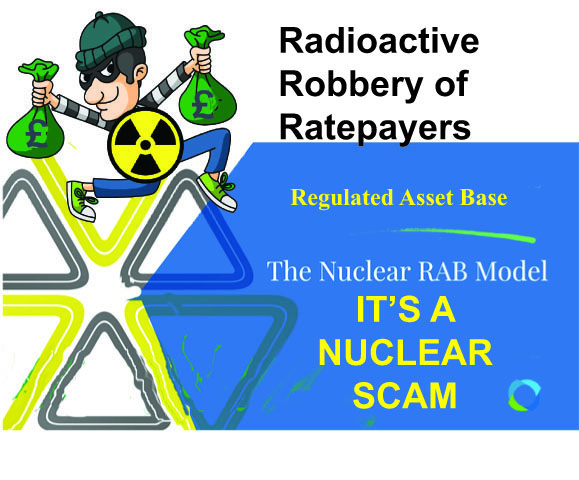
What’s more, under the government’s preferred funding model, construction costs would be passed on to consumers long before any electricity is delivered, further pushing up energy bills.
The review must therefore include plans to expand other sources of baseload,
including battery storage and carbon capture for gas-fired power stations.
Finally a credible strategy must include plans to reduce energy demand as
well as expand supply. The government needs to turbo-charge the drive to
improve home insulation, the switch to heat-pumps and the optimisation of
the energy network. A smart grid that allows differential pricing and
households to sell electricity from home solar panels and electric car
batteries could dramatically reduce energy supply requirements. Such plans
may lack the glamour of Mr Johnson’s fantasy of a floating wind farm in
the Irish Sea. But they would show that the government is serious.
Times 4th April 2022
https://www.thetimes.co.uk/article/the-times-view-on-britains-energy-strategy-power-play-p8g9hp0qp
Nuclear safety incidents in UK, as inspection numbers fall

Four nuclear safety incidents reported to ministers in 2021 as inspection
numbers fall. Incidents included a reactor shutdown in Lancashire, a fire
at Sellafield, and a package of radioactive material found in a London
street. Four nuclear safety incidents were reported to UK Government
ministers due to their severity last year, i can reveal, with experts
raising fears over the declining number of inspections.
In the most serious
safety breach, on 22 July, the Heysham One nuclear power station in
Lancashire had a complete loss of 400kV power after a National Grid
transformer failed. Both reactors tripped automatically and were cooled and
safely shut down, according to an Office for Nuclear Regulation (ONR)
report.
On 11 September, a package of radioactive materials was found in
the street by a member of the public after being lost in transit between
two London hospitals. The ONR said there was no risk to the public or the
environment.
Two incidents at Sellafield in Cumbria also met ministerial
reporting criteria under nuclear safety laws. An analysis of reports from
the Office for Nuclear Regulation (ONR) revealed the four incidents in
2021, which met ministerial reporting criteria under nuclear safety laws.
The overall number of Incident Notification Forms documenting security
issues at UK nuclear facilities was 368 in the first 10 months of last
year. This is 72 per cent higher than the 214 submitted in 2018. However,
the number of nuclear security inspections carried out by the ONR appears
to have fallen. Data shows there were 136 inspections up to 17 December
2021, compared with 169 in 2019. The Heysham One incident, which was stood
down after 16 hours, was rated as level 2 – the third lowest on the
International Nuclear Event Scale, which ranges from zero to seven. The
report said there were “no radiological consequences”.
iNews 4th April 2022
Kremlin condemns Polish comments on readiness to host nuclear weapons
Kremlin condemns Polish comments on readiness to host nuclear weapons , April 4 (Reuters) – The Kremlin on Monday condemned comments by the leader of Poland’s ruling party, who said Warsaw would be open to having U.S. nuclear weapons on its soil and would welcome a 50% increase in the number of U.S. troops in Europe.
Speaking to reporters on a conference call, Kremlin spokesman Dmitry Peskov said such a move would only lead to heightened tensions.
Jaroslaw Kaczynski, who heads the Law and Justice (PiS) party, said at the weekend that Poland would be open to having nuclear weapons stationed on its territory – but that this was not currently under consideration…………https://www.reuters.com/world/europe/kremlin-condemns-polish-comments-readiness-host-nuclear-weapons-2022-04-04/
1 This Month





PLEASE OPPOSE HR 8255 AND S.3639 – bills would accelerate satellite deployment, with no environmental review or safeguards – https://ncstd5li.quorum.us/campaign/169331/
To see nuclear-related stories in greater depth and intensity – go to https://nuclearinformation.wordpress.com
-
Archives
- October 2026 (91)
- September 2026 (339)
- August 2026 (330)
- July 2026 (355)
- June 2026 (287)
- May 2026 (306)
- April 2026 (356)
- March 2026 (251)
- February 2026 (267)
- January 2026 (308)
- December 2025 (358)
- November 2025 (359)
-
Categories
- 1
- 1 NUCLEAR ISSUES
- business and costs
- climate change
- culture and arts
- ENERGY
- environment
- health
- history
- indigenous issues
- Legal
- marketing of nuclear
- media
- opposition to nuclear
- PERSONAL STORIES
- politics
- politics international
- Religion and ethics
- safety
- secrets,lies and civil liberties
- spinbuster
- technology
- Uranium
- wastes
- weapons and war
- Women
- 2 WORLD
- ACTION
- AFRICA
- Atrocities
- AUSTRALIA
- Christina's notes
- Christina's themes
- culture and arts
- Events
- Fuk 2022
- Fuk 2023
- Fukushima 2017
- Fukushima 2018
- fukushima 2019
- Fukushima 2020
- Fukushima 2021
- general
- global warming
- Humour (God we need it)
- Nuclear
- RARE EARTHS
- Reference
- resources – print
- Resources -audiovicual
- Weekly Newsletter
- World
- World Nuclear
- YouTube
-
RSS
Entries RSS
Comments RSS

