Boris goes all out for UK nuclear
‘I do not think we should be building any new nuclear reactors until we have a geological disposal facility available.’ That applies to all scales of nuclear, SMRs as well as big plants, they all produce wastes.
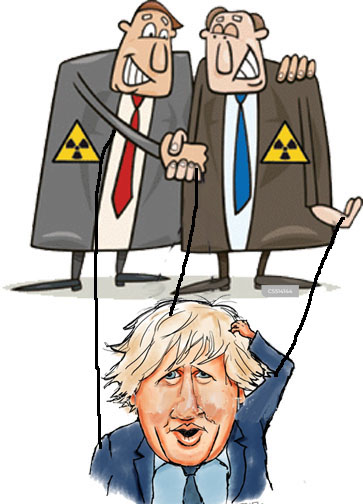
https://renewextraweekly.blogspot.com/2022/04/boris-goes-all-out-for-uk-nuclear.html Under the heading ‘Boris Johnson’s fixation on nuclear is a threat to Britain’s energy supply’, Times chief leader writer Simon Nixon said ‘Boris Johnson’s plans to build at least six or seven new nuclear power stations is the wrong strategy for meeting the government’s need to ensure the UK’s energy security, lower public bills and achieve its net-zero target. Britain’s track record on building nuclear power stations is almost as dire as its record in building garden bridges’.
Nevertheless, despite negative views like this, Boris ploughed on. Indeed he managed to turn this criticism around, asking ‘why have the French got 56 nuclear reactors and we’ve got barely six?.’ He said we needed ‘big ticket’ nuclear solutions and also looked to having Small Modular Reactors (SMRs) before 2030. Not everyone is convinced that SMR’s can deliver, but Johnson’s confidence in them may have been the result of a meeting with Last Energy, a US nuclear promoter backed by Elon Musk, which is pushing a simple fast-track mini PWR, at 20 MW, far smaller than the 470 MW Rolls Royce system. There was talk of 100s of units being deployed across the UK. Last Energy’s business credo ‘Innovate on the delivery model, not the reactor’, may have appealed to Boris.
However, on the renewables side, while he was still keen on offshore wind (‘Energy companies tell me they can get an offshore wind turbine upright and generating in less than 24 hours’), the prospects for on-shore wind, which had begun to look more promising, seem to have taken a hit in favour of more nuclear- on shore wind once again getting some Tory ‘eyesore’ backlash, despite it actually attracting 80% public support. The expansion of the ECO energy saving scheme was also hit, despite energy efficiency arguably being the cheapest option of all.
So when the new energy security strategy finally emerged it was not surprising that there was a commitment to 24 GW of nuclear by 2050, no new targets for on shore wind and very little on the energy savings side, just a £30m ‘heat pump investment accelerator competition’. But at least a 50 GW offshore wind target by 2030 was confirmed, with up to 5GW of it being floating systems, coupled with a doubling of the low-carbon hydrogen target to 10GW by 2030, with at least half being green hydrogen. However, on shore wind will only get limited support: communities can volunteer for a project (although they could have anyway) and possibly get cheaper power, but with no significant changes in planning rules. There will though be some PV planning rule changes to help solar expand- with an up to a five-fold increase in deployment expected by 2035. If achieved that would be a massive 70GW, although no target was specified.
Apart from the lamentable lack of support for on-shore wind and, even more provocatively, for energy saving, the nuclear expansion was the most controversial part. The strategy report says ‘a new government body, Great British Nuclear, will be set up immediately to bring forward new projects, backed by substantial funding, and we will launch the [already announced] £120 million Future Nuclear Enabling Fund this month. We will work to progress a series of projects as soon as possible this decade, including Wylfa site in Anglesey. This could mean delivering up to eight reactors, equivalent to one reactor a year instead of one a decade, accelerating nuclear in Britain’.
Why nuclear?
It’s hard to see why Johnson thinks a big nuclear push is needed, or a good idea- apart from catching up with France! A bit more credibly, the strategy report stresses the importance of energy independence, but the nuclear programme has of late been mostly based on imported (French) technology and expertise- as well as funding from overseas. It now looks as if he will no longer rely on China for any of this, but the new RAB funding scheme will allow nuclear plant developers like EDF to put a surcharge on UK power consumers bills to raise the necessary capital for construction in advance of any power being supplied. That may be independence of a kind, but the profits do still go abroad
And it will be a decade or more before any of the proposed new nuclear plants (at Sizewell and elsewhere) are running- assuming all goes well. So we will get hit with the costs now, or at least soon, but not get the benefits until far in the future. So much for helping to cut costs for hard pressed consumers
The energy independence idea is also not as urgent as it might appear. The UK does not import significant amounts of Russian gas, unlike Germany (and Austria), where admittedly things could get bad unless urgent action is taken. But they are doing that, Germany backing renewables even more strongly, and both still being opposed to nuclear. That choice has been reinforced by the war in Ukraine which has illustrated just how risky it can be to have nuclear plants in conflict zones. The possibility of terrorist drone attacks apart, the UK may not (yet) face risks like that, but its coastal plants will increasingly face risks from climate change driven sea level rises and storm surges.
One of the other key problems for nuclear has also been pointed up in response to the UK expansion plan – waste storage being a key one. Claire Corkhill, a professor of nuclear material degradation at the University of Sheffield said ‘I do not think we should be building any new nuclear reactors until we have a geological disposal facility available.’ That applies to all scales of nuclear, SMRs as well as big plants, they all produce wastes.
Overall, it does seem odd to be pushing nuclear so hard. For example, if it was really about an energy gap, it would be easy for renewables to fill it. RenewableUK says the UK could end its dependence on gas and replace it with renewable energy within the next 5 years – if the limit imposed on the amount of onshore wind was removed and budgets raised for deployment. Energy saving could do that too. If it was really about jobs, then, as the UKERC has recently pointed out, renewable energy can create at least 2 times more jobs than nuclear, while investment in energy saving can create 5 times as many. If it was really about variable renewables and grid balancing, well the last thing we need is more large inflexible nuclear plants. And if it was really about costs and consumer bills, then why go for nuclear, the most expensive option. If that sort of money was available, why not go for tidal lagoons and tidal current turbines?
However, all is not entirely lost. The 50 GW by 2030 offshore wind target is a significant one, as is the hoped for 5-fold by 2035 PV solar expansion – putting the 24 GW by 2050 nuclear target into some sort of perspective. But we don’t really need it. And judging by the gross completion problems with the EPRs in France and Finland, and the problems with China’s version of it, the UK’s new 8 plant nuclear plan, with its ‘one reactor per year’ average installation target, seems very unlikely to be realised.
All in all, the offshore wind and solar parts aside, not much of a viable security plan, and a bit thin in any case, with lots of targets but very little detail. Indeed, the Times leader (8/4/22) said ‘the number 8 appears to have been plucked out of the air’ and overall it was ‘little more than a glorified press release’, with the lack of effective commitment to energy saving making it ‘a cop out’. While Greenpeace said ‘the urgency of the climate crisis needed an urgent response. Sadly, the government’s energy security plan didn’t deliver.’ Not a lot of support then across the political spectrum.
Switzerland plans to bury spent nuclear fuel deep underground in clay
Straits Times SAINT-URSANNE, SWITZERLAND (AFP) 10 Apr 22, – Storing radioactive waste above ground is a risky business, but the Swiss think they have found the solution: Burying spent nuclear fuel deep underground in clay.
The Mont Terri international laboratory was built to study the effects of burying radioactive waste in clay which sits 300m below the surface near Saint-Ursanne in the northwestern Jura region.
The underground laboratory stretches across 1.2km of tunnels.
Niches along the way, each around 5m high, are filled with various storage simulations, containing small quantities of radioactive material monitored by thousands of sensors.
More than 170 experiments have been carried out to simulate the different phases of the process – positioning the waste, sealing off the tunnels, surveillance – and to reproduce every imaginable physical and chemical effect.
According to experts, it takes 200,000 years for the radioactivity in the most toxic waste to return to natural levels……..
Three prospective sites in the northeast, near the German border, have been identified to receive such radioactive waste.
Switzerland’s nuclear plant operators are expected to choose their preferred option in September.
The Swiss government is not due to make the final decision until 2029, but that is unlikely to be the last word as the issue would probably go to a referendum under Switzerland’s famous direct democracy system.
Despite the drawn-out process, environmental campaigners Greenpeace say Switzerland is moving too fast.
“There are a myriad of technical questions that have not been resolved,” Mr Florian Kasser, in charge of nuclear issues for the environmental activist group, told AFP.
For starters, he said, it remains to be seen if the systems in place can “guarantee there will be no radioactive leakage in 100, 1,000 or 100,000 years”.
“We are putting the cart before the horse, because with numerous questions still unresolved, we are already looking for sites” to host the storage facilities, he said.
Mr Kasser said Switzerland also needed to consider how it will signal where there sites are to ensure they are not forgotten, and that people many centuries from now remain aware of the dangers.
Swiss nuclear power plants have been pumping out radioactive waste for more than half a century.
Until now, it has been handled by the National Cooperative for the Disposal of Radioactive Waste, or NAGRA, founded in 1972 by the plant operators in conjunction with the state.
For now, the waste is being stored in an “intermediary depot” in Wurenlingen, some 15km from the German border.
Switzerland hopes to join an elite club of countries closing in on deep geological storage……………….
Following the 2011 nuclear accident at the Fukushima power station in Japan, Switzerland decided to phase out nuclear power gradually: Its reactors can continue for as long as they remain safe.
A projected 83,000 cubic metres of radioactive waste, including some high activity waste, will have to be buried.
This volume corresponds to a 60-year operating life of the Beznau, Gosgen and Leibstadt nuclear power plants, and the 47 years that Muhleberg was in operation before closing in 2019.
Filling in the underground nuclear waste tombs should begin by 2060…….
The monitoring period will span several decades before the site is sealed some time in the 22nd century. https://www.straitstimes.com/world/europe/switzerland-plans-to-bury-spent-nuclear-fuel-deep-underground-in-clay
UK government incoherent and inconsistent on energy crisis, and has no solution to the accumulating nuclear wastes
| Does the new government energy strategy tackle the immediate energy crisis? This is the third document in six months that the government has produced, and all that has happened is that they have become less coherent, and less and less connected to what actually matters to most people. What the Prime Minister seems to believe is that we want expensive nuclear ‘jam’ tomorrow, and that we are not that bothered about cheap energy efficiency ‘bread’ today. I think that this is rather like the Chancellors recent Spring Budget, in that it is simply not hearing, or paying attention, to what is actually happening in the country, and what matters to people who have got to live with the immediate crisis of their energy bills. And the way that the government can deal with that right now is to start spending money on energy efficiency, money by the way that the government promised in its manifesto and hasn’t actually delivered. In 2012, we were insulating about 2.5 million houses per year, now we are down to about 20 thousand. If we had carried on at that rate, we would be saving people money right now as this crisis has occurred. So, this is a real failure of the government to be consistent in doing the things that really matter to most people. Why would we want to use nuclear when there are much better options already available? This is the third big government announcement on energy policy in 6 months, and all you have got is if you were an investor why would you invest in whatever the current flavour of the month is for the government? You would wait to see what happens when things settle down. Government incoherence and inconsistency is really slowing down out whole response. The endless announcements, with no real delivery, is really slowing down our ability to deal with climate change. People are right to be terrified by the conclusions of the IPCCC report, they really are very scary indeed. There is a future bill for nuclear waste, which grows. The Nuclear Decommissioning Authority is responsiblefor dealing with nuclear waste in this country, it now spends several billions per year of public money in order to deal with the waste that we have already got. So, it is quite right to question why the government is even thinking about piling on more nuclear waste to be dealt with, when we can’t even deal with the waste that we already have now. We don’t know what to do with the high-level waste, that is the most dangerous waste, not because of its volume but because of its radioactivity. We don’t have a solution for that yet, despite 50 years of trying to find one. Tom Burke 7th April 202 2http://tomburke.co.uk/2022/04/07/does-the-new-government-energy-strategy-tackle-the-immediate-energy-crisis/ |
Ukraine War Has Upset Uzbekistan’s Nuclear Plans
Ukraine Has Upset Uzbekistan’s Nuclear Plans By Eurasianet – Apr 10, 2022, 10:00 AM CDT
- Four years ago, Uzbekistan turned to nuclear energy as a way to address its chronic energy shortages, relying on Russian investment and expertise to drive the projects forward.
- Today, with Russia facing sanctions from the international community due to its invasion of Ukraine, Uzbekistan’s nuclear future is suddenly looking very uncertain.
Uzbekistan is stuck between a rock and a hard place, not wanting to antagonize Russia by canceling the projects and wanting to avoid sanctions when the projects are completed……………………………………….. https://oilprice.com/Alternative-Energy/Nuclear-Power/Russias-Invasion-Of-Ukraine-Has-Upset-Uzbekistans-Nuclear-Plans.html
Russian soldiers in Chernobyl ‘picked up radioactive material with barehands’ and contaminated inside of plant
| Russian soldiers in Chernobyl ‘picked up radioactive material with bare hands’ and contaminated inside of plant. The Russian soldiers’ disregard for safety may have exposed them to potentially harmful doses of radiation. Employees at the power plant have described how Russian soldiers, who seized the plant for a month in late February, may have been exposed to potentially harmful doses of radiation, which brings a high risk of cancer and other health issues, even decades later. One soldier is already reported to have died. Drone footage released by the Ukrainian military revealed that the soldiers dug trenches in the nearby Red Forest, to this day one of the most radioactive places on earth at the site of one of the world’s worst nuclear disasters. Journalists discovered food wrappings, military gear and even a blackened cooking pot, suggesting the Russian troops had spent an extended period of time in the trenches. Staff at the Chernobyl Power Plant said the Russian soldiers contaminated the power plant with radioactive material they carried back from the forest on their shoes. Telegraph 9th April 2022 https://www.telegraph.co.uk/world-news/2022/04/09/russians-soldiers-chernobyl-picked-radioactive-material-bare/ |
Scotland’s First Minister Nicola Sturgeon has hit back at the UK Government’s plans for new nuclear power plants

| NICOLA Sturgeon has hit back at the UK Government’s plans for new nuclear power plants after The National revealed the Tories were considering building one in Scotland. The First Minister said “nobody’s ever yet worked out what to do with the waste” generated by atomic power and said it was “expensive” compared with renewables. It comes after The National revealed the Tories’ new energy strategy – which said no new nuclear plants would be built in Scotland – contradicted current UK Government policy which officials confirmed was still exploring the possibility of a new site [for a Fusion reactor] in Ayrshire. Speaking at the launch of the SNP’s Glasgow manifesto launch on Saturday, the First Minister told reporters: “We don’t support new nuclear. “It is an expensive form of energy compared to many renewable resources and, increasingly, wind energy and nobody’s ever yet worked out what to do with the waste from nuclear energy. “Scotland has vast renewable potential – we see that in offshore wind. I think one of the missed opportunities – for entirely political reasons – in the UK Government’s was around onshore wind, failing to increase generation from onshore wind. “But we’ve also got vast offshore wind resources which we see in the recent ScotWind auction round, so that’s where we should be focusing. “From the perspective of securing energy, independence and security but also cheaper energy bills in the longer-term renewables is where we need to put our efforts and – pardon the pun – our energies over the period ahead.” The National 9th April 2022https://www.thenational.scot/news/20057654.nicola-sturgeon-hits-back-scottish-nuclear-site-deliberations/ |
UK Government should ‘impose’ energy projects on devolved nations says Conservative editor
| UK Government should ‘impose’ energy projects on devolved nations says Conservative editor. The UK Government should “impose” energy projects on the devolved nations, a Conservative editor has said. Conservative Home deputy editor Henry Hill was responding to the suggestion by Business Secretary Kwasi Kwarteng that they should respect Wales and Scotland’s devolved competencies. Planning powers are devolved to Scotland, meaning that they could block any new nuclear site. The Welsh Government has the power to consent energy projects with a generating capacity of up to 350MW, meaning that the power to give the go-ahead to a nuclear power plant is reserved to Westminster. Kwasi Kwarteng said the nuclear reactors are being planned for England and Wales, insisting there is “huge appetite” for this “particularly in Wales”. But he said: “We have no plans to impose nuclear reactors in Scotland. It is a devolved affair, that is up to people in Edinburgh to decide what their nuclear policy is.” But Henry Hill said that “energy should not be evolved” saying that the UK Government should not “give a veto” to those opposing their energy plans. Nation Cymru 9th April 2022https://nation.cymru/news/uk-government-should-impose-energy-projects-on-devolved-nations-says-conservative-editor/ |
The Windscale nuclear accident 1957, and still not cleaned up. – a warning from history
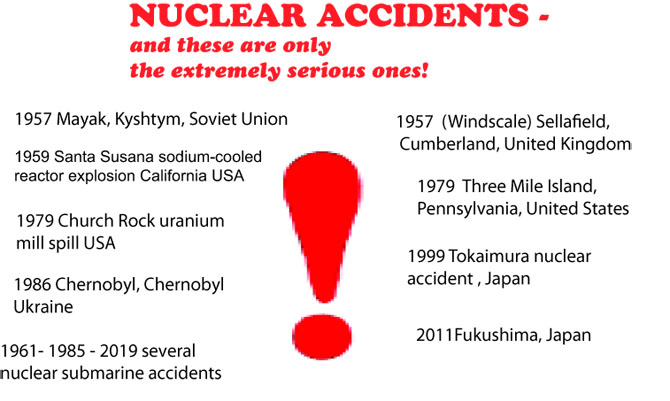
Nuclear power: the warnings from history. The PM wants to keep the lights
on with eight new atomic plants. He’s in denial if he thinks the
catastrophes of the past won’t happen again.
If Johnson is going to use nuclear history to justify his strategy, perhaps he needs to look a little
deeper, because Windscale was also the site of one of the world’s first
serious nuclear accidents. In October 1957, a fire raged for three days in
one of the reactors after changes to increase production.
Through the heroism of staff, and a significant degree of luck, the catastrophe was
contained. But significant radiation was released. Milk from cows within
200 square miles was contaminated. In 1982 officials estimated 260 people
developed cancer and 32 people died as a result. The two first reactors at
Windscale were closed, but the clean-up is still under way today.
Last November the top of the chimney in which the fire blazed was removed as
part of the demolition. The renowned nuclear historian Serhii Plokhy
describes the episode in a forthcoming book and points out: “The existing
nuclear industry is an open-ended liability.” No nuclear power station
has ever been fully decommissioned.
In Atoms and Ashes, Plokhy, 64, a
Ukrainian historian at Harvard, explores the causes and consequences of
Windscale and five other nuclear accidents: at Bikini Atoll in the Pacific
in 1954, Kyshtym in Russia in 1957, Three Mile Island in the US in 1979,
Chernobyl in Ukraine in 1986 and Fukushima in Japan in 2011.While most of
these accidents took place in the formative years of nuclear science,
Plokhy argues they could easily happen again. “Technology was improved as
a result, and every accident contributed to the shaping of subsequent
safety procedures and culture,” he writes.
“And yet nuclear accidents
occur again and again. Many of the political, economic, social, and
cultural factors that led to the accidents of the past are still with us
today, making the nuclear industry vulnerable to repeating old mistakes in
new and unexpected ways.”
Times 9th April 2022
https://www.thetimes.co.uk/article/nuclear-power-latest-warnings-history-chernobyl-ph9q7w80j
In the UK’s energy plan, the nation has been sold a dud
Jim Watson, director, UCL Institute for Sustainable Resources: Britain was
promised a bold and visionary energy plan. But we’ve been sold a dud.
Does it deliver what it says on the tin?
The answer is straightforward. It fails. At the heart of most definitions of energy security is reliability
of supplies for households and businesses. This is usually complemented by
a focus on affordability.
The new strategy does very little to deal with the immediate impacts of high fossil fuel prices.
While the government has announced some help for households via loans and a
council tax reduction, this is simply not enough. The energy price cap has
already risen to almost £2,000 a year and a further rise is due in the
autumn.
This comes on top of a wider cost of living crisis and high levels
of inflation.is available, but the price is too high for businesses to
function or households to keep warm. While more money to help people pay
their bills is needed, this must be accompanied by action to prevent these
acute impacts in future. This means making homes more efficient and
switching away from fossil fuels for heating. It is nearly a decade since
effective policies for home energy efficiency were cancelled and replaced
with new approaches, such as the green deal, which have failed
spectacularly.
As a result, the steady improvements in efficiency and
financial benefits to households have virtually stopped. A new programme of
home upgrades is urgently needed. This would not only reduce our dependence
on gas, but would also cut bills and carbon emissions.
According to many headlines, nuclear power is the “centrepiece” of the strategy. The
government’s plans are ambitious, but delivery will be difficult. New
nuclear plants will not have an impact for many years. The Treasury’s
fingerprints are visible in the careful caveats in the strategy, including
an insistence that new projects are “subject to a value for money and
relevant approvals”.
This reflects the long history of rising costs
within the nuclear sector, and the financial risks that consumers or
taxpayers will be exposed to.
In short, the government has pulled its
punches and avoided measures that would have a more immediate impact on
energy security – mainly by reducing the amount of energy we need to use.
Instead, it has produced a mixed bag of energy supply proposals. While some
are credible, a large nuclear power programme will require huge amounts of
political and financial capital. History suggests that this will be very
difficult to deliver.
Guardian 9th April 2022
In France, the nuclear waste keeps piling up: new reactors will add to the dilemma

France inches towards nuclear waste solution as more reactors planned
President Macron’s ‘French Nuclear Renaissance’ aims to provide energy independence and greener electricity for France – but the nuclear waste keeps piling up Connexion, By George Kazolias, 8 Apr 22,
Emmanuel Macron has announced plans to launch construction of six new nuclear reactors by 2050, along with studies for a possible eight further ones.
He also wants to prolong the life of existing reactors beyond 50 years in what he is calling the “French Nuclear Renaissance”.
Mr Macron’s vision to “take back control of [France’s] energy and industrial destiny” might be a winner with his electorate, but it clashes with the proposals of most of the left-wing presidential candidates, who want to reduce reliance on nuclear power.
New reactors will add to waste dilemma
Solutions for dealing with the waste already produced by existing power stations, however, are still struggling to get out of the starting blocks – and there is no plan for what would be done with waste from a potential 14 additional ones…………..At present, however, none of France’s nuclear reactor waste has been dealt with in a long-term way. All waste considered radioactive, almost two million cubic tonnes of it, is stored at surface level, in treatment centres and pools, or shallow repositories.
Some 60% of this comes from reactors and the rest is from medical, research, military and other sources.
The other waste, which includes items such as tools, clothing, mops and medical tubes, is not highly radioactive,
……… More problematic is what to do with France’s intermediate and high-level nuclear waste.
In 1998, a site near the village of Bure in the Meuse in north east France was chosen as the final storage place for most of it. It will be stored half a kilometre below ground in a vast network of tunnels and galleries known as a Deep Geological Repository (DGR).
The facility will be big enough for all the nuclear waste accumulated so far, but on-site studies, administrative procedures and opposition to the programme, including court cases and civil disobedience, have slowed its opening.
Deep underground storage could be three years away
The Bure DGR will store the waste in galleries carved out of 160-million-year-old compacted clay rocks. Known by its French acronym, Cigéo, the project currently holds 84% of the 665 hectares required to build the facility. The prefecture of the Meuse gave it a declaration of public utility (DUP) in December – a formal recognition that a proposed project has public benefits that must be obtained for most large construction and infrastructure projects before work can begin.
Once the Conseil d’Etat gives its consent, the prime minister can sign his own DUP. Andra will then have the power to get the rest of the property it needs.
In the meantime, work has continued with digging of wells and galleries to test reversible techniques of stocking waste for up to 100,000 years.
The prime minister is expected to sign off only after the presidential elections, but the final green light might be three years away as the rigorous and independent Nuclear Security Agency studies the permit request to move and store the spent nuclear fuel and other radioactive matter.
Plans are for existing not future waste
Activity at the Cigéo remains high, nevertheless. This year, a 1,700m² building, called The Eclipse, is being built to house companies working on underground trials.
A 100m-long cavity will also be dug to test technologies and conduct experiments. This is the length each cavity will have to be for intermediate-level waste, which is often solidified into concrete.
The nuclear authority is hoping to start storing this type of waste in 2025.
It is impossible to bury the high-level radioactive waste. This is turned into a glass-like substance, but then requires a cooling period of at least 50 years.
The clay storage facilities cannot handle temperatures above 90C.
Senator Sido said: “It is true that the most recent batches cannot be stocked in their present state. They are too hot and need a cooling-off period of several decades. But the first batches can be stocked now.”
The remaining high-level waste might not arrive before 2060. By then, France will have produced at least as much nuclear waste again. For that, it might have to create a new underground facility.
“As far as I know, there is no project in the pipeline for high-level and long-lived waste which will be produced in the future,” Mr Sido said. https://www.connexionfrance.com/article/Practical/Environment/France-inches-towards-nuclear-waste-solution-as-more-reactors-planned
UK government got its energy strategy so wrong
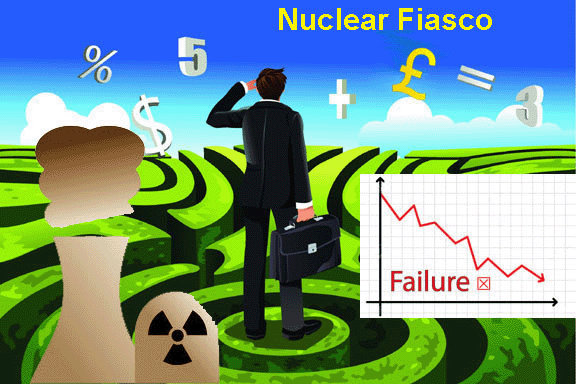
‘Major misjudgment’: how the Tories got their energy strategy so wrong. Analysis: betting big on nuclear, hydrogen, oil and gas while passing over energy saving measures, Johnson’s plan is a huge missed
opportunity.
Government industrial strategies are often derided as attempts to pick winners. The UK’s Conservative government has taken a different approach with its new energy strategy. In terms of dealing with the energybill and climate crises, it’s picking losers.
Nuclear power is the only major energy technology that has increased in cost in the last decade and
routinely suffers from massive time and budget overruns. Even Kwarteng acknowledges that France’s large nuclear fleet “cost a fortune”. The gamble Johnson is making, with taxpayers’ money, is that nuclear power is a more reliable wager to secure clean future power than renewables and fast-developing energy storage technologies. It’s a long shot.
Renewables and storage will develop much faster and get much cheaper due to the rapid learning that comes with small-scale technologies, unlike colossal projects
like nuclear.
Guardian 6th April 2022
Expert warning that UK’s nuclear plans mean that there won’t be room for all the new radioactive wastes.

 | |||
| to me |
Nuclear power plant plans could mean UK might run out of room for radioactive waste, says expert
https://inews.co.uk/news/nuclear-power-plant-plans-uk-could-run-out-room-radioactive-waste-1563015?ito=facebook_share_article-top&fbclid=IwAR2IxsDYG9O8oNJoXYfiKRKF18v2H-zI_l2NqC3VMWj5O8bGLZGYRMLQtss Current policy only allows for disposal of radioactive waste from 16GW of new nuclear capacity, far short of government’s new ambitions
By Madeleine Cuff, 8 Apr 22, Environment Reporter The UK could run out of room to store radioactive waste if the government presses ahead with plans to build eight new nuclear power stations across the country, a nuclear waste expert has warned.
Ministers today set out plans to accelerate the development of new nuclear power stations to bolster the UK’s energy security and push the country to net zero.
The long-awaited energy security strategy set out plans for trebling the UK’s nuclear generation, with up to 24GW of nuclear capacity planned for 2050.
But one of the country’s leading nuclear waste experts has told i the UK could “run out of room” to store the waste produced by so many plants.
Officials have spent the last 50 years hunting for a permanent way to dispose of radioactive waste produced by the UK’s fleet of nuclear plants.
In 2019 fresh search was launched to find a community willing to host the radioactive waste, which would be buried hundreds of metres below the Earth’s surface.
“The policy at the moment is that it can take all of the legacy waste – everything we have generated in the last 70 years, plus up to 16GW of new nuclear build,” said Professor Claire Corkhill, an expert in nuclear waste at the University of Sheffield.
But if the UK builds 24GW of new nuclear it could run into a storage problem, she warns. “My worry is that if we go to 24GW of nuclear energy then we might run out of room to store the radioactive waste,” she said. “We’ve jumped the gun a little bit in saying that we are going to have this much new nuclear energy without thinking really about whether we have got anywhere suitable to put the waste.”
She said it the government could look for a second storage site, but finding one could take decades.
UK’s new energy strategy will accelerate the development of nuclear power generation despite Treasury opposition
| As expected, the Strategy will detail plans to accelerate the development of nuclear power generation. It will target 24GW of installed capacity by 2050, meaning that nuclear will provide 25% of the UK’s electricity demands by mid-century. The Government has stated that it will support the delivery of up to eight large plants this decade, including Wylfa, Hinkley Point C and Sizewell C. It will also support small modular reactors (SMRs). It has been reported that Johnson has pushed hard for these targets on nuclear, despite opposition from the Treasury. Edie 6th April 2022 https://www.edie.net/energy-security-strategy-uk-targets-95-low-carbon-electricity-mix-by-2030-but-will-increase-oil-and-gas-production/ |
People Against Wylfa B (PAWB) to protest against plan for nuclear reactor on Anglesey island

An anti-nuclear campaign group are to protest outside the office of Ynys
Môn’s MPs over plans to build a new nuclear power plant on the island.
The UK Government this morning confirmed its intention to push ahead with a
nuclear project at the Wylfa site on the island of Anglesey. People Against
Wylfa B (PAWB) said that the UK’s energy needs could be met with
renewable energy and that ministerial claims that nuclear was necessary to
support weather-dependent renewables was “simply not true”.
Ynys Môn’s MP who has described herself as an ‘Atomic Kitten’ has been a
persistent advocate of a new nuclear plant on Anglesey.
A spokesperson for PAWB, Neil Crumpton, however said that the Prime Minister should not be
“gung ho” about nuclear power. “It is a complex and radio-toxic
technology,” he said. “The UK should be showing the world how wind and
solar energy, when backed-up by hydrogen-fired power stations, would
provide reliable electricity to consumers no matter what the weather or
season. Nuclear baseload is not needed.
Nation Cymru 7th April 2022
Rosatom, Russia’s nuclear corporation, exports nuclear fuel to Finland and others – has not been sanctioned by USA and Europe
Rosatom, which is the world’s biggest exporter of nuclear reactors and maintains a near-monopoly over the fuel they use to generate electricity, hasn’t been sanctioned by the U.S. and Europe.
it’ll be “three to four years” before Russian fuel currently being used in Finland needs to be swapped out in full for new assemblies.
Europe’s other energy problem: relying on Russian nuclear fuel https://www.mining.com/web/europes-other-energy-problem-relying-on-russian-nuclear-fuel/ Bloomberg News | April 7, 2022 A day before Russia invaded Ukraine, it sent four highly-trained armed guards across the border on a special mission to deliver fuel to an aging nuclear power facility.

Reactors based on Soviet designs generate power across the former Cold War bloc, accounting for more than half of all electricity in Ukraine and around two-fifths in a swath of territory arching from Finland to Bulgaria. So the fuel shipment was routine enough — until President Vladimir Putin ordered his army to war.
Russia and Ukraine agree the small security detachment arrived by train on Feb. 23 and was present as technicians unloaded a new batch of fuel rods at the Rivne Nuclear Power Plant 340 kilometers (210 miles) west of Kyiv. They differ wildly over what happened to the so-called Atomspetstrans guards as fighting began.
Ukraine told the International Atomic Energy Agency last week that they were disarmed and subsequently refused to return home. The Kremlin accused Kyiv of taking the four employees of state-owned Rosatom hostage. The IAEA is assessing the situation as it prepares to return monitors to Ukraine.
The incident was just one nuclear flashpoint of a war that’s being fought amid a fleet of operating reactors as well as the entombed site of the world’s worst atomic accident at Chernobyl.
But it also highlights another looming energy challenge for leaders on Moscow’s European periphery even as the continent moves to bar more Russian fossil fuels: how to cut their reliance on nuclear trade with a heavily-sanctioned Russia that many in the region want to further isolate.
“Countries are taking it a lot more seriously because of the situation,” top U.S. nuclear official Bonnie Jenkins said in an interview last month. “They are aware of their dependence.”
Rosatom, which is the world’s biggest exporter of nuclear reactors and maintains a near-monopoly over the fuel they use to generate electricity, hasn’t been sanctioned by the U.S. and Europe.
Non-proliferation experts have warned that doing so could boomerang back by coaxing more countries to enter fuel markets. U.S. officials said last month sanctions would have to be carefully calibrated to avoid damaging allied economies, as well as other U.S. diplomatic efforts, like the nuclear negotiations with Iran. Those talks foresee continued supply of fuel to the Persian Gulf country’s Russia-built reactor.
For Moscow, atomic exports remain a key geopolitical lever, and it’s using state financing to expand Rosatom’s reach with new units in China, India, Iran and Turkey, none of which have enforced war-penalties so far imposed on Russia.
Nuclear fuel differs from commodities like gas or coal because it requires precision-engineered assemblies that conform to licensing requirements set by safety regulators. Trying to cut ties prematurely with Russia could imperil electricity supplies for almost 100 million Europeans in countries that rely on nuclear plants as their biggest source of clean energy.
Jenkins, 61, the U.S. State Department’s under-secretary for arms control and international security, cautioned the switch could take years.
Still, said Liisa Heikinheimo, deputy director general for energy at Finland’s Economy Ministry, “it’s a fact that an alternative supplier is needed. It’s about to be a problem that’s soon reality.”
Finland, where Fortum Oyj operates two Soviet-built VVER reactors 90 kilometers east of Helsinki, has tried to find alternatives to Russia. It contracted British Nuclear Fuel Ltd., now owned by Westinghouse Electric Co., in the 1990s but ultimately stuck with Rosatom’s competitive prices.
More recently, the U.S. Department of Energy and Ukraine worked with Westinghouse to dislodge Rosatom fuel from 15 operating reactors, which still supply more than half the country’s electricity after six weeks of war wrought billions of dollars in damages to infrastructure.
Fuel made by Westinghouse, owned by private-equity investors at Brookfield Business Partners LP, now generates power at six Ukrainian units, with engineers needing until mid-decade to supply the rest.
“Westinghouse started in Ukraine because of the government-to-government agreement with the U.S.,” said Jose Emeterio Gutierrez, the Spanish nuclear engineer who formerly led the company’s decade-long effort to compete with Rosatom. But nuclear-fuel market peculiarities, along with a Soviet technological legacy, makes diversification difficult, he said.
Few nations possess the vast infrastructure needed to convert and enrich uranium ore into metal, which then has to be engineered into ceramic pellets and inserted into zirconium fuel rods with a safety tolerance measured in millimeters. A catalog of international regulations ensures that material isn’t diverted for weapons.
Rising demand for stable energy supplies, along with the European Union’s green label on nuclear power, could help to speed up the process.
Slovakia, with four Russian-built units, pitched a fuel consortium last month to share costs. The U.S. is also involved, pledging last week to help the Czech Republic diversify fuel for its six Russian-designed reactors.
But moving away from Rosatom will require time, said Heikinheimo, who figures it’ll be “three to four years” before Russian fuel currently being used in Finland needs to be swapped out in full for new assemblies.
(By Jonathan Tirone, Kati Pohjanpalo and Jesper Starn, with assistance from Thomas Hall)
1 This Month





PLEASE OPPOSE HR 8255 AND S.3639 – bills would accelerate satellite deployment, with no environmental review or safeguards – https://ncstd5li.quorum.us/campaign/169331/
To see nuclear-related stories in greater depth and intensity – go to https://nuclearinformation.wordpress.com
-
Archives
- October 2026 (81)
- September 2026 (339)
- August 2026 (330)
- July 2026 (355)
- June 2026 (287)
- May 2026 (306)
- April 2026 (356)
- March 2026 (251)
- February 2026 (267)
- January 2026 (308)
- December 2025 (358)
- November 2025 (359)
-
Categories
- 1
- 1 NUCLEAR ISSUES
- business and costs
- climate change
- culture and arts
- ENERGY
- environment
- health
- history
- indigenous issues
- Legal
- marketing of nuclear
- media
- opposition to nuclear
- PERSONAL STORIES
- politics
- politics international
- Religion and ethics
- safety
- secrets,lies and civil liberties
- spinbuster
- technology
- Uranium
- wastes
- weapons and war
- Women
- 2 WORLD
- ACTION
- AFRICA
- Atrocities
- AUSTRALIA
- Christina's notes
- Christina's themes
- culture and arts
- Events
- Fuk 2022
- Fuk 2023
- Fukushima 2017
- Fukushima 2018
- fukushima 2019
- Fukushima 2020
- Fukushima 2021
- general
- global warming
- Humour (God we need it)
- Nuclear
- RARE EARTHS
- Reference
- resources – print
- Resources -audiovicual
- Weekly Newsletter
- World
- World Nuclear
- YouTube
-
RSS
Entries RSS
Comments RSS

