Climate change hitting France’s nuclear power – the technology that’s supposed to solve climate change !
Electricity prices across Europe are expected to rise as the heatwave sweeping Europe has crippled nuclear power output in France. State-owned electricity provider EDF must reduce or halt nuclear output when river temperatures reach certain thresholds under French legislation.
This is to ensure that the water used to cool the plants won’t harm the environment when it is pumped back out. Climbing temperatures in the Garonne River mean that production will likely be slowed at the Golfech nuclear plant in the South of the country from Thursday, Electricite de France SA said.
Independent 12th July 2022
Macron’s nationalisation of nuclear energy corporation EDF will be a disaster for France
Macron’s energy power grab will be a disaster for France.
Nationalisation of the nuclear energy giant is an ill-thought-out, populist
response from a president overwhelmed by a political crisis. European
leaders have yet to come up with any convincing answers to the global
energy crisis. ………..
France’s energy system is in
complete disarray and Emmanuel Macron’s solution is arguably the worst of
the lot, in a decidedly crowded field – an ill-thought out, knee-jerk
populist response from a president battling a massive political crisis at
home. Faced with long delays and huge budget overruns on new nuclear plants
at home and abroad, corrosion problems at many of its existing reactors,
and the same spiralling cost of living crunch that has gripped most of
Europe, Macron has decided that now is the time to renationalise heavily
indebted electricity titan EDF.
. You can see the attractions, limited though
they are. As the country’s biggest utility by a sizeable margin, EDF has
become the face of France’s energy crisis. Taking EDF into state hands
removes it from the glare of the stock market, making it easier, in theory,
to tackle its huge financial and operational problems head on with the
approval of private shareholders no longer required.
Nevertheless, for all the political hype, it is a move that I am willing to bet will almost
certainly backfire – and in spectacular fashion, too. Whatever the
problem, nationalisation is rarely, if ever, the solution. History has
taught us that. It is even harder to believe that nationalisation will
improve EDF’s widespread operational issues.
One of the main reasons why
its finances are in such a sorry state is that scores of corroding reactors
have forced it to shut down many of its existing nuclear plants, strangling
output. It is also suffering from huge cost overruns and missed deadlines
on new projects. EDF is beset by a host of problems, almost none of which
are likely to be solved by vanishing into the bowels of the notoriously
inefficient, heavily technocratic, work-shy French state. Telegraph 13th July 2022
How To End the War in Ukraine?
Anti War.com by Jean Bricmont
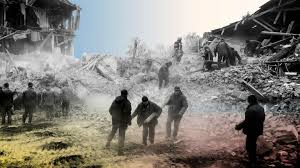
Given the devastating effects of this war, first in Ukraine but also, through sanctions, on the world economy and the risks of famine that they entail, it seems obvious that the first task of any diplomat and political leader should be to end this war.
The problem is that there are at least two ways of considering how this will end and they are irreconcilable.
The first, which until recently was the view of the U.S. government, which is the view of the Ukrainian government, European Greens, and the majority of our media, is that the Russian invasion is illegitimate, unprovoked, and must simply be repelled: Ukraine must regain all of its territory, including Crimea (which has been attached to Russia since 2014).
The other, supported by individuals as different as Chomsky, the Pope, Lula in Brazil, and Kissinger, is that a negotiated solution is inevitable, which in practice means Ukraine giving up territories such as Crimea and Donbass and presumably other regions, as well as agreeing to the neutrality of that country.
The supporters of the first solution shower those of the second with insults: Putin-lovers, pro-Russians, supporters of appeasement in the face of Russian fascism etc. But we can ask at least two questions about this first solution: is it fair? And is it realistic?
The fundamental problem with the fairness of this solution is that it assumes that there is one Ukraine and one Ukrainian people under attack by Russia. But Ukraine, which became independent in 1991 with the dissolution of the USSR, was not a former nation annexed by Russia in the past. Certainly, there was a historical Ukraine that had been absorbed into the Russian empire, but what became independent in 1991 was the former Ukrainian Soviet Socialist Republic, created in 1922 following the October revolution and which incorporated Russian-speaking populations in the east of the present Ukraine, and to whose opinion was never asked by anybody. It included also territories in the west added to Ukraine in 1939-1945 as well as the Crimea added in 1954.………………………………
If the right to self-determination of peoples is sacrosanct in the face of the territorial integrity of states in which they are minorities, then why does the territorial integrity of republics, which were in part administrative entities in dissolving multinational states, suddenly become sacrosanct in the face of the aspirations of minorities living in those republics?
……………………….. The precedent of the Kosovo war is often recalled by the Russians: if the NATO intervention there was legitimate to support the Kosovars, why is the Russian “military operation” to protect the inhabitants of Donbass not legitimate?
There have been many other conflicts of the same kind, and much bloodier: for example, the partition of the British Empire of India in 1948 between India and Pakistan, which initially included the present Bangladesh (called at the time East Pakistan) that became independent after a fierce war in 1971.
There is no simple solution to this kind of conflict. In principle, there could be one: ask by referendum on a local basis to which state each population wants to belong. But this solution is accepted by almost no one: if a referendum in Crimea is in favor of joining Russia, of which Crimea was a part between 1783 and 1954 (and, at that time, the joining of Crimea to Ukraine was decided in a purely authoritarian way), the West declares it illegitimate. If other referendums are held in the rest of Ukraine, they will also be declared illegitimate.
What we should hope for in order to resolve these local conflicts is that foreign powers do not use them to advance their economic and strategic interests. However, the United States and Britain have done exactly the opposite since 2014 (if not before) in Ukraine, first encouraging a coup that led to the overthrow of the legally elected president, Yanukovych, who had to flee for his life. This president was seen as pro-Russian, and the United States and Britain were not prepared to accept the situation. As the new power in Kiev was not only violently anti-Russian but also hostile to the Russian-speaking part of its population, a fraction of the latter demanded more autonomy within Ukraine, which was refused. Since then, there has been a more or less low-intensity war between part of the Donbass and the Ukrainian army.
Again, in principle, a peaceful solution could have been found through negotiations with the leaders of the rebel provinces, and this is what the Minsk agreements, accepted by the Ukrainian government but never implemented by it, provided.
It is true that there are other minorities in the world who are persecuted or badly treated by their governments, but it was particularly irresponsible for the Kiev government to behave in this way towards its minority in the east of the country, knowing that it could benefit from the protection of the Russian “big brother.” And it is unlikely that this conduct would have been adopted without the encouragement and political and military support of the United States and Britain.
This is why it can be considered that it was the American-British policy that pushed Russia to intervene. One can obviously condemn this intervention as contrary to international law, but then one would have to answer the question: what should the Russians have done to protect the populations of eastern Ukraine, assuming that their demands for autonomy are accepted as legitimate (and if not, in the name of what to refuse them)? Wait? Negotiate? But that is what they have been doing for eight years, sending very clear signals at the end of 2021 that their patience had limits.
Moreover, it is difficult for the architects of the wars in Yugoslavia, Iraq, Libya and Afghanistan to pose as great defenders of international law in the face of the Russians. Whatever one thinks of their military intervention in Ukraine, it is less illegitimate than the Western wars mentioned above.
…………………………………………….It is also necessary to point out the incredible hypocrisy of the discourse on the war in Ukraine, and on the accompanying sanctions, on the part of most of our journalists and intellectuals: when did we do anything similar during the US invasion of Iraq?
…………………………. In terms of interests, it is clear that the United States is using every weapon at its disposal, including espionage, to favor its businesses at the expense of ours.
………………………………………. As for the military issue, it is difficult to make definite predictions, but for the moment the Russians are moving forward, even if much more slowly than at the beginning. No Ukrainian counter-offensive has had a lasting effect. Some hope for a reversal of the situation following the delivery of sophisticated weapons to Ukraine by the United States and its allies, but this remains to be seen, and various voices in Washington itself are considering the need for negotiation as the only solution to the crisis.
it seems unlikely that Ukraine’s war aims of recovering the entire eastern part of the country and Crimea can be achieved. The Russians consider these territories, and especially Crimea, to be part of the “motherland” and they are far from having committed all their forces to this battle……………………………………..
In the end, it is likely that the only ones who will have defended the true interests of the Ukrainian people (as well as those of Europe) will be those who have advocated from the beginning (i.e., at least since 2014) for a negotiated solution to the conflict.
Jean Bricmont is a retired Belgian theoretical physicist. He is the co-author with Alan Sokal of Fashionable Nonsense Postmodern Intellectuals’ Abuse of Science (Picador, NY, 1998), of Humanitarian Imperialism; Using human rights to sell war (Monthly Review, NY, 2007), and of Quantum Sense and Nonsense (Springer, 2017).
https://original.antiwar.com/jean_bricmont/2022/07/11/how-to-end-the-war-in-ukraine/
Austria to take EU to court over ‘greenwashing’ of gas and nuclear

https://www.euronews.com/my-europe/2022/07/13/austria-to-take-eu-to-court-over-greenwashing-of-gas-and-nuclearBy Euronews 13/07/2022 –
Austria wants the European Court of Justice to rule on whether the Commission was allowed to issue a Delegated Act to label gas and nuclear as green, the country’s minister said on Wednesday.
A controversial plan by the European Commission to include gas and nuclear in its taxonomy — a planned EU classification to give the financial sector clarity on which economic activities can be considered sustainable — was approved by MEPs last week with Austria immediately announcing it will challenge the vote in court.
Speaking from Luxembourg ahead of an informal meeting of EU environment ministers on Wednesday, Leonore Gewessler stressed that “from the very beginning, Austria was strongly opposed to greenwashing fossil gas and to greenwashing nuclear in the taxonomy.”
“We will file a lawsuit at the European Court of Justice to prevent this greenwashing programme, I cannot call it otherwise, to come into force.”
“There is a legal period of two months after the entry into force that is there to file the suit for the annulment of the legislation under the treaties,” she explained, adding: “Of course, we will respect this time frame.”
Luxembourg has also announced it will turn to the courts over the issue but Gewessler said other member states could join them.
“Several other states have been very critical of, and very vocal also, in their criticism on the delegated act and so we will also look for further allies in the lawsuit,” she told reporters.
Environmental NGOs, including Greenpeace and WWF, have also condemned the vote by the European Parliament with Greenpeace also considering a legal challenge.
Opponents argue that adding branding gas and nuclear as sustainable could lead to billions of euros being invested in these two energy powers rather than in renewables or other green technologies which would, in turn, endanger commitments made under the Paris Climate Agreement as well as the European Climate Law.
These plan for the bloc to become the world’s first carbon-neutral continent by 2050 and to cut its greenhouse gas emissions by at least 55% by 2030, compared to 1990 levels.
The taxonomy, the Austrian environment minister stressed on Wednesday, is “a tool where financial markets, investors, ordinary people who want to invest their money into something good and useful and green and climate-friendly need to have the certainty that wherever there is a green label on, they are truly green projects.”
“So neither fossil gas, nor nuclear fulfil the criteria for really truly green investments. And we also question whether the Commission has the power to regulate this in a delegated act, and all of this will be put in the lawsuit,” she concluded.
Unconfirmed reports that Russian forces at Zaporizhzhia Nuclear Power Station might drain the cooling ponds

There have been unconfirmed reports that Russian forces at Zapphrizia
nuclear plant, Europe’s largest nuclear plant located in Ukraine, could be
attempting to drain the cooling ponds there – something which could spell
disaster for the continent and the UK.
The Russian forces reportedly want
to drain the cooling pond in order to conduct weapons searches. Dr Paul
Dorfman told Express.co.uk that this would be “utter madness” and
warned of disaster if the Russian forces went through with their plan.
Dr Dorfman is an Associate Fellow, Science Policy Research Unit (SPRU), Sussex
Business School, University of Sussex. He has worked with both the
Government as well as European Governments on various areas of nuclear
policy. He said: “Draining spent nuclear fuel ponds would be utter
madness, as cascading problems could lead to very significant radioactive
release – and depending on which way the wind is blowing, the radioactive
pollution could either go to Europe or Russia.”
Express 10th July 2022
EU Labels Gas and Nuclear as ‘Sustainable,’ Betraying Climate Promises

the taxonomy is the result of a “Faustian pact”
Socialist Project, July 13, 2022 • Anna Maria Merlo
It is a “disgrace,” a “scandalous result,” but “the struggle continues.” Green, left-wing and environmental organizations have strongly criticized the result of last Wednesday’s vote in the European Parliament, which rejected, by 328 votes to 278 and 33 abstentions, the “objection” – which amounted to a veto – against the inclusion of gas and nuclear in the Renewable Energy Taxonomy, at least as a transition, that had been put to the European Parliament’s Environment (ENVI) committee on June 14.
As the veto failed, the Commission’s text presented in January was approved, which deems certain investments for energy production in CO2-neutral nuclear power plants built until 2030 (and adopting a protocol for greater safety from 2025 and plans for waste storage from 2050) as “sustainable.” Also accepted are gas-fired power plants, provided they use the latest technology and allow the closure of even more polluting coal-fired plants.
The story does not end there, however: Austria and Luxembourg intend to go to the European Court of Justice, a court case that will be joined by various oppositions. The European Council will need to approve the Commission’s line, but there is opposition from eight countries (not enough, however, for a qualified majority that would block the decision)
Environment Takes a Back Seat
The Commission on Wednesday assured that it “remains determined to use all available instruments to move the EU away from carbon-intensive energy sources.” In these hours, the focus of the Commission and member states is all on the Russian threat to turn off the gas tap, and ecological concerns are taking a back seat………………………
Greenpeace reminded on Wednesday that including gas in the taxonomy means giving a gift to Putin: that’s at least €4-billion a year for Moscow to finance the war in Ukraine, €32-billion until 2030. The strengthening of the dollar against the euro and rising energy prices also help to fill the Russian coffers………..
for the Greens, the taxonomy is the result of a “Faustian pact” between France and Germany: the latter, anti-nuclear, has traded Paris’s support for gas for support for French (and Eastern European) nuclear power. “By keeping gas and nuclear as sustainable in the taxonomy,” the S&D group says, the conservatives have shamefully betrayed the EU’s climate ambitions…………………………………. https://socialistproject.ca/2022/07/eu-labels-gas-and-nuclear-as-sustainable-betraying-climate-promises/
Nuclear would do little to solve gas issue in Germany
Germany’s vice chancellor has defended the government’s commitment to ending the use of nuclear power at the end of the year
Independent UK Via AP news wire 12 July 22, Germany’s vice chancellor on Tuesday defended the government’s commitment to ending the use of nuclear power at the end of this year, arguing that keeping its few remaining reactors running would be complex and do little to address the problems caused by a possible natural gas shortfall.
government officials argue that natural gas isn’t so much a factor in generating electricity as in fueling industrial processes and providing heating.
“Nuclear power doesn’t help us there at all,” Vice Chancellor Robert Habeck, who is also the economy and climate minister and is responsible for energy, said at a news conference in Vienna. “We have a heating problem or an industry problem, but not an electricity problem — at least not generally throughout the country.”
Germany shut down three nuclear reactors in December and the remaining three are due to cease production at the end of this year as part of a long-running plan to phase out conventional power plants in favor of renewable energy.
In this year’s first quarter, nuclear energy accounted for 6% of Germany’s electricity generation and natural gas for 13%, both significantly lower than a year earlier. Germany has been getting about 35% of its gas from Russia.
Habeck said the legal certification for the remaining reactors expires at the end of the year and they would have to be treated thereafter as effectively new nuclear plants, complete with safety considerations, and the likely “very small advantage” in terms of saving gas wouldn’t outweigh the complications.
Fuel for the reactors also would have to be procured, and Scholz has said that the fuel rods are generally imported from Russia………….. https://www.independent.co.uk/news/ap-nuclear-green-party-berlin-olaf-scholz-b2121180.html
No end to nuclear costs for UK taxpayers
Varrie Blowers unpacks the impacts of the Nuclear Industry (Financing) Act
2022 in BANNG’s Regional Life column for June 2022.
Heard the fantasy about constructing an airport in the Thames estuary? And the one about
constructing a bridge from Scotland to Northern Ireland?
Well, there is a new fantasy going the rounds: that eight new nuclear power stations will be
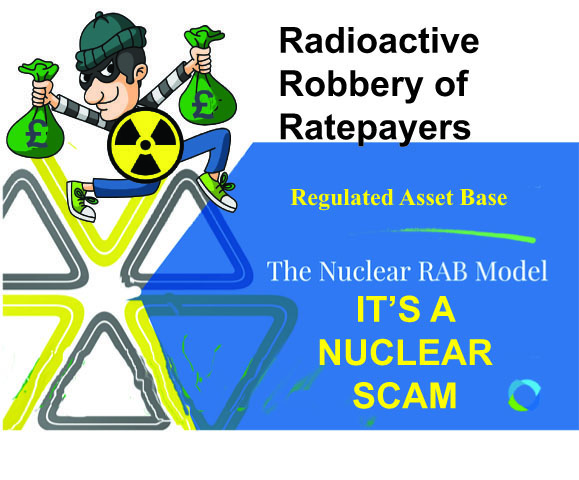
constructed in the UK in the next decade. And where is the Government proposing to obtain the huge sums required for construction? From your pocket, of course! Under the Nuclear Industry (Financing) Act, 2022, it is intended that in order to attract investors a levy will be added to consumers’ energy bills to pay the upfront costs. Energy Minister, Kwasi Kwarteng, thinks this will be ‘a small amount’ but at this time of
soaring energy bills seems unable to reveal the actual figure. And, on top of this, taxpayers will be paying £1.7bn to enable a large-scale nuclear
plant to achieve a final investment decision in this Parliament.
BANNG 13th June 2022
EDF the first company to take advantage of the European Union’s taxonomy classification of nuclear power as ”green”
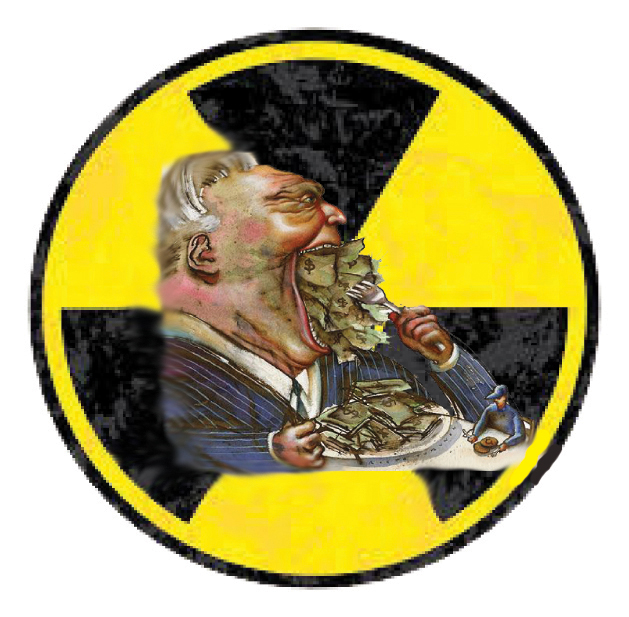
EDF has become the first issuer to harness last week’s hard-fought
inclusion of nuclear power in the European Union’s taxonomy of
sustainable activities and will use a new green financing framework to
support nearly €8bn of annual nuclear spending.
IFR 12th July 2022
https://www.ifre.com/story/3439095/edf-galvanises-nuclear-green-bonds-d6zm8jhtf5
Nearly 50,000 people have signed a petition calling for a full council debate and vote on the plans for seismic testing in the Irish Sea.
Anti-nuclear waste campaigners have protested over plans for seismic
testing in the Irish Sea. The research, which uses sound waves, is being
carried out to determine if the seabed contains suitable geology for
underground nuclear waste storage. Mid and South Copeland are among areas
in the UK mooted for what is known as a Geological Disposal Facility (GDF).
Nearly 50,000 people have signed a petition calling for a full council
debate and vote on the plans.
BBC 13th July 2022
France’s Competition Authority accuses 6 nuclear decommissioning companies of being an illegal cartel
France’s Competition Authority has accused six companies in the nuclear
decommissioning market of illegally exchanging information and rigging
public procurement procedures.
GCR 12th July 2022
https://globalcompetitionreview.com/article/france-alleges-nuclear-decommissioning-cartel
By classifying nuclear as ”green”, Europe benefit’s Putin’s Russia – a major supplier of nuclear fuel
By classifying gas and nuclear as “green” investments the EU has
indirectly handed Putin a pay check. More must be done, including sanctions
on uranium, to end his grip on Europe’s power supply.
At least a fifth of the uranium for Europe’s nuclear reactors comes from Russia
Tortoise 12th July 2022
https://www.tortoisemedia.com/2022/07/12/putins-other-nuclear-project/
Developer dismisses B-52 crash radiation fears at proposed site of Spanish resort
Two nuclear bombs exploded in 1966 after US aircraft involved in mid-air collision over Palomares in Almería
https://www.theguardian.com/world/2022/jul/14/developer-dismisses-b-52-crash-radiation-fears-at-proposed-site-of-spanish-resort Stephen Burgen in Barcelona, Thu 14 Jul 2022
A British company has defended its plans to develop a resort in south-east Spain after environmental groups claimed the area could be contaminated with radioactivity from nuclear bombs that fell after a plane crash in the 1960s.
On 17 January 1966 a US air force B-52 collided mid-air with a refuelling plane over Palomares in Almería, killing seven of the 11 crew.
Of the four 1.5 megatonne nuclear bombs the B-52 was carrying, three fell to Earth, of which two exploded as conventional bombs, spreading radioactive debris over a wide area, while the fourth landed in the sea. It was recovered 80 days later.
Shortly after the accident, the US shipped 1,700 tonnes of contaminated earth to South Carolina, after which it was largely forgotten.
British-based Bahía de Almanzora plans to build 1,600 homes, a hotel and a sports complex about a mile (1.5km) from the contaminated zone in Palomares, which has been fenced off for the past 56 years. The Almanzora proposal makes no mention of the 1966 incident or the contamination.
José Ignacio Domínguez, a lawyer who heads the local Ecologists in Action group, said: “The plutonium isn’t just in the fenced-off area because it’s carried on the wind and by animals such as birds and rabbits.” Domínguez said his group’s own tests have revealed dangerously high levels of radiation outside the closed zone.
Meritxell Bennasar from Greenpeace said: “A chain-link fence isn’t much of a barrier. Some of the contamination is only a few centimetres deep. There are places where the United States secretly buried contaminated soil and we’re only just finding out where they are.”
Fraser Prynne, development director for Bahía de Almanzora, said the contaminated land was “nowhere near the development” and that “this stuff about particles flying about is nonsense”.
“There’s no need to say it’s close to contaminated land,” he said. “There are probably 150 existing houses that are closer.”
The 1966 accident happened as Francoist Spain was opening up to tourism and shortly afterwards Manuel Fraga, the tourism minister, and Angier Biddle Duke, the US ambassador, staged a photo-op of them swimming in the sea at Palomares in an attempt to demonstrate that the waters were safe.
Fifty-six years later, 103 hectares (254,000 acres) remain fenced off and neither the Spanish nor US governments have complied with a mutual agreement signed in 2015 to clean up the zone.
“We’re as keen as anyone to see the area cleaned up,” Prynne said. “It’s American plutonium but there’s no nuclear cemetery in Spain and no one else wants it.”
Palomares was not mentioned during the recent visit to Madrid by the US president, Joe Biden, and when Julissa Reynoso Pantaleón, the US ambassador to Spain, was asked about the long-delayed clean-up in an interview this week in El País newspaper, she said only that “we are prepared to listen to any proposal from the Spanish government”.
Aside from the radiation issue, environmentalists say the proposed development will destroy what is virtually the last stretch of virgin coast in Almería.
“The only reason this part of the coast hasn’t been destroyed is because it’s radioactive,” said Domínguez.
The developers however say the mayor and the local population are in favour of the plan. “They’ve seen all the development along the coast and it’s been disappointing not to see it happening in their area,” Iain Anderson Moody said on behalf of the Almanzora
Office for Nuclear Regulation (ONR) finds shortfalls in EDF’s cybersecurity plans
French energy giant EDF has been placed under ‘enhanced attention’ by the
UK’s Office for Nuclear Regulation (ONR) after identifying shortfalls in
its cybersecurity plans, according to reports this weekend.
The ONR is
taking action due to the findings of routine inspections over the past 12
months. The Telegraph newspaper quoted the body as saying it had
“identified shortfalls in governance, risk and compliance in certain
technical controls” during these inspections. EDF owns and runs the UK’s
network of nuclear power stations at five locations and is currently
building a new nuclear power station at Hinkley Point in Somerset, together
with minority Chinese partner CGN.
The action takes place against a
backdrop of increased awareness of the vulnerability of energy
infrastructure around Europe to cyber-attack. In particular, Russia has
been blamed for cyber-attacks on both windfarms and nuclear power plants in
Europe as part of its invasion of Ukraine.
Info Security 11th July 2022
https://www.infosecurity-magazine.com/news/edf-scrutiny-cybersecurity-record/
Les Echos 11th July 2022
Danger intensifies around Zaporizhzhia Nuclear Power Plant in southern Ukraine

The Russian army is transforming Europe’s largest nuclear power plant into a military base overlooking an active front, intensifying a monthslong safety crisis for the vast facility and its thousands of staff. At the
Zaporizhzhia Nuclear Power Plant in southern Ukraine, more than 500 Russian soldiers who seized the facility in March recently have deployed heavy artillery batteries, and laid anti-personnel mines along the shores of the reservoir whose water cools its six reactors, according to workers, residents, Ukrainian officials, and diplomats.
The Ukrainian army holds the towns dotted on the opposite shore, some 3 miles away, but sees no easy way to attack the plant, given the inherent danger of artillery battles around active nuclear reactors.
Wall St Journal 5th July 2022
1 This Month





PLEASE OPPOSE HR 8255 AND S.3639 – bills would accelerate satellite deployment, with no environmental review or safeguards – https://ncstd5li.quorum.us/campaign/169331/
To see nuclear-related stories in greater depth and intensity – go to https://nuclearinformation.wordpress.com
-
Archives
- October 2026 (81)
- September 2026 (339)
- August 2026 (330)
- July 2026 (355)
- June 2026 (287)
- May 2026 (306)
- April 2026 (356)
- March 2026 (251)
- February 2026 (267)
- January 2026 (308)
- December 2025 (358)
- November 2025 (359)
-
Categories
- 1
- 1 NUCLEAR ISSUES
- business and costs
- climate change
- culture and arts
- ENERGY
- environment
- health
- history
- indigenous issues
- Legal
- marketing of nuclear
- media
- opposition to nuclear
- PERSONAL STORIES
- politics
- politics international
- Religion and ethics
- safety
- secrets,lies and civil liberties
- spinbuster
- technology
- Uranium
- wastes
- weapons and war
- Women
- 2 WORLD
- ACTION
- AFRICA
- Atrocities
- AUSTRALIA
- Christina's notes
- Christina's themes
- culture and arts
- Events
- Fuk 2022
- Fuk 2023
- Fukushima 2017
- Fukushima 2018
- fukushima 2019
- Fukushima 2020
- Fukushima 2021
- general
- global warming
- Humour (God we need it)
- Nuclear
- RARE EARTHS
- Reference
- resources – print
- Resources -audiovicual
- Weekly Newsletter
- World
- World Nuclear
- YouTube
-
RSS
Entries RSS
Comments RSS

