Scotland not impressed with UK Tory government’s enthusiasm for nuclear power

THE Scottish Government has rejected UK Energy Minister Greg Hands plea to “rethink” its stance on new nuclear power stations in Scotland. The Tory minister said it’s a “great pity” Scotland has opposed the construction of any fission power plants amid the cost of living crisis and that he would be willing to sit down with First Minister Nicola Sturgeon and Scottish Energy Secretary Michael Matheson to hear their concerns.
It has been a longstanding Scottish Government and SNP policy to oppose nuclear, with the focus instead on the just transition to renewables.
Hands made the comments during a round table with Scottish journalists in London, where he also said there was no reason to re-assess licences for fossil fuel projects in the North Sea – despite persistent warnings from the United Nations on any more oil and gas fields being brought into production.
Scottish Net Zero Secretary Matheson has previously said safety concerns are the main reason the government has rejected any new nuclear sites, adding that “it is probably the most expensive form of electricity you can choose to produce”.
Following the closure of Hunterston B in North Ayrshire in January, due to cracks found in graphite bricks which make up the reactor core, the only functioning nuclear power station in Scotland is the Torness plant near Dunbar, East Lothian.
The UK Government has said it will not “impose” any new nuclear power on Scotland despite
plans to approve up to eight new fission reactors –by 2030, boosting overall capacity up to 24GW by 2050. But Hands has insisted the Scottish government should reconsider its stance.
When The National pointed out that nuclear power is expensive, takes a long time to be brought online and produces harmful toxic waste, Hands said: “This country has an amazing
safety record when it comes to nuclear. …………………..
. Maggie Chapman, the Scottish Greens MSP for North East Scotland, criticised his comments and said that renewables are “cheaper, cleaner and safer” than nuclear, and are easier to scale up.
She said: “Time and again the Tories have shown that they cannot be trusted with our environment. Nuclear power is neither safe nor reliable, and it leaves a toxic legacy that could last for centuries. “As Hinkley Point shows us, it is also very expensive. Any expansion would take years, and need to be paid for on top of skyrocketing bills.
The National 11th July 2022
New Energy Security Bill waters down regulation for fusion, warns Nuclear Free Local Authorities
As the Nuclear Free Local Authorities have feared, following a pre-Christmas BEIS consultation, the Johnson Government has recently revealed its plans to relax the regulatory regime applicable to future fusion reactors by choosing not to classify them as ‘nuclear installations’.
Fission nuclear reactors are subject to nuclear site licencing requirements overseen by the Office of Nuclear Regulation under the Nuclear Installations Act 1965 (NIA 1965), but government ministers have now decided that fusion plants should instead be regulated by the Health and Safety Executive and Environment Agency like other industrial facilities. The new Energy Security Bill just introduced to Parliament by the Business Secretary will exclude fusion reactors from the provisions of the NIA 1965.
Ministers claim that fusion does not present the same ‘higher hazards’ found in fission plants, but the NFLA fears that their decision is about making the UK attractive to investors in their haste to make the UK a ‘fusion industry superpower’ rather than prioritising public safety.
In its response to the Department of Business, Energy and Industrial Strategy (BEIS) consultation, the NFLA had called for ‘no watering down’ of the regime, challenging the notion that fusion was largely without risk.
For research commissioned by the NFLA revealed that fusion would result in the production of large quantities of radioactive waste, with the risk that radioactive tritium could enter the water supply. Fusion also requires immense temperatures, hotter than the sun, to spark and sustain a fusion reaction and this energy must be safely contained using challenging and unproven engineering solutions. Operation would also result in the whole structure being subjected to prolonged exposure to neutron radiation, a situation which if not carefully monitored could result in the very integrity of the reactor vessel being placed in jeopardy.
The Chair of the NFLA Steering Committee, Councillor David Blackburn, said: “The NFLA’s view is that the government’s decision is misguided. It seems blasé to treat a fusion plant for regulatory purposes in the same way as a factory making chemical products. Fusion presents some of the same hazards and challenges as fission, but some are new; surely then fusion is nuclear and so a plant utilizing this technology must be a ‘nuclear installation’.
“In the view of the NFLA, there is no logical reason on safety grounds not to apply the same regulatory regime to fusion reactors as fission reactors. By signalling through the Energy Security Act their determination to exclude fusion from the rigours of the licencing regime, it seems clear that the present government is more focused on reducing the regulatory and cost burden on investors and commercial operators entering the market, putting expediency and profits before public safety.”
On waste management and decommissioning, the government’s position is even more unclear with ministers calling it ‘premature’ to outline clear proposals at this time, something the NFLA is especially perturbed about.
Councillor Blackburn added: “It is a shame that ministers have missed a trick by refusing to state clearly that future operators will have to share a greater burden of the cost of decommissioning and waste management, rather than passing the bill to the Nuclear Liabilities Fund and ultimately the British taxpayer.”
Macron’s nationalisation of EDF could have major implications for the UK
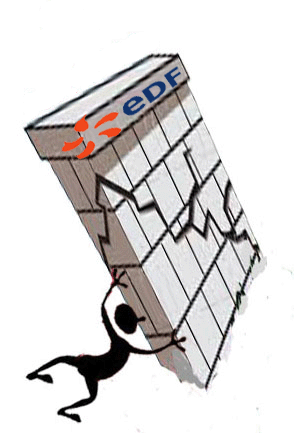
EDF has a more fundamental problem than state ownership can fix: the expense and long build times of nuclear power, compared to other technologies. “[Nationalisation] may change the capacity of the state to directly back the plans, but it doesn’t change the fact that it won’t be profitable,” argues Yves Marignac, at the négaWatt Association think-tank. “Nuclear is profoundly uneconomic. The market has said no,” adds Dr Paul Dorfman, associate fellow at the University of Sussex.
What Macron takeover means for Britain and France’s ‘nuclear renaissance’.
EDF nationalisation could have major implications for the UK’s nuclear fleet. France’s prime minister Elisabeth Borne faced boos and heckling as she set our her government’s plans to the National Assembly last week, striving for coalition after President Emmanuel Macron lost his outright majority in June.
High on her list was an announcement for France to take full ownership of its debt-laden energy giant EDF, as the weakened president tries to tackle the deepening energy and cost of living crisis
rippling across Europe amid the war in Ukraine.
Across the Channel, political turmoil was also affecting EDF. An announcement on planning approval for its Sizewell C nuclear project in Suffolk was pushed back until July 20 amid the chaos surrounding Boris Johnson’s resignation.
The company has a massive role in the UK’s energy sector, as owner of the UK’s nuclear fleet and only developer currently forging ahead with the country’s nuclear renaissance. Yet ballooning debts, outages and delays have raised doubts about its abilities on both sides of the Channel.
Will nationalisation in France be enough to fix its problems? The company’s problems stretch back beyond the turmoil in energy markets this year. Its debts of €43bn have swelled over several years amid high capital costs and spells of low electricity prices. Each year, EDF has to sell a chunk of its output at a fixed price to rivals, under state efforts to encourage competition.
Meanwhile, development of its flagship next-generation EPR reactors has been troubled. Though the first EPR power plant started running in China in 2018, one of its units has had to be shut for repairs due to cracked fuel rods. EDF says the problems have been “investigated and understood” and a solution found, with no risk posed to people or the environment. A second plant opened in Olkiluoto, Finland, in March – more than 10 years late and €8bn over budget. A third EPR in Flamanville, France, is running more than a decade behind schedule.
Meanwhile, Hinkley Point C, the new EPR power plant that EDF is building in Somerset, is now not expected to start generating until June 2027, with the pandemicdisrupting work. Sceptics of nuclear power argue EDF has a more fundamental problem than state ownership can fix: the expense and long build times of nuclear power, compared to other technologies. “[Nationalisation] may change the capacity of the state to directly back the plans, but it doesn’t change the fact that it won’t be profitable,” argues Yves Marignac, at the négaWatt Association think-tank. “Nuclear is profoundly uneconomic. The market has said no,” adds Dr Paul Dorfman, associate fellow at the University of Sussex.
Telegraph 10th July 2022
France and the big nuclear energy mistake
The French government wants to expand nuclear production in France and it also wants EDF to spend big money on the rehabilitation of numerous nuclear power generating stations. It has put pressure on EDF to embrace those policies and we suspect that it could force the issue as the majority shareholder.
France plans to renationalize EDF, its giant utility. That doesn’t sound like a big deal because the government already owns 84% of EDF’s outstanding shares.
But here is how we read the story.
The French government wants to expand nuclear production in France and it also wants EDF to spend big money on the rehabilitation of numerous nuclear power generating stations. It has put pressure on EDF to embrace those policies and we suspect that it could force the issue as the majority shareholder.
But a board of directors, with a fiduciary responsibility to shareholders and other providers of capital, would have a hard time approving a strategy that looked too risky or economically uncompetitive. EDF is, after all, not a division of the ministry of defense, but rather a somewhat privatized company with the government as its biggest and controlling shareholder. At least that is the appearance it would want to give to its shareholders. If France requires more nuclear power for geopolitical or strategic reasons,
despite its seeming cost disadvantage in the marketplace, we have no quarrel with that decision.
Our issue is with the current policy—to require some non-governmental shareholders to bear national security burdens and take financial risks that really belong uniquely to the government. The French have approached the matter with admirable clarity.
Oil Price 8th July 2022
https://oilprice.com/Energy/Energy-General/Europes-Big-And-Expensive-Energy-Mistake.html
The dilemma of disposal of radioactive trash

I don’t disagree with the opinion here, but why does no-one ever suggest STOPPING MAKING RADIOACTIVE TRASH ?
Roy Payne: FINLAND and Sweden are building their GDFs under the Baltic
sea. In the UK, the deepest potash mine in Europe stretches out for 20km
under the North Sea, and is as bone dry as any desert when you are 1km
beneath the surface. The European Parliament has conducted its own
independent analysis, ‘The World Nuclear Waste Report 2020’, which
concluded geological disposal is the ‘least worst option’ for the long-term
management of radioactive waste.
This is also the position of the German
Green Party, one of whose MEPs led the report. Those concerned about
burying radioactive waste deep underground argue the waste should be kept
on the surface – presumably on the assumption that over the next 100,000
years the planet’s surface will remain as constant, benign and unchanging
as deep rock formations, AND that humans will never ever make a mistake.
There are only two options available to us with regards radioactive waste
— keep it overground on the surface or bury it deep underground.
Because IF something goes wrong, it will either go wrong deep underground, or it
will go wrong overground on the surface. You don’t need to have a PhD to
work out which is the lesser of two evils — radioactivity leaking
underground harmlessly far away from the surface and people (which has
happened once), or radioactivity on the surface leaking instantly into the
air we breathe, the soil we grow our food in, and the water we drink.
But those are our only two choices — hence why the European Parliament,
German Green Party, and the international scientific community conclude
that geological disposal is the ‘least worst option’. I have no axe to
grind for NWS, and I certainly do not advocate for more nuclear. Nor do I
advocate for a GDF in Cumbria. But I do believe that if we are to build a
greener future, we have an ethical and environmental responsibility to
start the process of cleaning up the mess we’ve inherited.
Carlisle News & Star 10th July 2022
European Heatwave Risks Curbing French Nuclear Power Production
- Output from Golfech plant may be reduced from Thursday
- That comes as Europe needs France’s electricity more than ever
By Lars Paulsson July 12, 2022
The hot weather hitting Europe this week is set to reduce power output from France’s fleet of nuclear reactors, risking even higher electricity prices as the continent endures its worst energy crunch in decades.
Warm temperatures in the Garonne River mean that production restrictions are likely at the Golfech nuclear plant in the south of the country from Thursday, Electricite de France SA said in a filing with grid operator RTE. Temperatures in France and the Iberia region will be well above average over the next five days and even hotter next week, according to forecaster Maxar. ….. (subscribers only) https://www.bloomberg.com/news/articles/2022-07-12/french-nuclear-output-seen-curtailed-as-river-temperatures-rise#xj4y7vzkg
Europe divided over “greenwashing” gas and nuclear energy, but parliament ready to support the bill
For the European Parliament natural gas and nuclear power plants have been designated as climate-friendly investments. The European Commission released the proposal, formally called the EU taxonomy, in December as a list of economic activities that investors can label and market as green in the EU.
A motion to block the proposal received 278 votes in favor and 328 against, while 33 lawmakers abstained.
Unless 20 of the EU’s 27 member states oppose the proposal, it will be passed into law. The proposal was initially met with resistance among some EU member states, with one camp led by France strongly backing the green label for natural gas and nuclear energy, while Germany which has been phasing out its nuclear power plants — had opposed the plan.
Some environmental groups and EU lawmakers have also criticized the plan for “greenwashing” fossil fuel and nuclear energy.
Austria and Luxembourg have even pledged to sue the EU if the plan becomes law. Still, the proposal had the backing of the majority of the center-right European People’s Party, the European Parliament’s biggest lawmakers’ group.
Lawmakers of the centrist Renew Europe group were largely in favor of the proposal, while the Greens and Social Democrats mostly opposed it.
A total of 353 lawmakers — a majority of the Parliament’s 705 lawmakers — are needed to reject a plan for it to fail. The ongoing conflict over Russian gas supply to Europe has fueled opposition to the plan to label gas as environmentally friendly.
“It’s dirty politics and it’s an outrageous outcome to label gas and nuclear as green and keep more money flowing to Vladimir Putin’s war chest,” Greenpeace EU sustainable finance campaigner Ariadna Rodrigo said. “We will fight this in the courts,” she added.
Paul Tang, a Dutch EU lawmaker with the center-left Social Democrats, had criticized the plan as influenced by “the lobby from Gazprom and Rosneft,” both Russian state-owned energy companies.
Tang also slammed the move as “institutionalizing greenwashing.”
“It is now important to prevent this vote from setting a precedent for other countries to temper climate ambitions,” he wrote in a statement.
Bogdan Rzonca, a Polish member of the European Parliament (MEP) for the right-wing Law and Justice party (PiS), said less wealthy EU countries need private investments in gas and nuclear power to be able to move away from coal.
Gilles Boyer, a French MEP with the Renew group, said that meeting energy demand with renewable energy in the long-term “would be ideal, but it’s not possible right now.”
Czech Prime Minister Petr Fiala, whose country has just taken over the rotating EU presidency, said Wednesday’s vote was “excellent news” for Europe.
U.N. report on crimes, human rights violations in Ukraine-Russia war includes abuses done by the Ukrainian side
 | |||
|
UN OHCHR report on human rights violations in Ukraine-Russia war reminds us of the ugly, inhumane nature of warfare. The relevance for Westerners is the documentation of Ukrainian crimes, incl torture, disappearances, abuse of POWs, corpse desecration &c
US nukes in UK ‘would provoke Putin and put Britons on front line in any nuclear war’
THE RETURN of US nukes to the UK would be “insanely provocative” and put Britons on the front line of a nuclear war, it has been claimed.
https://www.express.co.uk/news/uk/1636941/vladimir-putin-russia-us-nuclear-weapons-lakenheath-return-latest By JON KING. Jul 9, 2022 US Government budget papers revealed earlier this year that vaults at RAF Lakenheath in Suffolk are being upgraded so they can store B61-12 nuclear bombs. The air base received the latest nuclear capable fighter jet, the F-35A, in December with 48 expected to be stationed there.
Hans Kristensen, Director of the Nuclear Information Project at the Federation of American Scientists, spotted the US Department of Defense had added the UK to a list of NATO nuclear weapons storage locations.
RAF Lakenheath has been home to US nuclear weapons in the past and has been undergoing upgrade work amounting to £600million, most of which is paid for by US taxpayers.
The Ministry of Defence (MoD), however, has neither confirmed nor denied that US nuclear weapons are in Britain or going to come to UK shores.
CND General Secretary Kate Hudson, commenting on US nuclear weapons coming to Britain, told Express.co.uk: “We should be very worried by this. Allowing the US to bring these weapons back to Britain is a very dangerous development.
“It would be insanely provocative. It would put us even more on the front line in any nuclear exchange. To have new, US [nuclear weapons] here when there’s a considerable possibility of a war between NATO, the US, and Russia – it is very, very dangerous.
“We hope the US will pull back from any actual deployment.”
An MOD spokesperson said: “It is NATO and UK policy to neither confirm nor deny the presence of nuclear weapons at a given location.”
It comes at a time of heightened tensions between Russia and the West with Russian President Vladimir Putin having put his country’s nuclear deterrent on alert at the beginning of the war in Ukraine.
Russia’s foreign ministry said last month Moscow would supply ally Belarus with missile systems capable of carrying nuclear weapons.
Former Russian President Dmitry Medvedev told the United States on Wednesday (July 6) attempts by the West to punish a nuclear power such as Russia for the war in Ukraine risked endangering humanity.
Commenting before Boris Johnson announced he was stepping down as leader of the Conservative Party, Ms Hudson accused the PM of being a “vociferous advocate” of escalating the war against Russia and putting Britain in a “very dangerous” position.
She continued: “If that continues, it is likely we will have a nuclear exchange. It is pretty impossible to imagine Britain would not be at the front of that exchange, knocking out Lakenheath and Faslane.”
France’s parliament could block Macron’s plan to nationalise EDF
French parliament could block EDF reform – analyst. French government
plans to reform utility EDF face being blocked in parliament due to
bolstered opposition from far right and left-wing parties, an analyst said
this week. “You’re going to have a lot of potential blockages with the EDF
reform,” said Phuc-Vinh Nguyen of the Jacques Delors Institute think tank.
“It is one of the major issues of the five-year term, which will have a
major impact on the revival of nuclear power, renewables and energy policy.
Without an agreement, your hands are tied.” French president Emmanuel
Macron’s ruling Renaissance party lost its absolute majority in the lower
house in parliamentary elections in June. This was due to major gains by
the Eurosceptic far right party, RN, now the leading opposition group in
the National Assembly and the left-wing Nupes party, which opposes
Macron’s plan to build new nuclear reactors.
Montel News 8th July 2022
https://www.montelnews.com/news/1334284/french-parliament-could-block-edf-reform–analyst
Nationalisation of French energy giant EDF means it is unlikely to spearhead future nuclear power projects in UK, according to top industry insider
By FRANCESCA WASHTELL, FINANCIAL MAIL ON SUNDAY,
The nationalisation of French energy giant EDF means it is unlikely to spearhead future nuclear power projects in the UK, according to a top industry insider.
The Hinkley Point C developer will instead focus investment on reactors in France, the source said.
French Prime Minister Elisabeth Borne announced last week that the state would buy the 16 per cent of shares in EDF it does not already own.
EDF, one of Britain’s big household energy suppliers, will continue work on Hinkley in Somerset, as well as Sizewell C in Suffolk, which is still being approved by the UK Government.
But the source said EDF would now shift its focus to France as it battles the energy crisis sweeping Europe, adding: ‘The odds of it putting money into another UK plant are incredibly small.
‘This has been a long time coming because being fully nationalised means it can put more money into French projects without having to worry about state aid.’ ……………………………… https://www.thisismoney.co.uk/money/markets/article-10998301/Nationalised-EDF-wont-build-new-nuclear-sites-UK.html
France’s government working out how to take full control of indebted nuclear company EDF
Banks line up for French state buyout of EDF. The French government is
working with Goldman Sachs and Société Générale as it explores taking
full control of utility EDF, with a tender offer to minority shareholders
the preferred option, according to people familiar with the matter. The
government announced this week it would take back the 16 per cent of EDF it
does not already own, saying the move would bolster the energy group’s
finances as it prepares for more investment in expensive nuclear reactors
and allow France to gain even greater control on its electricity production
as Europe is rocked by an energy crisis. The government has yet to detail
how it will take full ownership of the indebted company. A public offer to
EDF shareholders, rather than trying to push a nationalization bill through
parliament, appears to be the quickest and most feasible plan, according to
three people familiar with the matter.
FT 8th July 2022
https://www.ft.com/content/96336649-eff5-44af-850b-8996d4bde19c
EDF’s nuclear security shortfalls
EDF under scrutiny for nuclear security ‘shortfalls’. Hinkley Point C
developer placed under enhanced monitoring over threat of digital attacks.
Nuclear regulators have stepped up their monitoring of French power giant
EDF amid concerns about cyber security. The UK’s Office for Nuclear
Regulation (ONR) has put the company under “enhanced attention” after
finding “shortfalls” in its cyber security plans, The Telegraph can
reveal.
French state-owned EDF owns and runs the UK’s nuclear power
fleet. It is also building the UK’s first new nuclear power station in a
generation, Hinkley Point C in Somerset, with its minority Chinese partner
CGN.
Cyber security is of heightened concern nationally amid Russia’s war
on Ukraine. Russia has been blamed for cyber attacks which disrupted
windfarms in Europe on the eve of its invasion and security officials have
called on British organisations to bolster their defences.
In a blog post
last week, Dr Marsha Quallo-Wright, deputy director for Private Sector
Critical National Infrastructure at the National Cyber Security Centre,
said “now is not the time for complacency” despite no significant cyber
attacks on UK organisations since Russia’s invasion.
The ONR has stepped
up monitoring of EDF following a string of routine inspections over the
past 12 months, during which it said it “identified shortfalls in
governance, risk and compliance and certain technical controls”. EDF said
the shortfalls related to cyber security. A spokesman added: “EDF works
in very close partnership with the National Cyber Security Centre and some
joint studies with them identified some areas for improvement, such as in
risk awareness. “We are constantly striving to improve security and work
with various bodies, including the ONR, to achieve this. The cyber threat
is a constantly evolving area and we want to stay ahead of the threat.”
Telegraph 9th July 2022
https://www.telegraph.co.uk/business/2022/07/09/edf-scrutiny-nuclear-security-shortfalls/
Fears environment bills could be sidelined in Tory leadership race
Greg Clark is now being given the task of deciding on the proposed
Whitehaven coalmine in Cumbria but has not worked in the department for
years. On Thursday the government also announced it was postponing for a
second time a decision on whether to approve the £20bn Sizewell C nuclear
power plant in Suffolk. The treasury, with its new chancellor, Nadhim
Zahawi, is to decide whether to go ahead with a windfall tax on oil and gas
companies. A decision on this is due next week, and while it is a popular
measure with voters it is unknown whether Zahawi will press ahead with it,
and whether he will remove the loophole that would provide tax relief for
new oil and gas. There could also be a wait of some time for a government
response to the fracking review. The British Geological Survey has given
its report on the safety and feasibility of fracking to the Department for
Business, Energy and Industrial Strategy (BEIS), but the results will not
be seen until the government responds to it, with BEIS sources saying they
do not know when that will be. BEIS will also have to deal with the cost of
living and energy crises, with insulation measures and direct support for
the poorest households the most urgent priority. The energy security bill
is also coming, with an opportunity to overhaul the energy market so the
low cost of renewable electricity feeds through to consumers. Greenpeace
UK’s policy director, Doug Parr, said: “No matter how dire things may
seem in Westminster right now, when it comes to the climate crisis things
risk getting much worse without immediate action. However, delays to
decisions on whether or not to backtrack on coal and build a new mine, or
waste untold time and money on a new nuclear power station that will only
distract from genuine energy solutions, could be taken as positive, if they
were set to be given the green light as rumours suggest. “This
parliamentary reset must deliver a new prime minister that will take bolder
action on climate and nature. They must invest in real solutions like
cheap, clean, homegrown renewables and fixing the vast number of cold,
damp, energy-wasting homes. If not, we may lose even more time and find
ourselves in a far worse position than we already are.”
Guardian 9th July 2022
Ukraine Reform Conference – name changed to Ukraine Recovery Conference – to hide the reality of Ukraine’s endemic corruption.

Ukraine’s endemic corruption problems are suddenly forgotten as hungry Western investors smell ‘reconstruction’ profits,
The flagship “Ukraine Reform Conference” is suddenly rebranded to suit current needs. Rt. rachelmarsden.com 6 July 22,
Rachel Marsden is a columnist, political strategist, and host of independently produced talk-shows in French and English.
The annual Ukraine Reform Conference has, since 2017, brought together Western officials and their local ‘civil society’ foot soldiers to discuss ways that Ukraine can reduce its rampant corruption. But this year, before getting underway this week in Lugano, Switzerland, it underwent a name change to the Ukraine Recovery Conference.
Perhaps drawing attention to the existence of the country’s endemic corruption isn’t convenient for those looking to avoid heavy criminal penalties set up to explicitly prevent investment that fuels corruption?
Simply changing the marketing of the conference does nothing to alter the reality. If anything, it’s counterproductive for Ukraine itself and serves to enable and perpetuate serious systemic problems that prevent the country from progressing.
“The authorities are delaying the fulfillment of many important anti-corruption promises,” according to Andrey Borovik, executive director of the Ukraine office of Transparency International, an organization funded by Western governments and multinationals. As for Ukrainian President Volodymyr Zelensky, “corruption just doesn’t seem to worry Mr. Zelensky much – at least when those implicated are close to him,” claimed Kyiv Independent (another Western funded outfit) editor Olga Rudenko in a guest piece for the New York Times in February, right before the Russian military operation started.
Not exactly the kind of guy you’d want overseeing massive investment projects, one would think.
These days, tackling corruption is taking a rhetorical backseat to the Western push to frame Ukraine as just your typical European country. “For the last two years, we have been discussing large European values, mostly a theoretical debate,” Slovenian Prime Minister Janez Jansa has said. “Then, suddenly, we realised that those fundamental European values actually exist. And that they are threatened. And that Europeans are defending them. With their lives. In Ukraine.”
Despite acknowledging that Ukraine would have to enact “a number of important reforms,” EU Commission President Ursula von der Leyen said that “Ukraine has clearly shown commitment to live up to European values and standards. And embarked, before the war, on its way towards the EU.” In reality, the only thing that has actually changed is that Western officials saw an opening to exploit current public sympathy, if not ignorance, to gain acceptance for an idea that normally would be a much tougher sell to the average EU citizen. That is, the notion that Ukraine would be a net benefit to the bloc rather than an Achilles heel rife with problems that has no business being included in a zone that allows for free movement of people and goods among member states.
…………….. the head of Interpol, Jurgen Stock, has warned EU nations in particular that “the wide availability of weapons during the current conflict will lead to the proliferation of illicit weapons in the post-conflict phase.”
Neglecting to place Ukraine’s corruption problem uncompromisingly front and center in order to better peddle the premature public narrative of the need for investment under the guise of ‘reconstruction’ represents a threat to the EU – and one that Western officials are only too happy to facilitate, apparently. One has to wonder why that is.
It’s hardly a secret that Western nations have historically leveraged foreign aid to gain economic and political footholds within other countries, either through state-backed programs, civil society funding, or corporate opportunities. But there’s also another catch. Current Western laws such as the Foreign Corrupt Practices Act (FCPA) in the US, the UK Bribery Act, or the Loi Sapin II in France all create an obligation for any entity or individual investing in foreign countries to ensure a corruption-free transaction. If Western investment in Ukrainian reconstruction ends up in the wrong hands, then board members, employees, and managers could all end up facing criminal charges with penalties of prison.
………………………. Western entities have an economic interest in portraying Ukraine as a safe place to invest. Otherwise, they’re easy pickings for the authorities of other foreign countries who might choose to use corrupt investment dealings in Ukraine as a means of taking a competitor off the playing field.
…………………… to get the green light, and to convince the average taxpayer to accept funding the risk, everyone has to make the venture sound benevolent – hence the Marshall Plan comparisons – and reduce any references to corruption to a minor detail. https://www.rt.com/russia/558414-anti-corruption-ukraine-reform-conference
—
1 This Month





PLEASE OPPOSE HR 8255 AND S.3639 – bills would accelerate satellite deployment, with no environmental review or safeguards – https://ncstd5li.quorum.us/campaign/169331/
To see nuclear-related stories in greater depth and intensity – go to https://nuclearinformation.wordpress.com
-
Archives
- October 2026 (81)
- September 2026 (339)
- August 2026 (330)
- July 2026 (355)
- June 2026 (287)
- May 2026 (306)
- April 2026 (356)
- March 2026 (251)
- February 2026 (267)
- January 2026 (308)
- December 2025 (358)
- November 2025 (359)
-
Categories
- 1
- 1 NUCLEAR ISSUES
- business and costs
- climate change
- culture and arts
- ENERGY
- environment
- health
- history
- indigenous issues
- Legal
- marketing of nuclear
- media
- opposition to nuclear
- PERSONAL STORIES
- politics
- politics international
- Religion and ethics
- safety
- secrets,lies and civil liberties
- spinbuster
- technology
- Uranium
- wastes
- weapons and war
- Women
- 2 WORLD
- ACTION
- AFRICA
- Atrocities
- AUSTRALIA
- Christina's notes
- Christina's themes
- culture and arts
- Events
- Fuk 2022
- Fuk 2023
- Fukushima 2017
- Fukushima 2018
- fukushima 2019
- Fukushima 2020
- Fukushima 2021
- general
- global warming
- Humour (God we need it)
- Nuclear
- RARE EARTHS
- Reference
- resources – print
- Resources -audiovicual
- Weekly Newsletter
- World
- World Nuclear
- YouTube
-
RSS
Entries RSS
Comments RSS

