Putin Claim U.S. Is Dragging Out War Isn’t Crazy, Military Expert Says

Newsweek, BY NICK MORDOWANEC ON 8/18/22
aims made by Russian President Vladimir Putin that the United States is intentionally prolonging the Russia-Ukraine conflict may not be as implausible as described, says one U.S. military veteran and journalist.
In a speech this week, Putin called out “Western globalist elites” who he said are “provoking chaos, inciting old and new conflicts,” and attempting “to preserve the hegemony and power that is slipping out of their hands.” He added that the situation in Ukraine shows the U.S. is “trying to prolong the conflict.”
Sean Spoonts, a U.S. Navy veteran and editor-in-chief of Special Operations Forces Report (SOFREP), told Newsweek that President Joe Biden and Ukrainian President Volodymyr Zelensky seem to have separate policy goals in mind.
“It seems like while Ukraine would like to end the war quickly and decisively defeat Russian forces and drive them out of their country, U.S. policy almost seems designed to prolong the conflict hoping to bring about the collapse of Russia itself, both militarily and economically,” Spoonts said.
……………. As a recent report by The Washington Post indicated, the U.S. was privy to some of Russia’s plans for the invasion of Ukraine before it officially began on February 24. Spoonts alluded to Biden’s remarks on that day, when he said, “Some of the most powerful impacts of our actions will come over time as we squeeze Russia’s access to finance and technology for strategic sectors of its economy and degrade its industrial capacity for years to come.”
“Biden has said publicly that his goal is to degrade Russia as a world power, never again in the position to threaten its neighbors,” said Spoonts. “That goes a lot further than Zelensky’s goal, which is to simply get Russian armies out of his country and regain lost territories in Donbas, Luhansk and Crimea.”………………………………. https://www.newsweek.com/sean-spoonts-us-russia-ukraine-war-policy-goals-1735019
Russian President Vladimir Putin warned Macron that Ukrainian shelling of Zaporizhzhia nuclear plant risks disaster
Russian President Vladimir Putin warned his French counterpart Emmanuel
Macron that shelling of the Russian-controlled Zaporizhzhia nuclear power
plant in southern Ukraine, which he blamed on Kyiv, could result in a
large-scale disaster.
Reuters 19th Aug 2022
Russian Military From Nuclear Plant Showing Signs Of Radiation Sickness – Paramedic
https://ukranews.com/en/news/877286-russian-military-from-nuclear-plant-showing-signs-of-radiation-sickness-paramedic 21 Aug 22, The Russian military men, who were on the territory of the Zaporizhzhia Nuclear Power Plant, were hospitalized with symptoms of radiation sickness. To find out what is really happening on the territory of the Zaporizhzhia NPP, it is necessary to immediately demilitarize it and put it under the control of international organizations.
Paramedic Bohdan Bondarenko, who is now on the front line, stated this on Facebook.
“The Russian military, who performed tasks at the Zaporizhzhia NPP, were taken to intensive care with signs identical to radiation sickness. The Russians, of course, talk about chemical poisoning, but brought the wounded from the nuclear plant. Not to mention the level of trust in Russian information. Now, before it is too late, you need to do everything possible to get a true picture of the situation at the station,” Bondarenko said.
He noted that the military from the Zaporizhzhia NPP on July 31 were taken to a military hospital and are in intensive care. The Ministry of Defense of the Russian Federation distributed information that examination of the victims “revealed the presence of an organic poison of artificial origin.” But this happened when the Russians fired on the Zaporizhzhia NPP.
“Around this time, Russia and Ukraine exchanged mutual accusations of shelling the station. Ukrainian Energoatom announced a possible radiation leak at the Zaporizhzhia NPP. At the same time, Rosatom brought its employees out of the station as an emergency, and the occupiers refused access to the station to IAEA inspectors,” writes Bondarenko.
The paramedic believes that the situation with the concealment of information by Russia resembles the behavior of the leadership of the USSR immediately after the Chornobyl tragedy.
“Something similar was last observed in the first month after the Chornobyl disaster. The leadership of the USSR desperately hid and distorted the truth, which led to catastrophic consequences both for the health and life of millions of people, and for the Soviet government itself, which was not forgiven for this lie. It is necessary to immediately demilitarize the station and put it under the control of the UN, IAEA or other independent structure. It’s a matter of survival. Aware of the level of opportunities of international organizations, or rather their level of helplessness, but there is no other,” Bohdan Bondarenko stressed.
Ukraine nuclear accident fears heightened
Canberra Times 21 Aug 22, New blasts have resounded in the Russian-annexed Crimea peninsula and a Russian missile hit a residential area of a southern Ukrainian town not far from a nuclear power station, wounding 12 civilians, Russian and Ukrainian officials say.
The strike at the Pivdennoukrainsk (south Ukraine) nuclear station and fresh shelling near the Zaporizhzhia station, Europe’s largest such facility, heightened fears of a nuclear accident during the war, Ukrainian officials said. In Crimea, ….the Russian-appointed governor not recognised by the West said a drone had struck a building near the headquarters of Russia’s Black Sea Fleet on Saturday morning.
“A drone flew onto the roof. It was flying low,” governor Mikhail Razvozhayev said on Telegram. “It was downed right over the Fleet headquarters. It fell on the roof and burned up. The attack failed.”
Ukrainian media reported explosions in nearby towns – including the resorts of Yevpatoriya, Olenivka and Zaozyornoye.
Explosions and fires have struck Crimea in the past week — including a blast at a Russian air base that appeared to destroy large numbers of aircraft according to satellite photos.
Ukrainian officials have made no comment. Analysts have said the attacks were made possible by new equipment used by the Ukrainian army and predicted more would occur………………………………………..
Russia and Ukraine traded fresh accusations of shelling around the Zaporizhzhia station – held by Russia since March.
Vladimir Rogov, a Russia-appointed official in the nearby town of Enerhodar, said Ukrainian forces had launched at least four strikes on the plant. Yevhen Yetushenko, mayor of the Ukrainian-controlled Nikopol on the opposite bank of the Dnipro River, said Russian forces had repeatedly shelled the town.
Talks have been underway for more than a week to arrange for a visit to the plant by the UN nuclear power agency, the International Atomic Energy Agency………………………………….. https://www.canberratimes.com.au/story/7869033/ukraine-nuclear-accident-fears-heightened/
We must never forget the risks nuclear stations pose to us all in conflict situations
The Herald, Isobel Lindsay, 19 Aug 22, CURRENTLY there are two different discourses going on in relation to nuclear power with no cross-over (“If Russia turns up the heat, could a nuclear winter follow?”, The Herald, August 17).
There is a cosy consensus among UK politicians and commentators that we should have more nuclear power stations and that this is supposed to be environmentally friendly. This message is, of course, actively promoted by commercial interests. Never mind the huge cost of both the build and the decommissioning, the legacy of radioactive waste we are leaving for future generations, the impact of rising water levels and drought on these plants and the long build time.
But the other discourse playing out is the huge vulnerability of nuclear power plants in conflict situations. Both Russia and Ukraine are playing “dare you” in relation to the Zaporizhzhia power plant. The Russians are using it as a base that is too dangerous to attack and Ukraine has been having a few shots at it to frighten the Russians and the rest of Europe in order to get more help. If the worst happens, it is the wind that will determine who suffers most, not state boundaries.
The threat is not just from war situations. While we have careful security measures, risk is always there. In 2017 a member of a far-right apocalyptic group in the US was arrested with weapons on his way to a nuclear power plant. One of those killed in the January 2021 storming of the US Capitol was an employee of a nuclear plant. In 2014 an insider at a Belgium reactor sabotaged one of the plant’s turbines, leading to months of shut-down. There are plants on earthquake and tsunami vulnerable areas.
We are not short of low-risk methods for the radical reduction in carbon emissions. We need to challenge those who are promoting high-risk choices, https://www.heraldscotland.com/news/20672345.letters-must-never-forget-risks-nuclear-stations-pose-us-conflict-situations/
War Propaganda About Ukraine Starting to Wear Thin

Covert Action Magazine, By Chay Bowes – August 13, 2022,
More and More Are Seeing Through the Lies
As Amnesty International confirms the inconvenient truths, which many independent journalists and political observers already knew, about the Ukrainian army’s behavior in Donbass, it’s worth examining how manipulating the truth has become—not only an everyday occurrence but a central element of the West’s proxy war in Ukraine.
An increasing number of mainstream journalists, commentators and ordinary individuals who had rushed to “Stand with Ukraine ” are finding the inconvenient truths about the Zelensky regime and its Army harder and harder to ignore.
It was the icon of American democracy, President Abraham Lincoln that said “You can fool part of the people some of the time, you can fool some of the people all of the time, but you cannot fool all the people all of the time.” Of course, even though Lincoln’s astute observation has been widely misquoted, it certainly has a particular resonance when we consider the recent misadventures and persistent foreign policy failures of his beloved United States.
Most particularly are American efforts to maintain an increasingly skeptical public’s support for its faltering and hugely costly geopolitical ambitions in Ukraine.
So far it hasn’t been too difficult to package a message for general consumption, a drive-through narrative if you will, that is easily accessible and digestible by a trusting public, particularly when that same public has been globally denied key factual insights into the background of a long running complex conflict into which they have been seduced as blindfolded supporters.
The current crisis in Ukraine is however different; it has seen the pro-Western media machine cultivate and disseminate disinformation, propaganda and fake news on a previously unseen scale. While the U.S. and its NATO allies prosecute their proxy conflict on the ground, in the air, and at sea, another illicit battle is being fought on social media, TV and radio.
Of course, propaganda and the winning of “hearts and minds” is nothing new when it comes to conflict. As far back as the 19th century Governments were aware of how important the narrative was at home, they actively sought to suppress details which they thought may be offensive or unhelpful to the home audience.
…………………………………………..Today’s conflict in Ukraine is no exception, a similar narrative is peddled with the historical truths about where conflict grew from remaining unreported. Some of the most critical facts relating to Ukraine are routinely and conveniently rendered invisible by the mainstream media, such as when this civil war began and most crucially, who paid for and built the scaffolding on which it is now burning…………………………..
The “Absolute Truth”
When it comes to Ukraine a new, dangerous and lavishly funded weapon in the counter truth war has been deployed by western governments and media, I call it “Absolute Truth”. The Absolute truth doesn’t tolerate any challenges, when its allegations are proven false those realities are suppressed and ignored.
It immediately and efficiently targets any dissent from the prescribed narrative and brands challengers as “enemies,” “foreign agents,” or “useful idiots.” Critically there is no room for debate of any kind, there is no analysis of facts, there is only their Absolute Truth.
Should a journalist, State or individual question this Absolute Truth or merely suggest an objective analysis of the facts they are immediately and brutally marginalised and then targeted for retribution. This determined and choreographed punishment can range from the loss of a job to the isolation of an entire nation with threats of violence commonplace.
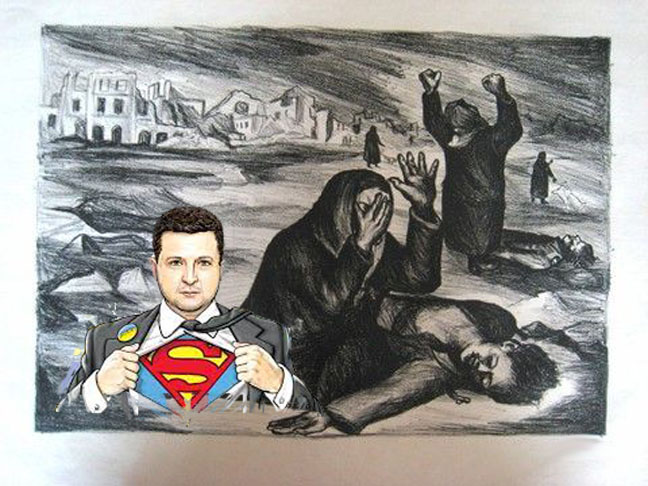
…………… Absolute truth also has a selective attitude when it comes to the behavior of its idols, when Mr Zelensky’s election with the assistance, cash and muscle of a corrupt oligarch is highlighted this is ignored, when his antidemocratic banning of all opposition and the imprisonment of its leaders comes up, its fine. if the Absolute Truth requires the acceptance and deployment of brutal Nazi militias against civilians, (previously designated by the west as terrorists) that is again entirely acceptable.
………………………………. Another sinister element of the cult of Absolute Truth is the reluctance to correct the record or admit when you get it wrong, from the “massacre” at Snake Island that never happened to the fake headlines about the Mariupol maternity hospital to name but a few, there is never any attempt to correct the record which begs the question how sincere were the allegations in the first place?
……………………………… Contrary to the best efforts of those that have funded, molded and justified this proxy war the truth has a habit of resurfacing. It will be impossible to “manage” the oncoming tide of reality that will gush out of Ukraine as the western powers refocus on their self-inflicted domestic troubles this winter, Zelensky himself may become the fall guy for the failed NATO escapade in Ukraine. ,,………
https://covertactionmagazine.com/2022/08/13/war-propaganda-about-ukraine-starting-to-wear-thin/
They’ve Bankrupted Themselves’: Europe Gutted Own Security to Funnel Kiev Weapons, Expert Says
Sputnik News 19 Aug 22
Ukraine’s European benefactors made a big show of rushing military aid to Kiev in the early months of Russia’s special military operation, but the torrent has waned to a trickle since then, with no new pledges being made in July. One military expert said Europe is running out of both equipment and willpower to support the “horribly corrupt regime.”
Scott Ritter, a military analyst and former US Marine Corps intelligence officer, told Sputnik on Thursday that NATO’s policy of giving Ukraine billions of dollars in weapons that so quickly get destroyed is “inefficient and counterproductive” from both a political and a national security point of view.
“The more Europe invests its military capacity into Ukraine, the weaker Europe gets,” Ritter said.
Proxy Wars Are Expensive
“I think there’s a couple of things at play here. One, and I think first and foremost, is that Europe has bankrupted its own military capacity by transferring military equipment to Ukraine in an unconstrained manner. It’s becoming clear to all that Ukraine is facing a very difficult time on the battlefield. Weaponry is being provided by Europe, by the United States, by NATO, and this weaponry is not being absorbed in a coherent manner by the Ukrainian Armed Forces.
Instead, it’s being received and rushed to the front where it is not being used effectively and increasingly it’s being destroyed by the Russians. This is very expensive, very inefficient. It’s detrimental not only to Ukraine’s military capability but also the nations providing the equipment. They’re literally stripping bare their own inventories to support Ukraine in a losing cause,” Ritter explained.
The second part of this equation is, not only is this inefficient and counterproductive from a national security standpoint, but it’s expensive and counterproductive from a political standpoint,” he said. “I think the political cost of supporting Ukraine is about to become very, very high.”
“Many political leaders in Europe now are going to be facing an increasingly hostile constituency, demanding answers as to why their leaders committed: a) economic suicide by joining in on a failed sanctions effort; b) are further bankrupting the nation by stripping bare their own arsenals, requiring them to expend money to restock. This is an expensive proposition. And c), supporting what is increasingly being documented as a very corrupt and, frankly speaking, vile regime in Kiev.”
“Many political leaders in Europe now are going to be facing an increasingly hostile constituency, demanding answers as to why their leaders committed: a) economic suicide by joining in on a failed sanctions effort; b) are further bankrupting the nation by stripping bare their own arsenals, requiring them to expend money to restock. This is an expensive proposition. And c), supporting what is increasingly being documented as a very corrupt and, frankly speaking, vile regime in Kiev.”
…………………………………….Ritter recalled Berlin and Paris were also key guarantors of the Minsk Accords, which were supposed to settle the Donbass conflict in the context of autonomy for the Russian-speaking regions………………………… more https://sputniknews.com/20220818/theyve-bankrupted-themselves-europe-gutted-own-security-to-funnel-kiev-weapons-expert-says-1099744371.html
Twelve months, one meeting – the complete lack of accountability on nuclear in Copeland

In fact, the Rolls-Royce fronted consortium developing a 470-MW so-called ‘Small’ Modular Nuclear Reactor still faces considerable challenges in bringing a design to market. The design still needs to be approved by the Office of Nuclear Regulation after a comprehensive Generic Design Assessment. If approved, the consortium would need to build and test an actual working prototype; establish facilities to fabricate the parts; master the fabrication and on-site assembly process; secure funding; navigate the siting, planning and Development Consent process; and actually build the first plant. So hardly a rose in fragrant bloom!
https://www.nuclearpolicy.info/news/twelve-months-one-meeting-the-complete-lack-of-accountability-on-nuclear-in-copeland/ 19 Aug 22, Despite Copeland Council being at the heart of plans to develop a new nuclear plant and a nuclear waste dump in the borough, the Nuclear Free Local Authorities were surprised to see that the Council’s Strategic Nuclear and Energy Board has only met once in the last twelve months.[1]
Only last month, Copeland Borough Council’s Portfolio Holder for Nuclear and Commercial Services Councillor David Moore described how “the future looks rosy” for new nuclear in Copeland as talks progress on Small Modular Nuclear Reactors.[2]
Unfortunately, for the members of the Board, there was no opportunity to explore how ‘rosy’ the future was as the scheduled 9 August meeting was subsequently cancelled. Since the last meeting of the Board on 6 October 2021, meetings have been cancelled on 9 December; 10 February; 28 April; 7 June; and latterly on 9 August 2022.
In fact, the Rolls-Royce fronted consortium developing a 470-MW so-called ‘Small’ Modular Nuclear Reactor still faces considerable challenges in bringing a design to market. The design still needs to be approved by the Office of Nuclear Regulation after a comprehensive Generic Design Assessment. If approved, the consortium would need to build and test an actual working prototype; establish facilities to fabricate the parts; master the fabrication and on-site assembly process; secure funding; navigate the siting, planning and Development Consent process; and actually build the first plant. So hardly a rose in fragrant bloom!
Perhaps the infrequency of the meetings of the Board can be related to the disquiet expressed by some members over the lack of accountability over plans for Copeland Borough Council to partner with Nuclear Waste Services to bring a nuclear waste dump (a so-called Geological Disposal Facility or GDF) to Copeland. The Board minutes for 9 October 2021 record that three Councillors wanted the final decision taken by a meeting of the Full Council rather than reserved to the Executive; with a tied vote, this proposal was defeated only on the Chair’s casting vote. To placate the objectors, Councillor Moore promised that ‘this committee and full Council would be updated on a regular basis’.[3] The Board has since never met.
Commenting, Councillor David Blackburn said: “At a cost of up to £53 billion, the GDF would be the biggest engineering undertaking to take place in Copeland, since the creation of the Sellafield complex. It would be a repository for Britain’s high-level nuclear waste from seven decades of civil nuclear operations, and also take waste from future generation. Taking up to 150 years to build, fill and seal, it would have massive implications for, and be completely disruptive to, any host community in Copeland for generations.
“The GDF process is fast moving on apace. Since October 2021, first a Working Group and then a Community Partnership have been formed with Copeland’s involvement. In the last month, seismic testing has been taking place off the coast of West Cumbria, an activity which has rightly been hugely controversial for its adverse impact on marine life. Yet during this whole time, this Board, the very body charged by Copeland Council to provide oversight on the GDF and nuclear projects, has not met; no reports on these and other important issues have been brought before this Board for debate; and there has been no opportunity for members of the public to sit in on deliberations. Hardly democracy at its finest.”
For more information, please contact NFLA Secretary Richard Outram by email on richard.outram@manchester.gov.uk or telephone 07583 097793
Commenting, Councillor David Blackburn said: “At a cost of up to £53 billion, the GDF would be the biggest engineering undertaking to take place in Copeland, since the creation of the Sellafield complex. It would be a repository for Britain’s high-level nuclear waste from seven decades of civil nuclear operations, and also take waste from future generation. Taking up to 150 years to build, fill and seal, it would have massive implications for, and be completely disruptive to, any host community in Copeland for generations.
“The GDF process is fast moving on apace. Since October 2021, first a Working Group and then a Community Partnership have been formed with Copeland’s involvement. In the last month, seismic testing has been taking place off the coast of West Cumbria, an activity which has rightly been hugely controversial for its adverse impact on marine life. Yet during this whole time, this Board, the very body charged by Copeland Council to provide oversight on the GDF and nuclear projects, has not met; no reports on these and other important issues have been brought before this Board for debate; and there has been no opportunity for members of the public to sit in on deliberations. Hardly democracy at its finest.”
For more information, please contact NFLA Secretary Richard Outram by email on richard.outram@manchester.gov.uk or telephone 07583 097793
Why Am I Banned in Ukraine?

plebiscite,” which is defined under the 1919 Versailles Treaty with very precise rules, starting with complete control by neutral powers and the vetting of eligible voters.
neither Moscow nor Kyiv will unilaterally accept defeat, and plebiscites are the only available exits from the burning house of war.
Geostrategist Edward Luttwak explains his support for plebiscites in Donetsk and Luhansk
https://www.tabletmag.com/sections/news/articles/banned-ukraine-edward-luttwak-donetsk-luhansk BY EDWARD N. LUTTWAK, 2 Aug 22, Last year a “Center for Countering Disinformation,” headed by former lawyer Polina Lysenko, was established within Ukraine’s National Security and Defense Council under the authority of President Volodymyr Zelensky. Its stated aims were to detect and counter “propaganda” and “destructive disinformation” and prevent the “manipulation of public opinion.”
On July 14, 2022, it published on its website a list of politicians, academics, and activists accused of “promoting Russian propaganda,” including me.
Two specific reasons were given for my inclusion on this list. The first one was that I said or wrote that “Putin has been provoked to start a war against Ukraine.”
This is an easy one to dispense with: I never said or wrote or thought that. Either Polina Lysenko or one of her staff confused me with somebody else, or else they cut short a longer phrase of mine, such as “Putin’s agents claim that he was provoked …”
The other reason given is that I’ve supposedly proposed holding referendums in the Donetsk and Luhansk regions of eastern Ukraine as a way out of the war.
This is inaccurate: I’ve proposed holding plebiscites, not referendums, and not just because Russia’s fake overnight vote held in Crimea in 2014 made “referendum” an infamous term, but because the term has no precise meaning—unlike “plebiscite,” which is defined under the 1919 Versailles Treaty with very precise rules, starting with complete control by neutral powers and the vetting of eligible voters.
This is crucial, both to exclude recent border-crossers and to include all traceable refugees. Under these rules, plebiscites were held in 1920 in Eupen-Malmédy to allow the locals to decide between annexation to Belgium or to Germany, in Schleswig to decide between Denmark and Germany, in Carinthia to decide between the new state of Austria and the new Kingdom of Serbs, Croats, and Slovenes, and in the Allenstein and Marienwerder districts of East Prussia to decide between Germany and Poland, with further plebiscites in 1921 in Upper Silesia, followed by a December plebiscite to allow the inhabitants of Sopron to choose between Austria and Hungary.
The First World War, with all its ravages, had just ended, the Spanish influenza was killing off many of the younger people who had survived years of warfare, and some of the contenders were brand-new states just getting organized, including truncated Austria, and brand-new independent Hungary and Poland.
Nevertheless, the plebiscites went off without major incident and avoided more fighting.
But Ukraine’s Center for Countering Disinformation did not merely confuse a free and fair vote with a fake referendum, but also disregarded my precondition that plebiscites should be held with Kyiv’s prior agreement, after a complete cease-fire and standstill, preceded by Russia’s renunciation of any other territorial claims.
All of the above were simply ignored, as was the fact that in countless interviews and tweets since the first day of the war, I’ve called for the supply of weapons to Ukraine and personally met with European defense officials to press them to send the specific weapons that have been most urgently needed at various stages: antitank missiles at first, self-propelled artillery later on, and small arms and armored combat vehicles all along.
Of course I do not know if and when Kyiv and Moscow might agree to hold plebiscites in Donetsk and Luhansk. But I do know that every war must end, that neither Moscow nor Kyiv will unilaterally accept defeat, and that plebiscites are the only available exits from the burning house of war.
Edward N. Luttwak is a contractual strategic consultant for the U.S. government and an author.
Ukraine using very advanced long range rockets to strike Russian air base in Crimea?
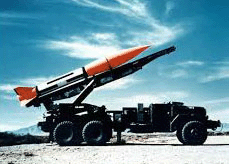
The devastation at the Russian air base in Crimea suggests Kyiv may have obtained new long-range strike capability with potential to change the course of the war. The base is well beyond the range of advanced rockets that western countries acknowledge sending to Ukraine so far, with some western military experts saying the scale of the damage and the apparent precision of the strike suggested a powerful new capability with potentially important implications. https://www.theguardian.com/world/live/2022/aug/12/russia-ukraine-war-zelenskiy-tells-officials-to-stop-leaking-military-tactics-un-sounds-nuclear-plant-warning-live
Russia admits that explosions in Crimea were the work of Ukrainian saboteurs
New Arms Depot Blast In Crimea An Act Of Sabotage, Kremlin Admits, BY TYLER DURDEN, AUG 16, 2022
Russia’s Defense Ministry on Tuesday confirmed a rare act of what appears to be a Ukrainian sabotage operation in Crimea. This after video emerged online showing a series of explosions after a fire engulfed a munitions depot there.
“On the morning of Aug. 16, as a result of an act of sabotage, a military storage facility near the village of Dzhankoi was damaged,” the ministry said. “Damage was caused to a number of civilian facilities, including power lines, a power plant, a railway track as well as a number of residential buildings. There were no serious injuries,” it added……………………
Importantly, this comes after a bigger Aug. 9 explosion some 200km inside Crimea at Russia’s Saky air base, in Novofedorovka. That attack, which destroyed multiple Russian jets, vehicles, and an ammo depot, has been subject of intense speculation as Ukraine’s government sent mixed signals in terms of taking responsibility………….
On an official level, the Ukrainian government denied it was behind the earlier Crimea base attack, but officials leaked to both The Washington Post and New York Times that it was a sabotage operation by Ukraine’s special forces.
Moscow had in the immediate aftermath downplayed it as an accident, perhaps seeking to avoid escalation, also possibly not wanting to acknowledge it was vulnerable to such a strike from Ukraine.
So this fresh Aug.16 “sabotage attack” strongly suggests the prior Aug.9 explosion was also a Ukrainian operation. The incident had also set off discussion over whether US-supplied HIMARS rockets could reach that far. If indeed there were foreign weapons systems behind it, it could set the US and Russia on a dangerous path of escalation and collision as the proxy war could fast develop into direct confrontation between superpowers in Ukraine.
Nuclear Free Local Authorities support dry storage for safety at Hinkley plant
In a rare example of synergy, the Nuclear Free Local Authorities has
written in support of a proposal by the developer of Hinkley Point C, EDF
Energy, to change the storage of spent fuel at the new plant from wet to
dry.
The NFLA was responding to a consultation called by the Environment
Agency when EDF submitted a request to change one of its agreed operational
conditions relating to storage. The NFLA has always been concerned at the
dangers attendant to storing spent nuclear fuel in cooling ponds and feels
that dry storage is better.
Fuel stored in ponds at nuclear plants in
Ukraine have come under threat in recent months, with fears that
bombardment could release radioactivity. Speaking about the NFLA
submission, Chair Councillor David Blackburn said: “The NFLA remains
opposed to new civil nuclear plants, including Hinkley Point C, but the
reality is that nuclear plants produce waste, and our practical concern is
to ensure that this is stored as safely as possible.
“Our policy on the
storage of nuclear waste differs from that of the UK Government. We favour
the ongoing near-site, near-surface storage of waste, to eliminate the need
for rail transportation and to ensure that waste can be actively monitored,
rather than the government’s preferred ‘dispose and disregard’ approach
of depositing waste in an underground or undersea dump and forgetting about
it.
“The situation at Hinkley Point C may remain unclear for some time.
EDF Energy has announced that the plant will not now be completed until the
summer of 2027 at the earliest, and very possibly later, and the company
will now be required to carry out a redesign of its reactor for safety
reasons following the accident at Taishan-1 in China last year.”
NFLA 17th Aug 2022
Counting the cost of cracking at EDF’s nuclear reactors in France

Nuclear Engineering, 11 Aug, 22,
The full extent of stress corrosion cracking at EDF’s reactors in France has still to be determined. Nonetheless, lower production as plants are re-examined has come at the worst possible time for the company.
On 15 December 2021 EDF announced that it would temporarily shut down two reactors at the Civaux site. The move came after inspections undertaken as part of as Civaux 1’s 10-yearly in-service inspection revealed defect indications close to welds in pipes that formed part of the of the safety injection system (SIS). This back-up circuit allows borated water to be injected into the reactor core in order to stop the nuclear reaction and to maintain the volume of water in the primary circuit in the event of a loss of primary coolant accident.
The discovery illustrated the mixed blessings of a ‘series’ approach to nuclear build, as EDF decided that it should also investigate and, if needed, address the same problem at other reactors in the N4 series, notably at Chooz, where there are four similar reactors. It began an outage at Chooz 2 on 16 December and at Chooz 1 on 18 December.
At that time EDF said the extended outage at Civaux and the closure at Chooz would cost it about 1TWh in lost generation to the end of 2021. But since then the company has found the problem to be more widespread.
ASN (Autorite´ de Su^rete´ Nucle´aire), France’s nuclear safety authority, said analysis on parts of the pipes removed from Civaux 1 had revealed the presence of cracking resulting from an unexpected stress corrosion phenomenon on the inner face of the piping, close to the weld bead. There was worse news for EDF. The ultrasonic inspection, which had been carried out during the plants’ regular 10-yearly outages, is mainly used to detect cracking caused by thermal fatigue. It is less effective at detecting stress corrosion cracking (SCC). That raised the fear that SCC had been present in reactors that had previously been examined by ultrasound and indications of SCC had wrongly been classified as spurious. The re-examination of Chooz B1 and B2 indicated this was indeed the case and there was SCC that needed to be addressed.
All five of the reactors in the initial group have had to undergo additional checks to determine which areas and systems are affected by the stress corrosion phenomenon.
To make matters worse still, checks at Penly 1, during its third 10-yearly outage, revealed indications on the same pipes, which laboratory analysis showed to be SCC, albeit at a smaller scale than at Civaux 1. Unlike the Chooz and Civaux reactors, Penly is not one of the 1450MWe N4 series but a 1300MWe reactor in an earlier French series.
As a result, EDF has returned to the checks previously conducted on all of its reactors to re-examine the results, searching for indications then thought to be spurious but now seen as potential indications of stress corrosion.
May update
In early May, speaking at an investor meeting after the company published results for the three months to the end of March, Regis Clement, EDF’s Deputy Head of Nuclear Generation, provided an update to investors.
He said inspections and examinations had confirmed stress corrosion in sections of piping at Civaux 1, Chooz 1 and Penly 1, where the affected parts will be removed and replaced. EDF had already begun investigations at Civaux 2 and Chooz 2 and now that has been extended to seven more units – Chinon 3, Cattenom 3, Bugey 3 and 4, Flamanville 1 and 2, and Golfech 1. Of these units, Clement said: “Indications have been found during ultrasound inspection process but we are not yet able to establish whether these are minor flaws in the composition of the steel, traces of thermal fatigue or stress corrosion.” Laboratory tests are under way.
In the end, EDF will inspect all its reactors. It expects that process to be completed by the end of 2023 and largely to be carried out during scheduled maintenance outages. Clement said, “At this time more or less 20% of the fleet is undergoing examination” and EDF expected to have a “high level of requirements” in controlling or remedying the problem.
The overall cost of assessing and remedying the problem cannot yet be fully assessed, ……………………….https://www.neimagazine.com/features/featurecounting-the-cost-of-cracking-9919744/
IAEA reiterates need for all military action to stop near Zaporizhzya Nuclear PP
International Atomic Energy Agency director general Rafael Mariano Grossi
told the UN Security Council on 11 August that the IAEA’s presence at the
Zaporizhzya Nuclear PP in Ukraine, to allow it to carry out important
technical activities in nuclear safety, security and safeguards and at the
same time provide a stabilising influence, is now essential. In a session
to discuss the situation at the plant, which has been occupied by Russian
forces since March, Mr Grossi reiterated his call for all military action
to stop at the site, which came under shell fire on 5 and 6 August.
Modern Power Systems 16th Aug 2022
https://www.modernpowersystems.com/news/newsshelling-of-zaporizhya-npp-9931814
Zaporizhzhia nuclear plant: Analysing safety of nuclear power in conflict zones
Zaporizhzhia Nuclear Power Plant ‘not designed to withstand fighting’. A
scientist in Ukraine warns that the reactor at Europe’s largest nuclear
power station is designed to protect against some threats, but not
shelling. One nuclear scientist working in Ukraine, who asked to remain
anonymous, told New Scientist that the reactors at the ZNPP are built to a
more modern design – known as VVER-1000 – than those at the Chernobyl
nuclear power plant, with a better containment structure, but that there
are still risks from nearby fighting.
“Normally, the design of
containment should resist an external impact like the crash of an airplane.
The concrete shell of VVER-1000 containment is about 1.2 metres thick,”
he says. “However, the safety of a nuclear power plant is not only down
to the containment of the reactor itself; it’s also the work of auxiliary
equipment that ensures the cooling of the reactor and spent fuel. We have
to keep in mind that [a] loss of power caused the accident in Fukushima [in
Japan in 2011].”
Aside from the reactor, there is also liquid and solid
radioactive waste stored on site. If damaged during shelling, this could
cause a radiation leak to the environment, the nuclear scientist says.
“The plant is designed to be protected from terrorist threats, but not
[from] military fighting. All should be done to avoid any chance of
fighting, not only at the plant site, but in all the areas around,” he
says.
New Scientist 16th Aug 2022
In March, Russian forces took control of the Zaporizhzhia nuclear power
plant and its satellite town. Olexiy Kovynyev, independent expert, former
reactor operator and shift supervisor, reflects on the events and what it
meant for the safety of nuclear power in conflict zones.
NS Energy 16th Aug 2022
1 This Month





PLEASE OPPOSE HR 8255 AND S.3639 – bills would accelerate satellite deployment, with no environmental review or safeguards – https://ncstd5li.quorum.us/campaign/169331/
To see nuclear-related stories in greater depth and intensity – go to https://nuclearinformation.wordpress.com
-
Archives
- October 2026 (74)
- September 2026 (339)
- August 2026 (330)
- July 2026 (355)
- June 2026 (287)
- May 2026 (306)
- April 2026 (356)
- March 2026 (251)
- February 2026 (267)
- January 2026 (308)
- December 2025 (358)
- November 2025 (359)
-
Categories
- 1
- 1 NUCLEAR ISSUES
- business and costs
- climate change
- culture and arts
- ENERGY
- environment
- health
- history
- indigenous issues
- Legal
- marketing of nuclear
- media
- opposition to nuclear
- PERSONAL STORIES
- politics
- politics international
- Religion and ethics
- safety
- secrets,lies and civil liberties
- spinbuster
- technology
- Uranium
- wastes
- weapons and war
- Women
- 2 WORLD
- ACTION
- AFRICA
- Atrocities
- AUSTRALIA
- Christina's notes
- Christina's themes
- culture and arts
- Events
- Fuk 2022
- Fuk 2023
- Fukushima 2017
- Fukushima 2018
- fukushima 2019
- Fukushima 2020
- Fukushima 2021
- general
- global warming
- Humour (God we need it)
- Nuclear
- RARE EARTHS
- Reference
- resources – print
- Resources -audiovicual
- Weekly Newsletter
- World
- World Nuclear
- YouTube
-
RSS
Entries RSS
Comments RSS

