Liz Truss commits to keeping Trident nuclear weapons on the Clyde, despite Scottish opposition to them
The National, By Judith Duffy 28 Aug 22,
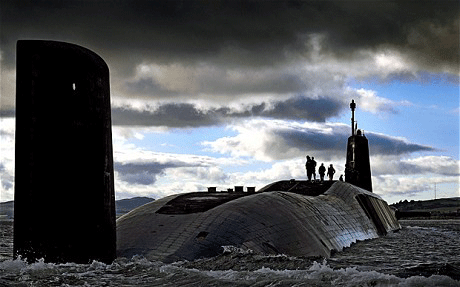
TORY leadership frontrunner Liz Truss has vowed to push ahead with renewing Trident if she wins the keys to Downing Street, as part of plans to “protect the UK”.
The Foreign Secretary has already pledged to boost defence spending to 3% of GDP by 2030 – a promise her rival Rishi Sunak has refused to match because he says he does not believe in “arbitrary targets” when it comes to security.
The Truss campaign has now set out her plan to “protect the UK”, including a “full renewal” of the nuclear deterrent, an update to the Government’s Integrated Review, and strengthened support for intelligence services………………………………..
The SNP have long committed to the removal of Trident nuclear missiles after independence.
The White Paper on independence published ahead of the 2014 independence referendum, promised the “speediest safe withdrawal of nuclear weapons from Scotland”.
In May, Nicola Sturgeon said it was her “expectation and hope” that Trident would be removed from the Faslane naval base on the Clyde in the first Holyrood term after a Yes vote. https://www.thenational.scot/news/20800761.liz-truss-commits-keeping-trident-nuclear-weapons-clyde/
The murder of Daria Dugina- by a Ukrainian neo-Nazi operative?
Nicolas Cinquini
senior intelligence analyst in the field of security risk management, I am a former lieutenant detective and intelligence officer within French State agencies, 24 Aug 22
Around 9:35 pm, on August 20, 2022, an explosion blows up in Moscow suburb the usual car of Alexandr Dugin, that his daughter, Daria Platonova, is driving alone. The 29-year-old woman is killed
Likely the intended target, her father was traveling in another car. On social networks, the Ukrainian nationalists are celebrating the attack. At 12:12 am, time in Paris, 1:12 am in Moscow, Eliot Higgins bullies on Twitter the father of the victim
43-year-old British national Higgins is a blogger and the founder of Bellingcat, the worst example of what the nerds are calling pompously open source intelligence (OSINT). Their analysis do not need to be reliable, they are supporting a political agenda in post-truth Western societies. That work is public and propaganda. Bellingcat is collaborating with atlanticist think tanks and Western intelligence agencies. Higgins and his fellows are morbid russophobic maniacs.
While Ukraine is losing the war on the battlefield, NATO is assessing an asymmetric strategy : threat of a nuclear catastrophe in Energodar, sabotages in Crimea and likely, political assassinations in Russia, which are terrorism.
60-year-old Aleksandr Dugin is a philosopher, was a dissident during the 80s in Soviet Union. In 1993, he co-founded the National Bolshevik Party (NBP), a scholarly mix of far-right and far-left, which opposed later Vladimir Putin -when Dugin had already left in 1998-, was suspected of preparing an armed uprising, was banned in 2007 as an extremist organization. He was the deputy head of the department of sociology of international relations at Moscow State University from 2009 to 2014, was finally not appointed head, while he was denouncing Maidan as a US coup and was calling for a Russian military involvement in Donbass. He has predicted that in Ukraine, the US would fight until the last Ukrainian. Some Ukrainians are fan of Dugin and Kiev democracy is cracking down on them. He is expressing his will to challenge the atlanticist empire, is pleading for eurasianism as a balance. Dugin is on a US sanctions list since 2014.
His daughter Daria was a journalist and an activist, on a US sanctions list since March 2022. She has written that the massacre in Bucha was staged. I am partly supporting this clear reality, think that the special purpose formations of the Ukrainian national police have also slaughtered collaborationists there.
On August 21, in a murder case so far, the investigators are still working on the site of the attack. In a criminal investigation, the first 48 hours are decisive, deserve a special attention. Little sleep for the detectives
In the afternoon, the authorities state
it has already been established that an explosive device was planted under the bottom of the car on the driver’s side
The understanding of the bomb will be a major step. Was it automatic, remotely controlled ? In the second hypothesis, the perpetrators would have finally decided themselves or received the order to trigger the explosion, despite Alexander Dugin was not onboard.
Spokeswoman of the Russian defense ministry, Maria Zakharova states
Russian law enforcement agencies are investigating the death of Daria Dugina. If the Ukrainian trace is confirmed – and this version was voiced by the head of the DPR Denis Pushilin, and it must be verified by the competent authorities – then we should talk about the policy of state terrorism implemented by the Kyiv regime. There have been plenty of facts accumulated over the years : from political calls for violence to the leadership and participation of Ukrainian state structures in crimes. We are waiting for the results of the investigation
Funny effect in Ukraine, where August 24 is also the day of independence since 1991. Media report that from August 22 to 26, all employees of the government neighborhood in Kiev have been recommended to work from home. I guess COVID is not the issue. Strikes on decision centers are feared and in the evening, large traffic jams appear at the exits of Kiev.
47-year-old Ilya Ponomarev is a wealthy businessman, whose political identity is winding, between communism, pan-slavism and social democracy, likely ambitious and opportunist. Then member of the State Duma, he opposed in 2014 the annexation of Crimea. He is living in exile between California and Kiev. Ukrainian nationalist, fan of historical Nazi leader Stepan Bandera, former president Petro Poroshenko has granted him the Ukrainian nationality in 2019. About 24 hours after the assassination of Daria Platonova, Ponomarev publishes a statement on his YouTube channel, February Morning, takes credit for the attack, on behalf of a so-called [Russian] national republican army (NRA). He states that Daria was indeed the target
As a clue of his intellectual integrity, I notice in his statement that Ponomarev is regarding the Ukrainian war crime in Yelenovka as a Russian attack. With so few scruples, he may be the optimal puppet for NATO and Ukrainian special operations in Russia.
………………………………………… 43-year-old Ukrainian national Natalia Shaban has entered Russia in July, rented an apartment in the victim’s building. She has attended the event where the bomb has been fixed under the victim’s car. After the assassination, she has left for Estonia, a NATO country. Last but not the least, while she is traveling with her 12-year-old daughter, Shaban is a Ukrainian operative, State security agency (SBU) or military intelligence (GUR)
Here is her card of the Ukrainian national guard, Nazi Azov regiment. Her call sign is Vovk [on original]
As a senior intelligence analyst in security risk management, I am watching for six months the Ukrainian PSYOPs and false flag crimes. No surprise, the Ukrainian authorities are denying that new terrorist action, their involvement in the assassination of Daria Platonova. They are denying summarily and do not risk to discuss the facts. No surprise, the US State Department and British media are supporting the Ukrainian deny. The Western communication is story-telling and disinformation.
The office of the United Nations High Commissioner for Human Rights believes that those responsible for murder of journalist Daria Dugina should be brought to justice. I agree, extrajudicial denazification should be an ultimate solution, if countries prevent the suspect from appearing before a Russian court.
………….. Russian news agency RIA Novosti reports that Natalia Shaban / Vovk entered Russia in July with a Kazakh passport under the false identity of Yulia Zayko, born on December 26, 1980……………… https://nicolascinquini.blog/2022/08/21/ukrainian-terrorism-in-moscow/
Fears of ‘radiation cloud through Europe’ if Ukraine plant blows.
Nuclear horror warning: Fears of ‘radiation cloud through Europe’ if
Ukraine plant blows. NUCLEAR power expert Dr Paul Dorfman has issued a
stark warning over the dangers of military aggression close to the
Zaporizhzhia plant in Ukraine. Dr Dorfman added: “Radiation doesn’t
respect national boundaries, it’s a question of where the wind blows.
“What we’ve seen here is the weaponisation of civil nuclear, something
a number of people have been worrying about for a significant time now.
“The key takeaway from this is, if and when we get through this, what
does that imply for current and any prospective nuclear in the context of
an unstable world?”
Express 26th Aug 2022
‘Peacemaker’ of death: This Ukrainian website threatens hundreds of thousands with extrajudicial killings — some are Americans
And every time someone unlucky enough to have had his or her home address or other personal data revealed turns up dead, the site is updated: the name of the deceased now appears in bright flickering letters reminiscent of a Las Vegas casino, and the person’s photo is crossed out with the callous inscription: ‘liquidated’.
Rt.com, By Olga Sukharevskaya, ex-Ukrainian diplomat, 28 Aug 22,
Mirotvorets, which compiles lists of ‘enemies of Ukraine’, has been operating with impunity for eight years
For the last eight years, a group of publicly unknown activists in Ukraine have been compiling lists of ‘enemies of the people’ with impunity. Hundreds of thousands have been declared criminals without trial.
Among them are not only Russian citizens, but also Ukrainian opposition figures and bloggers, European politicians, and US citizens. At the very least, being added to this list is a stigma that makes life difficult in Ukraine, but it can also serve as justification for imprisonment or, in some cases, even being killed. This is exactly what happened last weekend to Daria Dugina, daughter of world-famous Russian philosopher Alexander Dugin, who’s name also can be found on that list.
RT explains what is behind the Mirotvorets, or ‘Peacemaker’, website, whose creators seek to bring ‘peace’ to their country with the help of extrajudicial killings, and why the Ukrainian authorities have done nothing about this despite condemnation from the international community.
What is Mirotvorets?
The main page of the Ukrainian Mirotvorets website proclaims that the outlet represents a ‘Center for Research of Signs of Crimes against the National Security of Ukraine, Peace, Humanity, and the International Law’. It claims to have been created by a group of academics, journalists, and other specialists. However, their names are known to no one, and the outfit itself has never even been officially registered in Ukraine.
Nevertheless, this organization has been in operation for nine years, since August 2014. And although it positions itself as “independent, non-state media,” government officials still had a hand in its creation. In fact, the website emerged at the initiative of Anton Gerashchenko, a former adviser to the Ukrainian minister of internal affairs.
Mirotvorets’ activities boil down to publishing personal information on people who the site’s administrators consider a threat, in one way or another, to Ukrainian statehood.
The site’s owners urge the country’s law enforcement agencies to take note of the personal data and activities of the people it lists. However, street radicals sometimes also take heed of Mirotvorets’ lists.
And every time someone unlucky enough to have had his or her home address or other personal data revealed turns up dead, the site is updated: the name of the deceased now appears in bright flickering letters reminiscent of a Las Vegas casino, and the person’s photo is crossed out with the callous inscription: ‘liquidated’.
For example, the current Mirotvorets’ web page design displays this way the data of the Russian journalist Darya Dugina, daughter of the philosopher Aleksandr, who was brutally killed last weekend in her own car.
Despite the accusations from the Russian FSB, Ukraine denies any involvement in that murder. On Mirotvorets, however, Dugina’s death is described with a brief, dehumanizing commentary, along with a conspiracy theory: “Liquidated by the special services of fascist russia (sic) due to interspecies disagreements.”
Who gets on the Mirotvorets lists and how?…………………………..
Mirotvorets not only accuses people of committing ‘crimes’ but also includes more abstract offenses in its lists, such as producing “anti-Ukrainian propaganda” and “participating in anti-Ukrainian propaganda events.” The list even has a section for “agents of influence of the Russian Orthodox Church in Ukraine.” However, such areas are regulated by articles 9-11 of the ‘European Convention on Human Rights’, which concern freedom of expression, conscience, religion, thought, assembly, and association. The Mirotvorets center’s administrators are essentially seeking to deprive people whose opinions and beliefs do not suit them of their right to expression.
In addition, in the site’s ‘On Interaction and Cooperation with the Center’ section, there is a sample form for reporting personal information on ‘criminals’ and their relatives, which includes fields for addresses, phone numbers, photos, links to social network profiles, and their ‘crime’ (i.e., categorization as ‘militant’ or ‘terrorist’), all without trial or investigation.
The ‘criminals’ on public display, along with their wives, children, and parents, don’t even know they’re in ‘Purgatory’, let alone given a chance to defend themselves or cross-examine witnesses and confront their accusers.
A scandal in the noble family
As long as Mirotvorets was limiting itself to publishing information on Ukrainian citizens living in Crimea and Donbass, Ukrainian opposition politicians and journalists, and Russian residents and officials, the odious organization went unnoticed in the ‘civilized world’. But a scandal erupted in 2016, when Mirotvorets published information on employees of a host of media outlets, including the BBC, Reuters, Al Jazeera, AFP, Le Monde, the Guardian, Le Figaro, France 24, El Mundo, CBS News, CNN, Sky News, The Daily Telegraph, The Times, Cheska Televize, Radio France, Channel 9 Australia, the Associated Press, Japan TV, the Daily Mail, Die Welt, the Washington Post and New York Times, as well as representatives of Human Rights Watch and many other organizations, for “cooperating with a terrorist organization” (i.e., the Donetsk and Lugansk People’s Republics).
US State Department spokeswoman Elizabeth Trudeau noted at the time that the US was “very concerned about the hacking of a database and publication of personal information about journalists in combat areas.”
………….. In addition to journalists and human rights defenders, politicians have also made it into Mirotvorets’ database. The website published information on German Bundestag deputies who visited Crimea, a list that includes Evgeny Schmidt, Rainer Balzer, Gunar Lindeman, Harold Latch, Nick Vogel, Helmut Seifen, and Blakes Christian.
Ten US citizens, as well as French actor Samy Naceri, were relegated to ‘Purgatory’ for the same ‘offense’. According to the website, the Greek ‘enemies of Ukraine’ include former Energy Minister Panagiotis Lafazanis, cartoonist Stathis Stavropoulos, retired Air Force Lieutenant General Pavlos Hristou, and ‘Russian Athens’ editor Pavel Onoiko. While former Greek Prime Minister Alexis Tsipras also visited Crimea, he was removed from the database after expressing support for Petro Poroshenko. Top-tier politicians are also represented in Mirotvorets’ lists. Former German Chancellor Gerhard Schroeder can be found there, while Croatian President Zoran Milanovic and Hungarian Prime Minister Viktor Orban have also been recently added, as has authoritative American diplomat Henry Kissinger.
………….. Benjamin Moreau, deputy head of the UN’s human rights monitoring mission in Ukraine, stressed that the problem is moving from a purely legal to a practical one: some banks refuse to issue loans to persons included in the Mirotvorets database.
…………………… Closing Mirotvorets
There have been repeated demands to shut down the website. In 2018, Germany joined the chorus of journalists and human rights activists protesting Gerhard Schroeder’s inclusion in the database. According to the Cabinet of Ministers, “the Government of the Federal Republic of Germany most definitely condemns Mirotvorets and demands that the Ukrainian government and authorities assist in its removal.”
…………………… The Mirotvorets site is still up and continually updated with new data to this day. https://www.rt.com/russia/560965-ukrainian-mirotvorets-website/
A nuclear showdown? One of the greatest ‘realist’ fears about the Russia-Ukraine conflict is actually groundless, and here’s why
The US will not intervene directly, because it’s not an existential crisis for Washington – it stands to lose little from Kiev’s inevitable defeat.
the Ukraine conflict is not an existential one for either the US or NATO; a loss in Ukraine will be another setback – Afghanistan on steroids. But a Ukrainian defeat does not, in and of itself, threaten NATO with collapse or spell the end of the American Republic.
Scott Ritter, 23 Aug 22, Fears that the Ukraine conflict is now bogged down into some sort of stalemate which risks dangerous escalation from the parties involved in order to achieve victory are misplaced. There is only one victor in the Ukraine conflict, and that is Russia. Nothing can change this reality.
Renowned American intellectual John Mearsheimer has written an important article about the conflict, entitled: ‘Playing with Fire in Ukraine: The Underappreciated Risks of Catastrophic Escalation’. The article paints a dark picture about both the nature of the war in Ukraine (prolonged stalemate) and probable outcome (decisive escalation by the parties involved to stave off defeat
Mearsheimer’s underpinning premises, however, are fundamentally flawed. Russia possesses the strategic initiative – militarily, politically, and economically – when it comes to the war in Ukraine and the larger proxy engagement with NATO. Moreover, neither the US nor NATO is in a position to escalate, decisively or otherwise, to thwart a Russian victory, and Russia has no need for any similar escalation on its part.
In short, the Ukraine conflict is over, and Russia has won. All that remains is a long and bloody mopping up.
The key to understanding how Mearsheimer got it so wrong is to dissect his understanding of the ambitions of both the US and Russia when it comes to the issue. According to Mearsheimer, “Since the war began, both Moscow and Washington have raised their ambitions significantly, and both are now deeply committed to winning the war and achieving formidable political aims.”
This passage is especially difficult to parse out. First and foremost, it is extremely difficult to articulate a sound baseline when it comes to assessing US “ambitions” vis-à-vis Ukraine and Russia. President Joe Biden’s administration inherited a policy which had been conceived in the George W. Bush-era and partially implemented under the team of Barack Obama (where Biden played a critical role). This was a very aggressive policy geared toward undermining Russia with the goal of weakening the Russian president, Vladimir Putin, to such an extent that eventually he would be replaced by a figure more amenable to adhering to a US-dictated policy line.
But one cannot pretend that there were not four years of Trump administration policy which threw the anti-Putin – and, by extension, anti-Russia – narrative promulgated by the Obama administration on its head. While Trump was never able to gain traction for his ‘why can’t we be friends’ approach to US-Russian diplomacy, he was able to seriously undermine two major policy pillars which propped the Obama-era policy up, namely NATO unity and Ukrainian solidarity.
The Biden administration was never able to resuscitate the Obama-era policy direction regarding Russia, inclusive of its anti-Putin goals and objectives. Trump’s undermining of NATO’s unity and purpose, when combined with the humiliating pull-out from Afghanistan, put the bloc on the back foot when it came to standing up to the challenge of a Russian state determined to be more assertive about what it viewed as its legitimate national security interests, inclusive of a new European security framework respectful of the notion of a Russian ‘sphere of influence’.
……………………………. neither the US military nor its NATO allies are able to generate the kind of meaningful military capability needed to effectively challenge Russia on the ground in Ukraine.
This reality severely limits the scope and scale of any possible US ambitions regarding Ukraine. At the end of the day, Washington has only one path forward – to continue to waste billions of dollars of taxpayers’ money sending military equipment to Ukraine, which has no chance of changing the outcome on the battlefield, to convince a domestic American audience that their government is ‘doing the right thing’ in a losing effort.
There is no ‘military option’ in Ukraine for either the US or NATO because, simply put, there is no military capable of meaningfully executing such an option.
This conclusion is critical to understanding Russia’s ‘ambitions’. Unlike the US, Russia has articulated clear and concise objectives regarding its decision to dispatch military forces into Ukraine. These can be described as follows: Permanent Ukrainian neutrality (i.e., no NATO membership), the de-Nazification of Ukraine (the permanent eradication of the odious nationalistic ideology of Stepan Bandera), and the de-militarization of the state – the destruction and elimination of all traces of NATO involvement in the security affairs of Ukraine.
These three objectives only reflect the immediate goals of the Special Military Operation in Ukraine. The ultimate objective – a restructured European security framework that has all NATO infrastructure withdrawn to the 1997 boundaries of that alliance – remains as a non-negotiable requirement that will have to be addressed after Russia secures its final military and political victory in Ukraine.
In short, Russia is winning on the ground in Ukraine, and there is nothing either the US or NATO can do to alter this outcome. And once Russia secures this victory, it will be in a far stronger position to insist that its concerns about a viable European security framework be respected and implemented.
Mearsheimer believes that the situation on the ground in Ukraine provides both the US and Russia with “powerful incentives to find ways to prevail and, more important, to avoid losing.”
At the end of the day, the Ukraine conflict is not an existential one for either the US or NATO; a loss in Ukraine will be another setback – Afghanistan on steroids. But a Ukrainian defeat does not, in and of itself, threaten NATO with collapse or spell the end of the American Republic.
Simply put, Mearsheimer’s fear that a loss in Ukraine “means that the United States might join the fighting either if it is desperate to win or to prevent Ukraine from losing” is unfounded.
So, too, is his contention that “Russia might use nuclear weapons if it is desperate to win or faces imminent defeat, which would be likely if US forces were drawn into the fighting.” Russia neither “faces defeat” nor has anything to worry about, existentially, from a US military intervention which, from all practical points of view, could not materialize even if the US wanted to be so bold…… https://www.rt.com/russia/561376-ukraine-russia-conflict-us/
Imperiled Ukrainian nuclear power plant has the world on edge – a safety expert explains what could go wrong
The Conversation, Najmedin Meshkati, 26 Aug 22, “…………………………………… What are the risks to a nuclear plant in a conflict zone?
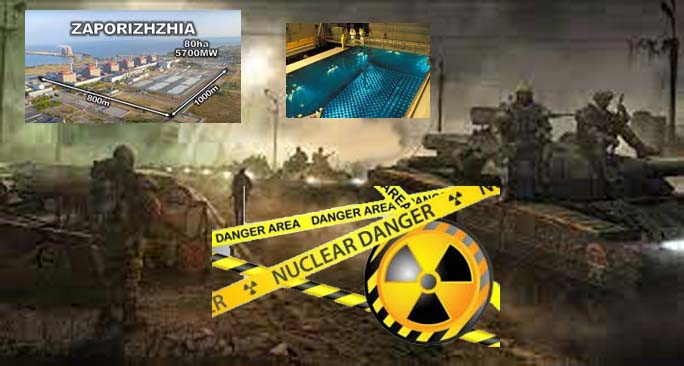
Nuclear power plants are built for peacetime operations, not wars.
The worst thing that could happen is if a site is deliberately or accidentally shelled. If a shell hit the plant’s spent fuel pool – which contains the still-radioactive spent fuel – or if fire spread to the spent fuel pool, it could release radiation. This spent fuel pool isn’t in the containment building, and as such is more vulnerable.
Containment buildings, which house nuclear reactors, are also not protected against deliberate shelling. They are built to withstand a minor internal explosion of, say, a pressurized water pipe. But they are not designed to withstand a huge explosion.
As to the reactors in the containment building, it depends on the weapons being used. The worst-case scenario is that a bunker-buster missile breaches the containment dome – consisting of a thick shell of reinforced concrete on top of the reactor – and explodes. That would badly damage the nuclear reactor and release radiation into the atmosphere, which would make it difficult to send in first responders to contain any resulting fire. It could be another Chernobyl.
What are the concerns going forward?
The safety problems I see are twofold:
1) Human error……….
2) Power failure
The second problem is that the nuclear plant needs constant electricity, and that is harder to maintain in wartime.
Even if you shut down the reactors, the plant will need off-site power to run the huge cooling system to remove the residual heat in the reactor and bring it to what is called a cold shutdown. Water circulation is always needed to make sure the spent fuel doesn’t overheat.
Spent fuel pools also need constant water circulation to keep them cool, and they need cooling for several years before they can be put in dry casks. One of the problems in the 2011 Fukushima disaster in Japan was the emergency generators intended to replace lost off-site power got inundated with water and failed. In situations like that, you get “station blackout” – and that is one of the worst things that could happen. It means no electricity to run the cooling system.
In that circumstance, the spent fuel overheats and its zirconium cladding can create hydrogen bubbles. If you can’t vent these bubbles, they will explode, spreading radiation.
If there is a loss of outside power, operators will have to rely on emergency generators. But emergency generators are huge machines – finicky, unreliable gas guzzlers. And you still need cooling waters for the generators themselves.
My biggest worry is that Ukraine suffers from a sustained power grid failure. The likelihood of this increases during a conflict because power line pylons may come down under shelling, or gas power plants might get damaged and cease to operate. …………………….
How else does a war affect the safety of nuclear plants?
One of the overarching concerns about the effects of war on nuclear plants is that war degrades safety culture, which is crucial in running a plant……………………..
War adversely affects safety culture in a number of ways. Operators are stressed and fatigued and may be scared to death to speak out if something is going wrong. Then there is the maintenance of a plant, which may be compromised by lack of staff or unavailability of spare parts.
Governance, regulation and oversight – all crucial for the safe running of a nuclear industry – are also disrupted, as is local infrastructure, such as the capability of local firefighters. In war, everything is harder…………….. https://theconversation.com/imperiled-ukrainian-nuclear-power-plant-has-the-world-on-edge-a-safety-expert-explains-what-could-go-wrong-189429
Russia-Ukraine war: Ukraine announces mandatory evacuations
Guardian 27 Aug 22, Residents near the Zaporizhzhia nuclear power plant in Ukraine have reportedly been given iodine tablets, amid mounting fears that the fighting around the complex could trigger a catastrophe. It comes after the plant, Europe’s biggest nuclear power plant, was temporarily disconnected from Ukraine’s national grid after all lines to it were cut on Thursday.
……………..
- By Friday afternoon, Energoatom, Ukraine’s state nuclear agency, said one of the two working reactors had been reconnected to the grid. The one reactor is building up capacity, the agency said, thanking the plant’s working for “tirelessly and firmly” keeping “the nuclear and radiation safety of Ukraine and the whole of Europe on their shoulders”.
- ………………………….A team of inspectors from the UN nuclear watchdog are poised to make an emergency visit to the Russian-occupied Zaporizhzhia nuclear power plant in southeastern Ukraine, according to reports. Sources have told the Wall Street Journal that it is “almost certain” that a mission from the International Atomic Energy Agency (IAEA) will visit the plant early next week, although details are still being completed.
- EU energy ministers will gather for an urgent meeting as soon as possible to discuss the current energy crisis following Russia’s invasion of Ukraine, the Czech prime minister said. The Czech Republic currently holds the presidency of the European Council.
- Ukraine’s deputy prime minister, Iryna Vereshchuk, has announced plans to expand mandatory evacuations for civilians living on the war’s front lines. Speaking on national television, Vereshchuk said evacuating women with children and elderly people would be a priority from some districts of the eastern Kharkiv region and the southern Zaporizhzhia and Mykolaiv regions.
- …………………………………….. The German ambassador to the UK has acknowledged that there is a risk that public support for Ukraine could wane this winter as the energy crisis intensifies.
Russia says it destroyed howitzer used to shell Zaporizhzhia nuclear plant
Aug 26 (Reuters) – Russia’s Defence Ministry said on Friday that its forces had destroyed a U.S.-made M777 howitzer which it said Ukraine had used to shell the Russian-controlled Zaporizhzhia nuclear plant.
In its daily briefing, the Defence Ministry said that the howitzer had been destroyed west of the town of Marganets, in Ukraine’s Dnipropetrovsk region.
Reuters could not immediately verify the report.
The Zaporizhzhia nuclear plant, Europe’s largest, was captured by Russian forces in March. It remains near the frontline, and has repeatedly come under fire in recent weeks. Both Ukraine and Russia have accused each other of shelling the facility.
Fears of a radiation leak mount near Ukrainian nuclear plant
WHSV3 By PAUL BYRNE, Aug. 26, 2022 ,
KYIV, Ukraine (AP) — Authorities began distributing iodine tablets to residents near Ukraine’s Zaporizhzhia nuclear power plant Friday in case of a radiation leak, amid mounting fears that the fighting around the complex could trigger a catastrophe.
The move came a day after the plant was temporarily knocked offline because of what officials said was fire damage to a transmission line. The incident heightened dread of a nuclear disaster in a country still haunted by the 1986 explosion at Chernobyl.
Continued shelling was reported in the area overnight, and satellite images from Planet Labs showed fires burning around the complex — Europe’s biggest nuclear plant — over the last several days.
Iodine tablets, which help block the absorption of radioactive iodine by the thyroid gland in a nuclear accident, were issued in the Ukrainian-controlled city of Zaporizhzhia, about 45 kilometers (27 miles) from the plant. A woman and her small daughter were among those receiving the pills……………..
In Thursday’s incident, Ukraine and Russia blamed one another for the transmission-line damage that knocked the plant off the power grid………
The plant requires power to run the reactors’ vital cooling systems. A loss of cooling could lead to a nuclear meltdown.
Ukrenergo, Ukraine’s transmission system operator, reported Friday that two damaged main lines supplying the plant with electricity had resumed operation, ensuring a stable power supply.
Hungary approves construction of two Russian-built nuclear reactors
Work to begin in coming weeks in move that emphasises ties between Viktor Orbán and Vladimir Putin.
Agence France-Presse in Budapest,Sat 27 Aug 2022
Hungary has announced that the €12.5bn (£10.6bn) construction of two nuclear reactors by Russia’s Rosatom will begin in the coming weeks after regulators approved the project.
The war in Ukraine has not deterred Hungary’s interest in the project to add to the four reactors already operating at the Paks plant outside Budapest.
The fact it is moving forward is another indication of the close ties between Hungary’s nationalist prime minister, Viktor Orbán, and the Russian president, Vladimir Putin.
“This is a big step, an important milestone,” the Hungarian foreign minister, Péter Szijjártó, said on Facebook after the national regulator issued a permit on Thursday after numerous delays.
………………………….Russia is financing most of the project with a €10bn loan to Hungary, which is paying the remaining €2.5bn.
………… Hungary has obtained exceptions and has negotiated extra deliveries of natural gas………………………. https://www.theguardian.com/world/2022/aug/26/hungary-approves-construction-two-russian-built-nuclear-reactors
Is NATO a Defensive Alliance?
The Hidden Truth about the War in Ukraine, The Postil Magazine, Jacques Baud “………………………………………………………………………………………… NATO’s rationale is to bring European Allies under the US nuclear umbrella. It was designed as a defensive alliance, although recently declassified US documents show that the Soviets had apparently no intention to attack the West.
For the Russians, the question about whether NATO is offensive or defensive is beside the point. To understand Putin’s point of view, we have to consider two things that are usually overlooked by Western commentators: the enlargement of NATO towards the East, and the incremental abandonment of the international security’s normative framework by the US.
In fact, as long as the US didn’t deploy missiles in the vicinity of its borders, Russia didn’t bother so much about NATO extension. Russia itself considered to apply for membership. But problems stated to appear in 2001, as George W. Bush decided to unilaterally withdraw from the ABM Treaty and to deploy anti-ballistic missiles (ABM) in Eastern Europe. The ABM Treaty was intended to limit the use of defensive missiles, with the rationale of maintaining the deterrent effect of a mutual destruction by allowing the protection of decision-making bodies by a ballistic shield (in order to preserve a negotiating capacity). Thus, it limited the deployment of anti-ballistic missiles to certain specific zones (notably around Washington DC and Moscow) and prohibited it outside national territories.
Since then, the United States has progressively withdrawn from all the arms control agreements established during the Cold War: the ABM Treaty (2002), the Open Skies Treaty (2018) and the Intermediate-range Nuclear Forces (INF) Treaty (2019).
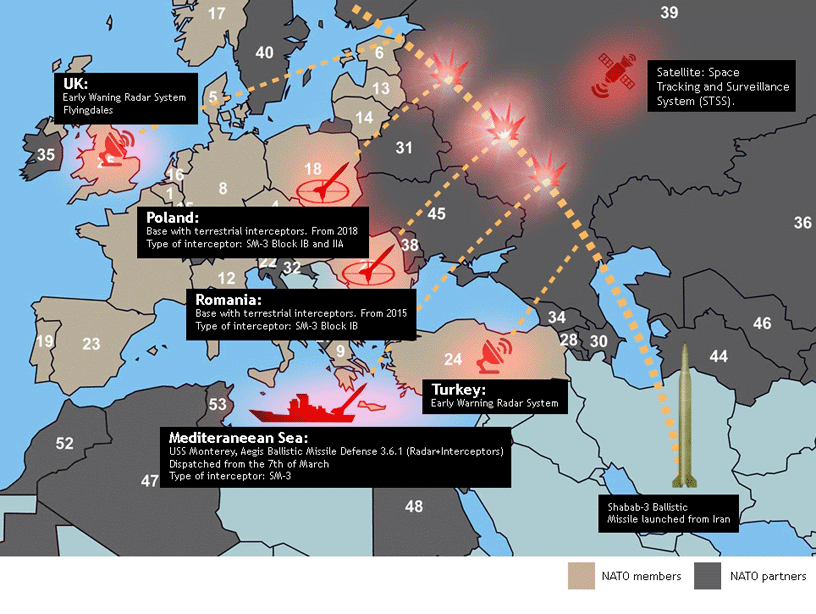
In 2019, Donald Trump justified his withdrawal from the INF Treaty by alleged violations by the Russian side. But, as the Stockholm International Peace Research Institute (SIPRI) notes, the Americans never provided proof of these violations. In fact, the US was simply trying to get out of the agreement in order to install their AEGIS missile systems in Poland and Romania. According to the US administration, these systems are officially intended to intercept Iranian ballistic missiles. But there are two problems that clearly cast doubt on the good faith of the Americans:
The first one is that there is no indication that the Iranians are developing such missiles, as Michael Ellemann of Lockheed-Martin stated before a committee of the American Senate.The second one is that these systems use Mk41 launchers, which can be used to launch either anti-ballistic missiles or nuclear missiles. The Radzikowo site, in Poland, is 800 km from the Russian border and 1,300 km from Moscow.
The Bush and Trump administrations said that the systems deployed in Europe were purely defensive. However, even if theoretically true, it is technically and strategically false. For the doubt, which allowed them to be installed, is the same doubt that the Russians could legitimately have in the event of a conflict. This presence in the immediate vicinity of Russia’s national territory can indeed lead to a nuclear conflict. For in the event of a conflict, it would not be possible to know precisely the nature of the missiles loaded in the systems—should the Russians therefore wait for explosions before reacting? In fact, we know the answer: having no early-warning time, the Russians would have practically no time to determine the nature of a fired missile and would thus be forced to respond pre-emptively with a nuclear strike.
Not only does Vladimir Putin see this as a risk to Russia’s security, but he also notes that the United States is increasingly disregarding international law in order to pursue a unilateral policy. This is why Vladimir Putin says that European countries could be dragged into a nuclear conflict without wanting to. This was the substance of his speech in Munich in 2007, and he came with the same argument early 2022, as Emmanuel Macron went to Moscow in February.
Finland and Sweden in NATO—A Good Idea?
The future will tell if Sweden’s and Finland’s decision to apply for NATO membership was a wise idea. They probably overstated the value of the nuclear protection offered by NATO. As a matter of fact, it is very unlikely that the US will sacrifice its national soil by striking Russian soil for the sake of Sweden or Finland. It is more likely that if the US engages nuclear weapons, it will be primarily on European soil and only as a last resort on Russian territory, in order to preserve its own territory from nuclear counter-strike.
Further, these two countries, which met the criteria of neutrality that Russia would want for its direct neighbors, deliberately put themselves in Russia’s nuclear crosshairs. For Russia, the main threat comes from the Central European theater of war. In other words, in the event of a hypothetical conflict in Europe, Russian forces would be engaged primarily in Central Europe, and could use their theater nuclear armies to “flank” their operations by striking the Nordic countries, with virtually no risk of a U.S. nuclear response.
Was it Impossible to Leave the Warsaw Pact?
The Warsaw Pact was created just after Germany joined NATO, for exactly the same reasons we have described above. Its largest military engagement was the invasion of Czechoslovakia in August 1968 (with the participation of all Pact nations, except Albania and Romania). This event resulted in Albania withdrawing from the Pact less than a month later, and Romania ceasing to participate actively in the military command of the Warsaw Pact after 1969. Therefore, asserting that no one was free to leave the treaty is not correct. https://www.thepostil.com/the-hidden-truth-about-the-war-in-ukraine/
The Hidden Truth about the War in Ukraine, and about Crimea and Donbass – Jacques Baud
The whole Western narrative about the “annexation” of Crimea is based on a rewriting of history and the obscuring of the 1991 referendum, which did exist and was perfectly valid.
The 1994 Budapest Memorandum remains extensively quoted since February 2022, but the Western narrative simply ignores the 1997 Friendship Treaty which is the reason for the discontent of the Russian-speaking Ukrainian citizens.
The Postil Magazine, Jacques Baud The cultural and historical elements that determine the relations between Russia and Ukraine are important. The two countries have a long, rich, diverse, and eventful history together.
This would be essential if the crisis we are experiencing today were rooted in history. However, it is a product of the present. The war we see today does not come from our great-grandparents, our grandparents or even our parents. It comes from us. We created this crisis. We created every piece and every mechanism. We have only exploited existing dynamics and exploited Ukraine to satisfy an old dream: to try to bring down Russia. Chrystia Freeland’s, Antony Blinken’s, Victoria Nuland’s and Olaf Scholz’s grandfathers had that dream; we realized it.
The way we understand crises determines the way we solve them. Cheating with the facts leads to disaster. This is what is happening in Ukraine. In this case the number of issues is so enormous that we will not be able to discuss them here. Let me just focus on some of them.
Did James Baker make Promises to Limit Eastward Expansion of NATO to Mikhail Gorbachev in 1990?
…………………………………………………………. In February 2022, in the German magazine Der Spiegel, Joshua Shifrinson, an American political analyst, revealed a declassified SECRET document of March 6, 1991, written after a meeting of the political directors of the foreign ministries of the United States, Great Britain, France and Germany. It reports the words of the German representative, Jürgen Chrobog:
We made it clear in the 2+4 negotiations that we would not extend NATO beyond the Elbe. Therefore, we cannot offer NATO membership to Poland and the others.
The representatives of the other countries also accepted the idea of not offering NATO membership to the other Eastern European countries.
So, written record or not, there was a “deal,” simply because a “deal” was inevitable. Now, in international law, a “promise” is a valid unilateral act that must be respected (“promissio est servanda“). Those who deny this today are simply individuals who do not know the value of a given word.
Did Vladimir Putin disregard the Budapest Memorandum (1994)?
In February 2022, at the Munich Security Forum, Volodymyr Zelensky referred to the 1994 Budapest Memorandum and threatened to become a nuclear power again. However, it is unlikely that Ukraine will become a nuclear power again, nor will the nuclear powers allow it to do so. Zelensky and Putin know this. In Fact, Zelensky is not using this memorandum to get nuclear weapons, but to get Crimea back, since the Ukrainians see Russia’s annexation of Crimea as a violation of this treaty. Basically, Zelensky is trying to hold Western countries hostage. To understand that we must go back to events and facts that are opportunistically “forgotten” by our historians.
On 20 January 1991, before the independence of Ukraine, the Crimeans were invited to choose by referendum between two options: to remain with Kiev or to return to the pre-1954 situation and be administered by Moscow. The question asked on the ballot was:
Are you in favor of the restoration of the Autonomous Soviet Socialist Republic of Crimea as a subject of the Soviet Union and a member of the Union Treaty?
This was the first referendum on autonomy in the USSR, and 93.6% of Crimeans agreed to be attached to Moscow. The Autonomous Soviet Socialist Republic of Crimea (ASSR Crimea), abolished in 1945, was thus re-established on 12 February 1991 by the Supreme Soviet of the Ukrainian SSR.
On 17 March, Moscow organized a referendum for the maintenance of the Soviet Union, which would be accepted by Ukraine, thus indirectly validating the decision of the Crimeans. At this stage, Crimea was under the control of Moscow and not Kiev, while Ukraine was not yet independent. As Ukraine organized its own referendum for independence, the participation of the Crimeans remained weak, because they did not feel concerned anymore.
Ukraine became independent six months after Crimea, and after the latter had proclaimed its sovereignty on September 4. On February 26, 1992, the Crimean parliament proclaimed the “Republic of Crimea” with the agreement of the Ukrainian government, which granted it the status of a self-governing republic. On 5 May 1992, Crimea declared its independence and adopted a Constitution. The city of Sevastopol, managed directly by Moscow in the communist system, had a similar situation, having been integrated by Ukraine in 1991, outside of all legality. The following years were marked by a tug of war between Simferopol and Kiev, which wanted to keep Crimea under its control.
In 1994, by signing the Budapest Memorandum, Ukraine surrendered the nuclear weapons of the former USSR that remained on its territory, in exchange for “its security, independence and territorial integrity.” At this stage, Crimea considered that it was—de jure—no longer part of Ukraine and therefore not concerned by this treaty. On its side, the government in Kiev felt strengthened by the memorandum. This is why, on 17 March 1995, it forcibly abolished the Crimean Constitution. It sent its special forces to overthrow Yuri Mechkov, President of Crimea, and de facto annexed the Republic of Crimea, thus triggering popular demonstrations for the attachment of Crimea to Russia. An event hardly reported by the Western media.
Crimea was then governed in an authoritarian manner by presidential decrees from Kiev. This situation led the Crimean Parliament to formulate a new constitution in October 1995, which re-established the Autonomous Republic of Crimea. This new constitution was ratified by the Crimean Parliament on 21 October 1998 and confirmed by the Ukrainian Parliament on 23 December 1998. These events and the concerns of the Russian-speaking minority led to a Treaty of Friendship between Ukraine and Russia on 31 May 1997. In the treaty, Ukraine included the principle of the inviolability of borders, in exchange—and this is very important—for a guarantee of “the protection of the ethnic, cultural, linguistic and religious originality of the national minorities on their territory.”
On 23 February 2014, not only did the new authorities in Kiev emerge from a coup d’état that had definitely no constitutional basis and were not elected; but, by abrogating the 2012 Kivalov-Kolesnichenko law on official languages, they no longer respected this guarantee of the 1997 treaty. The Crimeans therefore took to the streets to demand the “return” to Russia that they had obtained 30 years earlier.
On March 4, during his press conference on the situation in Ukraine a journalist asked Vladimir Putin, “How do you see the future of Crimea? Do you consider the possibility that it joins Russia?” he replied:
No, we do not consider it. In general, I believe that only the residents of a given country who are free to decide and safe can and should determine their future. If this right has been granted to the Albanians in Kosovo, if this has been made possible in many parts of the world, then no one is excluding the right of nations to self-determination, which, as far as I know, is laid down in several UN documents. However, we will in no way provoke such a decision and will not feed such feelings.
On March 6, the Crimean Parliament decided to hold a popular referendum to choose between remaining in Ukraine or requesting the attachment to Moscow. It was after this vote that the Crimean authorities asked Moscow for an attachment to Russia.
With this referendum, Crimea had only recovered the status it had legally acquired just before the independence of Ukraine. This explains why it renewed its request to be attached to Moscow, as in January 1991.
Moreover, the status of force agreement (SOFA) between Ukraine and Russia for the stationing of troops in Crimea and Sevastopol had been renewed in 2010 and to run until 2042. Russia therefore had no specific reason to claim this territory. The population of Crimea, which legitimately felt betrayed by the government of Kiev, seized the opportunity to assert its rights.
On 19 February 2022, Anka Feldhusen, the German ambassador in Kiev, threw a spanner in the works by declaring on the television channel Ukraine 24 that the Budapest Memorandum was not legally binding. Incidentally, this is also the American position, as shown by the statement on the website of the American embassy in Minsk.
The whole Western narrative about the “annexation” of Crimea is based on a rewriting of history and the obscuring of the 1991 referendum, which did exist and was perfectly valid. The 1994 Budapest Memorandum remains extensively quoted since February 2022, but the Western narrative simply ignores the 1997 Friendship Treaty which is the reason for the discontent of the Russian-speaking Ukrainian citizens.
Is the Ukrainian Government Legitimate?
The Russians still see the regime change that occurred in 2014 as illegitimate, as it was not done through constitutional process and without any support from a large part of the Ukrainian population.
The Maidan revolution can be broken down into several sequences, with different actors. Today, those who are driven by hatred of Russia are trying to merge these different sequences into one single “democratic impulse”: A way to validate the crimes committed by Ukraine and its neo-Nazis zealots.
At first, the population of Kiev, disappointed by the government’s decision to postpone the signing of the treaty with the EU, gathered in the streets. Regime change was not in the air. This was a simple expression of discontent.
Contrary to what the West claims, Ukraine was then deeply divided on the issue of rapprochement with Europe. A survey conducted in November 2013 by the Kyiv International Institute of Sociology (KIIS) shows that it was split almost exactly “50/50” between those who favored an agreement with the European Union and those favoring a customs union with Russia. In the south and east of Ukraine, industry was strongly linked to Russia, and workers feared that an agreement excluding Russia would kill their jobs. That is what would eventually happen. In fact, at this stage, the aim was already to try to isolate Russia.
In the Washington Post, Henry Kissinger, Richard Nixon’s National Security Advisor, noted that the European Union “helped turn a negotiation into a crisis.”
What happened later involved ultranationalist and neo-Nazis groups coming from the Western part of the country. Violence erupted and the government withdrew, after signing an agreement with the rioters for new elections. But this was quickly forgotten.
It was nothing less than a coup d’état, led by the United States with the support of the European Union, and carried out without any legal basis, against a government whose election had been qualified by the OSCE as “transparent and honest” and having “offered an impressive demonstration of democracy.” In December 2014, George Friedman, president of the American geopolitical intelligence platform STRATFOR, said in an interview:
Russia defines the event that took place at the beginning of this year [in February 2014] as a coup organized by the US. And as a matter of fact, it was the most blatant [coup] in history.
Unlike European observers, the Atlantic Council, despite being strongly in favor of NATO, was quick to note that the Maidan revolution had been hijacked by certain oligarchs and ultra-nationalists. It noted that the reforms promised by Ukraine had not been carried out and that the Western media stuck to an acritical “black and white” narrative.
A telephone conversation between Victoria Nuland, then Assistant Secretary of State for Europe and Eurasia, and Geoffrey Pyatt, the U.S. ambassador to Kiev, revealed by the BBC, shows that the Americans themselves selected the members of the future Ukrainian government, in defiance of the Ukrainians and the Europeans. This conversation, which became famous thanks to Nuland’s famous “F*** the EU!”
The coup d’état was not unanimously supported by the Ukrainian people, either in substance or in form. It was the work of a minority of ultra-nationalists from western Ukraine (Galicia), who did not represent the whole Ukrainian people. Their first legislative act, on 23 February 2014, was to abrogate the 2012 Kivalov-Kolesnichenko law, which established the Russian language as an official language along with Ukrainian. This is what prompted the Russian-speaking population to start massive protests in the southern part of the country, against authorities they had not elected.
In July 2019, the International Crisis Group (funded by several European countries and the Open Society Foundation), noted:
The conflict in eastern Ukraine began as a popular movement. […]
The protests were organized by local citizens claiming to represent the Russian-speaking majority in the region. They were concerned both about the political and economic consequences of the new government in Kiev and about that government’s later abandoned measures to prevent the official use of the Russian language throughout the country [“Rebels without a Cause: Russia’s Proxies in Eastern Ukraine,” International Crisis Group, Europe Report N° 254, 16 juillet 2019, p. 2].
Western efforts to legitimate this far-right coup in Kiev led to hide the opposition in the southern part of the country. In order to present this revolution as democratic, the real “hand of the West” was cleverly masked by the imaginary “hand of Russia.” This is how the myth of a Russian military intervention was created. Allegations about a Russian military presence were definitely false, an event the chief of the Ukrainian Security service (SBU) confessed in 2015 that there were no Russian units in Donbass.
To make things worse, Ukraine didn’t gain legitimacy through the way it handled the rebellion. In 2014-2015, poorly advised by NATO military, Ukraine waged a war that could only lead to its defeat: it considered the populations of Donbass and Crimea as enemy foreign forces and made no attempt to win the “hearts and minds” of the autonomists. Instead, its strategy has been to punish the people even further. Bank services were stopped, economic relations with the autonomous regions were simply cut, and Crimea didn’t receive drinking water anymore.
This is why there are so many civilian victims in the Donbass, and why the Russian population still stands in majority behind its government today. The 14,000 victims of the conflict tend to be attributed to the “Russian invaders” and the so-called “separatists.” However, according to the United Nations—more than 80% of civilian casualties are the result of Ukrainian shelling. As we can see, the Ukrainian government is massacring its own people with the help, funding and advice of the military of NATO, the countries of the European Union, which defends its values.
In May 2014, the violent repression of protests prompted the population of some areas of the Donetsk and Lugansk regions of Ukraine to hold referendums for Self-Determination in the Donetsk People’s Republic (approved by 89%) and in the Lugansk People’s Republic (approved by 96%). Although Western media keeps calling them referendums of “independence,” they are referendums of “self-determination” or “autonomy” (самостоятельность). Until February 2022, our media consistently talked about “separatists” and “separatist republics.” In reality, as stated in the Minsk Agreement, these self-proclaimed republics didn’t seek “independence,” but an “autonomy” within Ukraine, with the ability to use their own language and their own customs………………………………………. more https://www.thepostil.com/the-hidden-truth-about-the-war-in-ukraine/
NATO Abandons Diplomacy, Says No Longer ‘At Peace’
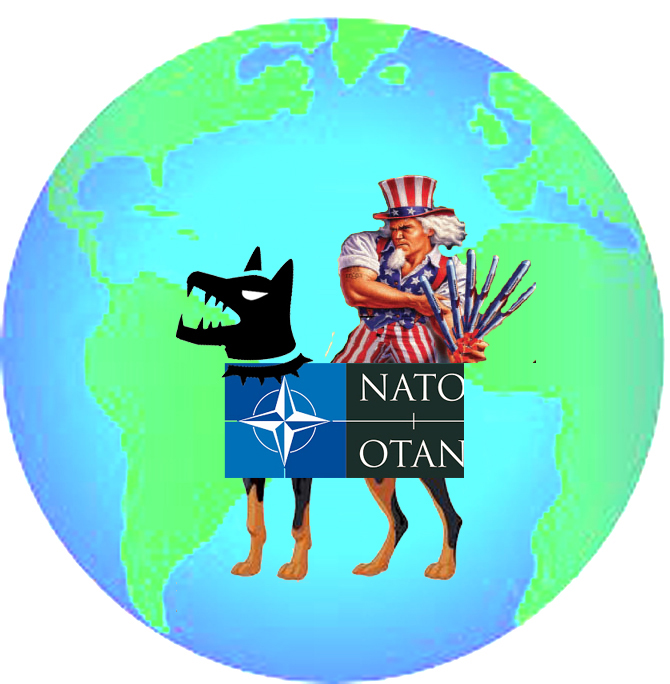
Libertarian Instituteby Bas Spliet | Aug 23, 2022 At the end of its annual summit in Madrid in late June, NATO adopted a new strategic concept. The guidance document is the eighth of its kind since the founding of the alliance in 1949. It radically breaks with the three previous post-Cold War security briefs, however, which observed that “the Euro-Atlantic area is at peace” because “the threat of a conventional attack against NATO territory is low.”
In the eyes of NATO, Russia’s invasion of Ukraine has changed that calculus, claiming that the military organization can no longer discount the possibility of an assault on sovereign NATO states. Continuing the same cryptic language, the new strategic concept concludes that the Euro-Atlantic area now is “not at peace,” in spite of no NATO member being in a state of war with Russia.
Behind this word play, a more dangerous policy change has been codified in the document. Since the adoption of the Harmel Report in 1967, NATO has always officially included diplomacy in one form or another (with political dialogue and strategic partnership being interchangeable labels) as one of its “core” or “fundamental” tasks. The “NATO 2030” report from November 2020, for instance, unequivocally stated that “NATO should continue the dual-track approach of deterrence and dialogue with Russia.”
In the new strategic concept, the core tasks have been purged of the need for diplomacy, except for one or two throw-away lines about “meaningful and reciprocal political dialogue” about arms control issues buried in the middle of the text. Rather, in addition to its original function of deterrence and defense, NATO now fully embraces “crisis prevention and management,” which it has spearheaded since the 1990s with its legally dubious and morally questionable interventions in the Balkans, Afghanistan, and Libya; and “cooperative security,” referring to NATO’s enlargement in Eastern Europe and its Partnership for Peace cooperation with countries in ever further-away regions, including the Black Sea, the Middle East, North Africa, and even the Indo-Pacific, which the British have been pushing to include in a “global NATO.”
Russia was the first country to sign up for the Partnership for Peace program back in 1994. The new NATO doctrine, however, states that Russia can no longer be considered a partner “in light of its hostile policies and actions.” The strategic concept ignores the fact that NATO’s enlargement and new core tasks, which the alliance adopted after the Cold War in an effort to justify its continued existence, have likewise long been seen as hostile in Moscow, nor does it offer any reflection on how the new policies might have contributed to the current unpeaceful “strategic environment.” Instead, it hails the “historic success” of NATO’s expansion in terms of space and substance and insists that the alliance “does not seek confrontation and poses no threat to the Russian federation.”
……………………………….. Now, NATO apologists, like Ukrainian President Volodymyr Zelensky, argue that if the alliance had not expanded eastward, Vladimir Putin would have been even bolder in his imperial ambitions. But as John Mearsheimer pointed out back in 2014, there is virtually no evidence that Putin aimed to incorporate Crimea before the Maidan coup. Rather, his offensive foreign policy in Ukraine since 2014, culminating in the 2022 invasion, is one of reaction to NATO creeping up to Russia’s borders. Bringing Ukraine into the NATO fold has long been a big fat redline for Russia, and we crossed it.
First of all, West-European officials promised the Soviets after the fall of the Berlin Wall that NATO’s borders would not move “one inch” eastward. But then all former Warsaw Pact countries and even some former Soviet Republics were incorporated in the 1990s and early 2000s. In addition to the evidence the National Security Archive assembled on this issue a few years ago, recent archival research has once again confirmed these broken promises.
Next, in 2008, Russian Foreign Minister Sergei Lavrov warned American diplomats that further NATO enlargement, particularly to Ukraine, would constitute a “potential military threat.” …………………………….
After 2014, Ukraine started to become a de facto member of NATO, which bolstered the Ukrainian regime to take a tough stance against Russia. In 2017, Trump decided to sell “defensive weapons” to Kyiv. Other NATO countries got in on the act, shipping weapons to Ukraine, training its military and teaming up with it in joint air and naval exercises. In June 2021, a British destroyer sailed through the Black Sea in an effort to shore up support for Ukraine, precipitating a diplomatic stand-off with Russia. NATO was undeterred, however, because a total of 32 countries participated in a major naval exercise in the Black Sea one month later.
In response, Russia decided to engage in coercive diplomacy, much like the Obama administration had done to get Iran to sign on to the 2015 nuclear deal. Putin amassed troops on the Ukrainian border, demanding guarantees that no offensive missiles would be installed in Eastern Europe and Ukraine not to join NATO. When the crisis was not solved diplomatically, Russia invaded Ukraine. Up until recently, there was hardly any diplomatic intercourse between Washington and Moscow in order to resolve the conflict. The UK’s Boris Johnson, too, “urged against negotiations” during a trip to Kyiv in April. Other NATO members, such as France, Germany, Italy and Hungary, have warmed to negotiations. But as long as there is no bigger push to re-establish diplomacy as a core task of the military alliance, Wilsonian rhetoric is likely to continue to make the world unsafe. https://libertarianinstitute.org/articles/nato-abandons-diplomacy-says-no-longer-at-peace/—
Emotionless Liz Truss says she would unleash nuclear annihilation if necessary
Emotionless Liz Truss says she would unleash nuclear annihilation if
necessary. The Tory frontrunner told a hustings event in Birmingham that
ordering the use of nuclear weapons is an “important part of being Prime
Minister”.
Mirror 23rd Aug 2022
https://www.mirror.co.uk/news/politics/emotionless-liz-truss-says-would-27816744
Ukrainian Hit List – targets Pink Floyd’s Roger Waters, Daria Dugina,Kissinger and 1000s of journalists
Roger Waters added to Ukrainian Hit List “Pink Floyd” star declared “Enemy of Ukraine” , Medium.com Deborah L. Armstrong 23 Aug 22
I have written about the Ukrainian hitlist known as Mirotvorets, or “Peacekeeper,” twice before. The first time was in this article about internet censorship, and the second time was when a 13-year-old Ukrainian girl, Faina Savenkova, was added to the list for publicly speaking out against Kiev’s bloody war on Russian-speaking civilians in the eastern part of Ukraine, a region known as the Donbass.
Mirotvorets is a database which lists thousands of journalists, activists, and anyone else who is declared an “Enemy of Ukraine.” Their personal information is published, such as the addresses of their homes, their phone numbers and bank account numbers; anything that can help them be easily located. When the people on this list are murdered, like Italian journalist Andrea Rocchelli was, the word ЛИКВИДИРОВАН, “LIQUIDATED,” written in Ukrainian, is stamped across their picture in big red letters.
And, as of today, Daria Dugina, who was killed in a car bomb explosion in Moscow on Saturday, appears as “liquidated” on the website, adding more credibility to Russia’s assertion that she was assassinated by a Ukrainian nationalist who rented an apartment in the building where Daria lived in order to surveil her prior to her killing. It is believed that she was killed because her father, Alexander Dugin was referred to as “Putin’s brain” and “Putin’s spiritual guide” in western media, though these claims are really just more speculation.
It seems that almost anyone can be added to this kill list. Even Henry Kissinger’s name is on the list despite his long history of Russophobia. But since he dared to air his concerns about how the US is teetering toward war with Russia and China, Kissinger, who once suggested dropping nuclear bombs on Moscow, is now declared an “Enemy of Ukraine.”
………. Why this site is allowed to operate is a good question. But you can access it easily, and even donate money to help the “cause,” if you are sympathetic to Nazis and think that assassinating people for their opinions is a wholesome way to support Ukraine.
The co-founder of “Pink Floyd” is known for his support of imprisoned Wikileaks’ creator Julian Assange, and for his opposition to imperialism and war, as well as for his awesome music, loved by millions around the world.
Waters recently referred to Joe Biden as a “war criminal” on CNN, and said that Biden is “fueling the fire in Ukraine.”
“This war,” the musician stated, “is basically about the action and reaction of NATO pushing right up to the Russian border, which they promised they wouldn’t do when [Mikhail] Gorbachev negotiated the withdrawal of the USSR from the whole of Eastern Europe.”
Waters also said that Crimea belongs to Russia, because the majority of people living on the peninsula are Russian.
The rock star’s views have outraged the pro-NATO crowd and their Nazi friends, as well as the social justice warriors who froth at the mouth in support of whatever the mainstream media declares to be “the current thing.” Waters, who has always been something of a dissident and anti-war, the way all rock stars used to be when rock and roll was still real, is attacked mercilessly by the “woke” crowd, who are intolerant of all who are not in lockstep with their views.
An investigation by the Russian Foundation to Battle Injustice reveals the names of the individuals, corporations and government entities which are believed to be the “organizers, sponsors and curators of the Ukrainian nationalist website.” While Mirotvorets is easily accessible to anyone who likes that sort of thing, this Russian human rights organization is blocked on major social media platforms like Facebook.
In its early days, Mirotvorets published the names of so-called “Russian separatists” (residents of eastern Ukraine) who oppose the Maidan coup and believe it was economically unwise to break off relations with Russia. But later on, the site began publishing the personal data of public figures, journalists, activists and even children.
Mirotvorets became infamous following the murders of two Ukrainian public figures in 2015, whose private information was published on the website. Oles Buzina, a 45-year-old writer and journalist, and Oleg Kalashnikov, a 52-year-old deputy of Ukrainian parliament, were killed just a few days after the publication of their home addresses.
In May of 2016, Mirotvorets publicized the personal data of more than 4,500 journalists and media representatives from around the world who had received permission to work in the territory of Donbass. Investigators say that Mirotvorets’ administrators hacked the database of the Ministry of State Security of the Donetsk People’s Republic and gathered the phone numbers, email addresses and home addresses of foreign journalists whom Mirotvorets accuses of “collaborating with terrorists” because they are covering the war from territories not under Ukrainian control.
The journalists began receiving threatening phone calls and emails and experienced an increase in cyber-bullying and harassment on social networks. The government of Ukraine issued a statement that it had found no violations of the law in Mirotvorets’ actions, even though the human rights organization, “Committee to Protect Journalists,” condemned the site’s doxing of thousands of journalists working in eastern Ukraine.
The US State Department confirmed that the Ukrainian Ministry of Internal Affairs was connected to the website, and acknowledged the publication of the journalists’ personal data, but the US government has taken no action to block the website, although many Russian websites and alternative news media have been blocked by social media giants for publishing information about the war in Ukraine which does not line up with official narratives.
And what’s more, there are companies in the US which cooperate with Mirotvorets and provide the website with information.
An analysis of the site’s network protocol by the Foundation to Battle Injustice found that the database uses the technological services of a company in California. And, if you look at the main page of Mirotvorets, you will see the address “Langley County, Virginia.” There are posts on the site from accounts which have names of western intelligence agencies: CIA, FBI, NATO, MI5, NSA……………………………………………………
Under the guise of crowdfunding, investigators say, Mirotvorets receives considerable financial assistance from anonymous donors in the west. Virtually anyone can donate to the site, but the site’s most likely sponsors are Ukrainian nationalists living abroad and people associated with western intelligence agencies who have enormous amounts of taxpayer money at their disposal.
The Foundation to Battle Injustice vows to continue its investigation of Mirotvorets until the website is finally removed.
Meanwhile, I’ll be rocking out to Pink Floyd. https://medium.com/@deborahlarmstrong/roger-waters-added-to-ukrainian-hit-list-5acede7b0414
1 This Month





PLEASE OPPOSE HR 8255 AND S.3639 – bills would accelerate satellite deployment, with no environmental review or safeguards – https://ncstd5li.quorum.us/campaign/169331/
To see nuclear-related stories in greater depth and intensity – go to https://nuclearinformation.wordpress.com
-
Archives
- October 2026 (74)
- September 2026 (339)
- August 2026 (330)
- July 2026 (355)
- June 2026 (287)
- May 2026 (306)
- April 2026 (356)
- March 2026 (251)
- February 2026 (267)
- January 2026 (308)
- December 2025 (358)
- November 2025 (359)
-
Categories
- 1
- 1 NUCLEAR ISSUES
- business and costs
- climate change
- culture and arts
- ENERGY
- environment
- health
- history
- indigenous issues
- Legal
- marketing of nuclear
- media
- opposition to nuclear
- PERSONAL STORIES
- politics
- politics international
- Religion and ethics
- safety
- secrets,lies and civil liberties
- spinbuster
- technology
- Uranium
- wastes
- weapons and war
- Women
- 2 WORLD
- ACTION
- AFRICA
- Atrocities
- AUSTRALIA
- Christina's notes
- Christina's themes
- culture and arts
- Events
- Fuk 2022
- Fuk 2023
- Fukushima 2017
- Fukushima 2018
- fukushima 2019
- Fukushima 2020
- Fukushima 2021
- general
- global warming
- Humour (God we need it)
- Nuclear
- RARE EARTHS
- Reference
- resources – print
- Resources -audiovicual
- Weekly Newsletter
- World
- World Nuclear
- YouTube
-
RSS
Entries RSS
Comments RSS

