Ukraine nuclear plant: what happens if it releases a radioactive plume?
An atmospheric scientist describes how researchers would track a toxic cloud in the case of an accident at the occupied Zaporizhzhia power station.
- Nature, Davide Castelvecchi, 2 Sept 22,
“…………………………………….. Nature spoke with Kusmierczyk-Michulec about how her work could help the world to cope with a possible accident at Zaporizhzhia.
What does the CTBTO’s nuclear-monitoring network do?…………………
How did the CTBTO help to track the plume from the Fukushima Daiichi accident?…………………….
How would we find out if there is a detection of radioactivity released from the Zaporizhzhia plant? Does your network have stations nearby?……………………………..
Are there prevailing weather patterns around southern Ukraine that would determine how the plume would probably move?
The answer is not so straightforward. Air masses can travel a long way, for a long time. After a few days, they may reach quite a far distance, depending on the weather conditions, wind directions and wind speeds. Prevailing weather patterns are not a sufficient indicator, especially in that region with quite variable wind direction……………………. more https://www.nature.com/articles/d41586-022-02811-8
Future threat to Europe’s water supplies as Switzerland’s glaciers are rapidly thawing
Switzerland’s glaciers have lost more than half their volume in less than a
hundred years, and the long hot summer this year has accelerated the thaw,
a new study shows. The glaciers support ski resorts and attract climbers
and hikers in summer, but are also essential to Europe’s water supply. Now,
communities across the Alps are worrying about their future.
BBC 1st Sept 2022
A concerted push now for renewable energy would save Britons billions of pounds
The UK would be paying “billions” of pounds less for its energy, if it had
stuck with plans to reduce fossil fuel use, an energy boss has said. Greg
Jackson, chief executive of Octopus energy, told the BBC there should be a
concerted push now. The same “sense of urgency” should be applied to the
switch to green energy, as there was for finding a Covid vaccine, he said.
The government said it had delivered a 500% increase in renewables since
2010. “Without the clean energy we have deployed over the past decade,
bills would be even higher today,” a spokesperson for the Department for
Business, Energy and Industrial Strategy (BEIS) said. There were already
plans to invest further in renewables, BEIS said.
In 2013, the coalition
government led by David Cameron made a series of changes, including cutting
back support for energy efficiency and later ended subsidies for onshore
wind. “If we hadn’t done that, energy bills this year would be billions of
pounds lower than they are,” Mr Jackson told the Big Green Money Show on
BBC Radio 5. “It’s short term behaviour that has left us even more exposed
than we need to be.”
Octopus Energy generates electricity from renewable
sources, including wind and solar and supplies energy to three million UK
customers. A report earlier this year by energy analysis site Carbon Brief
said bills in the UK were nearly £2.5bn higher than they would have been if
climate policies had not been scrapped over the past decade.
BBC 2nd Sept 2022
Boris Johnson’s legacy of the nuclear fantasy
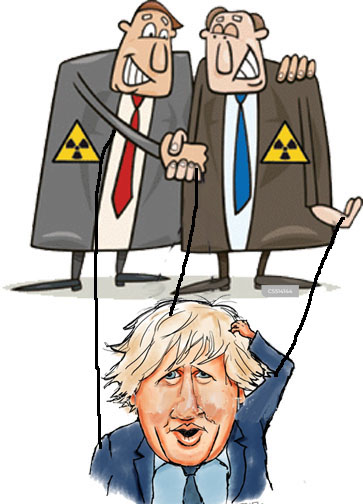
In response to the Prime Minister pledging £700 million of public money to
build a nuclear power station at Sizewell, Dr Doug Parr, Chief Scientist
for Greenpeace UK, said – “This money could insulate huge numbers of
draughty homes, and cut next year’s bills, instead of being thrown onto the
slow-burning financial bonfire that is EDF, to increase our bills for
decades.
Construction of this reactor type has gone massively over budget
and over schedule whenever they try to build it in Europe, and isn’t
operating as advertised anywhere. The funding model adopted to pay for it
was tried in the USA, and North Carolina households are still paying for a
nuclear reactor that was never built as the company went bust.
The contrast between these lumbering white elephants and the dynamic, cost cutting,
innovative technologies in the renewables sector could barely be more
striking. While this down payment on failure shows the government hasn’t
noticed, the market has, and investors have fled the nuclear sector.
To get Sizewell done, the government would have to step in and add the enormous
costs of building reactors to the enormous costs consumers are already
paying for their electricity. While Boris Island and the Boris Bridge
remain in the land of fantasy where they belong, Johnson will have his
legacy, the Boris Bill, and it will be very real for a very long time.”
Greenpeace 1st Sept 2022 https://www.greenpeace.org.uk/press-centre/
Stop Sizewell C urges Boris Johnson’s successor to totally review this costly nuclear project

Stop Sizewell C condemns Boris Johnson’s visit and support for Sizewell C,
speculating that the blessings of an outgoing Prime Minister may be the
kiss of death. Stop Sizewell said: “Like multiple vanity projects such as
the Bridge to Northern Ireland and “Boris Island” airport, Sizewell C
is another Boris Johnson infrastructure blowout that his successor should
consign to the bin.
When every penny matters, it’s totally wrong to shackle
the next Prime Minister and billions in taxpayers’ money to this damaging
project, whose ballooning cost, lengthy construction, failure-prone
technology and long term water supply are so uncertain.”
“Sizewell C would not be British, nor secure. It would be developed by an arm of a
foreign government, probably with considerable foreign ownership and be
reliant on overseas uranium.” Stop Sizewell C urges Boris Johnson’s
successor to totally review the Sizewell C project. Candidate Liz Truss has
said she plans to cancel green levies on bills, but if she were to continue
to support Sizewell C, it can only be financed if a nuclear levy is added
to household bills.
Stop Sizewell C 1st Sept 2022
Fighting at Ukraine nuclear plant brings chances of a meltdown to a ‘coin toss’, expert says

“If you lose both the offsite power and the backup diesel generators, there are other emergency measures that could be employed, but you only have a few hours to be able to set those up before the core might start to melt,”
By Samantha Hawley and Flint Duxfield for ABC News Daily, 2 Aug 22,
As calls continue for an end to military activity around Ukraine’s Zaporizhzhia power plant, experts are warning there is significant risk of a nuclear accident.
Key points:
- Nuclear experts are becoming increasingly concerned of a nuclear disaster at Russian-occupied Zaporizhzhia nuclear power plant in Ukraine
- A team from the UN’s nuclear watchdog arrived at the facility overnight
- Europe’s biggest nuclear power plant has been shelled repeatedly in recent weeks, and Ukrainian staff are reportedly working under threat
This week the Russian military, which has controlled the facility since March, agreed to a safety inspection by experts from the United Nations’ International Atomic Energy Agency (IAEA), who arrived overnight.
Despite this, the director of Nuclear Power Safety at the Union of Concerned Scientists, Edwin Lyman, said there was a significant possibility the situation could end badly.
“It’s probably a coin toss at this point,” he said.
While the fate of Europe’s biggest nuclear power plant has been thrust into the spotlight in recent weeks, Dr Lyman told ABC News Daily he became concerned the minute Russia set its sights on the facility in early March.
“When Russia started lobbing artillery shells at the plant and when a fire broke out, it was of extreme concern because one thing the nuclear power plant doesn’t handle too well is a large fire,” he said.
The fire was quickly contained, but as Russian forces took control of the plant, safety concerns only continued to grow.
Since then, there have been reports around 9,000 of the plant’s staff have been forced to continue working at gunpoint, and that some have been beaten and tortured.
“There is evidence that the Russians were intimidating the staff, not allowing them to report safety issues, accusing them of being spies or saboteurs and of physical abuse,” Dr Lyman said.
“These are obviously very poor conditions for the staff to work in.”
Plant under attack
In the past fortnight there have been further reports of shelling of the plant, with both sides claiming the other was at fault.
Ukraine has accused Russia of using the plant as a military base to launch attacks against Ukrainian positions.
Meanwhile, Russian Defence Ministry spokesman Igor Konashenkov said this week that nine shells fired by the Ukrainian artillery in two separate attacks had landed in the nuclear plant’s grounds.
While Dr Lyman doesn’t believe these kinds of attacks are likely to cause a major problem for the reactors themselves, he said there is still a risk they could damage other vital parts of the plant or make it difficult to maintain the reactors.
“The most dangerous parts of the plant, like the nuclear fuel in the reactors, is contained and under a fairly strong reinforced concrete containment building,” he said.
“Even if you had direct artillery fire on the containment, unless it was a sustained shelling, deliberately trying to destroy it, then it probably wouldn’t cause that much damage.”
However, Dr Lyman warned other parts of the plant were more susceptible to artillery fire.
“The turbine that’s used to convert the hot water or the steam that’s generated by the nuclear reactor into electricity are in less-protected buildings,” he said.
A power plant in need of power
A greater concern than artillery fire, experts believe, is the potential for the plant to lose its offsite power connection, something that has already happened twice in the past few weeks.
While it might seem strange that a power plant’s most vital input is electricity, external power is crucial in cooling the reactors to prevent them from overheating.
To reduce risk of meltdown, four of the plant’s six reactors have already been put into cold shutdown since the outbreak of the war.
But because the plant is responsible for around 20 per cent of Ukraine’s energy supply, shutting the remaining reactors would be a significant loss for the country.
The plant does have three external electricity supply lines, but these have all lost connection in recent weeks due to the conflict.
Last week, the company responsible for the plant, Energoatom, said fires at a nearby thermal power station had caused the nuclear plant’s last remaining electricity power line to be disconnected twice.
Ukrainian President Volodymyr Zelenskyy said the plant’s 20 backup diesel generators had to be “immediately activated” to avert a “radiation disaster”.
“If the diesel generators hadn’t turned on, if the automation and our staff of the plant had not reacted after the blackout, then we would already be forced to overcome the consequences of the radiation accident,” Mr Zelenskyy said in his nightly briefing.
Dr Lyman said the fact that the site has already lost offsite power showed how precarious the situation was.
“If you lose both the offsite power and the backup diesel generators, there are other emergency measures that could be employed, but you only have a few hours to be able to set those up before the core might start to melt,” he said.
Meltdown could happen in hours
One simulation of the reactors losing power showed they would have just over an hour before the cooling systems stopped working.
It predicted that the reactor would heat up so quickly that it would take less than five hours for it to break through the reactor vessel.
Even if that occurs, experts say a strong protective casing around the reactors means a Chernobyl-style disaster isn’t likely………………………
Ukraine prepares for radiation leaks
The Ukrainian government has begun preparations for the possibility of a radiation leak.
In recent weeks it has run emergency drills in nearby towns and distributed iodine tablets to residents.
Iodine helps prevent radiation from amassing in the thyroid, leading to thyroid cancer; a phenomena witnessed after the Chernobyl meltdown in hundreds of Ukrainian children.
While Dr Lyman believes it is a sensible precaution, he warned it would not be enough to protect people in the case of a leak.
“In nuclear reactors, you have a sea of a soup of hundreds of different types of radioactive isotopes, all of which interact in different ways of the body,” he said.
“So you can’t do much about that except to either evacuate to avoid exposure or to shelter for a long time in a structure that’s shielded against radiation.
“That’s why the best thing is to prevent any release in the first place.”
Overnight inspectors from the IAEA travelled to the city of Zaporizhzhia.
Experts from the team will remain on site to provide an impartial, neutral and technically sound assessment of the situation.
“I worried, I worry and I will continue to be worried about the plant until we have a situation which is more stable, which is more predictable,” IAEA head Rafael Grossi, who personally led the mission, told reporters after returning to Ukrainian-held territory…………………
https://www.abc.net.au/news/2022-09-02/fears-nuclear-disaster-zaporizhzhia/101394618
Ukraine accused of targeting possible route of nuclear inspectors

Zelensky cannot risk experts assessing the damage and announcing the cause?
Rt.com, 30 Aug 22, Kiev’s forces have hit the Zaporozhye plant’s resort house where the delegation could stay, a local council member has claimed.
Ukrainian forces are shelling a route that the International Atomic Energy Agency (IAEA) inspection mission could take to reach the Zaporozhye Nuclear Power Plant this week, local authorities claimed on Tuesday.
Zaporozhye Region council member Vladimir Rogov told RIA Novosti that “Ukrainian nationalists are targeting locations that could be visited by the IAEA mission in Energodar,” where the plant is located. He added that “[Ukrainian President Vladimir] Zelensky’s regime also started a military operation in the south of the country,” which raises concerns for the safety of the IAEA mission.
……………………On Monday, IAEA chief Rafael Grossi announced that an expert group would visit the NPP this week to assess the damage sustained by the plant and check the safety and security systems. Zaporozhye Nuclear Power Plant has been under Russian control since March.
Moscow has repeatedly accused Ukrainian forces of attacking the plant, while warning that the shelling could trigger a disaster that would eclipse the Chernobyl incident. Kiev insists, however, that Russian forces are shelling the site while stationing military hardware there.
On Sunday night, Ukrainian forces shelled Energodar, the city where the plant is located, local officials said. They claimed that the attack, which injured nine people and deliberately hit a number of residential houses, was meant to torpedo the upcoming IAEA mission. “This provocation by Kiev-controlled militants is aimed at derailing the visit of the IAEA chief to the Zaporozhye NPP,” they said at the time………. https://www.rt.com/russia/561775-ukraine-shelling-un-iaea-zaporozhye-nuclear/
Pentagon admits ‘likelihood’ of Ukrainian shelling near nuclear plant
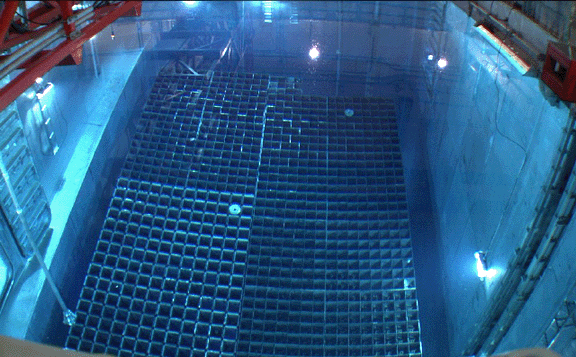
the biggest danger is not a reactor meltdown, but Ukrainian artillery striking the open-air spent fuel storage, which would result in a radioactive release
US officials responded to questions about Kiev’s forces targeting Zaporozhye,
https://www.rt.com/russia/561769-pentagon-ukraine-nuclear-shelling 30 Aug 22,
A senior US military official admitted on Monday that Ukrainian forces may have struck the area around the Zaporozhye Nuclear Power Plant, but insisted that this was only in response to Russian fire allegedly coming from the area. Earlier in the day, the Russian authorities said a Ukrainian artillery shell damaged the roof of the building storing reactor fuel.
“What I know for sure is that the Russians are firing from around the plant,” the unnamed official told reporters during a background briefing at the Pentagon. “I also know that there are rounds that have impacted near the plant.”
The official said it was “hard to explain, I guess” how the US was monitoring the situation around the nuclear power plant, Europe’s largest.
“And I don’t want to say that the Ukrainians haven’t fired in that vicinity either because I think there’s probably a likelihood that they have, but in good – in a number of cases, it’s returning fire of the Russians who are firing from those locations,” he said.
Russian forces established control of the Zaporozhye NPP in early March. National guard and nuclear protection specialists secured the site while the Ukrainian staff continued to operate without hindrance. The government in Kiev claims that Russian forces turned the plant into a military base from which they were attacking Ukrainian targets, but also that Russian troops were shelling themselves in a false-flag ploy to make Ukraine look bad.
The US official claimed “the Ukrainians are very aware of the potential impacts of striking the nuclear power plant and they’re going out of their way not to do that.”
Moscow has provided evidence to the UN of repeated Ukrainian attacks on the Zaporozhye NPP and the nearby town of Energodar since July, using kamikaze drones and even US-supplied artillery. The latest attack came on Monday, when a round breached the roof of a building where fresh reactor fuel was being stored, a member of the local administration said.
On Sunday, a drone was shot down over the plant, while Ukrainian artillery strikes on Energodar injured nine civilian residents.
Kiev has demanded that Russia hand the Zaporozhye NPP back over to Ukrainian control, or at least demilitarize a 30-kilometer area around it. On Monday, US National Security Council spokesman John Kirby also urged demilitarization, as well as a shutdown of the reactors. The US has previously echoed Kiev’s accusations that Moscow wants to “steal Ukraine’s electricity” by shutting down the plant or disconnecting it from the Ukrainian grid.
According to Russian nuclear experts, the biggest danger is not a reactor meltdown, but Ukrainian artillery striking the open-air spent fuel storage, which would result in a radioactive release.
International Atomic Energy Agency (IAEA) chief Rafael Grossi is personally leading the mission that is supposed to visit the plant this week.
Boris Johnson locking the next Prime Minister into unsustainable nuclear debt
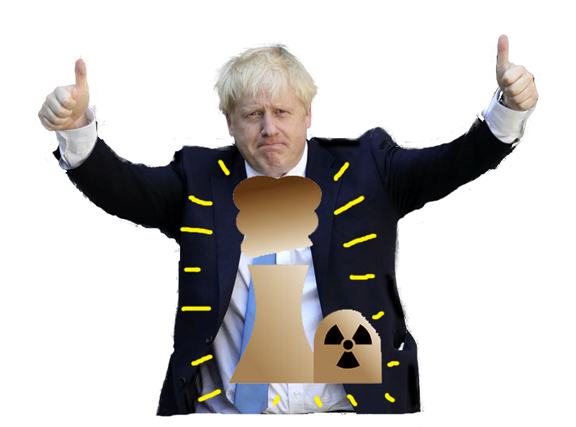
So long and thanks for all the nukes: Boris Johnson is marking his last week in No 10 by signing a £30 billion cheque that makes some allies of Liz Truss feel distinctly queasy.
With just five days until his successor takes office, this morning’s Times reveals that the prime minister is pressing ahead with plans to approve the Sizewell C nuclear power station in Suffolk.
It’s a decision some Truss allies would rather he had left to the next inhabitant of No 10. Earlier this month Simon Clarke, the chief secretary to the Treasury set for a senior role in the next cabinet, warned in a leaked letter that the costs of the project were “sufficient to materially affect spending and fiscal choices for an incoming government,
especially in the context of wider pressures on the public finances”. But Johnson looks set to bind the next PM’s hands anyway.
Times 31st Aug 2022
https://www.thetimes.co.uk/article/nuclear-option-spells-fallout-for-johnsons-successor-b68c9gh5w
Boris Johnson’s parting gift – a £30 billion nuclear debt.
Boris Johnson is poised to give approval this week for a nuclear power station costing up to £30 billion as ministers close in on a deal to reopen Britain’s biggest gas storage facility. The prime minister is preparing to announce an in-principle agreement to offer funding to the Sizewell C reactor in Suffolk before he leaves office, despite concerns about creating a multibillion-pound spending commitment for Liz Truss, the frontrunner to succeed him.
Johnson acknowledged yesterday that “it is going to be tough through to next year” because of the rising energy bills but said his successor would “provide a further package of support for helping people with the cost of energy”.
Johnson is thought to have privately decided to go ahead with Sizewell C earlier in the summer, but said yesterday that a public announcement was imminent. “We are going to have a long-term British energy security strategy, and we are putting in more nuclear — you’re going to be hearing more about that later this week,” he said on a visit to Dorset.
Johnson also promised “absolutely shedloads of wind
power” as he sought to pin the blame for high gas prices on Russia’s
invasion of Ukraine. “Be in absolutely no doubt that the gas price is
being driven by what Putin did in Ukraine,” he said. “I’m not going to
shrink from this — it is going to be tough in the months to come, it’s
going to be tough through to next year, and that’s because of Putin’s war
in Ukraine. But we’re going to get through it.” Kwarteng is also said to
be in the final stages of agreeing a deal with Centrica to reopen the Rough
gas storage facility under the North Sea, in an about-turn that could leave
taxpayers on the hook for hundreds of millions of pounds if the company
does not make as much as expected.
Times 31st Aug 2022
Satellite images show damage to buildings right next to Zaporizhzhia nuclear reactors
Satellite images show damage to Ukraine nuclear plant buildings right next
to reactor. Satellite images show armoured personnel carriers stationed
near Zaporizhzhia nuclear plant’s reactors.
Independent 30th Aug 2022
Shelling ‘leaves HOLES in roof of Russian-occupied nuclear power plant’:
Images reveal damage at Zaporizhzhia site – with Putin’s forces blaming
Ukrainian artillery for potential disaster.
Daily Mail 30th Aug 2022
Boris Johnson unveils £1.45billion nuclear submarine
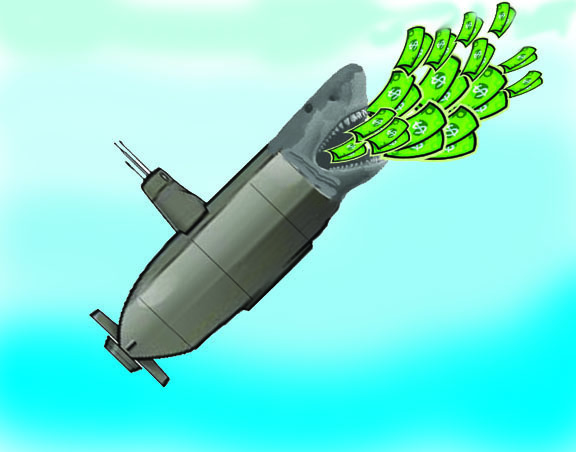
Boris Johnson’s farewell tour continues today as the outgoing Prime
Minister attends the unveiling of Britain’s latest nuclear submarine. The
£1.45billion nuke-powered HMS Anson – part of the long-delayed and
over-budget Astute-class programme – took nine-and-a-half years to build.
Mirror 31st Aug 2022
https://www.mirror.co.uk/news/politics/boris-johnson-visit-submarine-yard-27869239
Gas prices and nuclear outages put European grid at breaking point.

Prices in France and Germany and across Europe have again jumped to unprecedented levels thanks to soaring cost of gas and massive nuclear shortfalls.
Gas prices and nuclear outages put European grid at breaking point — RenewEconomy 1 Sept 22.
The month of August has been confirmed as the most expensive month ever for electricity in Europe, as markets were buffeted by the soaring cost of gas and outages that have taken up to two third’s of France’s nuclear capacity offline at time.
The twin impact of the soaring gas price – largely caused by the Russia invasion but exacerbated by French nuclear outages and reduced output from hydro power due to water shortages – has also prompted the EU to find new ways to shield the market from the impact of soaring fossil fuel prices.
According to analysts Rystad Energy, Italy – heavily dependent on imports from France’s nuclear fleet which have now all but stopped – became the first market to record a monthly average spot price above €500 per megawatt hour, with an average price of €547.
France came close to also breaking the €500 barrier, averaging €492, while Germany followed at €465 and the UK came in at €438.
And it is not going to get any better any time soon. In the past week, the average price surged to more than €600/MWh in the Italy, France and the UK, and on Monday France recorded a new record daily average price of €744/MWh as its nuclear output plumbed to new lows due to planned and unplanned outages.
In the coming winter, the picture looks even more bleak…………………….
the most expensive generator sets the price for the whole market, and for each unit of electricity delivered.
This has already crippled the France’s EdF, majority owned by the state, which is spending an estimated €40 billion buying expensive electricity on market to make up for the staggering shortfalls in production from its nuclear fleet.
France has gone from being a major and often the biggest exporter of electricity to the biggest importer, which is causing pressure on prices all over the continent as it sucks in much needed supply from other countries…………………… more https://reneweconomy.com.au/gas-prices-and-nuclear-outages-put-european-grid-at-breaking-point/
European Union providing Ukraine with over 5 million doses of potassium iodide tablets

The EU is giving more than five million anti-radiation tablets to Ukraine,
as fears grow of an accident at Europe’s largest nuclear power plant. The
Zaporizhzhia plant is under Russian occupation and has recently come under
fire, with both sides blaming each other for the attacks.
In some areas, officials are already handing out the pills, which can stop the body
absorbing radioactive iodine. Residents have been told only to take it if a
radiation leak is confirmed. So far, only people living within 50km (30
miles) of the power plant are being offered the potassium iodide tablets,
but the European Union is providing Ukraine with more than five million
doses which would allow for much wider distribution.
BBC 30th Aug 2022
Compulsory purchase orders of land for Sizewell C nuclear project
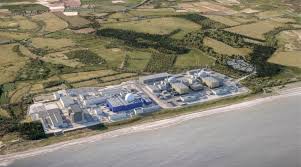
The majority of the compulsory purchase orders necessary for Sizewell C
have already been agreed, a spokesman has said. As part of the nuclear
power project, land is being purchased to build link roads, railways,
sports pitches and park and ride terminals. The full details of all the
properties affected is set out in a 1,000-page planning document.
East Anglian Daily Times 30th Aug 2022
https://www.eadt.co.uk/news/business/sizewell-c-compulsory-purchase-orders-suffolk-9236698
1 This Month





PLEASE OPPOSE HR 8255 AND S.3639 – bills would accelerate satellite deployment, with no environmental review or safeguards – https://ncstd5li.quorum.us/campaign/169331/
To see nuclear-related stories in greater depth and intensity – go to https://nuclearinformation.wordpress.com
-
Archives
- October 2026 (74)
- September 2026 (339)
- August 2026 (330)
- July 2026 (355)
- June 2026 (287)
- May 2026 (306)
- April 2026 (356)
- March 2026 (251)
- February 2026 (267)
- January 2026 (308)
- December 2025 (358)
- November 2025 (359)
-
Categories
- 1
- 1 NUCLEAR ISSUES
- business and costs
- climate change
- culture and arts
- ENERGY
- environment
- health
- history
- indigenous issues
- Legal
- marketing of nuclear
- media
- opposition to nuclear
- PERSONAL STORIES
- politics
- politics international
- Religion and ethics
- safety
- secrets,lies and civil liberties
- spinbuster
- technology
- Uranium
- wastes
- weapons and war
- Women
- 2 WORLD
- ACTION
- AFRICA
- Atrocities
- AUSTRALIA
- Christina's notes
- Christina's themes
- culture and arts
- Events
- Fuk 2022
- Fuk 2023
- Fukushima 2017
- Fukushima 2018
- fukushima 2019
- Fukushima 2020
- Fukushima 2021
- general
- global warming
- Humour (God we need it)
- Nuclear
- RARE EARTHS
- Reference
- resources – print
- Resources -audiovicual
- Weekly Newsletter
- World
- World Nuclear
- YouTube
-
RSS
Entries RSS
Comments RSS

